Introduction
Freshwater environments are habitat to at least 10% of the global biodiversity, corresponding to c. 126 000 species (Dudgeon et al. Reference Dudgeon, Arthington, Gessner, Kawabata, Knowler and Lévêque2006, Strayer & Dudgeon Reference Strayer and Dudgeon2010). This biodiversity is even more remarkable given that fresh waters cover only 0.8% of the Earth’s surface (Acreman et al. Reference Acreman, Hughes, Arthington, Tickner and Duenas2020). Nevertheless, threats to fresh waters have become more intense in recent decades, making this environment one of the most threatened in the world, with a sharp decline occurring in its biodiversity (Dudgeon et al. Reference Dudgeon, Arthington, Gessner, Kawabata, Knowler and Lévêque2006, Vörösmarty et al. Reference Vörösmarty, McIntyre, Gessner, Dudgeon, Prusevich and Green2010, Reid et al. Reference Reid, Carlson, Creed, Eliason, Gell and Johnson2019). Pollution and wastewater discharge are major drivers of biodiversity loss and, consequently, great efforts are necessary to understand the negative effects of these factors on the aquatic community and its conservation (Reid et al. Reference Reid, Carlson, Creed, Eliason, Gell and Johnson2019, Barros et al. Reference Barros, Brito, Peluso, Faria, Izzo and Teixido2020). Harmful effects also reach humans who are strictly dependent on inland waters, from the more basic needs such as water and food supplies to more complex uses such as industry. Hence, conserving freshwater environments is of utmost urgency.
Inland aquatic ecosystems could benefit from protected areas (PAs), which are crucial to biodiversity conservation globally (Abell et al. Reference Abell, Allan and Lehner2007, Gaston et al. Reference Gaston, Jackson, Cantú-Salazar and Cruz-Piñón2008). PAs can minimize anthropogenic pressures such as land conversion, fragmentation, habitat loss, hunting and logging (Grignolio et al. Reference Grignolio, Merli, Bongi, Ciuti and Apollonio2011, Feng et al. Reference Feng, Cao, Wang, Wang, Liu, Zhang and Du2021, Yang et al. Reference Yang, Viña, Winkler, Chung, Huang, Dou and McShea2021). However, the effectiveness of PAs at protecting aquatic biodiversity has been questioned, and PAs’ potential to protect fresh water needs strengthening (Hermoso et al. Reference Hermoso, Abell, Linke and Boon2016, Acreman et al. Reference Acreman, Hughes, Arthington, Tickner and Duenas2020). In addition, there is a lack of consideration by policymakers for freshwater ecosystems in PA design and management, providing only incidental protection to rivers, creeks, streams and wetlands within their borders (Herbert et al. Reference Herbert, McIntyre, Doran, Allan and Abell2010, Thieme et al. Reference Thieme, Rudulph, Higgins and Takats2012, Quenta-Herrera et al. Reference Quenta-Herrera, Crespo-Pérez, Mark, Gonzales and Kulonen2022). Recent studies having highlighted pesticide, pharmaceutical and personal care product contamination inside PAs, raising global concern regarding the influence of these compounds even in highly preserved regions (Elliot & VanderMeulen Reference Elliot and VanderMeulen2017, Bradley et al. Reference Bradley, Kulp, Huffman, Romanok, Smalling, Breitmeyer and Clark2021). For example, Bradley et al. (Reference Bradley, Romanok, Duncan, Battaglin, Clark and Hladik2020) recorded 80 different bioactive compounds in freshwater samples from five PAs in the USA. Sources of threats to water systems in PAs may be diverse, such as visitation (Weissinger et al. Reference Weissinger, Blackwell, Keteles, Battaglin and Bradley2018), agriculture and land conversion in surrounding areas (Battaglin et al. Reference Battaglin, Smalling, Anderson, Calhoun, Chestnut and Muths2016, Silva et al. Reference Silva, Dupas, Costa, Medeiros and Souza2021), which directly or indirectly influence the watershed. Therefore, assessing the risks to streams inside PAs is key to improving the effectiveness of PAs at protecting freshwater biota.
Here, we compare freshwater quality in streams inside and outside PAs designed to protect the last remnants of the Atlantic Forest in southern Brazil and, consequently, consider whether freshwater organisms could benefit from better water quality inside these PAs. This biome is one of the world’s foremost biodiversity hotspots, with high species richness and endemism levels, but it is also severely threatened (Ribeiro et al. Reference Ribeiro, Metzger, Martensen, Ponzoni and Hirota2009, Mittermeier et al. Reference Mittermeier, Turner, Larsen, Brooks, Gascon, Zachos and Habel2011). For this purpose, physicochemical and biological parameters as well as pesticide and pharmaceutical contamination in water were analysed.
Methods
Study area
Our study was carried out in and around four large PAs located in the southern region of the Atlantic Forest, comprising São Joaquim National Park (SJNP; 496.72 km2), Aparados da Serra National Park (ASNP; 131.48 km2), Serra Geral National Park (SGNP; 173.02 km2) and São Francisco de Paula National Forest (SFPNF; 16.16 km2). We also included a Private Natural Heritage Reserve (PNHR Portal das Nascentes; 0.16 km2) since it is a conservation unit near to SJNP (ICMBio/SISBIO lic. Nº73877-1). The whole study area lies within the Brazilian Atlantic Forest biome, with different types of phytophysiognomy but mainly Araucaria seasonal evergreen forests and highland prairies (Oliveira-Filho et al. Reference Oliveira-Filho, Budke, Jarenkov, Eisenlohr and Neves2013).
We selected 33 sampling sites in rivers and streams, 10 within and 23 outside PAs, with the latter being 1.3–49.5 km distant from the nearest PA (Fig. 1). Six streams inside the PAs originate within their boundaries (sites 1, 4, 5, 6, 23 and 24) and four streams have their sources outside the conservation units (sites 22, 25, 26 and 30). In each site, surface water samples were taken in November 2020 and November 2021. In total, 30 different water bodies comprise the study, characterized by low-order streams, with a predominantly rocky substrate and depths not exceeding 50 cm at the margins. The riparian vegetation varies among the sites, both in composition (given the different phytophysiognomies of the study area) and in conservation level and size. Based on the distribution and distance of the sites to the PAs, we divided the study region into six different areas (see Fig. 1 & Supplementary Table S1, available online): areas 1 (SJNP and PNHR), 3 (SGNP and ASNP) and 5 (SFPNF) correspond to PAs, while areas 2, 4 and 6 correspond to their respective outside regions. We grouped SJNP and PNHR into one area, as well as SGNP and ASNP, since they are adjacent.
Sampling sites (1–33) grouped into six areas, represented by the various symbols. The protected areas are delimited by various types of shading. NF = National Forest; NP = National Park.

Physicochemical and biological parameters
The temperature of the water (°C), dissolved oxygen concentration (mg/L), conductivity (µS/cm) and pH were measured three times at each site, at different points along the stream (2–3 m between them), using a Multiparameter Meter HI 9829 (Hanna Instruments, UK), and the data were averaged. Due to technical problems with the equipment at some sites, some measurements could not be taken; when only one measurement was obtained, it was used without averaging, and if no measurement could be taken (as for dissolved oxygen at site 8), the site parameter was excluded from statistical analysis.
The biological parameters – presence of Escherichia coli and total coliforms – were obtained using the Colipaper Alfakit® (Alfakit Eireli, Brazil) dip slide, following the steps specified by the manufacturer.
Pesticide and pharmaceutical determination
Approximately 500 mL of water was bottled in a dark glass container and stored in thermal boxes with ice. The detection and quantification of 147 pesticides and 31 pharmaceuticals (Table S2) were performed using solid-phase extraction (SPE) and ultra-high-performance liquid chromatography coupled to tandem mass spectrometry (UHPLC-MS/MS). For SPE, 500 mL of water sample was filtered on a polytetrafluoroethylene (PTFE) membrane (47 mm and 0.45 μm porosity; Agilent Technologies, Santa Clara, CA, USA), and the selected volume was percolated through Oasis® (Waters Corp., USA) hydrophilic–lipophilic balance (HLB) 60mg cartridges at a flow rate of 2–5 mL/min (Donato et al. Reference Donato, Kemmerich, Facco, Friggi, Prestes, Adaime and Zanella2012).
Chromatographic analyses were performed using a Waters Corp. UHPLC-MS/MS system equipped with an Acquity UPLC™ binary pump, a Xevo TQ™ MS/MS triple quadrupole detector, an autosampler, a column temperature controller and MassLynx V4.1 software for system control and data acquisition. In addition, an Acquity UHPLC ethylene bridged hybrid (BEH) C18 analytical column (50 × 2.1 mm, particle size 1.7 μm), kept at 40°C, was used for chromatographic separation. The mobile phase consisted of (A) water containing 2% (v/v) methanol and (B) methanol, both with 0.1% (v/v) formic acid and 5 mmol/L ammonium formate. In the gradient elution programme, the percentage of the organic phase (B) was: 0 min, 5%; 7.75 min, 100%, maintained until 8.50 min; and 8.51 min, 5%, remaining constant until 10 min. The flow rate was constant at 0.225 mL/min with an injection volume of 10 μL. The quadrupole mass spectrometer was operated in selected reaction monitoring mode using two transitions: one for quantification and one for identification. The UHPLC-MS/MS conditions were electrospray ionization in positive and negative modes, capillary voltage 2 kV, desolvation gas temperature 500°C, desolvation gas flow (nitrogen) 600 L/h, spray flow 80 L/h, collision gas flow (argon) 0.15 mL/min and source temperature 150°C (Donato et al. Reference Donato, Bandeira, Santos, Prestes, Adaime and Zanella2017). Despite the same method being implemented to detect and determine pharmaceuticals, there were subtle variations, following Oliveira et al. (Reference Oliveira, Izeppi, Loose, Muenchen, Prestes and Zanella2019).
Data analysis
Data on the physicochemical, biological, pesticide and pharmaceutical parameters were first analysed for normality and homogeneity using the Shapiro–Wilk, Bartlett and Levene tests (when data showed a non-normal distribution). Comparisons between the dependent variables (physicochemical, biological, agrochemical and pharmaceutical) and the independent variables (PAs and non-PA sites) were performed using Student’s t-test and Mann–Whitney U-tests. Analysis of variance (ANOVA) was used to highlight differences in the data among the six areas, combined with a Tukey post hoc test when values showed a normal distribution. When the data were non-normal, we used a Kruskal–Wallis test along with a Student–Newman–Keuls post hoc test. A p-value of 0.05 was used as the significance threshold. The analyses were performed using R 4.04 (R Core Team 2021) implemented in Rstudio 1.4 and BioStat 5.0 (Ayres et al. Reference Ayres, Júnior, Ayres and Santos2007).
In some cases, pesticides and pharmaceuticals were detected but not quantified since their values were higher than the limit of detection (LOD) but lower than the limit of quantification (LOQ), which meant that the compound was present but could not be accurately quantified. In such cases, we used the average of the LOD and LOQ values (see Table S2) in order to obtain quantifiable values for use in the statistical analysis. Otherwise, we would have had to use only presence/absence data, thereby losing information. Because of this, at some sites, the concentrations are lower than the LOQ.
Results
Physicochemical and biological parameters of the streams
The mean values obtained for the physicochemical parameters at 33 sampling sites are summarized in Table S1, as well as the counts of E. coli and total coliform colony-forming units (CFUs). At least one pesticide and one pharmaceutical were detected at each sampling site.
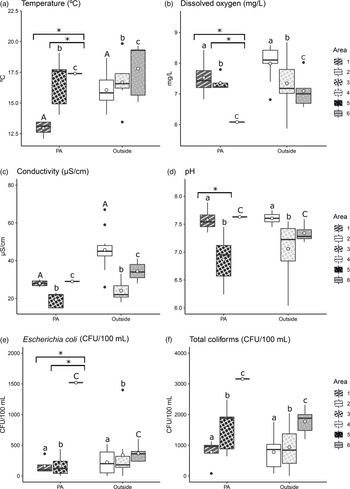
When comparing the physicochemical water parameters from sampling sites within PAs with those outside PAs, temperature (t = 1.859) and conductivity (U = 50.5) showed statistically significant differences, while dissolved oxygen (t = 0.934) and pH (U = 96.0) did not statistically significantly differ (Fig. S1). Biological parameters (E. coli and total coliforms) showed no differences between PAs and non-PAs (U = 98.0, t = –1.235, respectively).
Streams inside SJNP and PNHR (area 1) had lower temperatures (t = –4.407) and conductivities (U = 3.5) compared with values obtained for outside streams (area 2). No differences between the two areas were observed in terms of dissolved oxygen (t = –1.295), pH (U = 15.0), E. coli (t = –0.576) or total coliforms (t = 0.026; Fig. 2a–f).
Comparisons of physicochemical and biological parameters from streams sampled in the various study areas: (a) temperature, (b) dissolved oxygen, (c) conductivity, (d) pH, (e) Escherichia coli and (f) total coliforms in the water samples from the six regions analysed. 1 = São Joaquim National Park (SJNP) and Private Natural Heritage Reserve Portal das Nascentes (PNHR); 2 = region outside SJNP; 3 = Aparados da Serra National Park (ASNP) and Serra Geral National Park (SGNP); 4 = region outside ASNP and SGNP; 5 = São Francisco de Paula National Forest (SFPNF); 6 = region outside SFPNF. Statistically significant differences (p < 0.05) between samples indicated by t-tests and analyses of variance with Tukey post hoc tests are represented by upper-case letters. Lower-case letters represent statistically non-significant comparisons. Asterisks (*) represent significant differences (p < 0.05) in comparisons between protected areas (PAs). Within the boxplots, the horizontal lines represent medians, the white circles show means and the boxes and bars indicate the quartiles. Black circles represent outliers. CFU = colony-forming unit.

In addition, no differences were observed for physicochemical (Fig. 2a–d) or biological parameters (Fig. 2e & f) between areas 3 (ASNP and SGNP) and 4 (outside these PAs). Dissolved oxygen levels were significantly lower in the SFPNF stream (area 5) than those outside (area 6; t = 2.196; Fig. 2b). There was also a difference in the pH levels of these two areas, but, although statistically significant, this difference was small (means of 7.63 for area 5 and 7.34 ± 0.16 for area 6; t = –2.239; Fig. 2d). Temperature and conductivity showed no statistically significant differences between areas 5 and 6 (t = 0.219 and 0.820, respectively; Fig. 2a & c). The indicator of biological contamination – E. coli – also presented significantly higher values within area 5 in relation to outside streams (t = –2.052; Fig. 2e). The mean value of coliform CFUs within the PA (area 5) was 1520 CFU/100 mL, while outside the mean was 368 ± 142 CFU/100 mL (approximately four times lower). Total coliform counts showed no significant differences (t = –1.143; Fig. 2f), despite the high level in area 5 (3160 CFU/100 mL).
Comparing the results among the three PAs (areas 1, 3 and 5), four physicochemical parameters, besides the biological ones, exhibited significant variations. We observed differences in temperature (F = 7.123) between areas 1 and 3 (SJNP and SGNP + ASNP; Q = 4.68) and between areas 1 and 5 (SJNP and SFPNF; Q = 4.33), but areas 3 and 5 did not differ (Q = 0.73; Fig. 2a).
The dissolved oxygen (F = 6.725) concentration values in the water for areas 1 and 3 were similar (means of 7.53 ± 0.67 mg/L O2 for SJNP and 7.35 ± 0.25 mg/L O2 for SGNP and ASNP; Q = 0.776). In contrast, area 5 had significantly lower dissolved oxygen levels (mean 6.08 mg/L O2) than areas 1 (Q = 4.963) and 3 (Q = 4.514; Fig. 2b). The pH values differed significantly (F = 5.478) only between areas 1 and 3 (Q = 4.125), where mean pH values of 7.58 ± 0.23 and 6.87 ± 0.47 were observed, respectively. There were no significant pH differences between areas 1 and 5 (Q = 0.223) or between areas 3 and 5 (Q = 3.538; Fig. 2d). There were also no significant differences in the electrical conductivity values among the PAs (H = 5.119; Fig. 2c).
Significant differences in the values of the biological indicator E. coli (F = 5.132) occurred between areas 1 and 5 (Q = 4.103) and between areas 3 and 5 (Q = 4.222; Fig. 2e & f). The variation between these sites is due to the high E. coli count in the samples from area 5, averaging 1520 CFU/100 mL. However, the mean values for this parameter in areas 1 and 3 were 160 ± 134 and 168 ± 177 CFU/100 mL, respectively (Q = 0.031). The total coliform CFU values did not vary significantly among the PAs (H = 1.648).
Pesticides
We detected 19 out of 147 (13%) of the compounds assessed, being seven herbicides, eight insecticides and four fungicides (Fig. S2). Pesticides were detected in all sampled sites (Fig. S3 & Table S3). In nine out of 33 sites (c. 27%), we found only one type of pesticide, which was a herbicide in most cases. In 20 sites (61%), two classes of substances – herbicides and insecticides – were detected simultaneously, except for site 14, where herbicides and fungicides were present. At four sites (12%), all three classes were present (Table S3).
Among the herbicides, 2,4-dichlorophenoxyacetic acid (2,4-D) was present in 91% of the water samples collected (30 out of 33). Another widely used herbicide, diuron, appeared in 27% (9 of 33) of the streams sampled, all located in areas 1 and 2, followed by atrazine, which was present in three sites (9%; Fig. S2). Herbicide concentrations ranged from 0 to 0.121 µg/L. The highest average herbicide concentration was detected at site 31 (area 6), where the compound metribuzin contributed to the high value in the November 2021 sample (Table S4). Near this sampling point, site 32 had the second highest concentration of herbicides (area 4), showing an average value of 0.110 µg/L, with 2.4-D, atrazine and saflufenacil having the greatest preponderances. The highest herbicide concentration within the PAs was detected at site 1 (area 1), averaging 0.0725 µg/L. Herbicides were not detected in only two sites: one outside a PA (area 4) and one within a PA (area 3).
Insecticides were detected in fewer sites than herbicides, although they were present in c. 76% of them (Fig. S3 & Table S3). The insecticide ethoprophos was identified in 61% of the water samples (21 of 30), being present in all six areas. Chlorantraniprole was recorded in six sampled sites (17%). The insecticide compound detected in the highest concentration was imidacloprid, at site 18 (0.529 µg/L, area 4), and the mean concentration at this site was the highest observed (0.271 µg/L). We did not detect insecticides in eight sites, which were both inside (site 1, area 1; site 27, area 4) and outside PAs (sites 3, 9, 10, 11 and 14, area 2; site 33, area 6).
Mean fungicide concentrations ranged from 0 to 0.046 µg/L, being detected in only five sites (sites 13, 14 and 15, area 2; site 26, area 3; site 31, area 5; Fig. S3 & Table S3). Pyrimethanil and carbendazim were responsible for a large portion of the detected fungicides (Fig. S2 & Table S4). The other identified compounds were detected in only one or two sites throughout the study area, contributing less than 5% to the total concentration observed.
We did not record statistically significant differences in the mean concentrations of the three classes of pesticides between streams inside and outside PAs (U = 111.0, 109.5 and 105.5 for herbicides, insecticides and fungicides, respectively; Fig. S4). However, the mean concentrations observed were always lower inside (herbicides 0.0411 ± 0.02 µg/L, insecticides 0.0078 ± 0.006 µg/L, fungicides 0.0007 ± 0.002 µg/L) than outside PAs (herbicides 0.0460 ± 0.03 µg/L, insecticides 0.0201 ± 0.05 µg/L, fungicides 0.0033 ± 0.01 µg/L).
The mean concentrations of herbicides within PAs were significantly higher in streams from area 1 than area 3 (t = 2.198). Other comparisons among areas showed no statistically significant differences in the mean concentrations of the three pesticide classes (Fig. 3a–c). Data on the concentrations of each compound class can be found in Table S3. The compounds recorded in the two sampling campaigns can be seen in Table S4.
Comparisons of pesticide classes among the various study areas (for area codes, see Fig. 2): (a) herbicides, (b) insecticides and (c) fungicides. Statistically significant differences (p < 0.05) between samples indicated by t-tests and analyses of variance with Tukey post-hoc tests are represented by upper-case letters. Lower-case letters represent statistically non-significant comparisons. Asterisks (*) represent significant differences (p < 0.05) in comparisons between areas within PAs. Within the boxplots, the horizontal lines represent medians, the white circles show means and the boxes and bars indicate the quartiles. Black circles represent outliers. PA = protected area.

Pharmaceuticals
We recorded five out of 31 (16%) pharmaceutical compounds tested for in the study area: caffeine, diclofenac (an anti-inflammatory), albendazole (a vermifuge), trimethoprim (an antibiotic) and sulfadoxine (a sulfonamide; Table S5).
Caffeine was detected in all 33 sampling sites, with the mean concentration ranging from 0.0033 µg/L at sites 4 (area 1), 13 (area 2), 21 (area 4), 22, 23, 24 (area 3) and 33 (area 6) to 0.0585 µg/L at site 19 (area 4; Table S5). Diclofenac and trimethoprim were detected at only one site each (site 15, area 4, and site 26, area 3, respectively). Sulfadoxine was detected at sites 8 (area 2) and 33 (area 6). The vermifuge albendazole was found at sites 20, 21 (area 4) and 22 (area 3; Table S5).
Statistical tests were performed for caffeine since the other drugs were not detected at most sites. We did not observe statistically significant differences in caffeine levels between PA and non-PA sites (t = 1.163; Fig. 4a). However, significant differences in mean caffeine levels were recorded between streams in each PA and outside them: between areas 3 and 4 (area 3 = 0.0067 µg/L, area 4 = 0.0266 µg/L; U = 4.5) and between areas 5 and 6 (area 5 = 0.0225 µg/L, area 6 = 0.0111 µg/L; t = –2.403). The remaining inter-area comparisons performed did not produce statistically significant results (Fig. 4b).
(a) Comparisons of the caffeine concentrations between protected areas (PAs) and unprotected (outside) areas. (b) Comparisons of the caffeine concentrations between the various study areas (for area codes, see Fig. 2). Statistically significant differences (p < 0.05) between samples indicated by t-tests and analyses of variance with Tukey post hoc tests are represented by upper-case letters. Lower-case letters represent statistically non-significant comparisons. Within the boxplots, the horizontal lines represent medians, the white circles show means and the boxes and bars indicate the quartiles. Black circles represent outliers.

Discussion
We found that the water quality of streams inside the PAs mirrored the exogenous anthropogenic inputs and represented the condition of the streams in the region as a whole. Outliers in these parameters represent possible sources of pollution. However, we are aware that our results comprise only a particular fraction of time as the analysed physicochemical parameters and contaminants vary as a function of rainfall, pesticide application time and many other factors. In this sense, temporal data are required (e.g., from different seasons) to overcome these issues and corroborate our findings.
In general, the physicochemical water quality parameter levels in our study were not harmful to freshwater biodiversity. According to the Environmental National Council (CONAMA Brazil) resolution 357/2005 and the aquatic life criteria established by the United States Environmental Protection Agency (US EPA 1986), levels of dissolved oxygen should be higher than 6 or 5 mg/L, respectively, and pH should range between 6.5 and 9.0 or between 6.5 and 8.0, respectively. Only sites 18 (area 4) and 30 (area 5) require more attention regarding these criteria. Both showed patterns of decreasing dissolved oxygen concentration that could result in hypoxic conditions and so negatively affect aquatic organisms, forcing them to shift their breathing patterns or reduce their activity levels. This, in turn, could retard their development or cause reproductive impairments, such as increased embryo mortality and defects (Cox Reference Cox2003). It should be noted, however, that re-aeration from the atmosphere is the main factor that contributes to the oxygenation of low-order streams, which is affected by temperature, water depth and velocity, wind and waterfalls or dams (Cox Reference Cox2003, Franklin Reference Franklin2014). Site 30 is a shallow, narrow, low-order stream with slow water flow, and these factors could be responsible for its low dissolved oxygen levels. Moreover, site 18 also presented pH measures lower than 6.5, along with site 24 (area 5). Future monitoring actions at these sites should be carried out to obtain more data and confirm whether this phenomenon persists or whether it is due to seasonal variations in the watercourse.
The presence of E. coli and thermotolerant coliforms indicates contamination by faecal waste as these bacteria come from the faecal material of warm-blooded animals. The study area includes different land-use types, including cattle raising, which could contaminate the watercourses. Coliform bacteria as a whole are naturally present in the environment and most of them are not harmful, but when they are present in water, they may be a strong indicator of the presence of E. coli and other pathogens correlated with infectious diseases (Noble et al. Reference Noble, Moore, Leecaster, McGee and Weisberg2003). In general, the streams inside the PAs do not seem to be protected from biological contaminants. There is no standard for biological contamination in fresh water for the protection of aquatic life, but E. coli and total coliforms should be absent from water intended for public supply, as stipulated by Brazilian decree 1.469/00 (Brasil, Fundação Nacional de Saúde 2001) and by the US EPA (2017). All PAs had average counts of E. coli and total coliforms higher than the recommended threshold for excellent water quality for human bathing and primary contact; that is, higher than 200 E. coli and 200 total coliforms per 100 mL of water (CONAMA resolutions 274/00 and 357/05; CONAMA 2000, 2005). This biological contamination possibly originates upstream of the PAs, worsening downstream water quality inside PAs. To combat this, an integrative approach should be implemented with constant monitoring, focusing on preserving springs with pristine waters and protecting riparian vegetation in the entire catchment area (Pontes et al. Reference Pontes, Cavalcante, Sahoo, Júnior, Silva, Dall’Agnol and Siqueira2019). Indeed, the lack of a watershed management approach is one of the main factors that may weaken the conservation of fresh waters in PAs (Acreman et al. Reference Acreman, Hughes, Arthington, Tickner and Duenas2020).
Contrary to what was observed in other PAs, area 5 (SFPNF) showed a worsening of the dissolved oxygen concentration, pH level and E. coli and total coliform counts compared to the streams outside this PA (area 6). SFPNF is classified as a PA of category VI by the International Union for Conservation of Nature (IUCN) (Borrini-Feyerabend et al. Reference Borrini-Feyerabend, Dudley, Jaeger, Lassen, Pathak Broome, Phillips and Sandwith2017), being a PA with sustainable use of natural resources that supports types of human interference that may influence its running waters. In addition, SFPNF is considerably smaller than the other PAs sampled in this study, except NHPR (in area 1), so the land use in its surroundings could influence its watercourses more intensely. NHPR is in IUCN category IV, which aims to protect particular species or habitats, but this small PA is close to SJNP (both in area 1) and could benefit from this proximity. Other national parks such as SJNP (area 1), ASNP and SGNP (area 3) are in IUCN category II. This kind of PA does not support the sustainable use of the natural resources and restricts human interference to activities such as tourism. This could be a key point for understanding the differences among these PAs.
Large amounts of pesticides and pharmaceutical contaminants reach waterways through various sources, including spray drift from adjacent areas, drainage, runoff, precipitation and wastewater discharge (Park et al. Reference Park, Oh, You, Park, Jo, Lee and Kim2017, Quadra et al. Reference Quadra, Teixeira, Barros, Roland and Amado2019, Bradley et al. Reference Bradley, Romanok, Duncan, Battaglin, Clark and Hladik2020), and water contamination has thus become one of the major environmental issues worldwide (Brovini et al. Reference Brovini, Deus, Vilas-Boas, Quadra, Carvalho and Mendonça2021). Pesticides are commonly found in aquatic ecosystems (Bonifacio & Hued Reference Bonifacio and Hued2019, Fernandes et al. Reference Fernandes, Aparicio, Bastos, Geronimo, Labanowski and Prestes2019), even in PAs with wide swaths of riparian forest (Bradley et al. Reference Bradley, Romanok, Duncan, Battaglin, Clark and Hladik2020, Rocha et al. Reference Rocha, Santos, Zanella, Prestes, Gonçalves and Schuch2020). Riparian forests play a key role in conserving water resources, as they act as ‘protective shields’ of waterways against contamination by chemical compounds through reducing runoff connectivity (Rasmussen et al. Reference Rasmussen, Baattrup-Pedersen, Wiberg-Larsena, McKnight and Kronvang2011, Rocha et al. Reference Rocha, Santos, Zanella, Prestes, Gonçalves and Schuch2020). The transfer of pesticides is maximized when the vegetation only sparsely covers the soil (Rheinheimer et al. Reference Rheinheimer, Lima, Vargas, Bastos, Santos, Mondamert and Labanoeski2020). Therefore, one could expect there to be no (or at least significantly reduced) influence of pesticides in waters from pristine and conserved regions. However, we found no differences between streams inside and outside PAs; even the streams originating inside the PAs had pesticides detected in their water samples. These data indicate that the forest cover may not be controlling the entry of residues into river waters since both are contaminated by pesticide pollutants. In addition, current water conservation practices have been insufficient to limit the transfers of water, sediments and pesticides from crops to river systems.
In addition to the presence of vegetation, several other factors can influence the transfer of pesticides to water bodies, such as the frequency and intensity of rainfall events, the application period of pesticides (Lefrancq et al. Reference Lefrancq, Jadas-Hécart, La Jeunesse, Landry and Payraudeau2017, Yorlano et al. Reference Yorlano, Demetrio and Rimoldi2022), the terrain relief and slope (González Reference González2007) and the mobility/solubility of the molecules involved (Andrade et al. Reference Andrade, Gutierrez, Regaldo, Paira, Repetti and Gagneten2021). Herbicides were the most frequently detected class of pesticides in our study areas. Generally, herbicides are more soluble than insecticides and fungicides and therefore comprise a large fraction of the pesticides frequently detected in surface water monitoring studies (Schreiner et al. Reference Schreiner, Szöcs, Bhowmik, Vijver and Schäfer2016, Bighiu et al. Reference Bighiu, Höss, Traunspurger, Kahlert and Goedkoop2020) as the runoff rates of compounds with higher solubility tend to be greater (Chen et al. Reference Chen, Guo and Ngo2019). 2,4-D, which was detected in almost all of the sampling sites, is one of the most used herbicides worldwide (Maggi et al. Reference Maggi, Tang, Cecilia and Mcbratney2019) and the second most used pesticide in Brazil, despite its high toxicity (Moraes Reference Moraes2019), which has led to its prohibition in some countries (Pan 2021). As for atrazine, it is the most frequently detected herbicide in Brazilian surface waters (Caldas et al. Reference Caldas, Arias, Rombaldi, Mello, Cerqueira, Martins and Primel2019), and several other studies report the massive presence of this compound or its degradate hydroxyatrazine in the surface waters of the USA (Bradley et al. Reference Bradley, Battaglin, Clark, Henning, Hladik and Iwanowicz2017, Bradley et al. Reference Bradley, Romanok, Duncan, Battaglin, Clark and Hladik2020), Argentina (Iturburu et al. Reference Iturburu, Calderon, Amé and Menone2019, Pérez et al. Reference Pérez, Iturburu, Calderon, Oyesqui, Gerónimo and Aparicio2021), Iran (Almasi et al. Reference Almasi, Takdastan, Jaafarzadeh, Babaei, Birgani and Cheraghian2020) and even in Europe (Slaby et al. Reference Slaby, Cor, Dufour, Auger, Pasquini and Cardoso2022), where atrazine was banned almost 20 years ago. However, in aquatic environments, atrazine tends to be adsorbed and immobilized by sediments due to high lipophilicity and poor water solubility (Qu et al. Reference Qu, Li, Li, Liu, Zhao, Hua and Zhu2017), which may explain its low detection frequency at our sampling sites. Among the harmful effects of atrazine on aquatic life are its reduction of primary production in freshwater communities by inhibiting photosynthesis, with the compound demonstrating high levels of toxicity towards aquatic plants and adverse reproductive consequences in amphibians and other wildlife (US EPA 2017, He et al. Reference He, He, Yan, Gao, Zheng, Fan and Wang2019).
As the presence of pesticides in surface waters is a matter of global concern, environmental legislation worldwide establishes maximum allowable limits, but the regulations vary greatly from one country to another (Li & Fantke Reference Li and Fantke2022). In both sampling campaigns and for all sampling sites, the concentrations of pesticides detected were below the maximum limits permitted by current Brazilian legislation (Ministry of Health, Brazil 2021). However, it should be noted that many pesticides already prohibited in the European Union and other countries are still allowed in Brazil, and that the maximum limits allowed are high, which can compromise human and animal health. Moreover, while there is a limit to the total amount of pesticides that can be present in water in the European Union, this is not the case in Brazil. The main problem is that the determination of maximum limits per active ingredient (and not for the total amount of pesticides) facilitates the formation of pesticide cocktails, with implications that have been little studied (Moraes Reference Moraes2019).
Environmental contamination by pharmaceutical compounds is of increasing concern as they might negatively affect human, animal and ecosystem health (Ebelle et al. Reference Ebelle, Abdallah and Harrad2017, Rico et al. Reference Rico, Oliveira, Nunes, Rizzi, Villa and López-Heras2021, Wilkinson et al. Reference Wilkinson, Boxall, Kolpin, Leung, Lai and Galbán-Malagón2022). Continuous exposure of the freshwater biota to pharmaceutical residues in the environment may adversely affect these organisms (Frederic & Yves Reference Frederic and Yves2014, Ondarza et al. Reference Ondarza, Haddad, Avigliano, Miglioranza and Brooks2019), leading to potential biomagnification and bioaccumulation processes, mainly on primary consumers of the aquatic ecosystems (Lagesson et al. Reference Lagesson, Fahlman, Brodin, Fick, Jonsson, Byström and Klaminder2016, Świacka et al. Reference Świacka, Maculewicz, Kowalska, Caban, Smolarz and Swiezak2022).
One of the compounds detected in our study, caffeine, was present in all of the sampled streams. This compound is a natural alkaloid that acts as a stimulant on the central nervous system (Mandel Reference Mandel2002). It is considered an emerging contaminant because there is no standard or legislation to regulate its discharge or monitoring despite its potential environmental risks (Li et al. Reference Li, Wen, He, Hu and Liu2020). Caffeine is widely consumed worldwide through caffeinated beverages, food and medicines, and since high concentrations of this substance have been found in the aquatic environment, it has been considered an indicator of anthropogenic inputs of pharmaceutical compounds into freshwater environments (Li et al. Reference Li, Wen, He, Hu and Liu2020, Wilkinson et al. Reference Wilkinson, Boxall, Kolpin, Leung, Lai and Galbán-Malagón2022). Caffeine has been detected in rivers and streams on every continent, including Antarctica, raising concerns regarding its effects on aquatic communities (Wilkinson et al. Reference Wilkinson, Boxall, Kolpin, Leung, Lai and Galbán-Malagón2022). Despite this widespread contamination, there is no established maximum limit for this substance in aquatic ecosystems. A significant correlation between caffeine and coliform bacteria was observed in this study, demonstrating that this compound may indicate recent faecal contamination (Daneshvar et al. Reference Daneshvar, Aboulfadl, Viglino, Broséus, Sauvé, Madoux-Humery and Weyhenmeyer2012). Considering this correlation of caffeine and coliform bacteria in the sampled sites, there is evidently sewage inflow – potentially recent – into the streams of the sampled region. Although present, the concentration of caffeine recorded is considered low when compared to concentrations recorded in previous studies (Wilkinson et al. Reference Wilkinson, Boxall, Kolpin, Leung, Lai and Galbán-Malagón2022).
The detection of the anti-inflammatory drug diclofenac at site 15 may be related to its veterinary use in treating mastitis and acute infections, among other disorders in cattle (Bastos Reference Bastos2017). Relationships between environmentally relevant concentrations of diclofenac in water with oxidative stress and enzyme inhibition in the fish species Danio rerio and Astyanax altiparanae have been found (Bio & Nunes Reference Bio and Nunes2020, Muñoz-Peñuela et al. Reference Muñoz-Peñuela, Moreira, Gomes, Tolussi, Branco, Pinheiro and Zampieri2022). In addition, the interaction of caffeine with diclofenac may inhibit acetylcholinesterase activity in muscle tissue (Muñoz-Peñuela et al. Reference Muñoz-Peñuela, Moreira, Gomes, Tolussi, Branco, Pinheiro and Zampieri2022). Although the concentration found at site 15 is low, it serves as a warning regarding potential contamination by this substance and potential problems for aquatic biota. The ecotoxicological effect of the vermifuge albendazole on aquatic organisms, which was found in three relatively close sites, is unknown.
Among water pollutants, antibiotics have received the most attention in recent studies, given their effects on aquatic ecosystem populations and their human health implications (Gothwal & Shashidhar Reference Gothwal and Shashidhar2014). We detected trimethoprim in a water sample from a PA, but at a much lower concentration than that which is recommended in order to avoid complications for aquatic biota (Fick et al. Reference Fick, Lindberg, Tysklind and Larsson2010). In some sites, we detected sulfadoxine, which has been related to proximity to wastewater treatment plants (Čelić et al. Reference Čelić, Gros, Farré, Barceló and Petrovic2019).
Although the contaminants found were detected in low concentrations in our study area, the main concern emerging from our data relates to the cumulative or synergistic effects among several pesticide and pharmaceutical compounds on the aquatic biota both inside and outside PAs. Even at low concentrations, a single application of combined pesticides/pharmaceuticals may have drastic negative effects on several taxonomic groups (Relyiea Reference Relyiea2009, Bradley et al. Reference Bradley, Journey, Berninger, Button, Clark and Corsi2019). Future studies are needed to elucidate the possible relationship of the pesticides found with land use and seasonality. In addition, research on the potential effects of these compounds on taxa occurring in low-order streams could improve our understanding of their risks to aquatic biota.
The biodiversity in Atlantic Forest streams may not be effectively protected within the sampled terrestrial PAs. Our findings corroborate the idea that contamination by biological, pesticide and pharmaceutical pollutants affects the whole catchment area and influences the waters inside PAs, which are supposed to be safe from such anthropogenic threats. Terrestrial PAs, such as national parks, represent a very effective means of preserving terrestrial biodiversity (Gray et al. Reference Gray, Hill, Newbold, Hudson, Börger and Contu2016, Koskimäki et al. Reference Koskimäki, Eklund, Moulatlet and Tuomisto2021), but there is a need for the design of PAs to be improved in order to better protect freshwater biota through the protection of springs and catchments as a whole.
Supplementary material
For supplementary material accompanying this paper visit https://doi.org/10.1017/S0376892922000261.
Acknowledgements
We are thankful to Prof Dr Danilo Rheinheimer dos Santos for sharing some laboratory equipment with us and to Prof Dr Georgina Bond-Buckup (in memoriam) for helping delineate the project. We also thank two anonymous reviewers and N Polunin for their helpful suggestions.
Financial support
We thank the CAPES foundation (Coordenação de Aperfeiçoamento de Pessoal de Nível Superior) for the fellowship to VHdSM and CNPq for the productivity grant to SS (process 311142/2014-1).
Competing interests
The authors declare none.
Ethical standards
None.