INTRODUCTION
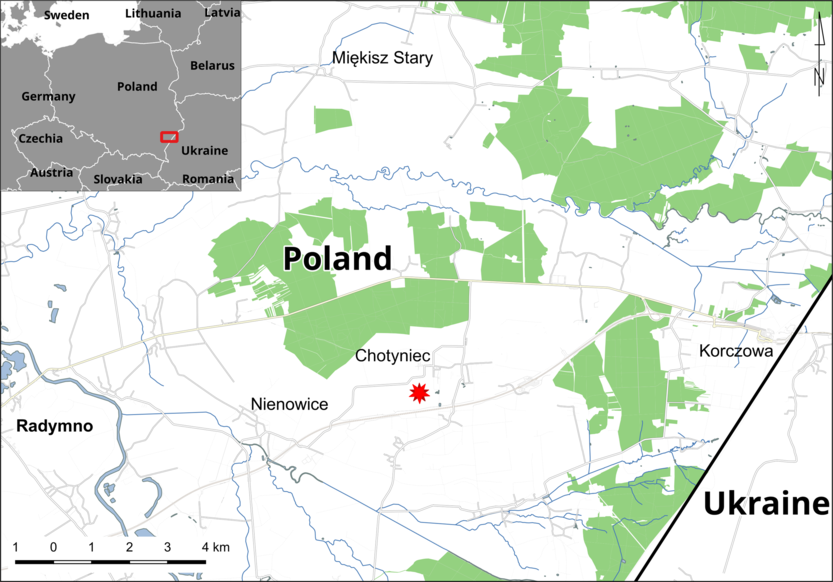
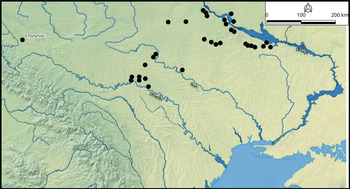
Since 2016, a hillfort from the early Iron Age has been excavated in Chotyniec, in southeastern Poland (Figure 1). Together with neighbouring settlements, where excavations were also carried out (Hruszowice, object 2 and 16 and Chotyniec 7), the site forms a unique settlement complex—the Chotyniec agglomeration (Czopek et al. Reference Czopek, Trybała-Zawiślak, Wojceszczuk, Osaulczuk, Bobak, Gebica, Jacyszyn, Pasterkiewicz, Pawliw, Petehyrycz, Połtowicz-Bobak and Wacnik2018). Materials discovered at the hillfort and in the settlements are identical. They represent the same cultural unit, a forest-steppe variant of the Scythian culture, and can be similarly dated (ca. 7th–5th/4th century BC). This is one of the westernmost enclave of the Scythian world, located about 150–200 km away from the previously known border (Figure 2). Its location (i.e. on the edge of the valleys of the Wisznia and San rivers) can easily be explained by natural conditions, as it is a contact zone between the Central European and Pontic provinces (covered by steppe and forest-steppe—Makohonienko Reference Makohonienko2009: 26–28). The former was occupied in the early Iron Age by the internally diverse Lusatian culture together with the Pomeranian culture, and the latter (west of the Dnieper) belonged to the Scythian cultural group. The hillfort in Chotyniec should therefore be treated as a border stronghold, guarding access from the west to the wide strip of forest-steppe located to the east (Makohonienko Reference Makohonienko2009: 25, Fig. 4).
Location of archaeological site 1 (hillfort) in Chotyniec (southeastern Poland).

Hillfort in Chotyniec in the context of other hillforts in Eastern European forest-steppe zone (data from Besonova and Skoryj Reference Bessonova and Skoryi2001; Gretchko Reference Gretchko2010).

One of the most important elements of a Scythian hillfort is a place of a specific, cult and ritual function, known as zolnik. Its significance results from the accumulation of layers of charcoal, ash (Russian zol), monuments (including spectacular ones, with high cognitive potential) and post-consumption animal bones, which are the remains of regular ceremonies. In older archaeological literature, a zolnik was characterized as a place for collecting ash (e.g. Kovpanenko Reference Kovpanenko1967). This characterization was largely due to limited research methods, lack of complex recognition of these objects, and accurate planigraphic and stratigraphic studies (Smirnova Reference Smirnova and Suprunenko1996). Currently, researchers emphasize that zolniks consisted of not only ash layers, but also internal structures and in-ground objects (individual clusters of artifacts, bones and charcoal). They are considered to be places of ritual activities, with their present form being the remains of rites associated with solar-chtonic cults that had the character of joint feasts (Bessonova and Skoryi Reference Bessonova and Skoryi2001).
Comprehensive research of the zolnik at Chotyniec corroborates this interpretation, as we managed to identify (visible in planigraphy and stratigraphy) a part of zolnik area which was functionally (and probably also chronologically) separate, as well as in-ground objects. Hence, it is not justified to treat the zolnik in the literal sense exclusively as an ash/burnt mound. Zolniks are places within hillforts and settlements which, together with a few other rare objects (e.g. clay altars), can and must be associated with the sphere of beliefs. They also had a significant social meaning. Cyclical rituals held within the zolnik united local communities (Bessonova and Skoryi Reference Bessonova and Skoryi2001). It can be concluded that the interpretations of zolniks are somewhat syncretic. These interpretations take into account both the waste character of the remains (this applies above all to many Bronze Age cultures, e.g. Koryakova et al. Reference Koryakova, Krauze, Epimakhov, Sharapova, Panteleeva, Berseneva, Fornase, Kaizer, Moltchanov and Tchetchushkov2011), as well as intentional constructions and traces of rituals found in the better-studied zolniks of the Scythian culture (Gretchko Reference Gretchko2010: 36–38).
Detailed typological and chronological analyses of artifacts, developed stratigraphy, planigraphic studies, and radiocarbon (14C) dating are basic and complementary methods of determining the time of functioning of the zolnik. Such an object was excavated in 2016–2018 during the research at Chotyniec, which has changed the current perception of Scythian issues in Central Europe (Bakay Reference Bakay1971; Bukowski Reference Bukowski1977) and throughout the Scythian circle (Rice Reference Rice1957; Grakov Reference Grakov1980; Rolle Reference Rolle1989; Parzinger Reference Parzinger2004, Reference Parzinger2007; Bruiako Reference Bruiako2005). The settlement zone in the forest-steppe type of the Scythian culture was shifted by approx. 150–200 km northwest as a result of these investigations. A series of 14C dates from the zolnik is therefore very important for determining the chronology not only of thispart of the site, but of the entire hillfort and open settlements located nearby (the Chotyniec agglomeration). Scythian armaments, parts of equestrian gear and ornaments are the only objects with narrow time ranges on the borderland between Eastern and Central Europe. In this zone, there are no artifacts related to the Hallstatt period (Gedl Reference Gedl1991; Trybała-Zawiślak Reference Trybała-Zawiślak2019). Therefore, determining their chronology and contexts, i.e. occurrence within complexes (such as the discussed zolnik) is very important. To the west and northwest of the Chotyniec agglomeration, in the Lusatian cultural circle clusters, numerous armaments (mainly arrowheads) and ornaments (mainly nail-like earrings) of Scythian provenance have been recovered (Bukowski Reference Bukowski1977; Kłosińska Reference Kłosińska2013). Until now they were associated with groupings of the Scythian culture which are located farther away, by the central Dniester River and even by the Dnieper. The Chotyniec agglomeration, which lasted continuously for several hundred years, should be treated as a place where artifacts of Scythian origin may have originated. This aspect of research in Chotyniec should be treated as one of its most important achievements.
ARCHAEOLOGICAL INVESTIGATION
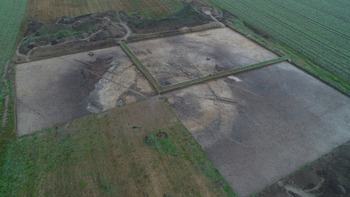
Since 2016, research has been conducted at a large (almost 36 ha) hillfort in Chotyniec (Czopek et al. Reference Czopek, Trybała-Zawiślak, Tokarczyk, Ocadryga-Tokarczyk, Burghardt, Adamik-Proksa and Rajpold2017). So far, the most spectacular results have resulted from excavations of the so-called zolnik (cult and ritual place), located in the northeastern part of the settlement (Figure 3). This was distinguishable in terms of morphology (small, poorly marked, oval elevation) and the presence of a lot of historical material on the surface (fragments of ceramics, animal bones located within the clear darkening). The range of zolnik strata determined the size of the main ritual space, which had an almost round shape, approximately 20.8 m (EW) × 21 m (NS). The maximum height of the cone could be up to 2 m from its base (i.e. the boundary of strata II and III). All size parameters correspond to medium-size zolniks of this type from other Scythian hillforts in the forest-steppe zone (Kovpanenko Reference Kovpanenko1967; Smirnova Reference Smirnova and Suprunenko1996: 185; Bessonova and Skoryi Reference Bessonova and Skoryi2001: 16). In a horizontal view, the zolnik was not a monolith. We managed to identify places more and less intensely used, and even to capture a break in strata, overlapping with the reduced intensity of the occurrence of artifacts, which can be interpreted as an intentionally prepared entrance to the interior of the object. In the central section, the original strata were damaged by a later, quite deep excavation of unexplained nature (the research has not yet finished there).
Chotyniec, site 1 (hillfort): photograph of the zolnik during excavation (visible black layers inside and on the edges of the zolnik and yellow layers of the shaft.

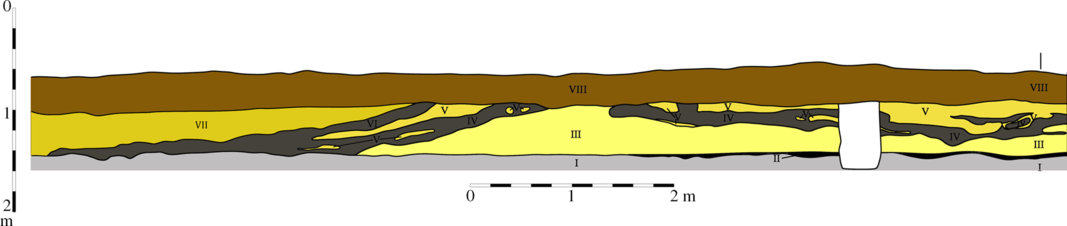
Individual strata (Figure 4) can be characterized and interpreted as follows (ordered from the undisturbed subsoil level):
I. A stratum of grey, slightly sandy clay, covering a light field bank;
II. A thin level of transitional stratum with abundant charcoal, but without historical material, which probably constitutes the remains of the sacral treatment at the base of the zolnik;
III. A bank stratum of yellow, sandy clay, forming a conical embankment;
IV. The proper, “zolnik I” stratum, intensely black, with traces of burning and charcoal, filled with a lot of historical material—fragments of ceramics, metal artifacts and a large quantity of animal bones; the stratum, similarly to stratum VI, which was of alluvial character, were deposited in central part of the zolnik;
V. Uneven stratum of yellow clay, covering the “zolnik I” stratum, which was created as a result of intentional efforts to cover fragments of zolnik after ceremonies; traces of the analogous stratum are also observable over the next stratum (VI), which means that it was also covered;
VI. Marginally preserved “zolnik II” stratum, in fact visible only on the outskirts of the zolnik, of an alluvial character, which probably was originally visible on the entire surface, and has now been destroyed by intensive cultivation;
VII. Clay layer covering the zolnik;
VIII. Contemporary arable soil.
Chotyniec, site 1 (hillfort): profile of the part of the zolnik illustrating stratigraphic relationships of layers I–VIII (explained in the text).

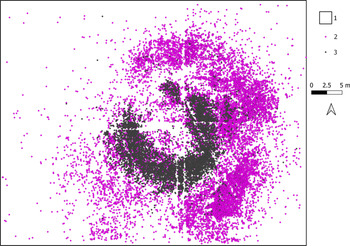
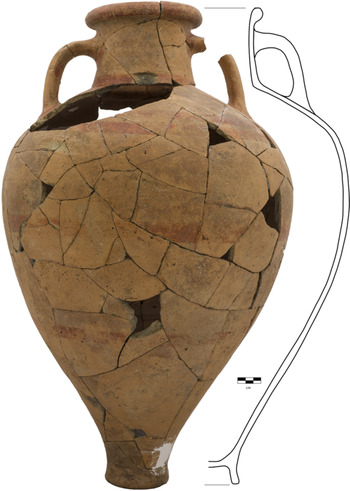
The distribution of the three basic categories of mass sources—ceramics, bones and burnt clay—in each case repeats the stratigraphic observations of the zolnik stratum. Bones, ceramics and other, rarely occurring metal objects are arranged mainly within the range of the zolnik strata, which were very rich in artifacts (Figure 5). Over 5800 fragments of animal bones, almost 30,000 burnt clay lumps and 15,000 fragments of ceramics have been recorded. Among the latter, fragments of Greek amphoras for wine deserve special attention. One of them was fully assembled and glued (Figure 6). It comes from the pottery center in Klazemenei (Monakhov Reference Monakhov1999: 39–40, Reference Monakhov2003: 51), and it can be dated for the turn of the 7th and the very beginning of the 6th century (Sezgin Reference Sezgin2004: 173–175). The second amphora can be dated similarly, reconstructed on the basis of a smaller number of fragments. Its provenance can be traced to the Lesbos circle (ceramics with grey surface: Monakhov Reference Monakhov1999: 41, 51, 55, Reference Monakhov2003: 43–44). Fragments of the Klazomenai amphoras and those related to the center on Lesbos can be found at many hillforts and Scythian settlements in the forest-steppe zone. The closest examples geographically come from sites by the central Dniester (Iwane Puste and Zalisje) from the West Podolia group (Daragan Reference Daragan2009: 123, 125, Figs. 5, 11). These are present on hillforts located further to the east (e.g. Zadnikov and Havrysh Reference Zadnikov and Havrysh2011). It should be assumed that it was not the Greek amphoras themselves that were the subject of exchange, but the wine found in them. The occurrence of fragments of amphoras in zolniks is associated with the participation of representatives of the Scythian aristocracy in the rituals held there (Bessonova and Skoryi Reference Bessonova and Skoryi2001: 29).
Chotyniec, site 1 (hillfort). Planigraphy of bones and ceramics within the zolnik: 1—border of the excavated area; 2—ceramics; 3—animal bones.

Chotyniec, site 1 (hillfort). Greek amphora discovered in 2018. Clazomenei workshop, 7th/6th century BC.

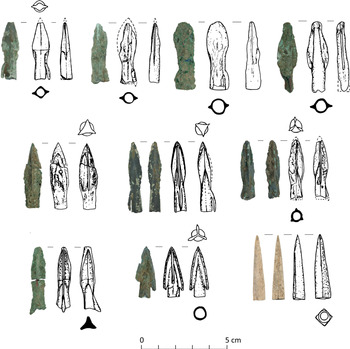
In addition to Greek ceramic imports, the second group of artifacts that give a good estimate the chronological position of the zolnik are bronze projectile points that are characteristic of the Scythian culture. Over 30 were found in this object (whole forms and fragments). Among the most common bronze specimens, we encounter bifacial and trifacial projectile points with barbs and a high sleeve, trifacial and triangular projectile points with a high sleeve. Two bone projectile points are objects with a rectangular cross-section (Figure 7). The entire collection is very consistent chronologically and belongs to the first and second chronological group according to Melyukova (Reference Meljukova1964: 18–23), so it can be dated for 7th–6th/5th century. The oldest forms, referring to arrowheads of Ehdzhe-Żabotin type and the so-called Kelermeski type, allow to narrow the chronology to the second half of the 7th and first half of the 6th century (Polin Reference Polin1987: 28–29), and the argument is also the lack of younger forms of projectile points, which in the Scythian world are distinctive for peg sets from the second half of the 6th and the 5th century. In the wider zone of the current Polish-Ukrainian borderland there are both older items, analogous to the Chotyniec ones, as well as younger ones (Czopek et al. Reference Czopek, Pawliw, Trybała-Zawiślak and Wojcieszczuk2015).
Chotyniec, site 1 (hillfort). Arrowheads—bronze and one bone; first chronological group according to Melyukova (Reference Meljukova1964), 7th–6th century BC.

Bronze ornaments can also serve as chronological indicators—a bent necklace, pins with mushroom-shaped heads (it is better to call them nail-shaped). Analogies for these are numerous and come from both graves and settlements. Their chronologies refer to the chronological range covering the end of the 7th and 6th century BC (Petrenko Reference Petrenko1978: 14–15, 18–19, 42).
Handmade ceramics are not a good indicator of chronology. Most types, e.g. numerous pots with plastic cordon under the spout and bowls with a rim folded inside, can be referred to the entire duration of the Scythian settlement in the forest-steppe zone, i.e. from the 7th to the 4th century BC. Only fragments of large, ornamented vase-like vessels with a black surface should be referred to the older horizon of the 7th–6th century BC (Geiko Reference Geiko2011: 145; Peliashenko Reference Peliashenko2014: 43–44).
MATERIAL AND METHODS
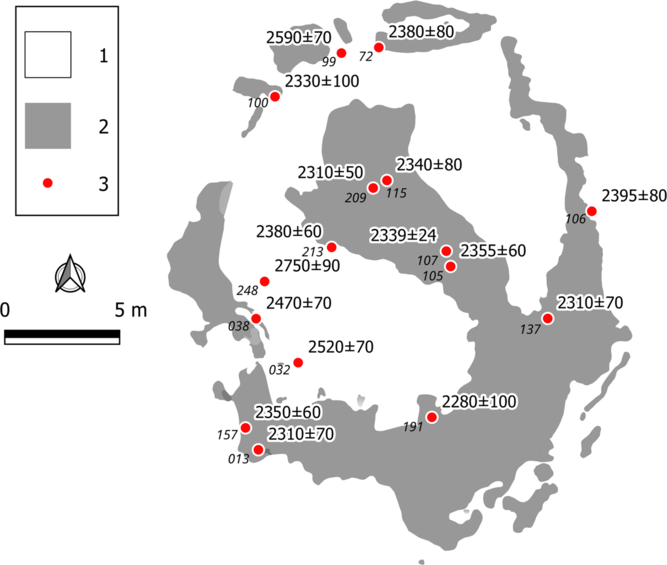
The 14C analyses encompassed 17 samples of charred wood collected during the excavations of the zolnik area. Samples were taken from all distinguishable layers throughout the zolnik space (Figure 7). Organic material was largely present at various utility levels. However, there were very fine charcoals within the black colored layers (Figure 8).
Chotyniec, site 1 (hillfort). Planigraphy of samples selected for 14C dating and determining their BP age: 1—border of the excavated area; 2—zolnik layers, filled with charcoal; 3—dated samples.

Selected 15 charcoal samples, several g in weight, were dated using the conventional LSC 14C dating technique in the Laboratory of Absolute Dating (Lab Code: MKL) in Skała and Cracow, Poland. Organic samples were chemically pre-treated with the acid–alkali–acid (AAA) method. After drying the sample, further procedures included a standard synthesis of benzene from carbonized samples (Skripkin and Kovalyukh Reference Skripkin and Kovalyukh1994, Reference Skripkin and Kovalyukh1998). Measurements were carried out with the Hidex 300 SL spectrometer (Krąpiec and Walanus Reference Krąpiec and Walanus2011).
Dating of 2 small samples (ca. 1 g charcoal) using the AMS technique was made in the Laboratory of Absolute Dating, Poland (graphite preparation; Krąpiec et al. Reference Krąpiec, Rakowski, Huels, Wiktorowski and Hamann2018) and CAIS, University of Georgia (measurements; Cherkinsky et al. Reference Cherkinsky, Culp, Dvoracek and Noakes2010).
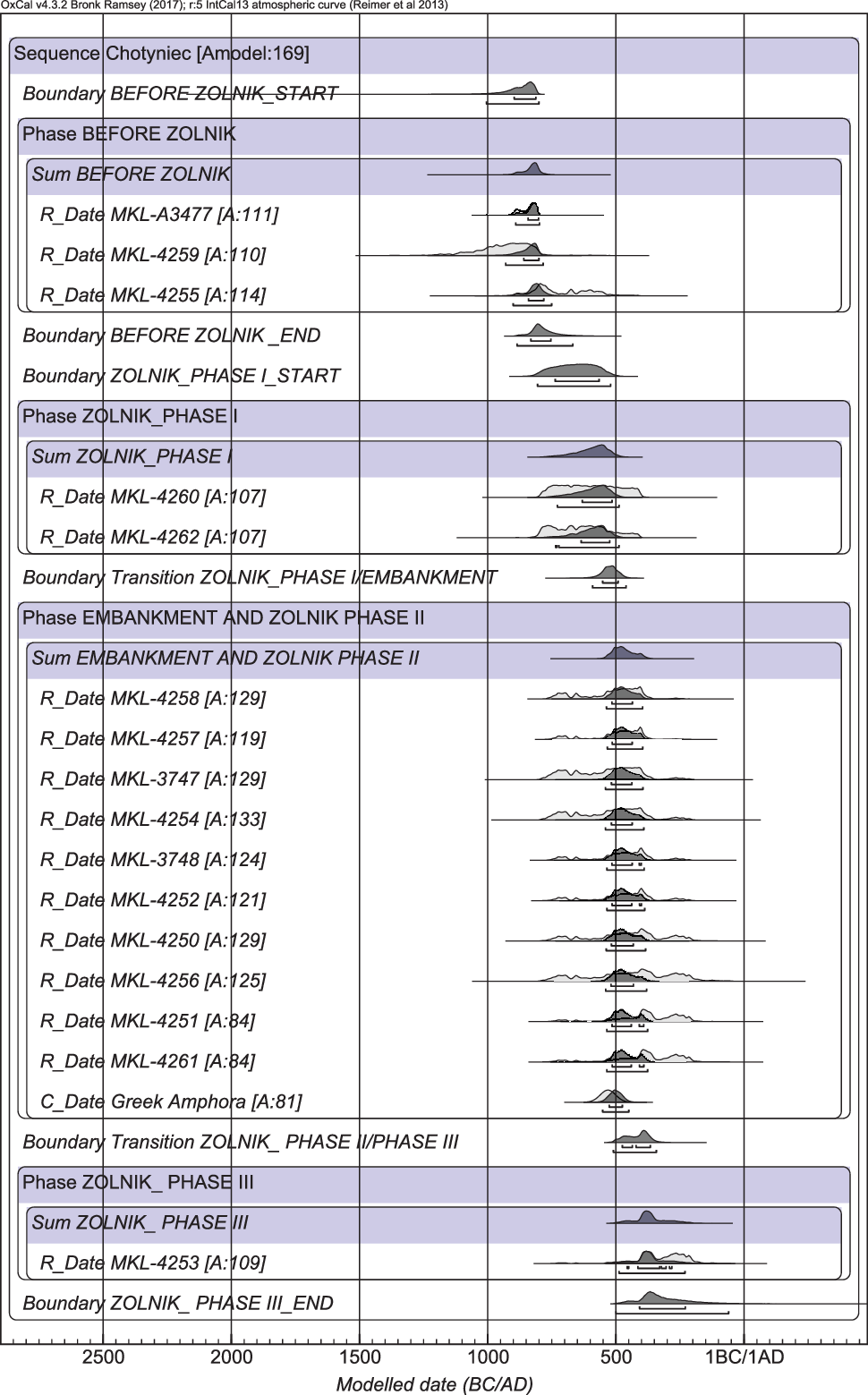
All dates were calibrated using the OxCal 4.2 calibration program (Bronk Ramsey Reference Bronk Ramsey2009) on the basis of the IntCal13 calibration curve (Reimer et al. Reference Reimer, Bard, Bayliss, Beck, Blackwell, Bronk Ramsey, Buck, Cheng, Edwards, Friedrich, Grootes, Guilderson, Haflidason, Hajdas, Hatt_e, Heaton, Hoffmann, Hogg, Hughen, Kaiser, Kromer, Manning, Niu, Reimer, Richards, Scott, Southon, Staff, Turney and van der Plicht2013).
RESULTS AND DISCUSSION
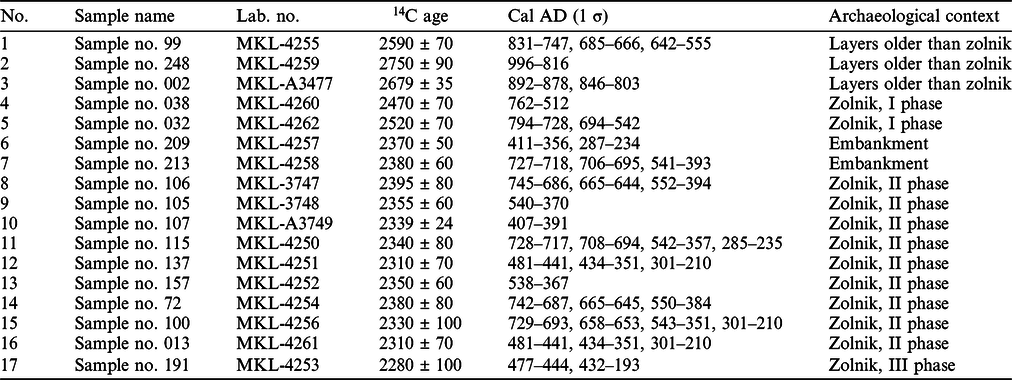
The reconstruction of events that took place within the zolnik was made on the basis of field observations and 14C dating. The 14C results are shown in Table 1. The time span covered by the phases was determined using a Bayesian model allowing for the calculation of probability distribution for the beginning, the end and the possible time span in calendar age (Figure 9).
List of 14C dates for samples from the relics of the hillfort in Chotyniec (LSC dating: lab code—MKL; AMS dating: lab. code—MKL_A).


The oldest date, indicating the 9th/8th century BC, refers back to the time before the arrival of the population from the east identified with the Scythian cultural model. It testifies to some human activity that cannot be associated with any artifacts. Subsequent dates refer to the activity of eastern newcomers with specific rituals, the remainder of which is the zolnik. Its oldest phase (I), visible only in the southeastern part, can be dated within the 8th–7th/6th century BC, and based on historical considerations in this part of Europe, it should be narrowed to the end of the 7th or the turn of the 7th and 6th century. An important element of the zolnik is a clayey embankment visible in most of the area occupied by this object. Its creation can be dated within the 6th–5th century BC. On this clay horizon lay the main zolnik (II) layer, which can be considered the second phase of use. Dating of the artifacts found there, including a well-documented chronology of a Greek wine amphora (the first 30 years of the 6th century BC), allow us to narrow this stage to the very beginning of the 6th century (Dupont Reference Dupont1983: 25–26; Sezgin Reference Sezgin2004: 173–175). The time between the construction of a conical clayey embankment and the beginning of the second phase may not be chronologically feasible, as these events appear to be immediately consecutive. Dating of phase 2 is well established—in the light of other dates it should refer to the 5th century BC, and after supplementing it with typological conclusions, also up to 6th century. Readable younger stage can be associated with the turn of the 5th and 4th century BC. The youngest dates (phase 3) indicate 4th–3rd century BC. They date barely preserved (destroyed by ploughing) and stratigraphically the youngest phase of use of the zolnik. This final stage, well defined on the basis of 14C chronology, is not really visible in archaeological sources. This may be due to the considerable destruction of younger layers and long survival of some artifacts (e.g. frequently occurring local, non-characteristic handmade ceramics). Thus, the time of functioning of this complex can be estimated at about 250–300 years and placed between 7th/6th and 4th/3rd century BC.
CONCLUSIONS
The importance of research in Chotyniec cannot be overestimated. It is of European significance. This site is the farthest northwest point of the Scythian cultural circle, as a kind of “gate of Great Scythia”. Its significance is emphasized by the finds of Greek amphorae, the only ones in this part of Central Europe. At the same time, for the first time, among all Eastern European zolniks known to date, a chronological model of the functioning of a unique ritual-ceremonial place has been presented using 14C dating. This is also important because of chronology, indicating that from the very beginning of the functioning of the Chotyniec agglomeration (i.e. 7th/6th century), that it does not differ in this respect from other important centers of the Scythian world in the forest-steppe zone. There is no doubt that the set of sites located in the immediate vicinity of the Chotyniec hillfort should be associated with the Scythian cultural circle. This is shown by the large area of the hillfort, its internal structure with the zolnik and the entire material culture. At the current stage of research (which is still ongoing), the whole zolnik, with all its content and planigraphic and stratigraphic observations, is of decisive importance in chronological findings for the entire agglomeration and neighbouring areas, thus in determining the time of Scythian domination on the border of Eastern and Central Europe. This is the first presentation of 14C results that support the functioning of the zolnik over centuries, and the chronology of artifacts.
ACKNOWLEDGMENTS
The study was supported by NCN, grant no 2017/27/B/HS3/01460 “On the border between two worlds. Chotyniec agglomeration of the Scythian cultural circle—stage I: field research”.