Depression is one of the most devastating forms of psychological illness, and its prevalence rates follow a distinctive developmental trajectory. Major depressive disorder (MDD) is common in the general population, with a lifetime prevalence rate of 16.2% and a past-year prevalence rate of 6.6% (Kessler et al., 2003). Although previously it was assumed that childhood and adolescence were relatively free of psychological difficulties (Douvan & Adelson, 1966; Offer, 1969), a recent study found the lifetime prevalence rate of MDD among adolescents to be 15.3%, with a 30-day prevalence rate of 5.8% (Kessler & Walters, 1998). Beginning in early adolescence, the prevalence of depression increases (Saluja et al., 2004), and by mid- to late adolescence, teenagers experience both subclinical and clinical depression at rates at least equal to adults (Flemming & Offer, 1990; Garrison, Schoenbach, & Kaplan, 1985; Schoenbach, Garrison, & Kaplan, 1984).
At the same time as the prevalence of depression increases significantly from childhood through late adolescence, there also is a shift in the gender ratio such that girls become more likely to experience depression than boys. In childhood, boys and girls have similar rates of depression (Kovacs, 1996), and some studies suggest that boys experience slightly more depression than girls (Anderson, Williams, McGee, & Silva, 1987; Hankin et al., 1998; Nolen-Hoeksema, Girgus, & Seligman, 1991). However, at about age 13 (Angold, Costello, & Worthman, 1998; Petersen, Kennedy, & Sullivan, 1991; Wichstrom, 1999) or 14 (Angold, 1990; Kandel & Davies, 1982, 1986; Lewinsohn, Hops, Roberts, Seeley, & Andrews, 1993), a gender difference emerges such that during adolescence, girls are twice as likely to suffer from depression. This gender difference persists into adulthood (Cyranowski, Frank, Young, & Shear, 2000). The growing weight of evidence for this distinctive prevalence pattern suggests that age and gender are critical factors in vulnerability that must be taken into account in research on etiology, treatment, and prevention. The striking change in prevalence of depression beginning in adolescence also indicates that a developmentally informed perspective is needed to create a comprehensive account of the heightened risk for depression among adolescent girls.
Developmental theorists have proposed multiple levels of analysis to consider when generating models of psychopathology (e.g., Cicchetti & Rogosch, 2002; Curtis & Cicchetti, 2003). Researchers have explored many factors to explain the gender difference in depression, including hormonal differences (e.g., Paikoff, Brooks-Gunn, & Warren, 1991), sexual abuse (Nolen-Hoeksema, 1994), personality style (Allgood-Merten, Lewinsohn, & Hops, 1990), and lower levels of assertiveness and instrumentality in girls (Galambos, Almeida, & Petersen, 1990). Although biologically based theories are important in the study of depression, they do not provide a sufficient explanation for the gender difference that arises in adolescence (Cicchetti & Toth, 1998; Nolen-Hoeksema & Girgus, 1994; Parker & Brotchie, 2004).
In this article, we take a translational approach to conceptualizing how social–cognitive processes that become prominent during adolescence might help to account for the increased risk for depression among adolescent girls. Specifically, we focus on the independent and interactive roles of two distinct but related aspects of social cognition: self-regulation toward personal goals and cognitive coping in response to goal blockage. We present an initial model for how self-discrepancy, or the belief that one is failing to attain important goals, and rumination, a maladaptive style of coping with perceived goal failure, could interact to intensify dysphoric responses to failure feedback. In turn, we discuss how chronic distress resulting from the combination of self-discrepancy and a ruminative coping style could lead to depression, and why this combination is more likely to occur in adolescent girls than adolescent boys. We present findings from a cross-sectional study of adolescent girls that supports our model, and discuss its implications for the etiology, treatment, and prevention of adolescent depression.
The Social–Cognitive–Developmental Context for Adolescent Girls
Adolescence is a phase of development marking the end of childhood and the beginning of a long period of increasingly independent functioning and greater accountability within the social world (Eccles, Barber, Stone, & Hunt, 2003). This context serves as a backdrop for the changes in prevalence in depression. Within the adolescent transition, there are cultural and societal shifts in social pressures as adolescents begin to encounter adult gender role norms, particularly in terms of others' expectations of them. The gender intensification hypothesis (Hill & Lynch, 1983) postulated that behavioral, attitudinal, and psychological differences between boys and girls appear or increase at the onset of puberty, and that those differences are primarily the result of increased socialization pressures to conform to masculine and feminine adult gender roles. Puberty has profound biological and behavioral effects on young girls (Dahl & Hariri, 2005), but it also acts as a social stimulus for others, altering how adults and peers respond to girls as their bodies develop (Brooks-Gunn, 1991; Galambos et al., 1990). At the same time, girls' own experiences and interpretations of pubertal events may influence how they experience and respond to social events (Brooks-Gunn, 1991; Galambos et al., 1990).
Self-Regulation and Self-Discrepancy
With increasing cognitive development, the emergence of complex peer networks, and increasing independence, adolescents are both expected to and expect themselves to formulate and pursue goals related to such identity domains as academic achievement, romantic relationships, college, and career (Higgins, Loeb, & Moretti, 1995). Theory and research regarding self-regulation from the basic science literature in social psychology can help to illuminate how goal formulation and pursuit, and the consequences of failure to meet goals, may increase vulnerability to depression among adolescents. The process of self-regulation, defined here as the ongoing pursuit of personal goals and evaluation of one's progress toward those goals (Carver & Scheier, 1990), both intensifies and generalizes as individuals move from childhood to adolescence and begin to pursue a greater number, range, and complexity of goals. Much of the ongoing process of self-regulation is automatic and implicit, as an individual's current behavior and attributes are continually compared to her/his salient goals and standards (Carver & Scheier, 2000). When a discrepancy is perceived between an individual's current state and a salient goal, the individual experiences negative affect and is motivated to reduce the discrepancy (Duval & Wicklund, 1972).
As a well-validated approach to self-regulation and goal pursuit within the social psychology literature, self-discrepancy theory (SDT; Higgins, 1987) is a model of self and affect that specifies how different kinds of goals operate as standards for self-evaluation. The theory postulates three domains of the self: the actual self, a representation of the attributes that a person believes s/he actually possesses; the ideal self, a representation of the attributes that a person would ideally like to possess; and the ought self, a representation of the attributes that a person believes s/he should or ought to possess. The ideal self and ought self are referred to as self-guides, and operate as goals and standards within the process of self-regulation. According to SDT, perceived discrepancies between the actual self and a self-guide lead to particular negative emotional/motivational states. Both correlational and experimental studies (e.g., Higgins, Bond, Klein, & Strauman, 1986; Higgins, Klein, & Strauman, 1985; Strauman, 1989) have demonstrated that a discrepancy between the actual self and the ideal self is associated with dejection-related emotions and with depressive symptoms, whereas a discrepancy between the actual self and the ought self is associated with agitation-related emotions and with anxious symptoms.
Although most studies of self-discrepancy and its associations with depression have been conducted in adult populations, there is evidence that actual:ideal discrepancy also predicts depressive symptoms in children and adolescents (e.g., Hankin, Roberts, & Gotlib, 1997; Ingram, 2003; Moretti & Wiebe, 1999). Higgins (1989) proposed that self-discrepancies in young children would have relatively limited affective consequences, because due to children's level of cognitive development, perceived discrepancies would be specific to particular behaviors or situations. However, when children reach adolescence, they acquire the cognitive capacity to represent and maintain more abstract personal goals (such as being athletic, popular, trendy, or intelligent). Self-discrepancies based on abstract goals should have more generalized, intense, and potentially chronic emotional and motivational consequences, because the ideal or ought self-guides involved would tend to be traitlike and therefore dispositional (rather than situational). The affective consequences of not meeting such generalized, traitlike goals should be greater than if the goals were situationally bound and transient. This postulate of self-discrepancy theory is consistent with the hopelessness theory of depression (Abramson, Metalsky, & Alloy, 1989), which states that stable and global attributions about negative life events trigger hopelessness and consequently depression.
In addition, whereas ideal and ought guides in children tend to refer to specific behaviors and therefore tend to be attainable by effort alone, the generalized, dispositional self-guides that adolescents come to possess are often more difficult to attain as well as less likely to be attainable by effort alone. Furthermore, whereas repeated successes might be required to see oneself as attaining a generalized, dispositional self-guide such as being popular, one instance of failure could be enough to create a perceived general discrepancy between the actual self and the self-guide. Taken together, these changes in self-guides at the transition to adolescence suggest that self-discrepancy may represent a vulnerability factor for depression particularly in adolescence, both because self-regulation toward personal goals is more difficult for adolescents than for children and because the goals are represented as dispositional and generalized, and therefore, even circumscribed failures could be experienced as general failures. In addition, these processes appear to be more common and more affectively potent for adolescent girls versus boys. Moretti and colleagues (Moretti & Higgins, 1999; Moretti & Wiebe, 1999) have observed gender differences in both the magnitude of self-discrepancy and the intensity of affective consequences of discrepancies, with women and adolescent girls tending to manifest more discrepancy and to report more discrepancy-related distress than their male counterparts.
Gender Differences in Coping With Stress and Failure
Because of the effect of gender role expectations on adolescents' relationships (both with peers and adults), internalized gender role norms are likely to influence adolescent girls' responses to stressors, particularly interpersonal stressors, in ways that may make them more susceptible to depressive symptoms than boys. Indeed, there is evidence that adolescent girls tend to ruminate more than adolescent boys (Broderick & Korteland, 2002; Muris, Roelofs, Meesters, & Boomsma, 2004), and that adolescents of either gender who identify with traditionally feminine gender role expectations tend to ruminate more than their peers who identify with traditionally masculine gender role expectations (Broderick & Korteland, 2002).
In contrast to coping styles involving voluntary engagement (e.g., problem solving) or disengagement (e.g., avoidance), rumination is generally an involuntary engagement response to stress or failure (Compas, Conner-Smith, Saltzman, Thomsen, & Wadsworth, 2001; Conner-Smith, Compas, Wadsworth, Thomsen, & Saltzman, 2000). Nolen-Hoeksema (1987, 1998) defined rumination as a passive, repetitious focus on depressive symptoms and the causes and consequences of those symptoms. There is substantial evidence in adults that rumination is an important risk factor for depression (e.g., Just & Alloy, 1997; Nolen-Hoeksema, Morrow, & Frederickson, 1993). Women are significantly more likely than men to use a ruminative coping style (e.g., Butler & Nolen-Hoeksema, 1994), and this gender difference in rumination appears to contribute to the observed gender difference in depression among adults (e.g., Nolen-Hoeksema, Larson, & Grayson, 1999).
Investigators have begun to examine rumination and the link between rumination and depression in adolescents, and their findings have implications for understanding the emergence of the gender difference in depression during that period. First, the use of rumination tends to increase from late childhood through adolescence (Hampel & Petermann, 2005). Second, as in adults, rumination is predictive of concurrent depression in older children and adolescents (Abela, Brozina, & Haigh, 2002; Garnefski, Boon, & Kraaij, 2003; Rose, 2002), and rumination is associated with increases in depressive symptoms up to 3 years later (Abela et al., 2002; Broderick & Korteland, 2002). There is even evidence to suggest that rumination is a stronger risk factor for depression among adolescents compared to adults (Garnefski, Legerstee, Kraaij, Van Den Kommer, & Teerds, 2002).
Although the adult literature demonstrates clearly that women ruminate more than men (e.g., Butler & Nolen-Hoeksema, 1994), the point at which gender differences in rumination emerge remains unclear. Two reports suggest that it happens by the fifth or sixth grade (Grant et al., 2004; Hampel & Petermann, 2005), although another suggests after the seventh grade (Abela et al., 2002). However, it appears that rumination may be a key factor in understanding the emergence of gender differences in depression with the onset of adolescence, because it enhances the effect of negative life events on depression among adolescence (Kraaij et al., 2003) and mediates the statistical association between gender and depression (Grant et al., 2004).
At the same time that girls begin to experience higher rates of depression, they increasingly view rumination as an appropriate coping mechanism (Broderick & Korteland, 2002). This may reflect changes in the social environment, because as boys grow older they also tend to endorse the belief that rumination is more appropriate for girls (Broderick & Korteland, 2004). This change in attitude likewise may reflect pressures from gender roles, because girls who identify with traditional feminine gender roles have more ruminative tendencies than peers who identify primarily with masculine gender roles (Broderick & Korteland, 2002), and this association becomes more pronounced over the course of adolescence (Broderick & Korteland, 2002, 2004). Although girls are more likely than boys to use ruminative coping, they are also less likely to use distraction coping strategies in response to failure feedback than boys, which also places them at greater risk for depression (Broderick, 1998). In short, by early to middle adolescence, girls ruminate more than boys, and both girls and boys view ruminative coping as an acceptable coping strategy for girls to use in response to stress (Ziggert & Kistner, 2002).
Self-Discrepancy and Ruminative Coping: A Pathway of Vulnerability That Differentially Affects Adolescent Girls?
Although the developmental context of adolescence seems to intensify gender role identification and the reliance on rumination among girls, the combination of perceived self-discrepancy and tendencies to ruminate in response to failure may be particularly problematic for adolescent girls. Why might this combination be especially problematic? Self-regulation theorists have argued that increased self-awareness due to rumination about failure can interrupt effective behavioral responses to failure feedback (Carver & Scheier, 1981). Such interruptions, in turn, may foster a vicious cycle of perceived self-discrepancy, rumination about the discrepancy, intensified focus on oneself and one's distress, and inadequate behavioral responses to the perceived failure, which can perpetuate the perceived self-discrepancy (Strauman, 1996). In this way, ruminative coping may serve to amplify dysphoric emotions that inevitably occur in response to everyday frustrations and failures, and ultimately contribute to a downward spiral of self-discrepancy and distress potentially culminating in a depressive episode (Akiskal & McKinney, 1973; Strauman, 2002). Rumination also could operate to maintain and prolong depressive episodes by increasing the chronic accessibility of actual:ideal discrepancies (Scott & O'Hara, 1993) and by occupying limited attentional and cognitive resources that otherwise could be engaged in problem solving.
Although there are both conceptual and empirical bases for predicting that the combination of actual:ideal self-discrepancy and a ruminative coping style would predispose individuals to more intense, prolonged depressive symptoms than actual:ideal discrepancy alone, we found no studies that tested such a prediction. Given the developmental perspective outlined above, we were particularly interested in whether the combination of actual:ideal discrepancy and rumination might help to account for the gender difference in vulnerability to depression that emerges at the start of adolescence. We conducted a cross-sectional investigation to examine the associations among self-discrepancy, coping styles, and depression in a sample of adolescent girls as a first step toward exploring this model. The following hypotheses were tested:
- Consistent with previous findings, we hypothesized that older adolescent girls would report higher levels of depressive symptoms than younger adolescent girls.
- Because ruminative coping has been reported to increase among girls as they enter adolescence, we hypothesized that older adolescent girls would report more ruminative tendencies than younger adolescent girls.
- Most importantly, we predicted that whereas both actual:ideal discrepancy and ruminative coping style would be independently associated with depression, the combination of significant actual:ideal discrepancy and ruminative coping would be associated with more severe depressive symptoms.
Method
Participants
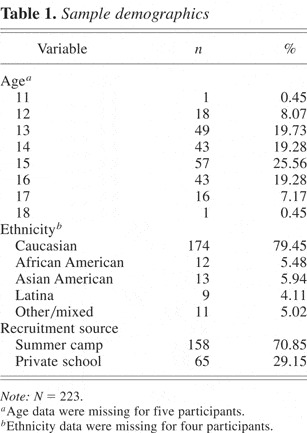
The sample included 223 female participants in the 7th through 12th grades who were enrolled in one of two private combined middle/high schools (29%) or participated in a summer drama and writing camp (71%). A description of the sample by age and ethnicity is given in Table 1. The mean age was 14.50 years (SD = 1.44; range = 11–18 years old). Although the socioeconomic status of the participants was not measured, it is assumed that the sample was predominantly middle to upper class, due to the nature of the schools and camp from which the girls were recruited.
Sample demographics

The sample was recruited with the cooperation of school and camp administrators and the permission of the local Institutional Review Board. In the schools, all girls in the 7th through 12th grades were eligible for the study and heard a brief presentation about it at an assembly. Those who were interested provided assent and obtained parental consent. For the camp, parents of all of the female participants in Grades 7 through 12 received a letter about the study prior to their daughters' arrival. Parents who were willing to have their daughters participate returned the consent form via mail, and adolescent assent was obtained prior to participation.
Procedure
Participants completed a set of self-report questionnaires in a group testing session conducted in a classroom. During this session, graduate and undergraduate student research assistants met with participants individually to administer a semistructured interview. In this article we report on findings from three of the measures that were administered.
Measures
Child Depression Inventory (CDI)
The Child Depression Inventory (Kovacs, 1992) is a widely used self-report scale for children ages 7 to 17 that focuses on depressive symptoms (Essau, Hakim-Larson, Crocker, & Petermann, 1999). The scale provides an overall measure of depression as well as subscales for negative mood, interpersonal problems, ineffectiveness, anhedonia, and negative self-esteem. Total scores can range from 0 to 54. Kovacs (1981) recommended that a score of 20 or above be used to identify a clinical level of depression. The CDI has acceptable reliability and validity (Kovacs, 1992).
Response Styles Questionnaire (RSQ)
The RSQ (Nolen-Hoeksema & Morrow, 1991) was designed to measure how an individual responds to feelings of depression or sad mood. Two RSQ scales were used: Brooding and Reflection. The Brooding Scale was selected to measure rumination (instead of the more commonly used Rumination Scale) to minimize the overlap between the rumination measure and the measure of depressive symptomatology, as suggested by Nolen-Hoeksema and colleagues (Treynor, Gonzalez, & Nolen-Hoeksema, 2003). The RSQ scales have acceptable convergent and predictive validity (Butler & Nolen-Hoeksema, 1994; Nolen-Hoeksema & Morrow, 1991; Treynor et al., 2003), and the RSQ has been used successfully adapted for use with an adolescent population (e.g., Schwartz & Koenig,1996).
Selves Interview
The Selves Questionnaire (Higgins et al., 1986) and the semistructured interview version (the Selves Interview) were designed initially to measure self-discrepancy in adults. The questionnaire version has been adapted successfully for use with individuals ages 11 to 18 years old (e.g., Hankin et al., 1997; Harrison, 2001), and the Selves Interview has been adapted successfully for children as young as first graders (Manian, Papadakis, Strauman, & Essex, in press). In the current study, the Selves Interview was administered individually, and participants were asked to generate lists of words to describe the type of person they believed they “actually are now” (actual self), a second list to describe whom they “would ideally like to be” (ideal self), and a third list to describe whom they believed they “ought to be” (ought self). Discrepancy scores were calculated according to the procedure described by Higgins et al. (1986). Briefly, each actual attribute was compared to each ideal and ought attribute to determine the number of matches (attribute pairs that are synonyms), mismatches (attribute pairs that are antonyms), and mismatches of degree (attributes are synonymous but differ in degree, for example, saying “intelligent” for the actual self but “very intelligent” for the ideal self). Synonyms and antonyms were determined using Random House Webster's College Thesaurus (Random House, 1998). Actual:ideal (A:I) and actual:ought (A:O) discrepancy scores were calculated according to the following formula: discrepancy score = 2 × (number of mismatches) + (number of mismatches of degree) − (number of matches). This scoring method has adequate psychometric properties (Higgins, 1987), and the Selves Interview has good test–retest reliability and criterion-related validity (Higgins, 1996; Strauman, 1992, 1996).
Results
Descriptive statistics
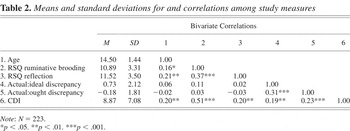
There were no significant differences in CDI scores across ethnic groups or recruitment source: ethnicity: F (4, 218) = 1.85, p > .05; source: t (222) = 0.57, p > .05. Samplewide means and standard deviations for the study measures and correlations among those measures are presented in Table 2. Approximately 9% of the girls in the sample (n = 19) exceeded the recommended clinical cutoff for the CDI (20; Kovacs, 1981).
Means and standard deviations for and correlations among study measures

Bivariate correlations
Despite the restricted age range within the sample, we found support for our hypotheses concerning associations between key study variables and age (each of which represented a replication of previous findings by other investigators). Older girls reported modestly but significantly higher levels of depressive symptoms, as measured by the CDI, than younger adolescent girls (r = 0.20, p < .01). There was also a small but statistically significant positive correlation between age and ruminative coping (r = 0.16, p < .05). As is typically the case in studies of self-discrepancy, both A:I and A:O were significantly correlated with depression and were moderately intercorrelated as well.
Independent and interactive effects of rumination and A:I discrepancy on depression
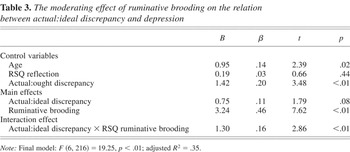
We hypothesized that both A:I and ruminative coping would predict depression independently, and that the interaction of A:I and ruminative coping would be a significant predictor of depression as well. These hypotheses were examined in a hierarchical multiple regression analysis with the CDI total score as the criterion variable. All predictor variables were standardized prior to analysis. The results from final model from this analysis are summarized in Table 3.
The moderating effect of ruminative brooding on the relation between actual:ideal discrepancy and depression

In the first step of the hierarchical analysis, we entered age, RSQ Reflection, and A:O as control variables. This step accounted for a significant portion of variance in CDI scores (R2 = .11, p < .01). Age (β = .17, p < .01), RSQ Reflection (β = .17, p < .01), and A:O (β = .24, p < .01) were all significant predictors of CDI scores in the expected direction. In the second step, A:I and RSQ Brooding were added to the model. This step accounted for a significant increment in variance explained in CDI scores (RΔ2 = .20, p < .01). As hypothesized, RSQ Brooding (β = .47, p < .01) significantly predicted CDI scores. However, A:I was only a marginal predictor of CDI scores (β = .11, p < .08), which was likely due, in part, to the moderate correlation between A:I and A:O, which had been entered into the model already. In the third and final step, a term for the interaction of A:I and RSQ Brooding was added, resulting in a significant increment in variance explained in CDI scores (RΔ2 = .02, p < .01). The final model accounted for approximately 35% of the variance in CDI scores, R2 = .35; F (6, 216) = 19.25, p < .01. As hypothesized, the interaction between A:I and RSQ Brooding was a significant predictor of depression (β = .16, p < .01).
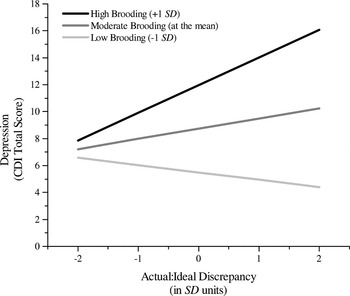
To probe the interaction, we examined the differences in the association between A:I and depression as a function of RSQ Brooding. Following the method of Aiken and West (1991), we computed slopes of A:I predicting CDI scores for low (−1 SD), moderate (at the mean), and high (+1 SD) levels of brooding. This analysis is illustrated in Figure 1. Among girls reporting low levels of ruminative brooding, the simple slope representing the association between A:I and depression was not significant (β = −.08, p > .25). However, among girls reporting moderate levels of rumination (at the mean), the association between A:I and depression was statistically significant (β = .11, p < .01). Most importantly, for those girls reporting high levels of rumination (+1 SD), the association between A:I and depression was quite strong (β = .29, p < .01). The significant interaction indicates that the association between A:I and depression was greater for the high-rumination versus the low-rumination and moderate-rumination groups.

Ruminative brooding moderates the effect of actual:ideal discrepancy on depression.
Discussion
Adolescent girls are at substantially greater risk for developing a depressive disorder than adolescent boys (Wade, Cairney, & Pevalin, 2002). No single factor appears to be sufficient to account for this gender difference in risk for a mood disorder; rather, beginning at the onset of adolescence, psychosocial, environmental, and biological factors are all likely to contribute to girls' greater risk (Crick & Zahn-Waxler, 2003). This study examined the independent and interactive influences of two psychological factors already known to manifest gender differences and already implicated in vulnerability to depression: self-discrepancy and ruminative coping. Consistent with a translational developmental perspective on depression (Cicchetti & Rogosch, 2002; Curtis & Cicchetti, 2003), our findings suggest that adolescent girls manifesting both high levels of actual:ideal discrepancy and a tendency to ruminate in response to stress and failure are particularly likely to report depressive symptoms.
Higgins (1989) and others have noted that adolescence is a time in which the tasks of life, in academic, social, and other domains, increase in both difficulty and complexity. As a result, self-regulation becomes more challenging as children become teenagers, and setbacks in pursuing personal goals are likely to be more frequent and have greater immediate and longer term consequences. Whereas during childhood many personal goals tend to be situation specific and to be attainable given sufficient effort, adolescents often find that becoming a particular kind of person involves challenges in multiple situations and domains and may not be possible through effort alone (Higgins et al., 1995; Raffaelli, Crockett, & Shen, 2005). Combining these developmental changes with the cognitive changes that characterize adolescence (which for the first time permit abstract, global self-representation, and self-evaluation) means that the stakes for self-regulation become greater. In particular, to the extent that an adolescent perceives a chronic discrepancy between her/his actual attributes and behaviors and her/his ideals, that individual is likely to experience more prolonged and significant distress than a preadolescent child experiencing a comparable magnitude of chronic self-discrepancy (Moretti & Wiebe, 1999). Thus, self-discrepancy theory implies that perceived failure in self-regulation is likely to be a more potent risk factor for psychological disorders during adolescence than during childhood (Higgins, 1989). Because adolescent girls tend to manifest greater self-discrepancy than their male counterparts (Moretti & Higgins, 1999; Moretti & Wiebe, 1999), self-discrepancy may indeed contribute to the gender difference in depression that begins to emerge at puberty.
Likewise, it is well established that rumination following perceived stress or failure can result in increased distress and less effective behavioral coping, which in turn, makes goal pursuit more difficult (Martin, Tesser, & McIntosh, 1993). Adolescents, and particularly adolescent girls, are more likely to use ruminative coping and to endorse it as a viable option for coping with stress and failure (Nolen-Hoeksema & Corte, 2004). Unlike strategies such as distraction, which effectively reduce acute distress and allow the individual to make additional efforts to succeed or to disengage from the present goal, rumination simply intensifies the individual's awareness that she/he is failing without offering a constructive response. These findings support a distinct, parallel set of psychological processes contributing to the emergence of a gender difference in vulnerability to depression during adolescence.
The unique contribution of this study is to take a broader perspective on self-regulation that considers the potential consequences of having both high levels of self-discrepancy and a tendency to ruminate in response to perceived failure. Studies in adults (Di Paula & Campbell, 2002) demonstrate clearly that rumination interferes with the ongoing cyclical process of self-regulation. From a control process perspective (Carver & Scheier, 2000), everyone invariably receives failure feedback as they seek to fulfill specific goals or to become particular kinds of people. However, whereas under optimal conditions the momentary distress associated with perception of self-discrepancy motivates the individual to either increase their efforts in goal pursuit or to switch to a different goal, rumination intensifies distress at the same time as it makes disengagement more difficult (Rimes & Watkins, 2005). To our knowledge, this broader self-regulatory model (derived primarily from theory and research in social psychology) had not been tested previously in adolescents, although other investigators (e.g., Nolen-Hoeksema & Girgus, 1994) had already suggested such a scenario.
Why did actual:ideal discrepancy only predict depression in combination with ruminative brooding, in contrast to the findings in the adult literature of a significant and discriminant association between A:I discrepancy and depression (Strauman, 2002)? We can suggest several possibilities. First, as mentioned previously, entering A:O discrepancy into the regression analysis before A:I discrepancy had the effect of controlling for variance shared between the two discrepancy scores. However, this explanation is probably not sufficient, because the same analytic strategy has been used repeatedly in studies of adults with different results. Second, another possibility is that the scoring used to quantify discrepancy, which includes both “matches” and “mismatches” between the actual self and the particular self-guide, may not be optimal for quantifying self-discrepancy in adolescents. That scoring was derived originally from regression analyses in college student and adult samples (Higgins, 1987; Higgins et al., 1985), but no such psychometric work has been reported yet in adolescent or child samples. However, supplementary analyses in the present sample (i.e., examination of unstandardized regression coefficients) indicated that the scoring was appropriate here as well. Third, it might be suggested that participants did not manifest substantial levels of self-discrepancy, but in fact, a comparison of the mean and standard deviation for A:I with studies in college student samples revealed no such differences.
Fourth, another possibility also bears mention. Given our model of how self-regulatory processes might lead to depression among adolescent girls, it is possible that self-discrepancy per se is not yet a significant independent risk factor (as it appears to be in adults). Rather, it may be that only when adolescent girls are ruminating about failures and setbacks in pursuing personal goals is self-discrepancy a contributory factor for depression. If so, then the pattern of findings from the hierarchical regression analysis, namely, that rumination per se and the combination of ruminative coping and self-discrepancy predict depression within the sample, should be taken at face value as support for a model of vulnerability to depression that is distinct from models validated in undergraduate and adult samples.
As in other samples, these data suggest that there is a positive relation between age and depressive symptoms in adolescent girls from ages 11 to 18. Extrapolating from prior studies and our cross-sectional data, this modest but significant increase in depressive symptoms over adolescence supports our conjecture that self-regulation becomes more challenging as girls leave childhood behind. However, we should note that the present sample contained a restricted age range and was cross-sectional, so that it may not be optimal for estimating the strength of association between age and depression across adolescence into young adulthood.
Acknowledging that our findings require replication, it is nonetheless useful to consider their potential implications for the design and implementation of prevention and intervention programs targeting the substantial increase in depression during adolescence for girls. First, the results suggest that the increase in depressive symptoms among girls begins during middle school, which implies that entry into middle school represents an appropriate time for preventive intervention. Early adolescence is also well suited for intervention because it is a time of goal setting and identity exploration. Goals may be particularly plastic during this time, which allows for interventions to target not only coping with failure to meet goals but also reassessing the appropriateness of goals. Second, our findings suggest that both the tendency to use ruminative coping and risk for depression among adolescent girls continues to increase with age, so that those girls who are not experiencing difficulties or manifesting risk during middle school are still potentially vulnerable later on. Assuming this pattern is replicated, it suggests that universal, rather than targeted, preventive interventions would be wise, because it may not be possible to identify at the time of transition to middle school all of the girls who are at substantial risk for depression prior to adulthood.
In addition, the magnitude of association between ruminative coping and depression that we observed, along with previous findings, suggest that intervention and prevention must focus on altering girls' beliefs about the appropriateness and the effectiveness of rumination, which are likely to be supported and even encouraged by their peers (both female and male; Broderick & Korteland, 2004; Rose, 2002). In this context, it is essential to acknowledge that interventions involve trade-offs and should be undertaken cautiously and studied thoroughly. Specifically, as other investigators have noted, ruminative coping is likely to increase risk for certain disorders (i.e., internalizing disorders such as depression) at the same time that it decreases risk for others (particularly externalizing disorders; Nolen-Hoeksema, 1998). As such, therapeutic and preventive interventions should not simply try to reduce reliance on rumination and brooding; rather, they should also provide more effective alternative strategies that do not lead to increased risk for other behavioral and emotional problems. Similarly, because all adolescents will experience some self-regulatory failure, it may be possible to intervene/prevent future depressive episodes by bringing the relatively automatic processes of self-regulation and rumination to the surface and teaching adolescents alternative, intentional strategies for self-evaluation and coping with disappointments and setbacks. An example of such an intervention developed for adults, self-system therapy (Vieth et al., 2003), has been shown to be particularly efficacious for depressed individuals with problems in self-regulation (Strauman et al., in press). Such skills could be further developed through adolescence and carried into adulthood, providing an effective long-term buffer against depression.
In terms of the limitations of our study, it is important to recognize that cross-sectional designs cannot provide definitive answers to questions of causality and etiology, so we caution against interpreting our findings as such. The results we observed were generally consistent with a developmental model, but only prospective longitudinal studies can provide clear support for assertions regarding particular constructs as risk factors for psychopathology (Hammen & Garber, 2001; Kraemer et al., 1997). In addition, although we chose to focus exclusively on girls in this study, it will be important for subsequent research to test the model in boys as well. Only by doing so can we determine the extent to which the model is gender specific. Based on previous findings in the self-discrepancy and rumination literatures, we anticipate that boys who manifest high levels of self-discrepancy and ruminative coping would likewise be at risk for depression, although other risk factors (e.g., gender role expectations and peer influences) may operate differently for boys. In addition, the study was conducted in a relatively racially/ethnically homogenous sample in which the participants were likely to be predominantly from middle-class and upper class families. Given observed differences in patterns of risk for adolescent depression as a function of race/ethnicity as well as community factors such as poverty (e.g., Kublik, Lytle, Birnbaum, Murray, & Perry, 2003), we must conduct additional studies in more diverse samples to ascertain the generalizability of these findings. Nonetheless, we are confident that integrative translational studies such as the present investigation will provide useful insights into the etiology, treatment, and prevention of adolescent depression.
We close with a discussion of the importance of a translational approach to developmental psychopathology. The work represented in this article, and our research program more generally, builds upon theory and basic research from social psychology. The conceptual framework we brought to bear on questions regarding the origins of gender differences in depression derives in part from studies of nondisordered samples and from theories developed originally for adult populations. Building connections between developmental psychopathology and basic behavioral science enhances our ability as researchers to take advantage of knowledge about basic psychological processes that may influence vulnerability as well as resilience to psychopathology among children and adolescents. In addition, it is important to recognize that children and adolescents are developing toward adulthood, which highlights the importance of drawing connections between their developmental processes in childhood/adolescence and their adult “end-point” processes (Cicchetti & Rogosch, 2002). We must work to better link our theories of developmental psychopathology to processes that we know exist in adulthood by answering questions such as: at what point do “adult” processes emerge? Do they develop linearly, or are there discontinuities in the developmental process? How do previously distinct risk factors coalesce into clusters of risk factors, and how do previously unimportant factors become risk factors? It is through the exploration of such questions that, as a field, we will be able to develop a truly life-span developmental perspective on psychopathology that also integrates our knowledge of basic psychological processes.