INTRODUCTION
Say's mud crab Dyspanopeus sayi (S.I. Smith, 1869) is native to the Atlantic coast of North America, from Nova Scotia to the Florida Keys, where it is one of the most common and abundant mud crab species (Williams, Reference Williams1984; Nizinski, Reference Nizinski2003). It is a euryhaline species which lives in estuaries and shallow coastal sea and can complete its life cycle in estuarine waters with salinities of 9–11 psu, possibly even lower (Dittel & Epifanio, Reference Dittel and Epifanio1982; Newell et al., Reference Newell, Kennedy and Shaw2007). It is also eurythermic, ceasing feeding and burying for overwintering only at water temperatures below 3–5°C (Gibbons, Reference Gibbons1984) and tolerates pollution well (Mizzan, Reference Mizzan1999).
The first recorded introduction outside the species' native range dates from 1960, when D. sayi was identified in Britain from artificially warmed docks in Swansea, Wales (Naylor, Reference Naylor1960). The species has become well established in several British estuaries and coastal areas (Ingle, Reference Ingle1980; Hayward & Ryland, Reference Hayward and Ryland1995) and is apparently spreading outside Britain, as it has been recently collected from the southern North Sea off the French and Dutch coasts (Vaz et al., Reference Vaz, ter Hofstede, Martin, Dewarumez, Verin, Le Roy, Heessen and Daan2007).
Elsewhere in Europe D. sayi was introduced in Venice Lagoon, probably in 1978–1979 (Mizzan, Reference Mizzan1995) although it was recorded later, when it was already widespread and abundant throughout the lagoon (Froglia & Speranza, Reference Froglia and Speranza1993). Since then D. sayi has become the dominant crab in the Venice and Marano Lagoons (Mizzan, Reference Mizzan1995, Reference Mizzan1998, Reference Mizzan1999; Mizzan et al., Reference Mizzan, Trabucco and Tagliapietra2005) and has been slowly spreading south along the Adriatic coast of Italy: Valli di Comacchio and Po River Delta (ICES, 2005) and Varano Lagoon in Apulia (Florio et al., Reference Florio, Breber, Scirocco, Specchiulli, Cilenti and Lumare2008).
The biology of Say's mud crab is well studied in the United States, especially in relation to its importance as a predator of both wild and cultured juvenile shellfish (Flagg & Malouf, Reference Flagg and Malouf1983; Strieb et al., Reference Strieb, Bricelj and Bauer1995). Its predatory behaviour and impact on the native malacofauna, as well as prey preference between cultured and alien invasive bivalves were studied in the Adriatic Sea (Mizzan, Reference Mizzan1998; Mistri, Reference Mistri2004).
In the present paper the presence of Dyspanopeus sayi is documented from the Romanian Black Sea. This is the first record of the species in the Black Sea.
MATERIALS AND METHODS
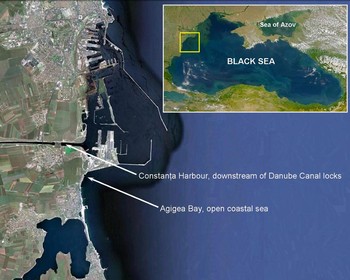
The first specimens of Dyspanopeus sayi were collected during September 2009 by diving at two sites (Figure 1). The first site is inside Constanţa Harbour, below the sluice gates of the Danube–Black Sea Canal. It is an estuarine environment with highly variable salinity (0–14 psu), strong currents and diverse habitats (complex concrete underwater constructions, boulders and rocks, tubeworm reefs, mussel beds, reedbeds and muddy bottoms) under strong anthropogenic impact. The second site is in Agigea Bay, in clean open coastal waters with stable salinity (16–17 psu), the main habitats being natural rocky reefs covered by mussel beds, sandy bottoms and hard clay banks.
The Romanian Black Sea (yellow rectangle) with the study area (large map) and the sampling sites (white arrows). Satellite image from Google Maps.

Samples were fixed in 10% buffered seawater–formalin for 24 hours and then transferred to 70% ethanol for storage. The collected material was identified as Dyspanopeus sayi in accordance with several identification keys (Hayward & Ryland, Reference Hayward and Ryland1995; Martin & Abele Reference Martin and Abele1986; Galil et al., Reference Galil, Froglia and Noël2002).
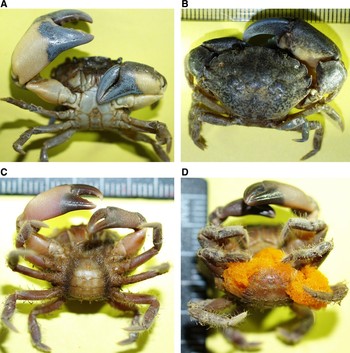
Six specimens of Dyspanopeus sayi (Figure 2) (2 females of which 1 ovigerous and 4 males of which 1 soft crab) have been deposited at the National Museum of Natural History ‘Naturalis’, Leiden, The Netherlands, under accession number RMNH D 53140.
Dyspanopeus sayi specimens from the Black Sea: (a–b) male; (c) female; (d) ovigerous female (divisions on the scale bar are millimetres). Photograph: D. Micu.

In situ observations were performed at both sites during September–October 2009 in a total of 22 SCUBA dives (17 daytime and 5 night dives) covering an estimated area of 9·104 m2 at depths of 3–7 m. In dark, overhead environments, this nocturnal species remains active in daytime so its behaviour can also be observed during the day. Densities were estimated by thoroughly searching within 1 m2 quadrat frames placed on the substrate.
Laboratory observations and experiments on the trophic and competitive relationships of D. sayi with Black Sea species were conducted in aquaria at NIMRD ‘Grigore Antipa’, Constaţa, Romania. The experiments are ongoing and the subject of other (in preparation) papers and will not be presented in detail here; only relevant observations will be presented.
RESULTS AND DISCUSSION
Invasion pathway and invasiveness
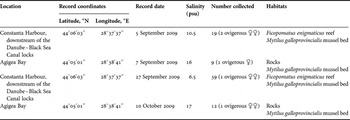
Seventy-nine specimens of Dyspanopeus sayi have been collected in total from two locations on the Romanian Black Sea coast, Constanţa Harbour and Agigea Bay in September–October 2009 (for details see georeferenced data in Table 1). Dyspanopeus sayi has a planktonic larval development which can last 27 days at 14°C and 14 days at 21°C (Chamberlain, Reference Chamberlain1957), enabling its transport by ships over both short and long distances, in bilge water of smaller boats (Darbyson et al., Reference Darbyson, Locke, Hanson and Willison2009) and ballast water of large ships (Naylor, Reference Naylor1960; Galil et al., Reference Galil, Froglia and Noël2002), respectively. The species already has a record of transoceanic introductions by ship ballast water in Britain and the Adriatic Sea and, since the first Black Sea occurrence of D. sayi was inside Constanţa Harbour, it is very likely that its introduction in the Black Sea was via the same pathway. Direct introduction from North America or Britain is less probable due to the infrequency of directly connecting ship voyages, but it is not impossible. There is intense ship traffic between Constanţa and Ravenna in the northern Adriatic, where D. sayi is known to occur (Fabbri & Landi, Reference Fabbri and Landi1999), therefore, Ravenna seems the most likely secondary source for the introduction of D. sayi in the Black Sea.
First records of Dyspanopeus sayi in the Black Sea.

In 2002 a detailed survey of the macrozoobenthic communities inhabiting tubeworm reefs and mussel beds in Constanta Harbour (Micu & Micu, Reference Micu, Micu, Öztürk, Mokievsky and Topaloğlu2004) did not record the presence of D. sayi. However, some of the recently collected D. sayi specimens are very close to the asymptotic size of the species, that is 30 mm carapace width (CW) measured between fifth anterolateral spines, and from Strieb et al. (Reference Strieb, Bricelj and Bauer1995) the present study can assume that at least one complete life cycle of 3 years has elapsed since the introduction of the species. This puts the probable date of introduction in the Black Sea somewhere between 2002 and 2006.
The invasion record of D. sayi (Britain and Adriatic Sea) shows capability to establish and endure in its areas of introduction, but invasiveness seems to vary in time. In the northern Adriatic, after an initial bout of high invasiveness, when it became the most widespread and abundant crab in the Venice Lagoon, largely exceeding the once ubiquitous and numerous natives Carcinus aestuarii Nardo, 1847 and Pilumnus hirtellus (Linnaeus, 1761) (Mizzan, Reference Mizzan1995), it has subsequently declined and it is strongly reduced in many areas, disappearing from places where it was previously abundant (Mizzan et al., Reference Mizzan, Trabucco and Tagliapietra2005).
Dyspanopeus sayi does not migrate seasonally between the coast and deeper waters in the native range. The movements of the adults are local, restricted to a few metres between the hideout and the feeding ground, therefore the spread of the species relies mainly on larval transport by currents (Strieb et al., Reference Strieb, Bricelj and Bauer1995) or by man. The observed rate of dispersal in Britain and the Adriatic Sea (Naylor, Reference Naylor1960; ICES, 2005; Mizzan et al., Reference Mizzan, Trabucco and Tagliapietra2005; Vaz et al., Reference Vaz, ter Hofstede, Martin, Dewarumez, Verin, Le Roy, Heessen and Daan2007; Florio et al., Reference Florio, Breber, Scirocco, Specchiulli, Cilenti and Lumare2008) is indeed rather low compared to other alien species, hence natural dispersal in the Black Sea is also likely to be slow if multiple secondary reintroductions by man do not occur.
Habitat choice and use
In the native range D. sayi is recognized as a cryptic species which prefers tridimensionally complex habitats that offer some degree of protection from predators, with biogenic habitats being at the top its preferences. Serpulid polychaete reefs of Filograna implexa Berkeley, 1835 offer D. sayi effective protection from the predator Callinectes sapidus Rathbun, 1896 and from fish predators. Interference and competition for food and shelter regulates D. sayi abundance in the tubeworm reefs (Heck & Hambrook, Reference Heck and Hambrook1991).
Other preferred habitats are oyster reefs, mussel beds, the bodies of red-beard sponge Clathria prolifera (Ellis & Solander, 1786), seagrass meadows, rocks and coarse gravel (McDermott & Flower, Reference McDermott and Flower1952; Strieb et al., Reference Strieb, Bricelj and Bauer1995; Mizzan, Reference Mizzan1999). Structural complexity is the primary factor influencing D. sayi preferential recruitment on biogenic habitats; later adults also respond positively to the prey value of the engineering species (Lindsey et al., Reference Lindsey, Altieri and Witman2006).
Habitat use by Dyspanopeus sayi in the Black Sea, as observed by us, is very much in agreement with the literature data presented above. Furthermore, at the estuarine site we observed differential habitat use during the diel cycle: during the night D. sayi feeds actively in Mytilus galloprovincialis Lamarck, 1819 mussel beds, during the day it hides in the calcareous reefs built by the serpulid tubeworm Ficopomatus enigmaticus (Fauvel, 1923). Only sub-adult males and some females remain in the interstices of the mussel beds during the day. The best hiding places in F. enigmaticus reefs or rock crevices are occupied by the largest males. Obviously there is competition for these places between males, with agonistic behaviour being observed by us in situ several times, while females are tolerated anywhere by the territorial male. Dyspanopeus sayi uses its strong chelae to actively modify the structure of the F. enigmaticus reef, enlarging or digging galleries for shelter and for mining barnacles Balanus improvisus Darwin, 1854, on which it feeds, out of the sponge-like structure of the reef.
Observed densities of large mud crabs ranged between 1 and 5 crabs m−2 in the tubeworm reef habitat, while density of juveniles in the mussel bed habitat was higher but could not be properly assessed due to the excessive crypticity of this agile species. Dyspanopeus sayi is an extremely cryptic species, for which visual diver surveys have proven ineffective for density estimation even during daytime (Strieb et al., Reference Strieb, Bricelj and Bauer1995). Also, it is active only during the night, spending the day in hiding (Mistri, Reference Mistri2004). For these reasons we expect that the distribution of the species along the Romanian Black Sea coast may be much wider than recorded by us and the densities presented here are probably underestimates.
Reproduction and size
In its native range D. sayi has a 3 years life span, with age-classes 0+, 1+ and 2+. Maximum size is 30 mm CW, with males being significantly larger, with larger chelae (Williams, Reference Williams1984). Males captured by us from the Black Sea population had sizes and masses ranging between 15.39–28.81 mm CW and 1.10–7.32 g respectively, while females where smaller: 12–19.37 mm CW and 0.8–2.03 g.
We collected 5 ovigerous females (CW 15.5–21.7 mm) in September and observed others in situ until the end of October. Reproduction takes place from June to October in the native range (Dittel & Epifanio, Reference Dittel and Epifanio1982), while in the northern Adriatic ovigerous females have been observed in September (Mizzan, Reference Mizzan1999).
Potential ecological impact
Dyspanopeus sayi is a predominantly carnivorous durophagous crab, its main prey items being bivalve molluscs and barnacles, followed by gastropods, smaller crabs and even recruits of the American lobster Homarus americanus H. Milne-Edwards, 1837 (Barshaw & Lavalli, Reference Barshaw and Lavalli1988). All its predatory activities take place at dusk or in darkness; when the crabs are exposed to daylight there is no predation (Mistri, Reference Mistri2004).
Using its powerful master chela, D. sayi can totally crush bivalves up to 8 mm diameter (Landers, Reference Landers1954; Whetstone & Eversole Reference Whetstone and Eversole1978) and attacks larger bivalves by patiently chipping away at the shell margin with the large crusher chela (Flimlin & Beal, Reference Flimlin and Beal1993). Although it is able to open bivalves as large as itself, D. sayi is more effective in predating small–medium sized prey of around 20–25 mm shell length (Mistri, Reference Mistri2004).
Following its introduction in the Adriatic Sea, during the initial phase of high invasiveness D. sayi has locally exterminated prey species like Balanus improvisus, Mytilus galloprovincialis, Mytilaster lineatus (Gmelin, 1791), Ostrea edulis Linnaeus, 1758, Crassostrea gigas (Thunberg, 1793) and Littorina saxatilis (Olivi 1792) (Mizzan, Reference Mizzan1998). Predation on juveniles of the trochid snail Osilinus articulatus (Lamarck, 1822) and the non-native Asian date mussel Musculista senhousia (Benson in Cantor, 1842) has been recorded (Mizzan, Reference Mizzan1998; Mistri, Reference Mistri2004).
Musculista senhousia also occurs in Constanta Harbour (Micu, Reference Micu, Öztürk, Mokievsky and Topaloğlu2004), but only casually, as isolated individuals. The bivalves on which we have observed D. sayi feeding in the Black Sea are the mussels Mytilus galloprovincialis and Mytilaster lineatus. Both species of mussels are highly abundant at both sites where we have collected D. sayi in the Black Sea, and no deleterious effects of its predatory activity were observable, although the crab has been present for at least 3 years.
Cannibalism has been observed by us in the laboratory, where 3 conspecific D. sayi males were attacked and consumed during ecdysis, although there was other food available.
It is too early to fully understand the impact of D. sayi in the Black Sea. The fact remains that an additional benthic decapod predator is present in estuarine waters, where previously only Astacus leptodactylus Eschscholtz, 1823 and Rhithropanopeus harrisii (Gould, 1841) were recorded. The chela of Dyspanopeus is much stronger than in R. harrisii, and so it can access larger or more difficult prey. Also, D. sayi is a new predator of barnacles, which previously were predated only by Rapana venosa (Valenciennes, 1846) juveniles.
Predators of Dyspanopeus sayi and interactions with native decapods
In its native range the first zoea of D. sayi is predated by the anomuran filter feeder Pagurus longicarpus Say, 1817 (Whitman et al., Reference Whitman, McDermott and Oehrlein2001)—in the Black Sea a similar larval predation on D. sayi zoeae can be enacted by the filter-feeding porcellanid craboid Pisidia longicornis (Linnaeus, 1767), which is widespread and abundant.
In the native range D. sayi adults are predated by three species of large, commercially important crabs: Callinectes sapidus, Ovalipes ocellatus (Herbst, 1799) and Cancer irroratus (Say, 1817), and by the toadfish Opsanus tau (Linnaeus, 1766). Dyspanopeus sayi is an important food item, contributing 80% of the food intake of these predators during the warm season (Stehlik et al., Reference Stehlik, Pikanowski and McMillan2004).
In the Black Sea Callinectes sapidus occurs as a vagrant and only as isolated specimens, so it cannot be counted as a predator of D. sayi. At the estuarine site we have observed predation by Dyspanopeus sayi on recruits of the sympatric Rhithropanopeus harrisii and Astacus leptodactylus, and it is likely that predation on recruits is mutual with these species. Our experiments and observations have shown that fish predators of D. sayi are the same as for the naturalized and sympatric R. harrisii, with gobiids consuming the small recruits and Sander lucioperca (Linnaeus, 1758) predating on the adults.
In our laboratory experiments D. sayi adults were readily predated upon by the large crab Eriphia verrucosa (Forskål, 1775) which is the most voracious predator of small crabs from the Black Sea. Being active during the night does not help D. sayi in avoiding predation by E. verrucosa, which is also active mainly during the night (D. Micu, underwater observations).
In estuarine waters D. sayi competes for shelter and food with R. harrisii and Astacus leptodactylus. The nocturnal habits of D. sayi might help resource partitioning with R. harrisii, which is active during daylight. The observed ratio between the two species was of at least 10 R. harrisii for every D. sayi individual. However, it might be biased due to the fact that, while D. sayi is excessively cryptic, R. harrisii is conspicuous and not at all concerned about hiding. Agonistic behaviour between the two species was not observed during our dives, but the best placed burrows in rocks or in tubeworm reefs were always occupied by large D. sayi males. In the coastal sea D. sayi competes for food and shelter with the native small crabs Pilumnus hirtellus and Xantho poressa (Olivi, 1792) due to very high niche overlap.
ACKNOWLEDGEMENTS
We thank Dr Tania Zaharia for her understanding and logistic support during this study. We wish to express our sincere gratitude to Dr Wim J. Wolff and an anonymous referee for helpful suggestions on the manuscript.