Introduction
Adenoidectomy remains one of the most commonly performed ENT surgical procedures. It is typically carried out in children for conditions such as nasal obstruction, otitis media with effusion, and obstructive sleep apnoea. Traditionally, it involves surgical excision performed as a blind procedure with a St Clair Thomson curette, in which haemostasis is achieved by packing the post-nasal space.
An acceptable alternative is suction diathermy adenoidectomy, which was first described by Wright et al. in 1997. It is performed either under indirect vision using a mirror or under direct vision using an angled endoscope.Reference Wright, Manoukian and Shapiro1 The National Institute for Health and Clinical Excellence (NICE) guidelines support the use of this technique when it is performed by specifically trained surgeons.2
A UK survey of the preferred adenoidectomy techniques among UK ENT consultants found that 8.1 per cent of respondents used suction diathermy adenoidectomy (although, notably, the survey only had a 66.6 per cent response rate).Reference Dhanasekar, Liapi and Turner3 Another indication of technique usage comes from the National Prospective Tonsillectomy Audit (which involved 33 921 patients): of the 9900 patients who also had adenoidectomy performed, the suction diathermy technique was used in 1489 patients (21.6 per cent).Reference Lowe, van der Meulen, Cromwell, Lewsey, Copley and Browne4
Clearly, suction diathermy adenoidectomy remains a technique performed in the minority. To our knowledge, in the West Yorkshire region only one surgeon (the senior author) uses this method. This audit was carried out to ensure that the complication rate of this technique was within published rates and in line with NICE guidelines.2
Materials and methods
This audit was registered with the Mid Yorkshire NHS Trust research and development department; the department agreed that ethical approval was not required.
A search of the operating theatre list database was conducted for relevant operations performed between January 2006 and October 2010. The search terms used were: ‘adenoidectomy’, ‘adenotonsillectomy’, ‘EUA postnasal space’ (i.e. examination under anaesthetic of the post-nasal space) and ‘tonsillectomy’. A case note review was subsequently carried out to identify patients who had undergone suction diathermy adenoidectomy alone or as an adjunct to another procedure. Details of patient demographics, indications for surgery, and any perioperative complications were recorded.
Results
A total of 140 patients who had undergone suction diathermy adenoidectomy were identified by the search. Either electronic or hard-copy notes were available for 121 of these patients.
Patient age at the time of operation ranged from 2 to 15 years (mean of 6 years). Primary adenoidectomy was performed in 117 cases (97 per cent), whilst 4 were revision cases (adenoidectomy was previously performed using the curettage technique). The procedure was carried out by a consultant in 120 cases and once by a supervised trainee.
In 120 cases, suction diathermy adenoidectomy was performed under indirect vision using a mirror. In one case, it was carried out in conjunction with endoscopic sinus surgery, and was therefore performed endoscopically.
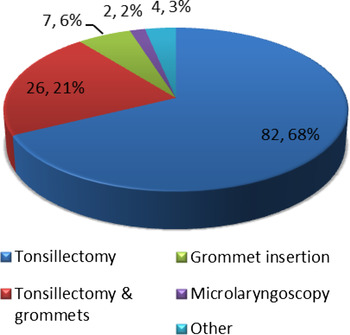
A breakdown of the indications for surgery is shown in Figure 1. Adenoidectomy was performed in isolation in only 2 patients; 82 patients also had a tonsillectomy, 26 underwent tonsillectomy and grommet insertion, 7 had grommets inserted, and 2 underwent microlaryngoscopy (see Figure 2).
Indications for surgery. AOM = acute otitis media; OSA = obstructive sleep apnoea; OME = otitis media with effusion

Distribution of adjunctive procedures.

Post-operative haemorrhage from the nasopharynx was recorded in two patients (1.6 per cent); one required a return to the operating theatre and one was managed conservatively. These events occurred at days 10 and 11 post-operatively. A further two patients were diagnosed with infection post-operatively and managed with oral antibiotics. Four patients re-presented with pain; in all cases, this was reported as sore throat and odynophagia secondary to tonsillar fossa infection, rather than pain related to adenoidectomy.
Discussion
Clearly the most concerning complication of adenoidectomy is post-operative haemorrhage, whether early or late. In this series, two patients experienced late haemorrhage, with no cases of early haemorrhage occurring.
A meta-analysis of 1812 patients who underwent suction diathermy adenoidectomy reported a 95 per cent success rate.Reference Reed, Sridhara and Brietzke5 Success was defined differently in each of the six studies included, using subjective scales of improvement (e.g. parental satisfaction or symptom resolution). This same meta-analysis reported an overall complication rate of 1.9 per cent, although it did not specify post-operative haemorrhage rates. With respect to intra-operative blood loss, suction diathermy adenoidectomy was associated with significantly lower estimated blood loss than curettage adenoidectomy (4.1 ml vs 24.0 ml).Reference Reed, Sridhara and Brietzke5
The clinical studies included in the meta-analysis (which ranged from retrospective case series to a prospective, randomised single-blinded trial) reported post-operative haemorrhage rates of 0–4.3 per cent.Reference Wright, Manoukian and Shapiro1, Reference Clemens, McMurray and Willging6–Reference Wynn and Rosenfeld12 In a separate report of the National Prospective Tonsillectomy Audit data by Lowe et al. the early and late haemorrhage risk rate for suction diathermy adenoidectomy was found to be 0.07 per cent.Reference Lowe, Brown and Yung13 These findings indicate that the post-operative haemorrhage rate of 1.6 per cent found in the current study is well within reported outcomes. It is interesting that suction diathermy adenoidectomy compares favourably with curettage adenoidectomy in the literature, in contrast to the comparisons between diathermy tonsillectomy and cold steel techniques.Reference Lowe, van der Meulen, Cromwell, Lewsey, Copley and Browne4
Other complications reported in the literature include pharyngeal infection, dehydration, pain, velopharyngeal insufficiency and Grisel's syndrome.Reference Reed, Sridhara and Brietzke5, Reference Henry, Gal and Mair14 In this series, there were two cases of nasopharyngeal infection (1.6 per cent), which were managed with oral co-amoxiclav. This is in keeping with the reported infection rate of approximately 2.1 per cent.Reference Wright, Manoukian and Shapiro1 There were no cases of velopharyngeal insufficiency or Grisel's syndrome, which are considered to be much less common complications.Reference Reed, Sridhara and Brietzke5 A case of cervical osteomyelitis has also been reported in the literature.Reference Baker, Bower and Glasier15
The pain associated with adenoidectomy, even when it is performed alone, is well recognised. In a study by Henry et al., 12 per cent of patients who underwent adenoidectomy by a variety of techniques complained of neck stiffness and/or pain. However, the current study found no association between neck pain and adenoidectomy technique, cautery time, or cautery setting.Reference Henry, Gal and Mair14 In our study, four patients (3.3 per cent) re-presented with pain. All four patients also had tonsillectomy performed at the time of surgery and were diagnosed with oropharyngeal infection post-tonsillectomy. It is conceivable that this pain may also have been adenoidectomy-related neck pain and we accept that this is a limitation of our retrospective approach.
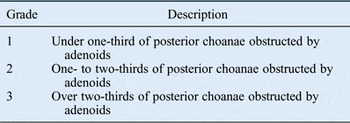
Adenoidal recurrence rates have been reported to be significantly lower with suction diathermy compared to curettage techniques. A randomised, controlled trial of 100 patients found residual or recurrent adenoidal tissue to be significantly reduced with suction diathermy adenoidectomy, as measured using the Wormald and Prescott grading system (see Table I).Reference Jonas, Sayed and Prescott8, Reference Wormald and Prescott16 At the time of writing, none of the patients included in the current study (who all underwent suction diathermy adenoidectomy) had re-presented with adenoidal recurrence, although this was not a primary outcome measure in our series. The operations were performed between January 2006 and October 2010. This audit was completed in October 2012, giving a minimum period of two years for patients to be re-referred with symptoms. Nevertheless, it is possible that patients have presented elsewhere or indeed have asymptomatic adenoidal recurrence.
Wormald and prescott grading systemFootnote *

* For classification of adenoidal tissue size.Reference Wormald and Prescott16
• Adenoidectomy is a commonly performed ENT surgical procedure
• National guidelines support the use of suction diathermy adenoidectomy carried out by trained surgeons
• This technique is not often used, but evidence indicates it is a safe alternative to cold steel methods
• Audits can be used to demonstrate the appropriateness of little-used surgical techniques
Interestingly, a review of malpractice cases concerning tonsillectomy and adenoidectomy in the US found that bleeding complications account for 17.5 per cent of claims, whilst accidental burn injuries represented 18.2 per cent of claims (however, it is not possible to differentiate tonsillectomy-related burns from adenoidectomy-related burns in this article).Reference Simonsen, Duncavage and Becker17 Recurrent or residual adenoidal or tonsil tissue represented 5.8 per cent of claims. Miscellaneous complaints, which included uvular injuries, velopharyngeal insufficiency, cervical spine osteomyelitis at the level of C2 and aspiration of adenoidal tissue, accounted for 45.5 per cent of claims. The findings of this review demonstrate the need for circumspection in the consent process. They also indicate that a significant proportion of malpractice claims do not stem from the most commonly discussed complication of haemorrhage.Reference Simonsen, Duncavage and Becker17
Conclusion
Suction diathermy adenoidectomy is a highly acceptable alternative to the curettage technique. Given the rare but serious potential complications, we wholeheartedly support the NICE guidance, which recommends that this technique is only performed by surgeons with specific training. This study demonstrates that by using the standard procedures for clinical governance, it is possible to ensure safe practice, even if there is only one user of a technique within a region.