Introduction
Discharge from psychiatric inpatient care bears an increased suicide risk. A recent US study reported a suicide rate of 178/100 000 people in the first three months after discharge, 15 times the national suicide rate (Olfson et al. Reference Olfson, Wall, Wang, Crystal, Liu, Gerhard and Blanco2016). The National Confidential Inquiry into Suicide and Homicide by People with Mental Illness (Appleby et al. Reference Appleby, Kapur, Shaw, Windfuhr, Hunt, Flynn and Tham2016) found that 33% (n = 707) of patient suicide deaths in England from 2004 to 2014 due to self-poisoning involved either tricyclic antidepressants or antipsychotic medications. An analysis of serious adverse drug events (ADEs) in the US by the FDA from 1998 to 2005 showed that of the top fifteen drugs most frequently identified in fatal events, four were antidepressant or antipsychotic drugs (Fernandes & Flak, Reference Fernandes and Flak2012), while a review by Thomsen et al. (Reference Thomsen, Winterstein, Sondergaard, Haugbolle and Melander2007) found that almost half of ADEs involving psychiatric patients were associated with psychiatric medications with 26.7% of the events classified as “preventable”. This raises the question of whether suicide death by overdose of psychotropic medication is something which is potentially modifiable through prescription practices on discharge from inpatient psychiatric care.
Fernandes and Flak (Reference Fernandes and Flak2012) note that specific recommendations to improve the quality of prescribing practice at this crucial time point (as patients enter that high risk, post-discharge phase) are lacking. In line with this, no national/international guidelines specific to the duration and volume/quantity of medication that should be prescribed on discharge from psychiatric inpatient care (to patients with or without indices of suicidal risk/behaviour) could be found by the researcher. With this in mind, the present study aimed to measure the duration and quantity of medication being prescribed to patients on discharge from inpatient psychiatric care, as an intervention point for iatrogenic provision of access to lethal means.
Methods
This research took place in an urban acute psychiatric inpatient care centre attached to a general hospital and serving a population of 300,000. A random retrospective sample of 50 hospital discharges was selected (based on an estimated data collection time of one day per case) using Microsoft Excel from a list of all discharges between January and June 2016. Patients’ discharge summaries and medical charts were requested, to collect patient demographic and prescription data. Psychotropic medications prescribed were converted to their “equivalent doses” using the Maudsley Guidelines (Taylor et al. Reference Taylor, Paton and Kapur2015) and Woods (Reference Woods2003). This standardized method is usually used to compare different antipsychotics when changing one antipsychotic medication to another (Andreasen et al. Reference Andreasen, Pressler, Nopoulos, Miller and Ho2010). Antipsychotic medications were converted to their chlorpromazine or “CPZ” equivalents. Antidepressant medications were converted to a fluoxetine equivalent (Hayasaka et al. Reference Hayasaka, Purgato, Magni, Ogawa, Takeshima, Cipriani and Furukawa2015) and benzodiazepine medications were converted to a diazepam equivalent (Ashton, Reference Ashton2002). When converted, the respective equivalences were then multiplied by the number of days prescribed to calculate the quantity of each medication class prescribed to each patient. Mood stabilizers, depot medications, methadone and general medications were also recorded separately per day and multiplied by duration (days) of the prescription. The toxicity and potential lethality of each prescription was then rated using the potentially lethal ranges of psychotropic medication as outlined in the Maudsley Guidelines (Taylor et al. Reference Taylor, Paton and Kapur2015) and other research sources (Capel et al. Reference Capel, Colbridge and Henry2000; Procyshyn et al. Reference Procyshyn, Bezchlibnyk-Butler and Jeffries2017). The Maudsley Guidelines (Taylor et al. Reference Taylor, Paton and Kapur2015) suggest that CPZ drugs have high toxicity and are potentially fatal in terms of overdose, with 2–5 g being the smallest dose likely to cause death. Fluoxetine is described as low toxicity in overdose. It is unclear what the smallest dose likely to cause death is but the Guidelines suggest it is probably above 1–2 g. Fatality is unlikely if fluoxetine (or equivalent) is taken alone but may be lethal in combination with other medications/ alcohol, similar to diazepam and its equivalents.
Results
Of the original sample of 50, three cases were excluded as they had not been discharged with a prescription but transferred to another hospital. Another seven were excluded as their charts were unavailable. From the remaining 40 charts, no prescription data was documented in the charts of a further 12 cases. This left a final sample of 28. Prescription data was collected from charts while demographic and clinical data was collected from the discharge summary. The age range of the sample was 19–77, with a mean age of 47. The mean length of hospital stay was 32 days and there was a range of axis-1 diagnoses (ICD 10) as follows: psychosis (29%), depression (32%), adjustment disorder (3.5%), bipolar disorder (11%), alcohol/ drug-induced psychosis (14%), eating disorder (3.5%) and post-traumatic stress disorder (3.5%). 3.5% had no axis-1 diagnosis.
Prescription length varied from 0 to 28 days with a mean length of 22.2 days. 71% of cases were prescribed some type of antipsychotic medication and 43% were prescribed some type of anti-depressant medication. 25% were prescribed some type of benzodiazepine medication and 19% were prescribed a type of mood stabilizer medication such as lithium, lamotrigine, oxcarbazepine or sodium valproate. A single case was prescribed methadone. 43% of all cases were also prescribed general medications. 75% of these were prescribed more than one general medication most commonly cardiac, hypertension, gastrointestinal and respiratory medications. Four cases had been deemed not to require a prescription on discharge as their admissions and treatment were in the context of either alcohol misuse or psychosocial stressors.
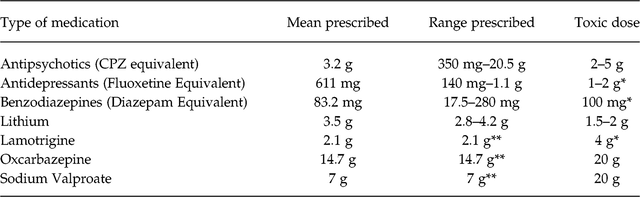
Of the 24 cases that had psychotropic medication prescriptions, eight cases were prescribed a high toxicity and potentially fatal dose of CPZ equivalent, and three cases (based on 1 g being toxic) a toxic and potentially fatal dose of Fluoxetine equivalent. This is based on the assumption of these medications being taken alone and does not take into account the potential toxicity and lethality of the combination/interactions of various medications, with 17/28 or 61% of all cases being prescribed more than one type/class of medication. The mean and range of each medication type prescribed to the sample are compared with the toxic doses in Table 1 below.
Mean and range of medications prescribed

*Fatality less likely if taken alone. **Only one case prescribed these medications.
Suicidal ideation or a passive death wish was explicitly mentioned in the discharge summaries of 14 of 28 cases as a presenting factor on admission. No significant differences were found between the mean amount of CPZ and fluoxetine equivalent medications prescribed to those with and without indices of suicidality in the sample (p > .001).
Discussion
To the best of the researchers’ knowledge, the findings in this study are new, and have not previously been reported elsewhere. This study found that in at least 39% of cases (11/28), psychotropic medication prescribed on discharge (dose × duration) was toxic and potentially fatal if taken in overdose and this initiated a baseline audit of prescribing practices on discharge from psychiatric care. Olfson et al. (Reference Olfson, Marcus and Bridge2014) suggest that suicide intervention efforts should be concentrated on periods of high risk. However, there remains a paucity of such targeted interventions in acute psychiatry. Discharge from inpatient psychiatric care may represent a golden opportunity for such an intervention, through modifying availability/access to psychotropic medication as a possible lethal means for suicide deaths by overdose of prescribed medication.
Rehabilitation and recovery in the community begins the day of discharge from hospital. The current best practice guideline from Ireland’s Mental Health Commission (2009) is that it is considered “good practice that individuals with severe mental illness and a history of deliberate self-harm within the previous 3 months or who are assessed as being at risk of suicide should have a follow up appointment within one week of discharge”. However, this guideline has resource implications for early outpatient/community care post-discharge and may have impacted on the variation of prescribing identified in this study. It is possible that other mental health services follow up patients within a week following discharge from hospital. Nonetheless, the known increased suicide risk during the early post-discharge period combined with the potential for intervention identified in this research is new knowledge that can be applied. Given the success of a seven-day post-discharge follow-up service in the UK (While et al. Reference While, Bickley, Roscoe, Windfuhr, Rahman, Shaw and Kapur2012) which was associated with a significant reduction in suicide rates from 24.8 to 19.5 per 100,000 annually during the initial three-month post-discharge time period, consideration should be given to additional, dedicated post-discharge multidisciplinary rehabilitation teams in Ireland or at least to more regular reviews by mental health teams on their post-discharge follow-up practices. Perhaps the advent of integrated Primary Care Centres may also be resourced and equipped to facilitate the timely provision of post-discharge prescriptions.
While psychotropic medications can act as a toxic and potential source of lethal means in overdose (which has been the focus of this study), this is secondary to the significant role they play in suicide prevention by treating mental illness. For example, there is an extensive literature to suggest that reductions in suicidal behaviours have been observed with lithium in mood disorders and clozapine in schizophrenia (Ernst & Goldberg, Reference Ernst and Goldberg2004). Indeed, in the present study, only two cases from the hospital sample were prescribed lithium and one case clozapine, which may indicate that these psychotropic medications are effective in keeping patients well in the community, in line with other studies (Abou-Saleh et al. Reference Abou-Saleh, Müller-Oerlinghausen and Coppen2017).
Psychotropic medications have varying therapeutic indexes, ranging from low (only requiring a small increase in dose to cause toxic and potentially lethal effects) to high. Many of the older psychotropic medications had a low therapeutic index and there was clinical awareness of this, which informed prescribing patterns previously (Lawrenson et al. Reference Lawrenson, Tyrer, Newson and Farmer2000). The advent of newer and “safer” psychotropic medication may have led to less awareness about their potential fatality in overdose, with the exception of lithium and its low therapeutic index and thus there may be a role for education identified in this regard.
Furthermore, one cannot ignore the significant medical co-morbidity with mental illness and associated prescribing highlighted in this hospital study. The methods undertaken focused on comparing quantities of psychotropic medications prescribed and were limited in terms of evaluating more specific toxicity and potential lethality regarding interactions between different types of medication. Additionally, there are limitations associated with converting antipsychotic doses to chlorpromazine equivalents as some newer, atypical antipsychotic drugs are less toxic in overdose (Minns & Clark, Reference Minns and Clark2012). Similarly, there are limitations associated with the conversion of antidepressant medications to an SSRI equivalent. For example, Venlafaxine presents a far higher mortality risk in overdose than other SSRIS (Buckley & McManus, Reference Buckley and McManus2002; Hawton et al. Reference Hawton, Bergen, Simkin, Cooper, Waters, Gunnell and Kapur2010). However, as the main aim of this study was to examine the potential iatrogenic risk that may be present due to the variation in the amount of psychotropic drugs prescribed on discharge, the psychotropic equivalence methods undertaken permitted an overview of toxic and potentially fatal doses. Future studies would benefit from a calculation of cumulative doses for each drug prescribed to each patient and the associated toxic and lethal doses for these drugs to give a more complex understanding of lethality.
A further limitation of the study was in relation to the examination of general medications prescribed. These medications undoubtedly add further toxicity to the prescriptions patients are receiving on discharge but were not examined in this study as the focus was on psychotropic drugs only. Future research would benefit from exploring the role of psychiatry in prescribing general medication and vice versa, and whether on discharge from inpatient psychiatric care, prescriptions written by Non-Consultant Hospital Doctors (NCHDs) should be limited to including psychotropic medications only.
There were also limitations in the quality of data available, particularly in relation to history of suicidal behaviour and risk in the discharge summary, suggesting history of suicidal behaviour or ideation may have been underestimated in the sample. The lack of prescription data in some patients’ charts was also a potential limitation. However, demographic and clinical details of excluded cases were compared with those included and there were no significant differences, suggesting that the sample used is representative of the population in question.
Despite these limitations, the novel method of converting medications to their respective equivalent doses allows for national and international replication and exploration of this question. Identifying the possible iatrogenic risk present at discharge through prescription dose and duration of psychotropic medication could potentially lead to a targeted suicide intervention around availability/access, which is worthy of further research.
Financial support
This research received no specific grant from any funding agency, commercial or not-for-profit sectors.
Conflict of interest
Eimear Cleary has no conflicts of interest to disclose. Prof. Abbie Lane has no conflicts of interest to disclose. Prof. Cecily Kelleher has no conflicts of interest to disclose. Prof. Kevin Malone has no conflicts of interest to disclose.
Declarations of interest
None.
Ethical standards
The authors assert that all procedures contributing to this work comply with the ethical standards of the relevant national and institutional committee on human experimentation with the Helsinki Declaration of 1975, as revised in 2008. The authors assert that ethical approval for publication of this short report was not required by their local Ethics Committee as data was collected as part of an audit and submitted to and reviewed by the Clinical Audit Committee at St. Vincent’s University Hospital.