Introduction
Dementia is characterized by inexorable intellectual and functional deterioration. Alongside cognitive decline, the seminal work of Burns and colleagues (Reference Burns, Jacoby and Levy1990a, Reference Burns, Jacoby and Levy1990b, Reference Burns, Jacoby and Levy1990c, Reference Burns, Jacoby and Levy1990d) documented the psychiatric phenomena in Alzheimer's disease (AD), categorizing non-cognitive symptoms into disorders of thought content, perception, mood and behavior. More recently, the term neuropsychiatric symptoms (NPS) has come to the fore. NPS have been found to occur in almost all persons with dementia (PWD) (Lyketsos et al., Reference Lyketsos, Lopez, Jones, Fitzpatrick, Breitner and DeKosky2002) with close to 98% developing one or more NPS over a five-year period (Steinberg et al., Reference Steinberg2008). However, the presence of NPS has not been described as part of the defining criteria of dementia (Cerejeira et al., Reference Cerejeira, Lagarto and Mukaetova-Ladinska2012).
NPS can affect an individual's emotional experience, thought content, perception, motor function, circadian rhythms, affect, and eating patterns. There have been attempts to categorize NPS into sub-syndromes, which comprise depression, psychosis, apathy, hyperactivity, agitation, sleep disorders, and prefrontal syndromes (Lyketsos et al., Reference Lyketsos2011). More specifically, NPS have been empirically classified into three groups: affective, psychotic, and other neuropsychiatric disturbance (Lyketsos et al., Reference Lyketsos2001); while Petrovic and colleagues (Reference Petrovic2007) have categorized NPS into four factors, namely, psychosis, psychomotor, mood liability, and instinctual. Nevertheless, mood, psychosis and behavioral disturbances have remained the stable categories.
Studies in Western populations have shown mood symptoms, such as depression and apathy, to be the most frequently observed symptoms in people with Mild Cognitive Impairment (MCI) and early AD (Lyketsos et al., Reference Lyketsos2011). Apathy remains prevalent and frequent throughout all stages of AD (Lyketsos et al., Reference Lyketsos2011). Psychotic symptoms, comprising delusions and hallucinations, in addition to motor disturbances and aggression, are more common in advanced disease (Aalten et al., Reference Aalten, De Vugt, Jaspers, Jolles and Verhey2005; Steinberg et al., Reference Steinberg2008; Lyketsos et al., Reference Lyketsos2011).
In Asian cohorts, mood symptoms are also commonly exhibited throughout the spectrum of cognitive decline (Zhang et al., Reference Zhang, Wang, Li and Yu2012). Psychotic symptoms such as delusions and hallucinations, activity disturbances and aggression tend to increase with dementia progression and are more common in moderate to severe dementia (Hamuro et al., Reference Hamuro2007; Cheng et al., Reference Cheng2009). Another interesting NPS pattern, noted by Hamuro and colleagues (Reference Hamuro2007), is that mood symptoms decrease with severity of dementia, while psychotic symptoms increase in moderate dementia, then decline in severe dementia.
The effects of NPS on PWD and their caregivers have been much explored. While NPS, particularly depression, adversely impact patient's quality of life (QoL), Shin and colleagues (Reference Shin, Carter, Masterman, Fairbanks and Cummings2005) found AD patients rated their QoL higher than their caregivers did, and a lack of influence of dementia severity on QoL. However, Tatsumi and colleagues (Reference Tatsumi2009) found caregiver-reported QoL decreased as dementia progressed.
Not surprisingly, caregiver QoL is negatively correlated with severity of NPS in the patient (Musnagpaisan et al., Reference Musnagpaisan2010; Huang et al., Reference Huang2012). The amount of informal care increases steadily as PWD exhibit more NPS (Okura and Langa, Reference Okura and Langa2011). NPS that increase caregiver distress include agitation, irritability and delusions (Fu et al., Reference Fu2001; Huang et al., Reference Huang2012). Family caregivers are also more distressed by NPS compared to professional caregivers (Cheng et al., Reference Cheng2009) and the degree of burden and distress experienced by caregivers can lead to decisions to institutionalize patients (Black and Almeida, Reference Black and Almeida2004).
Thus far, studies on NPS in PWD in Singapore have been limited. A cross-sectional study in a community sample reported 50% prevalence of NPS in PWD (Feng et al., Reference Feng, Yap, Lee and Ng2009). Another study revealed that PWD with more NPS caused more distress to the professional as well as the family caregiver in both institutional and ambulatory care settings (Tan et al., Reference Tan, Wong and Allen2005).
With the prevalence of dementia increasing in Singapore, a greater understanding of dementia is essential to cope with the expectant rise in the number of PWD with its attendant socio-economic implications. As such, it is important to elucidate more comprehensively the magnitude of NPS and their consequences to adequately inform resource allocation, service design, and clinical management. Hence, this study aims to determine the prevalence and patterns of NPS amongst PWD in Singapore, and examine their impact on PWD-QoL as well as caregiver distress.
Methods
Design and participants
This naturalistic study involved 667 patients with their caregivers who attended the ambulatory memory clinic at Khoo Teck Puat Hospital (a tertiary hospital formerly known as Alexandra Hospital) from 2007 to 2012. During their first visit, patients and caregivers were interviewed to gain understanding of their psychosocial environment. Demographic data such as age, race, marital status and education level; and family caregiver, and functional ability were recorded. A range of neuropsychological tests was used to assess the patients’ cognitive ability.
The patients were all clinically assessed by a team of geriatricians, clinical psychologists, and specialty nurses, and dementia diagnosis was established by consensus meeting using the team using the Diagnostic and Statistical Manual of Mental Disorders, 4th edition (DSM-IV) criteria; while internationally accepted criteria were utilized for determining the various dementia sub-types. The caregiver was also interviewed to evaluate the presence of NPS and determine the level of caregiver distress and PWD-QoL. The questionnaires used contained both English and Chinese versions in the same form. Although the study comprised majority Chinese subjects, the majority of caregivers were literate in English as English is the primary medium of instruction and a national language in Singapore.
The patient's demographic data and results of the assessment were collated and subsequently used for this study. Ethics approval for this study was granted by the National Health Group Domain Specific Review Board.
Instruments
Dementia severity
Global dementia severity was measured using the Clinical Dementia Rating (CDR) Scale (Morris, Reference Morris1993). CDR discriminates between the different stages of dementia and is well established for validity and reliability in many languages. CDR assesses the patient's cognition and function through six domains – memory, orientation, judgment and problem solving, community affairs, home and hobbies, and personal care. Based on the description provided, each domain is scored on a five-point scale.
Neuropsychiatric symptoms
NPS were evaluated using the Neuropsychiatic Inventory Questionnaire (NPI-Q), developed by Cummings and colleagues (Reference Cummings1994). The tool is used extensively with its inter-rater reliability and validity established in several languages (Cerejeira et al., Reference Cerejeira, Lagarto and Mukaetova-Ladinska2012), inclusive of the Chinese version (Leung et al., Reference Leung, Lam, Chiu, Cummings and Chen2001) which was used in our study. The version used in this study consists of 12 domains – delusions, hallucinations, agitation, depression, anxiety, elation, apathy, disinhibition, irritability, motor disturbance, night-time behavior, and appetite and eating. The two-part questioning format, based on primary caregiver's report allows the test to be conducted efficiently. The presence of each domain is established with a screening question. When the symptom is present, the caregiver is asked to grade the severity of each symptom based on a three-point Likert scale from one to three, indicating mild to severe, respectively.
We defined the severity of NPS based on individual symptom severity score and total NPS severity is the sum of severity scores on all NPS. We also categorized the overall severity of NPS into mild, moderate and severe. A patient with mild overall NPS has a severity score of not more than one on any NPS; while a patient with severe NPS would have at least one symptom with a rating of three.
Caregiver distress
The NPI-Q (Cummings et al., Reference Cummings1994) was also used to measure caregiver distress. When a caregiver reports the presence of a particular NPS, the distress brought about by the symptom is assessed on a six-point Likert scale, zero to five, with five denoting extreme or severe distress.
Quality of life
PWD-QoL was quantified using the Quality of Life–Alzheimer Disease (QOL-AD) scale (Logsdon et al., Reference Logsdon, Gibbons, McCurry and Teri2002), which has been validated in Singapore (Yap et al., Reference Yap2007). This tool contains 13 domains including physical condition, mood, memory, functional abilities, interpersonal relationships, ability to participate in meaningful activities, financial situation, and life as a whole. It uses a four-point Likert scale, one to four, where one is poor and four, excellent. The total scores are summed up to achieve a possible 52 points. There are separate interviews for patients and their caregivers. In our study, we only considered the caregiver's assessment of the PWD-QoL as an earlier study had shown that PWD could not reliably rate their own QoL in our population (Yap, et al., Reference Yap2007).
Statistical analysis
Statistical analyses were carried out using the Statistical Package for Social Sciences, version 19 for Windows, IBM 2010. NPS was analyzed in several ways – total NPS, individual NPS, and the two NPS clusters (disruptive and affective), which were determined using exploratory factor analysis (EFA). The EFA was performed on all the 12 NPS variables. An initial unrotated factor solution was obtained from principal component analysis, with extracted factors having Eigenvalue greater than 1. The two NPS clusters were extracted after varimax rotation and their internal consistency were determined.
Next, preliminary exploration of the relationship between NPS, caregiver distress and PWD-QoL involved Pearson's correlational analysis, satisfying the assumption of normally distributed data. Finally, multivariate analysis of the relationship between NPS, caregiver distress and PWD-QoL was performed with Analysis of Variance (ANOVA), using general linear regression modeling, controlling for age, race, sex, marital status, education, type, and severity of dementia.
Results
Patient demographics
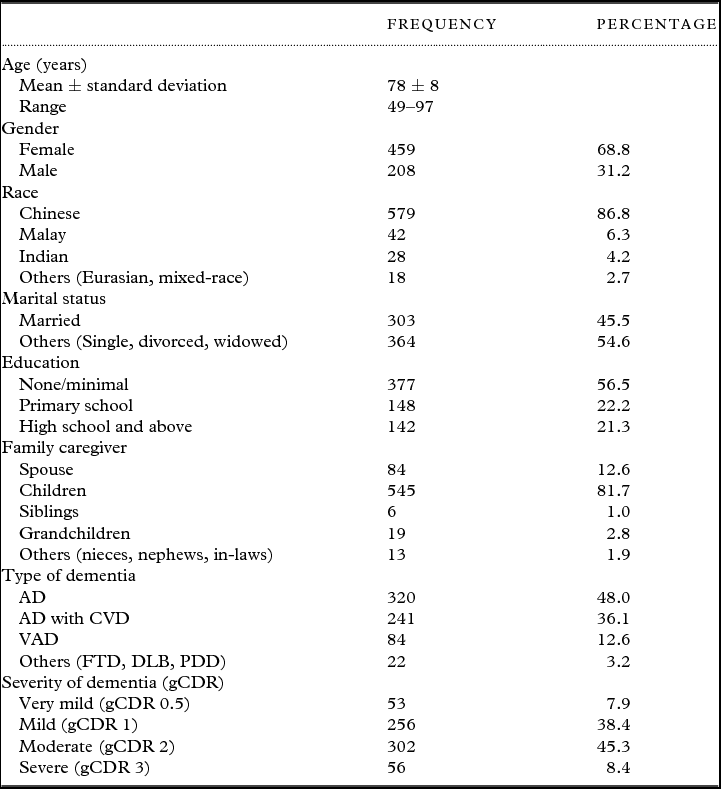
A total of 667 dyads of patients and their caregivers participated in this study. The demographics of the patients are summarized in Table 1. The mean age was 78 years and the majority were female, Chinese, with no or minimal education (i.e., less than six years of formal education). Most of the patients were either diagnosed with AD or AD with cerebrovascular disease (CVD); and were within the mild to moderate range of dementia severity. Caregivers were mainly the patients’ children, followed by spouses.
Demographic and clinical data of patients (n = 667)

AD = Alzheimer's disease; CVD = cerebrovascular disease; FTD = frontal lobe dementia; DLB = dementia with Lewy bodies; PDD = Parkinson disease dementia; gCDR = global clinical dementia rating.
Prevalence of neuropsychiatric symptoms
Ninety-six percent of patients presented with at least one NPS. Eighteen percent experienced mild, 31% moderate and 47% severe NPS. The prevalence of NPS was high across the dementia stages, ranging from 86.8% to 98.2% and the mean number of NPS concurrently experienced by PWD ranged from four to seven.
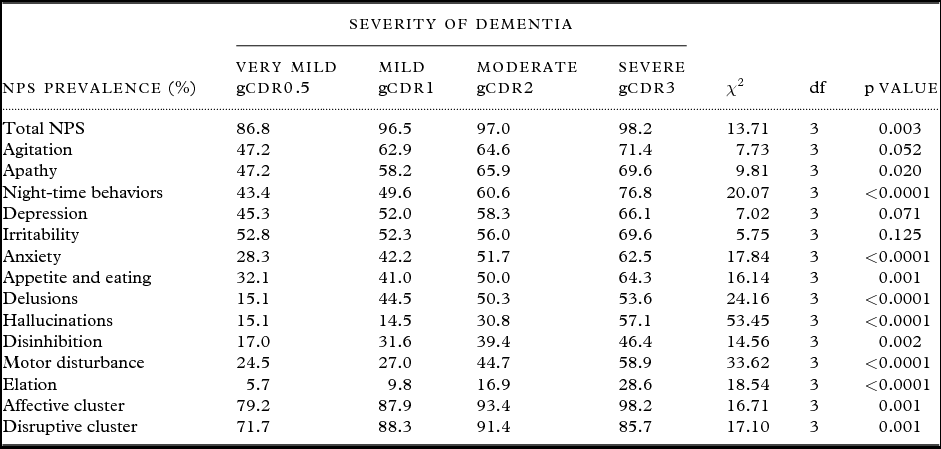
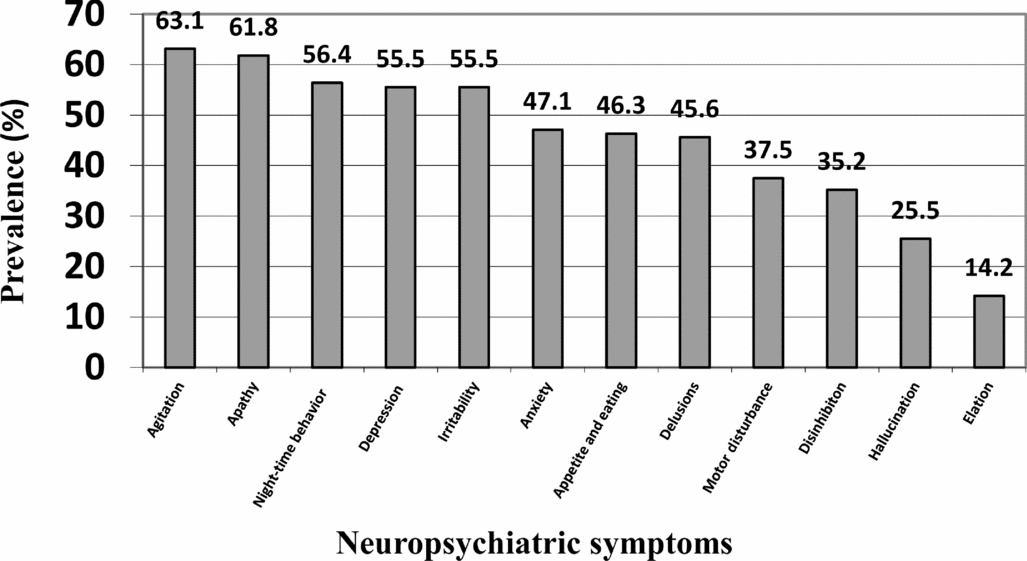
The three most common NPS were agitation (63.1%), apathy (61.8%), and night-time behaviors (56.4%), as seen in Figure 1. Two other symptoms, depression and irritability symptoms, were also highly prevalent, both at 55.5%. Disinhibition (35.2%), hallucination (25.5%) and elation of mood (14.2%) were the least common symptoms. The prevalence of each NPS increased with dementia severity (CDR global score) as shown in Table 2 but is comparatively different for each NPS. The NPS that showed significant differences across the dementia stages include apathy, night-time behaviors, anxiety, appetite and eating, delusions, hallucinations, disinhibition, motor disturbance, and elation.
Prevalence of NPS across the dementia stages
Bar chart showing the prevalence of individual neuropsychiatric symptoms.
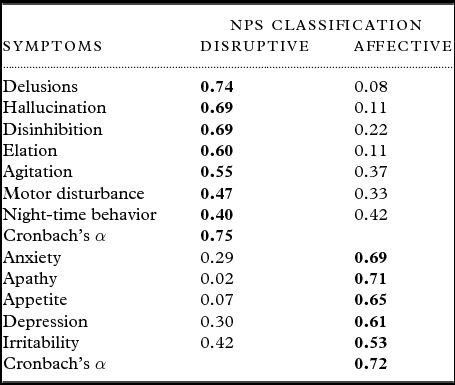
Based on EFA, all 12 NPS were classified into two clusters – Affective and Disruptive NPS, with adequate internal consistency as seen in Table 3. Both NPS clusters showed high prevalence across the stages of the disease. Nevertheless, while the affective cluster showed a significant increase (p < 0.005) in prevalence in the later stages of the disease, the disruptive cluster showed a reduction in the severe stage (p < 0.005).
Classification of NPS after factor analysis
Effects of neuropsychiatric symptoms
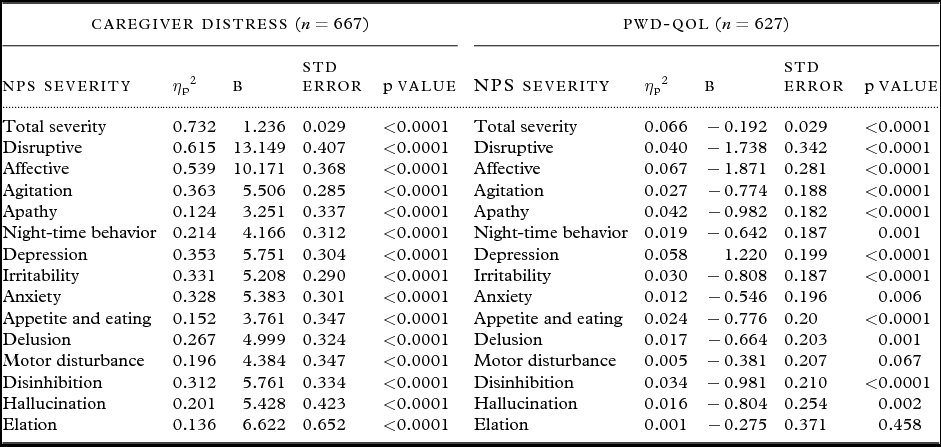
The total, individual, and cluster effects of NPS on caregivers’ distress and PWD-QoL are presented in Table 4. Total NPS severity, affective, and disruptive NPS, and most of the individual NPS significantly predicted caregivers’ distress and PWD-QoL, controlling for the type and severity of dementia, patients’ age, sex, and marital status.
Trend of severity of NPS against caregiver distress and PWD-QoL
The top three NPS that predicted the most caregiver distress were agitation (ηp2 = 0.363, p < 0.0001), depression (ηp2 = 0.353, p < 0.0001), and irritability (ηp2 = 0.331, p < 0.0001). This was followed closely by anxiety (ηp2 = 0.328, p < 0.0001) and disinhibition (ηp2 = 0.312, p < 0.0001). While apathy was the second most common NPS, it caused the least caregiver distress (ηp2 = 0.124, p < 0.0001). As regards the impact on PWD-QoL, depression (ηp2 = 0.058, p < 0.0001) and apathy (ηp2 = 0.042, p < 0.0001) were most significant. Conversely, hallucination (ηp2 = 0.016, p < 0.005) affected PWD-QoL least, and motor disturbance (ηp2 = 0.005, p > 0.05) and elation (ηp2 = 0.001, p > 0.05) did not significantly impact on PWD-QoL.
Apart from identifying the effect size of the individual symptoms, the total severity of NPS (ηp2 = 0.732, p < 0.0001) was found to cause more than twice the level of caregiver distress than the most distressing individual symptom, agitation. Both disruptive and affective clusters of NPS were also found to significantly impact caregiver distress and PWD-QoL but the disruptive cluster (ηp2 = 0.615, p < 0.0001) was more predictive of caregiver distress than the affective cluster (ηp2 = 0.539, p < 0.0001). On the other hand, the affective cluster (ηp2 = 0.067, p < 0.0001) was more predictive of PWD-QoL than the disruptive (ηp2 = 0.040, p < 0.0001).
Discussion
Consistent with findings of previous studies (Lyketsos et al., Reference Lyketsos, Lopez, Jones, Fitzpatrick, Breitner and DeKosky2002; Aalten et al., Reference Aalten2008), NPS were detected in almost all PWD who presented to the memory clinic, including those at the early stage of the disease. In particular, the presence of these symptoms increased with severity of dementia.
PWD presented with several NPS concurrently, with an average of four symptoms out of a total possible of 12 at very mild dementia and increasing to seven symptoms in the severe stage. The hours of informal care and supervision have been found to increase significantly with the presence of NPS. Okura et al. (Reference Okura and Langa2011) showed that those with three or more NPS required an additional 18.2 hours of active help and 28.7 hours of supervision each week. To cope with the increased caregiving demands, many Singaporean households now employ live-in foreign domestic helpers. In 2008, there were 170,000 foreign domestic helpers in Singapore, with about one helper for every six households. While the employment of an additional helper at home may help alleviate the burden of caregiving, issues such as elder abuse could arise, hence potentially adding to the overall burden experienced by caregivers (Yeoh and Huang, Reference Yeoh and Huang2010).
The presentation of NPS differs between patients, and can be expected to evolve as the dementia progresses. Within the individual symptoms, the prevalence generally increases with dementia severity as seen in Table 2. Consistent with previous local studies (Tan et al., Reference Tan, Wong and Allen2005; Feng et al., Reference Feng, Yap, Lee and Ng2009), the commonest symptoms were agitation (63.1%) and apathy (61.8%) while hallucination (25.5%) and elation of mood (14.2%) were the least common. Delusions, motor disturbances and disinhibition, often most trying for caregivers, increased more than twofold with progressive disease. It is pertinent to factor these findings into consideration when designing care facilities for PWD and planning for caregiver support services.
Caregivers reported that symptoms of depression, apathy, disinhibition, and agitation affected the PWD-QoL most. Of these, depression and agitation also impacted caregiver distress highly. Factor analysis streamlined the NPS into two clusters – affective and disruptive NPS. Importantly, affective symptoms showed an increasing trend in prevalence as dementia progressed and impacted PWD-QoL more. On the other hand, disruptive symptoms, which are most prevalent at the moderate stage of the disease, correlated more with caregiver distress. This is of practical significance and can provide the basis for symptom-based interventions. Increased affective symptoms call for efforts to improve PWD-QoL, such as incorporating pleasurable activities and structured day programmes, while highly disruptive symptoms warrant interventions involving pharmacological and non-pharmacological means, inclusive of those targeting caregivers, to reduce the frequency and severity of the behaviors and to help caregivers cope better.
Early intervention for NPS aims to enhance PWD-QoL, prevent caregiver burnout and nurture patient-caregiver relationship. Just as culture is often cited as a factor for the varied presentation of NPS (Fu et al., Reference Fu2001)), treatment recommended in the western countries may not have the same efficacy when applied in the current cohort of elderly in Asia. There is a need to explore more culture specific interventions in the Asian setting.
A study on Thai caregivers found the top three needs to be caregiver education and training, a telephone hotline for caregiver consultation, and a system to allow PWD to have rapid access to a consultation with the doctor (Musnagpaisan et al., Reference Musnagpaisan2010). Cheng and colleagues (Reference Cheng, Kwok and Lam2012) advocated the importance of managing upsetting thoughts as the most important means to manage burden in the Chinese caregivers. On the other hand, caregivers in Singapore expressed the need for respite care and supervision to ensure safety and well-being for the PWD; and positive caregiving outcomes were facilitated by maintaining mental well-being, and attending support groups and dementia caregiver training programmes (Liew et. al., Reference Liew, Luo, Ng, Chionh, Goh and Yap2010).
We have observed that the caregivers participating in this study tended to be children of PWD, a phenomenon common in Asia (Huang et al., Reference Huang2012). Due to differences in family roles, it is possible that the considerations, distress, and burden experienced could vary between the children and spousal caregivers. As children mostly have competing priorities in life such as work and other family commitments, helping them balance multiple responsibilities is key.
There are some limitations in the paper that are noteworthy. First, the cross-sectional nature of this study does not allow for causal relationships to be established. These relationships would be best informed by longitudinal cohort studies such as the MAASBED Study (Aalten et al., Reference Aalten, De Vugt, Jaspers, Jolles and Verhey2005) or Cache County study (Steinberg et al., Reference Steinberg2008). Second, as participants of the study were recruited through the hospital clinic, their symptoms were likely to be more noticeable and severe. Hence, due to a selection bias, prevalence of NPS in PWD could have been exaggerated.
Third, ethnicity has been identified as a factor in the reporting of dementia symptoms in the local population (Tan et al., Reference Tan, Wong and Allen2005). We have noted that our patient demographics only matched the population's ethnic distribution to a modest extent. However, the findings remained statistically significant controlling for race in our data analysis. Finally, although the total sample was sizeable, there were relatively fewer patients with severe dementia (n = 56). Hence, it may be less meaningful to comment on the trends of change in NPS with dementia severity.
The results show a high prevalence of NPS which increase caregiver distress and negatively impact PWD-QoL. The differential profile of NPS across the dementia stages call for stage-specific interventions. Affective NPS warrant efforts to improve PWD-QoL while Disruptive NPS demand caregiver focused interventions with an emphasis on cognitive reframing and acquiring problem solving skills (Vernooij-Dassen et al., Reference Vernooij-Dassen, Draskovic, McCleery and Downs2011). These findings have important implications in resource planning and service design to better provide for PWD and their caregivers.
Conflict of interest
None.
Description of author's roles
S.A. Khoo designed the study, contributed to the literature review, wrote, and edited the manuscript and was responsible for carrying out the statistical analysis. T.Y. Chen contributed to the literature review and wrote the manuscript. Y. H. Ang provided clinical input, oversaw data collection and edited the manuscript. P. Yap conceived and designed the study, edited, and finalized the manuscript.
Acknowledgments
The authors sincerely thank our specialty nurses, H.L. Chionh, H.M. Koh, and T.G. Tan, for their assistance in data collection and data entry. We also thank Professor Ng Tze Pin for providing his expertise in the data analysis. Finally, we thank all our caregivers for giving us their time to complete the study questionnaires.