Missed Training, Collateral Damage from COVID 19?
On March 11, 2020, the World Health Organization (WHO) declared the COVID-19 emergency a pandemic. 1 In order to limit the spreading of the virus, the Italian government enforced a total lockdown on March 9 which lasted 2 months. 2 This measure had a strong impact on enterprises. Only those deemed essential kept operating. Personal freedom was also limited due to restrictions on traveling and social activities. 2
The mandatory occupational health-training on workplaces was stopped during the most critical phases of the pandemic. In Italy, according to the 81/2008 law, the first aid manager is to be identified among the employees. Moreover, the 158/2012 law deemed mandatory that an employee be trained in BLS-D practice in certain businesses with specific features. Should an enterprise decide to buy a defibrillator, such trained personnel must intervene in case of cardiac arrest on the workplace. 3,4
BLS-D training and primary prevention projects have repeatedly been shown to be effective in reducing out of hospital deaths due to cardiac arrests. Reference Tay, Pek and Fan5 In addition, according to several reports, DL81 lectures have successfully curbed the number of incidents on the workplace and resulted in better emergency management by employees. 6
Despite the positive results, due to the pandemic, the Azienda Regionale Emergenze Urgenze (AREU), the local authority on emergency management and training in the Lombardy region, stopped all training courses starting on February 22, 2020. The courses resumed on July 14, 2020 following strict preventive measures. 7 All training was halted once more during the second phase of the pandemic, on November 6, 2020, 8 and then resumed on January 12, 2021. 9
Several papers analyzed BLS-D training and updates were implemented in the present protocols. Among them, in order to reduce close contact between students, distance learning was introduced to safely attend theoretical lectures and minimize time spent in the classroom. During practice sessions, the use of personal protective equipment (PPE) was made mandatory so as to reduce the chance of the virus spreading. Reference Baldi, Contri and Savastano10
Quantifying the reduction of trained laypersons is fundamental when evaluating the need to increase training courses enrolments in the aftermath of the emergency. A precise analysis is necessary to guarantee the correct number of trained personnel within the emergency system and in the workplace. Furthermore, such analysis is instrumental in safeguarding a minimum number of trained laypersons necessary to sustain the Public Access Defibrillator (PAD) project. AREU has entered more than 13000 devices in a publicly available registry online. Such devices are tracked through a GPS technology system and can accessed and used by laypersons. Should an emergency arise, laypersons can properly intervene by using PADs under healthcare personnel guidance through 112 (Unique Emergency Number/Numero Unico Emergenze / NUE).
Our analysis focuses on the main registry of the Lombardy region which, in line with the 158/2012 law, accounts for all trained laypersons who successfully completed a BLS-D course and received a certificate.
Methods
The number of trained laypersons was searched for in the main registry of the Lombardy region. The registry is known as “project Hippo.” The database was examined to find out the number of trained personnel and the number of training centers. The data were stratified by year and province.
We analyzed personnel registered between 2016 and 2020, in all the different provinces (Brescia, Milano, Bergamo, Pavia, Cremona, Lodi, Mantova, Lecco, Como, Monza, Varese, and Sondrio). The number of trained personnel was calculated as a proportion of the resident population in every single province. Data were obtained by the Istituto Nazionale di Statistica (ISTAT).
The study was conducted in accordance with the principles of the Helsinki declaration and was approved by the AREU Data Protection Officer on March 1, 2021.
Statistical Analysis
The categorical variables are presented as number and percentage. The variation between 2019 and 2020 was analyzed by means of χ2 test; the relative odds ratio (OR) and 95% interval confidences (IC95%) were provided. The Prism 8.0.1 statistical software (GraphPad Software LLC, San Diego, CA, USA) was used to this aim.
Results
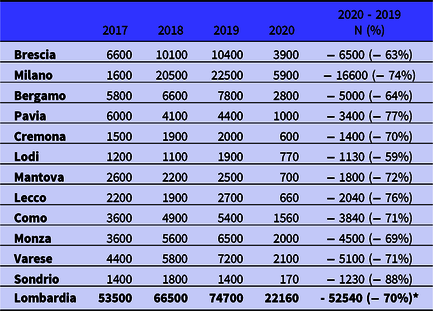
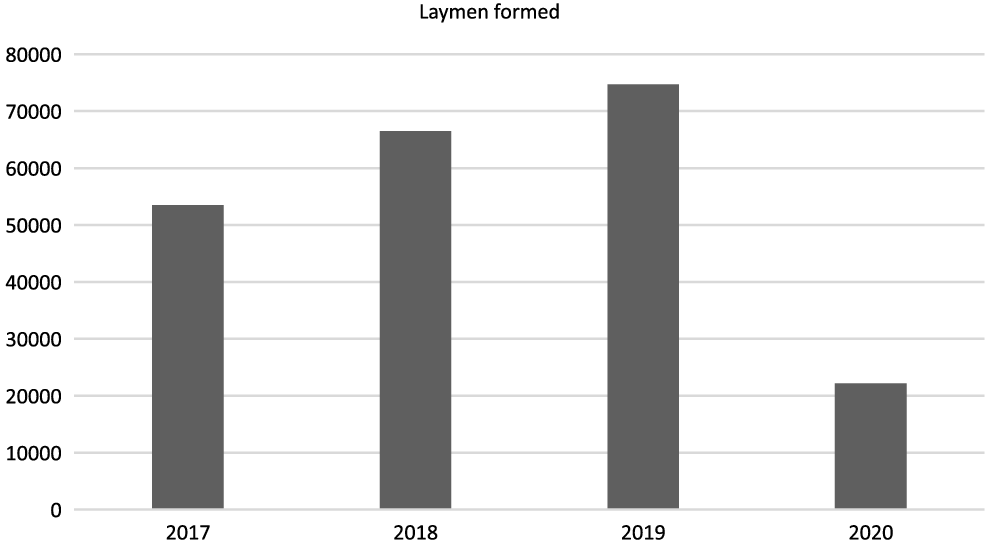
Analyzing the database, we found a positive increasing trend in the number of BLS-D trained laypersons all over the Lombardy region from the beginning of the project. The number of trained personnel has moved up from 53500 in 2017 up to 74700 in 2019. This trend abruptly ended in 2020 which registered a sharp 70% reduction compared with 2019 (Table 1).
Trained laypersons from 2016 to 2020, by province

*OR = 0.295 (CI = 95%, 0.291-0.300, P < 0.0001), considering a population of 10027602 January 1, 2020
Different provinces show a different proportion of trained personnel over the general resident population. For instance, within the general population of the Cremona province, 0.56% received BLS-D training, while 0.90% received BLS-D training in the Como province. The pandemic’s impact has starkly reduced emergency management training in the Lombardy region as seen in Table 1; during the lockdown period and during the second wave of the pandemic, the number of registered personnel in the regional database was close to zero.
Comparing these data with those reported for the months of September and October in 2019, newly registered BLS-D trained personnel averaged 200 people daily, while in 2020 in the same months newly trained personnel averaged 100 daily, with a 50% reduction.
Figure 1 shows the trend of newly trained personnel every year, starting in 2017.
Trained laypersons registered every year.

Discussion
The analysis aims to understand the extension of BLS-D training in the Lombardy region and highlight any change subsequent to the COVID-19 pandemic. BLS-D trained personnel kept growing from 2017 to 2019, reaching an abrupt reduction in 2020 due to the restrictions enforced to prevent the coronavirus from spreading. The significant reduction (OR = 0.295 [CI = 95%, 0.291-0.300], P < 0.0001], considering a population of 10027602 on January 1, 2020, in trained personnel must drive us towards a rational and efficient reorganization of the training system. The training centers and certified coaches will most likely face an increased demand from the emergency management institutions and businesses in the post-pandemic period. At the same time, an increase in the number of facilities and trainers is unlikely in the short period. Moreover, the celerity in the setting up of the training courses is of pivotal importance in order to catch up with the lost time, which has led to the missed re-training of certified laypersons in 2020.
The possible solutions are the following:
-
1. Enlargement of the training facilities
-
2. Increase in the number of training coaches
-
3. Setting up of mandatory distance learning certified courses for the necessary theoretical background.
In particular, this last solution could help in meeting the increasing demand for trained personnel. AREU recognizes that the setting up of digital solutions would prove most beneficial and effective. Efficiency may be increased by reaching out to multiple laypersons candidates by optimizing the training process. Unfortunately, such a solution was not implemented due to time restrictions and the draining of resources by the pandemic, leading management staff to focus on more pressing matters at hand.
A particular feature, which was highlighted during the analysis, was the evident discrepancy between the single provinces concerning the BLS-D training of laypersons. The different type of businesses in 1 specific province, or the different sensibilities of the general population towards the topic of emergency management could explain this phenomenon. More data and further research will be necessary to gain more insights and activate specific primary prevention projects.
Acknowledgments
The authors are sincerely grateful to Barbara Racah (barbara.racah@gmail.com) for the language revision of the manuscript.
Author Contributions
GS, LB, MM, GMS, and AZ conceived and designed the study; GS, LB, SC, and NF collected and analyzed the data; GS, SC GFV and NF interpreted the results of the experiments; GS prepared figures; GS drafted the first version of the manuscript; all authors edited, revised the manuscript, and approved the final version before submission.