Introduction
Learning from nature is a fundamental principle of all natural sciences, especially chemistry. Since 1900, more than 40% of the Nobel Prizes in chemistry have been related to the interface between chemistry and biology,1 which proves the importance of bionics, the subject that imitates the unique properties or functions of living organisms. Living organisms are composed of numerous functional interfaces, and all their advanced functions are realized by multifunctional integration. In recent years, scientists inspired by nature have prepared various interfacial materials with outstanding properties. Generally, there are three levels to the design of bioinspired materials, which have similar principles to the three kinds of paintings shown in Figure 1. The first is discovering the relationship between biological structures and functions and making the same structures in the same way as painting a portrait (Figure 1a) or mimicking the biological structure of a lotus leaf in an artificial device (scanning electron microscopy [SEM] image shown in Figure 1b).Reference Feng, Li, Li, Li, Zhang, Zhai, Song, Liu, Jiang and Zhu2 The second is inventing artificial functional materials with a simpler structure, just like the 1941 Chinese painting (Figure 1c) and the SEM image of a bioinspired superhydrophobic surface (Figure 1d).Reference Sun, Wang, Liu, Feng, Jiang and Zhu3 The third is creating something new based on the combination of structure and function, as is achieved in Picasso’s painting style (Figure 1e) or in the composite schematic (Figure 1f).Reference Sun, Wang, Feng, Liu, Ma, Jiang and Zhu4 Using the inspiration provided by these three levels, bioinspired interfacial materials with excellent properties such as superwettability can be designed.
Three levels of designing bioinspired materials. (a) “Mona Lisa” by Leonardo da Vinci and (b) an artificial superhydrohobic lotus leaf, which both mimic the structures of their biological counterparts, represent the first level, directly copying the relationship between biological structures and functions. Reproduced with permission from Reference 2. © 2002 Wiley-VCH. (c) “Horse” by Xu Beihong and (d) a bioinspired superhydrophobic surface represent the second level: invention, which means using a simple method to mimic the biological system. Reproduced with permission from Reference 3. © 2003 American Chemical Society. (e) “Guernica” by Pablo Picasso and (f) smart superwettability (represented here as a schematic) are examples for the third level: creativity based on a combination of structures and functions. Reproduced with permission from Reference 4. © 2002 Wiley-VCH.

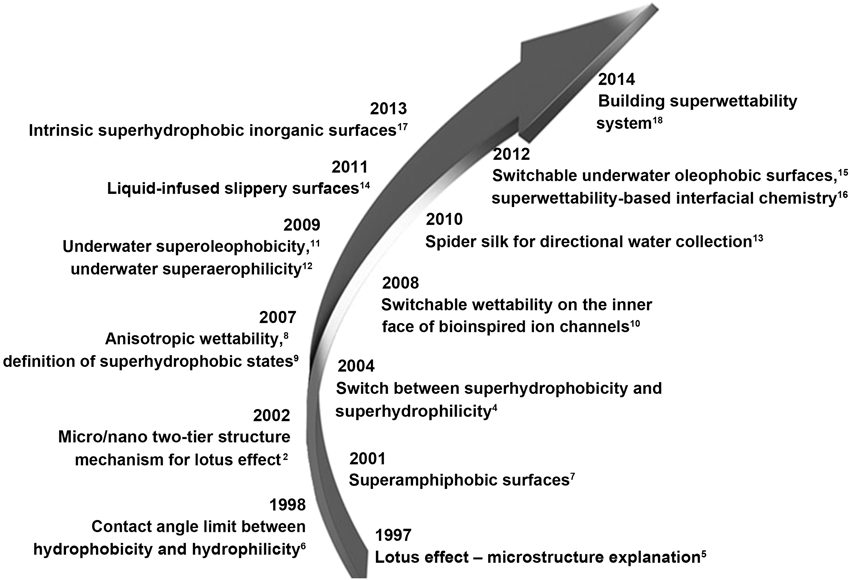
Wettability, especially superwettability which describes superphilic as well as superphobic states of liquid or gas on substrates, is an essential property of any interface, since it has a crucial influence on applications such as clothing, building, catalysis, heat conduction, and printing. Figure 2 summarizes some important milestones that have been achieved in superwetting systems in recent decades.Reference Feng, Li, Li, Li, Zhang, Zhai, Song, Liu, Jiang and Zhu2,Reference Sun, Wang, Feng, Liu, Ma, Jiang and Zhu4–Reference Tian, Su and Jiang18 Nature has provided us with many paradigms to illustrate the importance of superwettability, the most well-known being the lotus leaf. Although lotus leaves remain clean despite being grown in the presence of mud, the real mystery is their superhydrophobicity in air.
Timeline of some important milestones in the development of superwetting systems. Reference Feng, Li, Li, Li, Zhang, Zhai, Song, Liu, Jiang and Zhu2,Reference Sun, Wang, Feng, Liu, Ma, Jiang and Zhu4–Reference Tian, Su and Jiang18
In 1997, Barthlott et al. reported that the microstructures of lotus leaves induce superhydrophobicity, which triggered scientists to attempt to build superhydrophobic materials based on this microstructure.Reference Barthlott and Neinhuis5 However, the superhydrophobicity was not reversible when only the appropriate microstructure was present. In 2001, our group prepared superamphiphobic (superhydrophobic and superoleophobic) surfaces with aligned carbon nanotube films, indicating the significance of nanostructures.Reference Li, Wang, Song, Liu, Li, Jiang and Zhu7 Later, we revealed that two-tier structures with micro- and nanoscale features are the real origin of lotus leaves’ ability to remain superhydrophobic in air,Reference Feng, Li, Li, Li, Zhang, Zhai, Song, Liu, Jiang and Zhu2 and water can roll off easily on these superhydrophobic surfaces. If only the nanostructure exists on the surface, water would adhere to the surface easily. Thus, real superhydrophobicity needs a micro/nano two-tier structure. The difference between micro- or nanostructures and micro/nano two-tier structures can be explained using Wenzel and Cassie theories.Reference Cassie and Baxter19,Reference Wenzel20
Recently, Robin et al. also proved the importance of micro/nano two-tier structures for superhydrophobicity.Reference Verho, Korhonen, Sainiemi, Jokinen, Bower, Franze, Franssila, Andrew, Ikkala and Ras21 We have defined four states of superhydrophobicity.Reference Wang and Jiang9 In 1998, Volger et al. showed that the limit of hydrophobicity and hydrophilicity is a 65° contact angle, not the traditionally recognized 90°.Reference Vogler6 With this limitation, we achieved the first switching between superhydrophobicity and superhydrophilicity by combining micro-/nanostructures and temperature-responsive polymers.Reference Sun, Wang, Feng, Liu, Ma, Jiang and Zhu4 Besides isotropic static wetting states, there are many anisotropic dynamic wetting phenomena in nature, such as on the wings of butterflies.Reference Zheng, Gao and Jiang8 We have shown that water could roll easily in one direction on a butterfly wing, suggesting dynamic wettability.
Recently, more attention has been focused on wetting properties in other media besides air, such as underwater or under oil. Since we first reported the superoleophobicity of fish scales underwater in 2009,Reference Liu, Wang, Wei, Song and Jiang11 researchers have concentrated on different phase systems, such as liquid-infused slippery surfacesReference Wong, Kang, Tang, Smythe, Hatton, Grinthal and Aizenberg14 and switchable underwater oleophobic surfaces.Reference Liu, Xue, Liu and Jiang15 In addition to two-dimensional (2D) interfaces, we have also extended the binary cooperative concepts to one-dimensional (1D) nanochannels and fibers in recent years.Reference Hou, Guo and Jiang22–Reference Ju, Zheng and Jiang30 Most recently, some basic scientific concepts have been developed in superwettable systems. For instance, Varanasi et al. have reported intrinsically superhydrophobic inorganic materials due to the special electronic structure of rare-earth metals.Reference Azimi, Dhiman, Kwon, Paxson and Varanasi17 We have applied concepts of superwettability to basic research in interfacial chemistry, and in doing so have discovered a series of new media for chemical reactions as well as many novel methods for the preparation of nanomaterials.Reference Su, Wu and Jiang16
By integrating superwetting states in different media, we have generated a superwetting system that includes superhydrophilicity, superoleophilicity, superhydrophobicity, and superoleophobicity in air; superoleophilicity, superoleophobicity, superaerophilicity, and superaerophobicity underwater; and superhydrophilicity, superaerophilicity, superhydrophobicity, and superhydroaerophobicity under oil, as shown in Figure 3.Reference Tian, Su and Jiang18 Discussion of these systems in this article is mainly focused on results from our group. We begin with superwettability in 2D systems, followed by smart 2D interfacial materials with superwettability, and finally we introduce smart superwettability in 1D systems, superwettability-based chemical reactions, and fabrication of organic functional materials.
The superwetting system. The middle part: Hydrophilicity (HL), hydrophobicity (HB), oleophilicity (OL), and oleophobicity (OB) on flat substrates in air. The superhydrophilicity (SHL), superhydrophobicity (SHB), superoleophilicity (SOL), and superoleophobicity (SOB) states can be obtained in air by introducing micro/nanoscale two-tier roughness. Left blue semicircle: underwater superoleophilicity (UWSOL), superoleophobicity (UWSOB), superaerophilicity (UWSAL), and superaerophobicity (UWSAB) upon rough substrates. Right orange semicircle: under oil superhydrophilicity (UOSHL), superhydrophobicity (UOSHB), superaerophilicity (UOSAL), and superaerophobicity (UOSAB) upon rough substrates. Reproduced with permission from Reference 17. © 2014 Wiley-VCH.
Superwettability in 2D systems: From nature to artificial materials to applications
Superhydrophobicity in air
Our research began with lotus leaves, on which water slides off easily, and which show superhydrophobicity in air, with a contact angle larger than 150° and a sliding angle less than 5°.Reference Feng, Li, Li, Li, Zhang, Zhai, Song, Liu, Jiang and Zhu2 We found that there are many micropapillae (nipple-like structures) on the leaves and also large numbers of nanorods on the top of the micropapillae. These micro/nano two-tier structures, together with lower surface energy materials, are key for the superhydrophobicity of the liquid/gas/solid three-phase system. There are many more superhydrophobic interfaces in nature, including, for example, mosquito eyes, in which the periodically aligned micro-/nanostructure gives anti-fogging properties.Reference Gao, Yan, Yao, Xu, Zhang, Zhang, Yang and Jiang31 Another famous example is water strider legs. Water striders can walk freely on water due to nanoscale grooved structures on the oriented microscale setae or barbs.Reference Gao and Jiang32 Also, water droplets, such as those that adhere to rose petals, originate from periodic arrays of nanofolds covering micropapillae.Reference Feng, Zhang, Xi, Zhu, Wang, Xia and Jiang33
In addition to isotropic superhydrophobicity in air, anisotropic superhydrophobicity also exists widely in nature. We discovered that rice leaves possess anisotropic wettability due to 1D ordering of the micro-/nanopapillae.Reference Feng, Li, Li, Li, Zhang, Zhai, Song, Liu, Jiang and Zhu2 Another example of anisotropic wettability is the butterfly wing,Reference Zheng, Gao and Jiang8 on which a water droplet can easily roll in one direction but becomes tightly pinned in the opposite direction. These phenomena are ascribed to the directional arrangement of multiscale structures.
From the superhydrophobic interfaces in nature, it can be seen that the cooperative effects of micro/nano two-tier structures and low surface energy materials play important roles in the formation of superhydrophobic properties. The arrangement and orientation of micro- and nanostructures may control the wetting state and directional tendency for motion of liquids. With this biological principle, bioinspired interfacial materials can be designed using a range of methods.
Superhydrophobic interfaces have been constructed using a template method and aligned polyacrylonitrile nanofibers, generating the first superhydrophobic plastic without any modification.Reference Feng, Li, Li, Zhai, Song, Jiang and Zhu34 Using the same method, another superhydrophobic plastic consisting of amphiphilic poly(vinyl alcohol) nanofibers has also been fabricated, as shown in Figure 4a.Reference Feng, Song, Zhai, Liu, Xu, Jiang and Zhu35 The template method can also be extended to prepare superhydrophobic surfaces with various materials, demonstrating that it is an effective and low-cost method for fabricating superhydrophobic materials. In addition, a porous micro-/nanostructured plastic film composed of polystyrene that resembles the lotus leaf has been prepared by combining phase separation and electrospinning.Reference Jiang, Zhao and Zhai36 A superamphiphobic film has also been easily synthesized using the phase separation method.Reference Xie, Xu, Feng, Jiang, Tang, Luo and Han37
Superwettability in two-dimensional systems, from nature to artificial materials to applications. (Middle): Biological system with superwettability from lotus leaves. Reproduced with permission from Reference 2. © 2014 Wiley-VCH. Mosquito eyes. Reproduced with permission from Reference 31. © 2007 Wiley-VCH. Water strider legs. Reproduced with permission from Reference 32. © 2004 Nature Publishing Group. Rose petals. Reproduced with permission from Reference 33. © 2008 American Chemical Society. Rice leaves. Reproduced with permission from Reference 2. © 2002 Wiley-VCH. Butterfly wings. Reproduced with permission from Reference 8. © 2007 Royal Society of Chemistry. Fish scales. Reproduced with permission from Reference 10. © 2009 Wiley-VCH. Fish skin. Reproduced with permission from Reference 39. © 2014 Wiley-VCH. (a) Superhydrophobicity in air: poly(vinyl alcohol) nanofibers prepared by a template method. Reproduced with permission from Reference 35. © 2003 Wiley-VCH. (b) Artificial fish scales prepared using hierarchical macromolecule–nanoclay hydrogels, which show superoleophobicity underwater. Reproduced with permission from Reference 38. © 2010 Wiley-VCH. (c) Superhydrophobic sponges show superaerophilicity underwater. Reproduced with permission from Reference 40. © 2012 Wiley-VCH. (d) Schematic of an underwater superaerophobic nanoporous MoS2 electrode. Reproduced with permission from Reference 41. © 2014 Wiley-VCH. (e) Superamphiphobic textiles prepared by plasma treatment and fluorocarbon modification. (f) Water/oil separation film based on superhydrophilicity but superoleophobic underwater. Reproduced with permission from Reference 43. © 2011 Wiley-VCH. (g) Superoleophobic underwater-based printing.
Superoleophobicity underwater
Gaining inspiration from self-cleaning fish, we extended our system further from air-liquid-solid interfaces to liquid-liquid-solid interfaces. By directly observing fish scales, we found that these are patterned with many oriented micropapillae that are arranged in radial directions, and the surfaces of the micropapillae possess fine-scale roughness.Reference Liu, Wang, Wei, Song and Jiang11 The hierarchical structures on the fish scales render them superoleophobic underwater and superhydrophilic in air. Learning from nature, we developed a strategy to achieve artificial fish scales by constructing a surface of hierarchical macromolecule–nanoclay hydrogels (Figure 4b).Reference Lin, Liu, Chen, Chen, Ma, Han and Jiang38 In addition to being superoleophobic, the biomimetic surfaces also possess robust properties as compared to their biological counterparts. The artificial surfaces exhibit high compressive and tensile strengths, which is beneficial for industrial applications.
We have also recently found that the skin of filefish shows anisotropic oleophobicity underwater due to the oriented hook-like spines arrayed on the fish skin. Oil droplets tend to roll off in the head-to-tail direction but are pinned in the opposite direction.Reference Cai, Lin, Xue, Liu, Wang and Jiang39 Artificial fish skin with anisotropic oleophobicity underwater can be mimicked by soft lithography and plasma treatment with polydimethylsiloxane.
Superaerophilicity and superaerophobicity underwater
Lotus leaves are well-known for their superhydrophobicity in air. However, little research has focused on their superaerophilicity underwater. In 2009, we were the first to find that an air bubble could spread completely on submerged lotus leaves, where the spread was rapid due to the micro/nano two-tier structures on their surfaces.Reference Wang, Zheng, Nie, Zhai and Jiang12 Using photolithography combined with a wet-etching method, artificial lotus leaves that exhibited superaerophilicity underwater were obtained.Reference Wang, Zheng, Nie, Zhai and Jiang12
Inspired by the above results, we produced materials which effectively absorb methane bubbles by endowing commercial sponges with superhydrophobicity.Reference Chen, Wu, Su, Wang, Song and Jiang40 As shown in Figure 4c, they possess superaerophilicity underwater and thus, a large number of marine methane bubbles could be absorbed, stored, and transported effectively underwater. This is a simple yet practical method for the reduction of marine methane.
The wettability of air bubbles has great significance in real applications, such as gas evolution electrodes. Recently, we constructed an underwater superaerophobic nanoporous MoS2 electrode (Figure 4d) to which gas bubbles adsorb very weakly, such that they can easily leave the surface.Reference Lu, Zhu, Yu, Zhang, Li, Sun, Wang, Wang, Wang, Luo, Lei and Jiang41 These superaerophobic electrodes could effectively promote electrocatalytic performance, and we believe that the design based on superwettability would open up a new way for the development of gas evolution electrodes.
Superwettability-based applications
With all of these versatile methods of building surfaces with superwettability, some superhydrophobic interfaces could be produced on large scales for application in many industrial fields. Our group has developed an easy two-step method based on plasma treatment and fluorocarbon modification to produce superamphiphobic textiles (Figure 4e). This method is not only very easy but also does not change the other properties of the textiles.
Based on the properties comprising superhydrophobicity but superoleophilicity in air, and superhydrophilicity but superoleophobicity underwater, water/oil separation films have been fabricated through a simple spray-and-dry method using polytetrafluoroethyleneReference Feng, Zhang, Mai, Ma, Liu, Jiang and Zhu42 or hydrogel coated mesh (Figure 4f).Reference Xue, Wang, Lin, Chen, Liu, Feng and Jiang43 Both light and heavy oils could be separated from water using these two kinds of films. These materials based water/oil separation devices have been used in over 500 ships to remove condensed water in oil tanks.
Another technology based on underwater superoleophobicity was developed in recent years and has been termed “green printing.”Reference Tian, Song and Jiang44 The printing ink in this case spreads precisely on the superhydrophobic areas of the patterned plates in air and leaves the superhydrophilic part of the plates as a margin. Colorful images with fine resolution can be obtained using this method, as shown in Figure 4g.Reference Tian, Song and Jiang44
Smart 2D interfacial materials with superwettability
Our goal is to learn from nature, but then to use these ideas to make materials whose properties surpass those achieved by nature. By combining two complementary members of the superwetting system and achieving reversible switching between them, novel and superior properties can be generated for practical applications.
For a long time, people believed that the contact angle limit between hydrophilicity and hydrophobicity was 90°, since this is the value for which the cosine equals zero in Young’s equation.Reference Young45 However, this has no actual physical or chemical meaning. Based on the differences in the structure of interfacial water, Vogler et al. first revealed that the new threshold contact angle between hydrophilicity and hydrophobicity is 65°.Reference Vogler6 Our research has also proven this important conclusion.Reference Guo, Wang, Liu, Feng, Song and Jiang46 As shown in Figure 5, hydrophilic surfaces (contact angle <65°) will become more hydrophilic and even become superhydrophilic, while hydrophobic surfaces (contact angle >65°) will become more hydrophobic, even reaching superhydrophobicity.Reference Tian and Jiang47 Using this criterion angle of 65°, various smart interfacial materials with superwettability have been fabricated.
Smart two-dimensional materials with superwettability. (Middle): Threshold contact angle between hydrophilicity and hydrophobicity is 65°. Reproduced with permission from Reference 47. © 2004 Nature Publishing Group. (a–e) Smart interfacial materials with superwettability. (a) Thermal-responsive interfaces prepared by poly(N-isopropylacrylamide) (PNIPAM) molecules. Reproduced with permission from Reference 4. © 2004 Wiley-VCH. (b) pH-responsive interfaces constructed by fluoro group-modified i-motif DNA. Reproduced with permission from Reference 51. © 2007 Wiley-VCH. (c) Photoelectric cooperative responsive ZnO interfaces. Reproduced with permission from Reference 54. © 2009 Wiley-VCH. (d) pH and thermal cooperative responsive interfaces composed of p(NIPAM-co-AAc). Reproduced with permission from Reference 55. © 2006 Wiley-VCH. (e) Multiple responsive interfaces composed of PNIPAM and poly(acrylamidophenylboronic acid). Reproduced with permission from Reference 56. © 2007 Wiley-VCH. Note: LCST, lower critical solution temperature.
Thermal responsive smart interfaces in air
Poly(N-isopropylacrylamide) (PNIPAM) is a thermally responsive molecule that has gained considerable attention due to its different characteristics below and above the lower critical solution temperature (LCST; the temperature below which the individual components of the polymer are completely miscible). Inspired by nature, we introduced a PNIPAM micro-/nanostructure onto silicon surfaces (Figure 5a).Reference Sun, Wang, Feng, Liu, Ma, Jiang and Zhu4 Thus, the roughness-enhanced wettability could be changed from superhydrophobic to superhydrophilic, while the difference in contact angles on their flat counterparts was less than 30°. These new interfaces with wettability that can be tuned from superhydrophobic to superhydrophilic not only pave a new way to smart interfacial materials with superwettability, but also could have great influence in potential applications, including intelligent microfluidic devices and controllable drug release.
Other stimuli-responsive smart interfaces in air
Combining micro-/nanostructured substrates and responsive molecules, a series of composite materials have been generated that possess two complementary properties of superwettability that can be switched using light, pH, electric, chemical, or multiple stimuli.
For instance, ZnO nanorods fabricated by hydrothermal methods show reversible wettability between superhydrophobic and superhydrophilic due to their photoresponsive properties.Reference Feng, Feng, Jin, Zhai, Jiang and Zhu48 Using electrochemical deposition methods, the as-prepared nanostructured WO3Reference Wang, Feng, Yao and Jiang49 could also switch between superhydrophobic and superhydrophilic under the stimulus of light. Compared to the slow response times of inorganic materials, many kinds of organic molecules, such as azobenzene, also show great responsiveness to light.Reference Jiang, Wang, He, Wang, An, Song and Jiang50 A superwettability gate was obtained by binding an azobenzene-containing polymer to a laser-etched rough substrate.
The i-motif DNA (four-stranded DNA secondary structures that can form in sequences rich in cytosine) can undergo a transition from i-motif to a single-stranded structure under different pH conditions, as described in Figure 5b. By binding a fluoro group to the i-motif DNA, the wettability of the DNA integrated micro-/nanostructured surfaces can be changed from 8.8° at pH 4.5 to 148.3° at pH 8.5.Reference Wang, Liu, Liu, Ma, Fang and Jiang51
The wettability of interfaces can also be tuned using chemicals such as ammonia.Reference Zhu, Zhai, Sun and Jiang52 Due to the reversible change of the surface structure and surface-free energy under an ammonia atmosphere, the wettability of indium hydroxide can be altered from superhydrophobic to superhydrophilic with good reproducibility.Reference Zhu, Zhai, Sun and Jiang52 When two or more stimuli are combined, their cooperative interaction will generate interfaces that have the potential to be responsive to multiple stimuli.
Electrowetting is an effective and traditional technique for transferring a water droplet from the Cassie state to the Wenzel state (descriptions of the two states are found in Reference 51); however, the voltage needed has always been relatively high.Reference Marmur53 In 2009, our group realized photoelectric cooperative wetting based on patterned ZnO nanorods film, as shown in Figure 5c.Reference Tian, Chen, Nie, Xu, Song and Jiang54 The wettability transition occurred around 3 V when ultraviolet light and electric fields both acted on the film, and the wetting region could be controlled precisely, leading to the desired pattern.Reference Tian, Chen, Nie, Xu, Song and Jiang54
By grafting poly(N-isopropylacrylamide-co-acrylic acid) onto the rough silicon substrate, the film showed temperature and pH dual responsive properties (Figure 5d), and the wettability could be switched between superhydrophobic and superhydrophilic under the cooperative stimuli of pH and heat.Reference Xia, Feng, Wang, Sun, Song, Jiang and Jiang55 Similarly, integrating PNIPAM into pH- and glucose-responsive poly(acrylamidophenylboronic acid) molecules yielded multiple responsive smart surfaces, as shown in Figure 5e.Reference Xia, Ge, Hou, Sun, Chen, Zhang and Jiang56
Smart interfaces underwater
Inspired by fish scales, we have transferred the smart design concept into the oil/water/solid three-phase system. For example, under the stimulus of temperature, oil adhesion underwater could be controlled reversibly on the surface of PNIPAM hydrogels. Oil adhesion varied from superoleophobicity and low adhesion below LCST to oleophobicity and high adhesion above LCST.Reference Chen, Liu, Lin, Zhang, Ma, Song and Jiang57 Using rough films of the conducting polymer polypyrrole as the substrate, an in situ dynamic wettability transition between partly wetting and superoleophobic characteristics could be achieved by alternately applying positive and negative voltages.Reference Liu, Nie, Wei, Song and Jiang58 By tuning the doping and electrochemical driving potential of the aligned polypyrrole nanotube, a reversible superoleophobicity to superoleophilicity transition could also be achieved.Reference Liu, Liu, Ding, Wei, Zhu and Jiang59
The previously mentioned smart interfaces were all realized by tuning the chemical compositions or structures of the solid phase. Recently, a solid-phase-independent oil wetting transition was achieved by controlling the polar interactions at oil/water interfaces.Reference Liu, Xue, Liu and Jiang15 The wettability of polar oils on nonresponsive solid surfaces could switch from oleophilic to superoleophobic due to the Lewis acid–base interactions at different pH values in aqueous solution. This study provides a new strategy to construct smart, superwettability systems.
Smart one-dimensional interfaces
In recent years, in order to make superwettability systems more authentic in their functionality, our group has paid a lot of attention to 1D bioinspired smart systems, including nanochannels and nanofibers. Inspired by smart 2D interfaces with superwettability, we have transferred the stimuli-triggered smart gating concept to 1D interfaces.
Smart bioinspired nanochannels and their applications
Nanoscale channels that exist in living organisms play important roles in many physiological processes. Most of the channels possess “smart gates” to selectively allow ions or small molecules in and out of the channels. Learning from nature, we have constructed two kinds of nanochannels, including bioinspired ion channels and bioinspired ion pumps, and we have also investigated their potential applications.
Bioinspired ion channels
Solid-state polymeric single nanochannels have been widely used due to their outstanding mechanical and chemical properties, which are also easy to modify.Reference Hou, Dong, Zhu and Jiang60–Reference Zhang, Hou, Yang, Yan, Li, Tian, Wang and Jiang62 We first studied bioinspired ion channels with conical shapes by modifying the surface of single polymeric nanochannels with pH responsive i-motif DNA.Reference Xia, Guo, Mao, Hou, Xue, Xia, Wang, Song, Ji, Qi, Wang and Jiang10 As an extension of our previous work on 2D surfaces, the molecules could also undergo conformation changes and thus, affect the physical radius and wettability of the inner face of the nanochannel. As a result, the gate of the nanochannels could open and close in response to pH variation, as shown in Figure 6a. This is the first reported bioinspired single-ion channel, and it has drawn significant attention from scientists in this field. Following this work, we constructed a series of smart single nanochannels by integrating functionalization into the nanochannels (Figure 6b–c) that respond to various external stimuli such as pH,Reference Hou, Liu, Dong, Yang, Li and Jiang63 ions,Reference Hou, Guo, Xia, Nie, Dong, Tian, Wen, Wang, Cao, Yang, Xue, Song, Wang, Liu and Jiang64–Reference Tian, Zhang, Wen, Ma, Zhang, Liu, Zhai and Jiang66 temperature,Reference Guo, Xia, Xia, Hou, Cao, Wang, Xue, Zhang, Song, Zhu, Wang and Jiang67 and small molecules.Reference Han, Hou, Zhang, Guo, Li and Jiang68,Reference Hou, Zhang, Xie, Xiao, Wen, Li, Tian and Jiang69 Nanochannel systems that respond to multiple stimuli can also be developed by modifying single nanochannels with copolymers or functionalizing the channels with multiple responsive molecules (Figure 6d).Reference Guo, Xia, Cao, Xia, Wang, Zhang, Song, Wang, Jiang and Zhu70–Reference Zhang, Hou, Wang, Tian, Fan, Zhai and Jiang72
Smart bioinspired nanochannels and their applications. (Middle) Bioinspired nanochannels with different shapes. (a) Conical single polymeric nanochannels (SPNs) modified by i-motif DNA; the gate of the nanochannels can be opened and closed in response to pH. Reproduced with permission from Reference 9. © 2008 The American Chemical Society. (b) Thermal-responsive smart bioinspired ion channels (SBICs) fabricated by modifying conical SPN with poly(N-isopropylacrylamide) (PNIPAM). Reproduced with permission from Reference 67. © 2010 Wiley-VCH. (c) Mercury(II)-gated SBIC constructed by Hg2+-sensitive 50-thiol-ended T-rich single-stranded DNA integrated into Au-coated conical SPN. Reproduced with permission from Reference 66. © 2013 Royal Society of Chemistry. (d) pH- and thermal-cooperative responsive SBIC constructed through asymmetric modification with poly(acrylic acid) (PAA) and PNIPAM at the two sides of hourglass-shaped SPN, respectively. Reproduced with permission from Reference 66. © 2013 Royal Society of Chemistry. (e) Bioinspired ion pump based on cigar-shaped SPN. The nanochannel has two separate small tips embedded on the two sides of the nanochannel. Reproduced with permission from Reference 73. © 2013 American Chemical Society. (f–i) Four kinds of applications of the bioinspired single nanochannels. (f) Retina-inspired energy-conversion system that could transfer the photo energy to electric signals constructed by the pH-driven i-motif DNA modified nanochannels and photo acid/base molecules. Reproduced with permission from Reference 75. © 2010, Wiley-VCH. (g) Electric eel inspired energy-conversion device that could transfer the ion-concentration-induced chemical energy to electrical energy by using the negatively charged solid-state single nanochannels. Reproduced with permission from Reference 76. © 2010 Wiley-VCH. (h) Transmembrane salinity-gradient-induced electricity prepared by mesoporous carbon combined with the anodic aluminum oxide. Reproduced with permission from Reference 77. © 2014 American Chemical Society. (i) Pressure-driven energy-conversion system based on the negatively charged two-dimensional layered graphene hydrogel membrane. Reproduced with permission from Reference 78. © 2013 Wiley-VCH. Note: PVP, poly(vinylpyridine); PET, poly(ethylene terephthalate).
Bioinspired ion pumps
Ion transport across bioinspired ion channels, as described previously, is controlled by a single gate embedded in the small tip side of the conical nanochannels. By comparison, biological ion pumps possess two separate but cooperative gates that allow ions to pass through the channels actively against the ion concentration. Recently, inspired by biological ion pumps, we prepared a bioinspired single-ion pump based on a cigar-shaped single nanochannel.Reference Zhang, Hou, Zeng, Yang, Li, Yan, Tian and Jiang73,Reference Liu, Zhang, Li, Heng, Wang, Tian and Jiang74 As shown in Figure 6e, this nanochannel has two separate small tips embedded on the two sides of the nanochannels. This was achieved by modifying the nanochannels with different molecules, which could respond to different kinds of stimuli. Poly(vinylpyridine) and poly(acrylic acid) were used to modify the two tips of the nanochannels independently, thereby constructing two separate yet cooperative gates. As a result, the nanochannels show similar ion-transport properties to biological ion pumps. That is, they show three ion-transport features—alternating gate ion pumping processes, transformation of the ion pump into an ion channel, and a fail-safe ion pumping feature, which includes alternating gates and occluding states—that could all be realized by tuning the external stimuli continuously.
Applications
Ion channels play essential roles in many biological processes, such as the photoelectric conversion system of rhodopsin, a light-sensitive protein that exists in photoreceptor cells of the retina, and concentration gradient-driven electric power in electric eels. By learning from nature and using bioinspired nanochannels, we were able to fabricate several energy conversion devices.
Inspired by the retina and using the pH driven i-motif DNA modified nanochannels and photo acid/base molecules, as shown in Figure 6f, we have developed a novel energy conversion device that can transfer photo energy to electric signals.Reference Wen, Hou, Tian, Zhai and Jiang75 Electric eels similarly generate up to 600 V within milliseconds when they encounter danger; this high output is based on Na+/K+ ion pumps. Inspired by the biological mechanism, we used negatively charged solid-state single nanochannels to transfer ion concentration-induced chemical energy to electrical energy (Figure 6g).Reference Guo, Cao, Xia, Nie, Ma, Xue, Song, Zhu, Wang and Jiang76 While the energy conversion is based on the nanochannels, the output is relatively low due to the small size of the single nanochannels. Therefore, we used nanoporous composite membranes, that is, mesoporous carbon combined with anodic aluminum oxide, as shown in Figure 6h, to build an asymmetric membrane to harvest transmembrane salinity gradient-induced electricity.Reference Gao, Guo, Feng, Wang, Zhao and Jiang77 Our results show that the maximum output that could be achieved was 3.46 W/m2. This is higher than that of commercial ion exchange membranes and will find application in a range of fields.
More recently, we developed another pressure-driven energy conversion system based on a 2D layered graphene hydrogel membrane (Figure 6i).Reference Guo, Cheng, Wu, Jiang, Gao, Li and Jiang78 The membrane is negatively charged such that only positive ions can cross it. The electrokinetic response was observed by external pressure. This easily designed generator may find applications as an energy conversion device, such as power generation insoles in shoes, which could output power continually when people walk while wearing them.
Smart bioinspired fibers for directional liquid transport
Another 1D smart system is nanofibers that show smart superwettability and that transport liquid droplets directionally. These would have applications in microfluidics, water or oil collection, and smog removal. The arrangement of the micro-/nanostructures plays an essential role in their liquid transport ability.
Spider silks and their artificial counterparts
Inspired by the dew that hangs on spider silk, we investigated the smart superwettability of spider silk and developed a series of artificial spider silks. As shown in Figure 7a, under a misty environment, the fiber shows periodic spindle knots and joints, which result in a gradient of Laplace pressure (the pressure difference between the inside and the outside of a curved surface) and surface-free energy between the knots and joints. Water droplets can then move directionally along the fiber.Reference Zheng, Bai, Huang, Tian, Nie, Zhao, Zhai and Jiang13
Smart bioinspired fibers for directional liquid transport. Reproduced with permission from Reference 30. © 2014 American Chemical Society. (a) Microstructures of natural spider silk. Reproduced with permission from Reference 12. © 2010 Nature Publishing Group. (b) Artificial spider silks prepared by dip-coating method. Reproduced with permission from Reference 79. © 2010 Wiley-VCH. (c) Smart artificial spider silks prepared by modifying the spindle knots with thermal-responsive poly(N-isopropylacrylamide). Reproduced with permission from Reference 82. © 2013 Wiley-VCH. (d) Scanning electron microscopy images of a natural cactus spine. Reproduced with permission from Reference 83. © 2012 Nature Publishing Group. (e) Artificial cactus spines prepared by gradient electrochemical corrosion and gradient chemical modification. Reproduced with permission from Reference 84. © 2013 Wiley-VCH. (f) Arrays of artificial cactus spines for oil collection in oil/water/mixtures. Reproduced with permission from Reference 85. © 2013 Nature Publishing Group. Note: LCST, lower critical solution temperature.
Learning from the wettability of spider silk, we have fabricated a range of smart artificial fibers using methods such as dip coating (Figure 7b),Reference Bai, Tian, Zheng, Ju, Zhao and Jiang79 fluid coating,Reference Bai, Sun, Ju, Yao, Zheng and Jiang80 and electrospinning.Reference Dong, Wang, Wang, Bai, Wu, Zheng, Zhao and Jiang81 Like 2D surfaces, the wettability of fibers is also controlled by surface roughness and chemical compositions. Thus, we successfully prepared artificial spider silk and mimicked directional water transport by tuning these two factors of the nanofibers. Going beyond nature, we also made our structures stimulus-responsive by introducing thermal responsive molecules into the nanofibers, endowing the artificial spider silk with “intelligence” (Figure 7c).Reference Hou, Gao, Feng, Chen, Xue, Jiang and Zheng82
Cactus spines and their artificial counterparts
Nature provides a very efficient water collection system in the form of the cactus, which can survive in the desert due to the water collected by their spines. By observing the cactus spines directly, we found that their multiscale structures are key for water transport from the tip to the base (Figure 7d).Reference Ju, Bai, Zheng, Zhao, Fang and Jiang83 To make an artificial system with comparable efficiency, we fabricated single and even arrays of artificial cactus spines based on single copper conical needles.Reference Ju, Xiao, Yao, Bai and Jiang84,Reference Li, Ju, Xue, Ma, Feng, Gao and Jiang85 These could transport liquid droplets both in air and underwater, and they show great potential for water collection and water/oil separation (Figure 7e–f).
Superwettability-based chemical reactions and fabrication of organic functional materials
In addition to designing materials with superwettability properties, we have also successfully developed superwettability-based chemical reactions, crystallization, and fabrication of organic functional materials such as small molecules, polymers, and nanoparticles.
Superwettability-based chemistry
Using superwettable substrates, as shown in Figure 8a, we performed diverse chemical reactions in different media. Since the droplets on the superhydrophobic substrates maintain a spherical shape due to the low surface energy of the substrates, such that molecules cannot easily escape from the droplets, they could be utilized as miniature reactors to perform chemical reactions at very small scales, such as inorganic reactions in air,Reference Su, Wang, Song and Jiang86 organic reactions underwater,Reference Su, Wang, Song and Jiang87 and heated reactions under oil.Reference Su, Wang, Song and Jiang88 The basic principles are shown in Figure 8b–c.Reference Su, Wang, Song and Jiang86–Reference Su, Wang, Song and Jiang88
Superwettability-based chemical reaction and fabrication of inorganic/organic materials. Reproduced with permission from Reference 17. © 2014 Wiley-VCH. (a) Interfaces with superwettability. (b–c) A chemical reaction system based on superwetting interfaces. One droplet (containing reagent A) on a superwetting interface could coalesce with another droplet (containing reagent B) assisted by superhydrophobic tweezers, yielding a mixed droplet (containing product C). (d–e) When a solution droplet makes contact with a high-adhesion superhydrophobic patterned pillar-structured interface, liquid bridges could be formed between the adjacent micropillars. If the solution viscosity is low, the liquid bridges will break, thus, ordered nanocrystal patterns would be generated after water evaporation. (f–g) If the solution is sticky, the liquid bridges will remain, and aligned nanowires of the functional materials would be prepared after liquid evaporation. (a–e) Reproduced with permission from Reference 96. © 2011 Wiley-VCH. (f–g) Reproduced with permission from Reference 97. © 2012 Wiley-VCH.
Superwettability-based fabrication of inorganic/organic functional materials
Recently, we used interfaces with superwettability characteristics to fabricate a series of inorganic/organic functional materials (Figure 8d–f).Reference Su, Wang, Wu, Chen, Song and Jiang89–Reference Su, Wang, Ma, Song and Jiang96 When placing an aqueous droplet upon the superhydrophobic pillar-structured surfaces, direction-controlled liquid bridge arrays could be generated. Following the inward shrinkage of the three-phase contact line of the droplet, strictly-oriented liquid bridges connecting adjacent micropillars would be generated. After water evaporation, these well-defined, 1D liquid bridges can restrict the alignment of dissolved suspended building blocks of functional materials. With this strategy, small molecules were used to fabricate nanowires and crystalline nanowires.Reference Su, Wang, Ma, Song and Jiang96 Polymer nanowires have thus been aligned, and silver nanoparticles or microspheres have been patterned using this method.Reference Su, Wang, Ma, Wu, Chen, Song and Jiang97 These studies are anticipated to boost the development of 1D micro-/nanostructured materials for potential application in optoelectronic nanodevices.
Conclusions
Learning from nature is highly attractive, since nature provides us with numerous useful properties that have developed over millions of years of evolution. Although biological systems are very sophisticated, bioinspired materials can be successfully built by following several principles. First, organic and inorganic hybrid materials should be built over multiple length scales or dimensions. Second, bistable states should then be built with various weak interactions. Finally, the multifunctional materials should be integrated in one system. In this review, we have described the fabrication and potential applications of multiscale, superwetting, and artificial materials. These were inspired by a fundamental understanding of the superwettability of biological systems such as lotus leaves, rice leaves, butterfly wings, water strider legs, mosquito eyes, fish scales, spider silks, and cactus spines, which are all structured in multiple dimensions. We expect that our work will play a pioneering role in the development of bioinspired interfacial materials with superwettability characteristics, since the development of superwetting systems is still in its infancy. Much more work is required to explore its variety and variations, such as introducing novel three- or even four-phase systems and exploring the numerous interesting properties and promising applications that would follow.
Acknowledgments
This research is supported by the National Research Fund for Fundamental Key Projects (2013CB933000) and the National Natural Science Foundation of China (21121001, 91127025).
Ye Tian is an associate professor at the Institute of Chemistry, Chinese Academy of Sciences (ICCAS). She received her BS degree from Northeast Normal University, China, in 2006. She then joined Lei Jiang’s group as a PhD candidate and received her PhD degree in physical chemistry from ICCAS in 2011. Her scientific interests include biomimetic smart single nanochannels. Tian can be reached by email at tianyely@iccas.ac.cn.
Lei Jiang is a professor at the Institute of Chemistry, Chinese Academy of Sciences (ICCAS) and dean of the School of Chemistry and Environment, Beihang University. He received his BSc (1987), MSc (1990), and PhD (1994) degrees from Jilin University, China, in Tiejin Li’s group. He then worked as a postdoctoral fellow in Akira Fujishima’s group at Tokyo University. In 1996, he joined Kanagawa Academy of Sciences and Technology as a senior researcher under Kazuhito Hashimoto. He joined ICCAS as part of the Hundred Talents Program in 1999. He was elected academician of the Chinese Academy of Sciences in 2009 and the Academy of Sciences for the Developing World in 2012. His scientific interests are focused on bioinspired, smart, and multiscale interfacial materials with superwettability. Jiang can be reached by email at jianglei@iccas.ac.cn.