Introduction
Cognitive screening is the first step in detecting various types of dementias and other neuro-psychiatric syndromes. A plethora of cognitive screening instruments has been advocated in recent years. The Mini-mental State Examination (MMSE; Folstein et al., Reference Folstein, Folstein and McHugh1975) is most widely used (Diniz et al., Reference Diniz, Yassuda, Nunes, Radanovic and Forlennza2007; Nakasujja et al., Reference Nakasujja, Musisi, Walugembe and Wallace2007) and quick to administer when screening for cognitive dysfunctions. It has been modified and translated into many languages, including Chinese and Finnish (Salmon et al., Reference Salmon, Riekkinen, Katzman, Zhang, Jin and Yu1989), Korean (Park and Kevon, Reference Park and Kevon1990), Japanese (Larson, Reference Larson, Curb and Graves1992), Spanish (Loewonstein et al., Reference Loewonstein, Arguelles, Barker and Duara1993), Yoruba (Hendrie, Reference Hendrie, Curb and Graves1992), Cree (Hall et al., Reference Hall1993) and Hindi (Ganguli et al., Reference Ganguli1995). But the extent to which these instruments are used or their effectiveness is not well established. A survey of assessment scales in old age psychiatry services in England and Northern Ireland was conducted by Reilly et al. (Reference Reilly, Challis, Burns and Hughes2004) who found that among the cognitive screening instruments reported by 331 respondents, approximately 95% used the MMSE. In a recent survey by International Psychogeriatric Association (IPA), it was reported that the MMSE is a universally used screening instrument but has limitations in terms of its sensitivity and confounding biases with regard to education (Jones and Gallo, Reference Jones and Gallo2001), and culture and language (Shulman et al., Reference Shulman2006; Das et al., Reference Das2006). In Reference Jorm, Scott, Henderson and Kay1988, Jorm and colleagues published an analysis addressing MMSE bias by level of educational attainment among a sample of older adults using methods outlined in Berk's Handbook of Methods for Detecting Test Bias (Reference Berk1982). In the light of the above features and limitations of MMSE, the Indo-U.S. project developed a modified version of MMSE, known as the Hindi Mental State Examination (HMSE) (Ganguli et al., Reference Ganguli1995), specifically to counter this bias when screening rural illiterate elderly people for cognitive impairment in India. The study was conducted with the aim of studying the applicability of the two parallel tests – MMSE and HMSE – in scanning the urban literate as well as illiterate population for cognitive impairment and comparing the scores obtained by the subjects on the two instruments.
Methods
Sample
All the houses in a selected area near the Medical University in Lucknow were screened to identify households where elderly persons aged 60 years and above were permanently residing. These people were screened for inclusion. A consecutive series of 20 illiterate subjects (without schooling or formal education) and 20 literate subjects (having passed 5th grade or above) and who met the inclusion criteria formed the study sample. The inclusion criteria were: (1) willing to cooperate; (2) able to give informed consent; (3) no evidence of any diagnosed psychiatric disorder (past or present) other than mild cognitive impairment (MCI) or dementia; (4) no problem suggestive of organic pathology (due to head injury, seizure, mental retardation or substance abuse); and (5) no problems with speech, hearing or vision, which would impede the conduct of examination.
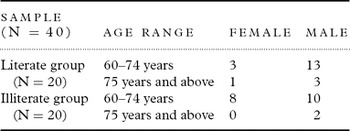
The literacy level, age and sex of the screened sample is given in Table 1.
Distribution of screened sample by age, sex and literacy level

Tools
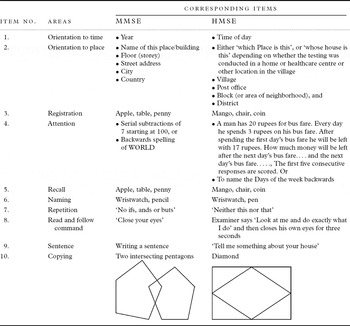
A systematically translated Hindi version of the Mini-mental State Examination (HVMMSE) and the HMSE were used for data collection. Table 2 shows item differences between the MMSE as developed by Folstein et al. (Reference Folstein, Folstein and McHugh1975) and the HMSE developed by Ganguli et al. (Reference Ganguli1995).
Item difference on MMSE and HMSE

To create the HVMMSE three translators, fluent in English and Hindi, translated the original English version of MMSE into Hindi. The translators discussed and compared the translated versions item by item to agree upon a pre-final translated Hindi version (PFHV) of MMSE. This version was administered to 10 literate and 10 illiterate persons aged 60 years and above drawn from another community to assess the comprehensibility of the items. The PFHV items were found to be comprehensible among both literate as well as illiterate persons in respect of the nature and content of the items. It was therefore treated as the final translated Hindi version (FHV) of MMSE. Two bilingual experts back translated the FHV of MMSE into English to establish meaning equivalence. The original English, the final Hindi version of MMSE and the back-translated English version of the final Hindi version of MMSE were referred to three bilingual mental health professionals to assess logical validity of the instrument. These mental health professionals unanimously agreed that the three instruments had very high meaning and lingual equivalence.
Procedure
The HVMMSE was first administered to the two illiterate and literate urban elderly groups. After a one month, the HMSE was administered to the same two groups. The cut-off score of 23 and below (Shaji et al., Reference Shaji, Bose and Verghese2005) was taken as an indicator of possible cognitive impairment using the HVMMSE. The cut-off score for possible cognitive impairment on HMSE was 19 or below, which was developed and adopted for the Indo-U.S. Project.
The statistical tests of χ2 with Yate's correction, percentage rank order correlation and qualitative analysis were used to analyze the data.
Results
Table 3 shows a significant difference with HVMMSE in screening literate and illiterate groups (0.001 level). HVMMSE tends to make the illiterate group positive in comparison to the literate group. All illiterate subjects (100%) scored below the cut-off score on HVMMSE while only four (20%) scored below the cut-off score on HMSE. In the literate group, HVMMSE classified three (15%) subjects as having possible cognitive impairment while HMSE classified only one subject in this way. There is no significant difference within HMSE when screening urban literate and illiterate subjects for cognitive impairment, but HVMMSE tends to find more evidence of cognitive impairment than HMSE when screening the illiterate urban elderly group. The results suggest that the two instruments do not classify elderly people uniformly as suspects/non-suspects for cognitive impairment. This disagreement is more pronounced in the case of illiterate subjects.
Distribution of positive and negative subjects on HVMMSE and HMSE by education and cognitive impairment

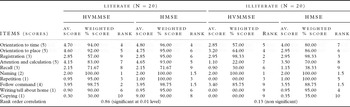
Table 4 shows the pattern of correlation of obtained scores on HVMMSE and HMSE by item of literate and illiterate subjects. The table shows a significant correlation (0.01 level) among literate subjects on subtests of HVMMSE and HMSE. It suggests that items of different subtests on HVMMSE and HMSE are significantly correlated for literate persons, while correlation between HVMMSE and HMSE items for illiterate subjects were found to be non-significant. This suggests that item differences in HVMMSE and HMSE bias the scoring profile among illiterate subjects, making them more vulnerable for greater positivity on HVMMSE than HMSE.
Rank order correlation and difficulty level of HVMMSE/HMSE scores on literate and illiterate subjects

Note: Av. Score = average scores obtained by 20 subjects on each item; % weighted = percentage of raw scores; Rank = order of difficulty
Average scores, weighted scores (percentage of obtaining perfect scores (ceiling) on each subtest) and the rank order of subtests with respect to relative difficulty in each phase (rank 1 denoting the easiest subtest, on which the largest proportion performed at ceiling) are given in Table 4.
Although several sets of comparisons could be made, the small sample size is most conducive to a focus on qualitative comparisons.
Literate group
The literate group scored highly on the following HVMMSE items: “naming” (100%), “repetition” (98.75%) and “read and follow command” (98.75%) and low on “copying” (30%), “registration” (57%) and “recall” (71.67%). On HMSE items, the literate group scored highly on “naming” (100%), “read & follow command” (100%), “orientation to time” (96%) and “orientation to place” (95%), “registration” (95%), “writing” (95%), “attention and calculation” (93%), but slightly lower on “recall” (71.67%).
Illiterate group
The illiterate group scored highly on the following HVMMSE items: “naming” (100%), “registration” (98.33%), “repetition” (85.75%) and scored low on “attention and calculation” (22%), “recall” (30%), “orientation to time” (57%) and “orientation to place” (64%). Not surprisingly, no one scored on “copying”, “writing”, “read and follow command” and “copying”. On HMSE, the illiterate group scored highly on “naming” (100%), “read command / follow command” (100%), “registration” (98%), “writing / tell about home” (95%), “repetition” (89%), “orientation to place” (86%), “time” (80%), and “attention and calculation” (70%), and scored low on “recall” (38.33%) and “copying” (35%).
Discussion
Results suggest that the HMSE was better able to screen the urban illiterate group for cognitive impairment whereas the HVMMSE was better able to screen the urban literate group. Neither of these cognitive screening tools agrees when screening both population groups (literate as well as illiterate) due to other confounding variables (education, language, etc). Illiterate groups were not familiar with “orientation of time” (day, date, month, year and season) and “place” (name of the place, building, floor (storey), city, state and country), nor able to perform items of “attention and calculation” (serial subtraction from 100 by 7 or spelling “World” backward) and “recall” (apple, table and penny) on HVMMSE. This group was unable to perform on “read and follow command” (close your eyes) and “writing and copying two intersecting pentagons”. Some subjects scored higher on HMSE items because of modification of items in line with their familarity, education and language. Comparison of HVMMSE and HMSE items for the literate group suggested that items of HMSE were easier for them in comparison to the HVMMSE. The same literate group, however, scored higher on all HMSE items of “copying” (diamond), “attention and calculation” (days backward), “registration” (mango, chair and coin), “read and follow command” (look at me and do exactly what I do), “writing” (tell me something about your home) and “orientation to time and place”. Unlike the literate group, the illiterate elderly subjects are unable to read newspapers or use writing skills, and are generally unable to distinguish geographical areas such as the name of their city, state and country and unable to copy complex structures. These findings are in agreement with the observations of Ganguli et al. (Reference Ganguli1995) and Das et al. (Reference Das2006).
Given the above, it is evident that either HMSE is screening more false negatives within the urban literate population or MMSE is screening more false positives within the rural illiterate population. These results suggest that when screening a population with a substantial proportion of illiterate individuals, it may be better to use an alternative validated version of the same test rather than to use different cut-off scores according to literacy levels. The need to confirm the above observations on a larger sample is imperative and if there is evidence to support the present observations, the development of a valid and reliable instrument for screening the literate as well as illiterate rural and urban Indian elderly population groups for cognitive impairment is vital.
Conflict of interest
None.
Description of authors' roles
S. C. Tiwari supervised all the work, critically reviewed the paper and its overall intellectual content and gave final approval for submission. R. K. Tripathi carried out the study, reviewed the literature, did the statistical analysis and wrote the paper. A. Kumar designed the study, helped in the translation and back-translation work and strengthened the intellectual content of the paper.
Acknowledgment
The authors thank Mr. Ashok Kumar Pandey for his help in preparing the manuscript for publication.