Introduction
Born is one of the largest and best-preserved European archaeological sites from the early modern period situated in an urban context and open to the public. It covers 8000 m2 of the late medieval and early modern city of Barcelona. The origins of Born lie in the War of the Spanish Succession (1701–1714), when Barcelona was the last military stronghold to fall, and the old neighbourhood of Born was the setting for the final battles after two years of siege. After 1714, the area was destroyed and a military citadel and an esplanade were built. In the nineteenth century, when the citadel was no longer in use, the area was developed with the construction of a public park, several house buildings, and a cast iron and glass art nouveau market. This market, known as Born, was in use until the 1970s. In 1997 the City Council decided to build a library inside the conserved and scheduled former market. Accordingly, a phase of rescue archaeology started with the aim of recording and removing any old remains. The archaeological work, however, unexpectedly uncovered the old neighbourhood in a surprisingly well-preserved state, offering an astounding snapshot of the city in 1714. In parallel to the archaeological site, municipal archives still preserve administrative and legal documentation dating back to medieval times. This has made it possible to compare in detail all the archaeological remains and the thousands of artefacts unearthed with documentary sources, turning Born into the largest, finest historically-documented early modern archaeological site in Europe. However, the transformation of the archaeological remains and the old market into a site museum, as it is now, was not devoid of controversy. First, between 2000 and 2002, the city of Barcelona had a vigorous public and media debate on whether to preserve the archaeological site in situ and open it to the public, or to remove it and have the library. Or to have both in the same place. Later, the debate also expanded to include patriotic sensibilities, because the site physically contains and shows the events of September 1714, which mark the last battle and defeat of Catalonia, which essentially meant the end of the political independence of modern Catalonia.
Very little has been published on the heritage management process of Born, and what has been said focuses exclusively on the politics of heritage in relation to the nationalist discourses generated during the last three years of the project, from 2011 to 2013 (e.g. Breen et al., Reference Breen, McDowell, Reid and Forsythe2016; Gallego Vila & Romero Martínez, 2016; Hernández-Cordero, Reference Hernández-Cordero2017). It is true, as I will describe in this article, that Born opened in 2013 with a strong patriotic angle which still resonates today, especially if we take into account the current political situation between Catalonia and Spain. It may be summarized as a gradual political and administrative recentralization of the Spanish Estado de las Autonomías, a growing tendency since 2006 to promote a single (Spanish) culture, language, and nationalism in a country theoretically defined as plurinational and multicultural (including the Catalans, the Basques, and the Galicians), a consequential antagonism towards Catalan identity and old republican feelings, and the rise of the pro-independence ‘Catalan process’ (2010–2017) (Colomer, Reference Colomer1998, Reference Colomer2017; Grau Creus, Reference Grau Creus2005; Sala, Reference Sala2014; Basta, Reference Basta2017). Born was created and matured as a heritage project during this significant decade and has undoubtedly been affected more than any other cultural facility in Barcelona by the political movements and ideological discourses of that time because it is the best architectural and urban landscape representation of the Catalonian defeat on 11 September 1714, which is today commemorated as the Catalan national day. But Born is more than merely an example of the politics of nationalism in Catalonia. The project was initially defined and then subject to the cultural policies of the so-called ‘Barcelona model’ (Marshall, Reference Marshall2004; Borja, Reference Borja2010; Montaner et al., Reference Montaner, Álvarez and Muxí2012; Balibrea, Reference Balibrea2017), which strongly marked the way it was managed and its identity as an archaeological heritage site open to the public.
This article analyses Born from 2000 to 2017 and the political and cultural management context linked to the Barcelona model that defined its current form as a cultural centre. In this context, it will discuss the role of archaeological heritage in defining Barcelona's culture policies today. I will show how Born has become a precious example of the controversy between the social and economic use of an archaeological site in a very particular model of cultural governance heavily affected by both urban regeneration and the development of cultural tourism, and the politics of remembering/forgetting behind the heritization processes. The importance of Born may lie primarily in the fact that its archaeological remains are unique in Europe, in the way they illustrate in great detail the daily life of a city between the sixteenth and eighteenth century, and secondarily in the politics and cultural policy of a singular city like Barcelona. However, the process of turning the archaeological remains and the old market into a cultural centre with a museum is also of special relevance to the debates on the role of archaeological heritage in European cities, especially when it involves cultural entrepreneurship, urban regeneration, and tourism.
The Barcelona Model
From the 1980s onwards, cultural policy in Europe has gradually shifted from a central, state model to a local one, that of the entrepreneurial city (Harvey, Reference Harvey1989). In parallel to this, a vision of culture as a key factor in the development of cities has emerged among politicians because of its ability to catalyse urban regeneration processes, and as a tool to generate economic growth (Bianchini, Reference Bianchini, Bianchini and Parkinson1993; Landry, Reference Landry2006). Since then, cultural policies have noticeably incorporated the terminology of business administration, and consequently notions like management, accountability, transparency, and above all the economic impact of culture (Belfiore, Reference Belfiore2004). In this context, the exploitation of heritage for tourism has acquired special importance as a form of local economic growth. As a direct consequence of these new approaches to managing urban culture, the notion of ‘place branding’ has gradually appeared (Ashworth & Voogd, Reference Ashworth and Voogd1990), and hence major cultural facilities in post-industrial cities have become the principal tools of European cultural policy, because of their capacity to drive urban regeneration processes, to build up the cities’ image, or to boost cultural tourism. A perfect example of this process is the so-called Barcelona model, which has been considered a benchmark at a European level (Marshall, Reference Marshall2000; McNeill, Reference McNeill1999).
The Barcelona model was born in the early 1980s and developed up to 2011; since then it has continued right up to the present either because of its merits or out of local government inertia. It is a model that emerged for quite specific political reasons in Barcelona and Catalonia after the Francoist dictatorship in Spain (1939–1975), but also drew on, and above all adapted, the British and American town planning trends of the 1980s into Mediterranean and Catalan circumstances (Monclús, Reference Monclús2003), as well as subsequent managerial models of cultural administration (Rodríguez Morató, Reference Rodríguez Morató2005; Rius-Ulldemolins Sánchez-Belando, Reference Rius-Ulldemolins and Sánchez-Belando2015). At a local level, the Barcelona model meant successfully returning the city to its inhabitants, recognizing both the quality of public space as an ideal of a Mediterranean city and its links to social place-making as well as public cultural management as a primary element of social cohesion, which meant that any major development would be assessed through a cultural prism (Landry, Reference Landry2006). With regard to cultural management, the Barcelona model follows mainly a hybrid model, combining public governance with private sector participation. It also included landmark developments involving major architectural projects and spectacular cultural and sport events used as agents in the urban and social regeneration of the city (Rius-Ulldemolins, Reference Rius-Ulldemolins2014b).
Historically, the model appeared at the same time as elected city councils returned in the country in 1979, with Barcelona being governed from then to 2011 by social-democratic and euro-communist parties. The early days were marked by a takeover for the population of public spaces (e.g. micro-squares, pocket parks, large park or squares, and public social spaces) as opposed to the speculation of the final years of Francoism, and this happened thanks also to a powerful movement of city residents (Andreu Aceba & Huertas Clavería, Reference Andreu Aceba and Huertas Clavería1996; Calavita & Ferrer, Reference Calavita and Ferrer2000). Municipal structures were also devolved to neighbourhood level to benefit local management, and culture was fostered as a form of social cohesion and coexistence (Borja, Reference Borja1996; Subirós, Reference Subirós1999; Truñó, Reference Truñó2000). The networks of public libraries, public markets and civic centres, and the revival of popular street festivities are prominent examples. This co-existence between the city council and the local association movement began to fall apart when the city won its bid for the 1992 Olympic Games. From this point onwards, the Barcelona model began to be one of major infrastructures, starting with the construction of new neighbourhoods (e.g. Vila Olímpica), the regeneration of the city waterfront (e.g. Poblenou), the addition of important infrastructure projects (e.g. a ring road system), and the rehabilitation of marginalized areas of the old quarter (Raval and Ribera), and through all these the collaboration between the public and the private sectors was consolidated. This meant a change in the stakeholders now relevant for the local governance, with architects, city planners, and the old local economic elites gaining prominent roles. The third phase of the Barcelona model is the period that followed the Olympics, marked by the reform of cultural administration on managerial lines, the creation of strategic plans for the cultural sector, and an emphasis on culture and creativity as drivers of urban development in a broad, multi-dimensional sense (Rodríguez Morató, Reference Rodríguez Morató2005). Finally, the beginning of the third millennium was characterized by the creation of major development projects, repeating the 1992 model of reinventing the city through urban regeneration but failing to understand the city's own urban and social fabric, and ending up in speculative failures (e.g. Forum 2004 and Diagonal Mar). During this phase, the city embarked on an openly commercial process of city branding (Sutton, Reference Sutton2013), which further increased the concern within society over the growing business orientation of the Barcelona model itself and its adverse effects on everyday community life (Andreu Aceba, Reference Andreu Aceba2008; Borja, Reference Borja2010).
It is true that the overall experience of the phase of urban transformation fuelled by the Olympic Games in 1992 constituted the seed of the Barcelona model, which can be deployed both locally and internationally on the basis of ‘creativity, uniqueness and authenticity’ (Rius-Ulldemolins, Reference Rius-Ulldemolins2014a; see also Landry, Reference Landry2006). But it has also had unforeseen side effects, like the gentrification of many neighbourhoods, and has neglected the use of culture for social cohesion. Critical analyses have also emphasized the negative effects of the model by describing its top-down approach to project management and local cultural governance, its tendency to invest in major events at the expense of policies that serve social needs, and the increasing instrumental subordination of cultural projects and events to local and international economic agents, especially tourism (Capel, Reference Capel2005; Delgado Reference Delgado2007; Blanco, Reference Blanco2009; Borja, Reference Borja2010; Degen & García, Reference Degen and García2012).
One of the features of the Barcelona model of interest here is its cultural policy model: the use of cultural facilities for a global city project, and how this model has transformed relations between the city, its administration, and the cultural sector (Rodríguez Morató, Reference Rodríguez Morató2005; Rius-Ulldemolins, Reference Rius-Ulldemolins2014b; Rius-Ulldemolins Sánchez-Belando, Reference Rius-Ulldemolins and Sánchez-Belando2015). This process happened along with a shift towards a managerial model following the UK Labour Party's New Public Management policies. As a result, the Municipal Culture Institute (Institut de Cultura de Barcelona, ICUB) was set up in 1996 as a managerial cultural administration body focused on initiatives and investments for the running of major cultural infrastructures and projects (‘catalysing actions’ according to its first head, Ferran Mascarell). Rodríguez Morató (Reference Rodríguez Morató2005: 363–69) sees the ICUB, together with the successive unpublished strategic plans for the cultural sector (in 1999 and 2006), as the instrument capable of fitting the development of the cultural sector into the general development horizon of the city, in which culture and the creative arts form the central axis. The formula for cultural policy in Barcelona must, according to Mascarell himself, be oriented towards building up the city in all senses, from fostering culture among the population to the capacity of generating innovation within the knowledge society; this also involves multicultural dialogue, social cohesion, job creation and economic growth (above all in tourism), urban regeneration, capital status and the internationalisation of the city's culture, and a boost to a host of cultural stakeholders, from the public to cultural businesses (cited by Rodríguez Morató, Reference Rodríguez Morató2005: 366–67). In cultural terms, the emphasis is placed on infrastructures and new cultural enterprises, especially those coming from artistic, writing, musical, audiovisual, design and multimedia activities, and those running major cultural events (Mascarell, Reference Mascarell2001). In this entrepreneurial model, the municipality-run museums (including archaeological museums) were to change from ‘container[s] of heritage towards a culture-generating facility model’ (Institut de Cultura, 2003: 63), that is, to become a municipal service for the growing cultural economy in the city. This is, then, the cultural policy framework in which the project of Born emerged as an archaeological and cultural space.
The City of 1714, the Cast Iron Market and the Archaeological Site
By the late seventeenth century, Barcelona consolidated a decisive economic transformation of its region towards a proto-capitalist system of production. In general terms, Barcelona was a prosperous, diverse, economically dynamic city connected to the world thanks to busy trade, not only with the rest of Catalonia but also with the centre of the Iberian Peninsula, the Mediterranean region, northern Europe, and the American colonies. It was a diverse society in its origins and social status, keen on imported products (especially tobacco and chocolate), and active in celebrating religion and festivities. In terms of urban development, the city was a mixture of a commercial guild-based structure running alongside the emergence of new forms of production and commerce; within this framework, the civil authorities rubbed shoulders with religious powers and people of high social status (Garcia Espuche, Reference Garcia Espuche2009). The major change in the city's make-up was caused by the War of the Spanish Succession (1701–1714), in which much of Europe fought for political control of the continent and consequently of trade with overseas colonies, pitting the supporters of the Austrian Habsburg dynasty (Austria, England, Portugal, and Catalonia) against those of the Bourbons (France and Spain). The final stage of this conflict was decided in Barcelona, with a siege that lasted two years, and where the besieging troops finally broke into the city through the Born area in the Ribera neighbourhood. The victory of the Bourbon troops led both to the end of post-medieval political forms ruling Catalonia independently from Castile and the beginning of a modern centralized state in Spain (as for the rest of Europe). In Barcelona, it led to structural changes in urban planning and composition of the population, with the building of a fortress, a citadel, complemented by a surrounding area free from buildings, known as the Esplanade. This new military facility was created by demolishing much of the Ribera neighbourhood. Between April 1716 and July 1718, the owners of the houses situated in the area where the esplanade was to be built were forced to leave and destroy their own homes and compelled to help build the fortress. It meant the demolition of over 1200 houses, the disappearance of 42 streets, and the eviction of 20 per cent of the population of Barcelona to other parts of the city or outside it. The clearance also affected basic elements of the city's infrastructure, such as the western mills, and involved the diversion of the main water channel; this in turn had an impact on future opportunities for crafts dependent on these infrastructures in the district, as well as the city's trade and recreational activities, of which the square known as the Plaça del Born had been the nerve centre until then (Garcia Espuche, Reference Garcia Espuche2009) (Figure 1).
Three urban and historical moments of modern and contemporary Barcelona. On the left, before 1714. In the centre, mid-seventeenth century, with the citadel. On the left, mid-nineteenth century, with the Eixample district and Ciutadella Park. The location of the El Born market/archaeological site is marked in black.

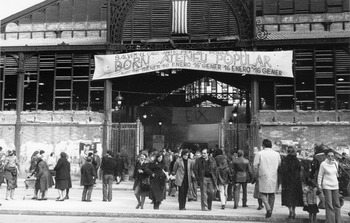
Thus, the area, whose buildings preserved in the archaeological site of Born formed a part, was buried underneath the esplanade, which was earmarked for military use and therefore excluded from any urban development until the nineteenth century. This use was revoked in 1802, when the citadel ceased to have any strategic purpose, and the esplanade was gradually turned into an avenue. From the mid-nineteenth century onwards, Barcelona began a process of modernizing the medieval streets of the city, demolishing the medieval and early modern walls (from 1854 onwards), which culminated in the construction of the Eixample district. One of the basic pillars of this process was the demolition of the citadel in 1841, which became a large, open public park, and the redevelopment of the area with new buildings and the construction of the Born market in 1878. All these changes had an enormous impact on the area's subsoil, except under the market itself, as its structure is based on light foundations (only 60 cm deep), which did not affect the ‘fossilized city of 1716. In 1921 the Born market was transformed into the wholesale fruit and vegetable market of the city. It was intended to be a temporary solution, but it remained a wholesale market until 1971. In architectural terms, the market drew its inspiration from the first European achievements with cast iron buildings, and today, together with several other public markets in the city, it is a scheduled example of this kind of public art nouveau architecture in Catalonia. In 1971, when the central market was moved to a larger wholesale and distribution centre outside the city, the plan was to demolish the old Born market and build a car park. According to Eduard Riu-Barrera (Reference Riu-Barrera2002), two unrelated factors helped preserve the market from this speculation. On the one hand the repercussions of the European controversy stirred by the decision in 1970 to gradually demolish the different halls of the great Parisian old market of Les Halles, which was in fact the model for the Born market itself, had an influence. On the other hand, the determination of the groups in Barcelona that had opposed the Francoist regime in Spain to fight to save buildings linked to local history from property speculators linked to the previous regime, was instrumental. Thus, in 1977 several campaigns were launched by residents and arts associations to prevent the demolition of the Born market and campaign to transform it into a public space (Hernández-Cordero, Reference Hernández-Cordero2017) (Figure 2).
‘Salvem el Casc Antic per al poble. Born Ateneu Popular. 16 Gener’ (January 1977).

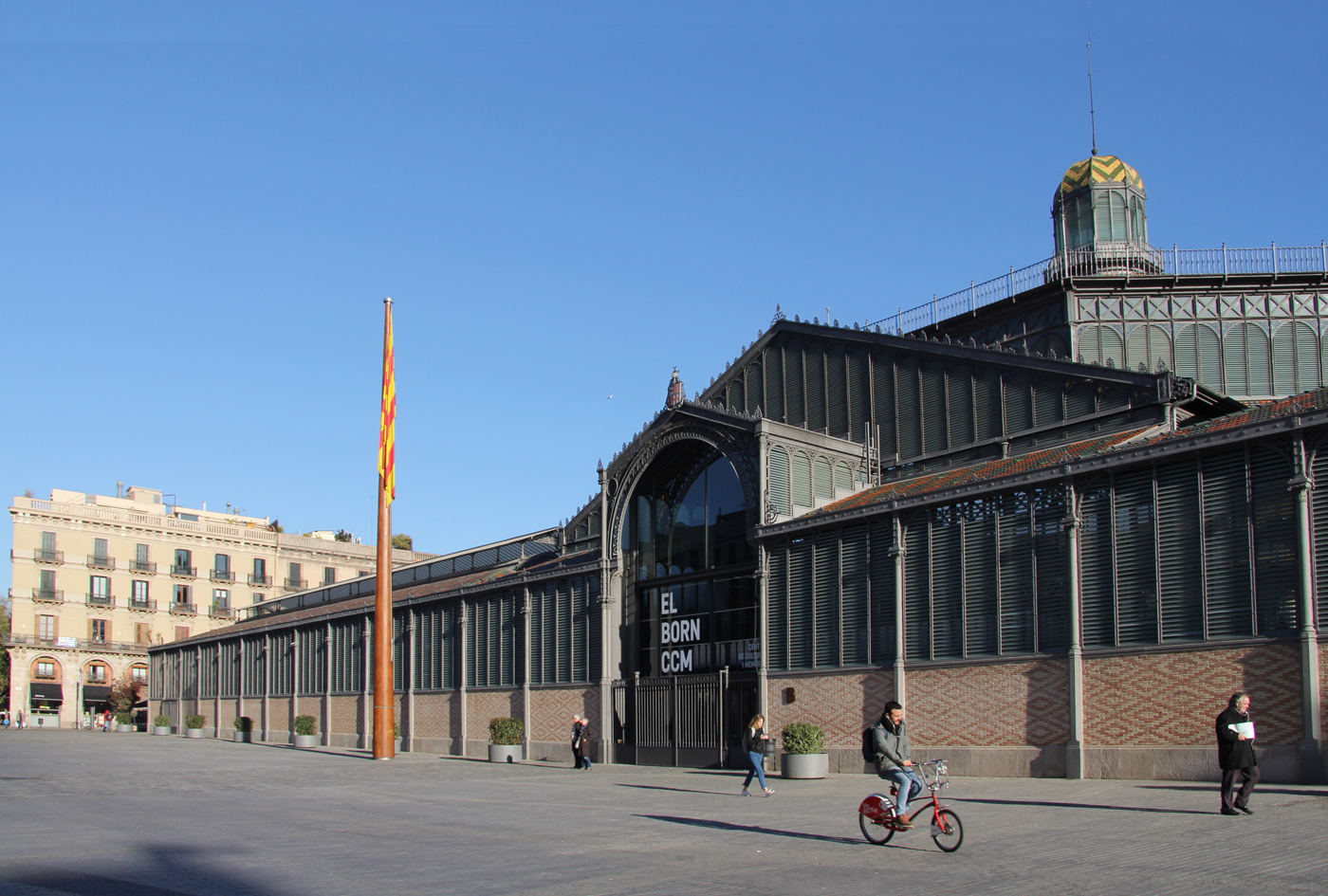
In 1979, the first democratically-elected city council after Francoism bowed to public demands to preserve the market, and the first architectural restoration work was carried out in 1981, though initially not to convert it into a centre for popular culture with a participatory project behind it (i.e. the ‘Ateneu Popular’). From this point the market hall was put to various, intermittent uses (as a venue for public concerts, popular festivities, exhibitions, and fairs) without the Barcelona City Council really knowing what to do with it in the long term. In the years following the Olympic Games in 1992, and as part of the new cultural policies of Barcelona led by the ICUB, there were (unsuccessful) talks about using the market for the first bookshop in Barcelona belonging to the French FNAC chain, and subsequently to house the Faculty of Communication of Pompeu Fabra University. As a result of these proposals, a series of archaeological trenches were dug, and they revealed the archaeological site and its historical potential. Faced by further protests and occupations of the market by local residents, Barcelona City Council finally decided in 1997, together with the Catalan government and the Spanish Ministry of Culture, to make it the home of the provincial library, demanded for decades from the Spanish government. Consequently, extensive archaeological excavations (2001–2002) were undertaken, making the archaeological, historical, and ideological importance of Born even clearer. After more than a year of public debate over its future and ten years of architectural conservation work, the former Born market once more opened its doors in September 2013, this time transformed into a cultural and exhibition centre with the remains of the city of 1714 restored and open to the public (Figure 3).
El Born main façade.

The Debate over Cohabitation
When a decision was taken in 1997 to house the Barcelona provincial library at Born, a restricted architectural competition was opened. The winning proposal involved first removing the walls of the former market, so altering the nature of its structure to turn it into an open space, and secondly digging out the subsoil to build the basement levels that were to function as storage space for the library. In view of such substantial changes to the original (scheduled) building, questions were asked as to whether the market at Born was really the best place for a library (e.g. Riu-Barrera, Reference Riu-Barrera2002), and whether there was in fact an institutional interest in installing a library there while undervaluing archaeology as a tool for cultural, social, and economic development. There is indeed a widespread perception, among the public and politicians in Barcelona, of museums and archaeological heritage sites as something more related to traditional (even conservative) forms of cultural policy, rather than an acknowledgement of their capacity to generate knowledge, contemporary culture, and social inclusion beyond identity discourses of a nationalistic kind (Antoni Nicolau, pers. comm.Footnote 1). In this context, the archaeological site at Born was seen as a disruptive factor in the city's economic and urban growth. Archaeology was an obstacle to be overcome, and rescue archaeology the legal and documentary way to remove this obstacle. The argument over the preservation or otherwise of Born was simply a further example of this local understanding of the uses of archaeology, with the peculiarity that the scale and the historical and political values of Born reshaped the debate. Professional groups, but also municipal institutions like the City History Museum of Barcelona (then known by the acronym of MHCB), faced the difficult task of convincing local politicians and town planners of the economic and social value of the archaeological site.
By 2001, as excavations progressed, the local authorities began to realize that the remains were more important than they had expected, and doubts started to emerge over whether they were compatible with the library project. This was the origin of the idea of cohabitation between stones and books, an idea which in the hands of municipal politicians and architects led to a new architectural proposal to show that compatibility was possible. Menéndez and Pastor (Reference Menéndez and Pastor2002) clearly explain the correlation of forces within Barcelona City Council and the Catalan government regarding this compatibility, and how their opinions were expressed in local newspapers, turning the issue of preserving the archaeological remains of Born into a matter for public debate leading to hundreds of letters to the editor. The press played a key role in this political and public debate by publishing opinion pieces by intellectuals, architects, historians, and politicians. Also published were leaks of decisions taken before technical reports or preliminary architectural designs had been drawn up, key interviews with people with a role in the decision-making process, and critical analyses of technical drafts. This is a debate where the party interests of those sitting on the City Council were openly or covertly mixed with municipal and private town planning interests, in which archaeology was seen as an obstacle to development in the city. Professionals in the historical field, on the other hand, saw the preservation of Born as the way to create a scientific space in which to find out more about the early modern city (e.g. Albareda et al., Reference Albareda, Beltrán de Heredia, Bernaus, Bohigas, Capella, Dupré, Fontana, García Cárcel, Garcia Espuche, Muñoz, Nicolau, Pardo, Rupert de Ventós and Ubero2002). In this context, the MHCB began to work discreetly but systematically to promote an exclusive use of the site of Born as a museum, by drawing up internal reports assessing its conservation as well as proposals to create a museum as the final purpose of the site (e.g. Nicolau, Reference Nicolau2002). Alongside this, the MHCB developed an active policy of acknowledging the social and economic value of archaeology to the city of Barcelona: it jointly organized five editions of the Congreso Internacional de Musealización de Yacimientos Arqueológicos (from 2004 to 2010), took part in the European APPEAR project on the enhancement of urban archaeological sites (Asensio et al., Reference Asensio, Colomer, Díaz Pedregal, Fohn, Hachimi and Hupert2006), staged an exhibition on archaeology and the city of Barcelona, and undertook the first (unpublished) studies of the direct and indirect impact of archaeological activity (i.e. the use of archaeological heritage as an added valued to its city branding) on the city's economy. All this was to argue for the cultural, social, and economic value of archaeology in Barcelona before the City Council, and consequently to advocate preserving Born as an archaeological museum site. Alongside this institutional work, professional groups working in archaeology, conservation, museums, and medieval history in Catalonia called unanimously for the remains to be preserved in situ, restored, and turned into a museum site, and the library to be relocated elsewhere in the city. The association of architects, on the other hand, was divided between those arguing for cohabitation and those preferring to relocate the library. Finally, the librarians intervened in the public debate, not to rate the architectural remains but to give their evaluation of the efficiency (or rather the inefficiency) of having a shared site. Gauging the opinions of local residents is more complex and diversified, because there are various residents’ associations representing different neighbourhoods, economic sectors, and streets, as well as those made up of long-term residents and those of newcomers resulting from recent processes of gentrification and property speculation in the district.
The final blow to cohabitation came in October 2002, when Barcelona City Council decided to preserve the whole archaeological site in situ and turn it into a museum site, moving the provincial library to another location. This was the beginning of ten years of building and engineering work, site conservation work, archaeological research, and construction of future exhibition spaces. However, these ten years were affected by delays and increases in the initial budget because the original architectural study had not taken structural problems in the market into account, and above all because changes in the political make-up of the City Council altered the ideological discourse of the project.
The National Epic
During the phase of public debate about the future of Born, a document produced by leading archaeologists, historians, architects, and museum experts proposed a particular way to present the finds by creating a new kind of cultural centre, ‘El Nou Born’ (‘The New Born’), based on three principles: it should be an urban history centre; it should be of a symbolic nature as a monument and memorial to urban populations who suffer wars; and it should become a public cultural activity centre (Albareda et al., Reference Albareda, Beltrán de Heredia, Bernaus, Bohigas, Capella, Dupré, Fontana, García Cárcel, Garcia Espuche, Muñoz, Nicolau, Pardo, Rupert de Ventós and Ubero2002). The first point ties in with the desire to turn the site into a modern history centre catering for new lines of research that finally discount the traditional idea that Catalonia under the Bourbons underwent a time of economic decadence, political decline, and cultural darkness, and to set the resulting situation after the war into the context of the early formation of the current nation-states in Europe. The second thread running through El Nou Born is directly linked to the intention of the Catalan socialist party and many Catalan intellectuals to stop Born from being turned into a ‘mausoleum of Catalanism’ (Muñoz, Reference Muñoz2002: 35) which glorified the victims of the Catalan defeat. To avoid this patriotic direction, El Nou Born was conceived as a place to remember everyday life in Barcelona in 1700, leaving the particulars of the siege of 1713–1714 in the background. However, in order not to forget the impact of the war, El Nou Born was also to recall the effects on urban populations of sieges and bombardment in wartime, something of which Barcelona has had dramatic and repeated experience since the seventeenth century, and which it shares with other places (e.g. Guernica in 1937, the London blitz in 1940–1941, the Sabra and Shatila massacre in 1982, the siege of Sarajevo in 1992–1996). Finally, the third thread of the project was to define Born as a multi-purpose centre for cultural activities to fit its opening to the cultural policies promoted by the City Council since the late 1990s. Hence the name ‘El Born Cultural Centre’ (El Born CC), without references to words like ‘museum’ and ‘archaeology’. Under this proposal, the archaeological remains would become the setting for other cultural and intellectual activities seen as more relevant to today's cultural concerns and city development in Barcelona.
In the middle of the process of implementation of ‘The New Born’ and as a result of the 2011 municipal elections, the City Council passed into the hands of a centre-right party professing Catalan nationalist ideas. The effect of this political change was soon visible in the Born project: a new director added a new museum discourse aiming to turn the Centre into a space devoted to the Catalan patriotic epic in relation to the events of 1714 and its political consequences for Catalonia. The ideological significance of Born is nothing new. During the debates prior to its preservation, some intellectuals and politicians gave the patriotic value of the site as sufficient reason for its conservation. This argument failed to gain enough traction to make it the sole reason for preserving the site in 2002 (Menéndez & Pastor, Reference Menéndez and Pastor2002; Gallego Vila & Romero Martínez, Reference Gallego Vila and Romero Martínez2016). Now, however, the political climate has changed not only on the City Council but also in the streets as a consequence of deteriorating relations between the Spanish and Catalan governments since June 2010 (Basta, Reference Basta2017; Colomer, Reference Colomer2017). In this context, Born easily became the new setting of Catalan pro-independence feelings, and the perfect historical scenario to recall and romanticize the struggles for freedom by the Catalan nation (Breen et al., Reference Breen, McDowell, Reid and Forsythe2016; Gallego Vila & Romero Martínez, Reference Gallego Vila and Romero Martínez2016; Hernández-Cordero, Reference Hernández-Cordero2017). In this context, the resignation of Albert Garcia Espuche as director of the centreFootnote 2 in October 2012 ushered in a new political management of the centre, interested now in turning Born into the ‘Ground Zero of the Catalans’ in line with an epic, ground-breaking vision (Torra, Reference Torra2013b; Torra, Reference Torra2013a). The signs were clear and immediate: the planned opening of a temporary exhibition about cast iron markets was replaced with one on the final battle and the fall of the city in 1714, entitled ‘Until We Prevail! The Siege of 1714’; changes were made to the panels on the rail running around the site to give more attention to the Catalans’ struggle to defend their freedoms; the exhibition and activity rooms in the centre were named after patriots who died on 11 September 1714; a pole, 17.14 m high, with a Catalan flag was installed in front of the centre; and the opening of Born CC in September 2013 was staged to coincide with the beginning of the institutional commemorations of the Tercentenary of the defeat of 1714 (see also Gallego Vila & Romero Martínez, Reference Gallego Vila and Romero Martínez2016). Accordingly, Born, like many other archaeological sites used by the politics of nationality, was valued for its ability to show material evidence of the idea of glorious ancestors and their achievements (in this case, a heroic defeat). This new political narrative for the archaeological site helped to approach the current situation with triumphalism, to promote the struggle for national self-determination, and to further the growth of national self-awareness. The political turn of Barcelona's city council happened to take place at the right moment to transform the archaeological site of Born into an emblematic historical place for the nationalistic discourses already in place in Catalonia.
In 2015, the municipal elections again brought about major changes, with the victory of a new left-wing political party, Barcelona En Comú, which rejects both Catalan and Spanish nationalistic discourses. Consequently, Born saw another ideological turnaround: a new director and management policy, and this time a new name, ‘Born Cultural and Memorial Centre’ (Born CCM), reflecting a desire to erase all national and nationalist symbols. Born CCM ceased to be devoted to a memorial of the War of the Spanish Succession, to now commemorate the ‘presence of radical movements, cultures, ethics and projects with a popular base’ (R. Vinyes, in Marimon, Reference Marimon2016), that is, the people who fought for democratic freedoms in the course of the twentieth century (see also Born CCM, 2017). As a result, the first temporary exhibitions were Franco, victòria, república: Impunitat i espai urbà 1960–1978 (Franco, Victory, Republic: Impunity and the City, 1960–1978) and El Born reivindicat, 1971–2001 (El Born claimed, 1971–2001). In this new framework of local contemporary history, the archaeology of 1714 again remained in the background; it became the accidental theatrical setting for other memories and other historical facts linked to political destruction and repression in Barcelona but the early modern past that actually made it an archaeological site museum was ignored.
Born and the Barcelona Model
The Born project was developed at a critical point in the Barcelona model, as the city model slowly lost its focus on the value of cultural resources for social and cultural cohesion, and turned towards the ‘biopolitics of the urban branding’ (Balibrea, Reference Balibrea2017), that is, when everything and everyone in the city was to be used to create an attractive brand, as Mascarell recognized in 2008 (cited by Balibrea, Reference Balibrea2017: 31), that sells a particular lifestyle, cultural attractiveness, and creativity. These circumstances of the city model, together with the politics of the moment, certainly marked the tone of the Born project from 2002 onwards, to the point of wondering both what its actual function was in the city's cultural policy, and how the model affected archaeological heritage management in Barcelona.
In terms of management, the Born centre might not be considered as part of the Barcelona model because it is not run according to a hybrid model of governance, publicly and privately owned and financed, and involving several professional players, like most of the city's cultural flagships (Rius-Ulldemolins, Reference Rius-Ulldemolins2014b). Born is managed exclusively by the ICUB and like many other museums owned entirely by the city council it is seen as a service to the city by local authorities. Furthermore, neither at the time of the ‘books vs stones debate’ (that is, library or archaeological site) nor afterwards while deciding how to manage it as a centre, did Born ever form part of the municipal concept of a cultural policy that sees urban regeneration processes as an opportunity to raise funds for cultural facilities and generate contemporary artistic and cultural clusters. In 1999, when the first Strategic Plan for the Cultural Sector in Barcelona was drawn up, the cultural clusters were located in the Raval area (Museu d'Art Contemporani de Barcelona, MACBA, https://www.macba.cat/; and Centre de Cultura Contemporània de Barcelona, CCCB, http://www.cccb.org/en#http://www.cccb.org/en) Montjuïc (Teatre Lliure, http://www.teatrelliure.com/en#http://www.teatrelliure.com/en; and Mercat de les Flors, http://mercatflors.cat/en/#http://mercatflors.cat/en/), and Glòries (Teatre Nacional de Catalunya, https://www.tnc.cat/#https://www.tnc.cat; and the Auditori https://www.auditori.cat/en/home#https://www.auditori.cat/en/home). The (unpublished) 2006 Plan set up the Barcelona Art Factories (http://ajuntament.barcelona.cat/fabriquescreacio/en) in former city textile factories converted into spaces for the creative arts (circus, dance, and theatre) run together with a range of local organisations, and this initiative was also exploited to transform the old industrial area of Poblenou into an innovative district, the so-called 22@ (http://www.22barcelona.com/index.php?lang=en) that offers modern spaces for the strategic concentration of intensive knowledge-based activities (research, ICT, technology, design, and business). Born was never part of these structural plans for cultural facilities intended to foster social change, and was only considered as another element of the municipal network of museums. This is probably linked to a wider perception among politicians and cultural managers of museums and heritage places as something more related to traditional forms of culture rather than an acknowledgement of their capacity to generate contemporary critical thinking and social inclusion. But it is also attributable to a common understanding among professionals that archaeology is a processual practice, and therefore beyond city politics (Figure 4).
Districts of Barcelona. The neighbourhoods of Poblenou, Glòries and 22@ are part of the Sant Martí district, and Raval and Ribera are part of the Ciutat Vella district. The cultural facilities located in Raval, Glòries, and Montjuïc are marked with a star (according to Pla Estratègic del Sector Cultural de Barcelona, 1999). Those located as assigned by the second Pla Estratègic del Sector Cultural de Barcelona (2006) are marked with a cercle.

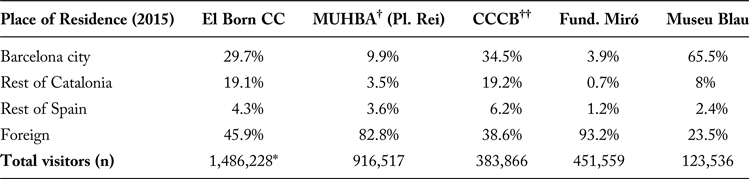
If Born did not form part of the cultural topography of the Barcelona model either in terms of administrative management or as a facilitator for urban regeneration in its neighbourhood, it did form an integral part of the municipal cultural museum of the Barcelona model as conceived by the ICUB in the late 1990s. Seen as a municipal museum, it performs the functions of a local service as assigned to these municipal facilities in the municipal Museum Plan of 1997: to switch from containers of heritage to generators of culture. Even this has not clearly defined what archaeological culture was going to generate (beyond exhibitions) and how archaeology connects with creative culture. Today, like most city museums (see Table 1), Born's main function is to enhance the cultural tourism industry. In 2015, about 11 million tourists visited Barcelona, 79 per cent of them of international originFootnote 3. Tourism in Barcelona is a strong industry, spinning off a diverse range of economic activities, from premier hotels to Airbnb homes, from exhibition design companies to freelancers in heritage conservation, facilitating a big events industry, which in its turn attracts congresses (half a million delegates in 2015) and human capital through the location of headquarters of international corporations, creative entrepreneurs, and European bodies.
Proportions of visitors to Barcelona's main cultural venues.

Source: GESOP, 2016: 26. †Museu d'Historia de Barcelona. †† Centre de Cultura Contemporània de Barcelona. *This is an at-door automatic account of visitors and includes a correction of −13 per cent for those people who just pass through the Centre (e.g. passers-by and service providers) but includes participants in all cultural activities organized by the centre.
In this city branding model, public and private museums, exhibition centres and heritage sites received about 29 million visitors, and Born CC is ranked as the fifth most-visited (Ajuntament de Barcelona, 2016). However, other variables must be taken into account. For example, visitors are mainly local residents from Barcelona and the rest of Catalonia (GESOP, 2016), the current number of visitors to the permanent exhibition and to the site dropping to 46,607 and 5,754 respectivelyFootnote 4, and the largest number of visitors coming in September, precisely when the National Day commemorates the fall of Barcelona in 1714 (Born CCM, 2017). It thus seems that Born plays a minor role in the international tourist business, as is also reflected in the activities offered, which are very locally oriented. In fact, the events of 1714 are seen in Catalan terms, losing all references to their European relevance as part of the formation of today's nation-states and as a milestone in European history: the siege of Barcelona was the last battle that finally concluded what the Treaty of Utrecht of 1713 established geo-politically for Europe and the Americas. Born thus offers the material culture and a visual setting of 8000 m2 not only of a Catalan/Spanish conflict, but of an event of European interest. Seeing it simply as a museum site with an ideological (nationalistic) discourse of interest only to a Catalan audience is missing its European dimension, both in the past and in the present.
The narrative of the Born management project within the Barcelona model reveals another symptomatic fact, which is how archaeology is understood by local politicians and city managers, and hence its role in Spain (if not Europe) in recent decades. Since the 1990s, archaeology in Spain has developed mainly as contract archaeology, a commercial activity provided as a service in conjunction with the construction sector. This shift is to be understood as part of current neoliberal policies in which the role of local and regional administrations is to create a fruitful environment, that is, subsidies and infrastructure for entrepreneurs to pursue their industrial activities. In the case of archaeology, the combination of these two circumstances led to the creation of innumerable contract archaeology companies and freelancers, most (if not all) of whose activity has been rescue archaeology, with few heritage management activities or other visions of heritage oriented towards social criticism being pursued (Parga-Dans et al., Reference Parga-Dans, Barreiro and Varela-Pousa2016). This work, both in museums and on sites, is still undertaken by local/national authorities, and then becomes the perfect setting for politics (especially in Spain) following the logic of party interests, identity politics, and building up tourism. In this context, there is a need for archaeology professionals to discuss the position of the archaeological heritage in the current political debates on cultural policies and city governance, above and beyond excavation, in order to bring out the cultural interest of the heritage for the development of society.
To summarize, a shared vision of archaeology as a service to urban development activities, a sense that local heritage is part of the service provided by the city council to facilitate other economic and the tourism-driven approach to cultural activities in Barcelona, and the failure to posit the archaeology of 1714 itself as a starting point for a critical debate on today's (Catalan) society have relegated archaeology to a secondary role in the Barcelona model. This marginality was clearly borne out in Born by the fact that its transformation into a cultural centre was implemented without much real regard for the archaeological site itself and the material cultural knowledge it offers, other than to use it to illustrate documentary sources (Hernàndez Cardona, Reference Hernàndez Cardona and Arrieta2015; Gallego Vila & Romero Martínez, Reference Gallego Vila and Romero Martínez2016). Its chief curator until 2012 stated at the Centre's opening event that ‘the stones add excitement but 95 per cent of the information comes from the [archive] documentation’ and that the objects recovered were only chosen for the exhibition on the basis of their attractiveness (TV3, 2014). The result is a centre increasingly distanced from the ‘stones’ that are its origin, with archaeological remains presented as the (albeit spectacular) setting for other cultural interests and, in every sense, other political and social battles.
Conclusions
Born raises several issues about public views of archaeology in Barcelona that might be of interest for other European cities aiming to include heritage as part of their cultural governance in the context of today's city branding trends. First, it is worth noticing that when Barcelona's city managers and politicians advocate for ‘knowledge creation through culture’, they envisage only contemporary culture. Cultural heritage is perceived only a source for tourism. Barcelona's heritage has a greater or lesser impact on its cultural policy, except to the extent that it generates economic activity in the form of rescue archaeology, the running of temporary exhibitions, and visitor management. Local heritage is a public asset at the service of other cultural enterprises and touristic events, but not a source of R&D or of social action (after Byrne, Reference Byrne, Fairclough, Harrison, Jameson and Schofield2008). Secondly, the political use of the site has been envisaged by all local stakeholders, nationalist and otherwise, official and alternative, who clearly see spaces for memory as social settings for cultural and social outputs in the present. This is not the case for most archaeologists who opted for neutrality, professionalism, and academic output. In this context, the heritage of 1714 might have served as a starting point to create contemporary debates on heritage and memory today in Barcelona. Instead it has become a local and processual end-point project closed in on itself. Archaeologists and historians succeeded in preserving the archaeological Born but its value as a heritage site relevant to contemporary local society was eclipsed by the development of ‘brand Barcelona’, which has led to the gradual gentrification and touristification of the whole district. El Born is now a centre for contemporary memory whose use as archaeological heritage is still subject to decisions. It remains to be seen how it will develop, with the appointment of a new director in May 2016. Meanwhile, as of the end 2017, the Barcelona provincial library is yet to be built
Born raises also several issues directly related to the politics of archaeological heritage as a public resource. This article has focused one of these threads, the role played by the archaeological heritage of Born in the cultural governance under the Barcelona model. However, in order to explore these dynamics, it has been necessary to explain, in a way not previously attempted, the vicissitudes of the Born project from 2000 to 2013. In doing this, several ‘collateral’ but structural issues have come up and form threads that may be worth following. Examples include the rich archaeological evidence of 1714 and how this material culture fits into, or redefines, the history of modern Europe; the nature of public debates on the conservation of cultural heritage in Barcelona (e.g. what actually matters, or what it represents, both for the public and for local politicians); the current dynamics of participation in local neighbourhoods in the planning of cultural projects; the politics of identity in Catalonia and Spain behind patriotic heritage (these are increasing regional debates in the context of ‘unity in diversity’ European's leitmotiv, but also on the actual articulation of this leitmotiv in relation to national or local heritages). Further goals include investigating the politics of memory and the consequent heritization processes in urban landscapes; the relation between archaeological heritage and cultural tourism beyond short-term economic benefits; traditional perceptions of the role of museums and archaeology in cultural governance among local authorities; the value and uses of archaeological heritage preservation and management in urban development today in post-industrial European cities, especially in the context of city branding; etc. These are issues intrinsically present in the Born project during its ten years of management. The way that these questions have been discussed and settled in Barcelona is seldom representative of the city and cannot be explained without acknowledging its idiosyncrasy inside the Catalan political, economic, and social situation. However, many urban archaeologists working in Europe will recognize these issues because they result from the practice of urban heritage management after the Valletta Convention. ‘Malta archaeology’ (Schlanger & Aitchison, 2010) seems to have brought to us a kind of dual situation: on the one hand, contract archaeologists can barely include the desired social and critical dimensions during or after excavations when working under the constraints of the construction industry, and have little voice when working for the authorities if they have no role in the latter's political positions (including the difficulty of implementing theoretically well-intentioned heritage management practices in particular administrative and political settings). On the other hand, other urban (cultural) stakeholders have been deciding on the social and cultural uses of archaeological heritage, transforming it into new urban settings that are not necessarily aligned with the critical views of professionals and academics concerning the meanings and uses of cultural heritage. In this context, European public archaeology will benefit from debates on the active social and cultural roles of heritage management within the framework of ‘Malta archaeology’. The Born project is a kaleidoscopic example that can provide many counter-arguments regarding the perils and potentials of managing urban archaeological heritage projects, if it could be seen beyond the narratives of nationalism or patriotism in cultural heritage.
Acknowledgements
This article has benefitted from comments by Paloma González Marcén (Universitat Autònoma de Barcelona) and Antoni Nicolau (Kultura), and two anonymous referees. I thank also the Born CCM, the City History Museum of Barcelona/Museu d'Historia de Barcelona (MHCB/MUHBA), the Servei d'Arqueologia de Barcelona, and those involved in the El Born Project (2000–2013) for their professionalism and teamwork during the years we worked together there.