Among typically developing children, mealtime difficulties are prevalent, affecting between 24–45% of children (Blissett, Meyer, Farrow, Bryant-Waugh, & Nicholls, Reference Blissett, Meyer, Farrow, Bryant-Waugh and Nicholls2005). They represent one of the most common reasons parents seek help from health professionals (Davies et al., Reference Davies, Satter, Berlin, Sato, Silverman, Fischer and Rudolph2006). Feeding difficulties are not easily resolved and influence the establishment of lifelong food preferences (McDermott et al., Reference McDermott, Mamun, Najman, Williams, O'Callaghan and Bor2008). Despite the high prevalence in young children, little attention has been given to feeding difficulties (Nicholls, Christie, Randall, & Lask, Reference Nicholls, Christie, Randall and Lask2001), particularly in typically developing children (Lewinsohn et al., Reference Lewinsohn, Holm-Denoma, Gau, Joiner, Striegel-Moore, Bear and Lamoureux2005; Wright, Parkinson, Shipton, & Drewett, Reference Wright, Parkinson, Shipton and Drewett2007). Studies have shown problems in children without a diagnosed feeding disorder to be similar to those of children with diagnosed clinical feeding problems in terms of frequency, types of behaviours (Sanders, Turner, Wall, Waugh, & Tully, Reference Sanders, Turner, Wall, Waugh and Tully1997) and caregiver stress (Greer, Gulotta, Masler, & Laud, Reference Greer, Gulotta, Masler and Laud2008).
Existing literature has strongly emphasised the relationship between dysfunctional parent-child behavioural interactions at mealtimes and feeding difficulties (e.g., Nicholls et al., Reference Nicholls, Christie, Randall and Lask2001; Sanders, Patel, le Grice, & Shepherd, Reference Sanders, Patel, le Grice and Shepherd1993), but this has largely focused on children with disabilities and/or chronic illness (Crist & Napier-Phillips, Reference Crist and Napier-Phillips2001) or obesity (Williams, Hendy, & Knecht, Reference Williams, Hendy and Knecht2008), or those with severe feeding difficulties requiring inpatient admission (e.g., Borrero, Woods, Borrero, Masler, & Lesser, Reference Borrero, Woods, Borrero, Masler and Lesser2010). Relatively little is known about child and parent mealtime behaviours in typically developing children (de Moor, Didden, & Korzilius, Reference de Moor, Didden and Korzilius2007; Orrell-Valente et al., Reference Orrell-Valente, Hill, Brechwald, Dodge, Pettit and Bates2007), including: limited validated self-report and observational methods (Demir et al., Reference Demir, Skouteris, Dell'Aquila, Aksan, McCabe, Ricciardelli and Baur2012); a paucity of data on the correspondence between self-report and observed parent and child behaviour (Demir et al., Reference Demir, Skouteris, Dell'Aquila, Aksan, McCabe, Ricciardelli and Baur2012; Gardner, Reference Gardner2000; Hurley, Cross, & Hughes, Reference Hurley, Cross and Hughes2011; Locke & Prinz, Reference Locke and Prinz2002), especially in a mealtime context; and limited understanding of key predictors of child and parent mealtime behaviours, including the role of parental cognitions (Blissett et al., Reference Blissett, Meyer, Farrow, Bryant-Waugh and Nicholls2005). In addition, the relationship between more general parenting style and mealtime specific parenting behaviour is relatively unexplored. In the context of obesity, general parenting style has been linked with lifestyle management parenting practices (Morawska & West, Reference Morawska and West2013), and in the context of mealtimes it has shown modest correlations with child mealtime behaviour (e.g., de Moor et al., Reference de Moor, Didden and Korzilius2007). Multimethod assessments are cited as best practice in research and clinical work (Snyder et al., Reference Snyder, Reid, Stoolmiller, Howe, Brown, Dagne and Cross2006); however, there is limited research on the correspondence between different types of measurement approaches. For example, correlations between observed and self-reported behaviour are often modest (e.g., Hill, Maskowitz, Danis, & Wakschlag, Reference Hill, Maskowitz, Danis and Wakschlag2008) and this has implications for the assessment and interpretation in both clinic and research contexts, particularly when methods show divergent findings.
The use of particular parenting strategies at mealtimes differentiates families of children with and without feeding difficulties (e.g., Crist & Napier-Phillips, Reference Crist and Napier-Phillips2001), and aversive mealtime parenting practices are significant predictors of problematic mealtime behaviours (e.g., Sanders, Patel et al., Reference Sanders, Patel, le Grice and Shepherd1993). Inadvertent reinforcement of inappropriate child behaviour by the use of strategies such as coaxing, providing alternate meals and allowing food between meals (Crist & Napier-Phillips, Reference Crist and Napier-Phillips2001; Williams et al., Reference Williams, Hendy and Knecht2008) or failing to offer unfamiliar food (Koivisto & Sjoden, Reference Koivisto and Sjoden1996); and negative strategies such as berating or threatening the child, force feeding or physically prompting the child to eat (Crist et al., Reference Nicholls, Christie, Randall and Lask2001; de Moor et al., Reference de Moor, Didden and Korzilius2007) have been associated with selective eating. There is some evidence that mealtime parenting strategies are significantly related to food refusal (Johnson & Harris, Reference Johnson and Harris2004) and that parenting mealtime practices are more powerful than homeostatic mechanisms related to satiety (Mrdjenovic & Levitsky, Reference Mrdjenovic and Levitsky2005). Furthermore, treatment approaches to feeding disorders, based on a functional analytic approach with a focus on reducing negative reinforcement of inappropriate mealtime behaviours in combination with other behavioural strategies, are effective in improving children's eating and behaviour (Adamson, Morawska, & Sanders, Reference Adamson, Morawska and Sanders2013; Bachmeyer, Reference Bachmeyer2009; Linscheid, Reference Linscheid2006; Morawska, Adamson, Hinchliffe, & Adams, Reference Morawska, Adamson, Hinchliffe and Adams2014).
In the wider parenting literature, parental cognitions are recognised as an important influence on parenting behaviour that ultimately impact children's outcomes (Grusec & Ungerer, Reference Grusec, Ungerer and Kucyzynski2003; Holden & Buck, Reference Holden, Buck and Bornstein2002). Parental cognitions about eating and mealtimes specifically may act as a mechanism in the maintenance of feeding difficulties, as behavioural and affective responses determine parents’ responses to mealtime misbehaviour and food refusal (Berlin, Davies, Lobato, & Silverman, Reference Berlin, Davies, Lobato and Silverman2009; Chavira, Lopez, Blacher, & Shapiro, Reference Chavira, Lopez, Blacher and Shapiro2000). Feelings of anxiety, worry, desperation and frustration have been reported in cases of feeding difficulties (Douglas, Reference Douglas, Southall and Schwartz2000) and have been identified as a key mediator in the process of feeding difficulties (Gueron-Sela, Atzaba-Poria, Meiri, & Yerushalmi, Reference Gueron-Sela, Atzaba-Poria, Meiri and Yerushalmi2011). These studies suggest that in the feeding context, parents’ dysfunctional beliefs can negatively affect their parenting behaviour and in turn impact on child behaviour. For example, a parent's anxiety about whether their child is eating a sufficient quantity of food may lead them to remove a non-preferred food and offer preferred foods when the child refuses to eat, negatively reinforcing the refusal behaviour.
Specific Aims and Hypotheses
The purpose of this study was first to examine the relationship between observed and parent-reported behaviour in families of typically developing children with and without feeding difficulties. To gain further insight into the relationship between observed and reported behaviours at mealtimes, the study examined factors predictive of observed child and parent mealtime behaviour, including the role of parental cognitions and more general non-mealtime parent and child behaviour. We hypothesised that:
• H1: Self-reported parent mealtime behaviour would be significantly related to observed parent mealtime behaviour.
• H2: Parent-report of more child behaviour problems would be significantly related to observed child mealtime behaviour problems.
• H3: Self-reported parent mealtime behaviour and parent beliefs would predict observed parent mealtime behaviour after taking into account child age and child behaviour.
• H4: Self-reported and observed parent mealtime behaviour and parent cognitions would predict observed child behaviour after taking into account child age and parent-reported child behaviour.
Method
The data used for the present study were obtained from a larger project examining differences between children with and without mealtimes difficulties (Adamson & Morawska, Reference Adamson and Morawska2014; Adamson, Morawska, & Wigginton, Reference Adamson, Morawska and Wigginton2015), which demonstrated a number of differences between parents with and without feeding problems. Parents were recruited to the study if they had concerns about their child's mealtime behaviour and were seeking help for this (mealtime problem group), or if they were not concerned nor seeking help with mealtimes (control group). A battery of self-report tests, home diaries and observations were completed by the parents, a subset of which was utilised in the current study. In the original sample there were 201 parents: 105 (52.2%) control and 96 (47.8%) mealtime problem group. Of the control group, 33 (31.4%) were observed and all meals were reported as typical. Of the mealtime problem group, 74 (77.1%) were observed and of these, 67 (90.5%) meals were reported as typical. For the purposes of this study, only those cases where meals were observed and the meals were rated by parents as typical were included. In this final sample of 100, children were older than in the original sample, M(SD) = 36.56 months (12.81) versus 30.96 (10.65), t(1,199) = −3.37, p = .001, and mothers were also older than in the overall group, M(SD) = 35.40(4.23) versus 33.97(4.89), t(1,199) = −2.15, p = .033. There were no other differences in demographic variables. We chose to combine the mealtime problem and control groups in the analyses in order to assess the broad range of child mealtime behaviours in typically developing children.
Participants
Participants were 100 parents (n = 33 and 67, control and mealtime problem respectively). There were 56 boys in the sample, and the majority (94%) of participants indicated they were of White ethnicity. Most were married or in a cohabiting relationship (92%), and the majority of children lived in their original family (91%). Two thirds (66%) of mothers held a university degree, while 18% had completed high school only, and 14% held a college or trade certificate. Most (89%) families had met their essential expenses in the previous year, and the majority could afford most (40%) or some (52%) of the things they really wanted after paying for essential expenses. The only demographic difference between mealtime problem and control parents was that children in the mealtime problem group were older, M(SD) = 39.67(13.20) versus 30.24 (9.31), t(1,98) = −3.67, p < .001.
Measures
Parents completed a suite of measures electronically. This included demographic information (e.g., child's age, family composition, parental education and employment), including items to assess medical and developmental issues, and parental concern about, and perceived need for, assistance regarding feeding.
The Parenting Scale (PS; Arnold, O'Leary, Wolff, & Acker, Reference Arnold, O'Leary, Wolff and Acker1993) is a 30-item questionnaire measuring three dysfunctional discipline styles: laxness (permissive discipline), overreactivity (authoritarian discipline, displays of anger), and verbosity (overly long reprimands or reliance on talking). Each item has a more effective and a less effective anchor, and parents indicate on a 7-point scale which number better represents their behaviour. In the current study, the total score was used in analyses and internal consistency was good (α = .89), with higher scores indicating greater levels of dysfunctional parenting. The scale has good test–retest reliability for the total score (r = .84) and has been found to distinguish clinical and non-clinical populations (Arnold et al., Reference Arnold, O'Leary, Wolff and Acker1993).
Child feeding behaviour, mealtime parenting strategies and parental cognitions were assessed via the 90-item Parent and Toddler Feeding Assessment (PATFA; Adamson & Morawska, Reference Adamson and Morawska2008). Parents rated the frequency of 21 common mealtime misbehaviours (e.g., spitting food out) on a 5-point frequency scale, and whether each behaviour was problematic using a yes/no format, followed by their confidence in managing each behaviour on a 10-point scale (higher scores indicating greater confidence). Parents then rated how frequently they used 30 strategies at mealtimes (e.g., eating with the child) on a 5-point frequency scale. Finally, parents rated their level of agreement with 35 statements about feeding on a 5-point scale (high scores indicating stronger agreement). For the purpose of this study, responses were summed to yield four summary scores, with higher scores indicating more problems: the frequency of child feeding difficulties (Child Frequency); the number of feeding problems identified (Child Problem); the frequency of maladaptive mealtime parenting strategies (Parent Strategies); and agreement with unhelpful parental cognitions about mealtimes (Parent Cognitions). The PATFA has good test–retest reliability (r = .68–.89; Adamson & Morawska, Reference Adamson and Morawska2008) and in the current sample demonstrated good internal consistency (α = .86, 90, .78, and .85, respectively).
Child behaviour was assessed using the Eyberg Child Behaviour Inventory (ECBI; Eyberg & Pincus, Reference Eyberg and Pincus1999), a 36-item measure of disruptive behaviour in children 2–16 years. Parents rated the frequency of disruptive behaviours on a 7-point scale (Intensity) and whether each was a problem for the parent (Problem) using a yes/no format, with higher scores indicating more problems. The ECBI is a measure sensitive to change, with good test–retest reliability (r = .86; Eyberg & Robinson, Reference Eyberg and Robinson1982) and internal consistency in the current study (α = .92 and .90 for the Problem and Intensity scales respectively).
An evening meal was filmed at home at a time convenient for families to ensure that behaviour was as typical as possible, and prior to the visit parents were instructed to prepare a typical meal. On the day of the visit, they were reminded to use their regular approach and stay on camera as much as possible. Observers set up the camera in an unobtrusive location and interacted minimally with the participants before moving to another room in the house for the duration of the observation. The coding started once the child was called to the table or when food was presented and ended either when the child left the table for the last time or the main meal was removed from the child. At the end of the observation, parents indicated whether the meal was typical in terms of the child's behaviour or the setting, and a second attempt was scheduled if the mealtime was reported to be atypical.
Observations were analysed by a coder blind to the group with the Mealtime Observation Schedule (MOS; Sanders, Le Grice, & Turner, Reference Sanders, Le Grice and Turner1993). The MOS employs a partial interval time-sampling procedure to record the presence of 16 child behaviours and 14 parent behaviours in consecutive 10-second intervals. This yielded four summary measures regarding the percentage of intervals in which: the child demonstrated appropriate (e.g., eating; Child positive) or inappropriate behaviour (e.g., noncompliance; Child negative); the parent displayed positive (e.g., praise; Parent positive) or aversive behaviour towards the child (e.g., negative physical contact; Parent negative). The MOS is an established method of coding that has good interrater reliability (mean k: parent codes = .83; child codes = .8; Sanders, Patel et al., Reference Sanders, Patel, le Grice and Shepherd1993), and has been shown to differentiate children with and without feeding difficulties (Sanders, Patel et al., Reference Sanders, Patel, le Grice and Shepherd1993) and to capture post-intervention change (Turner, Sanders, & Wall, Reference Turner, Sanders and Wall1994). Coders were trained in the MOS over several sessions and met periodically throughout coding to minimise drift. Approximately 20% of tapes (within each group) were randomly allocated to a second coder and interrater reliability values calculated based on correlations between raters in terms of the presence or absence of each code in each interval. Kappa was not appropriate as base rates of behaviour codes were low across participants (Watkins & Pacheco, Reference Watkins and Pacheco2000). Interrater correlations for the summary codes were moderate to high (Child positive = .49; Child negative = .49; Parent positive = .45; Parent negative = .79).
Procedure
Ethical clearance for the study was obtained in accordance with the ethical review processes of the University of Queensland and the National Health and Medical Research Council guidelines. Participants were recruited via advertisements at online parenting forums, primary health physician clinics, child-care centres, primary schools and play groups. These advertisements targeted parents who either had problems with their child's feeding and wanted help for these problems, or parents who did not have problems with feeding and were not seeking help. Parents who responded to the advertisement were contacted by phone in order to determine their eligibility and obtain informed consent. Participants were considered to be eligible if they were not currently accessing professional help for their child's behaviour or feeding, had no medical or developmental conditions, and the child was aged between 1.5 and 6 years. Parents completed the self-report measures and the observation was scheduled. Parents were then thanked for their participation by either receiving a free mealtime intervention if they were concerned about and seeking assistance for feeding difficulties (mealtime problem), or a movie/food voucher if they were not experiencing mealtime difficulties (control). Children in the mealtime problem group were not diagnostically assessed, as we were not seeking a sample of children with DSM-IV or ICD-10 diagnoses of feeding disorders.
Statistical Analyses
All analyses were conducted on the total combined sample and, as noted earlier, the only difference demographically between the control and mealtime problem groups was that the children in the mealtime problem group were older. In this study, we were interested in examining the broad range of child and parent mealtime behaviours. Our previous data has shown differences between groups in mealtime behaviour and parenting (Adamson & Morawska, Reference Adamson and Morawska2014), but in order to ensure sufficient power and diversity in this study we combined the groups. Hierarchical multiple regression was used to test the hypotheses and we controlled for age in the first step of all the regression analyses, and for child behaviour at step 2 to control for the effects of parental perception of behaviour. Relevant predictor variables were entered at step 3 of the analyses. We checked to ensure that patterns of results held for both the control and mealtime problem groups; however, sample size for these analyses was small given the number of predictors. Nevertheless, the pattern of results was largely similar in both groups, thus we combined the groups in order to broaden the range and generalisability of the findings.
Results
The data were screened for accuracy of data entry, missing values and outliers. The percentage missing for any item did not exceed 15.42% and in most cases items had no or few missing values. Missing items were substituted with the serial mean by group (mealtime problem or control) where less than 25% of the scale was missing, to facilitate calculation of total scores. Inspection of frequency histograms, z scores and Mahalanobis distance statistics suggested no univariate or multivariate outliers.
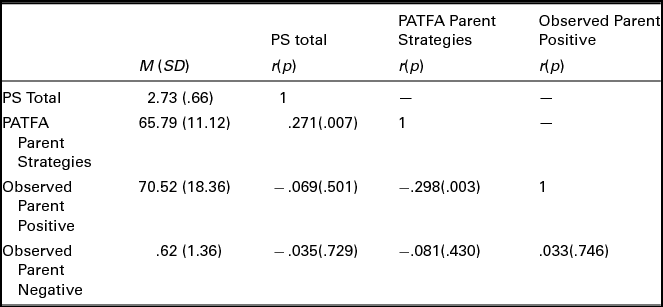
Table 1 shows the correlations between self-reported and observed parenting behaviour. As expected there was a significant correlation between observed positive parent mealtime behaviour and self-reported mealtime parenting behaviour (PATFA; H1). While self-reported general parenting (PS) and mealtime parenting (PATFA) were significantly correlated, PS scores were not significantly associated with observed mealtime parenting. Observed parent negative behaviour was not significantly correlated with any other variable though instances of this were rare across the sample, ranging from 0–8% of intervals.
Correlations Between Observed and Self-Reported Parenting Behaviour
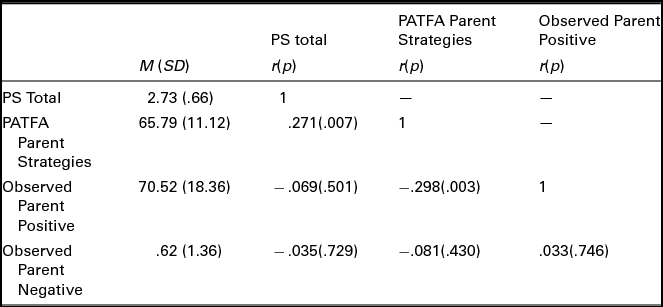
Note: PS = Parenting Scale; PATFA = Parent and Toddler Feeding Assessment.
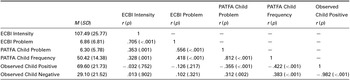
Table 2 shows correlations between parent-reported child behaviour and observed child behaviour. As can be seen from the table, parent reported child mealtime behaviour was significantly related to observed child mealtime behaviour (H2), while general behaviour was not related to observed child mealtime behaviour.
Correlations Between Observed and Parent-Reported Child Behaviour

Note: ECBI = Eyberg Child Behaviour Inventory; PATFA = Parent and Toddler Feeding Assessment.
Predictors of Observed Parent Behaviour
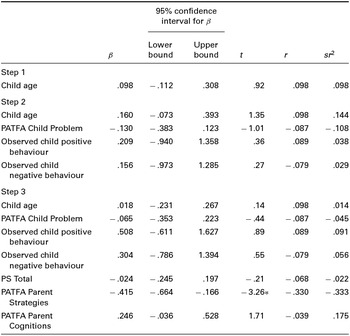
A hierarchical multiple regression was used to test the hypothesis that self-reported parent mealtime behaviour and parent beliefs would predict observed parent mealtime behaviour after taking into account child age and child behaviour (H3). Child age was entered at step 1, observed and parent-reported (PATFA Child Problem) child mealtime behaviour at step 2, and measures assessing reported parenting style (PS Total), mealtime parenting behaviour (PATFA Parent Strategies) and parent cognitions (PATFA Parent Cognitions) were entered at step 3. There was no significant relationship between child age and observed positive parent behaviour at step 1, R = .098; F(1,87) = .851, p = .359. The standardised regression coefficients (β), as well as their 95% confidence intervals and tests of significance, zero-order and squared semi-partial correlations for steps 1, 2 and 3 are shown in Table 3. Addition of observed and parent-reported child mealtime behaviour at step 2 did not significantly contribute to prediction, F change(3,84) = .681, p = .566. Addition of parent-report variables of parenting style, mealtime parenting behaviour and parent cognitions at step 3 significantly contributed to prediction of observed positive parent behaviour, F change(3,81) = 3.97, p = .011. All of the variables accounted for 15.7% of the variance (R adj2 = .08) in observed positive parent behaviour, F(7,81) = 2.16, p = .047. The only variable significantly related to observed positive parent behaviour was self-reported parenting mealtime behaviour, as indicated by a significant t value and confidence intervals, which do not span zero. Higher levels of dysfunctional mealtime parenting behaviour were associated with lower levels of observed positive mealtime behaviour.
Results of the Hierarchical Multiple Regression Predicting Observed Positive Parent Behaviour

Note: *p < .05; Note: PATFA = Parent and Toddler Feeding Assessment; PS = Parenting Scale
Predictors of Observed Child Behaviour
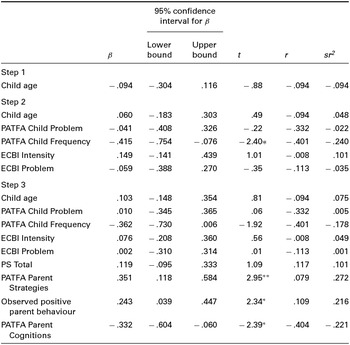
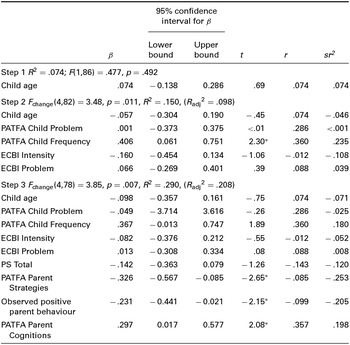
A second hierarchical multiple regression was used to test the hypothesis that self-reported and observed parent mealtime behaviour and parent cognitions would predict observed child behaviour after taking into account child age and parent-reported child behaviour (H4). Child age was entered at step 1, parent-reported child behaviour (ECBI) was entered at step 2, and self-reported (PS Total) and observed (PATFA Parent Strategies) positive parent behaviour and parental cognitions (PATFA Parent Cognitions) were entered at step 3. There was no significant relationship between child age and observed positive child behaviour at step 1, R = .094; F(1,86) = .770, p = .383. The standardised regression coefficients (β), as well as their 95% confidence intervals and tests of significance, zero-order and squared semi-partial correlations for steps 1, 2 and 3 are shown in Table 4. Addition of parent-reported child mealtime behaviour at step 2 significantly contributed to prediction, F change(4,82) = 4.27, p = .003. Child age and parent-reported child mealtime behaviour together accounted for 18% of the variance (R adj2 = .13) in observed positive child behaviour, F(5,82) = 3.59, p = .005. Only the frequency of reported child mealtime behaviour problems was significantly related to observed positive child behaviour, as indicated by significant t values and confidence intervals, which do not span zero. Addition of self-reported and observed positive parent behaviour and parent cognitions at step 3 significantly contributed to prediction of observed positive child behaviour, F change(4,78) = 4.48, p = .003. All of the variables accounted for 33.3% of the variance (R adj2 = .26) in observed positive child behaviour, F(9,78) = 4.32, p < .001. Self-reported parenting behaviour and observed positive parent behaviour, as well as parental cognitions, were significantly related to observed positive child behaviour, as indicated by a significant t values and confidence intervals, which do not span zero. The pattern of results was identical for observed negative child behaviour, and shown in Table 5.
Results of the Hierarchical Multiple Regression Predicting Observed Positive Child Behaviour

Note: *p < .05; **p < .01. PATFA = Parent and Toddler Feeding Assessment; ECBI = Eyberg Child Behaviour Inventory; PS = Parenting Scale.
Results of the Hierarchical Multiple Regression Predicting Observed Negative Child Behaviour

Note: *p < .05; **p < .01
Note: PATFA = Parent and Toddler Feeding Assessment; ECBI = Eyberg Child Behaviour Inventory; PS = Parenting Scale.
Discussion
The results support the hypothesis that self-reported parent behaviour is significantly related to observed parent behaviour, but only for mealtime behaviour and not for general parenting, when assessed in the mealtime context. Our sample had very low rates of observed parent negative behaviour, so all relationships were examined for parent positive observed behaviour. Similarly, only parent-report of child mealtime behaviour and not general behaviour was significantly related to observed child behaviour. These relationships are consistent with prior data, which indicate small but significant relationships between observed and self-reported behaviour (e.g., Hill et al., Reference Hill, Maskowitz, Danis and Wakschlag2008). These data provide evidence for the specificity of the measures used in this study, but also suggest that both parent and child mealtime behaviours may be independent of behaviour in other contexts, at least in this early age group. Given the long-term sequelae of child mealtime difficulties (McDermott et al., Reference McDermott, Mamun, Najman, Williams, O'Callaghan and Bor2008), this highlights the potential importance of targeting intervention efforts early, when difficulties may not have generalised to other contexts.
We aimed to examine predictors of observed parent and child mealtime behaviour, expecting that parenting factors, including parental cognitions, would be the most important predictor variables, after taking into account child characteristics and parent-reported child behaviour. However, self-reported parenting mealtime behaviour was the only significant predictor of observed positive parent behaviour. It is interesting that neither parent-report of general parenting nor observed child behaviour was related to observed parenting, and highlights the utility of parental report of their own behaviour in a specific context as an indicator of actual parenting practices. As predicted, self-reported and observed parenting, as well as parental cognitions, significantly predicted observed child behaviour, with all three variables accounting for similar proportions of unique variance. It is interesting to note however, that self-reported parenting behaviour was not significantly correlated with observed child behaviour. This is consistent with both the broader parenting literature (Patterson, Reference Patterson1982), as well as the small mealtime literature (Johnson & Harris, Reference Johnson and Harris2004; Mrdjenovic & Levitsky, Reference Mrdjenovic and Levitsky2005), indicating the importance of parenting practices in child behaviour. The significant relationship of parental cognitions to observed behaviour supports the theorised relationship between parenting behaviours and cognitions in feeding (Berlin et al., Reference Berlin, Davies, Lobato and Silverman2009; Chavira et al., Reference Chavira, Lopez, Blacher and Shapiro2000).
Implications for Practice
Examination of parenting cognitions about mealtimes in particular adds to the literature on how parents think and feel about feeding their children, and how this relates to how parents and children act at mealtimes. There are several potential implications of these findings for treatment, which should be explored empirically. First, identification of the psychosocial factors salient to childhood feeding difficulties may provide clearer targets for intervention (Morawska & Sanders, Reference Morawska and Sanders2007). In the current study, mealtime parent-report factors were related to observed behaviours while broader parenting and child factors were not, suggesting that treatment be directed towards mealtime specific constructs. Both parenting strategies and cognitions accounted for unique variance in observed child behaviour and so provide potential foci. The finding that parental cognitions predicted observed child behaviour provides a rationale for the inclusion of cognitive elements into parenting interventions for feeding. This is yet to be examined empirically, in keeping with the emerging nature of parental cognitions in the literature generally (Porter & Hsu, Reference Porter and Hsu2003).
A number of limitations need to be acknowledged in interpreting the outcomes of this study. First, while meals were filmed at home and parents asked to rate the typicality of the meal afterward, families were generally only observed once; however, this is consistent with other evidence that one meal can be representative (Janicke, Mitchell, & Stark, Reference Janicke, Mitchell and Stark2005). In this study, negative parenting behaviours were coded very infrequently, limiting the generalisability of the results to positive parenting behaviours. It is possible this is the result of observer reactivity, though research assistants were not present during filming. It may be that the types of negative behaviours coded via the MOS (e.g., negative physical contact, yelling) are seen as socially undesirable and parents limited their use of such strategies during the filming. The interrater reliability of the MOS codes was also only moderate for some of the composites. It is also possible that because parents self-selected for the study, their perceptions of the nature and severity of the mealtime problem were biased. However, our own data indicate that parents and children's mealtime behaviour recruited via this procedure can be reliably differentiated from those who do not perceive problems with their child's mealtime behaviour (Adamson & Morawska, Reference Adamson and Morawska2014). Furthermore, given the high prevalence of mealtime problems and the stress these cause for families, it is likely that our sample is reasonably representative of those parents who struggle with their child's mealtime behaviour but where the child does not necessarily meet criteria for a feeding disorder. Other limitations included characteristics of the sample, which comprised a reasonably homogenous group of educated mothers in intact marital relationships. While a small number of fathers and single parents participated, comparisons by family type were not feasible. Finally, children were slightly older in the mealtime problem group; however, inclusion of child age in the regression analyses did not contribute to prediction of either child or parenting behaviour.
Notwithstanding these limitations, the current study shows support for the correspondence between reported and observed behaviour, particularly when measuring within a specific domain of behaviour. Importantly, these relationships may be context specific. Future research could examine the relationships between context specific self-report and behaviour in more detail and whether particular contexts across families are more effectively assessed by one or both methods. Furthermore, this study adds to the data on the validity of the parent report measure used in this study (PAFAS). In addition, the study provides further evidence for the role of parenting factors in childhood feeding difficulties, particularly in the context of typically developing children, and thereby valuable foci for intervention. Assessment of these parenting constructs and other psychosocial factors as measures of outcome would further contribute to the literature in identifying effective treatments for childhood mealtime difficulties.
Conflict of Interest
The Triple P – Positive Parenting Program is owned by The University of Queensland. The University through its main technology transfer company, UniQuest Pty Ltd, has licensed Triple P International Pty Ltd to publish and disseminate the program worldwide. Royalties stemming from published Triple P resources are distributed in accordance with the University's intellectual property policy and flow to the Parenting and Family Support Centre, School of Psychology, Faculty of Health and Behavioural Sciences, and contributory authors. No author has any share or ownership in Triple P International Pty Ltd. Alina Morawska is an author of various Triple P resources.