


Malayalam (
 /m
a
l
a
j
aːɭa
m/; ISO 639) is a Dravidian language (Southern branch) spoken by over 33 million people in India, predominantly in Kerala (Lewis, Simmons & Fenning Reference Lewis, Simons and Fennig2013). The language is diglossic, with the formal register used in written media and orally in formal settings. Colloquial Malayalam, for which there is no standard orthography, varies by region and social community (Asher & Kumari Reference Asher and Kumari1997). The speech illustrated below is representative of the variety spoken by the Namboodiri subcaste of Brahmins in and around Kochi, a city in central Kerala. The Namboodiri subcaste was traditionally a land-owning priestly class, and until relatively recently, the community was very insular. Consequently, the dialect differed from standard Malayalam as it is spoken today; this is discussed in some detail in U. Namboodiripad (Reference Namboodiripad1989, personal communication).
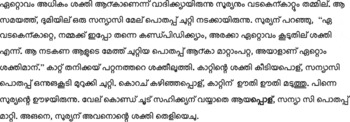
The recordings were made in San Diego by a female native speaker born and raised near Kochi. Although the variety of Malayalam illustrated here is colloquial, the citation forms are usually found in the formal register as well. The transcribed passage, on the other hand, contains many colloquialisms not found in the formal register, but they are representative of the variety of Malayalam illustrated here.
The transcriptions are phonemic, comprising only the symbols included in the consonant and vowel charts. Details regarding the phonetic realization of several phonemes are discussed in the text, with phonetic transcriptions of the example words provided. The Malayalam orthography is included for the citation words as well as for the passage. In cases where words are non-standard in the formal register (and therefore are usually not written), the Malayalam orthography represents the formal register.
Consonants

Obstruents
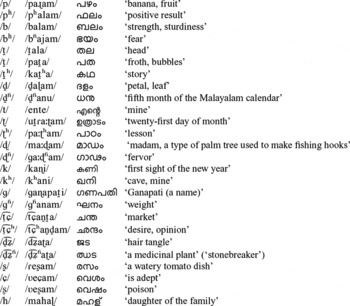
Malayalam obstruents primarily contrast six places of articulation: bilabial, dental, alveolar, postalveolar, retroflex, and velar. The postalveolar affricates /
 /, /
ʰ/, /
 /, and /
ʱ/ have been reported to be palatalized or palatal plosives (U. Namboodiripad Reference Namboodiripad1989, personal communication; Punnoose Reference Punnoose2010), and Asher & Kumari (Reference Asher and Kumari1997) say they are lightly affricated. The distinction between /ɕ/ in /ʋeɕa
m/ ‘is adept’ and /ʂ/ in /ʋeʂa
m/ ‘poison’ is shown spectrographically in Figure 1. The energy concentration for /ɕ/ is strongest above the fourth formant of the adjacent vowels (around 3750 Hz, center of gravity = 4219 Hz); for /ʂ/ it is strongest above the third formant of the adjacent vowels (around 2500 Hz, center of gravity = 4997 Hz). However, this contrast is neutralized in some varieties (Asher & Kumari Reference Asher and Kumari1997: 414). Sometimes /ɕ/ is reported as /ʃ/ (Punnoose Reference Punnoose2010), whereas Asher & Kumari (Reference Asher and Kumari1997: 414) say that the two realizations are in free variation. In our recordings, the high center of gravity for /ɕ/ (see Figure 1) suggests that transcription of the sound as /ʃ/ would be inappropriate for our speaker.
Spectrograms showing /ɕ/ vs. /ʂ/. The latter is characterized by stronger low-frequency energy.

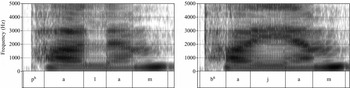
Voicing and aspiration in plosives are usually considered orthogonally contrastive in most varieties of Malayalam (except at the alveolar place of articulation, which has only /t/), including the Namboodiri variety illustrated here. However, voiced aspirated plosives are often voiceless in casual speech (U. Namboodiripad, personal communication), and this is also true for our speaker (as seen in Figure 2). Although our speaker did not produce voiced aspirated plosives, we nonetheless include them in parentheses in the phoneme chart because they are attested for some speakers of Namboodiri Malayalam – including the first author, who is also a native speaker.
Comparison of /pʰ/ vs. /bʱ/. For our speaker, both are voiceless aspirated plosives.
The absence of voiced aspirated plosives has been noted in other dialects as well (Velayudhan Reference Velayudhan1971, S. Kumari Reference Kumari1972, Valentine Reference Valentine1976, Mohanan & Mohanan Reference Mohanan and Mohanan1984, Asher & Kumari Reference Asher and Kumari1997). This variation is perhaps a reflection of the two major influences on the grammar of Malayalam: that of Dravidian and Sanskrit. With regard to obstruents, only the voiceless unaspirated plosives are native to Dravidian, whereas aspirated and voiced obstruents are Sanskrit influences on Malayalam, and more variably produced by speakers (Asher & Kumari Reference Asher and Kumari1997: 422).
As is common in other Dravidian languages (e.g. Tamil; Keane Reference Keane2004), voiceless unaspirated singleton plosives are usually realized as voiced between vowels and after nasals, and may be further weakened to voiced fricatives or approximants (Asher & Kumari Reference Asher and Kumari1997). For example, in the word
 /e
n
t
e/ ‘mine’, the voiceless alveolar plosive /t/ is produced as [d], such that the word may be transcribed phonetically as [e
n
d
e]. This contrasts with voiced dental [
 ] in
 /e

 a/ ‘what?’, phonetically [e
a].
Words ending in either a short vowel or a sonorant may optionally be followed by a word-final glottal plosive. Word-final aspiration is present orthographically in certain Sanskrit words, but we do not see phonetic evidence for it in this variety of Malayalam. For example, in our recordings both
 /
a
m
a
(h)/ ‘salute, bow down to’ and
 /ɡa
m
a/ ‘pride, aloofness’ are realized with word-final [aʔ] as [
a
m
aʔ] and [ɡa
m
aʔ], indicating that orthographic ‘word-final aspiration’ does not block the occurrence of word-final glottal plosives.
Many obstruents have limited distributions. Marginal /f/ is rare (represented orthographically by
 /p
h
/), and is used by only some speakers in loanwords, where it can also be in free variation with [p
h
], [p], and [ɸ], e.g.
 /k
aːp
i/ ‘coffee’ may be pronounced as [kɔːf
i] (with a retracted and raised [ɔː] for the vowel /aː/) or (more frequently in the Namboodiri dialect) as [k
aːp
i] (Asher & Kumari Reference Asher and Kumari1997: 414). Additionally, the contrast between /ʈ/ and /ɖ/ is marginal: neither sound appears word-finally; word-medially, both are voiced (and usually realized phonetically as [ɽ]).
Sonorants
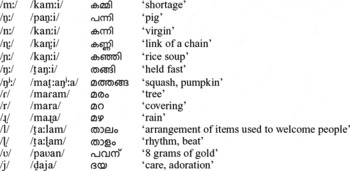
Like obstruents, singleton nasals also contrast at six places of articulation. However, instead of a postalveolar nasal, there is a palatal /ɲ/. Orthographically, dental /
/ and alveolar /n/ are written with the same letter
 . We illustrate some place of articulation contrasts for nasals with geminates, because they provide the most minimal set. (For singleton vs. geminate contrasts, see ‘Geminates’ section below.)
There is a seventh contrastive place of articulation for geminate nasals, which we transcribe as /ŋʲː/. Its functional load is very low; it mostly appears in a finite set of semantically-related words pertaining to gourds, e.g.
 /m
a
ːaŋʲːa/ ‘squash, pumpkin’,
 /k
u
m
pɭaŋʲːa/ ‘white gourd’,
 /p
iː
ːiŋʲːa/ ‘ridge gourd’. Its place of articulation is controversial, having been described as ‘lamino-palatal’ (Asher & Kumari Reference Asher and Kumari1997) or ‘palatal’, in contrast with /ɲ/, which has been described as ‘palato-alveolar’ (Mohanan Reference Mohanan1986). Orthographically, /ŋʲː/ is written with
 , the letter corresponding to /ŋː/, but compare
 /m
aŋːa
l/ (phonetically [m
aŋːa
lə]) ‘wiltedness, tiredness’ and
 /m
a
ːaŋʲːa/ ‘squash, pumpkin’. The nasal formants of /ŋː/ vs. /ŋʲː/ are at similar frequencies, but vowels adjacent to /ŋʲː/ are notably palatalized (see Figure 3a). The sound likewise contrasts with /ɲː/: compare
 /m
aɲːaɭ/ ‘turmeric’ (phonetically [m
aɲːaɭə]). The nasal formants for /ɲː/ versus /ŋʲː/ differ, and vowels adjacent to the latter show convergence of the second and third formants (the ‘velar pinch’) around 3000 Hz, characteristic of velar consonants (see Figure 3b). We do not consider /ŋʲː/ a velar–palatal nasal cluster [ŋɲ], because for the first author (a native speaker of this variety of Malayalam), its production does not involve anterior movement of the tongue body over the course of the nasal. Instead, the tongue body is against both the velum and hard palate, unlike /ɲː/, which is solely palatal, and /ŋː/, which is solely velar. Further, as seen in Figure 3, /ŋʲː/ is produced with steady nasal formants, suggesting that it is also not a nasal+/j/ cluster. It is possible that this sound forms part of a ‘clear’ (i.e. palatalized) set of nasal sounds, which would also include /ɲ/, similar to the ‘clear’ set of liquids found in the language (see discussion below).
Nasal formants. (a) Comparison of /ŋː/ vs. /ŋʲː/. Both /ŋː/ vs. /ŋʲː/ are characterized by steady nasal formants at similar frequencies, but note the higher F2 values for the /a/ adjacent to /ŋʲː/, suggesting palatalization. (b) Comparison of /ɲː/ vs. /ŋʲː/. The nasal formants differ, and /a/ adjacent to /ŋʲː/ shows a velar pinch between the second and third formants at around 3000 Hz.

Aside from the seven nasals, there are five liquids in Malayalam (Punnoose, Khattab & Al-Tamini Reference Punoose, Khattab and Al-Tamimi2013, Scobbie, Punnoose & Khattab Reference Scobbie, Punnoose, Khattab, Spreafico and Vietti2013): /ɾ r
l ɭ ɻ/. Punnoose et al. (Reference Punoose, Khattab and Al-Tamimi2013) distinguish the liquids by place, manner, as well as quality: /ɾ l ɻ/ are ‘clear,’ having a palatalized quality with a raised second formant in adjacent vowels, whereas /r ɭ/ are ‘dark’ and lack palatalization. For example, Asher & Kumari (Reference Asher and Kumari1997: 418) report that the tap /ɾ/ has a ‘distinct palatal resonance’; similarly, Jiang (Reference Jiang2010) labels the sound as /ɾʲ/. Though auditorily weak for our speaker, the palatalized quality in /ɾ/ can be seen in Figure 4, which shows spectrograms of
 /m
aɾa
m/ ‘tree’ versus
 /m
a
r
a/ ‘covering’. The second formant in /a/ rises above 2000 Hz adjacent to /ɾ/, but not adjacent to /r/.
Comparisons of formants transitions for /a/ adjacent to /ɾ/ vs. /r/. Note the higher second formant target for /ɾ/, suggesting a palatalized quality like [ɾʲ].

Aside from its palatalized quality, there is some debate as to the manner of articulation of /ɾ/. Ladefoged & Maddieson (Reference Ladefoged and Maddieson1996: 222, after Ladefoged, Cochran & Disner 1997) say that some speakers produce /ɾ/ as a trill that is slightly more advanced than /r/. However, our speaker consistently produces /ɾ/ as a tap. In contrast, /r/ is often very short and accompanied by frication, phonetically [
 ] or [
 ].
The place and manner of the retroflex central approximant /ɻ/ has been subject to much debate. Kumari (Reference Kumari1972: 27–28) calls it a ‘voiced retroflex palatal fricativised lateral’, whereas Asher & Kumari (Reference Asher and Kumari1997: 419) call it a ‘voiced sublamino-palatal approximant’. Because it has been reported to have frication (Kumari Reference Kumari1972), the sound is traditionally symbolized as /ʐ/ (Asher & Kumari Reference Asher and Kumari1997, Punnoose et al. Reference Punoose, Khattab and Al-Tamimi2013), but in our data this sound is always an approximant. Indeed, in an ultrasound study, Scobbie et al. (Reference Scobbie, Punnoose, Khattab, Spreafico and Vietti2013) found that /ɻ/ is a retroflex approximant with an advanced tongue root and raised tongue body, as well as a lateral release. Punnoose et al. (Reference Punoose, Khattab and Al-Tamimi2013) transcribe the sound narrowly as advanced and palatalized [
 ]. This phonetic transcription accords well with the recordings in our illustration: /ɻ/ has a palatalized quality (a raising of the second formant) similar to that found for the /ɾ/ (see Figure 4).
In addition to the liquids, there are two additional central approximants: /ʋ/ and /j/. The labiodental approximant /ʋ/ may be realized as [ʋ], [v], [w], or [
 ] (Asher & Kumari Reference Asher and Kumari1997).
Geminate consonants
According to Asher & Kumari (Reference Asher and Kumari1997: 432–435), there is a length contrast for all consonants except /f ʂ h ɾ r ɻ/. However, voiced geminate plosives and approximants are rare. Not all singleton–geminate pairs appear to exist in the Namboodiri dialect described here; thus, we include only some of the pairs reported to exist in Malayalam. As with phonemic singleton voiced aspirated plosives, the geminate counterparts are devoiced in our speaker's recordings.
The geminate /tː/ is usually slightly aspirated and palatalized (Asher & Kumari Reference Asher and Kumari1997, Jiang Reference Jiang2010). Voiced unaspirated geminate plosives occur mostly in loanwords. Between vowels, dental /
/ and palatal /ɲ/ are always geminated.

Vowels

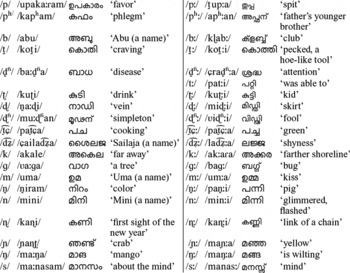
There are six vowels in Malayalam: /a i e o u/, and [ə], shown in the vowel quadrilateral based on data from the speaker as well as the first author (Namboodiripad Reference Namboodiripad2014). Of these, /a i e o u/ also contrast in length (see below). On the other hand, [ə], though phonetically distinct from the other five vowels, is not phonemic; it only occurs word-medially or word-finally: word-medially, instances of [ə] derive from /a/ or /u/ reduction, and word-finally, [ə] is viewed as a post-lexical ‘enunciative’ vowel after some consonants (Valentine Reference Valentine1976, Mohanan Reference Mohanan1986, Asher & Kumari Reference Asher and Kumari1997, Namboodiripad, Garellek, & Baković Reference Namboodiripad, Garellek and Baković2015; see Keane Reference Keane2004 for similar discussion of schwas in Tamil).
Short /a/ is often realized as raised [ʌ] or [ə] in unstressed syllables, while it may also be elided in fast speech (Asher & Kumari Reference Asher and Kumari1997: 440). Both /a/ and /aː/ may also vary in tongue advancement, ranging from [æ] to [ɑ]. Short /o/ does not occur word-finally (Asher & Kumari Reference Asher and Kumari1997, Punnoose 2011). Asher & Kumari (Reference Asher and Kumari1997: 420–421) also list /æ/, but this sound occurs only in a few English loanwords and may alternate with /aː/, e.g.
 /b
aːŋk/, phonetically [bæŋɡə] or (more commonly in the Namboodiri dialect) [b
aːŋɡə] ‘bank.’ Illustrative examples of the vowels follow:
Word-initial

Word-medial

Word-final

Long vs. short vowels

Diphthongs

There are four diphthongs in Malayalam: /a
i
e
i
o
i
a
u/. The diphthongs /a
i
a
u/ are marked orthographically (
 and
 , respectively), whereas /e
i
o
i/ are spelled with short /e/ (
 ) or /o/ (
 ) followed by /j/ (
 ). The diphthongs /a
i
a
u/ are usually realized with a raised nucleus as [ʌi ʌu], respectively.

Stress
Mohanan (Reference Mohanan1986) states that stress in Malayalam is predictable and not contrastive: it falls on the first syllable of the word, unless the first syllable has a short vowel and the second syllable has a long vowel, in which case stress falls on the second syllable (Mohanan Reference Mohanan1986, Broselow, Chen & Huffman Reference Broselow, Chen and Huffman1997). For example,
 /s
a
mːa
a
m/ ‘agreement’ has stress on the first syllable, whereas
 /s
a
mːaːn
a
m/ ‘gift’ has stress on the second syllable because the first vowel is short and the second is long. However, Terzenbach (Reference Terzenbach2011) found that Malayalam listeners perceive all word-initial vowels to be stressed, regardless of the following vowel's length. Moreover, even if word-medial long vowels are phonetically more prominent than initial short ones, they do not cause a perceptual shift in stress from the first syllable (Terzenbach Reference Terzenbach2011). To conclude, more work is needed to determine if lexical stress really exists in Malayalam, and, if so, what governs its position.
Transcription of recorded passage
Broad phonemic transcription

Orthographic version
English translation
The Sun and the North Wind were betting on who was the strongest. At the same time, down on earth, a monk wrapped in a shawl was walking. The Sun said: “Hey North Wind! We can find out who is the strongest right now! Whichever one of us can remove the shawl wrapped around that man is the strongest!” The North Wind blew as hard as he could. As the wind's strength grew, the monk wrapped the shawl around himself even tighter. After a while, the wind grew tired of blowing. Then, it was the sun's turn. When the monk couldn't take the heat of the sun any longer, he took off his shawl. That is how the sun proved his strength.
Acknowledgements
We would like to thank our speaker, Yamini Mappat. For helpful comments, we thank Usha Namboodiripad, Amalia Arvaniti, Christina Esposito, and an anonymous reviewer. We are also grateful for the editorial assistance of Ewa Jaworska.



