INTRODUCTION
Several converging lines of research suggest that indices of performance from tasks assessing response control may be robust intermediate endophenotypes of Attention-deficit/Hyperactivity Disorder (ADHD). Response control is a basic characteristic of human behavior, reflecting an individual’s ability to efficiently and accurately choose a preferred response while inhibiting the choice of a less preferred or incorrect response (Mostofsky & Simmonds, Reference Mostofsky and Simmonds2008). Children with ADHD commonly exhibit deficiencies in response control, leading to disinhibited responding (Wodka et al., Reference Wodka, Mahone, Blankner, Gidley Larson, Fotedar, Denckla and Mostofsky2007), as well as slow (Harris et al., Reference Harris, Schuerholz, Singer, Reader, Brown and Cox1995) and variable (Di Martino et al., Reference Di Martino, Ghaffari, Curchak, Reiss, Hyde and Vannucci2008; Vaurio, Simmonds, & Mostofsky, Reference Vaurio, Simmonds and Mostofsky2009) response times.
While impaired response inhibition has long been considered a core feature of ADHD (Barkley, Reference Barkley1997), there has been accumulating evidence in recent years that other aspects of response control are affected in ADHD. Prominent among these is intra-subject variability (ISV), which is assessed by measuring the variability within each individual’s reaction time (RT) series. ISV is thought to represent efficiency of response preparation and selection, with lower ISV (less variability) reflecting more efficient responding (Rommelse et al., Reference Rommelse, Altink, Oosterlaan, Beem, Buschgens, Buitelaar and Sergeant2008). Increased ISV in ADHD has also been extensively reported in a variety of paradigms including stop-signal (Klein, Wendling, Huettner, Ruder, & Peper, Reference Klein, Wendling, Huettner, Ruder and Peper2006), sustained attention (Bellgrove et al., Reference Bellgrove, Hawi, Kirley, Fitzgerald, Gill and Robertson2005), continuous performance (Epstein et al., Reference Epstein, Conners, Hervey, Tonev, Arnold and Abikoff2006), flanker (Di Martino et al., Reference Di Martino, Ghaffari, Curchak, Reiss, Hyde and Vannucci2008), oculomotor (Mahone, Mostofsky, Lasker, Zee, & Denckla, Reference Mahone, Mostofsky, Lasker, Zee and Denckla2009), and working memory tasks (Karatekin, Reference Karatekin2004). Furthermore, ISV has been reported to be “normalized” in children with ADHD on paradigms with fast event rates and incentives (Andreou et al., Reference Andreou, Neale, Chen, Christiansen, Gabriels and Heise2007; Kuntsi, Wood, van der Meere, & Asherson, Reference Kuntsi, Wood, van der Meere and Asherson2009). Thus, ISV may in fact prove to be a more robust intermediate endophenotype than measures of inhibitory failure, as it is associated with diagnostic characteristics of ADHD and is seen in close family members of individuals with ADHD, suggesting a genetic mechanism for expression of the phenotype (Bidwell, Willcutt, DeFries, & Pennington, Reference Bidwell, Willcutt, DeFries and Pennington2007).
Functional neuroimaging studies have been particularly relevant in identifying neural correlates of ISV (Kelly, Uddin, Biswall, Castellanos, & Milham, Reference Kelly, Uddin, Biswall, Castellanos and Milham2008). Studies have generally found lower ISV to be associated with increased activation in premotor and prefrontal cortex (Simmonds et al., Reference Simmonds, Fotedar, Suskauer, Pekar, Denckla and Mostofsky2007), as well as interconnected subcortical structures, the basal ganglia and thalamus (Rubia, Smith, & Taylor, Reference Rubia, Smith and Taylor2007). In a study of adults performing a flanker task, decreased ISV was also found to be associated with anti-correlation of activity in a frontal “task positive” region (anterior cingulate) and that in a “default mode” region (precuneus).
In a pair of recent functional magnetic resonance imaging (fMRI) studies, the neural correlates of ISV in children were examined using a simplified go/no-go task with minimized cognitive demands (with green = go and red = no-go). For typically developing children, lower ISV was found to be associated with increased activity in the rostral supplementary motor area (pre-SMA) (Simmonds et al., Reference Simmonds, Fotedar, Suskauer, Pekar, Denckla and Mostofsky2007), a region known to be critical for motor response control and selection (Isoda & Hikosaka, Reference Isoda and Hikosaka2007; Mostofsky & Simmonds, Reference Mostofsky and Simmonds2008). In contrast, for children with ADHD, increased pre-SMA activation was associated with greater ISV; furthermore, lower ISV in children with ADHD was instead associated with increased activation in a region of the midline prefrontal cortex, rostral to the pre-SMA (in BA8) (Suskauer et al., Reference Suskauer, Simmonds, Fotedar, Blankner, Pekar, Denckla and Mostofsky2008). The findings suggest that children with ADHD may be able to compensate for impaired response control through recruitment of top-down mechanisms mediated through prefrontal circuits. While this mechanism appears to be effective for some children with ADHD, it may, in some respects, be disadvantageous. Reliance on prefrontal cortex for what is typically more automatic response control may preclude the use of those prefrontal resources for higher order, more novel executive functions.
It is therefore important to examine whether “bottom-up” mechanisms that are instead facilitated by external manipulations in task design to increase vigilance and resulting readiness to respond can also contribute to improved response control in ADHD. In a recently published study (Wodka, Simmonds, Mahone, & Mostofsky, Reference Wodka, Simmonds, Mahone and Mostofsky2009), we piloted such an approach, hypothesizing that the introduction of uneven intervals between successive stimuli (“jitter”) would enhance response preparatory state, effectively keeping people “on their toes,” and in doing so improve ability to efficiently control responding. Consistent with our hypothesis, we found that a moderate degree of jitter does, in fact, improve response control in healthy adults.
The aim of the present study was to examine the impact of moderate interstimulus jitter on response control in children with and without ADHD. We hypothesized that the introduction of interstimulus jitter would facilitate performance on go/no-go tasks in both groups, but with greater relative effect among those with ADHD.
METHODS
Participants
Participants were recruited as part of a larger study examining brain mechanisms in ADHD. All participants and their parents signed a consent form that met Institutional Review Board standards. Children were between 9 and 14 years old, and had Full Scale IQ (FSIQ) scores of 70 or higher on the Wechsler Intelligence Scale for Children–Fourth Edition (WISC-IV). Children were excluded if a history of speech/language disorder or word reading difficulties was identified, either through telephone screening before the initial visit, or based on prior school assessment (completed within one year). Further exclusion criteria included evidence of visual or hearing impairment, or history of other neurological disorder. Parents of participants were screened by telephone to obtain demographic information, school, and developmental history. Children with ADHD who were taking stimulant medication were removed from the medication on the day of and day prior to testing. Children with ADHD taking psychotropic medications other than stimulants were excluded. A total of 39 children (14 control, 25 ADHD) were included in the present investigation.
Following initial telephone screening, participants were screened for psychiatric diagnoses using a structured parent interview (Diagnostic Interview for Children and Adolescents–Fourth Edition, DICA-IV). Additionally, ADHD-specific and broad behavior rating scales (Conners’ Parent/Teacher Rating Scale–Revised, CPRS-R/CTRS-R; ADHD Rating Scale-IV) were used to confirm ADHD diagnosis using the following criteria: (1) positive Diagnostic and Statistical Manual–Fourth edition (DSM-IV) ADHD diagnosis on DICA-IV; and, (2) T-scores greater than 65 on the DSM-IV Hyperactive/Impulsive or Inattentive scales of the CPRS-R or CTRS-R; and, (3) 6 of 9 DSM-IV symptoms met (item rating of 2 or 3) on the Hyperactive/Impulsive or Inattention scales of the ADHD Rating Scale-IV, home or school version. Children with DSM-IV diagnoses other than Oppositional Defiant Disorder and Specific Phobias were excluded. Additional exclusionary criteria for the control group included any history of mental health services for behavior or emotional problems, history of academic problems requiring school-based intervention services, or history of defined primary reading or language-based learning disability. Parents of controls also completed the DICA-IV, CPRS-R, and ADHD Rating Scale-IV, and teachers completed the CTRS-R and teacher form of the ADHD Rating Scale-IV. Controls with T-scores greater than 60 on either the DSM-IV Inattentive or Hyperactive/Impulsive scales of the CPRS-R or CTRS-R, or item ratings of 2 or greater for 4 or more symptoms of inattention or hyperactivity/impulsivity from the ADHD Rating Scale-IV (Home or School), were also excluded. All participants were screened for word reading difficulties, which were defined as a score less than the 25th percentile on the Basic Reading Composite of the Woodcock Johnson-III Tests of Achievement.
On the day of the assessment, children were administered the WISC-IV, reading measures, and go/no-go tests. Go/no-go tests were administered in a counterbalanced sequence, with both groups experiencing the task orders equally.
Study Measures
Go/no-go tests
Participants were seated in front of a computer that flashed red and green spaceships. They were instructed to push a button with their right index finger as quickly as possible in response to green spaceships only. Use of familiar color elements (green for “go”; red for “no-go”) minimized the working memory load of the test. Two versions of the go/no-go test were administered as part of the present study. In the fixed interstimulus interval (ISI) condition, cues appeared on the screen for 300 ms and were presented once every 1500 ms (1500 ms interstimulus interval). Cues were weighted towards green spaceships at a ratio of 3:1 (162 go cues; 54 no-go cues), intensifying the need to inhibit a rapid, habitual skeleto-motor response. In the jittered ISI condition, stimuli were presented with a variable ISI, using a moderate (33.3%) level of jitter in which five ISIs were presented randomly, ranging from1000 to 2000 ms (i.e., 1000, 1250, 1500, 1750, 2000). The total time of each task was 6 mins 30 s. For both measures, variables of interest included omission rate, commission rate, mean RT (for correct hits), and intra-subject variability (ISV) – which was calculated as (standard deviation of response time) / (mean response time).
Data Analysis
Distributions of all variables were examined and square root transformations were used for those variables showing excessive skewness. Group comparisons of demographic, IQ, and go/no-go test scores were analyzed using analyses of variance (ANOVAs) for continuous variables and chi-square tests for categorical variables. Repeated measures ANOVAs were used to examine the moderating effect of jitter on go/no-go test performance for each of the four variables of interest. Effect sizes for each were calculated using partial eta-squared ( ).
RESULTS
Demographics
The study included 39 participants: 25 ADHD (80% male), 14 control (50% male), of which 84% were Caucasian, 12% were African-American, 2% Asian, 1% Hispanic, and 1% mixed race. Within the ADHD group, there were 10 with Inattentive, 1 with Hyperactive-Impulsive, and 14 with Combined subtypes. Participants ranged in age from 9 to 14 years, with an average age of 11.1 years (ADHD mean = 10.9 ± 1.5; control mean = 11.3 ± 1.6). There were no significant differences between groups in age, sex distribution, socioeconomic status (SES), or racial composition. The control group had significantly higher FSIQ than the ADHD group, F(1, 37) = 9.41, p = .004,  = .26, but not Verbal Comprehension Index (VCI), F(1, 37) = 2.60, p = .113,
 = .07. Given the overlap between components of IQ and dependent measures in this study (especially those involving response preparation/processing speed), it was felt that covarying for FSIQ was not appropriate when measuring group differences on executive control (Dennis et al., Reference Dennis, Francis, Cirino, Schachar, Barnes and Fletcher2009). Additionally, a recent meta-analysis of the effects of attention on IQ assessment noted that children with ADHD taking stimulant medications had a mean increase of 6 to 7 IQ points compared to stimulant-naïve children who had been tested, suggesting that reduced IQ scores relative to typically developing peers may be driven by attentional problems and suboptimal test-taking behavior (Jepsen, Fagerlund, & Mortensen, Reference Jepsen, Fagerlund and Mortensen2009).
Group Differences for Go/No-go Variables
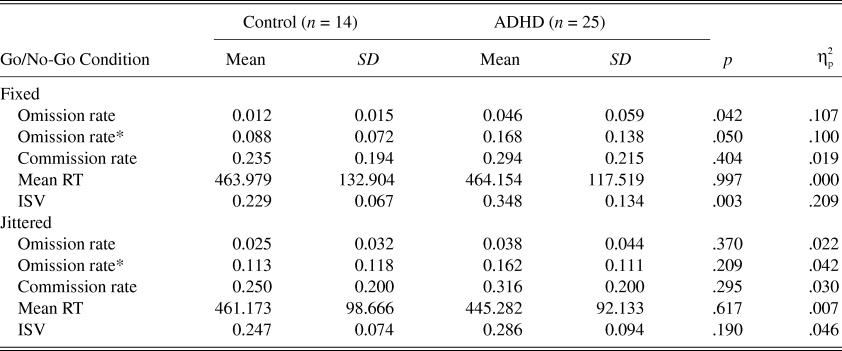
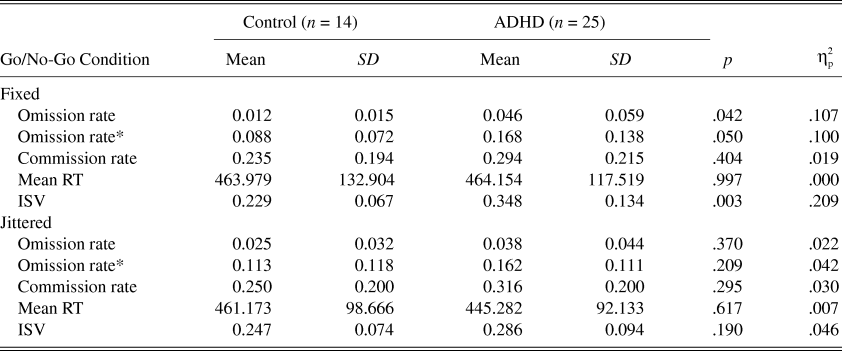
Means and standard deviations for go/no-go variables are listed in Table 1. For the fixed ISI condition, children with ADHD had significantly greater omission rates, F(1, 37) = 4.43, p = .05,  = .10, and greater ISV, F(1, 37) = 9.80, p = .003,
 = .21, than controls, with no significant differences in commission rate or mean RT. In contrast, for the jittered ISI condition, there were no significant differences between ADHD and control groups on any of the four variables of interest (omissions, commissions, mean RT, ISV).
Performance on go/no-go tests
Note
RT = response time in ms; ISV = Intra-subject Variability (SD/Mean RT in ms). *Square Root transformation.
Effects of Jitter Condition
Repeated measures ANOVAs, using group as the between groups variable, and jitter condition (fixed vs. jittered) as the repeated measure, revealed no significant effects for jitter condition or group–by condition interaction for omissions, commissions, or mean RT. In contrast, there was a significant group–by condition interaction effect for ISV, Pillai’s V = 0.125, p = .027, η2 = 0.125 (Figure 1). In order to examine the nature of the interaction, repeated measures ANOVAs were completed separately for each group. Within the ADHD group, children had significantly greater ISV on the fixed condition than on the jittered condition, F(1, 24) = 6.33, p = .019,  = .209. In contrast, the difference in ISV between the fixed and jittered conditions among controls was not significant, F(1, 13) = 1.54, p = .237,
 = .106.
Intra-subject Variability (ISV) by Test. Children with ADHD had significantly greater ISV than controls (p = .003) on the go/no-go test with fixed interstimulus interval (ISI), but not on the test with jittered ISI (p = .190). Additionally, children with ADHD had significantly greater ISV on the go/no-go test with fixed ISI than they did on the test with jittered ISI (p = .019), whereas controls did not differ in ISV on the two tests (p = .237).

DISCUSSION
The current study sought to examine the impact of moderate jitter on response control in children with and without ADHD. On the go/no-go task with fixed ISI, the ADHD and control groups did not differ in commissions or mean response time; however, the ADHD group had significantly more omissions and increased ISV compared to controls. Of note, the effect size for differences in ISV was large ( = .21), and approximately ten times the magnitude of the effect size for commission errors (
 = .02). This finding is consistent with the growing literature that suggests that ISV may be a stronger behavioral phenotype in ADHD than inhibitory control.
In contrast to the robust group differences on the fixed ISI go/no-go task, there were no group differences on any variable for the jittered ISI task, and all effect sizes were small ( < .05 for all). In other words, introduction of moderate jitter essentially “normalized” the performance of children with ADHD, with respect to lapses in attention (omissions) and sustained response control (ISV). Furthermore, children in the ADHD group performed significantly better on the jittered versus the fixed ISI task. Because the order of administration was counterbalanced, this difference does not appear to be a function of test order.
The introduction of jitter, and its seeming “normalization” of the ADHD population, requires us to examine the process utilized in preparing a response to a stimulus, and the dysfunction found in that process in children with ADHD. Between stimulus perception and choice to respond lie several critical executive function skills, including sustaining attention, inhibition of off-task behavior, and preparedness to respond (Denckla, Reference Denckla1996). Increased intra-subject variability in responding may depend in part on vulnerabilities related to response preparation (Pashler & Johnston, Reference Pashler and Johnston1989); however, the frequent intrusion of large reaction times may also be an indication of loss of vigilance or factors independent of stimulus familiarity or long-term memory processes (Gilden & Hancock, Reference Gilden and Hancock2007). Current research suggests that response selection and inhibition are closely related processes dependent on mechanisms important to motor response preparation (Mostofsky & Simmonds, Reference Mostofsky and Simmonds2008). Electrophysiological research findings suggest that pre-SMA circuits are crucial for accurate response selection and inhibition (Isoda & Hikosaka, Reference Isoda and Hikosaka2007). Given the importance of the role of pre-SMA circuitry, an association may exist between optimal response preparation and optimal response efficiency and accuracy, as seen in individuals with lower ISV (Wodka et al., Reference Wodka, Simmonds, Mahone and Mostofsky2009).
Jittering stimulus onset likely enhances response preparatory state by increasing vigilance, effectively keeping people “on their toes,” and in doing so improve ability to efficiently control responding. It follows that this effect of increased vigilance on readiness to respond may be mediated by bottom-up noradrenergic projections from the locus ceruleus. Dysfunction within these and other brainstem catecholaminergic systems (in particular, dopmainergic projections from the substantia nigra) have been hypothesized to play a role in the pathogenesis of ADHD (Sergeant, Geurts, Huijbregts, Scheres, & Oosterlaan, Reference Sergeant, Geurts, Huijbregts, Scheres and Oosterlaan2003). This is in large part due to observations of response to stimulant medications that enhance catecholaminergic transmission, as well as the more recently observed effect of atomoxetine, which selectively inhibits reuptake of norepinephrine (Pliszka, Reference Pliszka2005). As such, the use of jitter may represent an effective nonpharmacologic approach for improving response control in ADHD.
Future investigations of the influence of jitter on response control should take into account methods by which activation of response control may be more closely examined (i.e., fMRI and event-related potentials) in conjunction with go/no-go tasks. Additionally, it will be important to examine the impact of jitter on motivational (energetic) factors, as well as impaired delay aversion, which have been also described as fundamental deficits in ADHD (Sonuga-Barke, Wiersema, van der Meere, & Roeyers, Reference Sonuga-Barke, Wiersema, van der Meere and Roeyers2009). Strategies emphasizing moderate unpredictability in classroom settings may be effective in ameliorating some inattention symptoms in ADHD by improving overall response preparation; continued research is warranted to examine this hypothesis.
Several limitations to the current findings should be considered. The relatively small sample size precluded further examination of the contribution of age, sex, ADHD subtype, or the differential impact of jitter on “raw” response time standard deviation (compared with ISV; Klein et al., Reference Klein, Wendling, Huettner, Ruder and Peper2006). The sample had wide age range (9–14 years), and developmental neurobiological changes related to response control occurring during this period may have contributed to observed deficits in the later-maturing children with ADHD. Reductions in overall gray matter volume and prefrontal volume occur during this age range. Considering the relative “delay” in brain maturation associated with ADHD, group differences may be driven by the younger age of the sample (Shaw et al., Reference Shaw, Eckstrand, Sharp, Blumenthal, Lerch and Greenstein2007). Future research should continue to examine in detail the elements of response variability that are facilitated by introduction of moderate jitter (i.e., examination of ex-Gaussian distributions) to determine whether jitter facilitates reduction of “lapses” in attention or better response control throughout the task (Vaurio et al., Reference Vaurio, Simmonds and Mostofsky2009).
ACKNOWLEDGMENTS
The authors report no conflicts of interest. Portions of this manuscript were presented as a poster at the Annual Meeting of the American Academy of Clinical Neuropsychology in San Diego, California on June 18, 2009. This work was supported by HD-24061 (Intellectual and Developmental Disabilities Research Center), R01 NS043480, R01 NS047781, R01 MH085328, K02 NS044850, P50 HD 52121, and the Johns Hopkins University School of Medicine Institute for Clinical and Translational Research, an NIH/NCRR CTSA Program, UL1-RR025005. Drs. Mostofsky and Mahone contributed equally as mentors in this work.