










1. Introduction
Let $(X,\,0)$ be a germ of complex analytic set in $\mathbb {C}^{n}$
 and $f:(\mathbb {C}^{n},\,0)\to (\mathbb {C},\,0)$
 a holomorphic function germ. The Bruce–Roberts number of $f$
 with respect to $(X,\,0)$
 was introduced by Bruce and Roberts in [Reference Bruce and Roberts4] and is defined as

where $\mathcal {O}_n$ is the local ring of holomorphic functions $(\mathbb {C}^{n},\,0)\to \mathbb {C}$
 , $\textrm {d}f$
 is the differential of $f$
 and $\Theta _X$
 is the $\mathcal {O}_n$
 -submodule of $\Theta _n$
 of vector fields on $(\mathbb {C}^{n},\,0)$
 which are tangent to $(X,\,0)$
 at its regular points. If $I_X$
 is the ideal of $\mathcal {O}_n$
 of functions vanishing on $(X,\,0)$
 , then

In particular, when $X=\mathbb {C}^{n}$ , $\textrm {d}f(\Theta _{X})$
 is the Jacobian ideal of $f$
 and thus, $\mu _{\textrm {BR}}(f,\,X)$
 coincides with the classical Milnor number $\mu (f)$
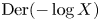
 . We remark that $\Theta _X$
 is also denoted in some papers by $\mbox {Der}(-\log X)$
 , following Saito's notation [Reference Saito11]. The main properties of $\mu _{\textrm {BR}}(f,\,X)$
 are the following (see [Reference Bruce and Roberts4]):
(a) $\mu _{\textrm {BR}}(f,\,X)$
 is invariant under the action of the group $\mathcal {R}_X$ of diffeomorphisms $\phi :(\mathbb {C}^{n},\,0)\to (\mathbb {C}^{n},\,0)$ which preserve $(X,\,0)$;
(b) $\mu _{\textrm {BR}}(f,\,X)<\infty$
if and only if $f$ is finitely determined with respect to the $\mathcal {R}_X$-equivalence;(c) $\mu _{\textrm {BR}}(f,\,X)<\infty$
if and only if $f$ restricted to each logarithmic stratum is a submersion in a punctured neighbourhood of the origin.







In general, $\mu _{\textrm {BR}}(f,\,X)$ is not so easy to compute as the classical Milnor number. The main difficulty comes from the computation of the module $\Theta _X$
 and most of the times, it is necessary to use a symbolic computer system like Singular [Reference Decker, Greuel, Pfister and Schönemann6]. If $(X,\,0)$
 is an isolated complete intersection singularity (ICIS) and $\mu _{\textrm {BR}}(f,\,X)$
 is finite, then $(f^{-1}(0)\cap X,\,0)$
 is an ICIS [Reference Biviá-Ausina and Ruas2, Proposition 2.8], therefore it has well-defined Milnor number. In a previous paper, [Reference Nuño-Ballesteros, Oréfice-Okamoto, Lima-Pereira and Tomazella9] we considered the case that $(X,\,0)$
 is an isolated hypersurface singularity (IHS). We showed that

where $\mu$ and $\tau$
 are the Milnor and the Tjurina numbers, respectively. Thus, (1) gives an easy way to compute $\mu _{\textrm {BR}}(f,\,X)$
 in terms of well-known invariants. The formula (1) was also obtained independently in [Reference Kourliouros8] and previously in [Reference Nuño-Ballesteros, Oréfice-Okamoto and Tomazella10] when $(X,\,0)$
 is weighted homogeneous.
An important application of (1) allowed us to conclude in [Reference Nuño-Ballesteros, Oréfice-Okamoto, Lima-Pereira and Tomazella9] that the logarithmic characteristic variety $LC(X)$ is Cohen–Macaulay. We recall that $LC(X)$
 is the subvariety of the cotangent bundle $T^{*}\mathbb {C}^{n}$
 of pairs $(x,\,\alpha )$
 such that $\alpha (\xi _x)=0$
 , for all $\xi \in \Theta _X$
 and for all $x$
 in a neighbourhood of $0$
 . When $(X,\,0)$
 is holonomic, $LC(X)$
 is Cohen–Macaulay if and only if for any Morsification $f_{t}$
 of $f$
 we have

where $n_\alpha$ is the number of critical points of $f_t$
 restricted to each logarithmic stratum $X_\alpha$
 and $m_\alpha$
 is the multiplicity of $LC(X)$
 along the irreducible component $Y_\alpha$
 associated with $X_\alpha$
 (see [Reference Bruce and Roberts4, Corollary 5.8]). When $(X,\,0)$
 is an IHS, it always has a finite number of logarithmic strata (i.e., it is holonomic in Saito's terminology) given by $X_0=\mathbb {C}^{n}\setminus X$
 , $X_i\setminus \{0\}$
 , with $i=1,\,\ldots ,\,k$
 and $X_{k+1}=\{0\}$
 , where $X_1,\,\ldots ,\,X_k$
 are the irreducible components of $X$
 at $0$
 .
In this paper, we are interested in another important invariant introduced in [Reference Bruce and Roberts4],

which we call here the relative Bruce–Roberts number. This is an invariant of the restricted function $f:(X,\,0)\to (\mathbb {C},\,0)$ under the induced $\mathcal {R}_X$
 -action. In fact, as commented in [Reference Bruce and Roberts4], it is equal to the codimension of the $\mathcal {R}_X$
 -orbit. Moreover, $\mu _{\textrm {BR}}^{-}(f,\,X)$
 is finite if and only if $f$
 restricted to each logarithmic stratum (excluding $X_0$
 ) is a submersion in a punctured neighbourhood of the origin.
A natural question is about the relationship between $\mu _{BR}(f,\,X)$ and $\mu _{BR}^{-}(f,\,X)$
 . It is shown in [Reference Bruce and Roberts4] that if $(X,\,0)$
 is a weighted homogeneous ICIS then

This, combined with (1) when $(X,\,0)$ is a weighted homogeneous IHS, gives that

Our main result in § 2 is that if $(X,\,0)$ is any IHS and $\mu _{BR}^{-}(f,\,X)$
 is finite, then

In particular, (2) also holds when $\mu _{BR}(f,\,X)$ is finite, even when $(X,\,0)$
 is not weighted homogeneous. We also show in Example 3.1 that (2) is not true for higher codimension ICIS.
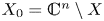
The relative logarithmic characteristic variety $LC(X)^{-}$ is obtained from $LC(X)$
 by eliminating the component $Y_0$
 associated with the stratum $X_0=\mathbb {C}^{n}\setminus X$
 . In [Reference Bruce and Roberts4], they showed that $LC(X)$
 is never Cohen–Macaulay when $(X,\,0)$
 has codimension $>1$
 along the points on $X_0$
 , but $LC(X)^{-}$
 is always Cohen–Macaulay when $(X,\,0)$
 is a weighted homogeneous ICIS (of any codimension). Again, Cohen–Macaulayness of $LC(X)^{-}$
 is interesting since it implies that

for any Morsification $f_t$ of $f$
 . As an application of (3), we show in § 3 that $LC(X)^{-}$
 is also Cohen–Macaulay for any IHS $(X,\,0)$
 (not necessarily weighted homogeneous).
In § 4, we consider any holonomic variety $(X,\,0)$ and study characterizations of Cohen–Macaulayness of $LC(X)$
 and $LC(X)^{-}$
 in terms of the relative polar curve associated with a Morsification $f_t$
 of $f$
 . Finally, in § 5, we give a formula which generalizes the classical Thom–Sebastiani formula for the Milnor number of a function defined as a sum of functions with separated variables.
2. The relative Bruce–Roberts number
The main goal of this section is to prove the equality (3). The next lemma is inspired by [Reference Biviá-Ausina and Ruas2, Proposition 2.8].
Lemma 2.1 Let $(X,\,0)$ be an IHS determined by $\phi :(\mathbb {C}^{n},\,0)\to (\mathbb {C},\,0)$
 and $f\in \mathcal {O}_{n}$
 . The map $(\phi ,\,f):(\mathbb {C}^{n},\,0)\to (\mathbb {C}^{2},\,0)$
 defines an ICIS if and only if $\mu _{BR}^{-}(f,\,X)<\infty$
 .
Proof. If $(\phi ,\,f):(\mathbb {C}^{n},\,0)\to (\mathbb {C}^{2},\,0)$ defines an ICIS then $\mu _{BR}^{-}(f,\,X)$
 is finite because

For the converse, if $\mu _{BR}^{-}(f,\,X)<\infty$ then the restriction of $f$
 to each logarithmic stratum, excluding $\mathbb {C}^{n}\setminus X$
 is non-singular. The proof is now the same of Proposition 2.8 in [Reference Biviá-Ausina and Ruas2].
The following technical lemma will be used in the proof of the next theorem. Given a matrix $A$ with entries in a ring $R$
 , we denote by $I_k(A)$
 the ideal in $R$
 generated the $k\times k$
 minors of $A$
 .
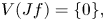
Lemma 2.2 Let $f,\,g\in \mathcal {O}_n$ be such that $\operatorname {dim} V(J(f,\,g))=1$
 and $V(Jf)=\{0\},$
 and consider the following matrices

where $\lambda ,\,\mu \in \mathcal {O}_n$ . Let $M,\,M'$
 be the submodules of $\mathcal {O}_n^{2}$
 generated by the columns of $A,\,A'$
 respectively. If $I_2(A)=I_2(A')$
 then $M=M'$
 .
Proof. We see $A$ and $A'$
 as homomorphims of modules over $R:=\mathcal {O}_n$
 :

We consider the $R$ -module $R^{2}/M=\operatorname {coker}(A)$
 , which has support $V(I_2(A))=V(J(f,\,g))$
 . Therefore, $\operatorname {dim}(R^{2}/M)=1=n-(n-2+1)$
 and hence it is Cohen–Macaulay (see [Reference Buchsbaum and Rim5]). In particular, it is unmixed. Now, $M'/M$
 is a submodule of $R^{2}/M$
 , so the associated primes $\operatorname {Ass} (M'/M)$
 are included in $\operatorname {Ass}(R^{2}/M)$
 . If $M'/M\ne 0$
 then $\operatorname {Ass} (M'/M)\ne \emptyset$
 and it follows that $\operatorname {dim}(M'/M)=1$
 .
Let $U$ be a neighbourhood of $0$
 in $\mathbb {C}^{n}$
 such that $0$
 is the only critical point of $f$
 . For all $x\in U\setminus \{0\}$
 , there exist $i_{0}\in \{1,\,\ldots ,\,n\}$
 , such that $\partial f/\partial x_{i_{0}}(x)\neq 0$
 . We may suppose $i_{0}=1$
 . Making elementary column operations in the matrices $A$
 and $A'$
 , we obtain

such that

By hypothesis $I_{2}(A)=I_{2}(A')$ and consequently $\langle c_{2},\,\ldots ,\,c_{n}\rangle =\langle \mu c_{1}-\lambda ,\,c_{2},\,\ldots ,\,c_{n}\rangle .$
 This implies $\lambda =\mu c_{1}+\alpha _{2}c_{2}+\cdots +\alpha _{n}c_{n}$
 , for some $\alpha _{2},\,\cdots ,\,\alpha _{n}\in R$
 . Thus,

and hence $(M'/M)_{x}=0$ . This shows that $\operatorname {Supp}(M'/M)\subset \{0\}$
 and hence, $M'=M$
 .
Given an IHS $(X,\,0)$ defined by a holomorphic function germ $\phi :(\mathbb {C}^{n},\,0)\to (\mathbb {C},\,0),$
 we consider the $\mathcal {O}_{n}$
 -submodule of the trivial vectors fields, denoted by $\Theta _{X}^{T}$
 , generated by

This module was related to the Tjurina number of $(X,\,0)$ in [Reference Nuño-Ballesteros, Oréfice-Okamoto, Lima-Pereira and Tomazella9, Reference Tajima13]. By using different approaches, it is shown that $\tau (X,\,0)=\operatorname {dim}_{\mathbb {C}}\Theta _{X}/\Theta _{X}^{T}$
 . Moreover, in [Reference Nuño-Ballesteros, Oréfice-Okamoto, Lima-Pereira and Tomazella9], we also proved that $\tau (X,\,0)=\operatorname {dim}_{\mathbb {C}}\textrm {d}f(\Theta _{X})/\textrm {d}f(\Theta _{X}^{T})$
 where $f$
 is any $\mathcal {R}_{X}$
 -finitely determined function germ. The following result generalizes this equality with a weaker hypothesis on $f$
 .
Theorem 2.3 Let $(X,\,0)$ be an IHS determined by $\phi :(\mathbb {C}^{n},\,0)\to (\mathbb {C},\,0)$
 and $f\in \mathcal {O}_{n}$
 such that $\mu _{BR}^{-}(f,\,X)<\infty ,$
 then:
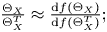
(i) $\frac {\Theta _{X}}{\Theta _{X}^{T}}\approx \frac {\textrm {d}f(\Theta _{X})+I_{X}}{\textrm {d}f(\Theta _{X}^{T})+I_{X}};$
(ii) $\frac {\Theta _{X}}{\Theta _{X}^{T}}\approx \frac {\textrm {d}f(\Theta _{X})}{\textrm {d}f(\Theta _{X}^{T})};$
(iii) $\textrm {d}f(\Theta _{X})\cap I_{X}=JfI_{X};$
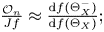
(iv) $\frac {\mathcal {O}_{n}}{Jf}\approx \frac {\textrm {d}f(\Theta _{X}^{-})}{\textrm {d}f(\Theta _{X})};$
(v) $\textrm {d}f(\Theta _{X}):I_{X}=Jf;$
(vi) $\textrm {d}f(\Theta _{X}^{T}):I_{X}=Jf,$
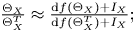



where $I_{X}$ is the ideal generated by $\phi$
 .
Proof.
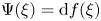
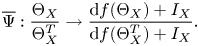
(i) The homomorphism $\Psi :\Theta _{X}\to \textrm {d}f(\Theta _{X})+I_{X}$
defined by $\Psi (\xi )=\textrm {d}f(\xi )$ induces the isomorphism
\[ \overline{\Psi}:\frac{\Theta_{X}}{\Theta_{X}^{T}}\to\frac{\textrm{d}f(\Theta_{X})+I_{X}}{\textrm{d}f(\Theta_{X}^{T})+I_{X}}. \]In fact, it is enough to show that $\Psi ^{-1}(\textrm {d}f(\Theta _{X}^{T})+I_{X})\subset \Theta _{X}^{T}.$ Let $\xi \in \Psi ^{-1}(\textrm {d}f(\Theta _{X}^{T})+I_{X})$ then $\Psi (\xi )\in \textrm {d}f(\Theta _{X}^{T})+I_{X}$, that is, there exist $\eta \in \Theta _{X}^{T}$ and $\mu ,\, \lambda \in \mathcal {O}_{n}$, such that
\[ \begin{cases} \textrm{d}f(\xi-\eta)=\mu\phi\\ \textrm{d}\phi(\xi-\eta)=\lambda\phi \end{cases}, \]then\[ \left(\begin{array}{@{}c@{}} \mu\phi\\ \lambda\phi \end{array}\right)\in \left\langle \left(\begin{array}{@{}c@{}} \dfrac{\partial f}{\partial x_{i}}\\ \dfrac{\partial \phi}{\partial x_{i}} \end{array}\right) \quad i=1,\ldots,n \right\rangle \]and\[ I_{2}\begin{pmatrix}\mu\phi & \dfrac{\partial f}{\partial x_{1}} & \cdots & \dfrac{\partial f}{\partial x_{n}}\\ \lambda\phi & \dfrac{\partial \phi}{\partial x_{1}} & \cdots & \dfrac{\partial \phi}{\partial x_{n}} \end{pmatrix}=I_{2}\begin{pmatrix}\dfrac{\partial f}{\partial x_{1}} & \cdots & \dfrac{\partial f}{\partial x_{n}}\\ \dfrac{\partial \phi}{\partial x_{1}} & \cdots & \dfrac{\partial \phi}{\partial x_{n}} \end{pmatrix}=J(f,\phi). \]Therefore\[ \left|\begin{array}{cc} \mu & \dfrac{\partial f}{\partial x_{i}} \\ \lambda & \dfrac{\partial \phi}{\partial x_{i}} \end{array}\right|\phi\in J(f,\phi) \]and since $\phi$ is regular in $\frac {\mathcal {O}_{n}}{J(f,\,\phi )}$ then
\[ \left|\begin{array}{cc} \mu & \dfrac{\partial f}{\partial x_{i}}\\ \lambda & \dfrac{\partial \phi}{\partial x_{i}} \end{array}\right|\in J(f,\phi),\quad i=1,\ldots,n. \]By Lemma 2.2, $\lambda \in J\phi$ and using [Reference Nuño-Ballesteros, Oréfice-Okamoto, Lima-Pereira and Tomazella9, Lemma 3.1], $\xi \in \Theta _{X}^{T}.$(ii) This equality also was proved in [Reference Nuño-Ballesteros, Oréfice-Okamoto, Lima-Pereira and Tomazella9] with the additional hypothesis that $f$
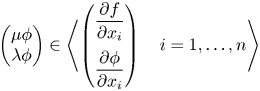
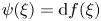
is $\mathcal {R}_{X}$-finitely determined.The epimorphism $\psi :\Theta _{X}\to \textrm {d}f(\Theta _{X})$
defined by $\psi (\xi )=\textrm {d}f(\xi )$ induces the isomorphism
\[ \overline{\psi}:\frac{\Theta_{X}}{\Theta_{X}^{T}}\to \frac{\textrm{d}f(\Theta_{X})}{\textrm{d}f(\Theta_{X}^{T})}. \]In fact, let $\xi \in \ker (\psi )$, then there exist $\lambda \in \mathcal {O}_{n}$, such that
\[ \begin{cases} \textrm{d}f(\xi)=0\\ \textrm{d}\phi(\xi)=\lambda\phi \end{cases} \]The rest is similar to the proof of (i).(iii) Let $\xi \in \Theta _{X}$
be such that $\textrm {d}f(\xi )\in I_{X}$, then there exist $\mu ,\,\lambda \in \mathcal {O}_{n}$, such that
\[ \begin{cases} \textrm{d}f(\xi)=\mu\phi\\ \textrm{d}\phi(\xi)=\lambda\phi \end{cases} \]Using the same techniques of the proof of (i), we have\[ \textrm{d}f(\Theta_{X})\cap I_{X}\subset Jf I_{X}. \]The other inclusion is immediate.(iv) It follows from the isomorphisms
\[ \frac{\textrm{d}f(\Theta_{X}^{-})}{\textrm{d}f(\Theta_{X})}=\frac{\textrm{d}f(\Theta_{X})+I_{X}}{\textrm{d}f(\Theta_{X})}\approx \frac{I_{X}}{\textrm{d}f(\Theta_{X})\cap I_{X}}\stackrel{(iii)}{=}\frac{I_{X}}{JfI_{X} }\approx\frac{\mathcal{O}_{n}}{Jf}. \](v) It follows from (iii).
(vi) It follows from (v) and $Jf\subset \textrm {d}f(\Theta _{X}^{T}):I_{X}$
.














Remark 2.4 The items (ii) and (iv) of Theorem 2.3 seem a bit peculiar since from (iv) the quotient $\textrm {d}f(\Theta _{X}^{-})/\textrm {d}f(\Theta _{X})$ does not depend on $(X,\,0)$
 while from (ii), $\textrm {d}f(\Theta _{X})/\textrm {d}f(\Theta _{X}^{T})$
 does not depend on $f$
 . Moreover by [Reference Nuño-Ballesteros, Oréfice-Okamoto, Lima-Pereira and Tomazella9, Reference Tajima13] if $(X,\,0)$
 is an IHS determined by $\phi :(\mathbb {C}^{n},\,0)\to (\mathbb {C},\,0)$
 , then $\operatorname {dim}_{\mathbb {C}}\dfrac {\Theta _{X}}{\Theta _{X}^{T}}=\tau (X,\,0),$
 therefore

The next theorem is one of the main results of this work.
Theorem 2.5 Let $(X,\,0)$ is an IHS determined by $\phi :(\mathbb {C}^{n},\,0)\to (\mathbb {C},\,0)$
 and $f\in \mathcal {O}_{n}$
 be a function germ such that $\mu _{BR}^{-}(f,\,X)<\infty$
 . Then $(\phi ,\,f)$
 defines an ICIS and

Proof. We consider the exact sequence

Since $(X,\,0)$ is an IHS

hence

The last equality is a consequence of the Lê-Greuel formula [Reference Brieskorn and Greuel3] and Theorem 2.3 (i).
3. The relative Bruce–Roberts number of a function with isolated singularity
In this section, $(X,\,0)$ is an IHS and $f\in \mathcal {O}_{n}$
 is a function germ $\mathcal {R}_{X}$
 -finitely determined, then all the results in the previous section are true in this case. In particular from (iv) of Theorem 2.3

Therefore, by the exact sequence

we conclude that

The following example shows that the characterization of the Milnor number (4) is not true anymore when $(X,\,0)$ is an ICIS with codimension higher than one.
Example 3.1 Let $(X,\,0)$ be an ICIS determined by $\phi (x,\,y,\,z)=(x^{3}+x^{2}y^{2}+y^{7}+z^{3},\,xyz)$
 , and $f(x,\,y,\,z)=xy-z^{4}$
 , $f$
 is a $\mathcal {R}_{X}$
 -finitely determined and

As a consequence of the characterization of the Milnor number (4), we prove that $LC(X)^{-}$ is Cohen–Macaulay when $(X,\,0)$
 is an IHS.
The logarithmic characteristic variety, $LC(X)$ , is defined as follows. Suppose the vector fields $\delta _1,\,\ldots ,\,\delta _m$
 generate $\Theta _X$
 on some neighbourhood $U$
 of $0$
 in $\mathbb {C}^{n}$
 . Let $T^{*}_U\mathbb {C}^{n}$
 be the restriction of the cotangent bundle of $\mathbb {C}^{n}$
 to $U$
 . We define $LC_U(X)$
 to be

Then $LC(X)$ is the germ of $LC_U(X)$
 in $T^{*}\mathbb {C}^{n}$
 along $T^{*}_0\mathbb {C}^{n}$
 , the cotangent space to $\mathbb {C}^{n}$
 at $0$
 . As $LC(X)$
 is independent of the choice of the vector fields $\delta _i$
 then it is a well-defined germ of analytic subvariety in $T^{*}\mathbb {C}^{n}$
 (see [Reference Bruce and Roberts4, Reference Saito11]).
If $(X,\,0)$ is holonomic with logarithmic strata $X_0,\,\ldots ,\,X_k$
 then $LC(X)$
 has dimension $n$
 , and its irreducible components are $Y_0,\,\ldots ,\,Y_k$
 , with $Y_i=\overline {N^{*}X_i}$
 as set-germs, where $\overline {N^{*}X_i}$
 is the closure of the conormal bundle $N^{*}X_i$
 of $X_i$
 in $\mathbb {C}^{n}$
 (see [Reference Bruce and Roberts4, Proposition 1.14]).
When $(X,\,0)$ has codimension higher than one, Bruce and Roberts proved that $LC(X)$
 is not Cohen–Macaulay. Then they consider the subspace of $LC(X)$
 obtained by deleting the component $Y_{0}$
 that corresponds to the stratum $X_0= \mathbb {C}^{n}\setminus X$
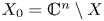 , that is

and as set-germs,

An interesting fact about $LC(X)^{-}$ is that it may be Cohen–Macaulay even when $LC(X)$
 is not Cohen–Macaulay, for example, if $(X,\,0)$
 is a weighted homogeneous ICIS, then $LC(X)^{-}$
 is Cohen–Macaulay, [Reference Bruce and Roberts4].
Proposition 3.2 Let $(X,\,0)$ be an IHS, then $LC(X)^{-}$
 is Cohen–Macaulay.
Proof. We consider $(0,\,p)\in LC(X)^{-}$ , then $(0,\,p)\in LC(X)$
 and there exists $f\in \mathcal {O}_{n}$
 such that $\textrm {d}f(0)=p$
 . In [Reference Nuño-Ballesteros, Oréfice-Okamoto, Lima-Pereira and Tomazella9], we proved that $LC(X)$
 is Cohen–Macaulay. Therefore, by [Reference Bruce and Roberts4, Proposition 5.8],

where $n_{i}$ is the number of critical points of a Morsification of $f$
 in $X_{i}$
 and $m_{i}$
 is the multiplicity of irreducible component $Y_{i}$
 . Thus,

and by [Reference Bruce and Roberts4, Proposition 5.11], we obtain that $LC(X)^{-}$ is Cohen–Macaulay.
Remark 3.3 We remark that in the proof of the previous proposition, we just used that if $(X,\,0)\subset (\mathbb {C}^{n},\,0)$ is a hypersurface such that $\operatorname {dim}_{\mathbb {C}}\textrm {d}f(\Theta _{X}^{-})/\textrm {d}f(\Theta _{X})=\mu (f)$
 for all $f$
 $\mathcal {R}_{X}$
 -finitely determined then $LC(X)^{-}$
 is Cohen–Macaulay if and only if $LC(X)$
 is Cohen–Macaulay.
4. Polar curves and logarithmic characteristic varieties
It is important to know whether the logarithmic characteristic variety of an analytic variety is Cohen–Macaulay. In [Reference Nuño-Ballesteros, Oréfice-Okamoto, Lima-Pereira and Tomazella9], we showed that this is the case for IHS. For non-isolated singularities, it is an open problem. In this section, we give one more step in order to solve it: we study the polar curve and the relative polar curve of a holomorphic function germ over a holonomic analytic variety. We show that these curves are Cohen–Macaulay if and only if the logarithmic characteristic variety and the relative logarithmic characteristic variety (respectively) are Cohen–Macaulay. As a consequence, we have the principle of conservation for the Bruce–Roberts number.
Definition 4.1 Let $f\in \mathcal {O}_{n}$ be a $\mathcal {R}_{X}$
 -finitely determined function germ and $F:(\mathbb {C}^{n}\times \mathbb {C},\,0)\to (\mathbb {C},\,0)$
 , $F(t,\,x)=f_t(x)$
 ,
a 1-parameter deformation of $f$ . The polar curve of $F$
 in $(X,\,0)$
 is

where $\Theta _{X}=\langle \delta _{1},\,\ldots ,\,\delta _{m}\rangle$ .
In [Reference Ahmed, Ruas and Tomazella1], it was proved that if $LC(X)$ is Cohen–Macaulay then the polar curve $C$
 is Cohen–Macaulay.
Proposition 4.2 Let $(X,\,0)$ be a holonomic analytic variety. If any $\mathcal {R}_{X}$
 -finitely determined function germ has a Morsification whose polar curve is Cohen–Macaulay then $LC(X)$
 is Cohen–Macaulay.
Proof. Let $(0,\,p)\in LC(X)$ , then there exists an $\mathcal {R}_{X}$
 -finitely determined function germ $f\in \mathcal {O}_{n},$
 such that $\textrm {d}f(0)=p$
 . Let $F:(\mathbb {C}^{n}\times \mathbb {C})\to (\mathbb {C},\,0)$
 , $F(x,\,t)=f_{t}(x)$
 ,
be a Morsification of $f$ . By hypothesis $\mathcal {O}_{n+1}/\textrm {d}f_{t}(\Theta _{X})$
 is Cohen–Macaulay of dimension 1, then by the principle of conservation of number

because if $x\in X_{i}$ is a Morse critical point of $f_{t}$
 , then $\mu _{BR}(f_{t},\,X)_{x}=m_{i}$
 , and by [Reference Bruce and Roberts4, Proposition 5.8], $LC(X)$
 is Cohen–Macaulay.
When $LC(X)$ is Cohen–Macaulay, we have

where $f_{t}$ is any 1-parameter deformation of $f$
 .
Our purpose now is to prove similar results for $LC(X)^{-}$ . We define the relative polar curve by

where $C$ is the polar curve of $F$
 in $(X,\,0).$

The proof of the next proposition is similar to the one of [Reference Ahmed, Ruas and Tomazella1, Theorem 3.7].
Proposition 4.3 Let $(X,\,0)$ be a holonomic analytic variety. If $LC(X)^{-}$
 is Cohen–Macaulay then the relative polar curve of every 1-parameter deformation of any $\mathcal {R}_{X}$
 -finitely determined function germ is Cohen–Macaulay.
For the converse, we need the following lemma, which is the analogous of [Reference Bruce and Roberts4, Proposition 5.12] for the relative Bruce–Roberts number.
Lemma 4.4 Let $(X,\,0)$ be a holonomic analytic variety and $f\in \mathcal {O}_{n}$
 . We assume that $f$
 restricted to $(X,\,0)$
 is a Morse function. If $x\in X$
 is a critical point of $f$
 then $\mu _{BR}(f,\,X)_{x}^{-}=m_{\alpha },$
 where $m_{\alpha }$
 is the multiplicity of the irreducible component $Y_\alpha$
 corresponding to the logarithmic stratum $X_\alpha$
 which contains $x$
 .
Proof. Let $Z_{i}=Y_{i}\setminus \bigcup _{j\neq i}Y_{j}$ where $Y_{i}$
 are the irreducible components of $LC(X)$
 . We know from [Reference Bruce and Roberts4, Proposition 5.12] that $LC(X)$
 is Cohen–Macaulay at points in $Z_{i}$
 , $i=1,\,\ldots ,\,k+1$
 . We see that $LC(X)^{-}$
 coincides locally with $LC(X)$
 and hence, $LC(X)^{-}$
 is also Cohen–Macaulay at points in $Z_{i}$
 , $i=1,\,\ldots ,\,k+1$
 .
In fact, let $(0,\,p)\in Z_{i}$ with $i\neq 0$
 , then $(x,\,p)\not \in Y_{0}$
 . Let $V:= T^{*}\mathbb {C}^{n}\setminus Y_{0}$
 , which is an open neighbourhood of $(x,\,p)$
 . Obviously, we have the equality of sets

Moreover, let $I,\,\;I^{-}$ and $I_{j}$
 be the ideals which define $LC(X)$
 , $LC(X)^{-}$
 and $Y_{j}$
 , $j=0,\,\ldots ,\,k+1$
 , respectively. Then,

Since $p\neq 0$ , $I_{0}$
 is the total ring at $(x,\,p)$
 , so we have an equality between germs of complex spaces.
Finally, we have

The equalities $(*)$ and $(**)$
 are consequences of [Reference Bruce and Roberts4, Propositions 5.11 and 5.2], respectively.
We are ready now to prove the converse of Proposition 4.3.
Proposition 4.5 Let $(X,\,0)$ be a holonomic analytic variety. If the relative polar curve of every 1-parameter deformation of any $\mathcal {R}_{X}$
 -finitely determined function germ is Cohen–Macaulay then $LC(X)^{-}$
 is Cohen–Macaulay.
Proof. Let $(0,\,p)\in LC(X)^{-}$ , then there exists an $\mathcal {R}_{X}$
 -finitely determined function germ $f\in \mathcal {O}_{n},$
 such that $\textrm {d}f(0)=p$
 . Let $F:(\mathbb {C}^{n}\times \mathbb {C},\,0)\to (\mathbb {C},\,0)$
 be a Morsification of $f$
 and set $f_{t}(x)=F(x,\,t)$
 .
By hypothesis $\mathcal {O}_{n+1}/\textrm {d}f_{t}(\Theta _{X}^{-})$ is Cohen–Macaulay of dimension 1. By the principle of the conservation of the multiplicity,

because if $x\in X_{i}$ is a Morse critical point of $f_{t}$
 , then $\mu _{BR}(f_{t},\,X)^{-}_{x}=m_{i}$
 by Lemma 4.4. By [Reference Bruce and Roberts4, Proposition 5.11], $LC(X)^{-}$
 is Cohen–Macaulay.
As a consequence of the previous result,

where $f_{t}$ is any 1-parameter deformation of $f$
 .
5. An example with non-isolated singularities
Given natural numbers $0< k\leq n$ , we can see $\mathcal {O}_k$
 as a subring of $\mathcal {O}_n$
 and $\Theta _{k}$
 as a subset of $\Theta _{n}$
 . We fix $(x_1,\,\ldots ,\,x_n)$
 as the system of coordinates in $\mathcal {O}_n$
 and we use $(x_1,\,\ldots ,\, x_k)$
 as the coordinate system of $\mathcal {O}_k$
 and $(x_{k+1},\,\ldots ,\,x_n)$
 as the one in $\mathcal {O}_{n-k}$
 .
Let $(X,\,0)\subset (\mathbb {C}^{k},\,0)$ be an analytic variety. We denote by $(\tilde {X},\,0)\subset (\mathbb {C}^{n},\,0)$
 the inclusion of $(X,\,0)$
 in $(\mathbb {C}^{n},\,0).$
 Then $\Theta _{\tilde {X}}=\mathcal {O}_{n}\Theta _{X}+\langle \tfrac {\partial }{\partial x_{k+1}},\ldots ,\tfrac {\partial }{\partial x_{n}}\rangle$
 and $LC(\tilde {X})=LC(X)\times \mathbb {C}^{n-t}.$

Consequently, if $LC(X)$ is Cohen–Macaulay then $LC(\tilde {X})$
 is Cohen–Macaulay.
In particular, if $(X,\,0)$ is an IHS then $LC(\tilde {X})$
 is Cohen–Macaulay.
Let $F\in \mathcal {O}_{n}$ a function germ with isolated singularity such that $F=f+g$
 with $f\in \mathcal {O}_{k}$
 and $g\in \mathcal {O}_{n-k}$
 . It is known by Sebastiani and Thom [Reference Sebastiani and Thom12] that $\mu (F)=\mu (f)\mu (g)$
 . We prove a similar result for the Bruce–Roberts number,

Proposition 5.1 Let $I$ and $J$
 be ideals in $\mathcal {O}_{k}$
 and $\mathcal {O}_{n-k}$
 , respectively. If we denote by $I'=I\mathcal {O}_n$
 and $J'=J\mathcal {O}_n$
 the respective induced ideals in $\mathcal {O}_n$
 , then

Moreover, if these dimensions are finite then

Proof. The equivalence follows from

For the equality, by hypothesis there exist positive integer numbers $k',\,\;k_{i}$ and $k_{j}$
 such that

where $\mathcal {M}_\ell$ is the maximal ideal of $\mathcal {O}_\ell$
 . Let $r=\max \{k',\,\ k_{i},\, \ k_{j}\}$
 , then

where $z_1=(x_1,\,\ldots ,\,x_k)$ , $z_2=(x_{k+1},\,\ldots ,\,x_n)$
 and $I''$
 and $J''$
 are the ideals in $\mathbb {C}[z_1,\,z_2]$
 generated by the $r-1$
 -jets of the generators of $I$
 and $J$
 , respectively. Analogously,

where $I'''$ and $J'''$
 are the ideals in $\mathbb {C}[z_1]$
 and $\mathbb {C}[z_2]$
 generated by the $r-1$
 -jets of the generators of $I$
 and $J$
 , respectively. Finally, the equality follows from

where $\otimes _{\mathbb {C}}$ denotes the tensor product, see [Reference Greuel and Pfister7, Proposition 2.7.13].
We observe that the previous result gives a simpler proof to the equality of [Reference Sebastiani and Thom12] about the Milnor numbers. Finally, we relate the Bruce–Roberts numbers $\mu _{BR}(F,\,\tilde {X})$ and $\mu _{BR}(f,\,X)$
 .
Corollary 5.2 Let $(\tilde {X},\,0),$ and $(X,\,0)$
 as before, and

then:
(a) $F$
is $\mathcal {R}_{\tilde {X}}$-finitely determined if, and only if, $f$ is $\mathcal {R}_{X}$-finitely determined and $g$ has isolated singularity.(b) If $F$
is $\mathcal {R}_{\tilde {X}}$-finitely determined, $\mu _{BR}(F,\,\tilde {X})=\mu (g)\mu _{BR}(f,\,X)$.



Proof. It is a consequence of the characterization of $\Theta _{\tilde {X}}$ and the previous theorem.
Acknowledgements
The first author was partially supported by CAPES. The second author was partially supported by MICINN Grant PGC2018–094889–B–I00 and by GVA Grant AICO/2019/024. The third and fourth authors were partially supported by FAPESP Grant 2019/07316-0.


