I. KBR MS 3824-5, fos 29r–34v
Giovanni Andrea Serra SJ Footnote 500 to Giovanni Paolo Oliva SJ, Footnote 501 novice director, Sant’Andrea al Quirinale, Rome; on the death of FS, 13 December 1642
(29r) Molto Reverendo in Christo Padre
[Pax Christi]
Dio sa con quanto desiderio ho bramato di ricevere alcuni giorni prima la di Vostra Riverenza delli 28 del passato per consolare il Padre Francesco Perseo, che ogni giorno mi domandava se havevo ricevuto risposta della mia, che mi fece scrivere. Passò final[men]te doppo 24 giorni di malatia sabato passato li 6 [dicembre] all’altra vita, veramente, con invidia di molti per haver lasciato in sì poco tempo tanto buon odore delle sue virtù in questo collegio che da Padri anche più gravi l’ho sentito lodare col nome di Santo,
Tre cose in questa sua malatia ha havuto tra gl’altre amirabili, La divotione della Beata Vergine, il parlar di Dio, et una allegrezza incredibile in tanti dolori patiti, et ultimamente nel morire non mi mancherebbero casi particolari per provar tutto questo, ma non voglio essere longo, non posso però taccere quel che disse il giorno avanti la sua morte al Padre Fabritio Pignatelli,Footnote 502 il quale discorrendo di cose indifferenti in camera sua domandò al Padre Francesco che mostrava segno di disgusto, se voleva quache cosa, gli rispose: Padre sì, vorrei parlasse di Dio adesso, e sempre, perché altrimente s’accresce il mio male, stupì il Padre, e corretto per dir così d’un novitio raccontò un essempio della Beata Vergine, e veramente incontrò il suo gusto, perché l’istesso Padre Francesco di questa sempre discorreva, sempre questa ringratiava, mostrando[si]Footnote 503 veramente figlio con una innocenza di Paradiso, e giaché non poteva andar lui in Chiesa a ringratiarla, diceva lui, del patire, che provava in quel letto, non quietava sinche due volte il giorno non mandasse me in luogo suo all’altare della Conettione, e io l’assicurassi d’esserli stato; Che maraviglia dunque se si mostrava sì allegro e nel patire, e nel morire.
Avisato l’ultima volta per l’altra vita dal Padre Spirituale esclamò subito ridendo Laetatus sum in his, quae dicta su[nt] mihi in domum Domini ibibus,Footnote 504 e seguito il salmo, e tutta quella (29v) sera si trattenne in atti sì devoti, sì santi, che più d’uno diceva di trattenersi in quella camera per eccitarsi a devotione, ne bisognava trattarci di vita perché ne sentiva disgusto parendoli d’esser più beato morendo, Disse al Padre Spirituale nondimeno, che se era gloria di Dio gl’impetrasse dal Signore Iddio, che restasse in quelli dolori, et affanni della malatia per una eternità intiera, che lui si contentava. Iddio lo contracambiò bene anche in questa vita, perché li concesse una morte felicissima con tutti li suoi sentimenti, quieta, senza turbationi, anzi ridendo, parlò sin all’ultimo ponto, havendo sempre in bocca quelli quattro tesori, che Vostra Riverenza insegna a suoi novitii, e mezzo quarto avanti che spirasse domandò a me se mi ricordavo il 2° santo che lei consigliava a pegliarsi nel ponto della morte, e nominando io San Martino, subito voltato al crocifisso disse se adhuc populo tuo sum necessarius non recuso laborem,Footnote 505 e queste furono l’ultime o penultime parole, se non erro, che dicesse, andandosene poi come angelo di Paradiso al Cielo.
Gli domandai mi lasciasse qualche ricordo il giorno avanti che morisse, mi rispose, che non lasciassi mai la mia oratione, e che facessi conto delle cose piccole, credo, che lo spirito santo lo facesse parlare, spero che pregherà per me come mi promisse nel paradiso, e che insieme m’impetrerà tanta gratia di poter mettere in essecutione i suoi ricordi, cert’è che per me è stato un grand’essempio; Mi ha lasciato li tre Tomi della sua filosofia, che teneva, haverò occasione di adoprarla con veneratione. Li vot[i] il Padre Provinciale gle l’haveva concessi 15 giorni prima quando incominciò ad agravarsi prima che gli fosse portato il viatico. Li Novitii perfetti di Vostra Riverenza Iddio se li piglia, gl’imperfetti li lascia acciò si perfettionino, io sono di questi secondi procurerò d’arrivare i primi e lo dico con qualche sentimento, e tutto il desiderio.
Auguro a Vostra Riverenza felicissime le prossime feste del santo Natale, come anche al Padre Domenico Vanni,Footnote 506 né mi sono mai scordato quanto gli devo; Godo et invidio insieme al Padre Nicolò GentileFootnote 507 la conversatione di Vostra Riverenza e stanza in Santo (34r) Andrea, se di già fosse venuto la supplico a salutarmelo caramente. Ho riverito come m’impone il Padre Preposito Padre Carrafa,Footnote 508 e Poderico, e tutti risalutano caramente Vostra Riverenza, e gli restano obligatissimi della memoria, che tiene di loro.
Se gli ricorda servo il Padre Spinelli, et io mi raccomando caldamente alle sue santi sacrificii et orationi
Napoli li 13 Decembre 1642
Di Vostra Riverenza
Il P. Contri seguita a tenerci tutti sospesi, hoggi sta più tosto peggio, che meglio, speranza in rimedii humani non v’è più, sta debilitatissimo e più s’implorano gli agiuti del cielo, di quel che si speri in quelli della terra, martedì sarà il giorno quarantesimo critico per lui, e a medici di gran timore, et osservatione.
Figlio e servo in Christo Indegnissimo
Gio. Andrea Serra
(34v) Al molto reverendo in Christo Padre il Padre
Giov. Paolo OlivaFootnote 509 rettore della Compagnia
di Giesù
Roma
Translation
(29r) Most reverend father in Christ
The peace of Christ
God knows with what desire I longed to receive some days ago your reverence’s letter of the 28 [November] to console Father Francis Percy, who used ask me every day if I had received a reply to my letter, which he had me write. He finally passed to the other life after an illness of 24 days on Saturday last 6 [December]. Truly, many were envious [of him] for having left in this college in so short a time such good odour of his virtues that I have heard fathers including those more grave praise him with the name of saint.
I have found three things among others admirable in this illness of his: devotion to the Blessed Virgin [Mary], speaking of God, and an incredible joyfulness in so many sufferings endured. Finally, in [his] dying, particular cases are not lacking to prove all this, but I don’t want to be long. However I cannot remain silent about what he [Francis] said to Father Fabritio Pignatelli the day before he died; Pignatelli, talking about banal matters in Francis’s room, asked Francis to indicate some displeasure, if he wished something, who replied: Father, yes, I would like that you would speak about God now, because otherwise my pain increases. This amazed the father. Corrected so to speak by a novice, Fabritio related an edifying story of the Blessed Virgin, which truly matched Francis’s taste, because Father Francis continued to talk of this, continuously thanking her, showing himself with a heavenly innocence truly to be a son. And although he himself was unable to go to the church to thank her, he used say, because of the suffering he was experiencing in bed, he did not relax until twice a day he had sent me in his place to the altar of the [Immaculate] Conception, and that I had assured him that I had been there. What wonder therefore that he showed himself so joyful both in suffering and in dying.
When the spiritual fatherFootnote 510 gave him notice, for the last time, of the other life, he exclaimed suddenly as he laughed, ‘I rejoiced at the things that were said to me: we shall go into the house of the Lord’, and followed [with] the psalm. All that evening he continued in prayers so devout, and so holy, that several said that they remained in that room to be aroused to devotion. Not wanting to talk of life because he experienced distaste for it, he appeared to them more blessed while dying. Nevertheless he said to the spiritual father, that [if it were for God’s glory] that he would remain in those pains and shortness of breath of his illness for a full eternity, that he would be content. God repaid him well also in this life, for he granted him a most happy death, with all his faculties, tranquil without agitation, rather smiling; he spoke up to the last, always having on his lips these four treasures, which your reverence teaches his novices, and some minutes before he expired, he asked me if I remembered the second saint which you used to recommend, to [invoke] at the moment of death. I named Saint Martin, and suddenly turning towards the crucifix he said, ‘Lord, if I am still needed for your people, I do not decline the task’,Footnote 511 and these were the last, or penultimate, words, if I’m not mistaken, that he uttered, then going off like an angel of paradise to heaven.
I asked him that he might leave me some memento the day before he died, he replied to me that I should never abandon my prayer and that I should value the little things;Footnote 512 I believed that the Holy Spirit was making him speak; I hope that he will pray for me in paradise as he promised me, and that together he will beg for me so much grace to be able to put into practice what was memorable about him; what is certain is that he has been for me a great example. He has left me the three books of his philosophy [course], which he had; I will have occasion to use them with veneration. Father Provincial granted him the vowsFootnote 513 fifteen days beforehand, when his condition began to get worse, before the viaticum was brought to him. Those of your reverence’s novices who are perfect, God takes; the imperfect ones he leaves so that they might perfect themselves, I am among these second ones; I will try to be among the first. I say this with some feeling, and every desire.
I offer your reverence most happy wishes for the coming feast of holy Christmas, as also Father Domenico Vanni, and I have never forgotten how much I owe [you]. I enjoy and envy, together with Father Nicolò Gentile, the conversation of your reverence during [my] stay in Sant’Andrea; if he has already arrived, I ask you to greet him dearly on my behalf. I have reverenced as you ordered me Father [Rector] Father Carrafa, and Poderico, and all in turn greet your reverence, and they remain most obliged that you remember them.
Father Spinelli remembers you, and I entrust myself warmly to your holy sacrifices [i.e. masses] and prayers
Naples 13 December 1642
Father Contri continues to hold us all in suspense, today he was rather worse, than better; there is no longer hope in human remedies; he is very weak, and heavenly helps are sought more than one might hope from earthly ones. Tuesday will be the critical fortieth day for him, and of great fear and observation for the doctors.
Your reverence’s son and most unworthy servant in Christ
Giovanni Andrea Serra
II. KBR MS 3824-5, fos 21v–22r
Nicola Consalvi on FS [undated; after 6 December 1642]
(21v) Cose notate sopra il P. Perseo da Nicola ConsalviFootnote 514
HavevaFootnote 515 nel caminare e nel portamento della sua persona una compositione singolare, di più nello stare al suo tavolino, nella ricreatione, sempre uniforme in questa parte.
Haveva grande modestia d’occhio senza veruna affectatione.
HavevaFootnote 516 una affabilità con un gratioso riso, e modesto in bocca continuo nella ricreatione, con singolare verecondia, e rispetto verso gl’altri non havendo mai nepure in cosa leggierissima trasgredito le leggi della verecondia. Parlava cordialmente di Dio, e della Madonna Santissima soleva dire, che dovevamo essere molto divoti di lei, perché era Madre nostra, ma con particolar sentimento
StandoFootnote 517 male d’occhi, e visitandolo io, stava contentis[sim]o, e sempre con la sua solita giovialità e riso e soleva dire del patire che era la più nobil cosa, e la migliore, perché Cristo sapienza eterna, che non vuole, né si può ingannare, ha fatto così; nella imitazione di Cristo haveva particolare sentimento.
HavevaFootnote 518 un’obbedienza straordinaria, poiché mai l’ho visto, che non sia stato prontissimo anco al cenno, e all’avviso del Portinaro; et era a quello con grande humiltà rassegnato, et in questa virtù (21r) dell’humiltàFootnote 519 spiccava particolarmente, nella ricreatione stando giustamente come un putto rassegnato al parere d’altri cedendo, non parlando di sé quanto a chi fosse, mai, né mostrando punto il suo sapere anco gustando degl’offitii humili, non parlava ne meno di sé nepure in cose spirituali.
Haveva grandissimo desiderio, che un suo fratello si convertisse, onde tenerissimamente ce lo raccommandava, e una volta sentendo, che l’Inghilterra andava molto bene nelle cose della fede, ne godeva molto, e pregavaci, che facessimo tutti sopra cio oratione. Di più al suo fratello per convertirlo andava ogni giorno quasi.
Havendo doi volte havuto una medesima penitenza per una medesima colpa per poca avvertenzaFootnote 520 del Portinaro in cosa però leggierissima venne al Portinaro e in grand’humiltà, modestia, e verecondia a dimandarli così. Se mi volete far la carità di dichiararmi il mancamento per potermene emendare.
Mi pare veramente, che caminasse irreprensibilmente in ogni cosa, e angelicamente, non havendovi io conosciuto imperfettione veruna. Il P. Oliva Rettore lo diede per modello nel dir la messa a Sacerdoti Novitii.
(22r) QuandoFootnote 521 veniva mortificato dal P. Rettore Maestro di NovitiiFootnote 522 al tempo de mancamenti, il che spesso succedeva per esercitio della sua virtù, sempre stava con un modesto e allegro volto.
CiFootnote 523 è stato un fratello, il quale mi ha detto, haverlo notato, che mai si appoggiava, nepure quando riposava nè nella sedia, istessa, dove riposava.
Translation
(21v) Some things noted about Father Percy by Nicola Consalvi
He had a particular bearing in walking and in his carriage of himself, more so when he was at his small table, at recreation, always unchanging. He had great modesty of the eyes without any affectation.
He was affable with a gracious laugh and always self-effacing in speech at recreation, with singular modesty, and respect towards others not having ever, even in a most trifling matter, transgressed the laws of modesty. He used to speak in a friendly way of God, and of the most holy Madonna he used to say, that we should be most devout towards her, because she was our mother, but with especial feeling.
Having difficulties with his eyesight, when I visited him he was most happy, always with his customary cheerfulness, and laughter, and he used to say of suffering that it was the most noble thing, and the best, because Christ, eternal wisdom, who neither wants to nor can deceive, had behaved like that; he had a special feeling for the imitation of Christ.
His obedience was extraordinary, for he was most prompt [at responding] even to the nod and the indication of the doorman; and with great humility he was resigned to [following] this indication, and in this virtue (21r) of humility he stood out especially at recreation, where he stood truly like a cherub resigned to yield to the opinion of others, not speaking of himself to anyone, never displaying his knowledge, and even enjoying humble duties, not speaking of himself in spiritual matters either. He had a huge desire that one of his brothersFootnote 524 would convert [to Catholicism], whence most tenderly he would recommend him to us. Hearing once that matters of the faith were going very well in England, he enjoyed this very much, and he asked us that we all would pray for this. Further, he used to go [to pray] almost every day for the conversion of his brother.
Having twice had the same penance for the same fault for paying little attention to the doorman in something however that was most trifling, he came to the doorman and in great humility, modesty and self-effacement to ask him as follows: if you wish, you can do me the charity of declaring to me the fault so that I may correct it.
It truly seems to me that he walked without fault in all things, angelically; for myself, I haven’t known any imperfection [in him]. Father Rector Oliva held him as a model for priest novices in saying the mass.
(22r) When he was corrected by Father Rector, Novice master, at the time of declaring faults, which used to happen frequently in order to exercise his virtue, he always had a modest and cheerful face. There was one brother who said to me, that he noticed, [Francis] never would lean against [a support], neither when he was resting, nor in the chair where he was resting.
III. KBR MS 3824-5, fo. 45r–v
Tomaso Mascambruno SJ to Gioseppe Blonditio SJ, 2 January 1643
(45r)+
Carissimo in Christo [fratello]
Pax ChristiFootnote 525
Vi ringrazio di tutto cuore della consolatione, che m’ havete data con la vostra lettera, con l’occasione di queste sante feste. Prego il Signore Dio, che ve le conceda felicissime con il nuovo, e cento altri anni, come io vivamente desidero. Intorno alla morte del P. Perseo: io vi dico con ogni sincerità, che ogni gran santo si può contentare di morire con quella tranquillità d’animo, resignatione alla divina voluntà, desiderio di morire; con che è morto lui. Che veramente ha edificati, e consolati tutti che hanno sentito sommamente di essere privi d’un speccho di santità come era lui. Però lui era già maturo per il cielo; et Iddio l’ha voluto per sé; dove con l’orationi aiuterà più efficacemente di quello, che haverebbe fatto con le pa[tibolo] l’Inghilterra.
Con che mi raccomando alle vostre sante orationi. Da Napoli 2 di Gennaro 1643
Servo indegno in Christo
Tomaso Mascam[bruno]Footnote 526
f. Gioseppe Blo[n]ditioFootnote 527
(45v)+
Al carissimo in Christo fratello il fratello Gioseppe Blanditio della Compagnia di Gesù
Roma[seal removed]
Franc[esco] SlingFootnote 528
Della morte del P. Perseo vero nomine Slingisby
Scritta ad un repetitore di questo Collegio
Translation
(45r) Dearest brother in Christ
The peace of Christ
I thank you wholeheartedly for the consolation which you have given me with your letter on the occasion of these holy feast days. I pray the Lord God that He may grant you most happy feast days with the new year, and a hundred other years, as I warmly desire. Regarding the death of Father Percy: I say to you in all sincerity, that every great saint may be happy to die with the tranquillity of soul, resignation to the divine will [and] desire for death with which he died. Truly he has edified and consoled all who have greatly felt the loss of a mirror of holiness, such as he was. However he was already ripe for heaven; God wanted him for Himself there, where he will help through prayer more efficaciously than England would have done [with] the scaffold.Footnote 529 Thus I recommend myself to your holy prayers.
From Naples 2 January 1643
Most unworthy servant in Christ
Tomaso Mascam[bruno]
F. Gioseppe Blo[n]ditio
(45v) To the dearest brother in Christ brother Gioseppe Blanditio of the Society of Jesus Rome
On the death of Father Perseo true name Slingisby
Written to a repetitore Footnote 530 of this college
IV. KBR MS 3824-5, fo. 50r–v
Bernardo Angelici SJ to Giovanni Maria Bentivogli SJ, 11 June 1643
(50r)Carissimo in Christo fratello
Pax Christi
Vedo quanto la charità vostra mi scrive circa il desiderio che ha d’esser informato da me di qualche cosa d’edificatione notata del Padre Perseo giovane già nostro condiscepolo. In risposta non gli posso dir altro di sì santo giovane che sempre ho ammirata la sua rara modestia in ogni cosa, et anche ogni prontezza in argumentare e far ciò che di lui io volevo, mentre stavo al suo circolo, onde non volendo ben spesso nissuno argumentare bastava che io gl’accennassi che non c’era pericolo che non havesse argumentato benché fosse all’improviso, e l’istessi scolari quando gli avvisavo per argumentare scusandosi tutti di non potere mi dicevano lo dica Vostra Riverenza a Perseo che non c’è pericolo che replichi mai, e dica di no.
Ho notato anche in lui con haverci discorso alcune volte che ogni cosa interpretava in bene, et se vedeva cosa che non la potesse manifestamente scusare si componeva tutto dando in un santo eccesso di rigorosa modestia. M’è dispiaciuta da una parte la nova della sua morte per haver noi perso un’esempio così sublime di perfettione christiana, dall’altra parte me ne son rallegrato, perché son sicuro d’esser lui andato dritto in Paradiso, e pregar per tutti noi appresso SDMFootnote 531 che quanto m’occorre alle vostre santissime orazioni molto mi raccomando
ViterboFootnote 532 li 11 Giugno 1643
Humilissimo servo in Christo
Bernardo AngeliciFootnote 533
[ ]CrFootnote 534
(50v) Al mio carissimo in Christo fratello M[aestr]o Giovanni Maria BentivogliFootnote 535 della Compagnia di Giesù
Roma
Collegio Romano
Translation
(50r) Dearest brother in Christ
The peace of Christ.
I note how much your charity impels you to write to me regarding your desire to be informed by me about any matter of edification noted in young Father Percy our former fellow-student. In reply I can only say of such a holy young man that I have always admired his rare modesty in everything, and that he was always ready to participate in formal academic exercises (‘argumentare’) and to do what I required of him, while I was part of his [study] group; whenever it happened that no one wished to present an argument, it was enough that I would nod to him, and there was no risk that he would not present an argument, even when asked unexpectedly. Whenever I would ask the students to present an argument, and all would excuse themselves saying they were unable, they would say to me, Your reverence, ask Percy, there’s no risk that he would ever refuse.
Having spoken with him on several occasions, I have noted that he interpreted everything in a positive light, and if he saw something that clearly he could not excuse, he arranged everything in a holy excess of rigorous modesty. On the one hand I was sorry to learn of his death, for we have lost such a sublime example of Christian perfection: on the other hand I rejoiced, because I am sure that he has gone directly to paradise, and that he prays for us before His Divine Majesty. This is as much as comes to mind. I entrust myself to your most holy prayers.
Viterbo 11 June 1643
The most humble servant in Christ
Bernardo Angelici.
(50v) To my dearest brother in Christ Master Giovanni Maria Bentivogli of the Society of Jesus
Rome
Roman College
V. KBR MS 3824-5, fo. 54r–v
Giuseppe Ceccaroni SJ to Giovanni Maria Bentivogli SJ, 12 June 1643
(54r) Carissimo fratello in Cristo
Pax Christi
Non poco sono restato maravigliato in sentire la morte del Padre Perseo, la modestia del quale, e singolare obedientia, che egli haveva in ripigliare, et argomentare, ancor quando non gli toccava, vi sarà molto nota, per essere cosa amirabile con tutte l’altre cose, che io ho inteso dalli suoi collegiali Inglesi, dalli quali vi potrete informare delle penitenze, che egli faceva nel collegio con grandissima edificatione di tutti, e delli patimenti supportati in prigione, quando andò in InghilterraFootnote 536 per convertire li suoi parenti etc con che finisco et alle sue orationi et a quelli de gl’altri amici con affetto singolare mi raccomando.
Di FabrianoFootnote 537 li 12 di Giugno 1643
[P.]C.V.
Servo indegnissimo e fratello in Cristo
Giuseppe Ceccaroni
(54v) De f. Fran[cesco] SlingisbaeoFootnote 538
Al mio carissimo in Cristo fratello Maestro Giovanni Maria BentivogliFootnote 539 della Compania di Giesù
Roma
Translation
(54r) Dearest brother in Christ
The peace of Christ
I was not a little amazed at hearing of the death of Father Percy. The modesty and exceptional obedience, which he had in taking part in revision exercises and academic arguments, even when it wasn’t his turn, will be well known to you. This was something admirable, along with all the other things which I have learned from his English fellow-students, from whom you will be able to inform yourselves of the penitential exercises which he used do in the college to the greatest edification of all, and of the sufferings endured while in prison, when he went to England to convert his relations etc. With this I conclude and I entrust myself to all your prayers and to those of the other friends with special affection.
From Fabriano 12 June 1643
Most unworthy servant and brother in Christ
Giuseppe Ceccaroni
(54v) To his dearest brother in Christ, Master Giovanni Maria Bentivogli of the Society of Jesus
Rome
VI. KBR MS 3824-5, fo. 55r–v
Tomaso Mascambruno SJ to Francesco Mascambruno SJ, 4 July 1643
(55r)
Del P. Perseo qui fu pochi giorni e visse da Ang[el]o come fece costì. S’ammalò e nell’inf[ermi]tà stette con somma quiete, e patienza; quando l’attese la morte mostrò somma allegrezza, e rassegnazione nella divina volontà stette sempre fin che spirò facendo atti divotamente e morì santamente. Altro di lui non posso sapere per essere stato qui poco tempo.
Con che mi raccomando alli santi sacrifici di Vostra Riverenza
Da Napoli 4 di luglio 1643
Di vostra riverenza
Servo indegnissimo in [Christo]
Tomaso MascambrunoFootnote 540
(55v) Al molto riverendo in Christo padre il Padre Francesco Mascambruno rettore di Compagnia di Gesù
Roma
Translation
Concerning Father Percy: he was here for a few daysFootnote 541 and lived as an angel as he did where you are [i.e. Rome]. He became ill and he bore his sickness with great tranquillity and patience. When death was approaching he showed great cheerfulness, and he was resigned to the divine will at all times until he expired, devoutly uttering prayers, and he died in a holy way. I cannot know any more about him because I have been here a short time.
With this I entrust myself to the holy sacrifices [Masses] of your reverence
From Naples 4 July 1643
Of your reverence [I am] the most unworthy servant in Christ
Tomaso Mascambruno
VII. KBR MS 3824-5, fos 76r–79r
Bartolomeo Conventino SJ re FS in novitiate, Rome [undated; post 6 December 1642]
(76r)+
A.M.D.G.
Io Bartolomeo ConventinoFootnote 542 testifico di haver notate le seguenti virtù nel P. Perseo di felicissima memoria mentre egli fu novitio in Roma
Nel parlare mi parve sempre, che particolarmente si potesse scorgere in lui un grandissimo affetto, e studio dell’imitatione di Christo, sì perché spesso toccava questo punto,Footnote 543 sì perché era grandissimo il sentimento che mostravaFootnote 544 nel trattare della vita e massime della passione di Christo: et una volta paseggiando in giardino al tempo della ricreatione, io gli sentii dire che il desiderio e la mira sua era di arrivare a tal regno, che se gli fusse dimandato perché ubidiva, perché si humiliava, perché si mortificava etc havesse a tutto potuto rispondere solamente Perché un Dio è morto per me.
Era meravigliosa la tenerezza, che haveva verso l’humanità santissima di Cristo et egli stesso confessava di sentirsi mosso grandemente nella consideratione dell’affabilità, mansuetudine etcFootnote 545 che andava riconoscendo in Cristo nel che disse anche, che si serviva di questo modo, cioè che s’imaginava qualche persona da lui conosciuta per santa, dotta etc e che si come non harebbe potuto veder patire questa senza suo gran dolore, così molto più si moveva à compatir Cristo.
Parlava con grandissima riverenza e sentimento del Santissimo Sacramento, et io gli udii dire che per eccitare l’affetto verso di esso quando diceva messa usava questo modo, che s’imaginava Cristo o nel prettorio flagellatoFootnote 546 o nel horto sudando sangue, o nel calvario, o in altr’atto simile e quando tenendo fisso l’occhio in (76v) quel luogo gli pareva di vedere Christo, e di compatirlo, allhora diceva a se stesso ecco qui che tu hai presente quel medesimo, confessando che restava colpito da questa riflessione quasi improvisa.
Una mattina tra l’altre hebbi occasione di conoscere il grande affetto che questo benedetto padre portava alla Beatissimma VergineFootnote 547 perché andando con lui et un altro compagno a caminare, tutto il viaggio che si fece dalle quattro fontane a S. Giovanni Laterano ritornando all’istesso luogo per S. Croce in Gerusalemme, tutto dico si passò in raggionare della Beatissima Vergine di cui disse tanti, e sì belli sentimenti che mai mi ricordo di haver udito ragionamento con più consolatione. Quello che in ciò mi ricordo determinatamente è che domandandogli io come si poteva fare per divenir devoto di questa gran Regina, egli disse che sopra ogni cosa stimava necessario il convincersi come quelle lodi che si dicevano di lei v.g. l’esser pietosa, l’esser potentissima, il proteggere chi l’invoca etc non erano solamente encomii, ma verità certissime, et effetti infallibili della sua bontà. Di qui, diceva, nascerà che l’huomo s’applichi da dovero al suo servitio e divotione, e sogiunse che egli già si era veramente convinto, di modo che teneva per certo che Dio non concedesse molte volte l’acquisto della santità, e delle virtù non perché non volesse darlo ma perché non gli era chiesto per mezzo della sua madre. Similmente mi ricordo, che quella mattina disse tra gli altri affetti, o Dio e come ha mai potuto il Demonio accecare in guisa gli (77r) heretici, che tenghino farsi disshonore a Dio mentre si honora la Beatissima Vergine? Dunque quello che ha posto ne suoi precetti, che siano riveriti i padri, e le madri di ciascheduno, haverà discaro che si honori la madre sua?
Era tanta la stima, che havea della Compagnia, che io un giorno gli sentii dire queste precise parole, Veramente io non so imaginarmi mezzo veruno sopra quelli, che ci dà la Compagnia per acquistare la vera perfettione;Footnote 548 e pure (soggiunse) gli huomini si possono imaginare cose assai. Tuttavia tornò più volte a testificare che egli non sapeva, né poteva fingerlo. Similmente disse che quando si vestì e venne con gli altri restò sommamente ammirato della pontualità e perfettione, con cui si viveva, e nel sentire i mancamenti, che al quarto solito si dicono a novitii, disse tra se stesso amirato di sentir riprendere cose tanto leggieri, Giesù vogliono, che siano angeli! Un’altra volta pure gli udii dire che se gli Heretici havessero potuto penetrare il modo di vita che si teneva in S. Andrea del Novitiato, teneva certissimo che assai più si sarebbono convertiti, che per molte prediche.
Era di tanta prudenza e cognitione nelle cose dello spirito, che essendo molte volte interrogato nelle conferenze cosa credesse di qualche dubbio proposto da altri novitii, non mi ricordo che mai errasse;Footnote 549 so bene che sentii più e più volte approvare grandemente le sue risposte dal maestro de novitiiFootnote 550 il quale quando ci era qualche dubbio, che altri non havessero saputo spiegare, ricorreva al P. Perseo. Dirò una di queste sue (77v) risposte, che mi ricordo. Fu dimandato da un novitio se portando il caso che venisse dimandata alcuna cosa leggiera in presto, né vi fosse tempo di domandarne licenza, tuttavia combattuto dal rispetto humano la dasse, ma però ricoprendo il tutto sotto pretesto della carità fraterna, come harebbe potuto fare questo tale in somiglianti occasioni per conoscere se veramente lo moveva a sodisfare il fratello la carità o pure il rispetto humano. Interrogato dunque sopra ciò il P. Perseo diede questa regola, che si facesse riflessione come trattarebbe se gli fosse dimandata l’istessa cosa da alcun altro a cui sapesse di sentire qualche avversione o almeno non ne havesse tanta stima, e che se vedeva, che a questo non sarebbe stato si pronto a dargli l’istessa cosa, era segno che nell’altro lo tirava il rispetto humano.
Era puntualissimo et attentissimo in tutte le sue attioni. Quando veniva in sala alla ricreatione osservai che inginocchiatosi in mezzo di essa si segnava con gran riverenza, e molto adagio con il segno della croce, e faceva questa breve orationeFootnote 551 che si suole ma tenendo sempre gli occhi fissi in terra, e con grandissima serietà: poi alzatosi in piedi stando pure nel mezzo dava un’occhiata adagio d’intorno in torno a quaterni, e mi pareva, che in quell’atto gli si vedesse in faccia l’indifferenza di andare con quelli che fosse più piacciuto a Dio; non seppi però mai il fine preciso perché ciò facesse.
Mi occorseFootnote 552 una volta di aprire il tiratore del suo tavolino, e restai stupito della pulizia et aggiustatezza con cui lo teneva. Quando gli era imposto qualche uffitio si faceva instruire puntualmente, ne dimendava (78r) alla ricreatione, e si conosceva una certa ansia e premura, che haveva di farlo compitamente.
Essendo venuto a Roma un suo parente heretico, lo raccomandò più volte alle orationi de novitii e mostrò nel parlare il gran desiderio,Footnote 553 che haveva di quell’anima: vi andò più volte à trattare, ma di quello che facesse vi sarà alcun’altro più informato di me.
La sua modestia era angelica senza una minima affettatione; mai gli fu veduto torcere il collo da alcuna parte, teneva quasi sempre gli occhi bassi e nel passegiare,Footnote 554 se non diceva l’offitio, teneva per lo più una mano posata sopra il petto e sotto di essa l’altro braccio attraversato alla cintura.
Era affabilissimo e parlava posatamente ma con una certa cordialità di Dio, che mi pareva impossibile sentirlo senza infiammarsi.
Era verecondissimo e molte volte l’ho veduto arrossire tutto, quando da i fratelli gli era domandata qualche cosa, che pareva potesse ritornare in sua lode, et alcune altre non rispondeva niente et altre se pur diceva alcuna cosa di se stesso si vedeva una certa simplicità, e schiettezza, che l’huomo non restava offeso ne pur da una minim’ombra di iattanza.
Rispettava tutti grandissimente né mai censurò o detto o fatto di veruno; e di questa virtù fece particolar mentione il P. Oliva dopo la sua santa morte dicendoFootnote 555 che era stata cosa degna veramente di meraviglia, come un huomo di tanto ingegno, e giuditio non havesse mai mostrato un minimo disprezzo [—]Footnote 556 di un detto del più semplice novitio, che vi fosse.
Insisteva assai nell’[u]bidienzaFootnote 557 del giuditio e diceva (78v) che richiedeva molta perfettione adducendo ancora molti motivi per abbracciarla.
Il P. Oliva suo Rettore lo diede per esempioFootnote 558 a gli altri novitii nella modestia e nella purità della conscientia e si può credere che lo dasse in tutte le virtù
Quando partì per Napoli era nel tempo, che egli faceva gli essercitii spirituali con i novitii, e per quanto io credo fu avvisato improvisamente di questo viaggio. Non poté per tanto né abbracciare, né parlare con i novitii,Footnote 559 che ancora stavano ritirati; ma andando, credo la sera avvanti al partire, alla casa professa fece ricreatione con i novitii che quivi stavano, uno de quali mi ha detto che parlò sempre con gran spirito di Dio; ma non disse ne pure una parola del suo partire.
NonFootnote 560 fu veduto mai turbato et una volta gli sentii dire, che lo teneva consolatissimo il sapere, che né infermità né altro sucesso se lui voleva poteva impedirlo, che non servisse, e desse gusto a Dio.
Stando in prima probatione, et andandovi ad insegnarliFootnote 561 di tessere discipline, gli domandai se haveva forbicette per tagliare non so che filo et egli mi rispose di sì andando à pigliare quelle della lucerna e nettandole, del che accortomi io, gli dissi dunque non gli hanno portate altre forbicette? Ma egli arrossendosi, e sorridendo non disse altro; ma mi accorsi che gli dispiaceva fosse stata scoperta la sua humiltà.
Benché fosse di [complessione] molto delicata e che nonFootnote 562 havesse troppa sanità, ad ogni modo faceva penitenze e discipline in refettorio, dove lo (79r) viddi una volta, che si batteva a tutto potere in tal atto, che m’intenerì.
Finalmente posso dire che non ci ho mai veduto mancamento veruno e che non trovo virtù la quale non mi paia, che spiccasse in lui benché non possa ricordarmi de casi particolari. So che dopo la sua partita et in altre occasioni che ho sentito parlar di lui chiunque l’havea conosciuto, havea molto che dire delle sue virtù. Basti per tutti il P. Oliva il quale come si dee credere havea piena cognitione dell’anima sua, e disse a tutti i novitii dopo la sua morte oltre a molte altre lodi, che se vi fosse stato alcuno il quale havesse detto di haver veduto un minimo mancamento, o inosservanza nel P. Perseo, egli voleva chiamarlo risolutamente buggiardo: e pure è noto a tutti quanto il sudetto Padre sia lontano dall’essagerare. Questo è quello, che mi son potuto per adesso ricordare del molto che ho veduto nel Padre Francesco Perseo, e deporlo a maggior gloria di Dio
Laus Deo, Deiparae Virgini et S. Ignatio
Translation
(76r) AMDGFootnote 563
I Bartolomeo Conventino testify to have noted the following virtues in Father Percy of most happy memory while he was a novice in Rome
In his conversation, it always seemed to me, one could detect in him in a particular way a most great affection for and study of the imitation of Christ, because he used always mention this, and also because he used to show great feeling in referring to the life and especially the passion of Christ. Once while walking in the garden during recreation, I heard him say, that his desire and goal was to reach that kingdom, and that if he were asked why he used to obey, why he used to humble himself, why he used to mortify himself etc. he would only have been able to reply, Because a God has died for me.
Marvellous was the tenderness he had for the most holy humanity of Christ. He himself confessed himself to feeling greatly moved in considering the friendliness, the meekness etc. which he recognized in Christ. He further said that he used the following method, that is, that he would imagine some person known by him to be holy, learned etc. and that as he would not have been able to see this person suffer, without great sorrow on his own part, so much more he was moved to have compassion with Christ.
He used speak with great reverence and feeling of the most Blessed Sacrament. I heard him say that to arouse feeling towards the Blessed Sacrament when he was saying mass, he would use this method, that he would imagine Christ either scourged in the pretorium, or sweating blood while in the garden, or on Calvary, or in some similar situation. When, with his gaze fixed on that place, (76v) he appeared to see Christ and to have compassion for him, then he would say to himself, here you have Christ himself present. And he confessed that he was struck by this almost unexpected reflection.
One morning I had occasion to get to know the great affection that this blessed father had for the Blessed Virgin. Going walking with him and another companion, for the entire route from the Quattro Fontane to San Giovanni Laterano returning to the same place via Santa Croce in Gerusalemme,Footnote 564 he spent the entire journey in discoursing on the most blessed Virgin, about whom he expressed such beautiful sentiments that I can never recall having heard reflections with greater consolation. What I recall specifically is that when I asked him how one might become a devotee of this great queen, he said that above all he deemed it necessary to convince oneself that those praises that are said of her, namely that she was compassionate, she was most powerful, that she protects those who invoke her etc. were not merely praises, but rather most certain truths, and infallible fruits of her goodness. From which, he used say, it will follow that the individual would truly apply himself to her service and devotion. He added that he was already truly convinced of this, to such an extent that he held it for certain that God frequently would not grant the acquisition of holiness and of the virtues, not because He didn’t want to give this, but because He had not been asked through the intercession of His mother. In a similar way I recall that on that morning he said among other things, o God, how could the devil ever have blinded (77r) the heretics in such a way that they would hold that honouring the most blessed Virgin would dishonour God? Therefore He who has placed among His precepts that everyone’s father and mother was to be reveredFootnote 565 would be displeased that one would honour His own mother?
His esteem for the Society was such, that one day I heard him say these precise words: truly I cannot imagine any other means superior to those which the Society gives us to acquire true perfection. And indeed, he added, men can imagine many things. In any case he reiterated several times that he did not know how to, nor could he feign it.
Similarly he said that when one got dressed and came with the others he very much admired the punctuality and perfection with which they lived. In listening to the faults, which at the quarter [of charity]Footnote 566 it was customary for the novices to tell, he said to himself he marvelled to hear such inconsequential things censured. Jesus, they wish that they were angels! Again another time I heard him say that if the heretics would have been able to become acquainted with the way of life which prevailed in the novitiate at Sant’Andrea, he held that certainly many more would be converted, than by many sermons.
He was of such prudence and knowledge in the things of the spirit, that when he was questioned frequently in the conferences what he thought of some issue raised by other novices, I don’t recall that he ever erred. I well know that many times I heard the novice master greatly approving his replies. Whenever there was some uncertainty, which the other novices would not have known how to resolve, the novice master used turn to Father Percy. I will relate one of his (77v) replies which I recall. A novice presented the situation where he was asked for something inconsequential suddenly, and there wasn’t time to ask permission for this; overcome by human respect, he gave it; but however placing the whole episode under the pretext of fraternal charity; how might he have been able to do this in similar situations so as to know whether it was charity, or human respect, that moved him to satisfy the confrere. When asked about this, Father Percy gave this rule, that one might reflect on how he would respond if he had been asked for the same thing by someone else towards whom he knew he felt some aversion, or at least for whom he had little esteem, and that he notices that he would not have been so ready to give him the same thing; this was a sign that in the first case, human respect was influencing him.
He was most punctual and attentive in all his actions. When he used to come into the common room at recreation I noticed that he used to kneel in the middle of the room and bless himself with the sign of the cross with great reverence and in a measured way. He used make this brief customary prayer but always with his eyes fixed on the ground, and with great seriousness. Then rising to his feet and standing just in the middle he looked around slowly, and it seemed to me that in this gesture one could see in his face his indifference in going towards the confrere who was most pleasing to God. However I never knew precisely why he did this.
It happened once that I opened the drawer of his small desk and I was amazed at how clean and neat he kept it. When some role was assigned to him, he made sure he was instructed in detail about it, he used to ask (78r) about the duties at recreation, and it was noticeable that he had a certain anxiousness and concern about fulfilling the role competently.
One of his heretic relatives came to Rome. Several times Francis asked the novices to pray for him, and in speaking [Francis] showed his great desire for this soul. He went several times to discuss with him, but about what he did, there will be someone else more informed than I am.
His modesty was angelic without the least affectation. His neck was never seen turned in any direction, almost always he kept his eyes low, and in walking, if he wasn’t saying the office, he used to hold one hand on his chest, and below this he held the other arm crossed at his belt.
He was most friendly and used speak of God in a calm way but with a certain cordiality, and it appeared to me impossible to listen to him without becoming ardent.
He was most diffident and many times I saw him blush profusely, when the confreres asked him something which, it appeared, might redound to his credit. At other times he didn’t respond at all, and on other occasions if he were to say something about himself one noticed a certain simplicity and frankness, so that the man was not offended, not even by the slightest trace of arrogant superiority.
He used to respect everyone greatly and he never criticized what anyone said or did. Father Oliva made particular mention of this virtue after his holy death saying that it had been something truly wonderful, how a man of such intelligence and judgment would have never shown the least contempt for something said by the most simple novice. He insisted much on the obedience of judgment and used to say (78v) that it required much perfection, giving many motives for embracing it.
Father Oliva, his rector, held him as an example of modesty and purity of conscience to the other novices, and one may believe that he gave him as an example in all the virtues.
He was doing the spiritual exercises when he left for Naples, and as far as I know he was informed unexpectedly of this journey. Thus he wasn’t able either to embrace or to speak with the novices, who were still on retreat. Going to the professed house, I believe on the evening before departure, he had recreation with the novices who were there. One of these told me that he spoke always with great spirit of God, but that he didn’t say a word of his departure.
He was never seen upset, and once I heard him say that for him it was most consoling to know that neither sickness nor any other event, if he wished, could prevent him from serving and pleasing God.
He being in first probation,Footnote 567 and going to teach him how to weave disciplines,Footnote 568 I asked him if he had scissors to cut some thread. He replied that he had, and he went to take those for the oil lamp and cleaned them. This I noticed. Therefore I said to him, did they not give you other scissors? But he blushed, and smiling said nothing. However I understood that he was displeased that his humility had been discovered.
Although he was of a very delicate complexion and his health wasn’t great, nevertheless he used to perform penitential exercises and use the discipline in the refectory, where I (79r) once saw him striking himself with all his strength in that act, so that I was moved to pity.
Finally I can say that I never saw any lack at all in him, and that I do not find any virtue in him that would be preeminent, although I cannot remember particular cases. I know that after his departure and on other occasions I have heard him spoken of by whoever had known him, and these spoke much of his virtues. Father Oliva suffices for all these, who, as one is given to believe, had full understanding of his soul. Oliva said to all the novices after his death, as well as many other commendations, that if there had been anyone who would have said that he saw the slightest lack or inattention [to the rules] in Father Percy, he (Oliva) would want to call him clearly a liar. And indeed it is known to all how much the self-same father is far from exaggerating. This is as much as I have been able to remember of so much that I have seen in Father Francis Percy, and this I testify for the greater glory of God.
Praise be to God, the Blessed Virgin, and Saint Ignatius.
VIII. KBR MS 3824-5, fo. 67r–v
Father David Lewis, priest, fellow-student, re FS in English College, Rome (1639–1641) [undated, post 6 December 1642]
(67r) P. Caroli BakeriFootnote 569 sacerdotis condiscipuli
[D] P. francisco Slinghisbeo in Coll[eg]io Anglorum RomaeFootnote 570
Cum eiusdem cum illo Recreationis essem, enixe a me petiit, ut curiosius eum observarem, et non solum culpas, in eo deprehensas, sed et actiones quae perfici Ullo modo poterant, sincere et libere ei aperirem, idem mecum se acturum pollicens, Si tamen hoc mihi onerosum et minui gratum non videretur. Addidit, emolumentum non leve utrique nostrum inde resultaturum tanquam a medio valde efficaci ad veram perfectionem solidamque virtutem acquirendam. Salutari enim istius exercitii beneficio fore aiebat, ut defectus nostri minimi nobis innotescerent, in quorum cognitionem multi minus emendationem neuter nostrum sibi relictus deveniret; haec [in]ter alia urgebat, et haec quidem experientia postea comprobavit. Mutuas autem has nostras accusationes singulis septimanis iterandas censebat,Footnote 571 tempusque congruum fore mediam horam in Sabbato Confessionem immediate praecedentem. Praeter Collegii regulas etiam minutissimas, et alia quae mihi memoria exciderunt, pauca haec infra scripta exacte observanda proposuit.
In Refectorio
Panem in mensa aliosque cibos decenter tractare, Ut in quid supererit, aliis vel sibi postea inservire posset.
Cibum proxime sibi porrectum sumere.
Vinum poculo caute infundare, neque nimium, ne difflueret.
Nimiam aviditatem in comedendo fugere.
Non loqui, neque aliis loquendi occasionem dare.
Ad tollendum gustum et delecta[ti]onemFootnote 572 [ovendum] inter comedendum lectori attente auscultare.
In Scholis
+ Inter eundum
+ Dato signo ad scholas aut aliud quemvis locum statim descendere.
Casu quo socius assignatus abesset, propinquiori se adiungere.
Quamprimum ac aperivatur Schola, subito rectuque in illam locumque proprium pergere.
Explicationis tempore aliis rebus non occupari.
Inter disputandum modestia uti, neque alios invidere, aut illorum argumenta nihili facere.
Scholis peractis, ad locum designatum festinare, ne expectare alii cogantur.
(67v)+
In recreatione
Non solum non minimo temporis spatio abesse sine licentia, sed neque talem licentiam petere, nisi urgente negotio quod alias commode fieri nequiverat.
Quoad situm corporis inter sedendum omnimoda[m] modestia[m] observare; nec inter colloquendum aliorum nudas manas aut faciem tractare.
Colloquia utilia maxime promovere.
Post signum datum a recreatione, ne minimum sedere aut loqui, sed ad cubicula statim pergere.
Sed in his omnibus caeterisque Collegii regulis levissimis tanta rigida fuit eius observantia, ut vix ullam unquam accusationis materiam suppeditaret, licet, ut verum fatear, magnam in hac re diligentiam adhibuerim, imo nec invenire erat, de quo diceretur, quod melius aut perfectius fieri poterat. Quamprimum tamen ac ad locum destinatum conveneramus, statim in genua provolutus (in eo enim situ suas culpas audire patierat) orationem praemisit, modoque quasi laetabundo sed humillimo suos defectus aperiendos expectabat; Sed cum eandam ei occinerem cantilenam, mihi, scilicet, non suppetere quod illi obijcerem, confundi totus videbatur, auribusque parum laetis haec accipiens, prius surgere noluit, quam saepius repetieram me non habere quod dicerem. Quod spectat ad studia Mathematica, ad quae se valde propendere aiebat, ut rigide in eum animadverterum, saepius precatus est. Cum enim pro hisce studiis horam illam solitam in Schola phisica sibi destinaverat, huic tempori adeo se alligavit, ut [se] vel minimo temporis spatio post signum datum finis lectionis Mathematicae proposition[um] cui erat intentus prosequeretur, et librum non clauderet, hoc ut culpam postea aperie[n]dam praescripsit. Sed nec ullum accusationi in hac materia locum reliquit. Si vero, me absente, ut leviter in ulla re offendiscet, ipse sui accusator erat. Me de defectu aliquo admonens, mitissime sed efficaciter hoc fecit, firmissimis rationibus exemplisque e Cassiano ut plurimum deductis quaecunque dixerat confirmans. Et sic quod mediae horae supererat, pie transegit.
Translation
(67r) From Charles Baker,Footnote 573 priest, fellow-student
On Father Francis Slingsby in the English College at RomeFootnote 574
Once when I was together with him at recreation, he fervently requested me to observe him closely and to disclose to him, sincerely and freely, not only the faults I noted in him but also actions which could in any way be improved. He promised he would do the same for me, provided that this did not seem irksome and unwelcome to me. There would be no slight gain for both of us from that practice, he added, since it is a powerfully efficacious means towards acquiring true perfection and sound virtue. He said that a salutary benefit of this exercise would be that our smallest faults would become known to us, while if left to himself neither of us would come to awareness of them, much less amendment. These were some of the things he said, among others, and experience afterwards confirmed them. He considered that our mutual criticisms should be repeated once weeklyFootnote 575 and that the half-hour on Saturday immediately prior to confession would be a suitable time. Apart from even the tiniest College rules, and other matters which have escaped my memory, he proposed that the few things set out hereunder should be observed exactly.
In the Refectory
To handle the bread on the table and other foods in a considerate manner, so that whatever was left over might afterwards be usable for others or oneself. To take the food that was placed closest to oneself. To pour wine carefully into the cup and not too much, lest it spill.
To avoid excessive avidity in eating.
Not to speak or give others an occasion for speaking.
In order to suppress the pleasure of taste and choice flavours while eating, to listen attentively to the reader.
In the Schools
While moving (between locations)
Once the signal is given for school or for any other place, to go down immediately.
Should the assigned companion be absent, to join someone who is relatively closely positioned.
As soon as school opens, immediately and decently to go in there to one’s own place.
While explanation is being given, not to occupy oneself with other things.
While in disputation, to practise modesty; not to envy others or despise their arguments as worthless.
When school has concluded, to make one’s way quickly to the designated place, lest others be compelled to wait.
(67v) In recreation
Not merely not to be absent for even the smallest space of time without permission, but not even to ask for such permission, unless for urgent business which cannot conveniently be accomplished otherwise.
As regards the posture of the body while sitting, to observe decency in every way; and during conversation not to touch the bare hands or faces of others.
To do one’s utmost to make conversations useful.
After the signal is given to leave recreation, not to sit and talk even for the shortest time but to go immediately to the cubicles.
But in all these and other rules of the College, even the slightest, his observance was so rigorous that he scarcely ever supplied any material for criticism, even though, to speak truly, I practised great diligence in this regard. Nor indeed could anything be found of which it might be said that it could have been done better or more completely. Nevertheless, as soon as we had met at the designated place, falling immediately on his knees (he subjected himself to hearing his faults in that position), he said a prefatory prayer and waited for his faults to be disclosed in rather a joyful, though an extremely humble manner. But when I sang him that same old song, namely, that there was nothing to hand that I could find fault with in him, he seemed completely disconcerted, receiving these words with ears that were scarcely joyful. He was unwilling to rise before I had repeated a number of times that I did not have anything I could say.
In what concerned the study of mathematics, to which he said he was powerfully drawn, he particularly often requested me to observe him with concentrated attention. Since he had marked out for his attendance the hour normally given for these studies in the School of Physics,Footnote 576 he bound himself entirely to this time. After the signal was given for the end of the lesson in mathematical propositions which he had been following intently, if even the slightest space of time elapsed before he closed his book, he prescribed this to be a fault that should afterwards be disclosed. But he did not give any ground for criticism in this matter either. Indeed, if I were absent and he light-mindedly offended in anything, he himself was his accuser.
When he admonished me for some fault, he did so very gently but efficaciously, with extremely well-founded reasons and examples for the most part taken from Cassian,Footnote 577 confirming the things he had said. And thus whatever was left of the half-hour, he put to pious use.
IX. KBR MS 3824-5, fos 68r–69v
Thomas Clifton: relation re FS in English College, Rome (1639-41) [undated, post 6 December 1642]
(68r) Thomae Cliftoni Copia relationis
Coll. Angl.Footnote 578
Obtenta prius a superioribus licentia per mediam horam singulis diebus legebamus una partem aliquam Graeci Testamenti: nunquam ille unum verbum non accurate intellectum praeterire voluit, ego laboriosam istam diligentiam saepius miratus petii aliquando ut mihi indicaret quamobrem ea in re tantopere laboraret: respondit sperare se id sibi aliquando in Anglia utile fore in convertendis haereticis qui solidis rationibus destituti ad Graecum textum recurrunt, et verborum latebris, in quibus nescio quam peritiam praetendunt, contra Catholicos se muniunt.
Nunquam ab eo contra ullum genius hominum durius aliquod dictum prolatum, nisi semel, audivi: Atque id ita accidit: Interrogatus a me quid in causa esset quod hic in Italia plurimi Energumeni reperiventur in Anglia vel paucissimiFootnote 579 interFootnote 580 haereticos:Footnote 581 Insolita quadam animi vehementia aiebat se putare haereticos omnes obstinatos revera esse a diabolo obsessos.
De aliis aut tacebat aut honorifice loquebatur, erat apud nos quidam minime malus ingenio tamen, atque hoc omnes sciebant, parum prompto inter recreanda nescio quis aliquid ab eo minus frapienter dictum per jocum retulit F.P [Franciscus Perceus] subrisit, atque aliud quid simile de eodem narravit. Ego (ut inter nos conveniebat) stato tempore illum de isto facto admonebam. Mirum est quantum ille sibi irascebatur, quantam suam mihi superbiam prae dicabat, quod christianum (ut eius verbo utar) fratrem suum contempsera[ ] atque aliis idem fagentibus applauserat. Mihi vero, quod mouveram, tantas gratias egit, ut quantum ex vultu, verbis, atque aliis indiciis potui collige[re] nihil unquam in vita illi aeque gratum, ac ista admonitio fuerit, (in qu- tamen ad eius animum [ten]tandum aliqua acerbitate usus sum) foverim.
Eundem ille vultum omni tempore servabat: dicebat mihi aliquando nunquam se, ex quo ad Collegium venerat, animo minus sedato usum fuisse ac septimana illa praeterita: quo audito plurimu[m] mecum miratus sum, nam tota illa hebdomada accuratius solito eum observaveram neque aut vultu, dictis, factisve ullum vel leviseimum perturbati animi indicium deprehenderam.
(68v) Blank
(69r) In recreationibus colloquia semper instituebat aut de lectione ad mensam aut de rebus in Anglia contra haereticos, ita ut multae istiusmodi historiae ab illo inter recreandum relatae mihi in memoria haerant minime pervulgatae, sed ad fidem Catholicam haereticis persuadendam utilissima.
Nunquam ille a collatione non abstinuit, quae tamen omni mane scholaribus in Collegio proponitur: quae abstinentia aestivo nonnunquam tempore summam illi molestiam (atque id certo scio) creavit.
Quos sibi in Collegio minus benevolos habuit eos data occasione beneficiis affecit, quod ego non semel observavi, et si quis eorum in re aliqua excelluit tacitis semper defectibus illud aliis cupide narravit.
Aestate cum summo mane e Collegio egrederemur meditationem ipse per viam confecit, et si inter familiares esset ad id eos hortabatur, sive secus ipse solus meditabatur.
Per annum integrum ego illius mores de industria notavi, sermones, gestus [etc] et nunquam vel minimum invidiae, impatientiae, levitatis aut altrem alicuius imperfectionis signum percipere potui, nisi illud late reputandum sit, quod supra commemoravi.
(69v)+
P. Thomae CliftoniDe P. PerseoFootnote 582
Translation
(68r) Copy of the relation by Thomas CliftonFootnote 583
English College
Having first obtained the superiors’ permission, for half an hour on particular days we read together some part of the Greek Testament.Footnote 584 He never wished to pass over even one word not accurately understood. Many times I was amazed by this laborious diligence, and once I asked him to let me know why he was so painstakingly thorough in this work. He replied that he hoped it would be useful to him at some time in England in converting heretics who, destitute of solid arguments, had recourse to the Greek text and, cloaked with words in which they pretend to have I don’t know what kind of expertise, set up defences against the Catholics.
I never heard him utter a particularly harsh word against any kind of people, except once. And this is how it happened. When I asked him why it was that here in Italy there were very many possessed persons, while among the heretics in England there were very few, with a certain vehemence of mind, unusual for him, he said that he thought all obstinate heretics were in reality possessed by the devil.
He either kept silent about other people or spoke of them with respect. Among us there was somebody whose natural talents were by no means bad, but who nonetheless (and everyone knew this) had very little ready wit. During recreation someone, I don’t know who, jokingly repeated some not very sensible thing this man had said. F. P. [Francis Percy] smiled and he himself told some other similar story about the same man. I myself (as was appropriate between us two) at the set time admonished him about this. It was astonishing how angry he became with himself, and how much he accused himself before me of pride, that a Christian (to use his own words) had despised his brother and had applauded others doing the same. He thanked me, however, because I had admonished him, with such warmth that from his face, his words and other indications, I could infer that I had never exerted any helpful influence on his life as gratifying as that admonition had been (even though, in order to test his soul, I had expressed myself with a certain acerbity).
He preserved the same expression of countenance at all times: he used to say to me now and then that, ever since he had come to the College, he had never been so disturbed in spirit as during the previous week. When I heard that I was greatly astonished, as throughout all that week I had observed him with uncommon care and I had detected no sign, even the slightest, of mental perturbation whether in his countenance, speech or actions.
(68v) Blank
(69r) During recreation times he always initiated conversations either about the reading at the meal or about activities in England against the heretics. Hence many stories of this kind, told by him during recreation, have become fixed in my memory; publicly they are very little known, but they are exceedingly useful for persuading heretics to come to the Catholic faith.
He never failed to abstain from the collation [or light meal] which is laid out every morning for the scholars in the College: sometimes during the summer weather this abstinence caused him (to my certain knowledge) extreme distress.
Whenever the opportunity arose, he conferred kindnesses on those in the College whom he regarded as less friendly to him. I witnessed that myself more than once. If any of those people excelled in something, eagerly he told this to others, keeping quiet about their faults.
In summer, when early in the morning we set forth from the College, he undertook a meditation along the way, and if he was with people well-known to him he urged them to engage in it, otherwise he meditated alone.
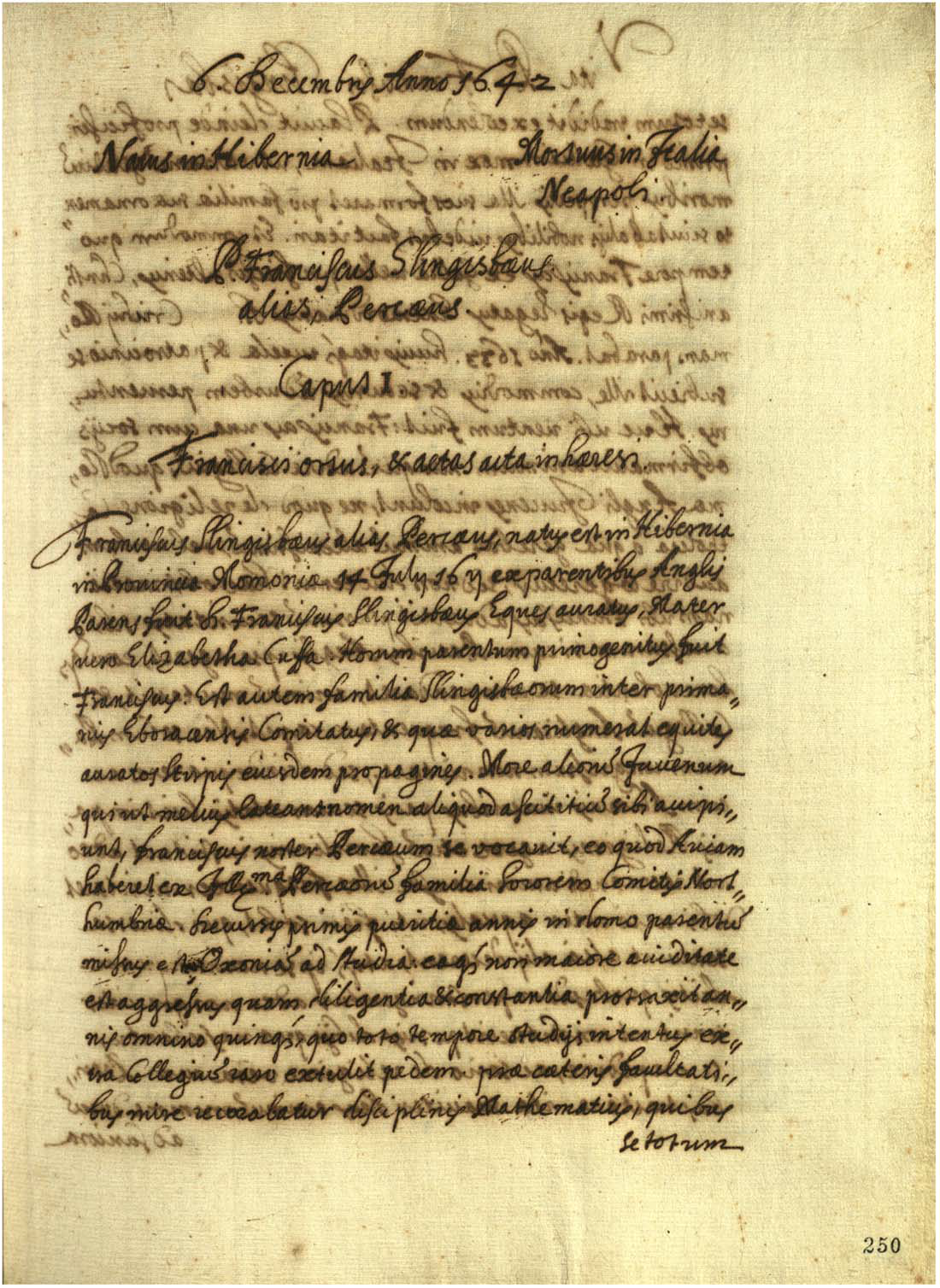
Beginning of unfinished vita of Francis Slingsby, ARSI, Vitae 149, fo. 250r.

Figure 2 Long description
The page displays a handwritten manuscript with text in Latin. The writing is dense and covers most of the page, with some words and phrases emphasized by darker ink. The text is arranged in paragraphs and the page number 250 is visible at the bottom right corner. The manuscript appears to be historical, with a formal script style.
For an entire year I took note of his habits of industry, ways of speaking, gestures, etc., and I was never able in the slightest degree to perceive envy, impatience, levity, or any other sign of imperfection, unless what I have recalled above should broadly be considered so.
X. ARSI, Vitae 149, fos 250r–258v
Life of Father Francis Slingsby alias Percy [unfinished; covering years 1611–1634]
(250r) 6 Decembris Anno 1642
Natus in Hibernia Mortuus in Italia Neapoli
P. Franciscus Slingisbaeus alias Percaeus
Caput I
Francisci ortus, et aetas acta in haeresi
Franciscus Slingisbaeus alias Percaeus, natus est in Hibernia in Provincia Momoniae 14 Julii 1611 ex parentibus Anglis Parens fuit Sr Franciscus Slingisbaeus Eques auratus, Mater vero Elizabetha Cuffa. Horum parentum primogenitus fuit Franciscus. Est autem familia Slingisbaeorum inter primariis Eboracensis Comitatus, et quae varios numerat equites auratos stirpis eiusdem propagines. More aliorum Juvenum qui ut melius lateant nomen aliquod ascititium sibi acccipiunt, franciscus noster Percaeum se vocavit, eo quod Aviam haberet ex Illma Percaeorum familia Sororem Comitis Northumbriae. Decursis primis pueritiae annis in domo parentum missus est Oxoniam ad studia eaque non maiore aviditate est aggressus quam diligentia et constantia protraxit annis omnino quinque, quo toto tempore studiis intentus extra Collegium raro extulit pedem. prae caeteris facultatibus mire recreabatur disciplinis Mathematicis, quibus se totum (250v) tradidit excolendum. Placuit deinde proficisci primo in Galliam mox in Italiam, ut variarum gentium moribus perspectis illae suos formaret pro familiae suae ornamento sicut ab aliis nobilibus videbat factitari.
Et commodum quo tempore Franciscus ex Gallia vellet proficisci ulterius, Christianissimi Regis legatus extraordinarius D. [ ] CrichiiFootnote 585 Romam parabat Anno 1633 huius itaque tutela et patrocinio se subiecit ille, commodius et securius ad urbem perventurus. Haec ubi ventum fuit. Franciscus una cum sociis obfirmavit animum nunquam adire Collegium, quod Romae Angli Iuvenes incolunt, ne quod de religione Catholica a qua gerebat animum alienissimum, vel verbum audire cogeretur, sed non diu tenuit hac obstinatio nam ubi Franciscus advertit plurimum securitatis sibi accessurum si cum Patribus Anglis ipse ageret, eorumque benevolentiae se commendaret, animum mutavit, et Collegium Anglicanum frequentare caepit. Nec solum Patrum congressum non vitare, sed deinde quaerere ac cum Alumnis iuvenibus paris secum aetatis licet imparis Religionis agere etiam familiarius instituit adeo ut recreandi animi causa illos frequenter visitaret Ubi vero inter aequales uti fieri solet, qui diversa sentiunt alia alii dicerent, atque ipse nonnumquam dictis quibusdam perstringeretur adeo non graviter sensit ut constituerit potius dubiis quae nascebantur se expedire, ac serio de religione vera cum Patribus tractare.
ita suaviter Deus animum minime durum ad saniora (251r) consilia flectebat, dicebat enim Franciscus se si de veritate catholicae Religionis convinceretur, nec hora unica absque ea victurum, sed continuo se ad Ecclesiam veram convoluturum etiam cum vitae ipsius corporalis iactura. Post vanos de religione congressus et disputationes privatim habitas tandem unius S. Augustini auctoritatem staturum se edixit. Ne tamen in re tanti momenti deciperetur, quoniam adulteratos esse a Catholicis Sanctorum PP codices iam olim in Anglia inaudierat, excerpta ex Sancto doctore loca aliquot conferre instituit operose cum vetustissimis manuscriptis vaticanis et ne fusus etiam in iis sibi fieret, ipsos Heidelbergenses codices ex Palatina Bibliotheca Romam sub Gregorio XV translatos accurate inspexit. Tandem ubi veritati Catholicae suffragari mirifice omnes vidit, manus dedit, et de ratione aggregandi se in gremium Ecclesiae caepit agere.
Id cum Sodalibus Acatholicis significasset deterrere illi primum modis omnibus et avocare conabantur, sed frustra, tandem promiserunt se quoque futuros catholicos, si prius relictis Romae sarcinis suis et pecunia, cum illis Franciscus pergeret Geneuam exploratum, quod Ministri Catholicorum argumentis essent responsuri, quibus si non satisfacerent abunde, se quoque omnes una cum illo Catholicam Religionem amplexuros. Consenserat in idem Franciscus spe plenus socios Christo lucrandi, unde protinus condictum itineris tempus fuit, sed postquam a sociis degressus in suum se conclave recepit tantus eum repente tremor ac horror (251v) invasit ut miraretur ipse, et cum illius nullam in se causam deprehenderet agnovit digitum Dei admonentis ne tam periculos[o] itineri se committeret, nec salutem suam alienae quaerendae studio in tantum discrimen coniiceret. Quare flexis humi genibus orationique se tradens et promissi sociis facti paenitens decrevit omni mora praevia certam securamque reddere salutem suam in Ecclesiae catholicae portu, postea si sociis staret eadem mens eorum quoque salutem provisibus procurare. Hoc ipsum sequenti die retulit sociis magna animi constantia, nec minore est executus, hinc omne consilium de suscipienda profectione Geneuensi evanuit.
Pergebat interim Franciscus momenta omnia quibus ad catholicam religionem monebatur: ponderare diligenter, et animam quam sortitus fuerat bonam diviniae gratiae aptare. Erat ipse non solum pacatus et quietus adeo, ut ne ludenti quidem elaberetur verbum, quod ullune posset offendere, sed adeo compositus in verbis omnibus et actionibus, ut omnium quibuscum agebat, animos in sui amorem pertraheret. Modestiae tamen eximiae comes erat verecundiae, et utriusqueFootnote 586 castitas omnino admiranda. Cum versaretur Romae nec dum Catholicus cum sociis suis haereticis, quadam vice ab illis induci se permisit, ut cum illis officium salutationis Matronae cuidam, praestaret. Socii cum illo pergunt ad Meretricem, ab eaque in conclave admittuntur, illi captata subducendi se occasione omnes egrediuntur, solo cum lupa relicto Francisco nihil simile cogitante, e[t] quidem observatis post se (252r) foribus cubiculi, ne illi egressus pateret. Hic procax faemina intentatam nihil relinguere quo Iuvenem ad patrandum facinus posset pellicere: ridentibus interea prae foribus sociis, et de expugnata Francisci virginitate, (passim enim vocitabant eum Virginem.) triumphantibus. Ipse tamen singulari Dei gratia praeditus, tanta fortitudine et constantia impudicam faminam elusit, ut integerrimam castitatem victis voluptatibus ex acie gloriosus retulerit, praeclarum sane facinus et in Catholico optime educato, atque adeo in religioso viro suspiciendum, suppar illi quod in Bernardo et Thoma Aquinate merito omnes mirantur et depraedicant.
Postquam omnibus optime ponderatis omnino statuit religionem Catholicam amplecti erroresque suos penitus execrari, restabat ut S. Officii Inquisitionis tribunal absolvendus ab Haeresi adiret, et cum ipsum Inquisitionis nomen invidia gravi atque etiam odio apud omnes Haereticos laboret, quo facilior illi redderetur Conversio, permissum illi fuit ut in privatis aedibus Illmi D. Boccabollae tunc Assessoris S. Officii abiurationem haeresis deponeret. Eo igitur Franciscus dum cum duobus Patribus de Societate se conferret novis Diaboli tentamentis impeti, et insolitis mentis tenebris obscurari, angoribusque animi tantum non prosterni.
Occurrebat identidem: quid si in hac religionis Mutatione in qua tantum positum est ad huc decipere? quid si fallere? (252v) quid dicens parentes et Amici? aliaque quae Diabolus suggerebat, Sed Franciscus exclusis omnibus et viriliter superatis perexit porro, et ex more antiquos errores eiuravit; continuoque sentit redire mentis lumen, et animi tranquilitatem cum magno laetitiae spiritualis augmento. Conversus iam pietatis exercitiis totum se tradidit, ut vel socii illius licet hetorodoxi dicerent placere sibi fervorem Francisci et optare ut omnes quam profitentur fidem simili ornarent pietatem. Mores quos ante conversionem habuit ex honestatis et modestiae legibus optime compositos, in dies magis ac magis excolere studebat, et exornare omnibus in locis semper sibi similis, in modestia exteriore excellebat, sed praecipue in templo, et eo tempore quo sacerdoti ad aram facienti aderat, iunctis enim ante pectus manibus tunc continenter orabat, et praesertim Christum quanta poterat maxima veneratione adorabat.
Cum ad Emnmm Cardinalem Barbarinum Summi Pontificis Nepotem adiisset, cumque officii causa humiliter salutasset tantam sui aestimationem in Cardinali excitavit primo suo Congressu, ut ille postea diceret cuidam Praelato, se in Francisco deprehendisse dictum vere esse a S. Gregorio, Anglos esse quasi Angelos hinc reliquo postea tempore mansit erga illum propensus, et non obscuris beneficiis amorem suum illustravit. Ubi de S.P. Ignatii exercitiis Spiritualibus, quibus se aliqui quotannis solent excolere, intellexit Franciscus nihil magis in votis (253r) habuit quam in ea incumbere atque con[vert]ere directione non solum prima vitae Catholicae principia sed integrum cursum instituere, quare integris octo diebus illis diligentissime vacavit non minore interioris hominis gustu, quam fructu et utilitate, persuasis ínterim sociis Franciscum alio concessisse corpori recreando quo tempore ille in Collegio Anglicano deliciis Spiritualibus perfundebatur. Inter alias meditationes, quae animum illius permoverunt, illa praecipue perculit, qua de fine ad quem homo est creatus pertractatur. hac enim peracta, rebus omnibus mature ponderatis, statuit apud animum suum omnino remittere nuntium mundo, quod in illo infinita videret, quae abhoc fine animum avocarent, et quod in religiosa vita plurima essent adiumenta ad eum finem conseguendum, Religiosorum virorum coetui se adiungere Ne vero decretum hoc animi e memoria excideret in libellum aliquem illud retulit ex quo describo una cum rationibus quibus permoveri se senserat ad traducendam inter Religiosos viros reliquam vitam. Triplici modo, inquit vivitquis in hoc mundo, vel ut Saecularis vel ut Ecclesiasticus, vel ut Religiosus, illum autem statum vita oportet eligere, qui omnibus consideratis aptissimus iudicatus fuerit ad finem ultimum assequendum, talem autem existimo Religionem propter Sequentes rationes.
1a quia Religio plura habet adiumenta et parviora impedimenta, (253v) quam caeteri duo status vitae. Patet primum membrum, cum in illis nihil sit ad perfectam vitam instituendam utile, quod in religione multo abundantius non reperiatur: et insuper multa alia quae religioni sunt peculiaria aut saltem frequentiora: ut bonum exemplum regula vivendi, commoditas vacandi Deo, Specialis gratia in tentationibus, salubrius consilium, illecebrarum fuga liberatio a sollicitudinibus mundanis, passionum extirpatio cum infinitis aliis. Veritas ultimi membri ex eo constat, quod religio nullum habeat impedimentum sibi proprium et quod non sit omnibus commune, Sed contra reperiuntur multa in statu seculari aut Ecclesiastico, a quibus liberantur religiosi, ut implicatio in rebus mundi, divitiarum copia, honoris ambitio, sollicitudo ex familia, mala exempla et lex mundi divinae legi prorsus contraria
2a Constat in Christo omnem fuisse perfectionem quam ut nos doceret praecepta nobis tradidit; nec his contentus exemplo etiam suo omnia confirmavit, nusquam vero invenio praecepta eius plenius observari, nec exempla eius melius exprimi imitatione quam in religione, ubi enim verior paupertas, ubi submissior humilitas, ubi maior abnegatio sui, ubi promptior susceptio crucis ubi simplicior conversatio sine dolo, ubi perfectior unio et fortius vinculum charitatis, ubi innocentius vivitur, aut ferventius Deus colitur? cum igitur religio ad Christi perfectionem proxime accedat, omni iure caeteris (254r) perfectior existimanda est, et propter excellentiss[ ] perfectionis eligenda.
3a Omnis vere sapiens illud vitae genus debet eligere quod monens elegisse desideraret. Omnes autem procul dubio religionem se amplexos esse, aut saltem instar religiosorum vixisse hora mortis optarent. nihil igitur consultius fieri potest, quam illud nunc amplecti, quod in hora mortis tantum praebehit solatium.
4a Diabolus tunc gravissimis utitur tentationibus ad impediendam aliquam resolutionem, quando illud praeiudet futuram causam maximi alicuius boni. Ideoque hoc meum propositum tanto magis salutare, [et] Deo gratum existimo, quanto fortius ab inimico oppugnatum comprobaverim: maximas enim habui gravitates, conturbationem mentis, et carnis reluctationem ad hanc resolutionem amplectendam. Sed haec omnia clare vidi militare contra finem a Deo mihi constitutum, et exinde haec omnia a Diabolo emanasse, con[ji]cio, quod post superatas difficultates ineffabilem animi quietem et consolationem senserim
Propter has quatuor rationes statuo et firmiter propono adiuvante Divina gratia, me, et omnia mea Dei Optimi maximi servitio dicare et pactum aeternum cum illo inire, ut ille sit mihi Deus, et ego illi Servus, semperque paratus ero pro libitu superioris dulci Christi iugo collum porrigere. Ita Franciscus cuius omnia propemodum verba discripsi, ait ex iis colligi posset quanta luce divinitus accepta mens (254v) illius fuerit illustrata et quibus amoris divini facibus voluntas eius accensa. Quare vero prae caeteris Religionibus Societatem Jesu elegens subinde referam ubi annutum de hoc votum conceptum, sicut in illius manu scriptis ad verbum inveni, quod votum ille sua manu descriptum Confessario suo consignavit. Atque ex illo tempore veluti non sui amplius sed iuris alieni factus, nil agere ille nisi ex praescripto Confessarii aut Superioris, atque in illis Deum ipsum venerari, diligere et perfectissimo studio obtemperare. Regulas Societatis non modo diligenter legere, et suspicere, sed etiam perfecte quantum temporis locique ratio patiebatur observare, praesertim eas, quibus quotidiana horae unius meditatio, bina Examina, aliaeque pietatis exercitationes ab omnibus instituendae mandantur.
Sub Quadragesimae tempus anni 1634 placuit Deo Francisci Virtutem et patientiam acutissimis arthindid[i]s doloribus probare, quo aria ex aedibus quas prope Collegium Anglicanum conduxerat in ipsum delatus Collegium, qua melior ipsius cura haberi posset plane insignia dedit patientis et ad omnem Dei voluntatem compositae voluntatis indicia, adeo vel omnibus esset aedificationi, qui tam adultam virtutem merito mirabantur in Iuvene adeo tenero et admodum nuper ex mundi Castris Vitaeque ex haeresi ductae ad signa patientis Christi translato. Ubi ex infirmitate caepit convalescere ad Parentem quem religuerat in Hibernia litteras scripsit, quibus suam ad fidem (255r) Catholicam conversionem significavit ex rationibus adiectis quibus Deo bene iuvante fuerat inductus ad eiurandos errores, in quibus tanto tempore caeci instar vixisse pudebat et vero en animus paenitebat. Parens acceptis filii litteris, et eius percepta, quam nunciabant, conversione ingenti furore iuxta ac dolore correptus, continuo respondet iubetque quam primum in Hiberniam redire, Sperabat siquidem a Papistis, sic vocant Catholicos, avulsum inter suos non gravate veterem religionem recepturum. Ubi ille parentis voluntatem intellexit, re prius commendata Deo in orationibus, subinde superioribus exposita, ex illorum consilio qui virtutem illius habebant perspectam, Roma discessit plenissimus Spe parentem, totamque familiam cum aliis multis convertendi, et redeundi Romam ad absolvenda studia, quam primum negotia cum suis in patria composuisset. Quatuor annis et medio Roma abfuit, quo toto tempore Meditationis horam aut duplex examen conscientiae nullo unquam die omisit, sive in Hibernia, ubi diutius contigit commorari, sive in Anglia, aut Gallia per quae Regna transivit. Hoc ipse post modum retulit Superiori cum illi de rebus omnibus conscientiae rationem exacte redderet.
Caput II Redit in Hiberniam Franciscus et incarceratur
Vix pedem intulerat Franciscus in Regnum Hiberniae cum boni (255v) omnes Catholici non solum gratulari sibi illius conversione, sed eius congressu delectari in eoque eximiam mirari modestiam integerimis moribus capi. tum vero propter excellentes has dotes suspicere iuxta et intime amare. Prima illius cura hic fuit convenire P. Robertum Nugentium à Societate nostra, totiusque Missionis Superiorem, morabatur ille cum Comitissa Hildariensi [recte Kildare] in illius arce, data primum illi suae conscientiae ratione, totiusque confecti itineris, ei se totum tradidit regendum nihil omnino facturus nisi illius ex ductu et consilio, vel mandato, quem Christi loco suscipiebat amandum, colendum, et sequendum. Illud vero tanta cum perfectione et constantia perfecit, ut ab illius nutu nullus illum revocaret aut retardaret consuetudo, nullus hominum sensus aut respectus, uti dicimus humanus. Iustum scilicet deducebat Dominus per vias rectas, et ostendebatFootnote 587 rationes aeternas et caelestes omnibus humanis sensis superiores. P. Robertus mirum in modum tam singulari virtute recreatus, morumque integritate et constantia in fide, plenus summa fiducia, et ipse copiosi fructus à se dimisit Franciscum ad convertendos parentes et amicos, nec vanam fuisse spem eventus felicissimus brevi post tempore comprobavit. Franciscus cum suis donis magna cum modestia ac prudentia agens tantum brevi effecit cum rationibus solidis, tum insigni christianorum morum innocentia, ut mater illius, duae Sorores ac Frater parati essent haeresi eiurata catholicam fidem complecti, in eaque vivere ac mori etiam invito parente homine obstinato, placuit P. Roberto differre faeminas melius probandas et edocendas.
(256r) Sed Henricum fratrem continuo admittere ad haeresim eiurandam, quod ille non minore suo quam francisci gaudio fecit, atque ista fuit prima praeda quam franciscus erebi ereptam transtulit in libertatem filiorum Dei. Permotus fuerat Henricus solida francisci de rebus fidei doctrina, et moribus eidem conformibus studebat circa idem tempus Henricus Oxoniae paullae ante in eadem universitate nominatus liberalium artium et Philosophiae Magister, qui ubi perceperat fratrem suum Romae ad Catholicorum partes avertisse, nunc vero a parente in Patriam revocatum propediem expectari, ceteris omnibus relictis solas de fide quaestiones perlegebat, professus se vel fratrem ad suas partes quas deserverat reducturum, vel se concessurum in partes catholicas illius si verioribus ac solidioribus rationibus ab illo convinceretur ubi vero Franciscus in patriam apulit et quotidianis a parente disputationibus exercebatur, aderat semper Henricus et tacitus non solum quae dicerentur utrinque ponderabat, Sed etiam Francisci in disputando cum parente modestiam, in urgendo efficaciam, in respondendo claritatem, patientiam insuper magnam ubi a parente indignabundo perstringeretur, omnia denique observabat accurate, praeterea privatim subinde cum Francisco agebat Henricus et illius virtute, quae occultari adeo non poterat quo[d] radiis suos frequenter diffunderet, mirum in modum rapi se sentiebat et affici, ut nollet diutius alia fide vivere quam illa, quam videbat in fratre adeo constanter et innocentibus moribus exornatam.
Non multo post ubi parens se frustra laborasse vidit reducendo ad partes suas Francisco, quin imo et uxorem suam, alterumque filium (256v) cum filiabus ab illo ad Catholicorum partes ut accederent persuasos furere primum caepit, subinde gravia quaedam minari nisi Franciscus respiceret, quem ad modum ille dicebat, quare voluit ut ex condicto de fide disputationem institueret. Erat apud illos Jacobus Usherus Hiberniae Pseudo Primas magni apud omnes vicinos nominis ob doctrinam, cum hoc certamen ineundum erat, Francisco ita volente ita iubente parente in has angustias coniectus Adolescens, coram omnibus se coniecit in genua fervent[er]que Deum est obtestatus ut sibi et Religionis causae non deesset, et qui Infantium linguas soleret facere disertas, ea nunc suggerere non gravaretur quae oportuna sciret in his angustiis, in quas non iniecisset se ultro suis viribus fisus, sed invitius esset coniectus plenus fiducia divini auxilii, adfuit Deus et effecit ut Franciscus non modeste magis quam clare solideque fidem Catholicam propugnaret et quae obiiciebantur refutaret cum insigni plausu Catholicorum qui aderant, qui fatebantur ea quae fuerant prolata a Francisco aliquid sapere quod supra communem usum esset et humanam consuetudinem. dabatur illi quippe in illa hora, quomodo et quid loqueretur.
Hac filii victoria, qua ad capessendam fidem uti debuisset parens, magis exacerbatur, vana statuit tentare ad expugnandum Franciscum, sed omnia irrito conatu, primum quidem ad se vocatum Franciscum blandis verbis studet demulcere, ostendens se magno doloris sensu affectum, quod ille suam et familiae suae fortunam adeo prodegisset, futurum enim fuisse si pristinam servasset fidem, e[t] etiamnum fore, si eam denuo reciperet, ut inter Regios Consiliarios sibi suisque omnibus magno esset adiumento iuxta et ornamento (cui Franciscus magna cum constantia non tamen (257r) sine debita modestia et reverentia respondit. Ego vero optime Parens, adeo insanus non sum, ut caelestia adquae catholici aspirant et soli perveniunt, iis postponam, quae terrena sunt et caduca, malo pro exiguis quae sperare me iubet plane incerta ea complecti quae in caelis sunt certa, ubi regnare cogito et spero, nec multo inferiora dixit Henricus Frater, nam cum illi parens Henrice frater tuus dolore intimo mea paene viscera ruperat, tu vero dolore penitus me conficis, respondit ille modeste, dolorem tibi creare, O Patre minime deberet quod Angelis in caelis gaudium parit, gaudent enim illi, Christo teste super uno peccatore poenitentiam agente. Et vero Henricus tanta animi constantia errores veteres erat detestatus, Catholicamque Religionem complexus ut dicere non dubitaret se in fide Catholica mansurum constantem etiam si alius nullus in mundo Catholicus reliquus esset.
Simili constantia praedicta fuit Mater et Sororem altera nam altera quam a franciscio didicerat fidem deservit ob metum Mariti haeretici. Tertia autem cum haeret dubia de fide capessenda morte sublata est. Hanc conversionem plenam plane admirabilem fecerunt, Parentis improbitas et mala quae non levia nec inaniter poterant timeri, siquidem Mater Francesci a Marito male tractabatur longo iam tempore et inveterata dissidia non solum animos sed habitationem diviserant, insuper media, quibus a Marito sustentabatur ad modum tenuia erant, haec omnia etiam fortissimam faeminam poterant terrere, et in suscepto conversionis cursu retardare. Sed illa superior omnibus calamitatibus quas praecedebat e[t] postea re ipsa perpessa est, nec minimum in suscepto consilio trepidavit sed contra audentior perrexit.
Poterat soror (257v) praeter parentis indignationem etiam mariti offensionem verita ad tempus saltem differre conversionem idem potuisset facere frater, qui totus a parente pendebat, nihilominus tamen Deo duce et francisco fortes facti omnia haec saluti animae, et Dei vocantis voluntati intrepide posthabuerunt. Nec minus fuerunt postea constantes intenenda fide suscepta, quam fuerant animosi in ea capessenda; quod procul dubio Francisci precibus est ad scribendum.
Dum enim ille carcere conclusus detineretur, parens Henricum in Anglia ablegavit, ratus fore ut ille a francisco avultus, et inter [ ]os hareticos anglos constitutos facile rediret ad vitam quam deseruerat nuper Religionis umbram. Matrem vero utriusque filii et filiam utriusque fratris convitiis et adhortationibus destitutas faeminiae volubilitate novam religionem non difficulter deserturas.
Neutrum tamen illi e voto successit, Deo ostendente nullum esse consilium contra dominum.Footnote 588 Omnes quippe superatis difficultatibus non levibus suam constantiam insigniter probaverunt. nam sicut ille conatu omni eos amoverat, qui spiritualibus colloquiis et consiliis afflictos faeminarum animos poterat stabilire, ita e contrario Deus e medio sustulit maximum quod habebant impedimentum, paulo enim post excessit e viciis filiae maritus homo haeresis amantissimus, et fidei catholicae osor acerbissimus duxit quidem illa ut uxor mariti mortem temporalem sed magis haeretici hominis exitium aeternum, gavisa tamen fuit quod matrimonii vinculis liberata, caelestis sponsi nuptias, quae vera libertate (258r) animas beant, sperare liceret et curas omnes temporales et molestias, cum aeternis iisque laetissimis commutare, id quod ipsa ex animo praesidit et ut alios suae felicitatis faceret participes, bonum enim est communi activum sui, et cum alios cum praesertim Ancillas, quae ipsa a francisco didixerat sedulo edocuit, et praeter fidem suo exemplo omnem virtutis honestatem impressit.
Nec minor fuit constantia Henrici, ille enim non solum haereticorum olim suorum sodalium precibus, sollicitationibus imo irrisionibus non fuit commotus, sed crevit, inter adversa fides ipsius et adeo singularis ut illa non videretur esse Iuvenis nuper ad fidem conversi sed viri maturi a puero omni virtutum genere inter Catholicos optime exculti. Testimonium sane praeclarum ex Anglia scripserunt ii, quibuscum aliquot menses vixerat inter filias et amicos Illsmi ViceComitis Falkland olim Proregis Hiberniae.
Dum Franciscus cum sororis suae marito ageret, eiusque conversionem urgeret ferventius respondet ille ioculariter et ardente ore, Caput, inquit, Religionis vestrae cornua habet, intelligebat ille Papam, quem Antichristum et bestiam Apocalypticam nominant haeretici, his contumeliis excitatus Francisci Zelus par pari redditurus et vestra ait Religio prodiit ex femoralibusFootnote 589 Henrici octavi, quod cum alter offuso cum risu excepisset, repetiissetque saepius et Francisci Matri habinde retulis[s]et, quamquam ab illa esset vissus isthaec verba supprimere, percrebuit tamen per familiam hoc dictum et ad aures Ministrorum delatum ansam praebruit accusandi Franciscum, quod indecore de protestantium Religione esset locutus
(258v) alia vice Parens ut Franciscum perverteret illum secum duxit ad PseudoEpiscopum Armacanum. Ille ubi esset conatus probare Catholicos vertari in errore et tempus venisse in Apocalypsi praedictum, quo Ecclesia vera deficeret Franciscus solita cum modestia respondit aliter a S. Patribus loca ille explicari, accedere quod plurimis aliis locis veritas Catholicorum protestantium ver[o] falsitas comprobetur, atque hac argumentatione usus est, religio illa non potest esse vera, quae docet haeresim, sed vestra docet haeresim, cum doceat non licere orare pro defunctis, qua est antiqua haeresis teste Augustino, Epiphaneo, aliisque, docet igitur unam haeresim manifestam. Hic ArchiEpiscopus [h]arere primum ad responsionem minime expectatam, subinde explicare haereseos nomine intelligi non raro quamcumque opinionum differentiam, alia[e]que similia. Demum cum non pauca ultro citroque dictae essent Franciscus ut se molestia disputationis liberaret, demisse rogat Archiepiscopum, dignaretur ille pro sua religione facere, quod ipse paratus esset praestare pro fide Catholica: ubique demum istud esset Archiepiscopus quaesivisset, illico Franciscus flexis genibus et occulis in caelum sublatis orat Deum ut si fides Catholica, quam profitebatur, vera non esset terra subito se vivum absorberet. Ad hac Pseudopresul tremere toto corpore, et obscuris vocibus claram magnamque animi perturbationem ostendere. Parens graviter offensus hoc filii facto, et Praesulis commotione, franciscum protinus iubet facesseret, paruit ille, et rem totam altissimo silentio pressit, percrebuit tamen inter Catholicos reiFootnote 590
Translation
(250r) 6 December 1642
Born in Ireland Died in Italy Naples
P. Francis Slingsby alias Percy
Chapter 1
Francis’s upbringing, and the period of his life spent in heresy
Francis Slingsby, alias Percy, was born in Ireland in the province of Munster on 14 July 1611, of English parents. His father was Sir Francis Slingsby, Knight Bachelor; his mother was Elizabeth Cuffe. Francis was their firstborn son. The Slingsby family is, moreover, one of the most prominent families of the county of York, with several Knights Bachelor among the progeny of that stock. Like other young men who, in order to remain more concealed, adopt some derived (or assumed) name, our Francis called himself Percy, for he had a grandmother of the most distinguished family of the Percys, who was a sister of the Earl of Northumberland.Footnote 591 After spending his first boyhood years in his parents’ house, he was sent to Oxford for studies, which he undertook with eagerness and diligence and constant application. He spent five years there in all, and in this entire time, intent on his studies, he rarely set foot outside the College.Footnote 592 Above other skills, he was wonderfully recreated by the disciplines of mathematics, and he applied himself fully (250v) to master these. Thereafter he chose to travel first of all to France and directly afterwards to Italy so as, having observed the customs of various peoples, to form his own conduct for the distinction of his family, as he saw other noble persons typically doing.
And at the very moment (in the year 1633) when Francis wished to travel onwards from France, the extraordinary legate of the Most Christian King, Monsieur [ ] de Créquy,Footnote 593 was preparing to go to Rome. Accordingly, Francis committed himself to the legate’s protection and patronage, so as to reach the city more conveniently and safely. Having arrived there, along with his companions Francis resolved never to go to the College where young Englishmen dwell in Rome, since he wished not to be obliged to hear even a word about the Catholic religion, to which he had an extremely hostile attitude. But he did not sustain this obstinacy for long, because when he perceived that he might be assured of the utmost safety if he were to have dealings with the English fathersFootnote 594 and commend himself to their goodwill, he changed his mind and began to frequent the English College. Not alone did he not avoid meeting the Fathers but thereafter he began to seek them out, and he also began to have friendly dealings with the young students of his own age, notwithstanding the difference of religion, to such an extent that for mental recreation he visited them frequently. As commonly happens among equals where people perceive things differently, various people would express different views, and sometimes he was slightly hurt by particular things that were said. But he was not at all grievously upset, and he resolved to free himself of the doubts that were germinating [in him] and to have serious discussion with the fathers about the true religion.
And thus God gently turned his mind, which was very little hardened, towards more salutary (251r) counsels. Francis, indeed, used to say that were he to be convinced of the truth of the Catholic religion, he would not live for one single hour without it, but rather he would continuously attach himself to the true Church even at the expense of his bodily life. After some fruitless meetings about religion and disputations held in private, at length he declared that he would acknowledge the authority of St. AugustineFootnote 595 alone. Lest however he should be deceived in a matter of such importance, since previously in England he had heard that the Catholics had corrupted the manuscripts of the church fathers, he began to make a laborious comparison of a number of passages extracted from the Holy Doctor [Augustine] with the most ancient Vatican manuscripts. So as not to become over-extended in [studying] those, he made a thorough inspection of those very Heidelberg codices which were brought to Rome from the Palatine Library under Gregory XV.Footnote 596 At length, when he saw that all of them [i.e. those passages] were wonderfully supportive of Catholic truth, he yielded, and he began to act regarding the procedure for attaching himself to the womb of the Church.
When he had indicated this to his non-Catholic companions, at first they attempted by all means, though vainly, to deter and hinder him. Eventually they promised that they too would become Catholics if Francis would go with them (leaving their baggage and money in Rome) to Geneva, to examine what the ministers would say in reply to the Catholic arguments. Then, if their counter-arguments were not abundantly satisfactory, they would all embrace the Catholic religion along with him. Francis, full of the hope of converting his companions to Christ, concurred with that, and a time was agreed forthwith for making the journey. But afterwards when he retired to his chamber, after parting from his friends, so great a trembling and feeling of horror suddenly assailed him (251v) that he was amazed. Unable to discover any inherent cause of it, he acknowledged the finger of God, warning him not to commit himself to such a perilous journey, nor to cast his own salvation in such danger in his zeal for seeking the salvation of others. Accordingly, kneeling on the ground and committing himself to prayer, he repented of the promise made to his companions. Anticipating all the hindrances [i.e. to his salvation, implied by the journey to Geneva], he decided to entrust his own salvation for certain safety to the harbour of the Catholic Church, and afterwards, if his companions were similarly minded, to attend to their salvation also with [proper] means. On the following day he communicated this to his companions with great firmness, and no less resolutely he carried it out: from then on, every intention of undertaking the journey to Geneva disappeared.
In the meantime, Francis was exploring all the important considerations which urged him towards the Catholic religion: pondering diligently, and with the good attitude he had chosen to have, making his mind amenable to divine grace. So much was he at peace, so calm, that he did not let slip so much as a word to a jocular companion which could in any way offend; not only that, he was so composed in his every word and action that he drew the souls of all those he dealt with to love him. Nonetheless he was a companion of exemplary modesty and bashfulness, and the chastity of bothFootnote 597 was in every way admirable. While he was living in Rome, not yet a Catholic, with his heretical companions, on some occasion he permitted himself to be swayed by them to perform together the social courtesy of greeting a certain lady of rank. His companions and he proceed to a harlot [who] admits them into her chamber. Seizing an opportunity to withdraw from Francis, all of them go out, and Francis was left alone with the whore, though he had no such intention; but however they guarded the bedchamber door after they had left (252r) so that he had no means of exit. That shameless woman left nothing unattempted by which she might entice the young man to commit a crime. His companions meanwhile were laughing outside the door and celebrating the conquest of Francis’s virginity (frequently they used to call him The Virgin). He, however, possessed of the singular grace of God, evaded the lewd woman with such firmness and fortitude that he gloriously bore away his chastity fully intact from the battle, overcoming the sensual inducements. This was certainly a remarkable deed, and one which would have been admired in a Catholic who had received the best education, and even in a vowed religious; it was almost on a par with what everyone admires and extols in Saints BernardFootnote 598 and Thomas Aquinas.Footnote 599
After giving everything the best consideration, he fully resolved to embrace the Catholic religion and to abominate his errors utterly. It remained for him to go to the tribunal of the Holy Office of the Inquisition to be absolved from heresy. And since the very name of the Inquisition is afflicted by severe ill-will and even hatred among all heretics, so that an easier conversion would be granted to him, he was given permission to make his abjuration of heresy in the private dwelling of the Most Excellent D. Boccabolla, then assessor of the Holy Office.Footnote 600 On that account, then, Francis, while he was conferring with two fathers of the Society, was assailed with new temptations of the devil and was blinded by an uncommon darkness of the mind. But even tormented to this degree in spirit, he was not prostrated.
Repeatedly the same questions presented themselves: what if there was a deception in this change of religion, where so much was at stake? What if there was some trick? (252v) What would his parents and friends say? – and other things that the devil suggested. But Francis, rejecting all these and manfully overcoming them, proceeded onwards, and abjured his old errors in the customary manner; and continually he felt his luminosity of mind returning, and tranquillity of soul with a great increase of spiritual joy. Once converted, he applied himself entirely to spiritual exercises, so much so that even those companions of his, unorthodox as they were, said that Francis’s fervour pleased them, and they wished that all should adorn the faith they professed with a similar piety. As time went on, more and more he strove to cultivate and embellish those excellent principles which, prior to his conversion, he had compounded from the laws of honesty and modesty. Always true to himself in all situations, he excelled in outer modesty, but especially in church, and whenever he was in the presence of a priest officiating at the altar, with hands joined before his breast he prayed continuously, and above all he adored Christ with the greatest reverence of which he was capable.
When he approached his Eminence Cardinal Barberini,Footnote 601 nephew of the Supreme Pontiff, after he had paid his respects with the humility due to the other’s rank, he evoked such esteem in the cardinal at their first meeting that the latter afterwards, speaking to a certain prelate, said that he had grasped that in Francis the saying attributed to St GregoryFootnote 602 was true, namely: the English (Angli) are like Angels (Angeli).Footnote 603 He remained well-disposed towards Francis for the remaining time afterwards and expressed his love with favours of no insignificant kind.
When Francis heard of the Spiritual Exercises of holy Father Ignatius,Footnote 604 by means of which it is customary that every year various people improve themselves, there was nothing he wished more (253r) than to devote himself to them and to change direction with the aim of establishing [in himself] not just the first principles but an integral course of Catholic life. On that account, he gave up eight entire days to their most diligent practice, which besides being useful and fruitful, was no less pleasing to the inner man. In the meantime, his companions were convinced that Francis had succumbed to physical recreation of another kind, at the time when he was being filled with spiritual delights in the English College.
Among other meditations which stirred his mind, he was especially struck by one: that which treats of the end for which man is created.Footnote 605 Having completed this meditation, and pondering everything maturely, in the privacy of his own soul he resolved to divorce himself from the world, because he saw an infinity of things there which called his mind away from that purpose, and because in religious life there were many helpful resources towards achieving that end. He decided to join the company of religious men [i.e. to enter religious life]. Lest this resolution of the soul lapse from memory, he recorded it in a kind of book from which I transcribe, along with the reasons by which he felt himself motivated to devote the rest of life to living among vowed religious.
There are three ways, he said, in which somebody lives in this world, as a secular person, as a priest, religious [i.e. member of a religious order]. One should accordingly choose that state in life which, when all is considered, has been judged most apt for achieving the final purpose. I judge vowed religious life to be such a state, for the following reasons.
1a. Because religious life has more helps and fewer impediments (253v) than the other two states of life. This is evident first of all, because anything in those other states of life which is useful for establishing the life of perfection is found much more abundantly in the religious life; and apart from that, there are many other things which are peculiar to the religious life or at any rate more frequent there. These include good example, a rule of life, convenience of finding time for God, special grace in temptations, more salubrious counsel, escape from enticements, liberation from worldly cares, extirpation of the passions, with an infinity of others. The truth of the argument finally consists in this, that religious life has no impediment proper to itself which is not common to all. But conversely, many things are found in the secular state or the ecclesiastical state from which vowed religious are freed, such as involvement in worldly affairs, copious wealth, ambition for honour, concern for family, bad examples, and the law of the world being utterly contrary to the law of God.
2a It is established that all perfection was in Christ. In order that he might teach it to us, he handed down rules; not content with these, he even confirmed them all by his own example. And nowhere do I find that his precepts are more fully observed, and his example better imitated than in religious life, for where is poverty more authentic, humility more submissive, abnegation of oneself greater, and the acceptance of the cross more prompt? Where is there simpler conversation, without guile? Where is union more perfect and the bond of charity stronger; where does one live more innocently and cherish God more fervently? Since therefore religious life approaches most closely to Christ’s perfection, with every justification (254v) it must be regarded as more perfect than the others, and fit to be chosen on account of the excellence of its perfection.
3a Every truly wise person must choose that type of life which, if he were advising, he would desire to be chosen. All, moreover, without doubt would choose at the hour of death to have embraced religious life, or at least to have lived in the manner of vowed religious. Therefore nothing can be done more judiciously than to embrace now what may offer such solace at the hour of death.
4a The devil employs the greatest temptations to impede any resolution, at a time when this prejudices the future possibilities of the greatest good for somebody. Therefore I regard this proposition of mine that I may have approved as all the more salutary, and gratifying to God, the more powerfully it has been attacked by the enemy. I have had the greatest distress, and perturbation of mind, and resistance of the flesh to embrace this resolution. But I have seen clearly that all these things are battling against the purpose which is constituted for me by God, and I infer from this that all these things have emanated from the devil, because after overcoming my difficulties I would have felt an indescribable calmness and consolation of mind.
For these four reasons I resolve and firmly intend, with the help of divine grace, to consecrate myself and everything I have to the service of the great Lord God, and to enter an eternal pact with Him, so that He may be my God and I His servant, and I will forever be prepared at my superior’s pleasure to offer my neck to the sweet yoke of Christ.
Thus says Francis; I have transcribed almost all of his words, and from them one may gather with what a received light of divinity his mind had been illuminated (254v), and what fires of divine love ignited his will. On this account he chose the Society of Jesus before other religious orders, and I will forthwith record his acceptance of the vow, as I have found it literally in writings by him personally, where he transcribed that vow in his own hand [and] submitted it to his confessor. And from that time on, as if no longer under his own governance but under the rule of another, he did nothing unless prescribed by his confessor or superior, and in those he revered, esteemed and with the most perfect zeal obeyed God himself. Not only did he diligently read and look up to the Society’s Rules,Footnote 606 but insofar as was reasonably possible in the given time and place, he observed them, especially the requirement for one hour’s daily meditation and the two examens,Footnote 607 and the other pious exercises which are commanded to be observed by all.
During Lent in the year 1634, it pleased God to test Francis’s virtue and patience with most acute pains of the joints, and therefore he was brought through the open space from the dwelling he had rented near the English College to the College itself, where he could have better care.Footnote 608 He gave clear signs of patience and indications of a will in every way composed to the will of God, so that he was an edifying example to all, who were properly amazed at such mature virtue in such a tender youth, and one who had been in the camps of the world and the life of heresy, and who had only lately been brought over to the battle-standards of the suffering Christ.
When he began to convalesce from his illness, he wrote a letter to his father whom he had left behind in Ireland, informing him of his conversion to the Catholic faith (255r) for reasons which he included. By God’s good help, these considerations had led him to abjure his errors; he was ashamed for having lived in them so long, in a condition resembling blindness, and behold, truly his soul repented. His father received the letter and understood the principles of its author, as declared there. Seized by a mighty rage and at the same time feeling sorrow on account of the conversion, he replied immediately, commanding his son to return to Ireland at the earliest opportunity. His hope was that, if only he were torn away from the papists (as they call the Catholics) and among his own relatives, his son would take up his old religion again without reluctance. When he understood his father’s will, having first commended the affair to God in prayer, he then immediately explained it to his superiors, who had observed his virtue, and on their advice he left Rome, in high hopes of converting his father and his entire family, among many others, and of returning to Rome to complete his studies as soon as he had settled his affairs with his relations in his native land. For four years and a half he was away from Rome, and in all that time he never once omitted the hour of meditation and the two-fold examination of conscience even for a single day, whether he was in Ireland, where he spent the greater part of the time, or in England or France while passing through these kingdoms. He himself afterwards reported this to his superior, giving him a precise account of conscience regarding all matters.
Chapter 2 Francis returns to Ireland and is imprisoned
Scarcely had Francis set foot in the kingdom of Ireland when all good (255v) Catholics sought not only to congratulate him on his conversion but also to have the pleasure of meeting him and to admire his extraordinary modesty and be charmed by his faultless manners, and because of these excellent gifts they began to esteem him and love him most dearly. His first concern in Ireland was to meet Fr Robert Nugent from our Society, superior of the entire mission. Fr Nugent was staying with the countess of Kildare in her castle.Footnote 609 Francis first gave him his account of conscience and an account of the entire journey he had just completed, and he committed himself totally to be ruled by him, saying that he would do nothing whatever except by Fr Nugent’s direction and counsel, or command, since he was recognizing him in the place of Christ to be loved, cherished and followed. This he performed with so much perfection and constancy, that at his [Nugent’s] nod, no [bonds of] companionship, no feeling or respect for people, or as we might say, nothing human would restrain or delay him. That is to say, the Lord was leading the just man by the right paths, and he was disclosing heavenly and eternal plans which were beyond all the human senses. Fr Robert was wonderfully refreshed by such singular virtue, moral integrity and constancy in the faith. Filled with supreme confidence, and he himself a man of abundant fruits, he sent forth Francis to convert his parents and friends, and after a short space of time, the most felicitous outcome proved that the hope had not been in vain. Gifted as he was, and acting with great modesty and prudence, Francis achieved so much in a few words with solid reasoning and by the remarkable innocence of his Christian morals, that his mother, two sisters and brother were prepared to abjure heresy and embrace the Catholic faith, and to live and die in it, even against the will of his father, who was an obstinate man. Fr Robert, however, thought it best to delay [the reception of] the women, so that they might be better tested and instructed.
(256r) But he chose to admit Francis’s brother Henry immediately to abjure his heresy, and Henry did so, with joy equalling that of Francis. And that was the first booty which Francis seized from the underworld and transferred to the liberty of the sons of God. Henry was moved by Francis’s solid doctrine on matters of faith, and by his conduct which was in conformity with the same. Henry was studying about that time in Oxford: shortly before, in that same university he had received the degree of Master of Liberal Arts and Philosophy. When he perceived that his brother in Rome had turned to the Catholic side, and had now been summoned by his father to his homeland and was expected there very soon, leaving everything else aside he undertook a thorough examination solely of questions of faith. He declared that he would either bring back his brother to the side he had deserted, or he himself would yield to his brother’s Catholic side, if he were convinced by truer and more solid arguments which Francis had. From the time when Francis landed in his homeland and was exercised in daily disputations with his father, Henry was always present and silently pondered the things that were said on either side; and not those only but also Francis’s modesty in disputing with his father, his efficiency in arguing, his clarity in responding, and moreover his great patience when he was furiously reproached by his father – in a word, all of this Henry carefully observed. Furthermore, he repeatedly had private discussions with Francis, and he felt himself captivated and affected in a wonderful degree by his brother’s virtue, which could not be hidden because it frequently shed its rays, and so he did not want to live any longer in any other faith except what he saw so constantly in his brother, a faith that was adorned with his blameless morals.
Not long afterwards, when his father saw that he had laboured in vain to bring Francis back to his own side (furthermore his wife and his other son, (256v) along with his daughters, had been persuaded by Francis to go over to the Catholic side), he first began to rage, then promptly threatened Francis with some grave consequences unless he showed respect for his own way of speaking, for which reason he desired to hold an arranged disputation about the faith. In that community James Ussher,Footnote 610 the pseudo-primate of Ireland, had a high reputation for doctrine among all contemporaries. The contest had to be entered against him. Francis, a mere adolescent,Footnote 611 was flung into these straits, given that his father willed and commanded it. Before everyone he threw himself on his knees and fervently implored God not to abandon him and the cause of religion. And since God was accustomed to making infant tongues fluent, let Him not be reluctant to supply those resources which He knew to be opportune in these difficulties! He had not thrown himself into a contest, relying on that which was beyond his strength; rather, he had been brought unwillingly into the dispute, full of trust in divine assistance. God was at hand, and he saw to it that Francis, modestly but not less clearly and solidly, contended for the Catholic faith and refuted whatever objections were made. He won remarkable applause from those Catholics present, who declared that the arguments Francis brought forward had wisdom in them beyond common usage and human custom. So much was granted him, certainly, at that hour, in his way of speaking and in what he said.
By this victory of his son, from which the father should have profited in taking hold of the faith, he was embittered even more. Vainly he had resolved to try to conquer Francis; all his endeavours had proved futile. Firstly, then, he called Francis to himself and with flattering words tried to soften him, revealing that he was afflicted with a great sense of sorrow, because Francis in such a manner had squandered his own and his family’s fortune. If he had preserved his original faith, in the future he would have become (and even now he might be, if he received that faith afresh) one of the royal counsellors,Footnote 612 which would be a great support to him and all his relatives, as well as a mark of distinction. Francis replied with great firmness, and nevertheless not (257r) without due modesty and respect. Best of fathers! I am not so insane that I would prefer, over those heavenly goods to which Catholics aspire and which they alone attain, goods that are earthly and transitory. Instead of the petty things that command me to hope for what is plainly uncertain, I prefer to embrace those which in heaven are certain, where I think and hope to reign.
And what his brother Henry said was not much inferior to this: for when his father said to him, Henry, your brother has almost ruptured my bowels with the deep sorrow he has given me, and you with sorrow are destroying me completely, Henry modestly replied, father, what gives joy to the angels in heaven should by no means give sorrow to you. For we have Christ’s word that they rejoice over one sinner who repents.Footnote 613 And indeed Henry, with great steadfastness of mind, had detested his old errors, and embraced the Catholic religion, and he did not doubt to say that he would remain constant in the Catholic faith even if there were no other Catholic left in the world.
Of similar constancy were his mother and one of his sisters;Footnote 614 another sister, however, whom Francis had instructed, abandoned the faith for fear of her husband who was a heretic.Footnote 615 A third sister, moreover, while she was clinging to doubts about adopting the faith, was carried off by death.Footnote 616 They made this complete conversion in a way that was wholly admirable: there was the father’s wickedness, and evils that were not trivial, nor were these to be feared in vain [they were not unlikely], since Francis’s mother, indeed, had been badly treated by her husband for a long time, and inveterate dissensions had divided not only their souls but their dwelling place. Moreover, the means of support which she had from her husband were slender for the purpose. All of these things might have scared even the strongest woman and impeded her in her course of conversion. But she bore herself superior to all the calamities which she endured to the full, those preceding and following this event, nor did she have the least trepidation in pursuing her purpose but, on the contrary, proceeded more boldly.
The sister (257v), dreading her father’s indignation and, in addition, her husband's displeasure, could have deferred the conversion at least for the moment; her brother could have done the same, since he was totally dependent on his father. Nonetheless, made strong by God their guide and by Francis, they bravely esteemed all these things of less value than the salvation of their souls and the will of God who was calling them. They were afterwards no less steadfast in holding onto the faith which they had adopted, than they had been spirited in adopting it; and undoubtedly this is to be ascribed to Francis’s prayers.
For while Francis was confined in prison, the father sent Henry away to England, calculating that when he was torn away from Francis and placed in the midst of committed English heretics, he would easily return to the life which lately he had deserted as being merely a shadow of religion. The mother of both the sons, and the sister of both the brothers, when deprived of their corrections and encouragements, with the mutability of their sex would abandon the new religion without much difficulty.
But neither of these things turned out as he desired it, for God showed that there is no counsel against the Lord.Footnote 617 All of those persons, indeed, overcoming difficulties of no inconsiderable kind, gave outstanding proof of their steadfastness. For even as the father, trying with all his might, removed those who by their spiritual conversation and counsel could have stabilized the souls of the afflicted women, so God on the opposite side removed from their midst the greatest obstacle that confronted them. A short time afterwards the daughter’s husband, a great lover of heresy and one who hated the Catholic faith most bitterly, died of his vices.Footnote 618 As a wife, indeed, she received (the pain of) her husband’s temporal death but still more, the eternal ruin of a heretic. However, she rejoiced at the fact that, freed from the bonds of marriage, she might hope for the wedding with a celestial spouse which delights minds with true liberty, (258r) and replace all her temporal cares and troubles with great eternal joys. She sincerely cherished that hope, and so as to make others participants in her happiness (for the good is an active force for the general benefit), to others and especially to her maids she diligently taught what she had learned from Francis, and apart from faith, her example carried the stamp of all the honesty of virtue.
No less constant was Henry. Not alone was he not shaken by the appeals, solicitations and indeed mockeries of the heretics who had once been his companions, but his faith grew amidst adversity, and his faith was so remarkable that it did not seem to be the faith of a young man lately converted to Catholicism, but that of a mature man who had been excellently brought up among Catholics from boyhood with virtues of every kind. A truly splendid testimony was written from England by people with whom he had lived for some months, among the daughters and friends of the most illustrious Viscount Falkland, formerly the viceroy of Ireland.Footnote 619
While Francis was engaged with his sister’s husband, whom he was most fervently urging to convert, the latter replied jestingly and with strong feeling: The head of your religion, he said, has horns. He meant the pope, whom the heretics call Antichrist and the beast of the Apocalypse.Footnote 620 Aroused by these insults, Francis was eager to return like for like. And your religion, he said, came forth out of Henry the Eighth’s underpants.Footnote 621 The other received this with a burst of laughter and repeated it often afterwards, and he promptly told it to Francis’s mother. Although it seemed proper to her to suppress those very words, the saying nevertheless spread abroad through the family and was brought to the ears of ministers [of the Church of Ireland], offering an opportunity of accusing Francis, that he had spoken indecently of the religion of the Protestants.
(258v) On another occasion his father, seeking to pervertFootnote 622 Francis, took him with him to the pseudo-bishop of Armagh.Footnote 623 That man attempted to prove that the Catholics had fallen into error and that the time predicted in the Apocalypse had arrived, when the true church would degenerate. With his accustomed modesty, Francis replied that those passages had been explained differently by the holy fathers of the church, and furthermore in many other places the truth of the Catholics and indeed the falsehood of Protestants is proved. And he used the following argument: the religion which teaches heresy cannot be true, but your religion teaches heresy, since it teaches that we should not pray for the dead; that is an ancient heresy, attested as such by Augustine, EpiphaniusFootnote 624 and others, and therefore [your religion] teaches one manifest heresy. Here the archbishop was dumbstruck by an answer which he had not in the least expected. Then he began to explain that heresy was not infrequently to be understood as a name for any difference of opinions, and other similar statements. At length, when a good deal had been said back and forth, Francis, so as to be freed from the irksome disputation, modestly requested the archbishop: let him deign to do for his religion what he himself was prepared to perform for the Catholic faith. When the archbishop at length asked what that was, there and then Francis, bending his knees and with his eyes raised to heaven, prayed to God that if the Catholic faith which he was professing was not true, then the earth should instantly swallow him alive. At this the pseudo-prelate trembled all over his body, and making obscure utterances, he displayed a manifest and great perturbation of soul. Francis’s father was highly displeased by his son’s action and the prelate’s disturbance. Immediately he ordered Francis to remove himself, and Francis obeyed; and he covered the entire event in the utmost silence, but [news] of the affair spread among the Catholics …Footnote 625
XI. KBR MS 3824-5, fos 20r–23v
Father William Malone SJ, rector, Irish College, Rome: on FS, summer 1634 to 1639 [undated, c.1643]
(20r) Patris Gulielmi Malonii Rectoris Collegii Hiberniae Romae qui illius fuit confessor in Hibernia
De Patre Francisco Slinghisbaeo alias Percaeo in HiberniaFootnote 626
A reditu in Hyberniam vitam egit tam mirifice piam, quae omnium tam Protestantium quam Catholicorum oculos summa cum admiratione in se convertit. Videre enim erat iuvenem aetate florentem, in aula regia cum nobilioribus, et inter illos sanguine coniunctis, familiarem, vultu decorum, vestium apparatu splendidum, modestiae tamen, pietatis, ac c[ae]terarum virtutum tam sedulum cultorem, ut haereticorum non pauci et primi in eius personam tenerrime affecti, cuius oderant relligionem, in illo sibi suaeque haeresi conciliando graviter desudarent, rati hoc, si effici posset, professioni suae fore tum honori tum emolumento, sed et operam et oleum perdidere omnes, tanta eius erat in tuenda vere fide constantia, facilitas tanta. Nec in firmissimus solum suae fidei rationibus assignandis, sed et in aliis suadendis, ut eandem amplecterentur, plurimum valuit. Brevi enim matrem, fratrem natu minorem, sorores, aliasque ab inveteratorum errorum caeno eius opera emersos, Ecclesiae Catholicae communioni restituit. Adhuc autem et pater ipse, licet haeresis suae propugnator acerrimus, in intellectu iudicioque convictus ab illo credebatur, qui tamen ob fines mundanos contrarium exterius profiteri non destitit, idemque cum aliis propinquis haereticis sentire, qui Franciscum vehementius adoriebantur urgebantque, odio incitati, quod ob matris caeterarumque conversionem in illum conceperant.
Tandem pater, suadentibus amicis, statuit eum coram D. UsheroFootnote 627 Primate haeretico, plenus spei tanti viri doctrina effectum iri, ut ex Protestantibus unus de novo fieret; Nec cum eo congredi recusavit Primas, ad disputationem tamen capessendam tardior videbatur Franciscus, ob suos, quos allegavit, in litteris leves progressus, Primatis vero diuturna in scholis exercitia. His non acquiescens pater, [eu]m obedire imperat. Quo audito, protinus consensit obsequentissimus filius, prius tamen humiliter petens, ut brevem coram deo oratiunculam effundere liceret, et ut simili postea precandi formula Primas uti dignaretur. Concesso quod optaverat, genuflexus deum devote oravit, ut gratiam suam sibi impertiret, qua adiutus, nihil ore proferret aut tueretur, praeterquam quod indubitatam veritatem dictaret conscientia, Et si quid auderet contra, aperiretur illico terra, et vivum absorberit eum Tartarus. His peractis, conversus ad Primatem idem ab eo fieri postulat, et dein disceptationem inchoaturum se pollicetur. At interno horrore perculsus impalluit Primas, totoque tremens corpore, exclamavit: Desperatus homo es, qui taliter Deum tentare ausus es, Abi hinc, tecum ulterius agere nolo, protinusque in vicinum se coniecit cubiculum, relictis DD. Francisco Slingsbeo (20v) et Carolo CootoFootnote 628 equitibus auratis cum aliis pluribus si non parum attonitos, at certe aedificatos parum.
Biduo post a satellite apprehensus, in carcerem compingitur, ubi in loco amplo, aperto, humidoque intra turrim lapideam, rigidae integraeque hiemis frigora pertulit, non sine uberiore tamen animi laetitia internoque gaudio, intumescentibus enim prae frigoris violentia inferioribus [co]rporis partibus.
Tantas coeli iniurias, tantamque temporis inclementiam ne sentire videbatur. De his autem certior factus e nostris unus, ignoto habitu assumpto, incarceratum visere ausus est, reque prout ferebatur comperta, eum tantumque eius circa se incuriam increpavit, vestes sibi, aliaque ad valetudinem recuperandam tuendamque necessaria parare iubens. Monitis illico morem gessit, fassus tamen, se plurimum cupere pro Deo veraque Dei relligione graviora his perpeti. Crebrae ad illum fuerunt multorum visitationes praesertim Catholicorum, et inter has nobilium quorundam. Nemo vero non rediit summopere aedificatus tam pio eius zelo, tam admirabili patientia. At Comes De Castle-haven, tanta morum eius suavitate prae caeteris mire capiebatur, adeoque non destitit Deputatum Wentworthium importunius sollecitare, donec eum e carcere demum in proprias aedes transferindum impetraverat. Ubi quomodo se gessit, patet tum ex amplissimo Comitis ipsius testimonio daFootnote 629 viri sanctitate, tum ex incredibili fere pietatis augmento, in comite ipso, in fratribus eiusdem, in tota denique familia, eius opera et exemplo propagatae. Ocultatus testis ipsemet saepe fui quotidianarum meditationum quas in privato sacello nobiles hi iuvenes una cum eo peregerunt; eo profecto cum devotione, applicatione, exteriorique corpori compositione, quae devotissimum Societatis nostrae novitium docere potuit. Huiusmodi eius conversationem expertus est Comes De Castlehaven, parem postea repperit senior Comitissa De Killdare,Footnote 630 quae mediantibus apud Deputat[u]m amicis Franciscum a comite ad se removendum obtinuerat, quem ut sanctum praedicabat, quem ut filium tenerrime et unice amabat. Nec aliter vixit suae potestatis vir tand[e]m factus, quocumque perrexerit, semper dilectus deo et hominibus, cum quibuscumque egerat, omnium animas adeo sibi conciliavit, ut eius suasu et industria ex Catholicis plurimi pessimae vitae nuntium remittentes, iam probi et pii, Ex haereticis multi errores suas pristinas deserentes, iam vera verae ecclesiae membra efficerentur, licet in eorundem vita reformanda ecclesiastici et relligiosi alii diu multumque sed incassum laboraverant. Et haec animarum negotiatio tam faeliciter ei semper ad votum successit, ut nullum unquam, hybernum praecipue, ab haeresi revocandum susceperit, quem non Catholicum dimisit, patribusque nostris deinde tradidit, ut in Catholicae fidei fundamentis exactius [in]structur.Footnote 631
(23r) Donumque hoc divinitus ei concessum, adeo in omnium ore erat, ut a principalioribus consiliariis unus, praesente Deputato additoque iuramento, asseveraret, totum in errores papisticos populum lapsurum, nisi ab illo, Francisco s[ci]licet, tunc in carcere detento, serio caveretur. Imo in secretorum consiliorum conclavi ab haeretico praedicante missae legebantur litterae, querelarum plenae de eo tanquam lupo voracissimo, in quem nisi propere dimitterentur canes, puta satellites, brevi fore ut Reformitatorum ovileFootnote 632 vacuum et inane repperiretur.
In urbe Dublinensi, ubi ut plurimum commorabatur, mirum dictu, quantum in multorum animis mutationem pie eius conversatio operata sit. Illum enim in sacello nostro sine oculorum hac illacue nedum corporis motu per horam saepius genuflexum, devotionibusque affixum, in sacrosancta Eucharistia reverenter sumenda frequentem, in Misse, imo et in pluribus audiendis aliquando assiduum videre erat, et his a variis [ ] limibus curiosius observatis, magna apud eos incrementa sumpsit pietas. Vitae autem eius exemplaris efficaciae argumentum non leve est illud, quid nobiles quidam iuvenes aetate Francisco pares, ex eius consortio et familiaritate eo pietatis devenerunt, ut quandam quasi Sodalitatem inter se instituerent, in qua non solum ipsi pie et exemplariter degebant, sed et alios dissolutioris vitae iuvenes ad meliorem frugem et parem vivendi normam reducere conabantur.
Senex iam pater Dubliniae morari solitus, quamvis ab extraordinariis favoribus et gratiis in filium conferendis, quantum poterat abstineret, nec in iisd[e]m aedibus una secum degare pateretur, Papistae inde notum sibi [ ] multum metuens, libens tamen privata cum eo colloquia saepe miscebat, et quidquid ad expensas communes necessarium videbatur, manu liberali elargiebatur, Imo eo vique paternus erga filium amor aliquoties procedebat, ut in spem magnam adduceretur Franciscus, patrem haeresi suae renunciaturum. Quamobrem nulla non obsequia ei alacriter praestitit, Imo, eo iubente, curias frequentare, causas fovenses, aliaque eiusmodi negotia saecularia prosequi non recusavit, id et hanc provinciam, licet naturali eius inclinationi contrariam prompte suscepit, eo semper respiciens, ut animam eius coelo tandem lucraretur, Quod dubio procul effectum iri credebatur, Si diutius regno immoratus fuisset, sed ob novas de eo querelas imminente rursus incarcerationis periculo, navem de improviso conscendere coactus Angliam appulit, decessus sui causis per litteras ad patrem amplissime et humillime priusFootnote 633 expressis.
Ne prolixior sim, quamdiu in hybernia vixit, pleraque virtutum genera, ut pietas, mortificatio humilitas et animarum zelus ita in eo relucebant, ut a nemine in dubium vocari poterat, quin
(23v)+
specialibus Dei auxiliis praevent[u]s, eam relligiosae perfectionis metam iam attigisset, ad quam institutum nostrumFootnote 634 principalius collimat, adeoquem ante ingressum in Societatem omnibus numeris absolutus Jesuita censendus erat, ut in ipso novitiatus limine merito in illum quadraret illud, fundamenta eius in montibus sanctis,Footnote 635 Quae omnia cum patres nostri probe noverant, quid mirum, si profectioni eius in exteras regiones minus libenter assenserint, iactis iam ab illo una cum fratre, sub professore ex nostris, philosophiae fundamentis. Quod ad novitiatum attinet, quidni cum eo hac in re dispensari poterat, ut eundem in Hybernia proficeret, nec sane hoc ei displicere videbatur. Cum enim haud ignoraret, quam dilectus esset omnibus, quacunque incedebat, quantumque apud omnes valebat tum in pietate promovenda, tum in litibus dirimendis, non potuit non fateri, et saepe fassus est, se plurimum delectari mirata illa incolarum ad virtutem devotionemque propensione. Unde haereditati suae renuncians, fratri in mandatis dedit, ut 400 aureas annuatim, quibus pia iuventute hyberna educanda fundaretur seminarium in Belgiis.
Tandem confessario suo, Romam accersito, socius ei adiungitur Franciscus, quo nuntio adeo laetabatur, ut suum hac in re assensum, tanquam immoderatum condemnaret, Satanaeque tentationem fore vereretur. Romam appulsus, suum in Hybernorum Collegium ingressum Patri Generali proposuit, cum ea tamen animi resignatione, quam inviolatam in sui dispositione semper custodierat; Nostros ut superior[e]s suos agnoscens, illis in omnibus obtemperans, eorum dicta in omnibus alacriter exequens, Ut discerni vix poterat, ad quid magis propendebat illi animus. Taceo hic eius in lectione spirituali sedulitatem, non solum enim privatim sed et in itinere, in diversoriis pium libellum evoluit, quod a Protestantibus quibusdem, qui hoc curiosius observaverunt mihi nuntiatum est. Taceo eius in cogitatione verbo et opere innocentiam, quae saepenumero post diligens examen vix absolutionis materiam in confessione suppeditaret.
Taceo modestiam, quae eo illum impulit, ut confessarium consuleret utrum non satius foret vestibus uti tenuioris pretii, quam quas a parentibus acceperat. De humilitate quid dicam? Ut in ea se exerceret, occasiones non oblatas quaerebat, oblatas avide arripuit, unde post datam semel in confessione absolutionem, unum a confessario enixe petiit, ut, nimirum, eius pedes deosculari sibi liceret.
Translation
(20r) [From] Father William Malone, rector, Irish College, Rome, who was his confessor in Ireland
Concerning Father Francis Slingsby alias Percy in Ireland.
From his return to Ireland he led a life so wonderfully pious which attracted to him the greatest admiration of everyone, of Protestants as much as of Catholics. For they saw that he was a young man in his prime, in the viceregal [‘royal’] court with the more celebrated people, and among them [some] related [to him] by blood; [and he was their] friend, handsome of face, splendidly dressed, and yet such a careful cultivator of modesty, piety and the rest of the virtues, that not a few of the leading heretics were very tenderly attached to his person; though they detested his religion they laboured zealously to win him over to themselves and to their heresy, thinking that if it could be achieved, his adherence would be an honour as well as a gain, but they all wasted their time and trouble, so great was his steadiness and his ease in defending the true faith. And he was very effective not only in being very firm in giving reasons for his faith, but also in persuading others, so that they embraced the same. For, in brief, he restored [his] mother, younger brother, sisters, and various other women, arisen by his efforts from the mire of long-standing errors to the communion of the Catholic Church.
And in addition to this the father himself too, although a most vehement defender of his own heresy, was believed to have been convinced by him [Francis] in mind and judgment; although on account of worldly ends [the father] did not cease outwardly to profess the opposite, and to express the same with other Protestant relatives, who were addressing and pressurizing Francis most vehemently, incited by the hatred they conceived against him because of the conversion of his mother and the other women.
At length his father, by the persuasion of friends, placed him in the presence of the heretical Primate Lord Ussher,Footnote 636 full of hope that he would be influenced by the teaching of such a man to become one of the Protestants anew; and the primate did not refuse to meet with him, although Francis seemed rather slow to undertake a disputation, because, as he alleged, of his slow progress in scholarship, [and] the primate’s long experience of exercises in the schools.Footnote 637 His father not agreeing to [this objection], ordered him to obey, on hearing which the most obedient son forthwith agreed, first however humbly begging that he might be allowed to offer a brief prayer before God, and that afterwards the Primate might deign to use a similar form of prayer.
His wish being granted, he prayed devoutly on his knees to God to bestow his grace on him, with the help of which he might utter or uphold nothing, except that which [his] conscience would dictate as the undoubted truth. And if he should dare anything to the contrary, that the earth might open immediately and the underworld would swallow him up alive. These things being done, turning to the primate he asks that the same might be done by him, and thereafter he promised to begin the disputation. But struck with inner horror the primate turned pale and, trembling all over, exclaimed: You are a desperate man, who have dared thus to tempt God, Go from here; I want nothing more to do with you; and he betook himself hastily to a nearby room, leaving LordsFootnote 638 Francis Slingsby (20v) and Charles Coote,Footnote 639 knights, with many others, if not particularly astonished, [they were] certainly too little edified.
Two days later he was arrested by a guard and confined in prison where in a large, open and damp place within a stone tower,Footnote 640 he bore the cold of an entire hard winter, not however without a fuller gladness of mind and inner joy, for the lower parts of his body were swollen from the ferocity of the cold. He seemed not to feel such harshness of the climate and such inclement weather. One of ours,Footnote 641 informed of these matters, having dared in disguise to visit the prisoner, and verified the situation as it was reported and chided him and his carelessness about himself, ordered clothes for him and the supplying of other things necessary for the recovery and protection of his health. He conformed immediately to the advice, admitting nevertheless that he greatly desired to suffer harsher things than these, for God and for his true religion.
There were many visits to him, especially by Catholics, and among these some of the nobility.
Everyone indeed returned greatly edified by his zeal which was so pious and his patience which was so admirable. Moreover the earl of CastlehavenFootnote 642 was, more than the rest, remarkably captivated by such sweetness in his character, and to such a degree that he did not cease relentlessly to solicit [Lord] Deputy Wentworth,Footnote 643 until at last he obtained his transfer from prison to his [Castlehaven’s] own house. Where he so conducted himself, it is known both from the very ample testimony of the earl himself concerning the man’s holiness, and from the quite unbelievable increase of piety in the earl himself, in his brothers and indeed in all his household, generated by his deeds and his example. I myself have often been an eyewitness of the daily meditations which these young noble folk undertook with him in the private chapel with devotion, application and bodily composure, which could have instructed the most devout novice of our Society. In this manner the earl of Castlehaven experienced familiar association with him, the same which the dowager countess of Kildare afterwards came to know, who by the mediation of [her] friends with the [lord] deputy had obtained that Francis was removed from the earl to herself; she praised Francis as a holy man, and loved him as a son most tenderly and to a singular degree.
In no other way did he live having at last become a man who was his own master,Footnote 644 wherever he went [he was] always beloved of God and of people; whomsoever he spent time with, he softened the souls of all towards himself to such a degree, that by his persuasion and industry, many among the Catholics of a most wicked life, who were divorced, [are] now upright and pious; many of the heretics, deserting their former errors, now were rendered faithful members of the true church, although churchmen and other religious had laboured long and hard, but in vain, to reform their life. And this issue of [the heretics’] souls succeeded so happily for him according to his wish, that he never undertook to win back anyone, especially an Irishman, from heresy, whom he did not send away a Catholic, and afterwards entrust to our fathers, so that he might be more exactly instructed in the basics of the Catholic faith.Footnote 645
(23r) And this gift, divinely granted to him, was so much in the mouths of all, that one of the principal counsellors, in the presence of the [lord] deputy and an oath being sworn, declared that the whole populace was going to fall into popish errors, unless they were earnestly guarded from him, namely Francis, then detained in prison. Indeed, in the chamber of the secret councils,Footnote 646 a letter sent by a heretical preacher was read, full of complaints about him as though [he were] the most greedy wolf, [and] that unless the dogs, namely the guards, were speedily loosed against him, in a short time the sheepfold of the reformers [i.e. Protestants] would be found empty and worthless.
In the city of Dublin, where he dwelt for the most part, it is wonderful to relate what a change was worked on the minds of many through acquaintance with his piety. For he was seen in our chapelFootnote 647 quite often kneeling for an hour without moving his eyes this way or that, still less his body, fixed in [his] devotions, frequently receiving the holy eucharist reverently, at mass, indeed also at times assiduous in hearing many [masses], and after these things had been carefully observed with sidelong glances by various … [people], piety increased greatly among them.Footnote 648
His life of exemplary virtue was no small evidence (or argument); for certain young nobles of the same age as Francis became pious through fellowship and friendship with him, so that they set up a certain sodality, as it were, among themselves, in which not only they themselves spent their time piously and in an exemplary fashion, but they also tried to bring back other youths of more dissolute life to a more virtuous condition and a similar way of living.
Now his aged father was accustomed to stay in Dublin, although he abstained from bestowing extraordinary favours and kindnesses on [his] son, as much as he could, and he was not known to spend time together with him in the same house, greatly fearing that [by doing so] he might be considered a papist. Nonetheless gladly he often used to share private conversations with him, and he used to give with a free hand whatever seemed necessary to [their] common expenses, and indeed at different times fatherly love towards the son was advancing with vigour, so that Francis was led to great hope that the father was about to renounce his heresy. Therefore [Francis] enthusiastically rendered certain services to him, indeed, at his bidding he did not refuse to frequent the courts, tending to lawsuits, or to pursue other worldly business of this sort; he took care of this duty, [which] he undertook promptly though against his natural inclination, for this reason, always mindful of him, that he might at length win [his father’s] soul for heaven, because it was believed beyond doubt it was going to be accomplished, if he had remained longer in the kingdom [Ireland]. But on account of new complaints about him [Francis], in imminent danger of imprisonment once again, he sailed to England, forced suddenly to take ship, having beforehand expressed the causes of his departure most fully and humbly in a letter to his father.
That I may not be too prolix, while he lived in Ireland, many kinds of virtue, such as piety, mortification, humility and zeal for souls shone so brightly in him, that it could not be called into doubt by anyone that, (23v) preceded by the special assistance of God, he had already achieved that goal of religious perfection, to which our instituteFootnote 649 principally aims, and to such an extent that before [his] entry into the Society he was esteemed fully a Jesuit,Footnote 650 so that of his own merit at the start of [his] novitiate, that was perfected in him, [namely] [he has set] his foundations on the holy mountains.Footnote 651 Since our fathers knew all these things well, what surprise [would there be], if they had less willingly assented to his departure into foreign parts; under a teacher of ours he together with [his] brotherFootnote 652 had already laid the foundations of philosophy. As far as the novitiate is concerned, why could a dispensation not have been given for him in this matter, so that he might fulfil the same [i.e. novitiate] in Ireland, and this certainly did not seem to displease him.Footnote 653
For since he was not unaware how beloved he was of all, wherever he went, and how much he prevailed with everyone both in promoting piety, and in dissolving quarrels, he could not but confess, and often did confess, that he was greatly pleased by that admired propensity of the inhabitants to virtue and devotion. Whence, renouncing his inheritance, he gave his brother instructions [regarding] 400 crowns [aureas] a year, with which a seminary for educating pious young Irishmen should be founded in Belgium.
At length his confessorFootnote 654 being summoned to Rome, Francis was attached to him as a companion, by which news he was so gladdened, that he condemned as immoderate his own approval in this matter, and feared it would be the temptation of Satan. Having arrived in Rome, he proposed to Father GeneralFootnote 655 his own admission to the Irish College though with that resignation of mind which he had always kept undisturbed in his outlook; recognizing our [Jesuit] superiors as his, obeying them in all things, eagerly following their orders in all matters, as if it was scarcely able to be discerned, to what his mind was more inclined.
Here I pass over in silence his application in spiritual reading, for not only privately but also when travelling, in [his] places of lodging he opened a little pious book, which was reported to me by certain Protestants who had observed this very attentively.
I pass over in silence his innocence in thought, word and deed, which time and again after diligent examination in confession scarcely sufficed as matter of absolution.
I pass over in silence his modesty, which drove him to consult his confessor whether it would be better to use clothes of less value, than those which he had received from his parents.
What shall I say of his humility? That he practised this [humility]: [when] opportunities were not offered, he sought them, [when they were] offered, he eagerly seized them, whence one time after absolution [was] given in confession, he earnestly begged one thing from [his] confessor that, truly, he would allow him [Francis] to kiss his [confessor’s] feet.Footnote 656
XII. KBR MS 3824-5, fos 1r–4r
On FS: from imprisonment autumn 1634, until entering novitiate, Rome, September 1641 [undated, c.1643; beginning of text is missing]
(1r)
32. Dum in carcere esset vigens fuit Catholicorum omnium ad illum visitandum concursus ut perpetua quaedam visitationum series de mane usque in vesperam fere quotdie texeretur. Qua in re mira eluxit Dei in aptum misericordia, quas ne visitationes istae honorificae ipsum supra se extollerent, ita illum interius angi scrupulis et affligi permittebat, ut licet corpore ade[a]t visitantibus, animo tamen abriperetur in scrupulos, ut nullam fere pro illis quietem sibi caperet.
33. Mittebat ad illum sic detentum Pater frequenter libros haereticos complures, ad quos legendos licet facultatem haberet a S. Inquisitione Romae ante discessum suum inde concessa, non alia tamen lege illos a Patre acceptare voluit nisi et ipse alios vicissim Catholicos quos ipse submittebat, perlegeret, quod ille perfecit licet non eo quo optabatur fructu.
34. Ibidem dum versaretur crebrius ad illum miserat Cancellarius HiberniaeFootnote 657 qui idem Pseudo-Episcopus est Londinoderri,Footnote 658 invitans ad Colloquium de Religione, cui cum franc[iscus] constanter respondisset se de nulla re quam Ecclesia Catholica docet dubitare, ideoque supervacaneum futurum adventum Illustrissimae Dominationis Suae, tandem tamen importunitate obtrudentis victus, respondit se quidem paratum esse audire quae sua Ill. D. dicturum esset, defecturus [quod] se meliori modo quo posset. Postero die accessit ad arcem ille, et cum de Communione sub utroque diu cum francisco disputasset, tandem decessit nec reditum amplius unquam tentavit.
35. Alio tempore ante dum adhuc in domo Paterna esset, Pater ut illum perverteret abducit illum secum ad Pseudo-Archiepiscopum Armacanum Primatem HiberniaeFootnote 659 et virum inter Heterod[oxos] supra eos eruditionis fama celebrem; eo cum pervenissent multis conatus est probare Archiepiscop[us] Romanam Ecclesia[m] in vari[is] erroribus versari; [v]enisseque iam tempus defect[ui] in Apocal. praedicatum ad quod cum francisc[us] modeste respondisset alios SS. Patres et interpretes aliter loca illa interpretari, se illorum potius interpretationi fidem adhibere, praesertim cum alia argumenta certitudinem fidei Catholicae evincerent, et e contra falsitatem [sese] Protestantium deinde per viam argumentationis contra Protestantes subintulit. Illa religio vera esse nequet quae docet vel unam apertam Haeresim, sed vestra Prot[estanta]m docet apertam haeresim [quod] minorem negatam ab Archiepiscopo probabat sic vestra religio docet non licere orare pro defunctis, sed haec haeresis antiqua fuit enumerata inter Haereses tam a S. Augustino quam a S. EpiphanioFootnote 660 [quod] docet unam saltem apertam haeresim. Hic Archiepiscopus horrore aliquantulum mox subiungere; verbum Haeresis antiquitus [s]aepius accipiebatur pro quacumque discrepantia opinionum quo in sensu vocata est a sanctis illis haeresis. Hic ult.[ ] cum multa dicta essent tandem franciscus ut se molestia disputationum huiuscemodi liberaret, rogat (1v) submisse Archiepiscopum, dignaretur id facere pro sua religione quod ipse pro fide Catholica praestare paratus esset quod eum quid illud esset sciscitatus fuisset Archiepiscop[us] fran. illico flexis genibus et sublatis in caelum manibus in hunc modum orare coepit: Submisse rogo omnipotentem Deum in cuius conspectu sto, ut si fides Catholica Romana quam profiteor non sit unice vera, terra subito dehiscat et me vivum absorbeat. Dum haec ille dice[bat] tremebat toto corpore Praesul et confusis vocibus magnam animi perturbationem prae se tulit, ad quam irascens filio Pater cum indignatione facessere inde iubet quocirca di[s]cessit Fran. et licet de re tota altum ipse premeret silentium, percrebuit tamen inter Catholicos statim provocationis huius fama, et tanquam de parta victoria de Primate sectae contrariae merito omnes laetati sunt. Quin etiam haec ipsa historia relata post modum ipsi Pontifici Urbano 8 et Cardinali Barberino ab Illustrissimo Comite WestmedanoFootnote 661 Hiberno in suo ad Urbem accessu, mirum est quantum utrosque exhilaravit prout ipsemet Westmedanus Patribus deinde Coll’Anglicani suo ore retulit.
36. Post aliquot septimanas in carcere sic exactosFootnote 662 perductus tandem ad examen est coram duobus Consiliariis Regiis, et cum duplex crimen ipsi impingeretur 1° quod praedicta verba contumeliosa in Religionem Protestantium protulisset, ortum scilicet habuisse ex fe[mo]ralibus Henrici 8. 2° quod persuadere aliis conatus fuisset fidem Catholicam quod per leges Anglicanas sub paena perduellionis est prohibitum. Ad 1um, ingenue fassus est se verba illa protulisse sed ioco et privatim cum marito sororis suae ut contumeliam ab ipso in Pontifice ioco impactam simili ioco et phrasi in Anglia satis communi retorqueret. Ad 2um fassus etiam est se conatum esse persuadere aliiFootnote 663 viam unicam ad salutem attingere ad quam ipsemet aspirabat, et cum Consiliarius alter inferret, id crimen esse secundum leges laesae Majestatis respondit ille, si ita sit, diffiteri nequeo, nec infectum reddere valeo. Atque ita iudicio abductus est.
37. Cum primum Romae rescitum fuisset ipsum in vincula coniectum fuisse, mirum dictu est quantopere adlaboravit Em. Cardinalis Barberini ut eum libertati restitueret, eum in finem efficacissimas litteras statim ad Reginam AngliaeFootnote 664 dedit, et ad Ducissam praeterea SabaudiaeFootnote 665 alias scripsit rogando ne ipsa apud sororem suam Reginam Angliae pro libertate fran[cisci] intercederet. Demum tantum effecit ut Regina Angliae tot Magnat[um] precibus pulsata curavit scribendum per suum P. Confessorem ad franc[isc]um, videret quid desideraret, se [omnino] id effecturam
(2r) 37. Hinc ut putatur cum sententia alioquin exilii in ipsum ferenda esset, primam exemptus carcere [ ] datus est in custodiam Illustrisissimo Comiti de CastelhavenFootnote 666 qui Catholico ferventisso pro illius libertate multum diuque antea desudaverat, et aedes suas pro custodia obtulerat.
38. His in aedibusFootnote 667 biennium ferme vixitFootnote 668 tanta cum omnium admiratione et stupore ut Illustrissimus Comes serio postea P. Rectori Collegii Anglicani Romae affirmavit, se diligenter ipsum et toto illo tempore observasse et postea in Gallia ubi per annum ferme integrum simul traduxerunt, nec tamen vel otiosum verbum nedum quid affine culpae in eo unquam deprehendisse. Addebat expectare se auditurum si forte Franc. ante ipsum moriatur et in incepto virtutis studio perseveret, qualia non nisiFootnote 669 de Magnis Dei famulis audiri solent.
39. Hac insigni morum compositione iam tum effectum est ut pro Religioso et Jesuita a multis partim haberetur, ita ut Patris nomine a pluribus prima fronteFootnote 670 (quanquam holoserica splenderet veste) consalutatus fuerit, quin ipsi cauponarii et opifices praesertim in Gallia Parisii [Lu]gduni et alibi cum ad ipsos accederet non alio fere quam Patris nomine (prout testatus est idem Illustrissimus Comes) eum compellabant
Interrogavit illum serio aliquando Mater sua num rerum esset quod de futuro illius Religioso statu vulgo spargebatur, quod eum ille facete elusisset, pressius rogavit illa, vis ergo coniugari? volo inquit ipse.Footnote 671 et uxorem ducere? etiam uxorem (respondit) ducam. et liberos habiturus es? etiam liberos ait ille si Deus dederit habiturus sum, omnia spiritualiter intelligendo. licet enim de paranda illi uxore opulenta et praenobile saepius ab amicis agitaretur, nunquam tamen anello pactus est se a proposito Castitatis in Religione quam prae omnibus mundi divitiis et voluptatibus constanter adamabat.
40. Vocatus tandem a P. Gen[erale] Romam ad persequenda ibi studia alacriterFootnote 672 statim obedivit et accepto praetextu fugae ex persecutione quam ipsi quidam ex affinibus propter conversionem sororis suae denuoFootnote 673 adornabat clam Patre ex Hibernia in Angliam inde in Galliam se subtraxit, ubi in antiquum hospitem suum Illustrissimum Comitem de CastFootnote 674 incidens ab eo fere annum tradendum ipsi Matheseos causa detentus est.
41. In Gallia cum LaudunumFootnote 675 progressus esset una cum Illustrissimo Comite et fratre suo HenricoFootnote 676 ad videndos celebres illo energumenarum exorcism[os] iamque ecclesiam quandam in qua exorcizabatur daemon simul ingressi essent, Apagite inquit daemon qui pietatem tantam prae vob[is] fertis, quare vos Religiosos vos non eff[er]tis? Sed unus inqu[it] vestrum Religiosus erit, reliqui duo longe sunt a tale proposito quod verissimum fuit
(2v)
42. Alias ibidem sed in alia Ecclesia, cum franc[iscus] daemoni lingua Anglicana et abstrusis vocabulisFootnote 677 in no[min]e Domini imperasset ut creatorem suam adoraret, utque terram oscularetur et pulvere lingua sua lamberet, fecit id totum licet cum magna relucta[tione] daemon indignans se ad ea etiam per saecularem cogi; et sub finem exorcismi cum congesta in unum cumulum multorum illic praesentium rosaria, reliquiaria, et numismata suis dominis distincte reddere iuberetur, Francisco restituitFootnote 678 reliquiariam thecam suam nominib[us] Jesu et Mariae insignitam, licet ab alio quopiam clam in cumulum coniectam, addidi[t]que: Accipe magne serve Dei qui patrimonium paternum pro amore Domini sui contemptisti, vexillum fidei tuae etc et tum ne fratri quidem non nota fuerat intentio francisci de patrimonio deserendoFootnote 679 multo minus aliquibus externis.
43. Romam postquam pervenisset, obtulit ei Cardinalis Barberinus locum in familia sua iamque habitationem in Cancellaria parari ipsi iusserat. Sed recusavit franciscus, submisse rogans ut sub protectione Eminentiae Suae in Collegio Angl[orum] sibi viveretFootnote 680 liceret iam iam sicFootnote 681 faciendum decreveratum Patris Generalis ad finem [usque] Philosophiae. Annuat Cardinalis, sed tunc obtulit ut cubiculum ibi separatum et famulum saltemFootnote 682 acceptaret se tanquam Protectorem Collegii cum ipso super his libenter dispensaturum. Verum et hoc modeste recusavit, et P. RectoremFootnote 683 insuper vehementer ursit ne quid sibi indulgenter concedi prae caeteris sive in victu sive in vestitu sive in cubiculo ullatenus pateretur.
44. In ipso statim ingressu in Collegium sp[e] solidum vitae novae fundamentum iacere desiderans exercitia spiritualia exp[e]tit et magnis ad virtutem omnem motibus perfecit. Ad contemptum suimet sibi altius imprimend[us] rogavit Confessarium ut sibi a Superiore licentiam impetradit flagellandi se publice in Refectorio tanquam servum malum inutilem, et indignum sancto Alumnorum caetu.
45. In Collegio regularum etiam minimarum diligens observator fuit et relictas fere ab aliis consuetudines pias ubi id ex superiorum voluntate futurum intellexit in praxim revocavit. Non erubuit a Praefecto vel Vice Praefecto iuniorum in se licentiam petere quoties exiret e cubiculo (quanquam alii id non facerent) quia antiqua Regula sic praecip[i]ebat.
46. Nihil nisi ex praescripto Superiorum agebat, ad quorum nutum (licet alioqui esset capacissimo ingenio) se in omnem partem facile instar pueri flectebat.
47. Valde serio affirmavit Illustrissimus et Piissimus Comes de Castlehaven cum Romae esset se plus pietatis ex illius consortio ha[b]esse quam ex ullo alio humano medio. Si quid ipse virtutis in se haberet, totum se id francisco secundum Deum debere. + Novisse se plures et plures in Hib[ern]ia qui ex solo Francisci aspectu et [c]olloquio vigentes ad virtutem stimulos percepissent.
[+ Margin, but deleted: A[ffir]mavit idem Illustrissimus Comes P. Rectori Collegii Angl[orum] et P. Thomae FitzharbartusFootnote 684 ]
(3r) De P. fran. Slinghisbaeo
48. Toto biennio ferme quo in Collegio Anglicano Philosophi[e] studuit, virtutum omnium exemplum Alumnis caeteris fuit. Regulas vel minimas maximi faciebat, nec ad illarum transgressionem velFootnote 685 aliorum exemplo vel quod obsoletas viderentur adduci se sinebat. exemplo sit:Footnote 686 inter alias Collegii illius Regulas est ut Alumni egressuri cubiculis veniam petant a Praefectis cubiculorum (qui maturiores Alumni et Sacerdotes plerumque sunt) vel saltem eosdem moneant si ad Superiores sese conferant. In desuetudinem ferme venerat haec Regula ex nimia Praefectorum indulgentia tamen quod praescriberetur in Regulis quae ad mensam menstruatim omnibus praelegi solent, re communicata cum superiore, statuit illam Franciscus sibi observandam, observavitque exacte quoties exibat e cubiculo, dehortantibus licet Praefectis ipsis prae verecundia quadam ne id facer[e] quibus aliisque similia dissuadentibus respondere solebat, nolle se pro tantillo labore tanti meriti iacturam facere.
49. Unum aliquem ex sociis maturioribus et magis spirituali profectui addictus superiore approbanteFootnote 687 adhibere solebat in monitorem sibi, conveneratque inter eos ut alter alterius mores in omnibus censorio oculo inspiceret, tum diebus sabbatinis vesperi in choram secedentes flexis genibus alternatim audiebant quid alter in altero per septimanam minus decore aut recte actum adnotasset, id quod verique ad insignem virtutem magno plane adiumento fuit.
50. Nihil illo mansuetius, nihil candidius; columbinam plane simplicitatem induerat ita ut irasci nunquamFootnote 688 (quamvis ab aliis ut inter studiosos fit subinde provocatus aut agitatus) visus fuerit.
51. Orationis donum praeclarum omnino a DeoFootnote 689 nactus fuerat ita ut in reddendo rationem conscientiae suo confessario, fassus sit se raro aut nunquam [Margin: De voto particulari ipsius et sanctis propositis vide in libello quo secret[a] animi sensa notavit] ferme distractiones pati, ariditatem tamen et desolationem quadam animi saepe prout visum est Domino probare servum suum.
52. Ad disciplinas ieiunia cilicia caeterasque corporis afflictiones propensus valde fuit ut a Confess[ari]o fraenandus fuerit. Bis ordinarie in hebdomada flagello in se saeviebat, et cum loci commoditas subinde deesset petebat a Confessario eunte, ad mensam secundam vesperi, clavem cubiculi ut in eoFootnote 690 occultius clam omnibus ut liberius suas devotiones perageret.
51Footnote 691 Denique toto tempore quo inter Alumnos in Collegio illo vixit non aliter pro ratione lociFootnote 692 sese ponit, quam in Religione sese gesserunt B. AloysiusFootnote 693 autFootnote 694 Jo[hann]es BerchmansFootnote 695 (3v) quorum vitas egrieFootnote 696 aemulabatur, adeo ut illius Confesarius saepius sancte affirmaverit, raro se in illius confessionibus materiam etiam sufficientem invenisse nisi repetita ex vita ante conversionem acta.
52. Valetudinis causa iussus est per aestatem anni 1640 et 1641 Tibur et TusculumFootnote 697 concedere etFootnote 698 in Tusculana quidem villa ubi inter Nostros degebat eodem plane modo se in omnibus gerebat ac si in Collegio esset, ad[ ] enim ibi humilitatis exercitio quod cum nostro fratre Coad[iuto]reFootnote 699 in culina scutellasFootnote 700 saepe lavabat tergebatque.
53. Cum biennii finis appeteret in Collegio, monitus est ut sacros ordines susciperet, et sic se ad ingressum in Religionem ad quam velut ad alteram RachelemFootnote 701 toto iam septennio et amplius anhelaverat se praeparet. Ad hos igitur magno fervore se accinxit, et tandem die … Footnote 702 Julii 1641 sacerdotio initiatus est. Officium divinum, et Messam magna semper cum attentione et reverentia recitavit.
54. festum Beati francisci BorgiaeFootnote 703 pro ingressu suo in Novitiatum elegit, atque ita pridie eius diei viz 30 Septembris 1641Footnote 704 comitantibus de more Alumnis colleg[is] suis ad domum probationis S. Andreae in Monte Quirinali perrexit et mox Habitum ibi relig[i]osum quem animo diu antea gestaverat etiam corpore induit.
56. Cum ante ingressum de sanitate ipsius addubitaretur a nonnullis, et de mittendo illo prius TusculumFootnote 705 ad corroborandos vires locutus fuisset Collegii [Rector] Cardinali Barberino, subiunxit Cardinalis subvereri se ne propter infermam valetudinem ferre non posset Religionis onera, quare iterum ac serio magno animi sensu,Footnote 706 obtulit illi familiam suam, affirmans gratissimo id sibi futurum, et quandiu sibi suppeteret, futurum coen[ ] panem.
57. Consideratissimus erat in omnibus quae agebat, ac ratione plurimum utebatur, unde nihil temere aggrediebatur, nec devotionis impetu indiscreteFootnote 707 se abripum patibatur sed re bene ponderata ad [ ] consilio fere in omnibus Superiorum quando ad eum poterat. tantoque erat prudentia naturalis et consilii in eo donum ut iam tum designaretur ab omnibus in magno Societatis superiorem.
58. Humillimus erat in conversatione et in despicientia sui solide fundatus, unde errores suos si quos subinde incidereat et tarditatem quandam naturae cui obnoxius eratFootnote 708 libenter et palam profitebatur et exameni in Philosophia subiecit se prompte (quanquam propter invaletudinem exemi facile potuisset) dictitans nolle se decipi homines circa ipsum et existimare, scire ipsum plusquam revera sciret.
59. Modestia vultus et exterioris hominis compositio tanta fuit, ut omnes quibuscum egerit in sui admirationem rapuerit, nihil in illo unquam leve, nihil inordinatum, nullum unquam verbum aut elusum aut iracundum audivisses, sed eadem perpetuo serenitasque vultus morumque candor in omnibus elucebant ut (4r) certe de illo dixeris quod de fratre suo Humberto dixit S. Bernardus:Footnote 709 Erat Footnote 710 humilis corde, dulcis sermone, strenuus opere (in studiis)Footnote 711 fervens caritate, in commisso fidelis, in consilio circumspectus et prudens. Compositus erat super omnes homines quos viderim in diebus istis, unus et idem perseverans omni tempore et omni hora.
Quae in Novitiatu egerit petenda sunt inde quomodo mortuus, Neapoli
Translation
(1r) 32. While he was in prison, a flourishing throng of Catholics of all kinds came to visit him, so that there was a continuous series of visits threaded together from morning to evening almost every day. In this remarkable situation, lest those visits, with the honour they conveyed, should raise him above himself, God’s mercy shone forth [upon him] to the right extent, allowing him to be inwardly disquieted and afflicted by anxieties. Hence even though in his body he was present for the visitors, mentally he was torn away by his anxieties, so much so that because of them he obtained scarcely any rest.
33. While he was in detention his father frequently sent him numerous heretical books. Although he had been given a licence to read such works, issued by the Holy Inquisition in Rome before his departure [from Rome],Footnote 712 he did not wish to accept them under another law from his father unless the latter in turn would read other Catholic books which he himself submitted; his father did so, although not with the benefit that had been wished for.
34. While he remained in that place [i.e. in prison], the Chancellor of Ireland,Footnote 713 who is also the Pseudo-Bishop of Londonderry,Footnote 714 repeatedly sent him greetings, inviting him to have a conference about religion. Francis steadfastly replied to him that he had no doubts about anything which the Catholic Church teaches, and therefore the arrival of his most honourable lordship would be futile. At length, however, worn down by that wheedling man’s importunity, he replied that he was prepared to hear whatever his most honourable lordship had to say, so as to set himself free from this in the best way he could. On the following day the other man [Bramhall] came to the fortress [Dublin Castle], and after a long disputation with Francis about communion in the two forms,Footnote 715 at length he went away and never again attempted to return.
35. At another time, while he was still in his paternal home, his father, so as to pervertFootnote 716 him, took him along with him to the Pseudo-Archbishop of Armagh and Primate of Ireland.Footnote 717 That man is famous among the heterodox by his reputation for erudition. When they came to him, the archbishop tried by many arguments to prove that the Roman Church had strayed into various errors, and that the time of desertion predicted in the ApocalypseFootnote 718 had already arrived. To this Francis replied modestly that others, fathers who were saints and commentators, had interpreted those passages differently, and that he would give credence rather to their interpretation, especially since other arguments demonstrated the certain truth of the Catholic faith. And conversely, by argumentation against the Protestants, he then added the falsehood of their faith. A religion cannot be true if it teaches even one manifest heresy; but your Protestant religion teaches a manifest heresy.Footnote 719 When the archbishop denied the minor premise, Francis proved it as follows: your religion teaches that it is not permitted to pray for the dead, but this ancient heresy was numbered among the heresies both by St. AugustineFootnote 720 and by Saint Epiphanius,Footnote 721 therefore it teaches at least one manifest heresy. Here the archbishop, horrified, straightaway interjected some little remark: in antiquity the word heresy was more frequently taken to mean any discrepancy of opinion, and in this sense it is called heresy by those saints. Here when much had been said, at length Francis, so as to be free of the unpleasantness of such arguments, (1v) humbly asked the archbishop: would he deem it worthy to do for his religion the service that he, Francis, was prepared to do for the Catholic faith? When the archbishop had enquired what this was, there and then Francis, on bended knees and raising his hands to heaven, began to pray in this manner: Humbly I ask Almighty God, in whose sight I stand, that if the Roman Catholic faith which I profess is not the only true one, let the earth suddenly open and swallow me alive! While he was saying this, the prelate trembled all over his body, and with confused sounds he showed signs of being greatly perturbed. Infuriated by this, Francis’s father indignantly ordered him [Francis] to leave that place, wherefore he went away, and although he himself kept a deep silence about all that had happened, nonetheless news of his challenge immediately spread abroad among the Catholics, and taking it as a victory scored over the primate of the hostile sect, for good reason they were all overjoyed. And indeed, when this very story was afterwards told to Pope Urban VIII himself and Cardinal Barberini by the most honourable Earl of Westmeath,Footnote 722 Irishman, on his arrival in Rome, it was remarkable how this story delighted both of them, as Westmeath himself afterwards personally related to the fathers of the English College.
36. After spending some weeks in prison, at length he was taken for examination before two royal councillors,Footnote 723 and a twofold crime was imputed to him: 1°, that he had uttered the previously mentioned insulting words about the religion of Protestants, namely that it had originated out of Henry VIII’s underpants;Footnote 724 2°, that he had tried to convert others to the Catholic faith, which according to the laws of England was prohibited under the penalties for treason.Footnote 725 On point 1, he frankly declared that he had uttered those words, but jokingly and privately to his sister’s husband, so as to return the insult which the latter had directed against the pope with a similar jocular phrase fairly common in England. On point 2, he declared also that he had tried to convert others to the only path to attain salvation, to which he himself aspired; and when the other councillor drew the conclusion that this was a crime according to the laws of lèse-majesté, he replied: if the fact is so, I cannot deny it, nor am I able to render it undone. And accordingly he was taken away for judgment.
37. When first it was learned in Rome that he had been thrust into prison, it was astonishing how assiduously his eminence Cardinal BarberiniFootnote 726 went to work to have him restored to liberty. To that end he immediately despatched an extremely cogent letter to the Queen of England;Footnote 727 he wrote another to the Duchess of Savoy,Footnote 728 asking her to intercede for Francis’s liberty with her sister the English queen. At last his representations were so effective that the Queen of England, moved by the appeals of so many high dignitaries, then had a letter written by her father confessor to Francis, so that she might see what he desired, and she would ensure that his wish was entirely fulfilled.
(2r) 37. Hence because, as it was believed, a sentence of exile was otherwise due to be passed on him, firstly he was released from prison and given for constraint into the custody of the most honourable Earl of Castlehaven,Footnote 729 a most fervent Catholic, who for a long time before had made intensive efforts for his release and had offered his own dwelling as a place of custody.
38. Francis lived for almost two years in this dwelling, with astonished admiration from all, as the most honourable earl afterwards earnestly declared to Fr RectorFootnote 730 of the English College in Rome. The earl had diligently observed him throughout all this time and afterwards in France, where they spent almost an entire year together, and yet he had never heard him utter even an idle word, let alone a word associated with guilt. He added that, if Francis should happen to die before him, assuming he had sustained the zeal for virtue that he showed initially, then he [the earl of Castlehaven] expected he would hear such things about him as one normally hears only about great servants of God.
39. Such was his excellent disposition and conduct, already at that time it had caused him to be taken by many, for the most part, for a religious and a Jesuit. So he was addressed by numerous people by the name of Father on first encounter (although he was brightly dressed all in silk); and even the shopkeepers and workmen, especially in France (in Paris, Lyons and elsewhere), when he approached them, they did not address him hardly by any other title than father (as that same most honourable earl has attested).
Once his mother asked him earnestly whether what was commonly rumoured, that in future he was to be a religious, corresponded with fact. When he pleasantly evaded the question, she asked him more precisely: do you wish to marry, then? I do want to, he said. And to take a wife? I will also (he replied) take a wife. And will you have children? I will have children too, he said, if God should give them (understanding all this in a spiritual sense). Although frequently he was urged by his friends to set about acquiring for himself a wealthy wife, of a distinguished noble family, nonetheless he never sealed an engagement with a ring, being resolved upon chastity in religious life, which he steadfastly loved above all the wealth and pleasures of the world.
40. At length he was called by Fr GeneralFootnote 731 to Rome to study there. Immediately, with alacrity, he obeyed, and availing of the pretext of fleeing from persecution (which one of his relatives was preparing anew for him, on account of the conversion of his sister), he covertly left his father in Ireland, going to England and thence to France. There he happened to meet his host of earlier times, the most honourable earl of Castlehaven, by whom he was detained, spending almost a year with him, because of mathematics.Footnote 732
41. In France he travelled to Loudon,Footnote 733 together with the most honourable earl and his brother Henry,Footnote 734 to see there the famous exorcisms of women who are possessed. As soon as they entered a certain church where a demon was being exorcised, Away with you, said the demon, you who bring so much piety before you; why do you not raise yourselves to the rank of religious? But one of you, he said, will be a religious; the other two are a long way from any such resolution (which was perfectly true).
(2v) 42. At another time, in the same town but in a different church, Francis, speaking abstruse words in English, commanded a demon in the name of God to adore his Creator and to kiss the ground and lick the dust with his tongue. And the demon fully did so, although with great reluctance, indignant at being subjected to such compulsion by a layman; and shortly before the end of the exorcism, when distinctly ordered by Francis to return to their owners rosaries, reliquaries and coins [or medals] belonging to many people there present, all piled in a heap, the demon restored to Francis a reliquary case of his own marked with the names of Jesus and Mary, although covertly thrown into the heap by someone else, and he added the words: Great servant of God, who has spurned your paternal inheritance for the love of God, take hold of the standard of your faith, etc. And at that time Francis’s brother, much less any unrelated persons, knew nothing at all about Francis’s intention of renouncing his patrimony.
43. After he had come to Rome, Cardinal Barberini offered him a place in his household, and he ordered accommodation to be prepared for him in the Chancery.Footnote 735 But Francis refused, humbly requesting that under the protection of his eminence he might be permitted to reside forthwith in the English College, there to do what Fr General had determined until the end of the philosophy course. The cardinal agreed, but then he offered Francis that at least he could receive a separate room and a personal servant; he himself as Protector of the College would gladly make available to him still more. But in fact he modestly refused this also, and he furthermore earnestly urged Fr RectorFootnote 736 not to allow anything at all to be granted in special favour to himself more than others, whether in food, clothing or accommodation.
44. Immediately upon his entering the College, wishing to lay a solid foundation for a new life, he desired spiritual exercises and performed them fully, with powerful movements towards virtue of all kinds. In order to impress himself more strongly with self-contempt, he asked his confessor to obtain for him from the superior permission to flog himself publicly in the refectory as a bad and unprofitable servant, unworthy of the students’ godly assembly.
45. In the College he diligently observed the rules, even the least of them, and he brought back into practice pious customs that had almost been abandoned by the others, when he knew that this would conform to his superiors’ will. He did not blush to seek permission from the prefect or vice-prefect of juniors whenever he left his room (although the others were not doing so) because the ancient rule so prescribed.
46. He used to do nothing except with the sanction of his superiors, and in every way he yielded to their expressed will like a boy (although otherwise he had a most capable intelligence).
47. The most honourable and most pious earl of Castlehaven declared in profound earnest, when he was in Rome, that he gained more piety from Francis’s company than from any other human means. If he had any pious virtue in himself, he owed it all to Francis, under God. He knew a great many people in Ireland who, purely from Francis’s appearance and conversation, had felt vigorous impulses towards virtue.
[Margin, but deleted: (What) the most honourable earl declared to Fr Rector of the English College, Fr Thomas Fitzherbert]
(3r) 48. During the period of almost two years when he studied philosophy in the English College, he was an example of all the virtues to the other students. He obeyed even the smallest rules to the utmost, nor did he permit himself to be induced to transgress either by the example of others or because [the rules] seemed to be obsolete. To take one example: among other rules of that College, there is one that students who wish to leave their rooms should ask permission of the room prefects (who for the most part are the more mature students, and priests), or at least inform them if they are going to confer with their superiors. This rule had practically fallen into disuse because of the prefects’ excessive indulgence. Nevertheless, because it is prescribed in the rulesFootnote 737 that are customarily read to all at table once monthly, Francis, having communicated with his superior about this, resolved that he ought to observe it. He observed it exactly, however many times he left the room; even if the prefects themselves from embarrassment dissuaded him, he replied to them as he normally responded to others who were saying the same, that he did not want to sacrifice so much merit on account of so little trouble.
49. With his superior’s approval, he used to consult one of the more mature fellow-students, one of those most devoted to spiritual progress, as his mentor. There was an agreement between them that each would inspect the conduct of the other in all things with a critical eye. Then on Saturday evening they would go apart into the choir, and on bended knees they would hear alternately what each one had noted in the other’s actions during the week that was less appropriately done, or rightly done. And truly, that was of evidently great assistance towards achieving eminent virtue.
50. No one was more placid than he, no one was more candid: plainly he put on the simplicity of the dove, so that he was never seen to become angry (although as happens among students, from time to time he was provoked or disturbed by others).
51. From God he had received a gift of prayer that was altogether outstanding, so that in giving his account of conscience to his confessor, he said that he rarely or almost never [Margin: On a particular vow of his and his holy resolutions, see the little bookFootnote 738 where he noted down the secret movements of his soul] suffered distractions; but however there was frequently an aridity and a certain despondency of mind, according as it pleased the Lord to put his servant to the test.
52. He was greatly disposed towards the disciplines,Footnote 739 fasting, hairshirts, and other corporal afflictions, to the point where he had to be restrained by his confessor. Normally twice in the week he used to flog himself with ferocity, and since frequently a convenient place was lacking, he used to ask his confessor who was leaving for the second sitting [of the evening meal] for the key of his room, so that he could conduct his devotions there, more covertly and unknown to everyone and with more freedom.
51.Footnote 740 Finally, during all the time when he lived among the students in that College he conducted himself as befitted that place, in just the same way as Blessed AloysiusFootnote 741 or John Berchm[ans],Footnote 742 (3v) whose lives he emulated outstandingly, had borne themselves in religious life. And hence his confessor very often solemnly affirmed that in his confessions he had rarely found sufficient material, unless it were things repeated from the life he had led before his conversion.
52. For reasons of health, he was ordered to withdraw to Tivoli and FrascatiFootnote 743 for the summer of the years 1640 and 1641. In a villa in Frascati where he stayed with members of ours [i.e. Jesuits], he conducted himself in all things entirely as if he had been in the College. [The only addition] there was an exercise of humility in which he, with a Jesuit brother, often washed and scrubbed dishes in the kitchen.
53. When the end of his two-year term in the College was approaching, he was advised to take holy orders, and accordingly he prepared himself to enter religious life, which he had eagerly desired, like another Rachel,Footnote 744 for seven years and more. For this he equipped himself with great fervour, and at length on the [ ]Footnote 745 day of July 1641 he was ordained a priest. He always recited the divine office and the Mass with great attention and reverence.
54. He chose the feast of Blessed Francis BorgiaFootnote 746 for his entry to the novitiate, and on the day preceding that feast day, i.e. 30 September 1641, with the customary escort of his fellow-students from the College he proceeded to the novitiate at Sant’Andrea al Quirinale, and soon afterwards he put on his body the religious habit which he had long before worn in his soul.
56.Footnote 747 Prior to his entry, some people had doubts about his health, and the college rector had spoken to Cardinal Barberini about sending him first to Frascati to build up his strength. The cardinal agreed that he too was apprehensive lest Francis should not be able to bear the burdens of religious life on account of feeble health. He therefore, yet again and in grave earnest, magnanimously offered him [a place in] his household, declaring that this would be most gratifying to him, and Francis would have full board there as long as he himself would have it.
57. He was most thoughtful in all that he did, using his reason to the utmost, so that he never undertook anything rashly, nor did he allow himself to be swept away imprudently by the vehemence of devotion: rather, he pondered the matter well, having regard in almost everything to the advice of superiors, when it was possible [for him to consult them]. His natural prudence and gift of counsel were so great that even there he was already marked out by all to become one of the Society’s great superiors.
58. He was exceedingly humble in conversation, with a solid foundation of contempt for himself. Hence he gladly and openly acknowledged his errors, if he committed some from time to time and indulged a certain sluggishness of nature, which was a fault of his. He submitted himself promptly for the examination in philosophy (although on account of his ill-health he might easily have had exemption), saying that he did not wish men to be deceived regarding himself [i.e. his capability] and to think he knew more than in reality he did know.
59. Such was his modesty of countenance and the disposition of the exterior man, that all who had dealings with him were swept away in admiration for him. You would never have heard a word from him that was frivolous or intemperate, never a mocking or angry word; constantly he had the same serene expression and candour of conduct which shone forth in all his dealings, (4r) so that certainly you would have said about him what St. Bernard said of his brother Humbert: He was humble of heart, sweet in speech, energetic at work (or study), fervent in charity, faithful to his commitments, thoughtful and prudent in counsel. More than all other men whom I saw in those days, he was well-ordered, remaining one and the same in all seasons and at all moments. Footnote 748
Accounts of what he did during his novitiate must be sought in the place where he died, Naples.
XIII KBR MS 3824-5, fos 80r-106v
Father Maurice Ward’s account of FS, for the years 1634-1642, January 1643.

XIV. KBR MS 3824-5, fos 5r–14v
Testimony of Robert Spreul SJ re FS, [undated; c.1643]
Text (i)
(5r) IhsFootnote 958 maria
Narratio fratris nostri Roberti Spreul ex Societate nostraFootnote 959
De insigni pietate, et illustri virtute, R.P. Francisci Slingsbie, e Societate Iesu prebyteriFootnote 960 natione Angli, e nobili et antiqua familia oriundi, et patrimonii ampliss[imi] haeredis, aliquae observationes, ab oculato teste et innumerabilibus obligationum vinculis illi devincto; conscriptae.
Si in omnium Sanctorum vitis qui sanctitate floruerunt, iure optimo illust.Footnote 961 Regii prophetae, mirabilis Deus in Sanctis suis,Footnote 962 tum maxime in praesenti occasione usurpari posse, sine ulla exaggeratione syncere existimo: unica enim S. Pauli conversione excepta, paucissimos reperies, ad virilem aetatem extra Ecclesiae Catholicae gremium enutritos, qui in ipso conversionis suae primordio, non citius fidem orthodoxam quam insignem vitae sanctitatem, et christianae perfectionis culmen amplexi sunt:
Id autem quam eminenter faelicissimae memoriae P. franciscus praestitit, vel ex hoc solo constare potest, quod statim postquam Romae conversus erat, spiritu[a]lia exercitia Sancti Ignatii suscipiens, adeo sese divino nutui et inspirationi, obsequiosum exhibuit, ut amplo patrimonio, et opulentis facultatibus spretis, Societatis Iesu institutum tanta animi constantia, ad vitam in eo degendam elegit, ut non solum vocationem per octennium integrum in saeculo, non obstantibus summis difficultatibus et obstaculis, firmam conservavit verum etiam magno animi ardore perfectionem relligiosam, exactissima regularum nostrarum observantia, conversando cum saecularibus, Haereticis, tum domi tum in aula, prosequutus sit.
Et quidem in ipsa suiFootnote 963 conversione ad fidem Catholicam, multa notatu digna, et extraordinaria occurrerunt, nam in veritate investiganda tam prudens et syncerum examen instituit; in examinandis pp.[patrum] testimoniis de controversiis fidei huius temporis, tam intensum studium adhibuit: in continua fere et ferventi oratione, crebris ieiuniis, et copiosis eleemosynis, ad explorandam divinam voluntatem; tam diligenter sese exercuit; et super omnia universa mundi blandimenta; honorum et promotionum spem, et expectationem; amicorum et parentum indignationes, et inimicitias tam invicto animo superavit ut facile in ipso limine, qualem habitura essent tam fausta auspicia exitum appareret. sed ea omnia in particulari, iis pertractando relinquo qui tunc Romae adfuerunt rerum omnium prout gestae sunt probe conscii, illa solum sigillatim enarrabo, quae ipse viderim, postquam Roma in Hyberniam rediit.
In primo autem loco, res meo iudicio magni quidem momenti, sese considerandam offert; cum enim Haeretici, quotquot relligionem catholicam profitentur, superstitiosos, Idololatras, deliria et paradoxa in rebus fidei amplectentes[,] insanos denique et non sui compotes [ae]xistiment, eos presertim qui ab eorum secta desciscunt, indignatione maxuma prosequuntur, ita ut cum caeterae difficultates omnes superatae sint, haec sola plerosque[,] caeteroquin de veritate fidei catholicae convinctos, in suis erroribus retineat, timor scilicet opprobrii, dedecoris et infamiae quae subire oportebit: quae quidem quam vera sint ii omnes vere experiuntur qui ad fidem catholicam conversi sunt. noster tamen invictus AtheltaFootnote 964 tam forti animo difficultatem hanc superavit, ut relligionem catholicam palam et aperte non solum profiteretur, verum etiam de tam insigni beneficio divinitus sibi collato, gloriaretur[,] et immensas Deo gratias ageret, et hoc quidem eo pluris existimandum est, quod multis post conversionem, relligionem catholicam non palam (5v) sed privatim profiteri conceditur, quam quidem conditionem generoso admodum animo p. franciscus respuit, et cum proregem hyberniae, vicecomitem Wentwoorth,Footnote 965 propinquo consanguinitatis gradu sibi licetFootnote 966 coniunctum, salutatum; post reditum, adiret, acerrimum tamenFootnote 967 catholicorum persecutorem, intrepide coram ipso, in frequenti nobilium haereticorum coetu, catholicum cum se professus est, et cum prorege, aliquem relligionis catholicae articulum impugnante, disputationem sustinuit,Footnote 968 quae omnia a primario proregis camerario praesente, mihi narrata sunt.
Cum autem pater eius, summae in eo regno authoritatis, in illustranda et amplificanda sua familia, magnam spem in filii sui prudentia, et supra aetatem[,] animi maturitate ab omnibus laudata, reposuerat, nihil non egit ut a relligione Catholica mentem eius abalienaret, propositis illi ante oculos, detrimentis et dedecore familiae tam illustri inustis, quod incapacem sese promotionum, honorum et ad publica gerenda muneraFootnote 969 reddidisset (catholici enim a publicis reipub[licae] officiis arcentur per leges) sed cum p. franciscus cum singulari reverentia et mansuetudine, illa Christi Domini verba, Quid prodest homini si universum mundum lucratus fuerit, animae vero propriae detrimentum patiatur,Footnote 970 pro responso[,] insinuavit, percipiens pater eius, quod cum Apostolo omnia terrena ut stercora arbitratus sit,Footnote 971 et quod hoc modo apud eum praevalere non posset, licet ei ut a secretioribus esset Regi a consiliis (quod supremus dignitatis gradus reputatur) spem amplam iniecerat: nihil aliud sibi reliquum esse existimavit, quam ut vi argumentor[ ] relligionem catholicam falsam esse, filio suo persuaderet, ut ita scrupulum conscientiae illi incuteret,
et cum iam ex quotidiannis congressibus cognovit se in disputando de rebus fidei p. francisco long[e] inferiorem esse, voluit illum ad Archiepiscopum et totius Regni primatem Doctorem UsherFootnote 972 adducere, qui doctissimus inter Haereticos ut re vera erat existimabatur et qui libros contra catholicam relligionem scribendo, magnam sibi authoritatem conciliaverat: cum autem multa Archiepiscop[us] contra fidem obiiceret, complacuit Domino Deo mirabili modo constantiam eius in relligione catholica probare, aut potius palam facere, solita enim eius promptitudo et alacritas in propugnanda acriter fide orthodoxa, et pristina lumina et motiva omnino illi adempta sunt, et summa mentis caligine et obscuritate affectus est, in his ergo angustiis constitutus, mentem ad Dominum Deum pro auxilio et directione eius elevans, summam mentis illustrationem dispersis tenebris, de veritate fidei catholicae sentiens, in genua provolutus est, obtestans Dominum Deum quod, si ipse fidem orthodoxam a Christo Domino et Ap[osto]lis praedicatam non professus sit, iuberet ut terra dehisceret, et illum obsorberet. haec cum magno fervore loquutus, ab Archiepiscopo ut tantundem pro fide sua praestaret, postulavit, Qui quidem summa cum (6r) festinatione resiliens, asservit p. franciscum sui compotem non esse, et quod temeraria praesumptione fidem suam tueri vellet, hoc vero factum cum aliqui etiam Catholici improbarent, sciscitans ego postea cur id fecisset, respondit se summa cum animi tranquillitate et deliberatione id fecisse, hoc praesertim animo, ut patrem suumFootnote 973 tandem de firma sua resolutione, de fide catholica non deserenda certiorem faceret, ut ita tot importunis vexationibus, quae ipsum a vita solitaria, exercitiis spiritualibus, et ne sibi vacare posset impedimento fuerant, liberaret.
Quod quidem licet mediante hoc heroico actu tandem praestitum sit, nihilo tamen minus, diversus longe effectus immediate subsequutus est, ita enim prorex et Archiepiscopus irritati sunt, ut eo ipso die in carcerem coniectus sit, ubi ea animi aequitate singulari modestia et mansuetudine cum omnibus conversatus est, ut magnum amorem et benevolentiam ab haereticis ipsis sibi conciliavit, Catholicos vero ipsum visitantes magnopere consolatus est, non solum per eam quam in relligione catholica profitenda prae se ferebat constantiam et ad extrema omnia in tali causa supportanda, promptitudinem[,] verum etiam per pia sua colloquia et sanctam conversationem, varios ad morum emendationem, et sanctioris vitae rationem ineundam insigniter permovit, unum prae caeteris cognovi ego, eius pia conversatione ita affectum, ut non exiguam vitae commutationem postea fecerit, non aliae causae, quam exemplo et praeclaris virtutibus p. francisci eam acceptam ferens,
Dum autem in carcere remaneret, iterum ab alio Episcopo Haeretico D. Bromnell,Footnote 974 qui acumine et doctrina excellere putabatur, ad subeundam pro fide disputationem provocatus est, materia et argumentum ab Episcopo selectum erat, sumptio S[anctissimae] Eucharistiae sub unica specie, nulla enim est controversia, in qua confidentius victoriam sibi, quam in hac pollicentur et sperant. Primarius quidam ex proregis Aulicis, diem disputationi indictum mihi, significavit, simulque ut praesens essem invitavit (adhuc enim Catholicus non eram) cum autem, uterque nostrum ad disputationem audiendam accessit, Episcopus accessum non concessit, ita ut nobilis (qui haereticus etiam erat) a quo invitatus eram aperte dixerit, videri sibi Episcopum suae fidei cuius tutelam suscepit, parum securum esse modo suae relligionis consortes ad disputationem illam admittere, nollet, in hoc autem congressu,Footnote 975 longe aliter quam in priori cum primate habito res successit, tam enim clara lumina de veritate relligionis Catholicae divinitus sibi inspirata expertus est, ut quaecunque ab Episcopo sibi obiecta fuerint, facillime dilueret; et certe quam egregie relligionem Catholicam hac occasione propugnaverat, hinc constare liquet,
quod sciscitanti mihi postea de eventu rei, et conquaerenti quod adesse non licuit, Is qui unicus disputationi intererat haereticus, et relligionis catholicae summus impugnator, nihil respondit, quod, sibi ab Episcopo satisfactum esset, argueret, solumodo rem dissimulare et tegere videbatur, quod utique non fecisset, si levissimum gloriandi de parta victoria, cum quavis apparentia, fundamentum habuisset.
Pater autem francisc[us] ingenue mihi confessus est, (6v) rem ita successisse, uti ipse fieri optabat, falsitatem enim argumentorum Episcopi non solum clarissime interiori mentis acie perspexit et vidit, sed et gravissimar[um] rationum copiam sibi occurrisse, quibus omnia ab Episcopo producta falsa esse palam faceret. Cum autem perspexerant omnibus iam exploratis modis, nullam amplius de reditu p. francisci ad ipsorum fidem spem superesse, diuturna saltem carceris afflictation[e] castigare decreverunt. Sed Benignissimus Dominus consilia, ipsorum irrita fecit, non alio sicuti eventus comprobavit, fine [,] quam ut fidelissimi sui servi, de gloria divini sui nominis, propagandi, flagrantissimi, opera, in multorum conversione uteretur, Serenissima siquidem Angliae ReginaFootnote 976 de statu et incarceratione p. francisci certior facta, litteras ad proregem dedit, quibus libertatem eius e carcere post octo ni fallor menses impetravit.
Sui autem iuris factus, diverso longe modo[,] quam iuventus nostr[i] temporis libertate sua utebatur, a liberiori enim spiritualis vitae exercitio, in carcere impeditus, veluti flamma diuturno tempore et violenter compressa, splendoreFootnote 977 relligiosarum virtutum, et ardoreFootnote 978 ferventiss[imae] charitatis, per insignem et vere Angelicam vitae sanctitatem universa civitatiFootnote 979 in qua vixerat praelucebat, cum enim post liberationem ipsius e carcere, invitaretur a patre, cui unice erat dilectus, propter eximias eius virtutes, ut domum rediret veluti Alter AbrahamFootnote 980 e domo sua et cognatione sua egredi voluit, veritus namque neFootnote 981 ut mundo etiam aliqua ex parte satisfaceret, splendidiorem vitam et magis deliciosam in domo patris (familia quippe nobili et divite[)] tum in victu tum in vestitu, tum etiam in famulitio, quam vitae statui cui se iam devoverat congrueret, transigere cogeretur:
multis et assiduis precibus a patre aegre tandem obtinuit, ut Dublini privatim commorari liceret, non alio fine, quam ut vitae relligiosaeFootnote 982 et proximorum saluti unice incumberet, et cum patribus SocietatisFootnote 983 qui in ea urbe residentiam habebant, liberius ageret, unico ergo pauperi famulo contentus, in domo privati civis, divertere decrevit, ubi omni vitae pompa deposita, quae alioqui illius conditioni debebatur, eam vitae rationem inivit, quae multis Relligiosis sub claustrali disciplina viventibus pudorem incutere posset, nullus enim Novitius in tyrociniis distributionem temporis sibi praestitutam exactius illo observatu[s] constituta enim tempora a patre spirituale, surgendi, orandi, etc. Iuxta Societatis morem praescribi sibi voluit, quae exactissime ex amore obedientiae observabat, horam integram orationi mentali mane impendebat, genibus nudis, studio deinceps, sacrae lectioni, sacro audiendoFootnote 984 in tempus prandii sese applicabat, examen conscientiae mensa[e] praemittebat, horam praecise recreationi dabat:
de Deo, sanctorum vitis, et rebus piis, cum illis de familia colloquia miscebat, qui omnes mihi testificati sunt non sine magna animorum commotione, colloquia ipsius ab illis audita fuisse, et quod ex nullius unquam conversatione, tam ingentem fructum fecerint; finita recreationis hora ad cubiculum (8r) se recipiebat,Footnote 985 ubi paululum quiescens examen particulare, a duobus aliis distinctum peragebat, deinde sese iis exercitiis sicuti ipsi praescriptum erat vacabat, corporis afflictationem[,] disciplinis, ciliciis, ieiuniis, exercebat, raro domum nisi urgente aliquo negotio egrediebatur[,] et temporis bene et fructuose terendi tam intensum studium adhibuit, ut ne momentum quidem in otio transigeret; sacramenta paenitentiae et Eucharistiae, omnibus festis diebus, more Societatis cum singulari devotione frequentabat, omnem denique vitae rationem Societatis instituto ita conformabat, ut audacter affirmare audeam neminem in quocunque tandem collegio[,] maius intensum studium, quam ille sui iuris in saeculo, in disciplina relligiosa et exacta regularum observantia collocasse: Et certe in legendis et relegendis regulis adeo assiduus erat, ut eas veluti alter Berkmans,Footnote 986 continuo secum circumferret; idque in loco tam secreto ut licet inter Haereticos continuo conversaretur, nemo id percipere posset[,] in superiori enim parte pilei quo ex castoris pilis utebatur, serici rasi intus consuto, regulas portabat:
Hanc autem singularem et admirandam vitae rationem licet P. franciscus omnibus quibus poterat modis, clam reservabat, incedebat enim[,] bysso, holoserico[,] texto itidem Attalico indutus[,] hoc siquidem et proprius status, et parentum imperium necessario illi imponebant nihilotamen minus efficere non potuit quin suavissimus virtutum suarum odor, longe lateque spargeretur, eoque magis, quod non solum inter Haereticos, sed inter ipsos Catholicos, neminem invenire erat, qui similem vitae elegendae modum amplecteretur: neque quidquam in ore omnium frequentius erat, quam p. francisci laudatio, et virtutum eius commemoratio. cum enim apud nos in regionibus nostris usu receptum sit, ut filii Nobilium virorum maxime vero Haeredes magnarum facultatum, in summo splendore, tam in victu, vestitu, quam famulitio vivant, equos siquidem alere, venationem exercere, et alia id genus vitae oblectamenta impigre amplecti, Quae omnia cum iuvenem nobilem in primo aetatis flore[,] honorificentiss[im]e et in summis deliciis dum in Haeresi erat educatum respuentem, licet in se licita et statui suo non inconvenientia cernerent, idque in Metropoli totius regni,Footnote 987 ubi inFootnote 988 Aula proregis, plurimi ipsius cognati et amici degerent: et vitae rationem mundo omnino contrariam cum verum omnium sublunarium magno contemptu summa alacritate ineuntem viderent; non modo catholici, qui in ea civitate plurimi erant, verum etiam Haeretici, summis laudibus p[atrem] francisc[um] prosequebantur, et sanctum aperte proclamabant, cuius rei oculatus testis ego fueram.
(8v) Sed non sine singulari Dei providentia, tam publicum virtutum suarum Theatrum illi assignatum erat: plurimi enim Cathol[ici] tam raro vitae exemplo, commoti, non solum in fide catholica confirmati, verum etiam in vitae emendatione, ingentes progressus fecerunt:
Haeretici etiam non pauci eius opera conversi sunt, InFootnote 989 quorum numero, Ego, qui haec scribo, licet tali beneficio omnino indignissimus, fueram: profiteor enim quanta possum synceritate, quod[,] post multos exantlatos labores in scrutinio veritatis nullum me tam efficax ad amplectendam relligionem catholicam inductivum expertum esse, quam eximia sanctitas, quae in vita p. Francisci elucebat, et inter alios multos ab eo ad fidem conversos, frater eius natu minor, summae indolis et spei adolescentis, ingenue mihi confessus est, quod regularis illa et relligiosa uniformitas, quam in orando, sacra lectione, conscientiae examine [etc] p. Franciscus constantissime observavit praecipuum fuisse motivum quod ad abnegandam haeresim ipsum induxerat, tam constans enim vitae tenor, cum tanta probitate coniunctus, rarum quid inter Haereticos, et insolitum omnino est neque sola vitae sanctitate; Licet hoc praecipuum erat, tam multum fructum fecit: gravissimis etiam rationibus et argumentis haereticos confutavit, et in controversiis fidei elucidandis, summum ingenii acumen monstrabat:
Haec licet magna sint, unum tamen addam, quod quidem nescio an non Aliquid supra humanum sapiat, non solum enim ego experientia propria, sed quotquot cum ipso familiariter agebant unanimi consensu testificari audieram: occultam quandam virtutem, conciliandi sibi multorum benevolentiam, et ad imitationem suarum virtutum alliciendi animos eorum quibuscamFootnote 990 conversabatur, licet ille nihil minus prae se ferret, illi inditam fuisse: quendam autem prae caeteris cognovi, qui ex solo eius aspectu, magna virtutum incitamenta, animo suo impressa esse expertus est, et certe nescio an ullum unquam cognovrim, in cuius externo, maior verecundia, modestia et benignitasFootnote 991 (tranquilli animi, et passionibus liberi non obscura indicia) apparebant; quod multi e nostra Societate Relligiosi, qui eum saecularem in coll[egi]o Rom[an]o praecipue vero eius condiscipuli palam in hunc diem testantur, cum enim de eo forte incidat sermo plurimi qui nomine tenus eum non cognoverant, circumscriptione quadam nominis vice utuntur [videlicet] modestus ille Anglus, sanctus, benignus [etc.] tam alta virtutum suarum vestigiaFootnote 992 solo externa praesentia, aspicientium animis impressa reliquit.
(9r) Quamvis autem sibi va[c]are, et soli Deo, mediantibus praedictis exercitiis et in publico raro prodire summopere desideravit, cum tamen de lucrandis animis minima spes iniecta esset, omnia privata (quod magnae perfectionis est) aut missa facere, aut differre paratus erat, neque ullum laborem aut molestiam in hoc genere detrectavit, operam suam pauperibus ac divitibus iuxta offerens, familiam integram, maritum [scilicet,] uxorem et liberos omnes ad fidem Dublini convertit, Matrem etiam suam, sororem et fratrem, praeter multos alios ad 20 ad minus. Dum in Hybernia commoraretur, quod quidem non parvi momenti res est si difficultas Haereticum convertendi consideretur.
Inciderunt forte dum simul diversaremur in manus meas aliqua ipsius scripta, quae summam eius et admirabilem diligentiam in perfectionis studio consequendae, claro indicio esse possunt, minimos enim defectus, et animi motus notaverat, redarguendo sese acriter et expostulando de re illa commissa, pios doloris, et amoris affectus miscendo, actus denique virtutis contrariae eliciendo, hoc autem faciebat de rebus quidem minimis, si [e.] g. aliquem primum aversionis motum sentisset dum ab aliquo tempore studiorum aut orationis visitaretur, tanta[m] conscientiae puritatem suspirabat.
Haec et alia multa ab eo ad multorum fructum gesta, melius p[atri] suo confessori quam mihi nota sunt. ampliorem eorum narrationem itaque aliis relinquo ea solum breviter subiungam, qua[e] in itinere quod Avenione,Footnote 993 Romam una cum magna mea consolatione, fecimus, occurrebant observatu digna. quam prompte enim, et quanta cum animi resignatione, non obstante fructu eximio quem faciebat, patriam, parentes, et bona omnia reliquerat, cum Romam per litteras vocatus est, et quam insignem heroicae obedientiae actum fecerit, in ordine ad observantiam voti Roma ad sepulchrum Beati AloisiiFootnote 994 postquam conversus erat, aliis enarrandum, quippe melius iis compertum relinquo.
(9v) Blank
Translation: Text (i)
(5r) Jesus, Mary
Account written by our brother Robert Spreul, of our Society
Some observations written about the extraordinary piety and remarkable virtue of Rev. Fr Francis Slingsby, a priest of the Society of Jesus and native of England, who was born into an ancient noble family, and was heir to a large patrimony, as made by an eyewitness, who was also strongly attached to him by countless bonds of obligation.
If, among the lives of all the saints who were distinguished for sanctity, on the highest authority of the most illustrious royal prophet,Footnote 995 God is wonderful among His saints,Footnote 996 then the following can, I sincerely believe, without any exaggeration be stated to the greatest extent on the present occasion, with the sole exception of the conversion of St Paul:Footnote 997 you will find very few men brought up to adulthood outside the bosom of the Catholic Church who at the very outset of their conversion had no sooner embraced the orthodox faith than they reached extraordinary sanctity of life and the summit of Christian perfection.
But, moreover, how eminently Fr Francis – of happiest memory – stood out, can be seen even from this single fact: that immediately after he had converted in Rome, he took the spiritual exercises of St IgnatiusFootnote 998 so much to heart and showed himself so obedient to the divine will and inspiration that, spurning a large inheritance and great wealth, he chose the rule of the Society of Jesus with such constancy of mind, and elected to spend his life in it, so that not only did he keep his vocation firm for eight whole years in the secular world, in spite of the greatest difficulties and obstacles, but he also pursued religious perfection with great ardour of mind by the most exact observance of our rules,Footnote 999 while keeping company with laypeople who were heretics, both at home and at court.
Indeed in his very conversion to the Catholic faith, many noteworthy and extraordinary things happened: for instance, in the search for truth he began an examination which was both prudent and sincere, in examining by intense study the testimonies of the fathers [of the Church] concerning the controversies of the faith of this time; in his almost constant and fervent prayer, frequent fasting and abundant almsgiving, while seeking the will of God; so diligently did he apply himself and overcome with such an unbroken spirit all the many blandishments of the secular world, the hope and expectation of public offices and promotions, the disdain and hostility of friends and parents, that it is easy to see, from the very outset, what results such favourable auspices would have. But I leave all the details of these events to be dealt with by those who were in Rome at the time, well aware of all of them just as they happened, and I shall relate one by one only those things which I myself have seen, after he returned from Rome to Ireland.Footnote 1000
In the first place, a matter of truly great importance, in my judgement, now presents itself for consideration; since heretics consider all those who profess the Catholic religion as superstitious people and idolaters, embracing what is crazy and paradoxical in matters of faith, in short they consider insane and not in possession of their faculties; [therefore] they attack with the greatest indignation especially those who break away from their sect; so that when all the other difficulties are overcome, only these kept the majority, otherwise convinced of the truth of the Catholic faith, in their errors, that is, the fear of the reproach, shame and disgrace which would have to be endured: all those who have converted to the Catholic faith truly learn the truth of those very things. However, our undefeated athleteFootnote 1001 overcame this difficulty with such a strong spirit that he not only professed his Catholic religion openly and publicly, but also boasted about such a great blessing being divinely bestowed upon him, and gave great thanks to God. This is to be valued in him all the more, since it is permitted to many, after conversion, to profess the Catholic religion not openly (5v), but privately, a condition which Fr Francis with very noble spirit refused. On his return [to Dublin], when he went to Viscount Wentworth,Footnote 1002 the viceroy of Ireland, although closely related to him by blood, he paid his respects to him; notwithstanding he was the most severe persecutor of Catholics, in the very presence of a crowded group of noble heretics [Francis] undauntedly professed himself a Catholic. When the viceroy attacked some article of the Catholic religion he [Francis] kept up the argument. All of these things were told to me by the viceroy’s principal chamberlain, who was present.
However, his father, who held the highest authority in that kingdom, wishing to make his family famous and great, had placed great hope in the prudence of his son, the maturity of whose spirit – which was beyond his years – was praised by all. There was nothing he did not do to alienate his son’s mind from the Catholic religion, by presenting before his eyes the damage and shame which would be branded on such an illustrious family because he himself would render himself ineligible for promotions and offices and for performing public duties (for Catholics are banned by the laws from holding public offices of the state). But when in response Fr Francis put forward, with exceptional reverence and mildness, those words of Christ the Lord, ‘What does it profit a man, if he gains the whole world, but loses his own soul?’,Footnote 1003 his father realized that he considered along with the apostle [i.e. Paul] that all earthly things were mere dross,Footnote 1004 and that he could not prevail over him in that way, although he [Sir Francis] had suggested to him a broad hope that he [Francis] would have been among the privy councillors to the kingFootnote 1005 (which is considered to be a position of the highest rank). He believed that there was nothing left for him to do but to persuade his son by force of argument that the Catholic religion was false, so that he might strike into him the scruple of conscience.
And since he already realized from their daily meetings that he was greatly inferior to Fr Francis in debating matters of faith, he wanted to bring him to the archbishop and primate of the whole realm, Dr Ussher,Footnote 1006 who was considered as being the most learned among the heretics, as he in fact was, and who by writing books against the Catholic religion had won himself great authority. However, when the archbishop made great objections against the faith, it pleased the Lord God miraculously to test his [Francis’s] firmness in the Catholic religion, or rather to show it openly. For his usual readiness and speed in ardently defending the orthodox faith, as well as his former enlightenment and motives, were taken away from him completely and he was affected by the densest mental blindness and obscurity of thought. Finding himself in these straits, he raised his mind to the Lord God to support and guide him, and – the highest illumination of the mind dispelling the darkness – he perceived the truth of the Catholic faith. He threw himself down on his knees, imploring the Lord God that if he himself had not professed the orthodox faith as preached by Christ and the apostles, he would command that the earth might split open, and swallow him up.
He said these things with great fervour and requested the archbishop to offer surety to the same degree on behalf of his own faith. But he, for his part, recoiling with the greatest (6r) speed, claimed that Fr Francis was not master of himself, and because he wished to defend his faith with rash presumption, even some Catholics criticized what he had done. Later when I enquired why he [Francis] had done this, he replied that he had done it with total peace of mind and deliberation, as he had particularly intended to inform his father finally of his own firm resolution not to abandon the Catholic faith, so that he might free himself in that way from so many harsh trials, which were a hindrance to his following the solitary life with its spiritual exercises, which he could not do without.
Even if, with this heroic act, he prevailed in the end, none the less, a very different result immediately followed: for the viceroy and the archbishop were so enraged that on that very day he [Francis] was thrown into prison, where he conversed with everyone with that fairness of mind, [and] singular moderation and gentleness, that he won to himself the great love and goodwill even of the heretics. He greatly consoled the Catholics who visited him, not only by means of that constancy in professing the Catholic religion which he displayed, but also by his readiness to bear to the very end all those things which have to be borne in such a judicial process. Indeed, with his pious discussions and holy conversation, he even prevailed remarkably on various people to correct their conduct, and to embark on a more holy way of life. I myself got to know one man, above all the rest, who was so affected by pious conversation with him that he subsequently made great changes to his way of life, relating that he had undertaken this for no other reason than the example and the outstanding virtues of Fr Francis.
While he was in prison, he was on another occasion summoned to take part in a disputation in favour of the faith by another heretic bishop, Lord Bromnell,Footnote 1007 who was considered to excel in acuteness and learning. The subject matter and the theme were chosen by the bishop: the taking of the most holy eucharist under a single species.Footnote 1008 For there is no controversy in which they more confidently promise and hope for victory than this one. One of the viceroy’s principal courtiers told me which day had been announced for the debate. He invited me at the same time to attend (for I was not yet a Catholic). But when both of us came to hear the debate, the bishop did not allow us to enter, so that the nobleman by whom I had been invited (who was furthermore a heretic) said openly that it seemed to him that the bishop had so little confidence in his faith, the defence of which he had undertaken, that he would not admit to that debate those who shared his religion. However, at that encounter things unfolded very differently compared to the previous one with the primate, for he [Francis] had experienced such clear illuminations, by divine inspiration, about the truth of the Catholic religion, that he easily refuted whatever objections were made by the bishop. Just how outstandingly he defended the Catholic Church on this occasion can be clearly established from the following: when I later made enquiries about the outcome of the matter, and complained that I was not permitted to attend, the only one present at the dispute – a heretic, and the main opponent of the Catholic religion – gave me no answer. He claimed he had been paid off by the bishop. It was clear that he was only dissembling and covering up the matter, which he would not have done in any circumstances if he had had even the slightest ground for boasting of the victory gained, whatever the appearances were.
Moreover Fr Francis openly confessed to me that (6v) the matter had turned out as he himself had hoped it would, for he had not only examined and seen the falseness of the bishop’s arguments most clearly and sharply in his mind’s eye, but also an abundance of most weighty reasons had occurred to him for making plain all the false arguments adduced by the bishop. But when they now perceived, after examining all the possibilities, that there no longer remained any hope of Fr Francis’ returning to their faith, they decided to punish him with a long prison sentence in any event. But the most Blessed LordFootnote 1009 turned their plans to nothing for no other purpose – as the outcome proved – than to use the works of his most loyal servant, who was the most passionate one in spreading the glory of his divine name, for the conversion of many. The most serene Queen of England,Footnote 1010 who was informed about the circumstances and the incarceration of Fr Francis, sent a letter to the viceroy, by which she obtained his liberation from prison, after eight months if I’m not mistaken.Footnote 1011
However, once placed under his own authority, he made use of his own freedom in a very different way than young people of our time, for – hindered in prison from the freer exercise of the spiritual life, like a flame violently kept down for a long time – he shone out to the whole city in which he livedFootnote 1012 with the splendour of religious virtues and with the ardour of the most fervent charity, through an outstanding and truly angelic holiness of life. For, after being freed from prison, he was invited by his father, to whom he was especially beloved on account of his exceptional virtues, to return home; like a second AbrahamFootnote 1013 he [Francis] wished to leave his home and his relations, fearing that as he might be giving satisfaction to the world to a certain extent, he might be compelled to live a more splendid and more delightful life in his father’s house (for it was a household noble and rich both in its manner of life and its dress, as well as in its servants) than would suit the state of life to which he had now devoted himself. Accompanied by many incessant prayers, with difficulty he finally obtained permission from his father to live privately in Dublin for no other end than to devote himself completely to the religious life and the welfare of his neighbours, and to spend time more freely with the fathers of the Society who had a residence in that city.Footnote 1014
Content with a single poor servant, he decided to lodge in the house of a private citizen, where, setting aside all of life’s pomp, which in other circumstances was due to somebody of his status, he entered into a way of life which could have shamed many [vowed] religious living in cloistered discipline. For no novice from among the young recruits observed the arrangement of time set out for them in a more exact manner than he did, for he wished his spiritual father to prescribe for himself [Francis] the times for rising and praying, etc., according to the custom of the Society, which he observed most exactly from a love of obedience. Early in the morning he used to devote a full hour to prayer on his bare knees, and apply himself successively to study, to sacred reading, to listening to sacred reading at lunchtime. He used to have an examination of conscience before his meal, and give one hour exactly to recreation: with those of the household he would mix discussion about God, the lives of the saints, and holy matters, all of whom bore witness to me, not without deep personal emotion, that they had listened to conversations with him, and that they had never taken such great fruit from any other acquaintance. When the hour of recreation ended, he would go back to his bedroom, (8r) rest for a little while and go through a particular examination distinct from the other two, then spend time on those exercises which he had prescribed for him, and practise the chastisement of the body by disciplines,Footnote 1015 hair shirts and fasts. He would rarely leave the house unless there was some urgent business, and he devoted such zeal to using his time well and fruitfully that he spent not one moment at leisure. He used to participate in the sacraments of penance and the eucharist on all the feast days, with singular devotion in accordance with the custom of the Society.
In short, he conformed his whole way of life to the practices of the Society in such a way that I dare confidently to affirm that nobody in any college ever devoted more intense zeal than he did, on his own free initiative [and] in a secular context, to religious discipline and to the perfect observance of the rules. Indeed he was so assiduous in reading and re-reading the rules that he used to carry them around with him all the time, like a second Berchmans.Footnote 1016 This was in a place so secret that even if he was constantly mixing with heretics, no one could observe it, for he used to carry the rulesFootnote 1017 in the top of his beaver-fur hat, one with a pouch of smooth silk inside.
Although Fr Francis kept this exceptional and admirable way of life secret by all the means he could, for he used to walk about dressed in richly woven linen and silk, since both his own status and his parents’ commands obliged him to do so. He could nevertheless not keep the most pleasing odour of his own virtues being spread far and wide. And this all the more so because, not only among the heretics, but even among the Catholics themselves, no one could be found who would embrace choosing such a way of life. There was nothing more often on everyone’s lips than the praises of Fr Francis and mention of his virtues. For it is usual among us in our countriesFootnote 1018 that the sons of noblemen – and especially the heirs of substantial property – should live in the height of splendour: in their food, clothing and in their servants, breeding horses, going hunting, and actively surrounding themselves with other such delights in life. When they perceived a young noble in the first flowering of youth, [who] while in heresy was educated most honourably and in the height of luxury, who rejected all these things although they were permissible and not out of keeping with his station; and this was happening in the capital of the whole kingdomFootnote 1019 where very many of his relatives and friends were spending time in the court of the viceroy; and when they saw him taking on with great eagerness – and with great contempt for all earthly things – a way of life altogether contrary to that of the world, not only the Catholics, who were many in that city, but also the heretics, used to honour Fr Francis with heaps of praise and openly proclaim him to be a saint. I myself was an eyewitness to this fact.
(8v) But it was not without the special providence of God that such a public stage for his virtues was given to him: for many Catholics, moved by such a rare example of life, were not only confirmed in their Catholic faith but they also took huge steps in amending their lives. Many heretics also were converted through his efforts. I myself, the writer of this account, was among their number, even though I am completely unworthy of such a favour. I acknowledge with as much sincerity as I can that, after enduring many hardships in the search for the truth, I experienced nothing so powerful in leading me to embrace the Catholic religion, as the exceptional holiness which shone forth in the life of Fr Francis. Among many others who were converted to the faith by him was his younger brother:Footnote 1020 a person of great talent and with the hope-filled spirit of a young man. He confessed frankly to me that the unswervingly regular and religious way which Fr Francis most constantly observed in praying, sacred reading and the examination of conscience was the pre-eminent reason which moved him to abandon heresy. For the course of his life was so steadfast, and bound up with such uprightness, a rare thing among the heretics, and altogether unusual. And not merely in the holiness of his life, even though this was pre-eminent; he produced great results; he refuted the heretics using the most weighty grounds and arguments, and in explaining controversies of the faith he showed his extremely acute intelligence.
Although these are important, I will add one further consideration, which I wonder if it does not savour of something supernatural, for it is not something only from my own experience, but from having heard it testified by unanimous consent from whomsoever had personal dealings with him: that a certain secret capacity had been implanted in him, one of winning the good will of many, and of enticing the minds of those with whom he conversed, so as to imitate his own virtues, although he was not making any show of them at all. Moreover I got to know – more than all the others – one who, merely from Fr Francis’ appearance, experienced great impetuses to the virtues impressed upon his soul. Certainly I do not know whether I might ever have made the acquaintance of anyone in whose outward manner there appeared greater diffidence, modesty and kindness – the clear signs of a mind at peace and free from passions. This is something which many religious of our Society,Footnote 1021 and particularly his fellow students, openly testify to this day from when he was a layman in the Roman college:Footnote 1022 for when he happened to be spoken of, many who did not know him by name still use a roundabout term instead, such as ‘that modest or holy or kind Englishman’, and the like, so deep were the traces of his virtues left by his external presence alone, fixed in the minds of those who saw him.
(9r) Furthermore, although he very much wished to have time for himself and for God alone by means of the exercises mentioned earlier, and rarely to appear in public, nevertheless, whenever there was the slightest hope of winning souls, he was ready either to dismiss or delay all private matters (which is something of great perfection). He did not turn down any toil or trouble in this type of work but offered his help equally to the poor and the rich. While living in Ireland he converted a whole family in Dublin – husband, wife and all their children – to the faith, as well as his own mother, sister and brother, besides many others, at least twenty in all. This is a matter of no small importance, considering all the difficulties in converting a heretic.
While we were lodging together, some things written by him happened to fall into my hands. These can serve as a clear indication of his outstanding and admirable zeal in the pursuit of perfection: for he had noted down the slightest defects and movements of his soul, rebuking himself severely and expressing strong disapproval of the fault he had committed, mixing devout feelings of pain and of love, and finally summoning up acts of the opposite virtue. He used to do this even about the tiniest things: if for example he had some initial feelings of aversion when visited by someone at a time of study or prayer. For so great a purity of conscience did he yearn.
His father confessorFootnote 1023 knows better than me about these and the many other deeds carried out by him to the benefit of many. I therefore leave to others a fuller telling of them, and I briefly add only those things worthy of observation which happened on the journey which to my great consolation we made together from Avignon to Rome. I leave it to others – as indeed they have more certain knowledge of the matter – to tell how promptly, and with what resignation of mind, notwithstanding the excellent harvest he was reaping, he had left his fatherland, parents and all his goods, when he was summoned by letter to Rome, and what an outstanding act of heroic obedience he made in the observance of the vow [made] at the tomb of Blessed AloysiusFootnote 1024 in Rome after his conversion.
Text (ii)
(10r) Admodum R[everen]de Pater
P.C.Footnote 1025
Praeterieram oblivione, aliqua scitu digna in iis quae mandato R[everenti]ae Vestrae scripseram circa vitam et mores p. HenriciFootnote 1026 Slingsbei faelicissimae memoriae, quae quidem hic paucis adiungere, tum syncerrissimus meus in defunctum amicum amor, tumetiamFootnote 1027 mandatis R[everenti]ae vestrae obtemperandi desiderium, veluti stimulus et calcar, excitant me et compellunt.
Cum itaque frater Germanus p[atris] francisci, Dominus Henricus Slingsbee[,] nobilissimae indolis adolescens (qui a fratreFootnote 1028 catholicus factus, magno cum fervore eius exemplo, et convictu, perfectionem altissimam vitae christianae, etiam in saeculo non obscure prae se ferebat) e Gallia in patriam reditum pararet, paucos ante eius discessum dies, tractare peramice in[ter] fratres coeptum est, de resignatione patrimonii in gratiam D. Henrici, minoris natu, Hic mecum egerat, ut P. Francisco, eius nomine (erat enim modestissimus) proponerem; se quidemFootnote 1029 in promptu esse ut vitam relligiosam eligeret, si hoc vitae propositum tanquam a Deo profectum frater eius ratum haberet; verum enimvero ex altera parte existimare sese, matura rei deliberatione habita, expediens futurum iri, divini obsequii ratione habita, ut alter eorum vitam in saeculo transigeret, et in haereditatem paternam succederet, atque ita nobilis familiae memoriam ad posteros propagaret, [+ MARGIN cum hi duo soli ex prole mascula superessent.] eoFootnote 1030 tamen concilio,Footnote 1031 ut patrocinio suo et clientela, pauperiores catholicos ab oppressionibus Haereticorum, tueretur, orphanos et viduas aleret, et caetera misercordiae opera sedulo exerceret, hac enim ratione divina obsequia non minus promovere posse, immo sua opinione magis, quam si uterque relligiosus esset[:] ad haec praestanda integrum patrimonium necessarium videri.Footnote 1032
Ad haec benigne, et prompte sine ulla haesitatione P[ater] Franciscus, se quidemFootnote 1033 concilium fratris sui quoad unicam eius partem magnopere laudare, in impendendo [scilicet] patrimonio in operibus misericordiae quod autem ad memoriam familiae propagandam attineret, se quidem longe alio animo esse, mundum enim abunde populatum, ad splendorem familiae conservandum, patrimonia satis ampla, in tanto mundi luxu, integra profundi, et licet de fratris pia intentione nil dubitaret, incertum tamen esse, qua mente posteri eius futuri essent; idcirco gratius longe Domino Deo futurum iri, si integrum patrimonium post mortem patris in fundando amplo seminario in Belgio pro adolescentium educatione impendatur, Qui ad patriam reversi relligionem Catholicam promoverent, hac itaque ratione familiae memoriam ad posteros securius et laudabilius transmitti posse, et alumni in hoc seminario enutriti, maximo cum faenore [MARGIN + et divini obsequii incremento] posteritatis vices expleturi essent; sibi denique mirum videri homines, tam immensos labores subire, ad momentaneam sui memoriam in hoc mundo continuandam, et tamen de perenni et interminabili aeternitate parum aut nihil curare. haec et alia multa de verum terrenar[um] contemptu, disserens; conclusit denique, magnitudinem meriti, et augmentum gloriae, quaeFootnote 1034 consequerend[o] fundatore in his oper[ibus] cuicunque tandem mundanae faelicitati longe anteponenda esse[,] quippe qui participes futuri essent omnium bonorum operum (10v) quae a singulis ibi educatis, vel in ordine ad Deum, ut orando, sacrificando, [etc] vel ad proximum, praedicando, confitendo, sacramenta administrando [etc] perpetrarentur. Quam autem clara haec sint, animi, divina gratia et caelesti luce illustrati indicia, elegantiori calamo exarandum relinquo.
Contigit etiam ut ego primus fuerim, qui acerbissimum de eius morte nuncium, Magistro Novitiorum P. I. Paul[o] Olivae de[di]derim, qui tam inopinat[o] casu perculsus, magnopere mortem eius luxit, dicens mortuum esse illum a quo plura, ipse in omni virtutum exercitio didicerat, quam eum docuisset; et quod unum in eo (quod forte in nullo unquam reperierat) observasset cum angelica scilicet vitae innocentia et eximia sanctitate raram, etiam inter provectiores, coniunctamFootnote 1035 prudentiam; et eamFootnote 1036 animi moderationem, ut nullam unquam ab eo proficisci actionem videret quae discretionis et prudentiae sale non esset condita[.]
neque hoc contentus, connovitios eius omnes in Aulam convocat, praemissoque de brevitate et incertitudine vitae discursu, mortem p. francisci ipsis aperuit, praecipiens ut coronas Beatae Virginis pro defunctis in Societate recitari solitas, non eo fine, dicere[ ] ut a purgatoriis flammis liberaretur, [MARGIN + quippe quod istis suffragiis P. Francis[cus] non indigere arbitre[tur].] sed in gratiarum actionem quod Dominus Deus tam excellens exemplar in sanctitate vitae et regularum observantia exactissima, ex convictu et conversatione p[atris] Francisci, iis largitus esset; exhortans omnes ut + tam praeclaram virtutum omnium Ideam, sibi ante oculos perpetuo haberent, de cuius integritate et illibatis vitae moribus, omnes quotquot aderant testificari secumFootnote 1037 possent, tam irreprehensibilemFootnote 1038 P. Francisc[i] in relligiosa disciplina fuisse observantiam, ut ne vel minimam regulam violatam unquam ab eo dicere auderent.
Non spero latere R[everenti]am Vestram, quod in Hybernia inter multos vere apostolicos ab eo exantlatos labores, familiam integram Dublini, maritum scilicet, uxorem et liberos omnes ad fidem Catholicam convertit, Quod quidem et alia multa quae caeteros omnes latent, frater eius D. Henricus testificari posset qui mihi ingenue confessus est, insigni P. Francisci vitae regularitateFootnote 1039 pietate et modestia, maius eum commotum fuisse, quam ullis argumentis quibus usus est, utFootnote 1040 religionem Catholicam amplecteretur.
Haec quantalacunqueFootnote 1041 grati animi et synceritatis erga amicum charissimum meae, indicia, raptim exarata et multis mendis aspersa, aequi bonique R[everenti]am Vestram consulere precor,
R[everenti]ae Vestrae Humillissimus in Christo servus
Rob[ertus] Spreul
Translation: Text (ii)
(10r) Very Reverend Father,
The peace of Christ
The most sincere love I have for my late friend, as well as the desire to obey your reverence’s instructions, stir and compel me, like a goad and a spur, to add here in a few lines some things worth knowing about the life and character of Fr HenryFootnote 1042 Slingsby, of most happy memory, which I omitted, through forgetfulness, in what I had written on your reverence’s instruction.
Fr Francis’s full brother, Master Henry Slingsby, a young man of most noble nature, was preparing to return from France to his homeland. Having been made a Catholic by his brother, he openly showed by his great fervour – in example and conviction – the highest perfection of Christian life, even in the secular world. But a few days before his departure, they began to discuss – in the very friendly way brothers do – giving up his [i.e. Francis’s] right to inherit their father’s estate in favour of Henry, his younger brother. The latter had suggested to me that I should propose this to Fr Francis in his name (for he was a very reserved person). Henry for his part was ready to choose the religious life, if his brother confirmed that this course of life seemed to be something proceeding from God. But on the other hand, however, after mature deliberation on the matter, he [Henry] considered that it would be expedient, taking into account obedience to the divine will, that one of them should spend his life in the secular world, and succeed to their father’s estate. He would by that means still hand on the memory of their noble family to their descendants, since these were the only two remaining male offspring in the family.Footnote 1043 Thus by this strategy he could – using both his patronage and his dependents – protect poorer Catholics oppressed by the heretics, feed orphans and widows and zealously carry out other works of mercy. In his opinion, it would be possible by taking this approach to promote obedience to the divine will not less, but even more, than if each of them had become a religious. The entire estate seemed necessary to carry out these actions.
Without any hesitation Fr Francis kindly and promptly said that he was full of praise for his brother’s suggestion concerning his own share, namely to spend the inheritance on works of mercy. But as regards furthering the memory of his family, he was of an entirely different view, for the world was completely devastated, and the patrimony, sufficiently great to preserve the honour of the family, was being squandered in its entirety amidst great worldly extravagance. Although he had no doubt about the pious intent of his brother, nevertheless it was not clear what view his future descendants were going to have. For this reason it would be much more pleasing to the Lord God if after the death of their father the undivided estate would be used in founding a large seminary in Belgium for the education of young men. These would return to their fatherland [i.e. Ireland] and promote the Catholic religion, and it would thus be possible to prolong the memory of the family among their descendants in a more secure and praiseworthy way. The students nurtured in this seminary would pay the dues owed to posterity with maximum interest and with the added benefit of obedience to the divine will.Footnote 1044 Finally, it was a wonder to him that men appeared to undertake such great labours so as to prolong a fleeting memory of themselves in this world, and yet to care little or nothing for eternity, which was everlasting and never-ending. He debated these and many other aspects of his disregard for the things of this world, and in the end concluded that the amount of merit, and the increase in glory, to be acquired by becoming a founder in these works ought to be greatly preferred to any worldly happiness. In fact they were going to be participants in all the good works (10v) which would be carried out by each man educated there, either in relation to God, by praying and offering mass, or for their neighbour, by preaching, hearing confessions and administering the sacraments. However, I leave it to a more elegant writer to set down how clearly these are signs of a mind illuminated by divine grace and heavenly light.
It also happened that I was the first to bring the very bitter news of his death to the novice-master, Fr Gian Paolo Oliva,Footnote 1045 who was shocked by such an unexpected event, and greatly mourned his passing. He said that he had learned more about every exercise of the virtues from the man who had died, than he himself had taught Fr Francis. He had observed one thing in him (which perhaps he had never found in anyone else): namely a rare prudence – even among the more advanced – joined with an angelic innocence of life, and the utmost holiness. Also there was a self-control, such that he never saw any action proceed from him which was not flavoured with the salt of discretion and prudence. Not content with this, he [Oliva] called together all his fellow novices to the hall, and after prefatory remarks on the shortness and uncertainty of life, he informed them of the death of Fr Francis. He instructed them that the usual rosaries of the Blessed Virgin for the departed in the Society should be said, not for the purpose of freeing him from the flames of purgatory, for in fact he thought that Fr Francis did not need these prayers of intercession,Footnote 1046 but to give thanks that in the companionship and conversation of Fr Francis the Lord God had bestowed on them so excellent an exemplar of holiness of life and of the most exact observance of the rules. He called on everyone to keep always before their eyes this outstanding archetype of all the virtues; all who were present were able to witness for themselves the integrity and untainted manner of his life, that Fr Francis’s observance of religious discipline had been so blameless that they would not have a mind to say that he had ever broken any rule, no matter how small.
I hope it does not escape Your Reverence that among the very many apostolic works carried out by him in Ireland, he converted to the Catholic faith an entire family in Dublin, namely the husband, wife and all the children. These as well as many other incidents escape the attention of all the rest [i.e. which nobody else knows about]. His brother, Henry, would be able to testify – as he frankly made known to me – that the outstanding regularity of life of Fr Francis, his piety and modesty, had had more of an effect on him, than any arguments he used, to get him to embrace the Catholic faith.
I beg Your Reverence to take in a good and gracious spirit these little expressions of my grateful heart and sincerity toward my very dear friend, written hastily and sprinkled with many mistakes,
Your Reverence’s most humble servant in Christ,
Robert Spreul
Text (iii)
(12r) Ihesus Maria
De virtutibus patris percaei alia quaedam obser[vandi] dignaFootnote 1047
[Margin: 1] In itinere nostro Romam, Savonam pertranseuntes, d[um] aliquot militiae, et alii ex ea urbe cives, in ea nav[e] in qua nos vecti sumus, GenuamFootnote 1048 una venerunt, quo cum appulimus, exscensus vetitus fuit, donec examinarent an per Nicaeam in ProvinciaFootnote 1049 iter fecissemus, ubi falsus rumor pestilentiam late grassari asserebat, [prae]ter haec autem, qui Savona venerant, metuentes, ne si nos ingenue confiteremur ubi res erat, omnes simul in navicula ea, per duas septimanas, veluti in carcere (ut f[ieri] solet in similibus eventibus) intra portum includerem[ur] una voce patrem percaeum, qui Italice loquebatur, adeu[ntem] aiebant necessarium omnino fore, ut ea in re dissimu[let] neve fateretur ullo modo Nos illac pertransisse, quib[us]cum respondisset,Footnote 1050 se mentiri non posse, [ ] improperia iungentes non obscure prae se ferebant, nos n[on] impune laturos, si nostra causa ita male mulctaren[t] [,] quibus omnibus non obstantibus, imperterritus respondit [al]ter, se omnia prius extrema perpessurum, quam ut Dominum Deum suum, vel levissime quidem offenderet, postea ad me conversus, ne inquit in tam manifesto discri[mine] imparati simus[,] sed integrum rei eventum Domino Deo pe[r] intercessionem S. Catharinae De Genua, cuius corpus [deinde] visitabimus, commendemus. Quo quidem sermone vix f[acto,] licentia omnibus a Magistratu concessa est, urbem [ ]diendi, sine ullo examine ulteriori, contra quam prius [in]tenderant.
[Margin: 2] Magnopere studebat tam in ordine ad se quam ad a[lios] ut in divino servitio illud Christi Domini persuasum sibi h[oc] iugum meum suave, et onus meum leve,Footnote 1051 neque aliquid quod hominibus adeo inculcari debeat, quam insignis Daemonis fraus, qua persuadere mundo satagit, Divin[um] servitium aggredientibus, vitam severam rigidam an[xiam] degendam esse, et hoc quidem documentum[,] in conversio[nem] cuiusdam ad religionem Catholicam, ab ipso procurato, [mag]no cum fructu exercuit, cum enim in generali totius [vi]tae confessione facienda, perplexis, et anxiis cogitati[onibus] caepit paenitens agitari, pater percaeus re animadversa, dulci et suavi sermone, animum eius mitigavit, summa cum mentis tranquillitate, et spirituali ga[udio] confessionem suam peregerit.
(12v) [Margin: 3] Non minore mentis puritate, et intentionis rectitudine negotia secularia pertractabat, aut studia prosequebatur adhuc in saeculo, quam exercitia spiritualia peragere solitus erat, quippe utraque pro Deo fieri arebat, cum autem quidam ab ipso conversus, vespera ante Diem festum quo sacra synaxi sese reficere statuebat, negotium quoddam saeculare peragendum erat necessario, et de hoc, cum patre percaeo lamentabatur, quod distractiones mundanae debitam praeparationem impedimento futurae essent, respondit benigne, hoc ex amore proprio proficisci sibi videri, ut autem hoc pateat, infit in negotii huius procuratione, offeras Domino Deo, laborem illum et molestiam, quam in eo conficiendo subire oportet[,] eadem animi devotione et pietate, qua sacram lectionem, et animi recollectionem aggressurus eras, et experieris,Footnote 1052 non minore cum fructu, ad sacram synaxim accedes, quam si illud quod voluntas propria suggereret, praestitisses.
Robertus Spreull.
Ihesus MariaFootnote 1054
Adiuncta quaedam de patre Perceo
Translation: Text (iii)
(12r) Jesus, Mary
Further matters worthy of note concerning the virtues of Fr Percy
On our way to Rome, while travelling through Savona, a few soldiers and other citizens of that city came to Genoa in the ship carrying us. When we landed there, we were forbidden to go on shore until they checked whether we had travelled via Nice in Provence, where a false rumour was spreading that a plague was raging on a wide front. In addition, those who had come from Savona feared that if we admitted openly where the plague was located, we would all be confined to that small ship for two weeks, imprisoned – as it were – inside the port, as is usually done in such circumstances. Going to Father Percy, who spoke Italian, with one voice they said that it would be absolutely necessary that he would keep the matter secret and not admit in the slightest that we had travelled through there [i.e. Nice]. When he replied to them that he was incapable of lying, they showered lots of jibes at him and made it clear that they would not carry us without punishment, if they themselves were to be punished so badly because of us; notwithstanding all this, Fr Percy responded, undaunted, that he would endure all the greatest extremities before offending his Lord God in the least way. Then he turned to me, and said: ‘So as not to be unprepared in such an evident crisis, let us commend the outcome of the whole matter to the Lord God through the intercession of Saint Catherine of Genoa,Footnote 1055 to whose remains we will soon be paying a visit.’ These words had barely been spoken by him when – without any further examination, despite what they had earlier in mind – licence to [visit] the city was granted to us all by the magistrate’s office.
He used earnestly to apply himself – as regards both himself and others – so that in his divine service he was convinced of Christ the Lord’s saying: my yoke is easy and my burden is light.Footnote 1056 For him there was nothing which ought to be impressed upon mankind so much as the devil’s notorious deceit, by which he [the devil] strives to persuade the world that a harsh, stern, troublesome life is to be led by those who set about the service of God. This was the lesson which he employed with abundant fruit for the conversion – procured by himself – of someone to the Catholic religion. For instance, when a general confession of the whole of his life was to be made, and a penitent began to be agitated by anxious thoughts, Fr Percy, after noticing the difficulty, soothed his mind with sweet and pleasant words, and [the penitent] proceeded to carry out his confession with complete peace of mind and spiritual [joy].
(12v) He used to carry out his worldly business, or pursue his studies while still in the world [i.e. before entering religious life], with no less purity of mind and rightness of intention, than that which he habitually showed when doing his spiritual exercises, in fact he was thirsting that both be done for God. When, on the evening before the feast-day on which he had decided to be renewed by the holy mass, for someone who had been converted by him it was necessary that some secular business had to be done; the person was lamenting about this with Fr Percy, saying that the distractions of the world would hinder the preparations required; Fr Percy kindly replied that it seemed to him that this sprang from his own self-love, but in order that this might be seen, in his care for this matter he began to say: you should offer to the Lord God the hard work and trouble required in carrying it out, with the same devotion and piety of mind with which you were about to approach the sacred reading, and the recollection of mind, and you will find that you will approach holy mass with no less fruit, than if you had offered that which your own will had suggested.
Robert Spreull.
RSFootnote 1057 Ihesus Maria
Some additions concerning Father Percy
Text (iv)
(13r) De quibusdam praeclaris virtutum actibus R.P. Francisci Slingsbee, societatis Iesu faelicissimae memoriae. Dum ex Hybernia Romam iter faceret:
Postquam P. Franciscus, patria, parentibus, et omnibus, quae in hoc mundo chara esse solent, relictis, et spretis, In Angliam appulisset, ad iter Romam sese accincturus, oblivione praetereundum minime censeo, heroicum quendam actum ab ipso editum: discesserat ille ex hybernia patre inscio, quippe qui discessum eius proregis authoritate omnino impedivisset, viatico et sumptibus pro tam longo et arduo Itinere destitutus, sed hoc floccifaciens prae summo quo flagrabat animi ardore; ut mundum relinqueret:Footnote 1058 vestitum simplicem et pauperem Londini sibi comparavit, eo animo et consilio, ut iter pedes conficeret, et si alia omnia defecissent, ostiatim Romam usque mendiceret, Quod quidem non minori quam Beatus Stanislaus,Footnote 1059 fervore, fecissetFootnote 1060 si non per particularem providentiam Dei aliter ordinatum esset:
cum enim esset in procinctu ad iter capessendum, venit ex Hybernia nobilis quidam cui virtus eius probe cognita erat, Comes de CastleHeaune, eo consilio et intentione ut ad exteras regiones de more invisendas peregre proficisceretur, Nactus igitur P[atrem] Franciscum LondiniFootnote 1061 non destitit, donec frequentibus orationibus et deprecationibus, Itineris sui comitem sibi adiungeret, sed magno suo emolumento, nam per sanctam conversationem Patris Francisci, et virtuosa exempla, ita commotus est, ut ab eius directione et gubernamine[,] totus penderet. Et certe quam efficaciter ad vitam sancte et pie transigendam, conversantium secum animos, occulta quadam virtutum suarum esca, alliceret Hinc liquide constare potest: cum [•n•] ut vulgo dicitur, raro peregrinantes sanctificand[ ] et plerique nobilium in suis peregrinationibus, aliis omnibus, quam sanctitati incumbant, hic tamen comes aliam longe ex praescripto Patris Francisci inivit rationem: iis enim rebus quae apud exteras nationes in pretio sunt perlustratis et cognitis, reliquum tempus, studiis Mathematicis impendere, ut ita otium et peccandi occasionem evitaret, Comiti auctor fuit: sese Magistrum et praeceptorem exhibens, in iis siquidem disciplinis apprime doctus erat: hac igitur pia illecebra animum nobilis ab omni mali occasione avertens, viam sibi ad quod primario collimabat praeparavit, tandem enim effecit ut non minus Christianae perfectionis assequendae quam disciplinarum, studio et desiderio teneretur: Sacramentum siquidem paenitentiae singulis septimanis, sancte obire, et sanctissima etiam Eucharistia omnibus Dominicis et festis, nunquam omisit, Lectionem sacram, et alia devotionum exercitia, statutis horis, constanter peragere, persuasit, Quae quidem eo magis existimanda sunt, quod nobilis hic iamdudum ad virilem et maturam pervenerat aetatem, uxorem et liberos habens.
Ad hunc igitur modum cum biennium integrum in Gallia degerat sanctitatem et christianae vitae perfectionem non solum in semet sed in aliis quoque promovendo Epistolam a R.N.P. Generali (13v) Mutio Vitellescho accepit, in qua licet nihil esset quod directe eum Romam vocaret, propensionem tamen suae Paternitatis ad hoc, colligens, magna celeritate ad iter sese accinxit, comite, omnibus modis tentatis, frustra renitente, quem tamen ne alioquin de se optime meritum, offenderet, de consilio suo vitam relligiosam amplectendi certiorem fecit: Non potest verbis explicari, quam aegre id animo tulerit comes, non solum quod spe sua, fruendi societate Patris Francisci, per totum iter suum excidererat, quam quod soror sua unica, rarae pulchritudinis et virtutis, amplissima dote instructa, cui D[ominum] Franciscum maritum in animo suo destinaverat, tam faelici sorte privaretur: Id enim tum in Hybernia per amicos, tum in Itinere D[omino] Francisco iamdudum proposuerat, sed sicuti caetera mundi blandimenta invicto animo, floccifecerat, ita non minori animi fortitudine, hanc etiam difficultatem viriliter superavit: tanto enim animi ardore caelestia sponsalitiaFootnote 1062 anhelabat, ut terrena veluti alter Alexius facile contemneret.
Cum autem in Hibernia simul eramus, postquam eius opera, et pia industria Catholicus factus fuerim, et sancta ipsius conversatione ad melioris vitaFootnote 1063 rationem ineundam incitatus, inter alia pia documenta et consilia spiritualia exercitia S. Ignatii (quorum excellentiam et utilitatem luculenter mihi significaverat) peragere suasit: quae quidem cum sub ductu R. p.p. MaloniiFootnote 1064 suscepi, piis eorum orationibus, magis, quam meis meritis D. opt. Max.Footnote 1065 vanitatem, et inconstantiam rerum omnium sublunarium, luce meridiana clarius, mihi demonstravit. Relligiosae igitur vitae institutum amplecti in illis exercitiis statuens, in discessu p. francisci, convenimus in Gallia simul congredi, et Romam una proficisci, Cum igitur AvenionemFootnote 1066 usque pervenerim, et adhuc ubi terrarum charissimus meus amicus esset, ediscere non potui, atque ita Romam pergere cum praesenti sodalitio, veritus ne ipsum non reperirem, statuens: Benignissimus Dominus, Nolens me tanta simul consolatione et eximia aedificatione privari, in gravem morbum incidere permisit, qui me in adventum eius retinuit: cuius quidem mentionem idcirco facio, ut singularem amici mei charitatem, et humilitatem, quam meae aegritudinis tempore, erga me exercuit enarrem: non solum namque pecunias mihi mutuo dedit, sed vilissima quaeque officia me licet invito, (quippe cui ego potius inservire quam ille mihi tenebar) quae ne servo quidem praecepisset mihi praestitit:
(14r) Postquam autem ita convaluerim, ut iactationem Itineris aliquo modo ferre possem, AvenioneFootnote 1067 20 Novembris 1639Footnote 1068 iter incepimus, cuius quidem peragendi rationem ita suaviter instituit et ordinavit P. Fransisc[us] ut sicuti maiorem nunquam consolationem hactenus quam in eo Itinere habuerim, ita neque in hac vitaFootnote 1069 habiturum me, credam: Itineris ordo talis fuit: primo mane equis conscensis Itinerarium recitavimus, postea magnum temporis intervallum quod horam excedebat orationi mentali: p. Fransiscus devotissime vacabat, maiori multo animi recollectione, quam ego iam in cella[.] facta reflexione, quam nunquam omittebat, per horam quasi alteram, lumina et fructum orationis, piissimis colloquiis mihi communicabat, ex quibus colligere perspicuum erat, quod eminentem contemplationis gradum Deus illi donaverat, seraphicos enim et ferventissimos animi affectus, clarissima etiam sp[irit]ualium rerum lumina, proposita denique ad perfectionis Relligiosae culmen et ap[i]cem consequendum syncerissima in oratione semper habebat:
postea vero his colloquiis finitis reliquum tempus matutinum, studiis suis Mathematicis etiam equitando dabat, tam excellentem enim memoriam, et imaginativam, habebat, ut omnes Euclidis demonstrationes absque libro conficere, tanto cum fructu, et tam exacte, ac alii apprime in his studiis versati in suis cubiculis circino et aliis requisitis instructi facere solent: si autem mane missae sacrificio interesse non liceret, in urbe ubi prandimus, eiFootnote 1070 intereramus: si vero occasionem Missam audiendi per viam defuturam p. Franciscus, inquisitione diligenter facta, [a]gnovisset, nocte praecedenti, parochianum, vel in monasterio aliquo, relligiosum, commonefacere per hospitem curavit, ut tali hora constituta summo mane, sacrum nobis facerent, mercede, saepe ubi quis illud recipere velit, data: post prandium vero, aliquo temporis spatio, de rebus piis conferendis dato, ad studia iterum vel ad caelestium rerum contemplationem sibi solitar[i]e vacabat: inclinante vero die antequam ad diversorium appropinquaremus, ad coronam Beatissimae Virginis, et etiam Sancti, si festus esset, cuius commemoratio celebrabatur, secum recitandum invitabat: examen deinde conscientiae adiungebat, ut scilicet eo ‘citius’ post caenam ad quietem sese componeret, ut maturius mane ad iter expediti essemus:
ad urbem vero ubi diversandum esset appulsi, quot potuit ante noctem Ecclesias et monasteria, visitavit, et Sanctissimum Sacramentum adoravit: In diversorium vero regressus, ne momentum temporis in otio transigeret, ad studendum sese diligenter usque ad caenam accinxit: multos enim libros onerario equo secum portabat: Ut vero humilitatem suam et caritatem exerceret, peiorem equum, lectum, cibum [etc]Footnote 1071 sibi elegit: praetendens aegritudinem (14v) meam ex necessitate id exigere: Licet hoc ut praetextu, et ut virtutem suam clam tegeret, uteretur. et hanc Itineris rationem constantissime observavit: sacramenta vero paenitentiae et sanctissimae Eucharistiae singulis D[omin]icis et festis de more, summa cum devotione, per integrum iter frequentabat: cum autem ad civitates maiores venimus, ubi per aliquot dies remansimus, locis sanctis et insignioribus rebus perlustratis, reliquum tempus domi studendo vel orando transigebat. si quae autem Loca ubi sancti alicuius sepulchrum aut corpus esset, praetereunda essent, summa cum veneratione et devotione multas horas ibi orationi impendebat: opera vero misericordiae, siqua sese obtulisset occasio; diligenter exercebat, cum enim Genua ad Ligurinum portum transfretaturi essemus, et Relligiosus quidam ordinis Sancti Francisci discalceatus, naulum quod Navarcho persolveret non haberet, summa cum charitate pro eo persolvit: Eleemosynas etiam variis in monasteriis ad missae sacrificium pro conversione sui patris offerendum reliquit.
Atqui haec sunt quae pro meo modulo observasse me memini, non dubitans quin plurima alia, prae mea in virtutum exercitio dignoscendo, ignorantia, et summa eius diligentia et humilitate, ne probitas sua aliis innotesceret, observatu digniora, in hoc itineris tempore ab eo perpetrata sint; caeterum eum apud me sui, quantum nemo unquam ante, desideriumFootnote 1072 reliquit: nullum enim efficacius motivum ad tepiditatem meam, et torporem excitandum experior, quam cumFootnote 1073 in mentem revocem, quanto cum animi ardore, tot egregiis de Diabolo, mundo et carne reportatis victoriis, ad relligiosam perfectionem consequendam, omnia sua studia et desideria dirigebat, D. opt. Max. pro infinita sua bonitate concedere mihi dignetur, virtutum suarum characteres ita animo imprimere, ut eas pro mensura gratiae mihi data, syncero studio imiter, ad Divini nominis gloriam, et animae meae salutem.
Translation: Text (iv)
(13r) Concerning some outstanding acts of the virtues of Rev. Fr Francis Slingsby, of the Society of Jesus, of most happy memory, while he was making the journey from Ireland to Rome:
After Fr Francis had left behind and spurned his fatherland, his parents and all that is held dear in this world, he travelled to England so as to equip himself for the journey to Rome. I do not at all think that we should pass over in forgetfulness a certain heroic act that he performed: he had departed from Ireland without his father’s knowledge, for in fact the man had obstructed his departure completely, on the authority of the viceroy.Footnote 1074 He was destitute of the provisions and funds needed for such a long and arduous journey, but made light of this out of the great spiritual ardour with which he was burning. So as to leave the secular world behind, he bought himself simple, poor clothing in London, with the intention and plan of carrying out the journey on foot; if all else was lacking, he would beg from door to door all the way to Rome.
This he would have done with fervour, no less than Blessed Stanislaus,Footnote 1075 if things had not been ordained otherwise by the special providence of God: for when he was all set and on the point of taking to the road, a certain nobleman came from Ireland, whose virtue was well known to him: the earl of Castlehaven.Footnote 1076 He was departing for abroad with the plan and intention of visiting foreign parts for the customary sightseeing purposes. He came across Fr Francis in London and did not cease until he was able to persuade him, with frequent prayers and entreaties, to join him as a fellow traveller on his journey, but it was to his own great advantage, for he had been so moved by the holy conversation and virtuous example of Fr Francis, that he would depend completely on his direction and guidance. Indeed it can clearly be seen from the following how effectively [Francis] was able to lure the minds of those who kept company with him to lead their lives in a holy and sacred way, with his virtues as hidden bait, as it were. Rarely do people travel abroad with •n•,Footnote 1077 as it is commonly called, for the purposes of sanctification. And most nobles in their travels have inclinations towards everything but holiness. However this earl started on a totally different way of life on the instructions of Fr Francis, namely having surveyed and got to know those things which are prized in foreign countries, he spent the rest of his time on mathematical studies. In this way Francis was the model for the earl as regards avoiding idleness and occasions of sin. He showed himself to be the master and instructor, since he was exceedingly learned in those disciplines: hence, by using this holy enticement he averted the mind of the nobleman from every occasion of evil; [in himself] he prepared the way towards what he was chiefly aiming at, for in the end he brought it about that [the earl] would be held no less by his zeal and desire in attaining Christian perfection than by his interest in learning. He never missed the sacrament of penance every week, so as to die a holy death, nor the most holy eucharist every Sunday and feast-day, and [Francis] persuaded him to do spiritual reading and the other devotional exercises consistently at the established times. All these things are to be considered even greater, since this nobleman had long reached the age of manhood and maturity, having a wife and children.Footnote 1078
After he had spent two full years in FranceFootnote 1079 in this way, promoting holiness and the perfection of the Christian life, not only in himself but also in others, he received a letter from our reverend Fr General, (13v) Mutius Vitelleschi,Footnote 1080 from which, although there was nothing directly calling him to Rome, he nevertheless inferred his paternity’s inclination for this, and got himself ready for the journey with great speed, although the earl resisted in vain, despite trying all means. However, so as not to offend the person who had otherwise deserved the best from him, he informed him of his plan to embrace the religious life. It is not possible to set forth in words how much this distressed the earl, not only because his hope of enjoying the company of Fr Francis for the whole of his journey had been lost, but also because his only sister,Footnote 1081 who was a woman of rare beauty and virtue, and provided with a very substantial dowry, for whom he had in his mind intended Master Francis as a husband, would be deprived of such a happy fate. For he had long ago proposed this to Master Francis both in Ireland through friends and on the road, but just as he [Francis] had dismissed the rest of the world’s attractions with his unconquerable spirit, he manfully overcame this difficulty also, with no less personal courage. He used to pine for the heavenly betrothal gifts with such spiritual fervour, that like a second Alexius of RomeFootnote 1082 he easily disdained the earthly ones.
But when we were together in Ireland, and after I, due to his efforts and energetic devotion, became a Catholic and was roused by holy association with him to enter upon a better way of life, he persuaded me among other sacred lessons and plans, to undertake the Spiritual Exercises of St Ignatius (the excellence and usefulness of which he had made brilliantly clear to me).Footnote 1083 And when I undertook these, under the guidance of Rev. Fr Malone,Footnote 1084 the good Lord God showed me – more clearly than the midday sun, and more through the pious prayers I found there rather than my own merits – the vanity and inconstancy of all earthly things. Having decided, therefore, in these exercises to embrace the religious way of life,Footnote 1085 on the departure of Fr Francis, we agreed to meet in France and to go to Rome together. Consequently when I reached Avignon, and still could not find out where in the world my dearest friend was, I decided to go to Rome with the company then present, fearing that I would not find him. The most gracious Lord, unwilling that I be deprived of such great comfort and of exceptional edification simultaneously, allowed me to fall seriously ill, which detained me until his arrival. I mention this so that I may relate the singular charity and humility of my friend which he showed towards me at the time of my illness: for he not only lent me money, but performed the lowliest duties for me, even though against my will (especially since I was the one obliged to serve him, rather than he me), tasks which he would not even have told a servant to do.
(14r) But after I had recovered enough to be able to bear somehow the agitated movement of the journey, on 20 November 1639 [recte 1638] from Avignon we took to the road. Fr Francis established and arranged the way of carrying out this journey in such a smooth manner that it was as if I had never before then had greater consolation than on that journey, nor do I believe that I shall have the like in this life. The [daily] routine on the journey was as follows: in the early morning after mounting our horses we read our itinerary aloud. Then there was a long period, of more than an hour, which Fr Francis used to spend very devoutly in mental prayer with much more recollection of soul, than I do now in my cell. After the reflection, which he never used to omit, he used to share with me for about another hour, in the holiest of discussions, the lights and fruit of his prayer. From these it was evident to gather what a high degree of contemplation God had granted him, for in his prayer he always had seraphic and most fervent spiritual movements, and also very clear illuminations of spiritual matters. Finally he always used to have the most sincere intentions for seeking the peak and summit of religious perfection.
After that, when these discussions were concluded, he used to give over the rest of the morning time to his own mathematical studies even while horse-riding. For he had such an excellent and imaginative memory that he was able to complete all the proofs of EuclidFootnote 1086 without a book, with such fruit, and just as exactly as others – exceedingly well versed in these studies, in their own bedchambers and with a pair of compasses and other requisites – were in the habit of doing. But if it were not possible to attend the sacrifice of the mass in the morning, we used to attend it in the town where we were having lunch. If however Fr Francis, having made careful enquiries on the previous night, found out that there was no prospect of hearing mass en route, he would arrange through our host to impress upon a parish priest or a religious in some monastery, so that at a fixed time in the early morning they would say mass for us, [and] a fee was often paid where they wished to receive it. After lunch, after giving some time for discussing sacred matters, he again devoted his time to studying or to contemplating heavenly things on his own. And as the end of the day approached before we came near to a lodging house, he would invite us to recite the rosary of the Most Blessed Virgin with him, and also − if it was a feast-day − of the saint whose commemoration was being celebrated. He would then add an examination of conscience, so as by this to compose himself ‘more speedily’ for sleep after the meal, and so that we would be ready for the road rather early the next morning.
Arriving at a town where we were to lodge, he visited as many churches and monasteries as he could before nightfall, and prayed in adoration of the most holy sacrament.Footnote 1087 On retiring to the lodging house, lest he would spend a moment of time at leisure, he prepared himself to study intensively until mealtime, for he carried many books with him on his pack-horse. Indeed, to practise humility and charity, he would choose the worst horse, bed, food, and the like, for himself, pretending that (14v) my illness required this of necessity, although he was using this as an excuse, so as to keep his own virtue secret. He kept most consistently to this programme on the route: to be sure, he used habitually to frequent the sacraments of penance and of the most holy eucharist with the greatest of devotion, on every single Sunday, and on feast days, throughout the whole journey.
But when we came to bigger cities, where we stayed for a number of days, after visiting the holy places and the more prominent sights, he used to spend the rest of his time in the house studying or praying. If we had to pass by some places where there was the tomb or remains of some saint, he would spend many hours there in prayer, with the greatest veneration and devotion. If the occasion arose, he used to carry out works of mercy attentively; [for example] when we were about to cross the sea from Genoa to the port of Livorno,Footnote 1088 and a discalced religious of the Order of St Francis did not have the fare to pay the captain of the ship, he paid it for him with the greatest of charity. [Francis] left alms in different monasteries for celebrating mass for the conversion of his own father.
Now these are the things which I for my own small part can remember having observed. But I do not doubt that many other more noteworthy deeds were done by him during this journey, but [not mentioned here] out of my ignorance in discerning his exercise of the virtues, and because of his supreme diligence and humility which did not want his goodness becoming known to others. For the rest, he left with me the feeling of grief for him, the way that no one else before ever has. I find no more effective motive to rouse me from my lukewarmness and my indolence than when I recall with what spiritual fervour, and with how many exemplary victories won over the devil, the world and the flesh, he used to direct all his efforts and desires to the attainment of religious perfection. May the Lord God in his infinite goodness deign to grant me so to impress the characters of his virtues in my heart that I may imitate them with sincere zeal according to the measure of grace granted to me, to the glory of the divine name, and the salvation of my soul.
XV. KBR MS 3824-5, fo. 56r
Henry Slingsby to Father General Muzio Vitelleschi on the death of his brother, Kilkenny, Ireland, 17 May 1644
(56r) Ex litteris Perillustrissimi Domini Henrici Slingisbaei datis Kilkenniae in Hibernia 17 Maii 1644 de morte fratris sui P. francisci ad P.N.S. [Patrem nostrum scripsit]
Nemo vitio vertere mihi iuste poterit quod extraordinario quodam doloris sensu prosequarFootnote 1089 iacturam talis Fratris qui mihi secundum Deum ac sanctos eius praecipuus Auctor fuit et adiutor ad omnia quae sub felicitatis nomine in hac vita comprehendi possunt. Ab ipso ortum secundum sed meliorem [tr]axi, natus eius opera Deo et Ecclesiae Catholicae; Illius curae ac precibus adscribo quod in eadem Ecclesia huc usque ad stuporem multorum constans perseverem; Illius tum monitis tum exemplis fortiter impulsus sum ad agendam vitam professioniFootnote 1090 fidei susceptae consentaneam, et utinam in ea postquam ab illo divulsum sum, non nimium proh dolor! refrixissem. Si felicitatis ullius in numero habendus sit hono[r] qui defertur ab hominibus, eo etiam solitus illius causa fruor, et quidem copiosius ibi, ubi innotuerat ille magis, ego minus. Si existimatio aliqua virtutis ac probitatis mihi meisque rebus afferre poterit aliquid adiumenti, ubicunque aut vixit ille aut quocunqueFootnote 1091 pervasit saltem nominis illius fama per totum hoc Regnum, certus sum me nullo eorum commodorum [c]ariturum quae conciliare solet bonus odor nominis. Possideo Illius libros, possideo et agros, omnia denique Illius tendo praeter virtutes, quibus tamen si ille me vestire potuisset, certo sci[o] nunc non carerem, usque adeo libenter transfusurus erat in me etiam illas. Verum cum persuasum habeam me frui nunc saltem Illius precibus confido me virtutum quoque ex parte participem futurum pro mensura gratiae et capacitatis.
(56v) Blank
Translation
(56r) From a letter by the most illustrious Master Henry Slingisby, given in KilkennyFootnote 1092 in Ireland on May 17, 1644 concerning the death of his brother Fr Francis, [which] he wrote to our FatherFootnote 1093
No one will be able justly to impute it as a fault to me that, with an extraordinary sense of grief, I will describe the loss of such a brother, who, in compliance with God and his saints, was my principal adviser and helper towards all that can be expressed under the term happiness in this life. From him I received a second and better birth, when through his work I was born to God and the Catholic Church; I attribute it to his solicitude and his prayers that I steadfastly persevere in that Church to this day, to the astonishment of many; by his admonitions and example I have been powerfully motivated towards making my life consistent with the profession of the faith that I have adopted; and if only I had not – alas! – exceedingly flagged in zealFootnote 1094 now that I have been forcibly separated from him! If honour that is bestowed by men may be counted as any kind of happiness, usually I enjoy that also on his account; and indeed, the more copiously according as he became more prominent, and I became less so. If a reputation for virtue and probity may be of some assistance to me and my affairs, then in all parts where he had lived or, at any rate, wherever in the entire kingdom the fame of his name had spread, I am certain that I will lack none of those advantages which a good reputation usually attracts. I possess his books, and I also possess his lands, and lastly I increase everything of his, except his virtues. But if he could have adorned me with those, I know with certainty that I would not lack them now, so gladly would he have poured them into me. And truly, being convinced that now I benefit at any rate from his prayers, I am confident that I will also share in the virtues, according to the measure of my grace and capacity.