The new conodont species Idiognathodus praeguizhouensis new species from the Moscovian-Kasimovian strata in the Naqing section (southern Guizhou, South China) is systematically described. Idiognathodus praeguizhouensis n. sp. is a form without a lobe and differs from the remaining coeval Idiognathodus forms in South China, all of which have lobes. This species is interpreted as the direct ancestor of the Kasimovian species I. guizhouensis (Wang and Qi, Reference Wang and Qi2003); the evolutionary pathway is discussed.
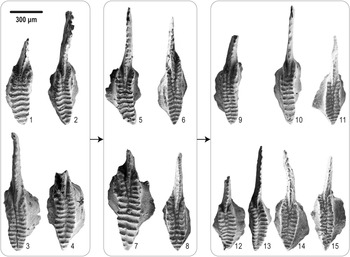
Wang and Qi (Reference Wang and Qi2003) named two nonlobed species, Streptognathodus guizhouensis Wang and Qi, Reference Wang and Qi2003 and Idiognathodus nashuiensis Wang and Qi, Reference Wang and Qi2003, and the weakly lobed S. luosuensis Wang and Qi, Reference Wang and Qi2003 from the Naqing section. The first was later reassigned to Idiognathodus because its transverse ridges are mostly uninterrupted (Barrick et al., Reference Barrick, Qi, Wang, Wang, Qi, Groves, Nemirovskaya, Ueno and Wang2010). The last was later reassigned to Idiognathodus mainly because of its eccentric groove (Qi et al., Reference Qi, Barrick, Hogancamp, Chen, Hu, Wang and Wang2020). Idiognathodus guizhouensis has a slightly concave platform with an extremely short carina, partially interrupted transverse ridges, and noticeably short rostral ridges that are distinct from those of coeval Idiognathodus spp., i.e., I. magnificus Stauffer and Plummer, Reference Staufffer and Plummer1932 and related forms. It was previously believed that this species appeared suddenly and then disappeared in the Kasimovian. Recently, Qi et al. (Reference Qi, Barrick, Hogancamp, Chen, Hu, Wang and Wang2020) named several species from the Kasimovian-Gzhelian boundary of the Naqing section, namely I. fengtingensis Qi, Barrick, and Hogancamp in Qi et al., Reference Qi, Barrick, Hogancamp, Chen, Hu, Wang and Wang2020, I. luodianensis Qi, Barrick, and Hogancamp in Qi et al., Reference Qi, Barrick, Hogancamp, Chen, Hu, Wang and Wang2020, I. naqingensis Qi, Barrick, and Hogancamp in Qi et al., Reference Qi, Barrick, Hogancamp, Chen, Hu, Wang and Wang2020, and I. naraoensis Qi, Barrick, and Hogancamp in Qi et al., Reference Qi, Barrick, Hogancamp, Chen, Hu, Wang and Wang2020, which are related to I. guizhouensis, I. luosuensis, and I. nashuiensis. Here, I. praeguizhouensis n. sp., the proposed ancestor of I. guizhouensis, is recognized from the upper Swadelina subexcelsa Biozone to the I. magnificus Biozone in the Naqing section (see Hu et al., Reference Hu, Qi and Wang2021 for more detail). Early specimens of I. praeguizhouensis n. sp. have a longer carina, uninterrupted transverse ridges, and several inconspicuous nodes on the caudal side of the ventral platform (Fig. 1.1–1.4). It gradually transformed into I. guizhouensis by losing its caudal nodes, shortening the carina, and forming medial nodosity along the dorsal part of the short carina (Fig. 1.5–1.8). In this stage, a single node can appear on the caudal side (Fig. 1.7, 1.8). Finally, the complete nonlobed I. guizhouensis appears (Fig. 1.9–1.15). The discovery of I. praeguizhouensis n. sp., together with species named by Qi et al. (Reference Qi, Barrick, Hogancamp, Chen, Hu, Wang and Wang2020), reveals a distinct clade in the deepwater South China Sea. This clade is completely recorded in the Naqing section, starting with I. praeguizhouensis n. sp. in the early Kasimovian, followed by I. guizhouensis in the late Kasimovian and the I. luodianensis group across the Kasimovian-Gzhelian boundary, and ending with I. nashuiensis in the early Gzhelian. The elements of the I. praeguizhouensis n. sp. clade are endemic species; they have only been recovered from South China so far.
Morphological transformation from Idiognathodus praeguizhouensis n. sp. to I. guizhouensis: (1–4) Idiognathodus praeguizhouensis n. sp.: (1) NIGP 167197, sample LDC230.75-231.05; (2) holotype, NIGP 167198, sample LDC231.05-231.3; (3) NIGP 167200, sample NSC225.25; (4) NIGP 167196, sample LDC227.2-227.4; (5–8) transitional forms from I. praeguizhouensis n. sp. to I. guizhouensis (Wang and Qi, Reference Wang and Qi2003): (5) NIGP 167199, sample LDC231.7-232; (6) NIGP 175039, sample LDC 239.3; (7) NIGP 167201, sample LDC235.61-235.7; (8) NIGP 175040, sample LDC239.3; (9–15) I. guizhouensis: (9) NIGP 175041, sample LDC243.5; (10) NIGP 175042, sample LDC243.5; (11) NIGP 169833, sample NSC244.25; (12) NIGP 175043, sample LDC244.35-244.45; (13) NIGP 175044, sample NSC244.25; (14) NIGP 175045, sample NSC244.25; (15) NIGP 169835, sample N97. All specimens in oral view.

Materials and methods
Based on more than 250 limestone samples from the Moscovian-Kasimovian strata from the Naqing section, > 10,000 P1, P2, and ramiform elements were examined and identified in > 80 species including unnamed and transitional forms assigned to nine genera (see Hu et al., Reference Hu, Qi and Wang2021). Among them, specimens of Idiognathodus praeguizhouensis n. sp. were examined in this study by visual investigation with a binocular microscope and photographed by a scanning electron microscope (SEM).
Repository and institutional abbreviation
All specimens described and illustrated in this paper are reposited in the Nanjing Institute of Geology and Palaeontology (NIGP), Nanjing, China.
Systematic paleontology
Phylum Chordata Bateson, Reference Bateson1886
Subphylum Vertebrata Cuvier, Reference Cuvier1812
Class Conodonti Branson, Reference Branson1938
Order Ozarkodinida Dzik, Reference Dzik1976
Family Idiognathontidae Harris and Hollingsworth, Reference Harris and Hollingsworth1933
Genus Idiognathodus Gunnell, Reference Gunnell1931
Type species
Idiognathodus claviformis Gunnell, Reference Gunnell1931.
Idiognathodus praeguizhouensis new species
Figure 1.1–1.4
- Reference Hu2016
“Idiognathodus praezuizhouensis n. sp.” Hu, p. 135, pl. 28, figs. 1–5.
- Reference Wang, Wang, Qi, Hu and Wang2020
“Idiognathodus praeguizhouensis Hu, Reference Hu2016”; Z.H. Wang et al., p. 95, pl. 28, figs. 1–6.
- Reference Wang, Hu, Huang, Qiao, Wang, Shen, Sheng, Li, Lin and Shi2020
“Idiognathodus praeguizhouensis Wang X. D. et al.”; Hu in Z.H. Wang et al., pl. 5-1-31, figs. 1–4.
Holotype
The holotype is a P1 element from sample LDC231.05-231.3, NIGP 167198 (Fig. 1.2). Bed of sample LDC231.05-231.3 is from the Kasimovian strata in the Nandan Formation, Naqing section, southern Guizhou, South China.
Diagnosis
P1 element with narrow, transverse ridged platform, noticeably short carina, absence of lobes, and only a few nodes at each side of the ventral part of the platform.
Occurrence
Upper Swadelina subexcelsa Biozone to the Swadelina makhlinae Biozone; transitional forms range to the I. magnificus Biozone.
Description
The platform of the P1 element is lanceolate, narrow, and slightly curved caudally. The dorsal end of the platform is pointed to subrounded. The blade is about the same length as the platform. The carina is truly short, ~ 1/8 of the length of the platform. One to three small nodes can occur at the dorsal end of the carina as a continuation of the carina. The rostral ridges are noticeably short and almost restricted on the platform; in larger specimens, they extend noticeably short distances and converge with the blade. Accessory lobes are absent. Only 1–3 small inconspicuous nodes occur ventrally on each side of the platform. In general, the caudal nodes are more prominent. The platform is covered by transverse ridges (to 11). They are continuous in general, and can be slightly dissected or deflected by a very shallow groove. The oral surface of the platform is slightly concave. Laterally, the element is flat. The basal cavity is deep, moderately wide, and symmetric.
Etymology
prae-: L., before, preceding.
Materials
Twelve sinistral elements and 13 dextral elements.
Remarks
This species was originally described in the doctoral thesis by Hu (Reference Hu2016) together with other new species. However, this thesis was not officially published and only circulated among a few people. Subsequently, other species described in this thesis have been published (Hu and Qi, Reference Hu, Qi, Barrick and Brenckle2017; Hu et al., Reference Hu, Qi and Nemyrovska2019). Here, we present the formal systematic description and correct errors by Z.H. Wang et al. (Reference Wang, Wang, Qi, Hu and Wang2020) and X.D. Wang et al. (Reference Wang, Hu, Huang, Qiao, Wang, Shen, Sheng, Li, Lin and Shi2020), in which this species was informally referred to as “Idiognathodus praeguizhouensis Hu, Reference Hu2016” and “I. praeguizhouensis Hu in Z.H. Wang et al., Reference Wang, Wang, Qi, Hu and Wang2020,” respectively.
This species is the proposed ancestor of Idiognathodus guizhouensis, which is characterized by a very narrow platform, a short carina, noticeably short rostral ridges, the absence of lobes, and a series of nodes as continuation of the carina in the median groove. Idiognathodus praeguizhouensis n. sp. differs from its descendant by extra nodes on both sides of the platform, a shorter continuation of the carina, and generally more continuous transverse ridges. The species evolved to I. guizhouensis by lengthening the continuation of the carina in the groove and reducing extra nodes (Fig. 1.5–1.8). The caudal rostral ridge can be much longer in some transitional forms (Fig. 1.6).
Acknowledgments
This study was supported by the National Natural Science Foundation of China (grant no. 42172002). We thank D. Korn for his proofreading and suggestions, and Q. Wang for his assistance during fieldwork. We are grateful to J. Barrick, S. Rosscoe, and L. Stephen who reviewed this manuscript and gave constructive suggestions.