Introduction
Closed basin lakes in Antarctica often exhibit a saline to hypersaline chemistry, since the inflow of ions from glacial meltwater and snowfields during summer, in combination with year-round low precipitation, high wind speeds, and high evaporation leads to ion concentration in the water column.
In Taylor Valley, one of these lakes, Lake Bonney, is characterized by hypersaline bottom waters (Figs 1 & 2). Lake Bonney is separated into west and east lobes by a constriction of the valley, the so-called Bonney Riegel, and by a sill at c. 12 m water depth. The bottom waters of east and west lobe Bonney (ELB and WLB) have large differences in ionic and isotopic composition (e.g. Neumann et al. Reference Neumann, Lyons, Priscu, des Marais and Welch2004, Poreda et al. Reference Poreda, Hunt, Lyons and Welch2004, Knoepfle et al. Reference Knoepfle, Doran, Kenig, Lyons and Galchenko2009) as a result of differential palaeolimnologic history during the Holocene (Poreda et al. Reference Poreda, Hunt, Lyons and Welch2004).
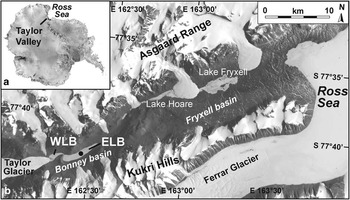
a. Location of McMurdo Dry Valleys in Antarctica. b. Landsat 7 satellite image of Taylor Valley, southern Victoria Land, Antarctica (US Geological Survey 2007). The black dot in east lobe Bonney (ELB) indicates the coring location Lz1023.

The late Quaternary history of the Bonney basin is in part controlled by the advance and retreat of the Taylor Glacier, which contacts WLB (Fig. 1). The Bonney drift, glacial deposits left by Taylor Glacier, indicates that the latter advanced far eastward into Taylor Valley during the Eemian and overrode and probably reshaped the Bonney basin (Higgins et al. Reference Higgins, Hendy and Denton2000b). During the last glacial period, Taylor Glacier was in a retreated position and a large lake, Glacial Lake Washburn, occupied much of Taylor Valley (Hall et al. Reference Hall, Denton and Hendy2000). Glacial Lake Washburn is proglacial to an advanced Ross Sea Ice Sheet (RIS) that closed Taylor Valley mouth on the McMurdo Sound. Palaeodeltas found on the valley slopes indicate that this Glacial Lake Washburn had a maximum water depth of up to c. 300 m. Radiocarbon dates from these deltas indicate that Glacial Lake Washburn occupied the Bonney basin at least until c. 12 000 14C yr bp (Hall & Denton Reference Hall and Denton2000), before enhanced evaporation and the retreat of the RIS led to a significant lake level drop during the late Pleistocene or early Holocene (Hall & Denton Reference Hall and Denton2000, Wagner et al. Reference Wagner, Melles, Doran, Kenig, Forman, Pierau and Allen2006). Since then, smaller separated lakes occupy the individual sub-basins in Taylor Valley: Lake Hoare and Lake Fryxell in the Fryxell Basin, and both lobes of Lake Bonney in the Bonney Basin (Fig. 1). In the Bonney basin, the hypersaline bottom waters of ELB carry the geochemical features of a strongly evaporated water mass with δD values well below the meteoric water line (Matsubaya et al. Reference Matsubaya, Sakai, Torii, Burton and Kerry1979) and very positive δ13C values for dissolved inorganic carbon (DIC; up to +9 ‰ vs VPDB between 37 and 19 m; Knoepfle et al. Reference Knoepfle, Doran, Kenig, Lyons and Galchenko2009). Such positive values for δ13CDIC were observed in strongly evaporated brine associated with deposition of evaporites (Stiller et al. Reference Stiller, Rounick and Shasha1985). It is noteworthy that bottom waters of WLB do not exhibit such an isotopic signal of evaporation. Poreda et al. (Reference Poreda, Hunt, Lyons and Welch2004), on the basis of helium isotope data, proposed that rising lake level in the WLB led to flooding of the ELB during the late Holocene with a connection of both lakes at a uniform lake level, similar to that of today, c. 200 years ago.
Former studies of Lake Bonney concentrated on its hydrological, biological, biogeochemical, and physical properties, mainly within the scope of the McMurdo Long Term Ecological Research (LTER) program (e.g. Priscu Reference Priscu1998). Sedimentological studies of Lake Bonney are few and contradictory. Wilson et al. (Reference Wilson, Hendy, Healy, Gumbley, Field and Reynolds1974) reported a 30 cm thick salt crust and Craig et al. (Reference Craig, Fortner and Weand1974) observed that a 10 cm thick salt crust mainly consisting of hydrohalite and halite formed the surface sediments.
During an expedition in summer 2002–03, a 270 cm long core (core Lz1023) was recovered from ELB. It is the longest sediment sequence so far recovered from this part of Lake Bonney. In this report we provide a detailed sedimentological characterization of core Lz1023 and discuss the palaeolimnology of ELB as constrained by this sediment record.
Study site
Lake Bonney is located in upper Taylor Valley at 57 m a.s.l. (Fig. 1). WLB and ELB are connected only by a narrow channel with a water depth of c. 12 m (Fig. 1). Both lobes are c. 900 m wide, but ELB at 4.8 km is distinctly longer than the WLB at 2.6 km long. The bathymetry indicates steep slopes along the length axis of both lobes, and relatively flat bottoms. The maximum water depth is c. 40 m in both lobes. During the past century, a lake level rise of more than 10 m was calculated (Chinn Reference Chinn1993, Bomblies et al. Reference Bomblies, McKnight and Andrews2001, and own measurements during summer 2002–03). Water input into Lake Bonney originates mainly from meltwater of Taylor Glacier, but also from adjacent smaller alpine glaciers (Matsubaya et al. Reference Matsubaya, Sakai, Torii, Burton and Kerry1979). The perennial ice cover of both lakes has a thickness of 3.0–4.5 m on average (Lyons & Welch, http://metacat.lternet.edu:8080/knb/metacat?action=read&qformat=mcm&sessionid=&docid=knb-lter-mcm.62, accessed 12 December 2009).
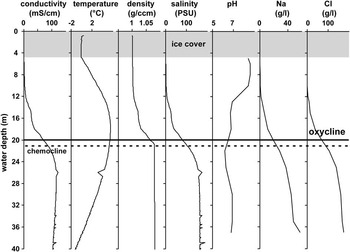
ELB can be described as a perennial salt lake, which is hydrologically closed and chemically stratified with dense brine at the lake bottom overlain by fresher surface water (Eugster Reference Eugster1980). Water temperatures in ELB rise from c. 0°C below the ice cover to a maximum of nearly 5°C at 18 m depth and drop again gradually to -1°C at the lake bottom (Fig. 2; Priscu, http://metacat.lternet.edu:8080/knb/metacat?action=read&qformat=mcm&sessionid=&docid=knb-lter-mcm.88, accessed 8 July 2010). A chemocline is established at c. 22 m water depth in ELB (Lawson et al. Reference Lawson, Doran, Kenig, des Marais and Priscu2004). Above the chemocline, the input of meltwater from glaciers leads to oxygenated waters in the uppermost 20 m and to relatively low conductivity (< 4 mS cm-1) and salinity (< 4 psu) (e.g. Lawson et al. Reference Lawson, Doran, Kenig, des Marais and Priscu2004). In the monimolimnion below the chemocline, hypersaline conditions with values of > 150 psu prevail, and salinity, conductivity, and density increase towards the bottom waters (Fig. 2). Evaporation processes and cryo-concentration of freshwater have probably played an important role in the evolution of the hypersaline brine in ELB (Poreda et al. Reference Poreda, Hunt, Lyons and Welch2004). Bottom waters are supersaturated with respect to sodium chloride (Hendy et al. Reference Hendy, Wilson, Popplewell and House1977) and mid-depth waters are supersaturated with respect to calcite (Neumann et al. Reference Neumann, Lyons, Priscu, des Marais and Welch2004). The origin of these ions is still under debate. The chemical composition indicates a marine origin (e.g. Matsubaya et al. Reference Matsubaya, Sakai, Torii, Burton and Kerry1979). A possible source could be Blood Falls (Mikucki et al. Reference Mikucki, Pearson, Johnston, Turchyn, Farquhar, Schrag, Anbar, Priscu and Lee2009), which delivers saline and iron-rich waters into WLB from an ancient water mass beneath Taylor Glacier (Hubbard et al. Reference Hubbard, Lawson, Anderson, Hubbard and Blatter2004). However, their different chemical compositions can exclude a direct transfer of saline waters originating from Blood Falls into ELB (Mikucki et al. Reference Mikucki, Pearson, Johnston, Turchyn, Farquhar, Schrag, Anbar, Priscu and Lee2009). Other studies suggest that the saline waters in Lake Bonney originate from ancient seawater, modified over time by addition of salts from atmospheric precipitation, leaching of soils, and chemical weathering of catchment rocks (Keys & Williams Reference Keys and Williams1981), as well as by subsequent loss of solutes via mineral precipitation (Lyons et al. Reference Lyons, Welch, Snyder, Olesik, Graham, Marion and Poreda2005).
Water profile of east lobe Bonney (Priscu, http://metacat.lternet.edu:8080/knb/metacat?action=read&qformat=mcm&sessionid=&docid=knb-lter-mcm.88, accessed 8 July 2010; Lyons & Welch, http://metacat.lternet.edu:8080/knb/metacat?action=read&qformat=mcm&sessionid=&docid=knb-lter-mcm.62, accessed 12 December 2009).

Material and methods
Core Lz1023 was recovered from the central part of ELB (77°42′892′′S, 162°26′216′′E; Fig. 1), at a water depth of 38.3 m. The coring took place through a hole in the 4.9 m thick ice cover. As observed by an underwater video camera, a hard sediment surface, apparently formed by salt crystals and sparse amounts of clastic particles, prevented penetration of a gravity corer. Consequently, an UWITEC piston corer was manually hammered into the sediment. After recovery, the piston core was placed in a dry borehole in the ice cover and immediately frozen in vertical position, using dry ice. After four hours, the core was removed from the ice hole, and the inner PVC tube containing the sediments was extracted from the outer metal tube by slowly melting the water between both tubes. The total length of core Lz1023 was determined in the field to be 259 cm. The frozen core was cut into three segments on-site and was transported and stored frozen at -20°C until processed at the University of Illinois at Chicago (USA). There, the frozen core segments were split lengthwise into two halves, photographically documented and described. One core half was again split lengthwise and one of the quarters was subsampled in contiguous 2 cm intervals. The water content of the subsamples was determined by the weight loss before and after freeze-drying.
The dried subsamples were diluted in deionized water and then passed through a 0.45 μm filter to separate clastic material, here defined as the fraction being left on the filters. The liquid fraction, which contains the dissolved ions derived both from the salt crystals and the initial pore water, was analysed for major cations and anions. Sodium (Na) and potassium (K) were measured by atomic adsorption spectrometry (AAS) with an AA 6800 (Shimadzu Corp), and chloride concentrations were determined using an ion chromatograph DX-120 (Dionex Corp).
The clastic fraction was analysed for grain-size distribution, as well as carbon and sulphur contents. As the total amount of the clastic fraction was extremely low, sporadically occurring gravel (> 2 mm) would have overprinted the results and hence was removed by sieving. The grain-size distribution of the clastic fraction < 2 mm was measured with a laser particle size analyser 1180 (CILAS Corp). For biogeochemical analyses, an aliquot of the clastic fraction was ground to < 63 μm and homogenized. Total carbon (TC) and total inorganic carbon (TIC) contents were determined with a DIMATOC 100 (DIMATEC Corp) analyzer. The total organic carbon (TOC) content was calculated by the difference between TC and TIC. The total sulphur (TS) contents were measured with an Elementar III (VARIO Corp) analyzer. Element weight percentages are related to the clastic fraction only.
Very low amounts of TIC and TOC throughout the core made radiocarbon dating difficult. A single sample from 170–174 cm depth contained sufficient TIC and was selected for accelerator mass spectrometry (AMS) dating at the Leibniz Laboratory for Radiometric Dating and Isotope Research in Kiel, Germany (Table I).
Radiocarbon dates of carbonates from a bulk sediment sample of core Lz1023, east lobe Bonney.

Results and discussion
Stratigraphy
In contrast to the hard sediment surface encountered during coring, the sediment surface in the core was slushy after core opening, which led to re-determination of the core length to 270 cm. The entire sediment core is comprised of three major components: water, idiomorphic salt crystals, and a clastic fraction. According to changes in the sedimentological characteristics, core Lz1023 can be separated into four major units.
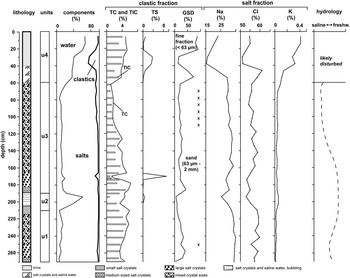
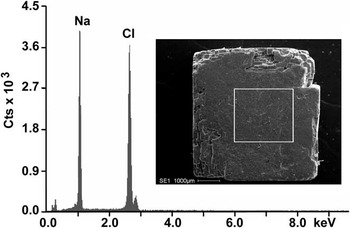
Unit 1 ranges from 270–210 cm (Fig. 3). It is characterized by low water contents (10%) and a low proportion of clastic material. Energy-dispersive X-ray spectroscopy (EDAX, Fig. 4) and the results of the ion measurements (Fig. 3) indicate that the salt crystals are mainly formed by halite (NaCl). Salt crystals vary in size throughout this unit. Medium size salt crystals with about 1 cm edge length are dominant between 270 and 260 cm. Crystals with up to 2 cm edge length can be observed between 260 and 250 cm core depth. Between 250 and 220 cm depth, mixed crystal sizes between 1 mm and 1 cm edge length occur, and shallower than 220 cm depth, the individual salt crystals are barely visible without a microscope. The size of the crystals provides some information about the conditions during their growth. Occurrence of large crystals indicates long-term stable concentration, whilst mixed crystal sizes can be explained by changing brine conditions with contemporaneous nucleation and crystal growth (Lowenstein & Hardie Reference Lowenstein and Hardie1985). Alternating conditions of crystal growth can be caused by a variable supply of solutes and by variations in the strength of evaporation processes (Eugster Reference Eugster1980). However, since these processes are very complex and not completely understood, palaeoenvironmental information can only with caution be derived from the differing crystal sizes in core Lz1023. The idiomorphic shape of the cubic salt crystals (Fig. 4) suggests a slow crystallization process (King Reference King2005).
Lithology, major components, total carbon (TC), total inorganic carbon (TIC), total sulphur (TS), grain size distribution (GSD), and occurrence of gravel (> 2 mm) in the clastic fraction (marked by x), and sodium (Na), chloride (Cl), and potassium (K) concentrations in the salt fraction of core Lz1023.

Diffractogram and SEM photo of a salt crystal from 150 cm depth in core Lz1023.

The clastic proportion is very low throughout unit 1. The grain size distribution is dominated by sand (0.063–2 mm). As high wind velocities and aeolian sand transport are common in Taylor Valley (Doran et al. Reference Doran, McKay, Clow, Dana, Fountain, Nylen and Lyons2002), the sand in unit 1 most probably results from aeolian transport. Currently, only small amounts of aeolian material are trapped in and on the ice cover of Lake Bonney. An absence of perennial ice cover, as proposed to have formerly occurred during an evaporative phase of the lake (Poreda et al. Reference Poreda, Hunt, Lyons and Welch2004), could have led to more trapping of aeolian material. A maximum in the fine fraction correlates with a slight increase in the proportion of clastic components at about 258 cm depth (Fig. 3). As aeolian transported material is dominated by sand and coarse silt, the maximum in the fine-grained fraction (< 0.063 mm) can best be explained by increased meltwater inflow from glaciers. Consequently, decreasing amounts of fine-grained material and a gradually decreasing proportion of clastic components upwards could be correlated with decreasing meltwater supply to the lake and are potentially related to a cooling period with less glacier melt. Gravels (> 2 mm) are lacking except for one horizon at c. 250 cm depth. Total carbon (3.5–6%) is mainly formed by TIC and is inversely correlated to the proportion of the fine-grained fraction (Fig. 3). The TOC contents, derived from the difference between TC and TIC, apparently positively correlate with the TIC contents. The minimum in TIC and TOC contents around c. 250 cm in unit 1 could be due to restricted carbonate precipitation and low productivity in the lake or be due to enhanced decomposition of organic matter. However, increased amounts of reduced sulphur, which would indicate increased decomposition of organic matter (Lawson et al. Reference Lawson, Doran, Kenig, des Marais and Priscu2004), are not observed throughout unit 1.
Unit 2, from 210–190 cm core depth, is characterized by a distinct maximum (up to 60%) in water content (Fig. 3). This high water content is most probably related to decomposition of gas hydrates as indicated by extensive bubbling during subsampling and thawing of the core. It can however, not be fully excluded that dehydration of metastable minerals, such as the hydrated carbonate ikaite (CaCO3·6H2O) or hydrated salt hydrohalite (NaCl·6H2O) may have contributed to the relatively high water contents in this unit. Both ikaite and hydrohalite are stable in the pressure (c. 5 bars) and temperature (-1°C) conditions of the bottom of ELB (Marland Reference Marland1975, Williams-Jones & Samson Reference Williams-Jones and Samson1990). However, neither ikaite nor hydrohalite are known to release gas, as we observed, when dehydrating to calcite and halite, respectively. Additionally, the relatively low abundance of TIC in unit 2 excludes ikaite as a source of the high water content. Na and Cl remain the dominating ions, but K shows slightly enhanced values relative to unit 1 below and unit 3 above (Fig. 3). Since the presumed gas hydrates (or metastable minerals) in this unit were decomposed and a partial dissolution of very small salt crystals may have taken place, an identification of the salt crystals in this unit cannot be given at this stage.
The very minor clastic component of unit 2 is mainly composed of sand (0.063–2 mm). Total carbon is between 3 and 6% by weight of the clastic fraction, but in one sample (194 cm), a significant amount of TOC (c. 4 wt%) corresponds with a small peak in TS.
Unit 3, from 190–60 cm, is characterized by low water content (c. 10%) and a slight increase in clastic sediments upwards. Between 80 and 60 cm depth, the water content increases from c. 10 to 20%. The sizes of the salt crystals vary throughout unit 3. Crystals with 1 mm to 1 cm edge length occur in the lower part, crystals with 1–2 cm edge length occur between 182 and 165 cm, and crystals with a broad variation of edge lengths (1 mm to 2 cm) occur between 165 and 60 cm. As in unit 1, these differences may have resulted from changing conditions during the growth of the salt crystals. The ion composition of the salts is similar to that of unit 1, primarily Na and Cl with a negligible amount of K, indicating halite as the dominant mineral species.
The clastic fraction is again dominated by sand (0.063–2 mm). The fine fraction (< 0.063 mm) has a slight maximum in the lower part of unit 3 and decreases in abundance upward. Gravel of up to 1 cm in diameter occurs between 110 and 70 cm depth (Fig. 3). Today, in the presence of an ice cover, grains with diameters larger than 1 cm, mainly originating from melting icebergs or mass movement processes from the surrounding valley slopes, remain on the ice surface (Hendy Reference Hendy2000b). The occurrence of relatively small gravel grains at the top of unit 3 hence could be related to migration of coarse material through the ice cover or due to dropping of coarse grains through cracks in the ice cover. However, the absence of, or a very thin perennial ice cover would promote the occurrence of gravel in the sediments. The overall decrease of TC from c. 7 to 1% towards the top, which is caused by an overall decrease of TIC and a drop from significant amounts (< 3.5%) of TOC between 190 and 140 cm to negligible amounts in the upper part of this unit, can be explained either by decreasing productivity and carbonate precipitation or by increasing decomposition. A significant minimum in TC to < 2% at c. 170 cm depth corresponds with a horizon of largest (c. 2 cm) halite crystal sizes, slightly increased amounts of clastic sediments, and the only distinct maximum in TS (Fig. 3). Since there is no organic matter enrichment observed along with the TS peak, this TS maximum could be due to an occurrence of gypsum crystals.
Unit 4 is the top portion of the core (Fig. 3). High water content, increasing upward, and a low salt content characterize this unit. Salt crystals of < 1 mm edge length occur only sparsely. The top 20 cm of the core exhibits a brighter colour as it contains a smaller proportion of clastic components. The ion composition shows a minimum in Na and Cl between 40 and 20 cm depth, which corresponds to an increase in K concentration (Fig. 3).
The clastic fraction in unit 4 shows a distinct increase of the fine-grained material (< 0.063 mm) relative to lower units, except between 40 and 20 cm, where the clastic components, dominated by sand (0.063–2 mm), have a distinct maximum. Total carbon, which again is mainly comprised of TIC, forms 4–6% of the clastic fraction. Total sulphur values increase between 40 and 20 cm, where the clastic component has its maximum with up to 25% (Fig. 3).
Overall, the sedimentological characteristics of unit 4, indicating gradual changes upwards, are not consistent with the hard and distinct sediment surface observed by means of an underwater video camera in the field. It can be speculated that hammering the piston core into the sediment broke up the hard sediment surface of ELB, and that salt crystals and clastic material became mixed with bottom water, before the core was frozen subsequent to recovery. The sediment surface/bottom water transition may have been disturbed, hampering interpretation with respect to the environmental conditions. However, unit 4 may at least partly reflect the sediment surface/bottom water transition. Previous investigations described the presence of hydrohalite (NaCl·2H2O) and halite (NaCl) at the sediment water interface (Craig et al. Reference Craig, Fortner and Weand1974). Hydrohalite has a water content of 38.1% and seems to be a primary precipitate in Lake Bonney. Since the water content between 50 and 30 cm depth in unit 4 is c. 40% (Fig. 3), this horizon can probably be attributed to a horizon of hydrohalite. In addition, the increased contents of TIC and TS in unit 4 are potentially related to carbonate and gypsum formation, minerals observed in prior studies of these surface sediments (Craig et al. Reference Craig, Fortner and Weand1974).
Chronological constraints
AMS radiocarbon dating of carbonates from 170–174 cm sediment depth yielded an age of 10 830 ± 60 and 10 940 ± 100 14C yr bp. However, these ages have to be regarded critically. The input of old carbon derived from glacial melt and the lack of exchange with the atmosphere due to the perennial ice cover may result in a reservoir effect of up to several thousand years (Hendy & Hall Reference Hendy and Hall2006), as it is common in other Antarctic lakes. Furthermore, dating was conducted on carbonates, which most probably originate from DIC in the water column. Radiocarbon dates from DIC show remarkable variations throughout the water column in ELB. Dissolved inorganic carbon ages from directly below the ice cover indicate c. 3500 14C yr bp (Lawson Reference Lawson2005). Highest radiocarbon ages of up to 13 700 14C yr bp occur around the chemocline and are explained by an inflow of water from WLB, which exhibits very high DIC ages of up to c. 25 000 14C yr bp (Neumann et al. Reference Neumann, Lyons, Priscu, des Marais and Welch2004, Lawson Reference Lawson2005). Dissolved inorganic carbon in the bottom waters of ELB indicates radiocarbon ages of between c. 8000 and 10 000 14C yr bp (Doran et al. Reference Doran, Berger, Lyons, Wharton, Davisson, Southon and Dibb1999, Lawson Reference Lawson2005). As the radiocarbon ages and the related δ13C values in the bottom waters of ELB and the dated horizon in core Lz1023 are similar, it is probable that the dated carbonates in core Lz1023 originate from the bottom waters, as is suggested by studies of the ion composition in the bottom waters (Lyons et al. Reference Lyons, Frape and Welch1999). The radiocarbon dates in core Lz1023 thus only provide a maximum age for this horizon and a more precise age estimation based on the radiocarbon dates cannot be given.
Alternative age estimations are also problematic. U/Th dating of aragonites and gypsum in the surface sediments of ELB provided ages of between 1800 and 10 000 yr (Hendy et al. Reference Hendy, Wilson, Popplewell and House1977, Hendy Reference Hendy2000a). Age estimations based on accumulation rates in evaporite systems provide a wide range of sedimentation rates. For example, chemical sedimentation rates of 2 cm yr-1 were recorded in Freefight Lake in the Great Plains, western Canada (Last Reference Last1993) and would indicate that core Lz1023 records only about 100–150 years. On the other hand, Schreiber & El Tabakh (Reference Schreiber and El Tabakh2000) suggested sedimentation rates of about 0.18 cm yr-1 for stratified hypersaline water bodies, which would imply that core Lz1023 records c. 1500 years. Simple calculations based on experiments (Dronkert Reference Dronkert1985) and assuming seawater as precipitating liquid and present climate conditions with ablation rates of 150–500 mm yr-1 (Clow et al. Reference Clow, McKay, Simmons and Wharton1988) would yield ages of 400–1300 years for core Lz1023. However, a continuous formation and precipitation of salts in ELB cannot be assumed, despite relatively constant percentages of clastics throughout units 1, 2, and 3. According to reconstructions based on isotopic studies, the hydrological conditions in ELB have significantly changed during the past several thousand years (Poreda et al. Reference Poreda, Hunt, Lyons and Welch2004) and precipitation and dissolution of salts as well as sedimentation breaks could have occurred.
Palaeoenvironmental implications
Absolute chronological constraints for core Lz1023 are not available. However, the relative palaeoenvironmental changes, which can be deduced from the observed variations in the sedimentological composition, can be compared with other palaeoenvironmental reconstructions from the region and thus allow a tentative age estimation for core Lz1023.
A significant accumulation of clastic particles, which could indicate evaporation events (Lowenstein & Hardie Reference Lowenstein and Hardie1985) or salt dissolution at the sediment surface in response to enhanced freshwater input, was not observed throughout core Lz1023. The most significant evaporation event in Taylor Valley during the late Quaternary was probably the final evaporation of Glacial Lake Washburn between c. 11 000 and 8000 14C yr bp (Hall & Denton Reference Hall and Denton2000, Hendy Reference Hendy2000a, Wagner et al. Reference Wagner, Melles, Doran, Kenig, Forman, Pierau and Allen2006). This age corresponds well with the radiocarbon ages in core Lz1023 and with the DIC in the bottom waters (Lawson Reference Lawson2005) and thus supports the hypotheses that the radiocarbon ages provide maximum ages and that core Lz1023 is < 10 000 years old. A Holocene age of core Lz1023 is supported by the low proportion of clastic sediments, as they were deposited in Glacial Lake Washburn (Wagner et al. Reference Wagner, Melles, Doran, Kenig, Forman, Pierau and Allen2006). Mid to late Holocene evaporation events were of minor importance and are partly restricted to the individual basins in Taylor Valley. For example, the mid to late Holocene evaporation events recorded in Lake Hoare (Lyons et al. Reference Lyons, Tyler, Wharton, McKnight and Vaughn1998) or in Lake Fryxell (Wagner et al. Reference Wagner, Melles, Doran, Kenig, Forman, Pierau and Allen2006, Whittaker et al. Reference Whittaker, Hall, Hendy and Spaulding2008) do not provide a consistent age. Also the existing reconstructions of late Holocene lowstands in Lake Bonney are somewhat inconsistent. While Poreda et al. (Reference Poreda, Hunt, Lyons and Welch2004) suggested a lowstand with ice-free conditions prior to 3000 yr bp, Croall (Reference Croall2005) reconstructed lowstands at c. 1500, 800 and 400 yr bp. None of these events apparently was significant enough to become recorded as a distinct clastic layer in ELB. The overall sedimentary characteristics, however, imply that distinct environmental changes are recorded in core Lz1023.
The occurrence of gravel in units 1 and 3 could be due to a non-perennial ice cover, and hence most probably more saline conditions, as they exist today in ELB. More saline conditions around 250 cm and between c. 120 and 65 cm depth in core Lz1023 are supported by relatively large salt crystal sizes, which indicate relatively stable environmental conditions. In contrast, the sediments between 230 and 150 cm indicate no occurrence of gravel. Moreover, this horizon is characterized by increased contents of TOC and TIC and a slight minimum in Na and Cl ions. These characteristics imply more freshwater conditions, a stratified water column, a permanent ice cover, but also slightly increased productivity and carbonate precipitation. Distinctly changing salt crystal sizes in this horizon indicate unstable environmental conditions. The minimum in salt crystal sizes around 200 cm (Fig. 3) is probably the result of high nucleation and these unstable environmental conditions. A freshening of ELB waters could originate from enhanced meltwater inflow from local sources, such as minor alpine glaciers, or from freshwater overflow from the WLB into the ELB (Poreda et al. Reference Poreda, Hunt, Lyons and Welch2004). This could have occurred during the so-called Alpine I drift, when Taylor Glacier and alpine glaciers advanced and reached maximum positions younger than 2500–3500 14C yr bp (Hall & Denton Reference Hall and Denton2000, Higgins et al. Reference Higgins, Denton and Hendy2000a). Lake Fryxell exhibited a relatively high lake level between 3000 and 2000 yr bp (Whittaker et al. Reference Whittaker, Hall, Hendy and Spaulding2008), which was probably supported by a humid climate during this period (Smith & Friedman Reference Smith and Friedman1993). The sediments between 230 and 150 cm depth in core Lz1023 from ELB could have been deposited around the same period, implying that the period after c. 2000 yr bp was characterized by more saline conditions (Fig. 3). This would at least partly match with lake level reconstructions of ELB based on helium isotope data, which indicate saline to hypersaline conditions and a non-perennial ice cover sometime between c. 3000 and 200 yr bp (Poreda et al. Reference Poreda, Hunt, Lyons and Welch2004). Given the uncertainty in chronology in core Lz1023, these correlations remain speculative.
It can also only be speculated about the most recent history of ELB, since the sediment surface in core Lz1023 appears to have been disturbed by the coring. Enhanced freshwater inflow into ELB, which is confirmed by diffusion processes occurring higher in the water column today (Spigel & Priscu Reference Spigel and Priscu1996) and by the rising lake level during the last century (Chinn Reference Chinn1993, Barrett et al. Reference Barrett, Virginia, Wall, Doran, Fountain, Welch and Lyons2008), and the establishment of a permanent ice cover during the past 200 years (Poreda et al. Reference Poreda, Hunt, Lyons and Welch2004) might explain the occurrence of carbonates and gypsum, such as indicated in unit 4 and observed in other surface sediment studies from ELB (Craig et al. Reference Craig, Fortner and Weand1974, Hendy et al. Reference Hendy, Wilson, Popplewell and House1977). It cannot be excluded that the enhanced freshwater input led to equilibrium between precipitation and dissolution and that precipitation of halite from the brine is currently interrupted. Interruption of halite precipitation would probably lead to a higher proportion of clastic material, if sedimentation of clastic material remains relatively constant. The maximum of clastic material in unit 4 would support such a scenario.
Conclusions
Core Lz1023 from ELB shows for the first time that idiomorphic halite crystals of different sizes form at least the uppermost 2.1 m of sediments. Other evaporites, such as gypsum or aragonite, appear to occur in few horizons, but may have been disturbed particularly at the sediment surface by the coring process. An overall very low and relatively stable proportion of clastic material, i.e. minerals and organic matter that were not water soluble, implies that major desiccation events or dissolution events were lacking throughout the period recovered in core Lz1023. However, the occurrence of gravel at the core base and in the top part of the core implies more saline conditions, as they exist today. The interspersed horizon with no occurrence of gravel, relatively high contents of TOC and TIC, a minimum in Na and Cl ion concentration and relatively small salt crystal sizes implies more freshwater conditions. These conditions are described to have occurred probably younger than 2000–3000 years ago in the region, but may have also occurred between two lake level lowstands, as they are reported from Lake Bonney at 800 and 400 years ago. The exact chronology of core Lz1023 has to remain open at this stage, since the low contents of carbon hamper radiocarbon dating and age estimations based on evaporite sedimentation rates yield high uncertainties.
Acknowledgements
The project was funded by the Deutsche Forschungsgemeinschaft (DFG, Me 1169/4-1) and by the National Science Foundation (OPP 0096250, 0126270). Peter Glenday, Jennifer Lawson Knoepfle, and David Mazzucchi are thanked for their assistance in the field. Brenda Hall, Berry Lyons and Alan Vaughan are thanked for numerous comments and suggestions on the manuscript.