Surgical site infections are one of the most repeatedly reported healthcare-related infections. Reference Bischoff, Zeynep Kubilay, Allegranzi, Egger and Gastmeier1,Reference Allegranzi, Bagheri Nejad and Combescure2 The role of the operating-room ventilation system in decreasing surgical site infections is conflicting, especially for orthopedic implant surgery. Reference Charnley3
Many studies have reported a decrease in air pollution related to the use of laminar airflow, frequently called “ultraclean ventilation,” systems compared to other types of operating room ventilation. Reference Diab-Elschahawi, Berger and Blacky4,Reference Birgand, Toupet and Rukly5 However, there is proof that air pollution might not be related to wound infection. Reference Diab-Elschahawi, Berger and Blacky4
Randomized trials, conducted in the 1970s, which did not control for the administration of prophylactic antibiotics, representing a decrease of surgical site infections rates in total hip replacement and total knee arthroplasties related to the use of laminar airflow in the operating room compared to conventionally ventilated. Reference Marotte, Lord and Blanchard6,Reference Lidwell, Lowbury, Whyte, Blowers, Stanley and Lowe7
The first study, in which subjects were randomized to laminar airflow operating rooms or conventional airflow operating rooms and all subjects received proper surgical antibiotic prophylaxis, was conducted from 1981 to 1990. Reference Fitzgerald8 No significant difference in the risk of deep surgical site infections was observed following total hip replacement and total knee arthroplasties.
Moreover, laminar airflow ventilation has been considered a risk factor for the development of severe surgical site infections in prosthetic joint infections. Reference Gastmeier, Breier and Brandt9 Only a few guidelines have provided suggestions related to ventilation systems in the operating room. The US Centers for Disease Control and Prevention (CDC) 2003 guidelines for environmental infection control in healthcare facilities give no suggestions for performing orthopedic operations in operating rooms supplied with laminar airflow due to lack of proof. Reference Chinn and Sehulster10 The surgical site infections prevention guidelines published by the Society for Healthcare Epidemiology of America (SHEA) and the Infectious Diseases Society of America (IDSA) in 2014 suggest following the American Institute of Architects’ recommendations for proper air handling in the operating room. Reference Anderson, Podgorny and Berríos-Torres11 The Royal College of Anaesthetists guidelines for the provision of anesthesia services issued in 2016 recommend performing major joint replacements in an operating room with multiple air changes per hour, not necessarily laminar flow ventilation, to reduce the risk of wound infection. Reference Krovvidi12
The purpose of this meta-analysis was to evaluate the effectiveness of ventilation systems in the operating room on the stoppage of surgical site infections. In this context, laminar airflow ventilation was compared with conventional ventilation in any type of surgery.
We sought to understand the relationship between ventilation used in the operating room with its different types and surgical site infection.
Methods
The study performed here followed the meta-analysis of studies in the epidemiology statement, Reference Stroup, Berlin and Morton13 which was conducted following an established protocol.
Study selection
Studies included were observational cohort studies that reported statistical measures of relationship (odds ratio [OR], incidence rate ratio, or relative risk, with 95% confidence intervals [CIs]) between the type of ventilation used in the operating room and surgical site infection.
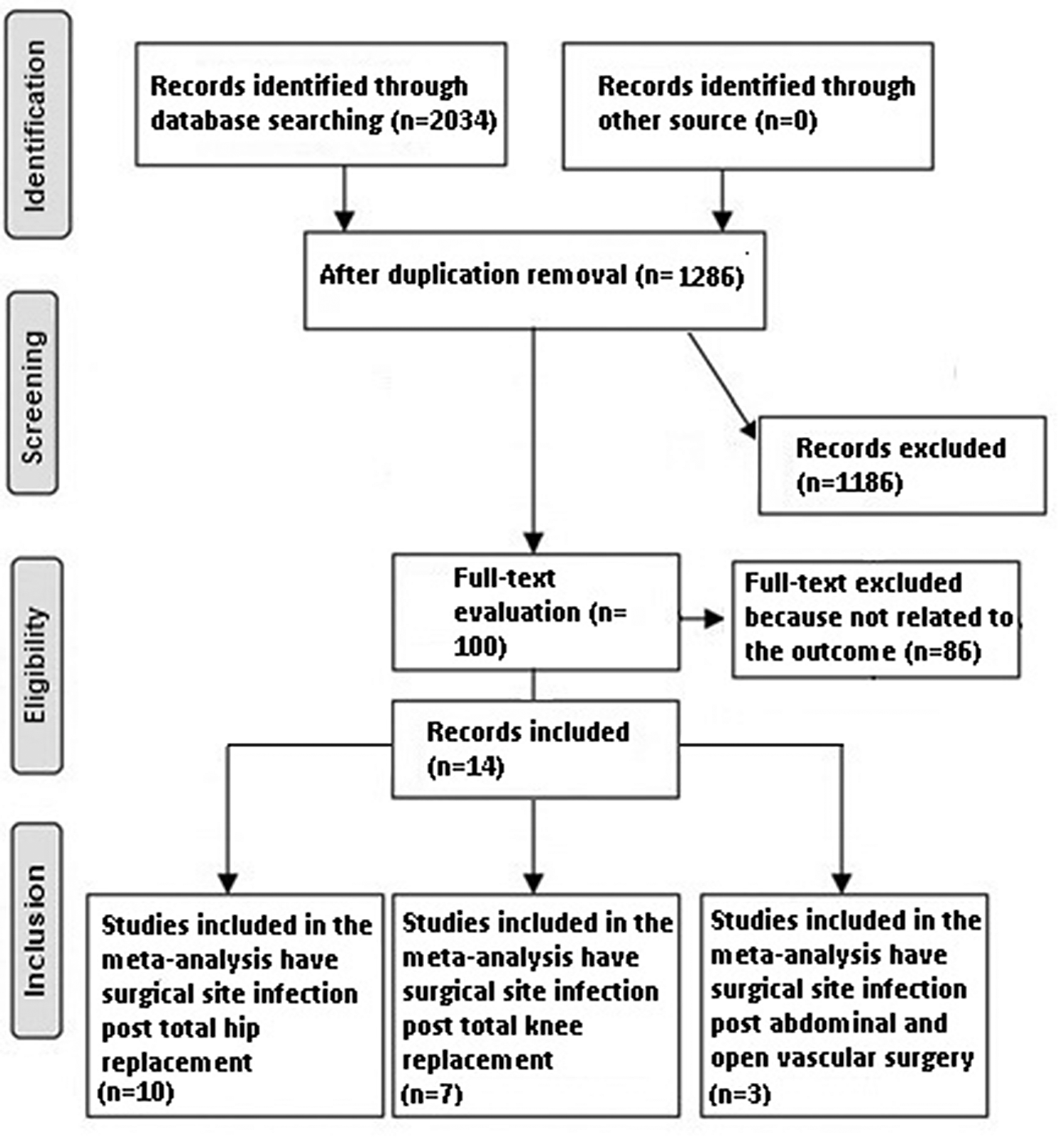
Only human studies in any language were considered. Inclusion was not restricted by study size or publication type. When there were multiple publications from the same cohort, only data from the most recent publications were included. We excluded review articles and commentaries and studies that did not provide a measure of a relationship. Figure 1 shows the study procedure.
Schematic diagram of the study procedure.

Identification
First, we conducted a systematic search of OVID, Embase, Cochrane Library, PubMed, and Google scholar through May 2020, using a combination of key words and similar words for ventilation, surgical wound infection, operating rooms, and laminar airflow. All identified studies were combined in an EndNote file, duplicates were discarded, and the title and abstracts were reviewed to exclude studies that did not report the relationship between the type of ventilation used in the operating room and surgical site infection, based on prespecified inclusion and exclusion criteria. The remaining articles were inspected for related information.
Screening
Data were summarized on the following bases: study-related and subject-related characteristics (on a standardized form); last name of the primary author; period of study; year of publication; country and region of the study; study design; population type, the total number and number of operations performed; demographic data; clinical and treatment characteristics; operation categories; surgical site infection evaluation period; qualitative and quantitative methods of evaluation; information source; outcome evaluation; and statistical analysis odds ratio or relative risk, along with 95% CI, of the relationship between the type of ventilation used in the operating room and surgical site infection. Reference Gupta, Das and Majumder14 When data from one study were based on operation type and related categories, we extracted them separately. To assess the risk of bias in these studies, we evaluated individual studies using the “quality in prognosis studies” tool, which evaluates validity and bias in studies of prognostic factors across 6 domains: participation, attrition, prognostic factor measurement, confounding measurement, and account, outcome measurement, and analysis and reporting. Reference Hayden, van der Windt, Cartwright, Côté and Bombardier15 Any inconsistencies were addressed by a re-evaluation of the original article.
Eligibility
The primary outcome focused on the type of airflow ventilation used in the operating room relation to surgical site infection. Similarly, a comparison between the count of surgical site infection with laminar airflow ventilation and conventional ventilation categories was extracted and reported in a summary.
Inclusion
Sensitivity analyses were restricted to studies reporting the relationship between ventilation used in the operating room categories and surgical site infection. For subgroup and sensitivity analyses, we used comparisons between types of ventilation used in the operating room.
Statistical analysis
`The dichotomous method with a random-effects model or fixed-effect model was used to calculate OR and 95% CI. The I2 index was calculated; the I2 index is between 0% and 100%. Values of ~0%, 25%, 50%, and 75% indicate no, low, moderate, and high heterogeneity, respectively. Reference Higgins, Thompson, Deeks and Altman16 When I2 was >50%, we chose the random-effects model; when it was <50%, we used the fixed-effects model. A subgroup analysis was performed by stratifying the original evaluation per outcome categories, as described previously. In this analysis, a P value for differences between subgroups of <.05 was considered statistically significant. Publication bias was evaluated quantitatively using the Egger regression test (publication bias considered present if P ≥ .05), and qualitatively, by visual examination of funnel plots of the logarithm of ORs versus their standard errors (SEs). Reference Higgins, Thompson, Deeks and Altman16 All P values were 2 tailed. All calculations and graphs were performed using Review Manager version 5.3 software (The Nordic Cochrane Centre, The Cochrane Collaboration, Copenhagen, Denmark).
Results
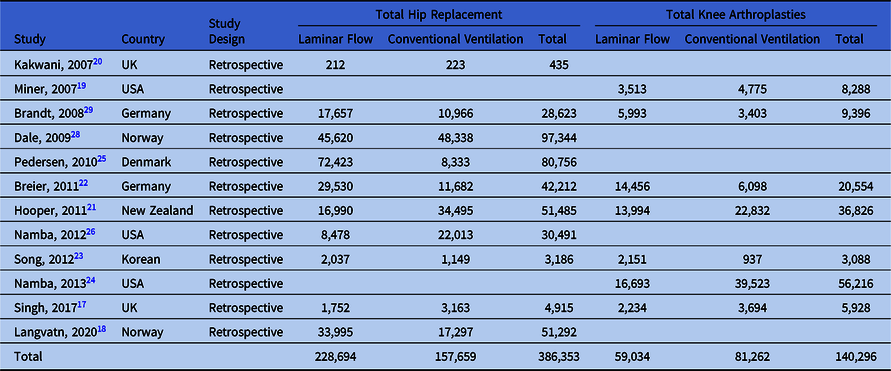
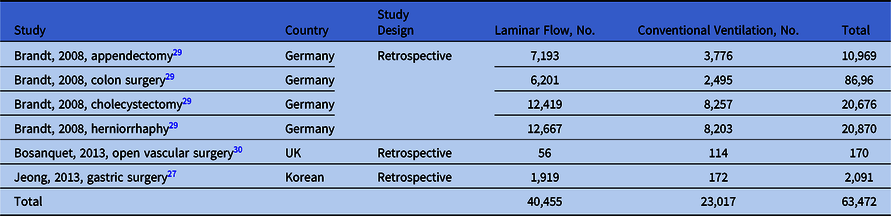
In total, of 2034 unique studies were identified, of which 14 studies satisfied the inclusion criteria and were included in the study. The details of the included studies are listed in Tables 1 and 2. Reference Singh, Reddy and Shrivastava17–Reference Bosanquet, Jones, Gill, Jarvis and Lewis30
Details of the Total Hip Replacement and the Total Knee Arthroplasty Studies Showing Number of Operations Under Laminar Airflow Ventilation and Conventional Ventilation

Details of the Abdominal and Open Vascular Surgery Studies Showing Number of Operations Under Laminar Airflow Ventilation and Conventional Ventilation

The 14 studies included 590,121 operations: 328,183 operations were performed under laminar airflow ventilation and 261,938 were performed under conventional ventilation. All included studies reported a type of ventilation used in the operating room and surgical site infection.
The study size ranged from 170 to 99,230 operations. The number of operations performed under laminar airflow ventilation ranged from 56 to 62,130. The number of operations performed under conventional ventilation ranged from 114 to 57,327. Also, 10 studies reported data stratified operations by surgical site infection in total hip replacement, and 7 studies reported data stratified operations by surgical site infection in total knee arthroplasties. Furthermore, 3 studies reported data stratified operations by surgical site infection in different abdominal and open vascular surgery. In addition, 3 studies observed higher surgical site infection related to conventional ventilation with total hip replacement; 3 studies with total knee arthroplasties; and 3 studies with different abdominal and open vascular surgery. The results were observed in all populations studied.
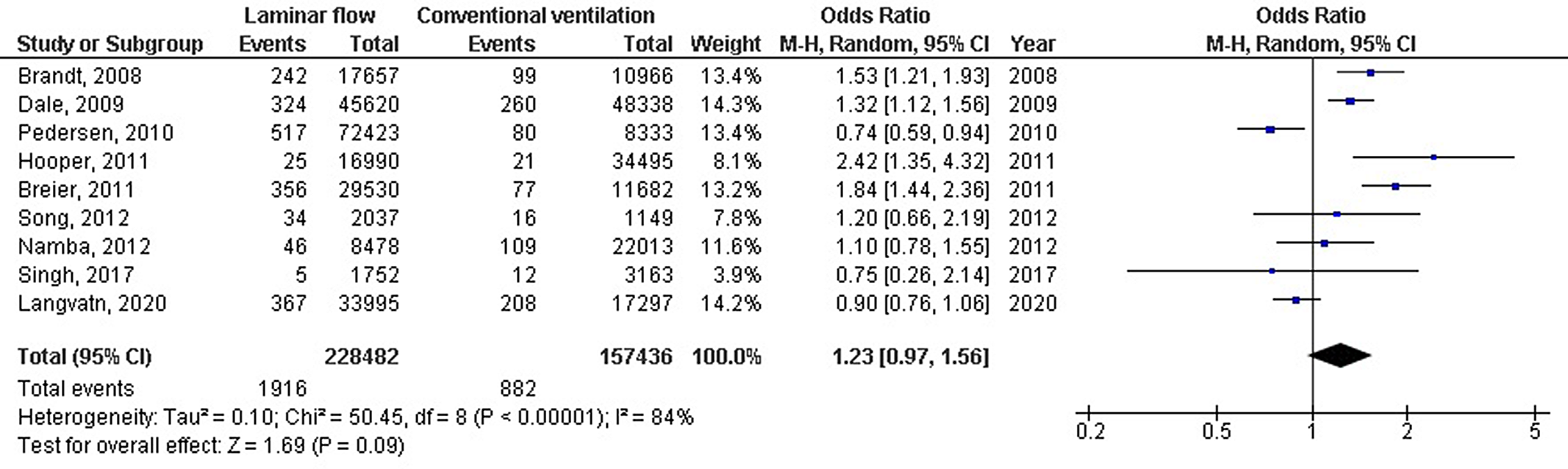
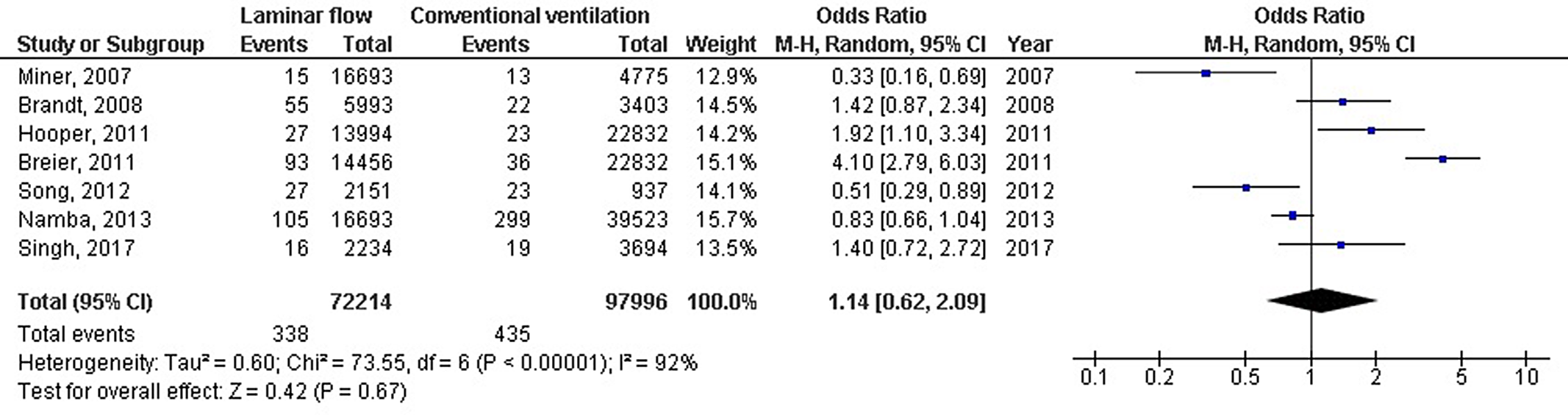
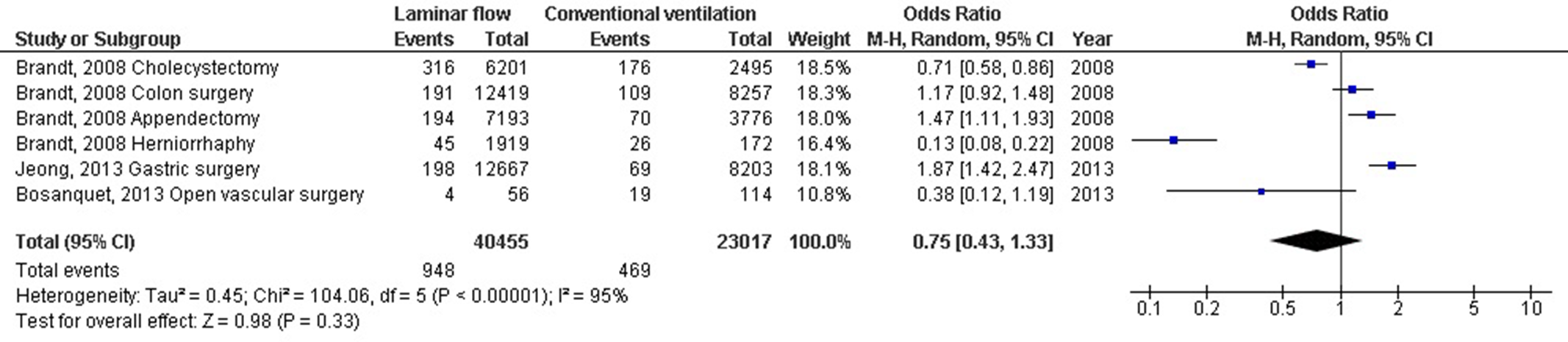
No significant different was found between operation performed under laminar airflow ventilation and conventional ventilation with total hip replacement (OR, 1.23; 95% CI, 0.97–1.56; P = .09) with high heterogeneity (I2 = 84%) (Fig. 2); with total knee arthroplasties (OR, 1.14; 95% CI, 0.62–2.09; P = .67) with high heterogeneity (I2 = 92%) (Fig. 3); and with different abdominal and open vascular surgery (OR, 0.75; 95% CI; 0.43–1.33; P = .33) with high heterogeneity (I2 = 95%) (Fig. 4). A stratified analysis of studies that did and did not adjust for smoking, obesity, intraoperative temperature, glycemia, or cautery was not performed because no studies reported or adjusted for this factor or whether a higher rate surgical site infection was related to all these factors or with exact factor.
Forest plot of the total hip replacement related to surgical site infection.

Forest plot of the total knee arthroplasties related to surgical site infection.

Forest plot of the different abdominal and open vascular surgery related to surgical site infection.

Based on the visual inspection of the funnel plot as well as on quantitative measurement using the Egger regression test, there was no evidence of publication bias (P = .85).
Discussion
The type of ventilation used in the operating room was not associated with surgical site infection. In this meta-analysis study based on 14 studies in 590,121 operations, 328,183 operations were performed under laminar airflow ventilation and 261,938 operations were performed under conventional ventilation, and no risk of the type of ventilation related surgical site infection was detected. Reference Singh, Reddy and Shrivastava17–Reference Bosanquet, Jones, Gill, Jarvis and Lewis30 This finding suggests that the implantation of laminar airflow ventilation in the operating room, with its higher cost for the sake of decreasing surgical site infection, was of no real benefit. And importantly, cost-effective analyses found that laminar airflow was more expensive than conventional ventilation systems. Reference Kramer, Külpmann, Wille and Christiansen31,Reference Graves, Wloch and Wilson32
The reasons for the nonsignificant difference between the laminar airflow ventilation and the conventional ventilation in the operating room on surgical site infection are likely to be multifactorial.
The idea of forming a clean, particle-free zone by ultraclean, low-turbulence displacement flow originated from a need for a clean atmosphere in the pharmaceutical industry. However, during surgical operations, several factors disturb the airflow, restricting its efficiency. For example, lights, personnel, and tools generate a turbulent reverse flow; heat-releasing operating lights, heating devices, and the body heat from the operating-room personnel generate thermal convection streams; and ventilation exhausts from medical tools such as saws or drills, disturb the laminar airflow. Also, operating-room personnel and medical devices disburse airborne microorganisms and particles. Thus, the operating-room air around the open surgical field is not particle free. Reference Young, Chisholm and Zhu33,Reference Sommerstein, Rüegg, Kohler, Bloemberg, Kuster and Sax34 Also, the fresh air from a laminar airflow system cools the surgical wound and the subject under operation, which can lower tissue temperatures in the surgical wound or cause systemic hypothermia, if the patient’s temperature is not monitored and maintained during the operation. Reference Yang, Huang and Zhou35
We need further research, particularly well-designed clinical trials of endoprosthetic surgery, to evaluate whether operating-room ventilation reduces surgical site infection rates. However, randomized clinical trials may not be reasonable because they would require a very high sample size to have enough power to detect a significant difference and would be very expensive. Cluster randomized trials could be difficult to control the factors between the sites, such as different surgeons operating in the same operating room.
The available evidence demonstrated by this meta-analysis and the previous cost-effectiveness analyses Reference Kramer, Külpmann, Wille and Christiansen31,Reference Graves, Wloch and Wilson32 found laminar airflow systems to be more expensive than conventional ventilation systems. Thus, we do not recommend the implementation of laminar airflow in the operating room as a protective measure to reduce the risk of surgical site infection. Several studies have suggested that the benefits associated with laminar flow ventilation with high-efficiency particulate air (HEPA) filtration are related to the design and number of exhaust arrays positioned over the operating room table. Reference Wagner and Schreiber36–Reference Darouiche, Green and Harrington38 However, that issue was not addressed in any of the studies selected for this meta-analysis. Reference Singh, Reddy and Shrivastava17–Reference Bosanquet, Jones, Gill, Jarvis and Lewis30
None of the studies we reviewed reported whether smoking, obesity, intraoperative temperature, glycemia, or cautery is related to all surgical site infections or with a specific subtype of surgical site infection separately for subjects with high risk.
This study has several limitations. The evaluation time of the type of ventilation used in the operating room and surgical site infection across studies varied. We were unable to analyze other measures of airflow ventilation different categories effect on surgical site infection. Also, we could not answer whether the type of ventilation used in the operating room is not related to all surgical site infections or related to a certain type of surgical site infection.
The present meta-analysis study suggests that the ability to detect a benefit from laminar flow with HEPA filtration may be impacted by a paucity of well-designed clinical trials. This is especially true in the orthopedic arena, where the typical modern rate of infection associated with primary total joint replacement is <2.5%, dictating the need for large sample size, involving thousands of patients, to discern clinical significance (P < .05). However, laminar airflow with HEPA filtration might provide additional protection for healthcare workers during surgical procedures, particularly those that generate aerosols, such as those performed on patients infected with severe acute respiratory coronavirus virus 2 (SARS-CoV-2).
In conclusion, based on this meta-analysis, operating under laminar airflow or conventional ventilation may have no independent relationship with the risk of surgical site infection in total hip replacement, total knee arthroplasties, and different abdominal and open vascular surgeries. This lack of relationship leads us to not recommend the use of laminar airflow ventilation because it has a much higher cost than conventional ventilation.
Acknowledgments
Financial support
No financial support was provided relevant to this article.
Conflicts of interest
All authors report no conflicts of interest relevant to this article.