In the late summer of 1825, Woodbine Parish, the British chargé d'affaires in Buenos Aires, signed the Treaty of Friendship, Commerce, and Navigation. This accompanied Great Britain's official recognition of the independence of the Provinces of Río de la Plata. Parish would spend five years of his life in that region, devoted to diplomacy and to gathering data on its history, natural history and economic potential. Different agents fulfilled Parish's requests. From the most remote corners of the area, geographical observations and documents taken from the colonial archives travelled via Buenos Aires to London along with animals preserved in alcohol, plants and fossils.Footnote 1
Parish's shipments triggered a debate about one particular South American mammal: the extinct genus Megatherium, created in 1796 by Georges Cuvier based on drawings of a complete skeleton found in the outskirts of Buenos Aires and mounted in the Royal Cabinet of Madrid. Dominican friar Manuel de Torres discovered the skeleton in 1787 and asked the Marquis de Loreto, Viceroy of Río de la Plata, to send a draughtsman from the Spanish Royal Corps of Artillery to make drawings of it.Footnote 2 Torres, before removing the bones, wanted to ‘extract them to paper (‘extraerlo en papel’) in a map or describe the state in which they were found’.Footnote 3 The draughtsman arranged the bones in a skeleton with measurements, indicating that this unknown animal differed from the elephant in the shape of its limbs, from the rhinoceros in its figure, and from the anta (South American tapir) in size.
After the drawing was rendered, the skeleton was mounted first in Buenos Aires and then in Madrid. Cuvier considered Megatherium to be allied to the sloths, and to be a fossil member of the Edentata, quadrupeds without incisor teeth. As Martin Rudwick remarked long ago, Megatherium was a milestone both in Cuvier's career and in the acceptance of the idea of extinction. It also converted the Royal Cabinet into an attraction for every expert travelling to Madrid who wanted to examine the great beast with his own eyes.Footnote 4 For many years, French and British museum administrators negotiated with Madrid to purchase a cast of the beast's only existing skeleton.
Obtaining a specimen of Megatherium was more than a matter of national pride, it was a potential solution to the discrepancies over its anatomy that arose in the genus created by Cuvier, who never saw the actual skeleton. Megatherium was suspected of having been created through art. First, in Madrid, where feet, teeth and plaster were joined together; then, in Paris, by Cuvier, who composed an animal that Linnaeus, if alive, would have placed among his Paradoxa or contradictory animals: at the limits where imagination, reality and human worship meet.Footnote 5 As this paper explores, the anatomy of fossil animals was ripe with this paradoxical character.
In this sense, the specific case of some enigmatic fossils found in South America in the early nineteenth century illustrates how natural history was sustained by intercontinental chains of information and exchange, linking the fossil localities with collectors, local naturalists, foreign residents and scientists in Europe and the Americas. As Rudwick has emphasized, comparative anatomy as a discipline depended on the exchange of letters, bones and drawings from far and wide.Footnote 6 By tracing the routes of fossil mammal bones traded in the 1830s, this essay elaborates both local and intercontinental networks that ascribed new meanings to objects with little intrinsic value. Recent debates on global history and history of science have focused on global networks of knowledge circulation and on how knowledge was transformed on the move.Footnote 7 ‘Zooming in on the local’ – as Lissa Roberts has expressed it – allows us to show how the bones, far from departing South America as mere raw materials, had acquired new meanings before starting their travels abroad.
The circulation of bones and information on fossils from South America was fragmentary, in terms both of the imagined skeletons and of the various agents who arranged the bones on their way. This world was further fragmented by the trade routes, by the special interests of museum administrators and by personal ambition. Fossils and skeletons were scattered throughout the pampas region, and in different collections on both sides of the Atlantic. Constructing a fossil animal meant bringing together teeth, feet and, most important, scraps of information from various places and remote events that, as this paper shows, were occurring simultaneously. In that sense, palaeontological knowledge literally developed in bits and pieces assembled through different mechanisms.Footnote 8
Based on primary sources from the South American end of the information network and on South American scholarship, this paper aims to contribute to the current debates among historians of science about the mobility of knowledge. French, Spanish, German, English and Portuguese sources recall the transnational character of these undertakings, defined by multiple translations and transactions occurring, as recent debates have argued, not only in the ‘centres of accumulation’ but also in multiple points of interaction along the network.Footnote 9 Instead of analysing the early history of South American fossil mammals with knowledge of how Charles Darwin would later use the fossil record, we rather focus on the conditions that made Darwin's work possible. After setting the scene, the paper presents the events that were happening in the first half of the 1820s in different parts of the world and how they were fortuitously mingled together. In the second part, it zooms in on the local context of 1830s London, where the fossil genus Glyptodon would emerge towards the end of that decade.
Commercial experiments and natural history
In 1806, the British mineralogist John Mawe initiated ‘a voyage of commercial experiment’, spending time in Montevideo and Buenos Aires (established in 1776 as the viceroyalty's capital) during the British invasions of the Río de la Plata. Mawe observed the social order of these cities, identifying possibilities for trade. Among the six social classes he described, Mawe remarked that within the clergy, the seculars – a group that historiography has called the ‘enlightened priests’ – were distinguished by their learning.Footnote 10 Among this group's most remarkable members, Dámaso A. Larrañaga, Saturnino Segurola and Bartolomé Muñoz amassed important collections of manuscripts, scientific instruments and natural objects. Promoters of new agricultural methods in the spirit of the late Bourbon administrative reforms, secular priests conceived of learning as a way to display the immanence of God vis-à-vis the fugacity of human facts.Footnote 11 They exchanged books, objects and observations, relying on various agents for the purchase of scientific publications. This commerce connected them to European collectors by way of carriages and cargo ships moving between the Argentine hinterland and Rio de Janeiro, Liverpool or Le Havre.Footnote 12
Mawe met Larrañaga several times, going with him beyond the gates of Montevideo to collect fossil shells.Footnote 13 Later, Mawe would send books to Larrañaga from London, receiving mineralogical samples in return. Mawe visited Buenos Aires before the changes brought on by the independence movements, when British and American physicians settled inland to serve the new armies, compiling information related to mines, plants and local animals. Propelled by European political events, French émigrés would serve the new administrations together with the secular priests and the former colonial military engineers that remained in the Río de la Plata.Footnote 14 The latter were in possession of the unpublished maps and reports that they had prepared for the colonial administration.
Segurola and Larrañaga were in charge of the Public Libraries of Buenos Aires (1810) and Montevideo (1816). Whereas, in 1813, Muñoz had donated his natural-history collections to establish a museum in Buenos Aires that never opened,Footnote 15 Larrañaga kept his as private property. Instead, he gave his books to Montevideo's library, planning new acquisitions according to his own interests and the needs that arose to classify local nature.Footnote 16 Aimé Bonpland, famous for having travelled with Humboldt, arrived in 1817. He soon entered into these circles, exchanging letters and compliments.Footnote 17 Bonpland was also a natural-history dealer, travelling with collections, books and instruments to be sold to local institutions and experts. In February 1818, when Bonpland started corresponding with Larrañaga, he apologized for writing only about ‘trade and natural history’,Footnote 18 accepting that the mundane commerce of books and the circulation of natural systems were just the prelude to all classificatory attempts. However, politics and the uncertainties of civil war, as Bonpland and Larrañaga lamented, aborted any attempt devoted to natural history.
The decade of the 1820s brought peace and new actors, at least for a while. In Buenos Aires, the establishment of the university, the Academy of Medicine (both in 1821), the Public Museum (Museo Público, 1823), and the contracts issued to several Italian experts created institutions of scientific socialization. The mid-1820s witnessed the arrival of foreign diplomats, who entered into Buenos Aires society. In the 1830s, two European governments acknowledged the new republic: France (1835) and the Italian Kingdom of Sardinia (1837). The Provinces had already been recognized by Portugal in 1821, the United States in 1822 and Great Britain in 1825. The consuls from these foreign nations pursued navigation and trade prerogatives that were connected with the surveying of natural resources, harbours and mines. Objects and information circulated on the routes traversed by natural-history collectors, whose progress depended on the proliferation of cargo ships, permits to privateers and the presence or absence of war. The expansion of British, French, Portuguese and Sardinian commercial interests in the new South American republics and the Brazilian empire would shape comparative anatomy in the years of the Bourbon Restoration. In this framework, former colonial officials interacted with the new agents on the basis of the knowledge they had produced and amassed as functionaries or employees of the collapsed Spanish empire. Maps, drawings, and documents that integrated the colonial administrative chain of communication acquired new meaning as objects of trade and science.
Megatherium and Larrañaga's Dasypus: archives, collections, travellers, letters and books
At the same time as European institutions were negotiating for a cast of Megatherium, Muñoz in Buenos Aires and Larrañaga in Montevideo discussed the characteristics of the local species as classified and depicted by former naturalists. Armadillos were of interest to them: since 1808, they had been studying their carapaces.Footnote 19 Larrañaga instructed Muñoz on what to observe and how to depict the coat of armadillos in order to obtain reliable images that he could compare with the plates published in Europe.Footnote 20 In 1814, Larrañaga recorded in his journal, ‘once again fossil bones have been discovered nearby. According to the information I got, they belong to the same family that Cuvier had named Megaterium [sic]. They were promised to the library and I hope to inspect them very carefully’.Footnote 21 Waiting for the bones to arrive, Larrañaga translated the notice on Cuvier's Megatherium from the Encyclopaedia Britannica of 1810, which emphasized its peculiar characteristics.Footnote 22 He also translated an article ‘On fossil bones, shells, etc.’ from the Monthly Magazine, or British Register of 1806, which referred to the diverging opinions on Megatherium's resemblance to sloths or to elephants.
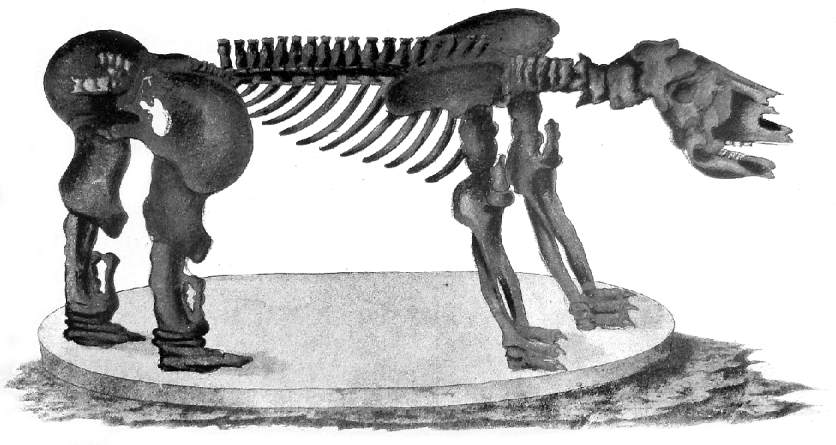
Studying the recently discovered bones, Muñoz accessed the duplicates of documents dispatched by Marquis de Loreto in 1787, stored in the archives of Buenos Aires and the private collections of former colonial officials. He prepared a copy of the skeleton's depiction for Larrañaga, removing the original description, and adding that it had received the name Megatherium (see Figure 1).Footnote 23 Through the purchase of publications, access to the local archives and the ongoing discovery of bones, Larrañaga was not only aware of the debates that this skeleton had provoked; he in fact had more information on that particular skeleton than the European naturalists. As these South American actors and geographies have been either ignored or celebrated as local glories, historiographic emphasis was focused on the achievements of Larrañaga despite his ‘isolation’ from the learned world. However, recent historiography in the global dimension of knowledge reveals that natural history did not occur in one single place in Europe; on the contrary, it depended on multiple personal networks that communicated all over the world. Thus it is not surprising that Larrañaga felt that by translating and excerpting European publications in one of the most important harbours of the South Atlantic world he was in possession of all that he needed to rearrange words and facts.
Depiction of Megatherium by Muñoz, reproduced from Escritos de don Dámaso Antonio Larrañaga, Montevideo: Imprenta Nacional, 1924, Atlas: Zoología, Paleontología y mapas (Biblioteca Ameghino, Museo de La Plata).

Immersed in these endeavours, Larrañaga elaborated a classificatory tableau of local mammals. He placed Megatherium or Cuvier colosalis among the Edentata and the armadillos (Dasypus). In another tableau, he included two kinds of megathera: Megaterium colosale (genus Dasypus, family Edentata), and Megaterium cataphractum, denoting a fully armoured animal, apparently described by or dedicated to Bonpland. In fact, while in Buenos Aires, Bonpland heard through one of his commercial agents travelling between Buenos Aires and Montevideo that Larrañaga possessed bones similar to the great skeleton Bonpland had seen in Madrid. Bonpland suggested that Larrañaga keep the bones in his country, sending an abbreviated sketch to Cuvier, the only person who could appreciate it. Apparently, he never did so. Yet Larrañaga welcomed many travellers in the following years, discussing the objects he had arranged in his house-museum, where ‘his Dasypus’ was one of the main attractions. Here, Larrañaga's house represents one of the relays where exchanges occurred and new meanings were added to things observed by and discussed among travellers, commercial agents and experts.
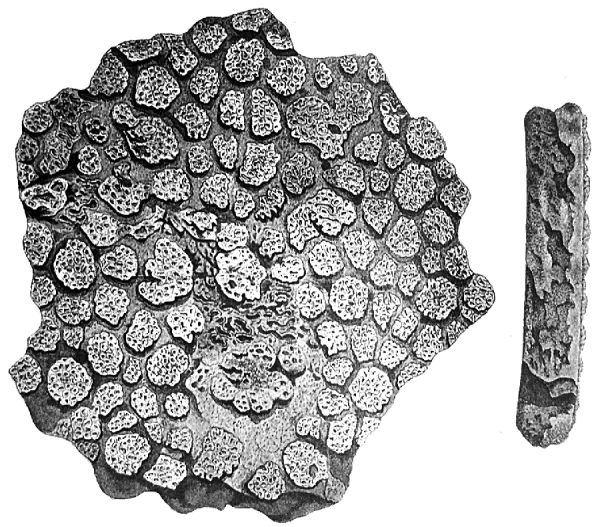
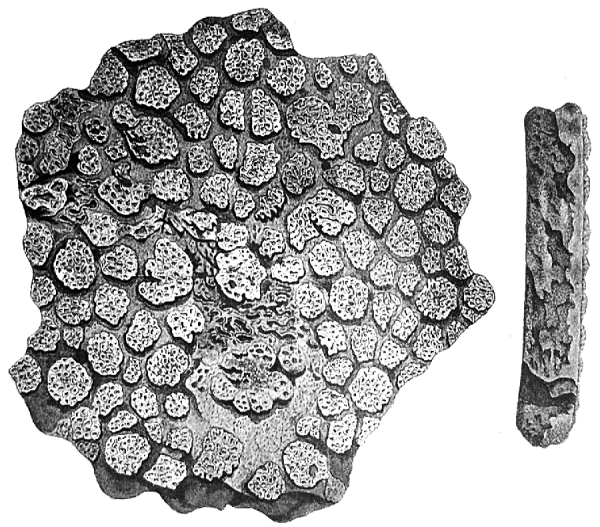
In 1821, Larrañaga hosted French botanist Auguste Saint-Hilaire, who was travelling in the Brazilian territories. Saint-Hilaire later recommended that Larrañaga receive the Prussian traveller Friedrich Sellow. Sellow was commissioned by the Portuguese government – and financed also by Prussia – to botanize and collect animals, minerals and fossils in Southern Brazil and Banda Oriental (Uruguay). In Larrañaga's museum, Sellow saw two fragments of tessellated armour, one belonging to an animal's back and the other to its tail. He reported to Berlin Larrañaga's ideas that the armour belonged to Megatherium (see Figure 2).Footnote 24 In 1823, Saint-Hilaire, back in Paris, published a letter from Larrañaga about the discovery in Uruguay of a femur of Cuvier's Megatherium. In that communication, Larrañaga reported the presence of external scutes, and that the limb and the tail resembled those of armadillo.Footnote 25 Larrañaga promised to write further on the topic; although his political commitments and his blindness aborted such an effort, his suggestion that Megatherium was loricated or armoured, like the armadillo, had already started circulating in South America and Europe.
Fragments of the armoured cuirass collected by Larrañaga, reproduced from Escritos de don Dámaso Antonio Larrañaga, Montevideo: Imprenta Nacional, 1924, Atlas: Zoología, Paleontología y mapas (Biblioteca Ameghino, Museo de La Plata).
In the meantime, Sellow collected several coat fragments in different regions of Uruguay and Brazil. He provided information about the geology and geography of the places where the bones were discovered and described the local uses of the remains. Second-hand information was incorporated in the data transmitted to Berlin and Rio de Janeiro, including names of the people involved in the transactions, which – as Sellow knew – would be crucial for future travellers. While in Porto Alegre, Sellow had heard about two huge skeletons found about eight hundred kilometres from the city. Although the report turned out to be exaggerated, Sellow went there to collect the bones, observing the cultural spheres where they circulated. Bones, far from being ‘pristine nature’, had a variety of uses and meanings. While they were desired for the natural-history collections of Rio de Janeiro, Berlin and Montevideo, children crushed the bones and played with the fragments, gauchos used them as stones to grill meat, and soldiers interpreted them as ‘petrified palm trees’. Local residents would soon discover that these pieces could be traded at a good price. Thus, when transformed into scientific objects, the bones also became objects of commerce and acquired a new meaning as a commodity. Sellow perished in 1831 during his travels in Brazil; his notes and collections, however, were dispatched to Rio and Berlin.
All of these displacements reveal that Megatherium was not simply a creature of Cuvierian worship or the work of the curators of the Royal Cabinet: it was created by the arts embedded in the recording practices of public servants, the instructions of colonial administrators, and the flow of papers and freight on commercial and transport vessels.Footnote 26 Moreover, the following sections will show the unstable character of these zoological entities, whose integrity depended on, and at the same time was threatened by, the gathering and combining of scraps of information. In that sense, the addition of meaning and the incremental aspect of knowledge circulation should not be read either in positive terms or as driven by nature, as the idea of scientific progress is. Megatherium and its allied genera speak more of contingency as the force that finally connects the fragments scattered all over the world.
Larrañaga's opinion as to Megatherium's scaly shell was soon reproduced in two reference works – first by French zoologist Anselm Gaëtan Desmarest, in his article on Megatherium in the Dictionnaire des sciences naturelles, which described the relationships of this animal with the sloth, anteater and armadillo. Following Larrañaga, Desmarest stated that the skin of Megatherium resembled a mosaic of ossified polygonal scutes.Footnote 27 Next, Cuvier more cautiously transcribed Larrañaga's letter, with no further comment, as a footnote to the chapter on Megatherium in the second edition of his Recherches sur les osemens fossiles of 1823 (t. 5, first part, p. 191). In that edition, Cuvier devoted more pages to reviewing the genus on the basis of the new engravings published in Bonn by German Baltic embryologist Christian H. Pander and anatomist Eduard d'Alton in 1821, after their 1818 visit to Madrid. Pander and d'Alton reaffirmed the affinities of Megatherium with sloths, classifying the extinct species into the living genus, calling it Bradypus giganteus.Footnote 28
In December 1824, at almost the same time as Larrañaga's ideas reached Europe, the American physician William Colesberry presented an incomplete specimen of a very strange animal collected in the Andean slopes of Mendoza to the Philadelphia Museum. Colesberry, a former member of the revolutionary expedition to fight Spanish colonial authorities in Chile, had lived in Mendoza since 1813,Footnote 29 and obtained the animal in a living state. Locally known as pichiciego (pink fairy armadillo), the animal survived in confinement for only a few days. The viscera and most of the skeleton were missing; therefore its description by Richard Harlan, professor of comparative anatomy at Charles Wilson Peale's Philadelphia Museum Company, was based on the examination of its exterior, together with the skull and teeth.Footnote 30
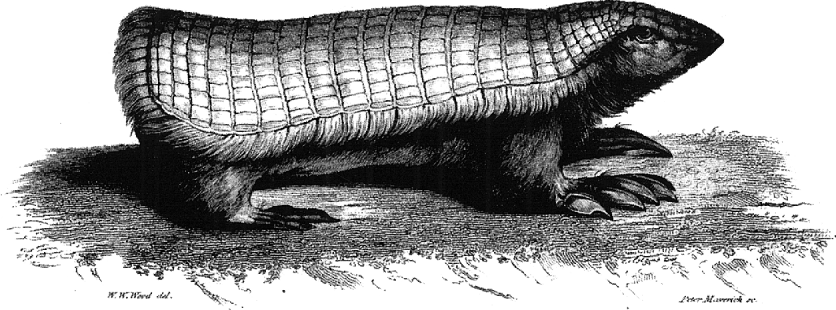
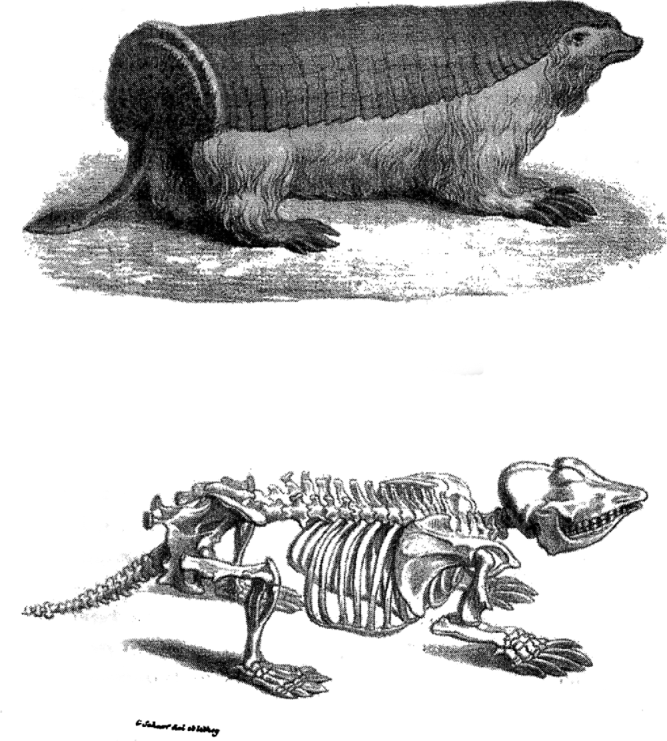
Harlan named the animal Chlamyphorus truncatus, a new genus and species of the Edentata (see Figure 3).Footnote 31 The most conspicuous characteristic of this rather small animal was the shell that covered the body, which was of a consistency somewhat more dense and inflexible than boot leather of equal thickness. The superior semicircular borders of the truncated surface, together with the shell's lateral borders, were fringed with silky hair. On the head, the occipital was covered by the first five rows of back plates, in a continuous fashion. The anterior top half of the head was covered by rows of plates. Harlan suggested that while its external characteristics connected Chlamyphorus to the genera Dasypus, Talpa (moles) and Bradypus (sloth), the form of the lower jaw approximated the animal to Ruminantia and Pachydermata. Harlan's article – extensively reviewed in Europe – was published in Annals of the Lyceum of Natural History of New York, in the same issue that announced the recent discovery of Megatherium remains in Georgia.Footnote 32
Chlamyphorus truncatus reproduced from Richard Harlan, ‘Description of a new genus of mammiferous quadrupeds, of the Order Edentata’, Annals of the Lyceum of Natural History of New York (1825) 6, Plates XIX and XX.
Harlan's Chlamyphorus would soon be related to Larrañaga's Dasypus. In 1825, Desmarest, reviewing Harlan's report, found that pichiciego was closer to the armadillos, and hence even closer to Larrañaga's conception of Megatherium, which had a head like an armadillo and a slender tail like Chlamyphorus.Footnote 33 Furthermore, Megatherium and Chlamyphorus shared characteristics from different genera in a single species and were used to understand animal relationships. The following years witnessed several attempts to find more specimens of pichiciego and its consolidation for a while as the model for an armoured anatomy of Megatherium. It was in this context, and following the instructions of geologists and anatomists, that travelling and resident naturalists sought more pieces to ship abroad. The next section is the story of this search for bony armour, and the relationship between Megatherium and the pichiciego.
From the garbage pit to the museum: instructions, fieldwork and craftsman skills
In 1824, Woodbine Parish arrived in Buenos Aires. With the goal of obtaining the best existing accounts of the Provinces, he wrote to the governors, following the same channels established by the Spanish colonial administration. He also created ‘chains of information’ based on his register of British citizens and, in particular, physicians and mining surveyors residing in the Provinces.Footnote 34 Thanks to these chains, Parish was soon able to send to London a new specimen of Chlamyphorus truncatus, obtained in Mendoza from the Scottish naval service medical officer John Gillies, who had been travelling around the country since his arrival in 1820.Footnote 35 The specimen of Chlamyphorus was presented in alcohol to the Zoological Society Museum in London and was described by zoologist William Yarrell, who in March 1828 reported on its dissection.Footnote 36 As Harlan had noticed, the skeleton resembled that of the armadillo more than any other mammal. However, it differed in the composition and arrangement of the coat of mail, in the posterior truncated extremity, and in the tail.
Parish, who had shipped bones of the fossil Mastodon found in the Valley of Tarija to England, was then asked by Reverend William Buckland, professor of geology at Oxford, to procure further fossil specimens in the Río de la Plata Provinces.Footnote 37 Parish heard that the French traveller Alcide d'Orbigny had found fossil bones in 1827.Footnote 38 Rumours of a nearly perfect skeleton found in the Banda Oriental (Uruguay) – probably Sellow's – arrived at the same time as the news that this type of skeleton disintegrated when exposed to the air. In 1830, Parish found a good source of bones about two hundred kilometres south of Buenos Aires, in the dry basin of the River Salado and its tributary lakes, which until 1825 was the frontier with those lands still controlled by indigenous peoples:
I heard that some bones of an extraordinary size had been brought to Buenos Aires from the Estancia of Don Hilario Sosa upon the Salado … upon going to see them, I was at once struck with their resemblance to Cuvier's representation of the [Megatherium] … They were discovered … by a Peon accidentally passing, who noticed the upper part of the Pelvis projecting above the surface of the water.Footnote 39
News of these fossils emerged thanks to the chain of information that linked the field with the Buenos Aires landowners (estancieros): the dry season revealed a considerable number of skeletons, and the farm labourers reported the remains of dead animals, following instructions regarding hygiene in these rural areas. In 1819, Juan Manuel de Rosas, owner of one of the estancias (ranches) where huge bones were being found, compiled a series of instructions for the administrators of his extensive estate in the pampas.Footnote 40 These instructions, which reflect the strict discipline that ruled in Rosas's rural state, defined a hierarchy of observers and emphasized the need for constant observation and the recording of even small events. Every man on the estancia who was able to read and write kept pen and paper at hand to register observations that would be transmitted to his superiors.
Rosas, as governor of the province between 1829 and 1832, had an excellent relationship with Parish. Thus the consul benefited indirectly from the instructions Rosas gave to estancia administrators to keep an eye on the bones of dead livestock (osamentas) in order to maintain the ranches in clean and proper order:
Garbage must be deposited in the place selected to dispose of it. In no way should there be scattered bones … Men should not live surrounded by rubbish. I insist: it is unacceptable for bones and little bones to be scattered everywhere, everything must go to the rubbish dump … Skeletons of every kind of animal, regardless of their quality, must be gathered in a place devoted to this end. Therefore, there must be no skeletons in the field, all must be collected and brought together for the branding of livestock.Footnote 41
In one of the moves that characterized the configuration of knowledge, procedures relating to the hygiene of rural establishments were fortuitously incorporated into Parish's chain of information and then into comparative anatomy. Bones of all zoological kinds were revealed while collecting garbage in the rural lands. Normally, bones were burnt or transformed into movable objects, such as chairs for a land where timber and rocks were scarce. In this case, thanks to the diplomatic skills of Parish, the giant bones were transferred from the garbage pit into the anatomists' realm. Parish remarked,
I was naturally very desirous to obtain possession of these remains, but it was not without much difficulty that I prevailed upon Don Hilario to give them up to me. He was beset on all sides by applications for them: His medical attendant was a Frenchman, and had very nearly persuaded Him to send them to the Museum at Paris: a large sum was offered for them by one of my own Countrymen from the North, who wished to send them to Edinburgh; and at last some of the Members of the Government of Buenos Ayres hearing of the general interest they excited, began to think it would be but proper to secure them for their own National Museum.Footnote 42
As Parish experienced, there was intense rivalry for the possession of this rubbish scattered throughout the pampas.Footnote 43 Cuvier himself was informed of this discovery immediately after it was made.Footnote 44 Probably due to his good relationship with the governor and the landowners, Parish succeeded in obtaining the bones: he got not only the skeleton but also the skull, which Mr Sosa had given to Father Segurola the year before. Parish knew Segurola well; since Segurola collected maps, colonial reports and Jesuit manuscripts, Parish visited him frequently to search for documents to be copied and forwarded to England.
Parish then found a way to get to the bottom of the chain and meet the people who could show him where the skeleton had lain. Parish chose ‘a competent person to search for the remainder of the bones’, hiring Mr Oakley, ‘a formerly assistant in one of the Public Museums of Natural History in the United States’,Footnote 45 or, in Darwin's words, a ‘joiner with red hair’.Footnote 46 With a good command of English and Spanish, Oakley soon learned how to apply his skills as a craftsman to the extraction of fossils and would become the assistant to future travellers. It took Oakley four days to reach the Salado. Upon his arrival, many bones were found still lying scattered about the banks. Some of the vertebrae had been damaged by fire, others by exposure to the sun and air in the six or seven months they had been lying there. Oakley remarked what Sellow had already observed in Uruguay:
to the Peons the Pelvis luckily appeared to be useless: turn it which way they would, they all agreed that it did not make half so comfortable a seat as either a bullock's or a horse's head; but the vertebrae did not so easily escape, and in a place where not a stone is to be seen, were eagerly seized upon as excellent substitutes to boil their camp-kettles upon.Footnote 47
As Rosas's instructions also indicated, the bones were gathered and used during the branding season as seats for the ranch workers or as stones for the campfires made to boil water, grill meat or heat the branding irons. But Oakley went further. After collecting all of the loose bones, he examined the river bed for more by probing the bottom with a long pointed cane. There he found some hard substances embedded in the mud, which he supposed were the bones for which he was searching. The challenge was how to extract them; here, his woodworking skills helped him to design a type of dam in the channel of the river, to carry the water further down the stream. With the help of half a dozen labourers, the embankment was completed in four or five days.Footnote 48
Oakley's training probably aided him in articulating the pieces of the skeleton: while some bones were found close together, several pieces were picked up as far as thirty or forty feet from each other. Moreover, the state of the bones when taken out of the water varied greatly: some were perfectly hard and polished, while others were porous and rotten, and disintegrated after a short exposure to air. Therefore only an expert eye could see – or create – joints in the bones that were in such a poor state of conservation. Indeed, the mere possibility of mounting a skeleton required various layers of expertise and protocols of observation: the instructions to keep the estancias clean, the labourers' records, the artisan's skills and the metropolitan requests to have such a completed piece for the cities' museums.
Believing that similar remains might be found in the same deposit, Parish charged Oakley to make enquiries amongst the rural people, and particularly the men employed in ditch digging. Oakley returned with a variety of reports that such bones had been found and were still visible in several places. They discovered some on the properties of Governor Rosas, who immediately offered every assistance from his own people, as well as from local authorities. Oakley spent about three weeks digging up two skeletons enveloped ‘in a thick coating, or rather shell resembling that of a Tortoise in which they differed from the Marquis de Loreto's specimen; from Señor Sosa's; – and from all others I ever heard of’.Footnote 49 One of the shells lay about a foot below the principal level of the bones, the concave side on top, resembling, according to Oakley, the section of a large cask. Its form appeared natural and perfect when discovered, but when lifted out of the bed it broke into small pieces and crumbled to dust. The other skeleton lay embedded in a stratum of hard clay on the banks of the lake at Estancia Las Averías, a considerable part of it made visible by the occasional beating of the waters against the sides of the lake in stormy weather. The rural people assured Oakley that it was at least twelve feet long, and from four to six feet across its widest part. It was very hard, but could not be dug up. Oakley, however, secured all the larger fragments, which dried out and hardened even more with exposure to the air. A fragment of the pelvis was all that reached Buenos Aires. The skeletons, carefully packed and considered very nearly complete, went to Buenos Aires in ox carts, from where the consul forwarded them to England early in 1831.
The gathering of the bones shows the roles of different people, devices, protocols and skills in bringing the pieces together. Most of these human agents would disappear in later publications, which also hid the constellations of devices and procedures that made the bones and skeletons visible: instructions, manual skills, digging, branding. Taking into account the spatial dispersion of the bones, the fact that the pelvis and the skull were already in Buenos Aires, and that six or seven months had elapsed when Oakley commenced excavating the mud, the role Parish played in composing the complete skeleton is crucial, even though the consul, who first attributed the bones to Mastodon, was not at all an expert in comparative anatomy. For him, the pieces scattered among collections and in different spots were fragments of a single natural entity and were dispatched in this way to London.Footnote 50 Once there, the skeletons were given to the Hunterian Museum of the Royal College of Surgeons, on the condition that the Board of Trustees paid the freight from Buenos Aires and that casts be made for other collections: the Geological Society, the University of Cambridge, the British Museum, and the museum of William Buckland, who supervised the casting.Footnote 51 William Clift, curator of the Hunterian Museum, took care of their description, trying to decide what to do with the fragments of the huge shell, cask or coat that, when exposed to the air, crumbled into pieces. He was not alone. The same was happening in Montevideo, Buenos Aires, London, Berlin and Paris.
In fact, in 1827, German naturalist Christian Weiss had described the fragments shipped by Sellow, attributing some of them to a genus of turtle and wondering whether Megatherium had had an articulated, armadillo-like shell or solid armour.Footnote 52 By then, French zoologist Geoffroy Saint-Hilaire requested that Humboldt intercede to obtain copies of the fragments stored in Berlin for the Paris museum. Geoffroy attributed the scutes to the armours of the crocodilian genus Teleosaurus, naming it lepitherium (animal aux écailles remarquables).Footnote 53 Several anatomists, however, pursued the relationship with living armadillos and Chlamyphorus, almost convinced that future depictions of Megatherium had to be covered with a Chlamyphorus-like armour. Moreover, many considered that Megatherium should be removed from the group of the sloths and related instead to the armadillos.
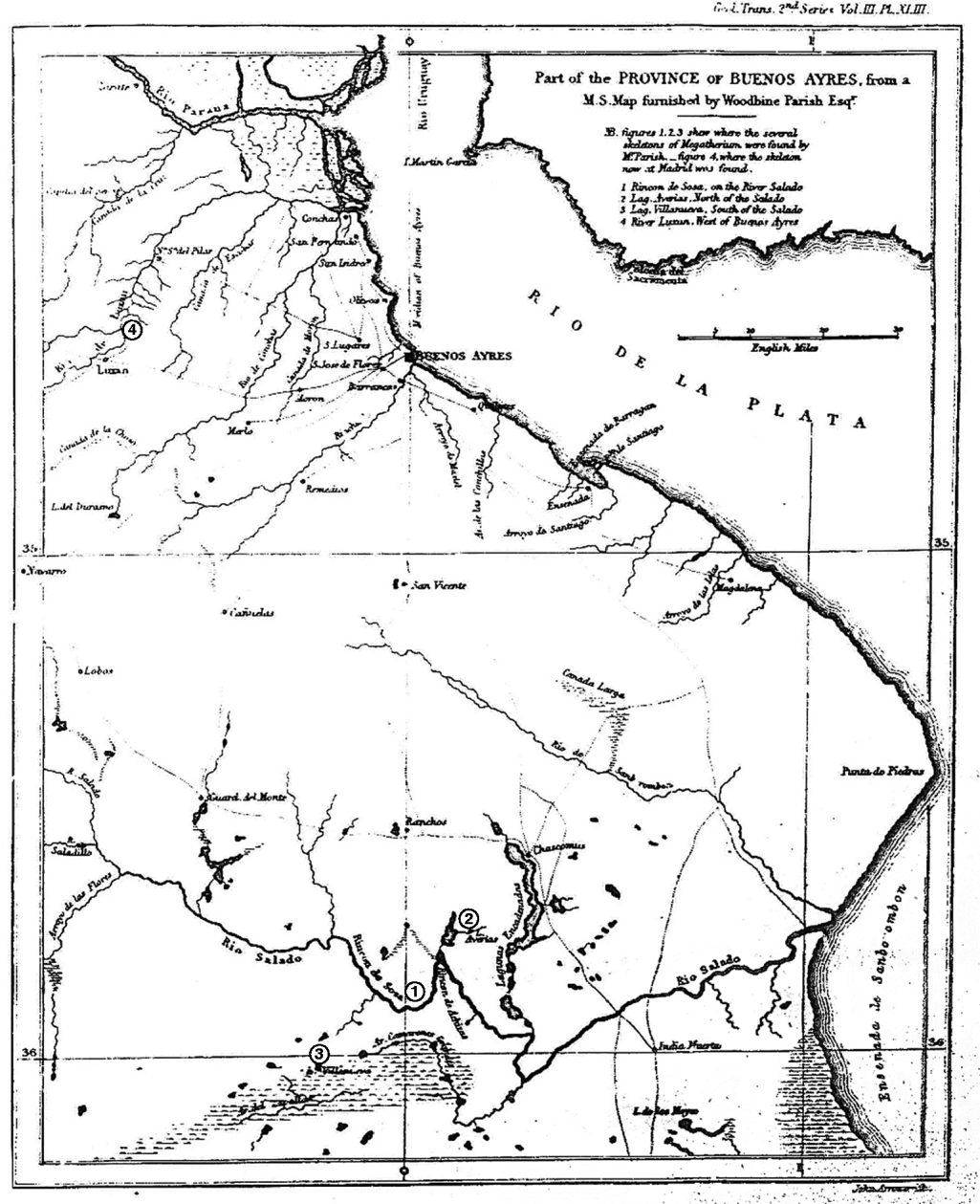
In June 1832, Clift delivered to the Geological Society of London his descriptions of the skeletons sent by Parish, an event immediately reported in Buenos Aires. Publication included a drawing of a portion of the shell, a map of Buenos Aires displaying the three spots where the bones had been found (see Map 1), and a sketch with the missing bones of the London skeleton, which circulated in the Río de la Plata Provinces through the consuls. Father Segurola, among others in Buenos Aires, received an offprint that he treasured in his collection of manuscripts and books.Footnote 54 These ‘missing bones’, as explored in another paper,Footnote 55 would feed what local agents called the ‘fossil fever’ that exploded in the pampas in the second half of the 1830s.
Reproduced from William Clift, ‘Notice on the Megatherium brought from Buenos Ayres by Woodbine Parish, Esq. FRS’, Transactions of the Geological Society (1835) 3 (Biblioteca F. Ameghino, Museo de La Plata).
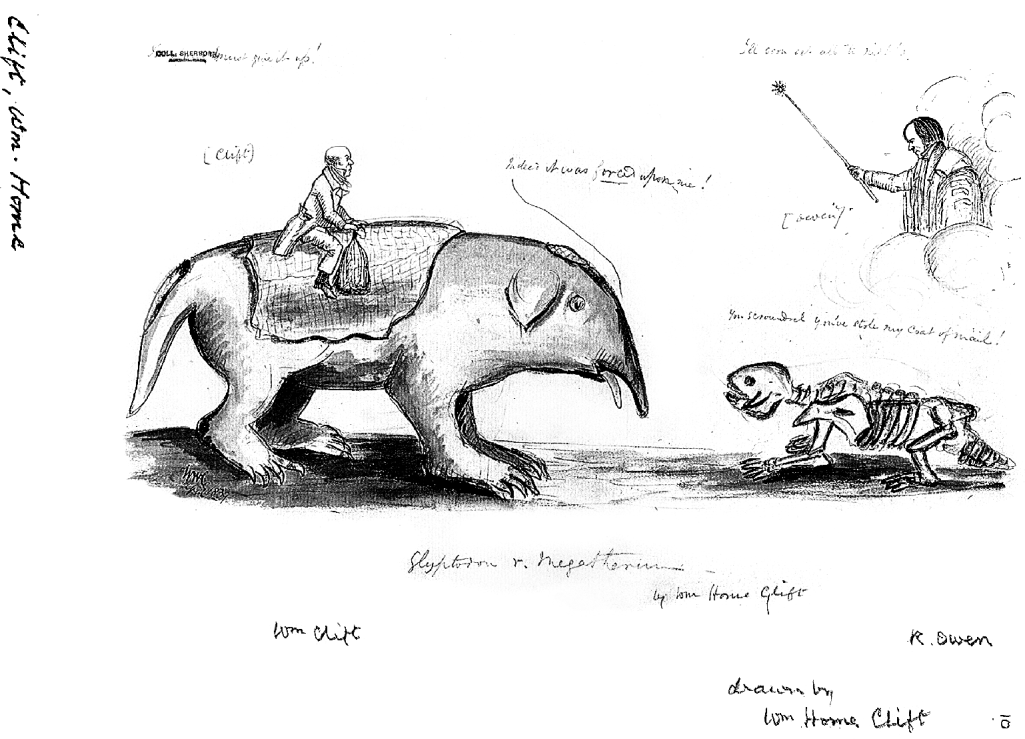
Today, no one remembers that for some years, Chlamyphorus was the model for conceiving the cuirassed anatomy of Megatherium. The caricature drawn by William Clift displayed the close connections between Yarrell's depiction of Chlamyphorus and the cuirassed anatomy of Megatherium, showing what nobody put in writing but was in everybody's mind (see Figure 4). In this sense, that sketch constitutes a key to understanding how the circulation of objects and fragments shaped the unstable anatomy of new fossil animals.Footnote 56 In fact, although Clift entitled this work ‘a description of the remains of Megatherium’, he referred to three skeletons found in three different spots. Clift repeated that ‘the osseous remains were accompanied by an immense shell, or case, portions of which were brought to this country’.Footnote 57 However, he did not mention to which animal the shell belonged. Clift's insecurities about attaching the shell to Megatherium were tied to the growing conviction in London at the time that Chlamyphorus truncatus was in structure a miniature version of the second described animal, namely that with the shell.Footnote 58 This opened a story of intrigue and espionage that includes agents in different museums sending information back and forth between London, South America and several European cities.
‘Glyptodon and Megatherium’. Humorous sketch figuring Clift, Professor Owen, Glyptodon and Megatherium by William Home Clift, April 1839 (Ref. T24074/N- NHM Picture Library).
In the years that followed Clift's oral presentation, several experts tried to elucidate the owner of the armour. In 1833, Eduard d'Alton presented his report at the Berlin Academy of Sciences on the observations made by Sellow and other remains recently arrived from Rio de Janeiro.Footnote 59 D'Alton compared these fragments with the cuirasses of several species of Dasypus stored in Berlin, concluding that the fossil carapace from Uruguay shared all the characteristics of living armadillos, with the remarkable fact that they could not be found together in a single living species.Footnote 60 He clearly stated that they were not remains of Megatherium, but of a large extinct animal more closely allied to a species of Dasypus. He classified the new animal as an armadillo, but, since the teeth and skull were lacking, he could not go beyond the generic level. D'Alton tried to compare the feet and hands with those published in Yarrell's report on Chlamyphorus. However, the depictions did not illuminate either its internal organization or its relation to armadillos. The discovery of a living specimen of Chlamyphorus, d'Alton remarked, enriched the order of Edentates with a new paradoxical genus. Together with the three skeletons of Megatherium presented by Clift, two of them apparently covered by tessellated armour, these bones created a puzzle concerning the relationship among these peculiar South American animals.
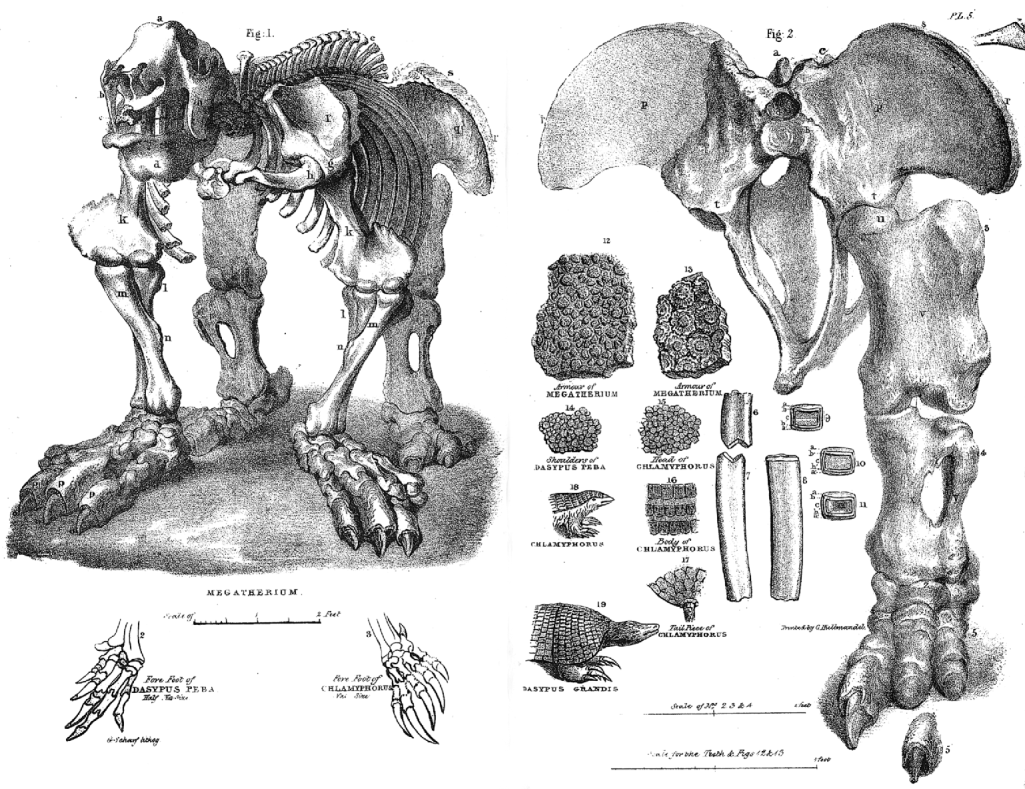
While in Paris, Megatherium was compared with pangolins;Footnote 61 Buckland, in England, had no doubts that all the bones brought by Parish belonged to a single kind, namely Megatherium armoured with a bony cuirass. In his Geology and Mineralogy Considered with Reference to Natural Theology (1836), Megatherium was presented as an animal allied to the sloth. Buckland conjectured that Megatherium resembled a tilted wagon, ‘probably … covered with a bony coat of armour; varying from three-fourths of an inch, to an inch and half in thickness, and resembling the armour which covers these living inhabitants, of the same warm and sandy regions of South America’.Footnote 62 Moreover, he showed the resemblance between the forefeet and some parts of the armour of ‘Megatherium, Chlamyphorus, and Dasypus peba as extended even to the detail of the patterns of the tuberculated compartments into which they were divided’ (see Figure 5).Footnote 63 Buckland referred also to the Berlin collections as described in 1830 by Weiss in ‘a similar admixture of bones and armour, derived from more than one species of animal, bearing a bony cuirass’.Footnote 64 Buckland compared Megatherium to the only known mammals with a compact coat of plated armour to explain its purposes:
but as the Armadillo obtains its food by digging in the same dry and sandy plains, which were once inhabited by the Megatherium, and the Chlamyphorus lives almost entirely in burrows beneath the surface of the same sandy regions; they both probably receive from their cuirass the same protection to the upper parts of their bodies from sand and dust, which we suppose to have been afforded by its cuirass to the Megatherium.Footnote 65
Megatherium – dressed as a giant pink fairy armadillo – resulted in a heavily constructed and ponderous animal that could neither run, leap, climb nor burrow under the ground.
Megatherium, Chlamyphorus truncatus and Dasypus peba reproduced from William Buckland, Geology and Mineralogy Considered with Reference to Natural Theology, London: William Pickering, 1836, vol. 2, Plate 5 (Max Planck Institute for the History of Science Library).
The long year of 1838
Sometime after Clift published his paper, Charles Darwin sent a considerable number of skeleton pieces of Megatherium and other animals to England. Like Parish, Darwin presented the entire series to the Museum of the College of Surgeons, requiring that casts be given to the British Museum, the Geological Society, Cambridge and Oxford. He also wanted to keep one set for himself.Footnote 66 Clift and his son-in-law Richard Owen professed a peculiar interest in bringing these collections together, as they were probably connected with the specimens already presented by Parish. Owen would describe them in the four numbers of the Zoology of the Voyage of the Beagle, whose first issue appeared in February 1838. The second and third numbers were published in March and May 1839, the fourth in April 1840.Footnote 67
In the meantime, late in 1838, Owen created the new genus Glyptodon, bringing together a new consular report from Buenos Aires and the bones donated by Parish to the College of Surgeons.Footnote 68 As Rupke has underlined, Owen focused more and more on the microscopic observation of tooth enamel as a valid characteristic to determine systematic relationships.Footnote 69 Yet, in those years, the type of relationship between extinct and extant Edentata would be completely reconsidered. Many of these reconsiderations originated in the reports, offers and parcels sent by fossil providers, who were attracted by the growing demand and discovered that dealing in old bones was a good investment.Footnote 70 The volume and quantity of fossils obtained by these means were many times greater than those provided by Darwin and Parish. Moreover, taking into account that Darwin himself relied upon his own chains of information,Footnote 71 one can ascertain that this fauna emerged through the combination of local expertise, the protocols and agents employed to survey the pampas, the competence of several learned societies and individuals, and, last but not least, the archives of colonial administration.
Parallel to the elaboration of Owen's Fossil Mammalia, Parish prepared an account of the Provinces of Río de la Plata. The writing of his account reflects the doubts and the new alliances that these bones were creating. When Parish was writing the chapter devoted to the geology of the pampas, he still followed Buckland's suggestions. However, he was also advised by his colleague Joseph Pentland, former secretary to the Consulate-General in Peru. Pentland had resided in Paris since 1828, acting as liaison between the English scientists and Cuvier's laboratory, which, despite Cuvier's death in 1832, remained the most prestigious centre for comparative anatomy.Footnote 72 On Pentland's advice, Parish postponed finishing the chapter on the Megatherium anatomy that he wanted to include in his book.
Clift, on the contrary, initiated a search for armadillos in British collections in order to compare the feet of Megatherium to living Dasypodidae. In this search, he asked permission to dissect a duplicate specimen of Dasypus giganteus brought by Mawe from South America to trace the affinities or analogies of these animals.Footnote 73 Clift relied upon several translators, who prepared memoranda for him on German works, and on the news from La Plata and Paris transmitted to Parish. He discovered that other armours had been mentioned in the past or were lying unexamined in the British cabinets.Footnote 74 Clift collected sources, letters, transcriptions, translations and reports with the same zeal and detail with which he dissected animals and mounted skeletons, demonstrating – as Rudwick proposed – how comparative anatomy also relied on practices of antiquarians, namely going back and forth between the texts, the figures and the objects collected by different agents and stored in multiple repositories scattered all over the world.Footnote 75 Not only was the anatomy of Megatherium at stake, there was also a general philosophical concern at play. Clift did not want to compromise with words that expressed ‘analogy’, ‘resemblance’, ‘alliances’ or ‘affinity’. His prudence prevented him from deciding about the nature of Megatherium. But similar doubts also exploded in Paris, where Pentland knew that, contrary to Buckland's opinion, the categorizing of Megatherium as a cuirassed mammal fed Henri Ducrotait de Blainville's criticism of Cuvierian principles. If Megatherium were to be considered close to the armadillos, as French anatomist de Blainville argued,Footnote 76 it would have contradicted Cuvier, who until his death defended its character as a sloth.
In December 1835, Pentland wrote to Parish to ask if certain bones of the hind foot stored in London, casts of which were donated to Paris, were found associated with the scaly covering. To him, it appeared difficult to reconcile those pieces with the general structure of Megatherium. He stated in confidence to Parish that the hind foot was that of a gigantic armadillo, very nearly as large as an elephant and the largest Rhinoceros. Pentland stated, ‘in the Skeleton, no portion is more characteristic than the bones of the hinder foot, and these resemble in every respect to the same part in the Dasypus gigas, and some other species of Dasypi’.Footnote 77 He had compared them, concluding that the covering belonged to this animal, not to Megatherium. The information about where the bones were found cleared up all doubts. Pentland was almost sure that Parish had the honour of having discovered a new fossil animal as interesting as Megatherium. Parish replied to Pentland, confirming the locality of the bones and also commenting on Clift's doubts and Buckland's ideas:
Your opinion as to the Shell belonging to a species of Dasypus agrees entirely with Clift's, whose caution in fixing it on the Megatherium you will have noticed … I begged Buckland, in consequence, not to commit himself to the shell being a portion of the Megatherium. He, however, I know, is strongly inclined to do so, and he has been confirmed in his notions by some remains (sent I believe to Berlin) which he saw on his late continental trip.Footnote 78
Parish requested permission to talk to Clift, which Pentland conceded in early January 1836. In the same letter, Pentland commented extensively on his works regarding the anatomy of the South American fossils. The locals confirmed what he had envisioned: Megatherium was most probably hairy, as were modern sloths. Pentland was sure that two gigantic Edentata formerly inhabited the Salado region, one allied to the sloth, and the other very closely allied to the armadillo, if not belonging to that genus. He was led to that conclusion by comparing the few bones of the Salado with the tarsal bones of several species of living armadillo, to which he had access in the Museum of Paris. In addition, he had seen a portion of a humerus from the same area, found near the River Salado, sent to Paris by d'Orbigny along with the ‘scales’ from Banda Oriental in the Berlin Museum. In every case, he concluded, ‘Buckland's opinion as to the Megatherium's scaly covering is no longer tenable.’Footnote 79
Parish tried to convince Buckland not to commit himself with the cuirass of Megatherium. But Buckland did not want to listen: on 9 January, thanking Parish for the advice, he wrote that he had little doubt that besides Megatherium there were other animals that had a similar armour, but ‘the finding half a dozen more Cuirasses among the ancient animals of the Pampas will not deprive Megatherium of his privilege of belonging also to that honourable Corps’.Footnote 80 He had printed the chapter on the subject long ago, but was open to correcting any errors in his description of the plates. He insisted that the evidence deposited in Berlin was conclusive. However, he had not seen the collection: Lichtenstein, the director of the museum, related it to him at a meeting in Strasbourg of October 1835.Footnote 81 Richard Owen would later have the pleasure of erasing the paragraphs relating to the cuirass of Megatherium in the edition of Buckland's treatise from 1869.Footnote 82 However, he had not always thought that way. In fact, publishing the first number of Fossil Mammalia (February 1838), Owen – ignoring Pentland's opinions – underlined,
It is remarkable that all the fossils, collected by Mr. Darwin, belong to herbivorous species of mammalia, generally of large size. The greater part are referable to the order which Cuvier has called Edentata, and belong to that subdivision of the order (Dasypodidæ) which is characterized by having perfect and sometimes complex molar teeth, and an external osseous and tessellated coat of mail. The Megatherium is the giant of this tribe; which, at the present day, is exclusively represented by South American species, the largest (Dasypus Gigas, Cuv.) not exceeding the size of a Hog. The hiatus between this living species and the Megatherium, is filled up by a series of Armadillo-like animals, indicated more or less satisfactorily by Mr. Darwin's fossils, some of which species were as large as an Ox, others about the size of the American Tapir.Footnote 83
That means that early in 1838 Owen placed Megatherium among the Dasypodidae, representing the end of a line that connected the fossil and living species of Dasypus by a series of armadillo-like animals. However, all this would change with the news arriving from Argentina.
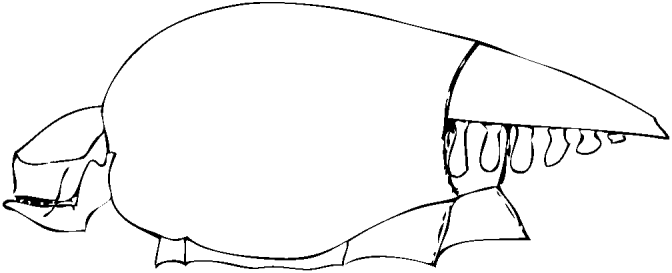
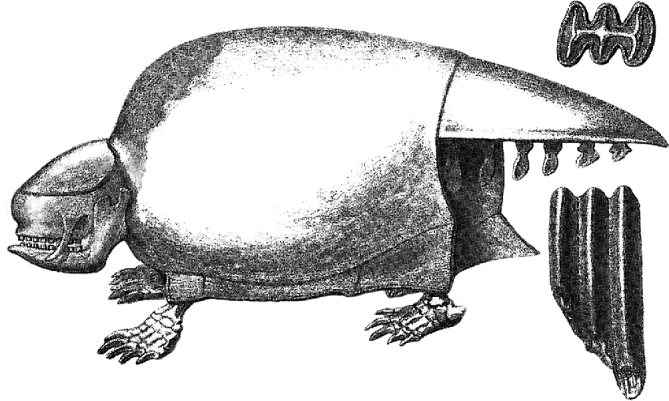
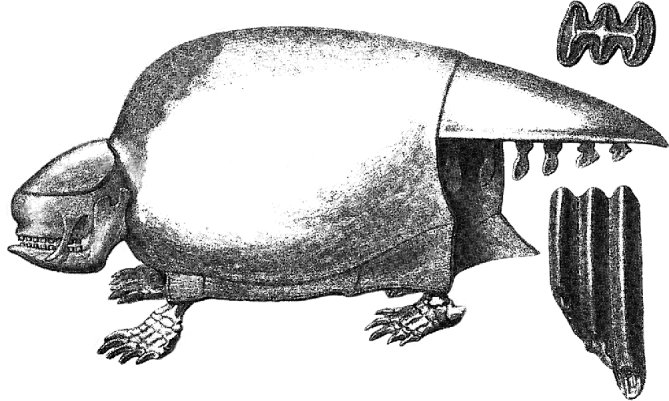
Late in 1838, Parish was trying to finish his book; still oscillating between Buckland's and Pentland's opinions, he stated that there were grounds for supposing that Megatherium was covered with a coat of mail. Furthermore, several pages were devoted to Yarrell's description and depiction of Chlamyphorus to help to understand the anatomy of cuirassed Megatherium (see Figure 6). Suddenly, he received a letter from Buenos Aires that made him decide to contact Owen. Parish placed the latest report from the River Plate in Owen's hands: the consul, Charles Griffiths, had received a note from the Genoese pilot Nicolás Descalzi, who had brought the bones of an immense Megatherium to town. Mr Griffiths, in possession of Clift's paper and sketch, paid Descalzi a visit and found that the side of the pelvis missing in the London and Madrid skeletons was in good condition. Descalzi – fully aware of the British zeal for acquiring new fossils – had discovered these bones in another of Rosas's estancias, where he was acting as a surveyor for his properties.Footnote 84 He had collected other remains, from some depth below the old channel of a dried-up stream. Griffith added that Descalzi asked for two thousand silver dollars for each of his skeletons, and that the Sardinian consul had already made a sort of agreement with him.Footnote 85 London received, instead, one of the teeth and a sketch of the animal, which ‘conveyed the idea of a gigantic quadruped of the Megatherium or Armadillo family, having the internal skeleton, and the external dermal bony case in their natural relative positions’ (see Figure 7).
Chlamyphorus truncatus, reproduced from Woodbine Parish, Buenos Ayres and the Provinces of the Rio De La Plata: Their Present State, Trade, and Debt; with Some Account from Original Documents of the Progress of Geographical Discovery in Those Parts of South America during the Last Sixty Years, London: J. Murray, 1839 (Biblioteca Nacional).
‘Fossil animal dug up by Nicolas Descalzi on the 31st of August and 1st Sep. 1838 in the Provincia de Buenos Aires, Departamento de Cañuelas … The part A was 8 ½ feet below the surface and B about 5.’ Based on the sketch kept in the ‘Manuscript notes on Glyptodon 1838’ (Owen Collections OC 78, NHM). Courtesy of the Natural History Museum of London.
With the volume almost printed, Parish received Owen's conclusions on Griffiths's report: based on the regularly fluted or sculptured form of a portion of the tooth, Owen established a completely new genus of quadruped.Footnote 86 In this instance, Parish could only resolve the situation by attaching four pages to the already finished and printed chapter, numbering the additional pages with letters from ‘178b’ to ‘e’ to keep the index as it was, and adding ‘a sketch reduced by Mr. Clift, from an original drawing made of it in situ’, at the beginning of the book. This insertion allowed him to add Owen's news of a new animal with a shell.
The urgency was connected to the awareness of the imminent publications of the descriptions and naming of new kinds of extinct animal with tessellated armour. Several attempts had been made to attach the shell to a kind of animal: German oryctologist Heinrich G. Bronn in Lethaea geognostica (2nd edn, Stuttgart, 1838, vol. 2, p. 1258) created the name Orycterotherium and Chlamydotherium to refer to two hypothetical extinct mammals with and without shell, to which a particular foot stored in Berlin could be attached.Footnote 87 As we have seen, Pentland was sure that there were two animals, which he did not name but which other naturalists were naming. Bones and shells from the caverns of the valley in Rio des Velhas, Brazil, were communicated under the name of Hoplophorus by Danish naturalist Peter Lund in 1837 (published 1841) and also in a letter sent to Paris in November 1838 and published in French in the Comptes rendus, 15 April 1839, the same date as Griffiths's letter to Parish.Footnote 88 D'Alton brought the subject to the Meeting of the German Physicians and Scientists at Erlangen in September 1839, proposing the name Pachypus. Commissioned by the Library and Museum of Montevideo, the physician Teodoro Vilardebó, Bernardo Berro (Larrañaga's nephew), and Arsène Isabelle, chargé d'affaires of France, excavated the skeleton of an enormous animal with carapace in December 1837, which received the name Dasypus giganteus. They published a note in Montevideo in 1838 and forwarded it to Alcide d'Orbigny in Paris.Footnote 89 However, Parish had already received the news from his informants in Buenos Aires, a note that he translated for Owen and later transcribed in the memoir Owen published in 1841 (delivered 1839).Footnote 90 Since it was not officially communicated, the pages included in Parish's book in late 1838 assured a name for this monster of many names and contested anatomies: ‘Glyptodon’ (γλυϕω, sculpo, οδους, dens), depicted by Clift by appending the feet stored in London since 1831 to the sketch received from Buenos Aires. In such a way, Glyptodon brought together shells, feet and teeth found in spots separated by hundreds of kilometres (Figure 8). As Huxley remarked, they dealt with different objects, mounted in different museums, with different names, and combining fragmented pieces from abroad.Footnote 91
Glyptodon (Parish), reproduced from Woodbine Parish, Buenos Ayres and the Provinces of the Rio De La Plata: Their Present State, Trade, and Debt; with Some Account from Original Documents of the Progress of Geographical Discovery in Those Parts of South America during the Last Sixty Years, London: J. Murray, 1839 (Biblioteca Nacional).
Concluding remarks: the sword of Ajax
However, Owen still doubted. He requested more information from Charles Léopold Laurillard – who, after Cuvier's death, had added a footnote to the fourth edition of Ossemens fossiles discussing the possibility of attaching the carapace to Megatherium.Footnote 92 Owen wanted to confirm the materials on which de Blainville had worked to make Megatherium a member of Dasypus,Footnote 93 asking if he had received new collections from South America. Aware of the fragility of these monsters' anatomy and of the lack of control Europeans had over shipping from the pampas, he knew that every new fragment could change the anatomy and the affinities of these animals. Once reassured, Owen proceeded to create Glyptodon clavipes.
In France, Pentland was exultant. He hurried to write to the Academy of Sciences, reporting that de Blainville was wrong and that Owen had to be considered Cuvier's successor.Footnote 94 Laurillard, Owen and Pentland celebrated that only experienced anatomists could use the Cuvierian principles: ‘the principle of correlation of form is like the sword of Ajax: not every man can wield it’,Footnote 95 meaning that an anatomist must know as much as Cuvier to obtain similar results. Otherwise, the principle may lead to suicide.
Owen created Glyptodon as a result of contingent findings, the superposition of different traditions of knowledge, and the confluence of commercial, diplomatic, scientific and philosophical transactions. Focusing on the teeth, Owen also displayed his ability to work with the fragmentation of the worlds created by several European collections, with their fragility, and with the amount of things arriving from South America. But most important, Owen was situated in a world where consuls could articulate the information circulating across the seas. In the chains of information, comparative anatomy was united with the policies of the Río de la Plata Provinces and the lines of foreign and trade agents. Transversal communication among collectors and vertical communication from the bottom to the top of these chains created routes for establishing relationships among living and extinct animals.
In this paper, the practices of comparative anatomy were connected with the space of discovery and the place of analysis. The museum is sometimes portrayed as the locus where anatomists, upon receiving boxes of bones from distant places, arrange skeletons according to preordained wisdom. The stories of Clift, Pentland, Larrañaga and Parish describe how the bones of unknown animals never travelled as raw materials and how the circulation of objects happened in several directions. Anatomists also relied upon letters and opinions, which could travel faster and more economically than parcels of bones. In this way, a credible picture of how Glyptodon got its shell goes beyond the individual experiences of anatomists in London, Paris, Buenos Aires, Montevideo or Berlin. The bones, if they could speak, would recall itinerant travellers crossing the path of autochthonous collectors.
Finally, this paper raises the question of why South American experts and the spaces where they worked are usually described as ‘local’. It is the challenge of the history of science to rethink why the nightmares of William Clift – or the pubs of Lancashire – are considered spaces of centralized, global relevance, whereas no one gives the same status to Larrañaga's house.