Language often presents speakers with multiple linguistic forms (or variants) to convey a particular discourse-pragmatic function. Systematic variation in the use of two (or more) variants is commonly referred to as orderly or patterned heterogeneity (Weinreich, Labov, & Herzog, Reference Weinreich, Labov, Herzog, Lehmann and Malkiel1968, p. 100), because it renders a complex linguistic system where linguistic choices (not necessarily conscious choices) are constrained by social and linguistic factors related to the speaker, the grammar, the discourse, the interactional context, among others (Sankoff, Reference Sankoff and Newmeyer1988, p. 151). Take Spanish variable clitic placement (VCP), for example. In order to express the Spanish equivalent of “I want to buy it,” speakers of Modern Spanish have two choices with respect to the placement of the direct object clitic pronoun “it” (lo/la in Spanish), as in (1a) and (1b).
(1)
a. En la charla lo va a escuchar con atención (Proclisis)
at the talk him.ACC.3MSG go.PRS.3SG to listen.INF with attention
At the talk [she] is going to listen to him carefully.
b. En la charla va a escuchar=lo con atención (Enclisis)
at the talk go.PRS.3SG to listen.INF= him.ACC.3MSG with attention
At the talk [she] is going to listen to him carefully.
Although speakers’ choices in (1) do not alter the base/referential meaning of the utterance, the existence of variation allows speakers to signal the cognitive prominence of objects and their referents (Serrano, Reference Serrano2011, p. 27). Variationist studies of VCP that focus on naturalistic production have unveiled regularities in naturalistic use as well as a handful of linguistic and social factors that condition VCP (e.g., Davies, Reference Davies1995; Schwenter & Torres Cacoullos, Reference Schwenter and Torres Cacoullos2014). For example, Modern Spanish displays greater overall frequency of clitics in preverbal position (proclisis), as in (1a), as opposed to postverbal position (enclisis), as in (1b)—this is particularly so in spoken registers. In addition, objects ranking higher in animacy and discourse topicality tend to favor proclisis. The main factor identified in the previous literature as constraining VCP, though, is the finite verb, meaning that some verbs have stronger likelihoods for clitics to be used in proclisis, whereas other verbs are more likely to be used in enclisis. Whereas many systematic patterns of variation in language production (like those found in Spanish VCP) have been documented, much less is known about how those patterns are processed in comprehension.
Recent trends in sociolinguistics have begun to bridge variationist sociolinguistics and cognitive science to address this lacuna (Chevrot, Drager, & Foulkes, Reference Chevrot, Drager and Foulkes2018, p. 687). By employing methods and metrics from psycholinguistics (e.g., self-paced reading and reaction times), researchers gain a window into the cognitive mechanisms involved in processing sociolinguistic variation (Campbell-Kibler, Reference Campbell-Kibler2010, p. 37; Loudermilk, Reference Loudermilk2013). One empirical question in this line of research is whether the probabilistic constraints that condition language variation in production disrupt or facilitate processing during comprehension (Squires, Reference Squires2014, p. 179). Studies that have addressed the processing of morphosyntactic variation suggest that (at least some) patterns of systematic variation may have correlates in processing, with familiar dialectal variants (e.g., Kaschak & Glenberg, Reference Kaschak and Glenberg2004; Squires, Reference Squires2014) as well as of variants in contexts (i.e., configurations of constraints) that occur more frequently in naturalistic production (Geeslin & Leal, Reference Geeslin and Leal2016; Henrique, Reference Henrique2016) being processed faster. Available literature, therefore, suggests that frequencies of use as well as probabilistic associations of forms with elements in the discourse and social contexts may impact language processing for comprehension.
If language use and exposure impact processing for comprehension, we could then predict that particular VCP configurations that are relatively strong based on frequency of use (such as preverbal clitics with particular finite verbs) would be easier for monolingual speakers of Spanish to process compared to less frequent configurations. By the same token, and following evidence of bilingual parallel activation in language processing (Kroll, Dussias, Bogulski, & Valdés Kroff, Reference Kroll, Dussias, Bogulski and Valdés Kroff2012), one could predict these effects to extend to use of and exposure to more than one language, as is the case in bilingual speakers.Footnote 1 We could then ask whether experience with a second language (L2) that displays categorical direct object placement (like English) impacts how VCP variation is processed in Spanish as a first language (L1). Crucially, English overlaps with one of the Spanish variants (enclisis) in similar constructions, but this shared structure is the dis-preferred variant in Spanish globally.
The present study pursues two main goals. First, we examine whether processing of Spanish VCP in monolingual speakers reflects the probabilistic distributions consistently found in naturalistic production. Second, we examine whether experience learning English as a L2 impacts L1 morphosyntactic processing of Spanish by comparing monolingual Spanish speakers living in Spain with a group of L1 Spanish speakers from the same community who are proficient learners of English (L2). This approach allows us to use bilingualism as a tool to examine the link between production and comprehension by studying how monolingual and bilingual experience with language impacts the processing of morphosyntactic variation in the L1.
Background
The link between production and comprehension in speakers’ L1
The link between production and comprehension has been modeled by some experience-based accounts of language processing (e.g., Gennari & MacDonald, Reference Gennari and MacDonald2009; MacDonald, Reference MacDonald and MacWhinney1999, Reference MacDonald2013; MacDonald & Thornton, Reference MacDonald and Thornton2009). The production–distribution–comprehension (PDC) model, for example, proposes that accessibility constraints in language planning during production shape distributional language patterns and sentence structures. Following usage-based proposals that repetition triggers chunking (i.e., treating a series of units as a single unit; Bybee & Scheibman, Reference Bybee and Scheibman1999), the PDC further proposes that comprehenders “encode these regularities via statistical learning, and they use this knowledge to guide their interpretation of new input” (Wells, Christiansen, Race, Acheson, & MacDonald, Reference Wells, Christiansen, Race, Acheson and MacDonald2009, p. 252). Reali and Christiansen (Reference Reali and Christiansen2007) phrase it this way: “readers’ expectations are influenced by exposure to sequences of words (or classes of words) that have been repeatedly used in similar contexts” (p. 19). In this section, we review evidence supporting experience-based models of language processing, such as PDC, which posit that distributional patterns promoted in production and use lead to more readily activated structures and may in turn facilitate processing during comprehension of the L1.
Research focusing on how speakers process region-specific or dialect-specific morphosyntactic variation has found a cost for processing variants not present in the speakers’ own dialect. Kaschak and Glenberg (Reference Kaschak and Glenberg2004), for example, report slower reading times of [need+past participle] constructions (e.g., “needs washed”) by speakers from geographical areas where the construction is not used, and they find that this effect was reduced with increased exposure (see Fraundorf & Jaeger (Reference Fraundorf and Jaeger2016) for similar results at onset of testing). A similar processing cost has been reported for variable subject–verb agreement (as in “After eating, the turtle don’t walk very fast”; Squires, Reference Squires2014, p. 179) in speakers of English who do not speak African American English (Squires, Reference Squires2014). Data from Spanish indicate a cost of reading the direct object pronoun le among Mexican–Spanish speakers (whose direct object pronoun paradigm does not include le) compared to speakers from Seville (an area characterized by leísmo, which is the use of le instead of lo/la in the direct object pronoun paradigm; Geeslin & Leal, Reference Geeslin and Leal2016).
Differences may also surface when processing two variants present within a given dialect if one of those variants is more frequent relative to the other, or if that variant has developed a strong association with a particular configuration of linguistic or social factors constraining its use. For example, Spanish leísmo (described above) is conditioned by grammatical gender, being more common with masculine referents than feminine referents (Fernández-Ordoñez, Reference Fernández-Ordoñez, de Vogelaer and Seiler2012), and Geeslin and Leal (Reference Geeslin and Leal2016) report that native speakers of a leísta dialect read le with masculine referents faster than le with feminine referents. Research on English relative clauses (subject relative clauses vs. object relative clauses) has also reported differences in processing difficulty that were consistent with the regularities found in corpora, whether in terms of frequency of use (Reali & Christiansen, Reference Reali and Christiansen2007) or structural regularity (Gennari & MacDonald, Reference Gennari and MacDonald2008, Reference Gennari and MacDonald2009). Similarly, a study of variable subject–verb (S-V) agreement in Brazilian Portuguese reports that the processing of variants follows patterns attested in variationist sociolinguistic studies of naturalistic production (Henrique, Reference Henrique2016).
Finally, native speakers of code-switching varieties (i.e., speakers whose native language experience is characterized by code-switching) have also been reported to use distributional regularities (e.g., knowledge of the acceptability of particular types of code-switches) in language processing (Beatty-Martinez & Dussias, 2017; Fricke, Kroll, & Dussias, Reference Fricke, Kroll and Dussias2016; Guzzardo Tamargo, Valdés Kroff, Dussias, Reference Guzzardo Tamargo, Valdés Kroff and Dussias2016; Valdés Kroff, Dussias, Gerfen, Perrotti, & Bajo, Reference Valdés Kroff, Dussias, Gerfen, Perrotti and Bajo2017). In sum, these studies suggest that (at least some) patterns of systematic variation found in production have correlates in processing, with faster processing of certain variants over others, particularly in linguistic or social contexts, where those variants are more frequent in production.
Bilingual language experience and cross-linguistic influence
Bilinguals access language nonselectively in processing. The attentional control associated with bilingual experience has been linked with generalized effects in cognitive performance found among bilingual speakers (Bialystok Reference Bialystok2009, p. 3). However, this nonselective access also creates predictable sites of conflict and convergence between languages in the bilingual mind, which has been identified as a condition for cross-linguistic influence (CLI; Hulk & Müller, Reference Hulk and Müller2000; Jarvis & Pavlenko, Reference Jarvis and Pavlenko2008). Where both languages overlap, facilitation is usually found, while interference can be observed at points where the two diverge (e.g., Kroll, Bobb, & Hoshino, Reference Kroll, Bobb and Hoshino2014; Kroll, Dussias, Bice, & Perrotti, Reference Kroll, Dussias, Bice and Perrotti2015; Midgley, Holcomb, & Grainger, Reference Midgley, Holcomb and Grainger2011). One example of facilitation is given by the fact that syntactic structures can prime each other when there is sufficient degree of similarity across languages (e.g., Desmet & Declercq, Reference Desmet and Declercq2006; Hartsuiker, Pickering, & Veltkamp, Reference Hartsuiker, Pickering and Veltkamp2004; Loebell & Bock, Reference Loebell and Bock2003; Meijer & Fox Tree, Reference Meijer and Fox Tree2003; Shin & Christianson, Reference Shin and Christianson2009; but see Hwang, Shin, & Hartsuiker, Reference Hwang, Shin and Hartsuiker2018, for cross-linguistic priming of dissimilar structures).
Even though most research into CLI has concentrated on L1→L2 influence (e.g., Gass & Selinker, 1992; Hartsuiker et al., Reference Hartsuiker, Pickering and Veltkamp2004; Kroll & Stewart, Reference Kroll and Stewart1994; MacWhinney, Reference MacWhinney1992), L2→L1 influence has been attested in the literature as well (Cook, Reference Cook and Cook2003), including a vast literature on attrition (see, e.g., Köpke, Reference Köpke, de Houver and Ortega2019; Schmid & Köpke, Reference Köpke, de Houver and Ortega2019). Previous studies of L2→L1 CLI, also referred to as “reverse” or “ backward” transfer, have focused mainly on phonetic and phonological influences (Caramazza & Yeni-Komshian, Reference Caramazza and Yeni-Komshian1974; Chang, Reference Chang2012, Reference Chang2013; Flege, Reference Flege1987; Herd, Walden, Knight, & Alexander, Reference Herd, Walden, Knight and Alexander2015; Namjoshi et al., Reference Namjoshi, Tremblay, Spinelli, Broersma, Martínez-García, Connell and Kim2015, Schuhmann & Huffman, Reference Schuhmann and Huffman2015) or lexical processing (Ameel, Storms, Malt, & Sloman, Reference Ameel, Storms, Malt and Sloman2005; Baus, Costa, & Carreiras, Reference Baus, Costa and Carreiras2013; Bice & Kroll, Reference Bice and Kroll2015; Ivanova & Costa, Reference Ivanova and Costa2008; Linck, Kroll, & Sunderman, Reference Linck, Kroll and Sunderman2009; Malt, Li, Pavlenko, Zhu, & Ameel, Reference Malt, Li, Pavlenko, Zhu and Ameel2015; van Hell & Dijkstra, Reference van Hell and Dijkstra2002).
The influence of an L2 on L1 morphosyntactic processing, however, has attracted less attention. One finding pointing to such influence in morphosyntax is that bilingual speakers seem to become more tolerant to ungrammatical L1 constructions or to reject L1 grammatical constructions more than monolingual speakers (Altenberg, Reference Altenberg, Seliger and Vago1991; Balcom, Reference Balcom and Cook2003; Jarvis, Reference Jarvis and Cook2003; Kasparian & Steinhauer, Reference Kasparian and Steinhauer2017). Another L2→L1 effect reported in the literature is that bilingual speakers can exhibit reduced reliance on L1 cues and processing strategies or increased reliance on L2 cues or processing strategies compared to monolinguals (Dussias, Reference Dussias2003, Reference Dussias2004; Dussias & Sagarra, Reference Dussias and Sagarra2007; Hernandez, Bates, & Avila, Reference Hernandez, Bates and Avila1994; Liu, Bates, & Li, Reference Liu, Bates and Li1992; Morett & MacWhinney, Reference Morett and MacWhinney2013; Su, Reference Su2001).
Most of the studies along this vein, however, have examined bilinguals who were immersed in the L2 (but see Herd et al., Reference Herd, Walden, Knight and Alexander2015; Schuhmann & Huffman, Reference Schuhmann and Huffman2015). Keckskes and Papp (Reference Kecskes, Papp and Cook2003), however, identify “instructed foreign language in a relatively homogeneous language community” (p. 248) as one of the social contexts of language contact where CLI may occur. However, very few studies have explored L2→L1 CLI in morphosyntactic phenomena among language learners immersed in the L1, where the L2 could also be referred to as a foreign language. Some interest in this line of research has emerged within the study of the impact of bilingual education on children’s and adolescent’s L1 development and use. For example, Kecskes (Reference Kecskes1998) reports increased structural complexity in L1 written production of Hungarian teenagers living in Hungary who were part of an English or French immersion program (for a review of more recent studies in this line, see Spies et al., Reference Spies, Lara-Alecio, Tong, Irby, Garza and Huerta2018).
We are aware of only a handful of studies that have tested L2→L1 CLI in online processing of morphosyntax among adult L2 learners immersed in the L1. One set of studies found processing facilitation when participants read ungrammatical sentences in the L1 that were grammatical in the foreign language (e.g., de Souza & de Oliveira, Reference de Souza and de Oliveira2017; Oliveira, de Souza, & Oliveira, Reference de Souza and de Oliveira2017). To the best of our knowledge, though, only one study has examined processing of a syntactic feature that presented variation in the L1 (word order), but was more categorical in the L2, partially overlapping with one of the grammatical L1 variants. Cedden and Aydin (2017) tested whether knowledge of an L2 with stricter word order (English: SVO) impacts processing of an L1 that exhibits constituent order variation (Turkish: SOV, SVO, and SVO-ki). The study examined the processing of sentences in Turkish by monolingual speakers of Turkish (monolingual group), Turkish learners of English (bilingual group), as well as trilingual Turkish–English–German speakers (trilingual group), and multilingual speakers. The bilingual group consisted of advanced L2 learners who had started studying English in high school and had taken a test of English before being admitted to graduate-level language programs in Turkish universities. Reading times (RTs) among monolingual speakers were the longest of all participant groups and the L2 group showed the shortest RTs. Of interest, whereas the L1 group showed a cost in RTs in the scrambled SVO-ki condition compared to the canonical SOV condition, neither the L2 group nor the third language group showed such cost. Therefore, the slight difference between processing of noncanonical word orders between monolingual and bilingual speakers in Cedden and Aydin (2017) could have resulted from facilitation due to extensive L2 use. Echoing the conclusion reached by Dussias, Valdés Kroff, Beatty-Martínez, and Johns (Reference Dussias, Valdés Kroff, Beatty-Martínez and Johns2019) about the need for “a shift in the way bilingual language processing research moves forward that considers variability in language experience not as a source of noise but rather as a source of evidence” (p. 479), here we explore whether instructed acquisition of English (L2) in Spain can lead to L2→L1 CLI in the processing of variable morphosyntax in the L1.
If language activation is nonselective and processing is modulated by patterns of language use, then it follows that experience with an L2 displaying categorical use of a structure that is variable in the L1 could strengthen preference for the native language variant that is shared across their two languages, even if this variant is dis-preferred in their L1. The present study tests this hypothesis using VCP in Spanish compared to the analogous, but invariable, structure in English.
The Experimental Variable: Spanish VCP
Spanish direct object clitics in complex verb constructions (V[+finite] + V[–finite, +transitive]) can be placed either preverbally (“proclisis”) or postverbally (“enclisis”) without affecting the base interpretation of the clause (Kayne, Reference Kayne1975; Suñer, Reference Suñer1980), as illustrated in examples (1a) and (1b) earlier, which we reproduce again below.
(1)
a. En la charla lo va a escuchar con atención
at the talk him.ACC.3MSG go.PRS.3SG to listen.INF with attention
At the talk [she] is going to listen to him carefully.
b. En la charla va a escuchar=lo con atención
at the talk go.PRS.3SG to listen.INF= him.ACC.3MSG with attention
At the talk [she] is going to listen to him carefully.
Here we consider VCP a case of inherent variability, where there is asymmetry between forms (the two variants: proclisis vs. enclisis) and function (deictic relationship and salience) (Labov, Reference Labov1972). Yet inherent variability does not mean free variation. Walker (Reference Walker2010) explains that “each [variant] may occur with greater or lesser frequency than other variants of the same variable when certain elements of the linguistic or social contexts are present” (p. 10). In order to infer the role of a particular variant in the system, variationist analyses look for probabilistic associations between variants and elements in the linguistic and/or social context.
In Modern Spanish, corpus research has consistently found patterns for clitic placement in VCP. Native speakers’ VCP use shows a preference for proclisis, particularly in spoken discourse (Davies, Reference Davies1995). Furthermore, VCP has been found to be conditioned by the finite verb used in the construction (e.g., Davies, Reference Davies1995; Myhill, Reference Myhill1988), with some finite verbs showing strong associations with proclisis (e.g., 86% proclisis with ir a “go to,” as in [1a]), and other verbs showing a strong association with enclisis (e.g., 62% enclisis tener que “have to”; Davies, Reference Davies1995). These patterns of overall proclisis bias and preferred use by lexical construction have been reported across dialects (for a review, see Requena, Reference Requena2015). Other factors affecting VCP, such as animacy and discourse topicality, will not be explored in this study given that they have been shown to rank lower than the lexical regularities in the strength of their conditioning. To the best of our knowledge, processing of Spanish VCP has not been examined in monolingual speakers, but this is necessary to see whether preferred configurations of finite verbs and clitic position in production also show facilitation in processing for comprehension.
Spanish VCP in Spanish–English bilingual speakers
In contrast with VCP in Modern Spanish, English only permits postverbal object pronouns in analogous constructions (see the categorical placing of “him” in the English glosses for [1a] and [1b]).Footnote 2 Therefore, the Spanish VCP context is an apt site to ascertain whether patterns of use across languages influence processing behavior in the native language. In their book on CLI, Jarvis and Pavlenko (Reference Jarvis and Pavlenko2008) identify cross-linguistic similarity between the L1 and the L2 as one of the most widely recognized constraints on transfer. Surface overlap has also been identified by Hulk and Müller (Reference Hulk and Müller2000) as a condition for CLI in bilingual L1 acquisition. Therefore, overlap between one of the clitic positions in Spanish (enclisis, as in [1b]) and the categorical postverbal position of direct object pronouns in English satisfies this surface overlap constraint believed to be necessary for syntactic CLI.
The claim that Spanish enclisis and English direct object pronoun placement are treated analogously by speakers is supported by research on cross-linguistic structural priming. In a study of VCP, for example, Meijer and Fox Tree (Reference Meijer and Fox Tree2003) found that Spanish target sentences, where both preverbal and postverbal clitics are grammatical, were recalled more often using a postverbal direct object clitic (i.e., enclisis, see [3]) after an English prime sentence with a postverbal direct object pronoun ([2a]) than after an English prime with no direct object pronoun ([2b]). The authors interpreted this result from the perspective of a “lemma-driven model where lemmas drink from one and the same pool of syntactic structures” (p. 174). Their study using syntactic priming in speech production not only illustrates the strong association between Spanish enclisis and English direct object pronoun placement in equivalent constructions but also identifies VCP as a possible site for CLI in language processing for comprehension.
(2)
a. Prime: The phone probably stopped ringing before Cecilia was able to answer it.
b. Prime control: The writer outlined the plot for his new novel before he began to write.
(3)
La radio es muy fuerte cuando los niños quieren escuchar=la.
The radio is very loud when the children want to listen to it.
The fact that the bilingual group’s recall in Spanish was affected by word order of the English prime suggests that these structures may share representation across these two languages, or are at least perceived by bilingual speakers as analogous (Rothman, Reference Rothman2011).Footnote 3 This raises the question of how learning and using English as a L2, which is categorical with respect to direct object pronoun placement, might impact processing behavior in L1 Spanish, which displays VCP.
Corpus studies of naturalistic bilingual speech production have generally failed to show an effect of bilingualism on frequencies and patterns of VCP use with particular lexical items (for a review, see Shin, Requena, & Kemp, Reference Shin, Requena, Kemp, Auza Benavides and Schwartz2017). One study involving simultaneous Spanish–English bilingual children in a small bilingual community in Canada, however, found an enclisis bias in sentence recall (Pérez-Leroux, Cuza, & Thomas, Reference Pérez-Leroux, Cuza and Thomas2011), but such an effect has not been found in naturalistic or elicited production in larger US bilingual communities (Requena & Dracos, Reference Requena, Dracos, Bertolini and Kaplan2018; Shin et al., Reference Shin, Requena, Kemp, Auza Benavides and Schwartz2017). When it comes to processing, we are aware of only one study that has addressed whether bilingualism impacts how clitics in Spanish L1 are processed in VCP constructions. Rossi, Diaz, Kroll, and Dussias (Reference Rossi, Diaz, Kroll and Dussias2017) showed processing costs when monolingual speakers living in Spain read ungrammatical clitic placement (*quiso la calentar “he wanted it to reheat”) compared to grammatical enclisis (quiso calentarla “he wanted to reheat it”). Crucially, the authors compared performance by monolingual speakers to performance by proficient L2 learners of Spanish and Spanish–English bilinguals living in the United States. All groups reported similar costs when reading ungrammatical sentences. Of interest here is the fact that even after being immersed 4 years in the US context, Spanish–English bilinguals resembled monolinguals on their sensitivity to ungrammatical sentences with clitics. Rossi et al. (Reference Rossi, Diaz, Kroll and Dussias2017) conclude that
clitics appear to be a stable structure in native speakers that is not easily affected by the conditions of language use. These results are important in that they demonstrate that the clitic construction is apparently not open to the influences of the frequency of use in the way that other lexical information and parsing preferences may change in response to L2 usage. (e.g., Dussias, Reference Dussias2003; Dussias & Sagarra, Reference Dussias and Sagarra2007; Malt & Sloman, Reference Malt and Sloman2003; Schmid, Reference Schmid2010). (p. 9)
While Rossi et al.’s (Reference Rossi, Diaz, Kroll and Dussias2017) finding in trials with variable contexts rightly points to the bilingual language experience not impacting speaker’s detection of ungrammaticality in clitic placement, it does not speak to whether patterns of VCP use reported in naturalistic production (e.g., greater use of proclisis with some verbs and enclisis with other verbs) have correlates in processing when speakers are asked to process grammatical proclisis versus grammatical enclisis. Whereas their study examined sensitivity to ungrammaticality in clitic grammar, the present study looks at sensitivity to probabilistic regularities attested in naturalistic production. In addition, while Rossi et al. (Reference Rossi, Diaz, Kroll and Dussias2017) tested the L1 of Spanish–English bilingual speakers immersed in the L2 environment, here we investigate processing preferences in Spanish–English bilingual speakers immersed in the L1 environment. To our knowledge, no study to date has compared whether bilinguals who are learners of English as a foreign language and who are immersed in the L1 context differ from monolinguals from the same community in the processing of VCP. Production data suggest that monolingual speakers show very clear patterns of use, which permits an arguably more nuanced level of inquiry into processing and grammatical competence than has hitherto been investigated.
The current study
The research questions that guide this study are
-
a. Do the production asymmetries reported in the literature find a correlate in speed of processing for comprehension in monolingual speakers of Spanish living in Spain?
-
b. Are the same asymmetries in (a) among monolingual speakers also found in proficient learners of English (L2) living in Spain?
Given that no previous study has examined grammatical VCP in comprehension, the present study seeks to find out first whether the production asymmetries reported in the literature (viz., proclisis bias and lexically conditioned preferences) find a correlate in processing for comprehension. If this is the case, we predict that monolingual speakers should take longer to process enclisis ([1b]) compared with proclisis ([1a]). Conversely, it could be the case that no difference is found or that, rather than production frequencies, it is formal complexity that drives processing costs. If the latter, we expect that enclisis should be easier to process than proclisis due to the surface overlap between postverbal clitics and the canonical position of object dependent phrases, which is also postverbal (Jakubowicz & Nash, Reference Jakubowicz and Nash2001; Prévost, Reference Prévost2006). With respect to the processing of clitic placement by verb, we expect a greater processing cost when the clitic occurs in a position that is dispreferred in naturalistic production. Consequently, in the enclisis condition, we expect a greater cost of processing ir a compared to the other two verbs, which favor enclisis. While ideally we would expect the converse to be true (viz., a greater cost of processing proclisis with querer and tener que compared to the proclisis-favoring verb, ir a), this effect is likely to interact with the general preference for proclisis in the language overall.
Second, the present study constitutes the first attempt to answer whether partial overlap between a categorical L2 (English) and a L1 that presents morphosyntactic variation (Spanish) modulates L1 sentence processing in proficient L2 learners of English. We hypothesize that if proficient learners of English also access language nonselectively and such coactivation renders cross-linguistic effects in processing, they should show facilitation (or reduced cost) relative to their monolingual peers at points where the morphosyntax of Spanish overlaps with English (i.e., enclisis). This result would increase our understanding of cross-linguistic effects in sentence processing by providing new insight into the possible role of overlap due to morphosyntactic variation in one of the languages involved. In contrast, if the L2 learners also show the processing cost of enclisis predicted for monolinguals (because it is less frequent in modern spoken Spanish), it would follow that exposure to and/or proficiency in English L2 when not immersed does not impact processing of Spanish VCP. This could have implications for the conceptualization of the bilingual language processing of instructed L2 learners living in non-immersed contexts.
Method
Participants
Forty-two Spanish speakers between the ages of 18 and 35 from Granada, Spain, participated in the study. Participants were classified into two groups: 22 Spanish–English bilinguals (M age = 24.1 years, SD = 4.58, 11 female) and 20 Spanish functional monolinguals (M age = 21.2 years, SD = 1.9, 14 female). Participants were recruited from an undergraduate participant pool as well as through flyers on campus and word of mouth; each participant provided written informed consent and received €10 for their participation in the study.
Participants in the bilingual group were advanced learners of English (some were college students of English Philology at the University of Granada) who had an average of 5 months of experience living in an English-speaking environment. The functional monolingual group only learned English during elementary and secondary education and reported limited to no use of English at the time of testing.
All participants completed a Spanish version of the Language Experience and Proficiency Questionnaire (Marian, Blumenfeld, & Kaushanskaya, Reference Marian, Blumenfeld and Kaushanskaya2007) in which they reported their language knowledge on a scale from 1 to 10 (1 being the lowest) for reading, listening, and speaking in both Spanish (L1) and any additional languages. In addition, all participants were administered a version of the DELE, a Spanish proficiency test designed by the Spanish Ministerio de Educación, Cultura y Deporte (Ministry of Education, Culture, and Sport; http://diplomas.cervantes.es/en), and a lexical decision task to make sure that dominance in Spanish was constant across groups. The bilingual group was also administered a version of the Michigan English Language Institute College English Test (MELICET; English Language Institute, 2001), a 50-point multiple-choice test designed to assess their proficiency in English. The monolingual group did not perform the MELICET, as it would have been of limited utility. Self-ratings were retained as reported, as participants in each group rated their proficiency in both languages. Similarly, data from the DELE were included as a point of comparison. For the lexical decision tasks, accuracy and mean response latencies were calculated in two ways: first, by trial type; and second, by collapsing both word and nonword trials. Response latencies on the lexical decision tasks were restricted to correct trials only and data were trimmed to exclude RTs below 200 ms and those greater than 2.5 SD beyond the mean.Footnote 4 Two-sided Welch’s t tests were used to compare the bilingual and monolingual groups by measure, and degrees of freedom were approximated using the Welch–Satterthwaite equation. To correct for multiple comparisons, Bonferroni’s correction was applied.
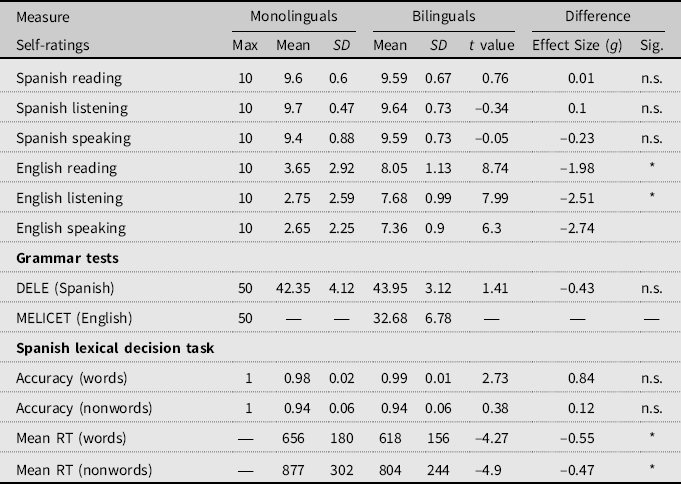
Table 1 lists means and standard deviations for each group on self-ratings of English and Spanish, results of proficiency tests, as well as lexical decision accuracy and mean response time by word. The monolingual and bilingual groups were not significantly different in their self-ratings of Spanish proficiency, nor did they differ in their performance on the DELE (all ps > .05). This was expected as Spanish was the L1 of all participants. Although the monolingual group did report some exposure to English,Footnote 5 the bilingual group self-reported much higher proficiency in English than the monolinguals (p < .001). Scores in the MELICET ranged between 21 and 45 (out of 50 total points) with a mean of 32.6 (SD = 6). Similar scores characterized proficient bilinguals in previous studies (Armstrong, Bulkes, & Tanner, Reference Armstrong, Bulkes and Tanner2018; Contemori, Reference Contemori2019; Contemori & Tortajada, Reference Contemori and Tortajada2020). Taken together, these measures suggest that the two participant groups were well divided by language proficiency (see Appendix A for correlation among proficiency measures).
Background characteristics of the bilingual and monolingual participants

Note: Bonferroni’s correction was applied due to multiple comparisons. Effect size calculated using Hedge’s g (Hedges, Reference Hedges1981). *p < 0.001.
Materials
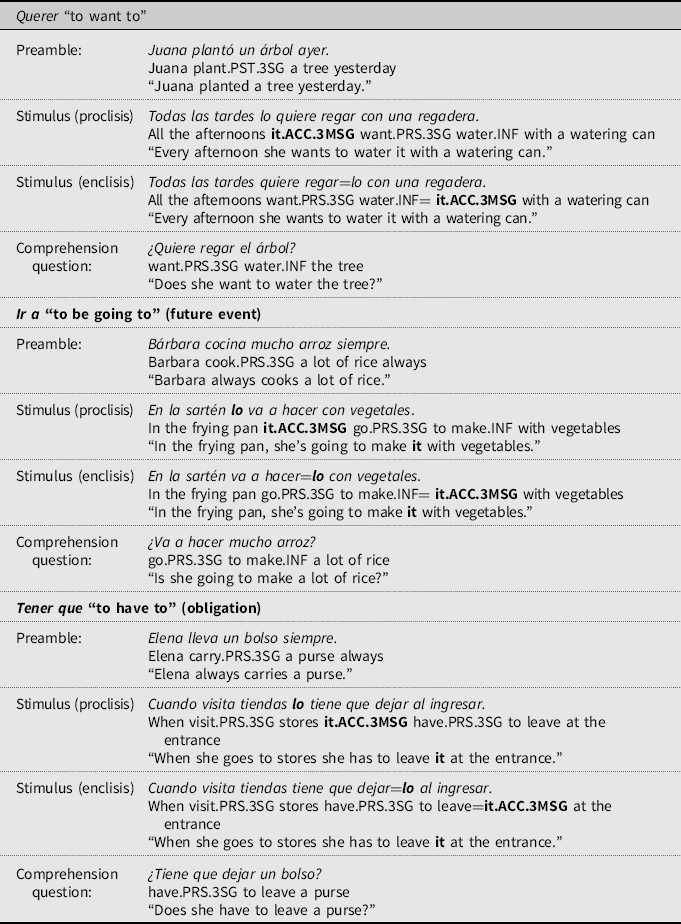
Forty-eight experimental sentences and 6 practice items were created (see Table 2 for sample stimuli). The experimental sentences were split evenly among three finite verbs (ir a “to be going to,” querer “to want,” and tener que “to have to”; n = 16 per verb). These verbs were chosen because they vary in observed clitic positioning preference: ir a prefers proclisis, but tener que and querer favor enclisis. Stimuli were balanced by verb for clitic position: half were presented in enclisis (n = 8) and half in proclisis (n = 8). No participant saw both the proclisis and the enclisis form of the same stimulus sentence. In addition, animacy of the clitic referent was controlled within each of these groups: for each finite verb and clitic position, half of the items (n = 4) had animate referents and the other half (n = 4) had inanimate referents. Trials began with a five-word preamble that preceded the experimental sentence. The preamble contained a proper name, a transitive verb, and a direct object adjacent to an adverb of manner, place, or time. The direct object in the preamble (i.e., the clitic’s referent) consisted of a determiner followed by a noun (un árbol “a tree”) in trials with inanimate referents; or a differential object marker a followed by a proper name (a Marcos “Marcos”) in trials with animate referents. The direct object in the preamble was always masculine in gender (thus restricting the direct object clitic in the experimental [stimulus] sentence to lo DO masc ). We chose the masculine form because it occurs more frequently than the feminine gender in corpus data (e.g., Requena, Reference Requena2015). Next, the preamble was followed by its corresponding experimental sentence without pauses. The preamble ended with a period and the experimental sentence began with a capital letter.
Examples of stimuli with clitics in both positions

The experimental sentences began with a three-word adverbial phrase (e.g., Desde su niñez “since her childhood” or Todas las tardes “every afternoon”), followed by a complex verb phrase (VP) consisting of one of the three target verbal constructions in finite form (ir a “go to,” querer “want to,” and tener que “have to”) followed by a nonfinite verbal complement with either a proclitic (e.g., lo va a llevar “is going to take him”) or an enclitic (e.g., quiere regarlo “wants to water it”). To minimize the influence of wrap-up effects near the targets, an additional two-word adverbial phrase was added to end the sentence.
Stimuli varied in length for each of the three target verbs as ir a “go to” and tener que “have to” consist of two words (as opposed to querer “want to,” which in Spanish does not take a subsequent preposition or particle when followed by an infinitive). In addition, because enclitics attach orthographically to the nonfinite verb in Spanish, stimuli with enclisis always had one fewer word/window than those with proclisis. Thus, the full VPs (i.e. [target verb+infinitive+clitic] or [clitic+target verb+infinitive]) varied in length by verb and clitic position: the shortest stimuli were those with querer in enclisis (e.g., quiere comerlo “wants to eat it”), where the verb+clitic constituent consisted of only two words, and the longest stimuli were instances when the two longer verbs appeared in proclisis (e.g., lo tiene que comer “has to eat it”), which had four words. To account for this variability, we designated the word following the VP (i.e., the first word of the sentence-final adverbial) as the critical region of interest (ROI).Footnote 6 To balance the number of words across the conditions, trials with querer “want to” in enclisis were followed by a three word-adverbial (e.g., sin más reparos “without further reservations”), whereas the enclitic trials with the other target verbs were followed by a two-word adverbial. As a result, all the experimental sentences with proclisis contained nine words, and all the sentences in enclisis contained eight words (because enclitics are attached to the infinitive).Footnote 7
The ROI (i.e., the word following the VP) was followed by one other word (except in the enclisis condition with querer, where two more words followed) to avoid end-of sentence wrap-up effects. The words used in the ROI were either prepositions (e.g., para “for”) or adverbs (e.g., casi “almost”). Word frequency (log) and word length (in graphemes) were checked for the words in the ROI using values in the NIM database (Guasch, Boada, Ferré, & Sánchez-Casas, Reference Guasch, Boada, Ferré and Sánchez-Casas2013) and distributions across conditions were tested via analyses of variance. We did not find evidence for significant differences between the words used in the ROI across the three verb conditions, neither in frequency, F (2, 45) = 0.19; p = .82, nor in orthographic length, F (2, 45) = 0.54; p = .58.
Each experimental trial ended with a yes/no comprehension question that was created to ensure that participants were paying attention to the sentences during the reading task. The comprehension questions referred to the clitic referent and were counterbalanced by response (i.e., half required an affirmative answer and half required a negative answer).
Data collection procedure
Stimuli were divided into two lists such that the sentences appearing with enclisis in List 1 appeared with proclisis in List 2, and vice versa. All other aspects of the stimuli were identical between the lists. Participants were counterbalanced by list, and the presentation order of the stimuli in each list was randomized. Stimuli were presented using a noncumulative word-by-word self-paced reading task (Just, Carpenter, & Woolley, Reference Just, Carpenter and Woolley1982) using E-Prime (Schneider, Eschman, & Zuccolotto, Reference Schneider, Eschman and Zuccolotto2002). Each trial started with a fixation cross in the middle of the screen. Once the space bar was pressed, the first word appeared in the middle of the screen. Participants proceeded through the sentence by pressing the space bar, reading one word at a time in the middle of the screen. Once they went on to the next word, the preceding word disappeared. The time that elapsed between the onset of a word and each subsequent word was recorded. Each experimental sentence was immediately followed by a comprehension question, which appeared in full form on a separate screen (see Table 1 for examples). Participants were told to answer as quickly and accurately as possible by pressing “yes” or “no” response keys on a computer keyboard. RTs and accuracy for the comprehension probe were collected. Trials whose comprehension questions were inaccurately answered (223/2017, 11%) were excluded from the analysis. All language background tasks were administered after the self-paced reading experimental task.
Data analysis
All analyses were conducted in R (R Core Team, 2020) using the base package unless otherwise specified.Footnote 8 Response latencies to the self-paced reading task were trimmed via a combination of visual inspection of the distribution and quantile–quantile plots of the data. Visual inspection of a histogram of the data revealed a tail for response times above approximately 900 ms, so these were excluded. In addition, all response latencies below 200 ms were excluded, as these were likely too fast to be genuine RTs (cf. Luce, Reference Luce1986, pp. 58–71; Whelan, Reference Whelan2008). This variable was not transformed for statistical analysis, because doing so was unnecessary and would have rendered the model results more difficult to interpret than with raw RTs (see also Baayen & Milin, Reference Baayen and Milin2010). Instead, strict model validation procedures were followed to ensure validity of the data.
Response latencies were modeled using linear mixed-effects models, which permit simultaneous inclusion of by-subject and by-item random effects, under a Bayesian framework. Group and condition were deviation coded, with negative values assigned to monolingual and proclisis. Regarding Verb, ir a “to be going to” constructions frequently co-occur with a proclitic pronoun in naturalistic language use, while tener que frequently co-occurs with an enclitic pronoun and querer slightly favors enclitic pronouns (Requena, Reference Requena2020). As such, we collapsed tener que and querer and used deviation coding to contrast these with ir a (the latter being assigned a positive value). This coding schema allows us to investigate whether verbs that co-occur more frequently with enclisis in production show corresponding facilitation in perception, here represented by two-way interaction between verb and clitic position.
We began by fitting a model with all main effects, their interactions, and the maximal random effects justified by the model (cf. Barr, Levy, Scheepers, & Tily, Reference Barr, Levy, Scheepers and Tily2013). In this case, we did not hypothesize that monolinguals and bilinguals should differ in their behavior relative to the animacy constraint, so any Animacy × Group interactions were excluded in the model specifications. The initial fitted model included main effects for Verb, Clitic Position, Language Group, and Animacy; a three-way interaction among Verb, Clitic Position, and Language Group; and two-way interactions between Verb and Clitic Position, Verb and Language Group, Animacy and Clitic Position, and Verb and Animacy. The random effects structure included random intercepts for Subject and Item and random slopes for Verb, Clitic Position, Animacy, and all second- and third-order interactions by Subject.Footnote 9 The model was fitted using the rstan_lmer function in the rstanarm package in R (Goodrich, Gabry, Ali, & Brilleman, Reference Goodrich, Gabry, Ali and Brilleman2018). We utilized Gaussian priors for predictors, as these are self-conjugate and thus simplify estimation of the posterior distribution. The posterior distribution was sampled using the no U-turn sampling algorithm (Hoffman & Gelman, Reference Hoffman and Gelman2014), which is more robust than standard Markov chain Monte Carlo sampling, using four chains with four thousand steps each (2,000 warmup and 2,000 sampling). The adapt_delta value, which represents a penalization for transitions of higher magnitudes from step to step, was set at a conservative value of 0.999 (cf. Stan Development Team; http://mc-stem.org.users/documentation).
To assess model fit, we took a three-tiered approach. First, we calculated a Bayesian equivalent of the R2 value to determine how much variance was accounted for by the model.Footnote 10 Second, we examined quantile–quantile plots of the model residuals to verify that the model fit the data appropriately. Third and finally, we used graphical posterior predictive checks via the pp_check function in rstanarm to establish that the samples from the posterior distribution fit expected distributions, that autocorrelation was low for the key parameters, and there were no divergent transitions in posterior sampling.
The model’s accuracy and generalizability were validated using leave-one-out cross validation with the Pareto k diagnostic. This value is a shape parameter to the generalized Pareto distribution that indirectly approximates the integrity of the posterior sampling chains; higher values indicate more drastic transitions from one step to the next, lower variance in the information criteria, and slower rates of convergence. We set a standard threshold of 0.7 (cf. Vehtari, Gelman, & Gabry, Reference Vehtari, Gelman and Gabry2017) during this process, and we examined the percentage of transitions with k values below 0.5 relative to those between 0.5 and 0.7.
Results
The median Bayes R 2 value for the fitted model was .50, which represents a good fit for linguistic data (95% confidence interval [.47, .53]); importantly, the validation steps suggest the model did not overfit to these data. In total, 1757 out of 1761 data points (99.8% of the data) had Pareto k values below 0.5, and no transition had a k value above 0.7. More detailed diagnostics are available via a Shiny package in the online-only Supplemental Materials.
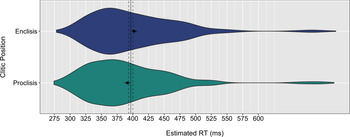
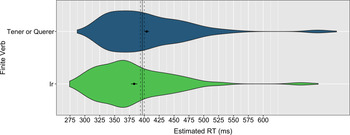
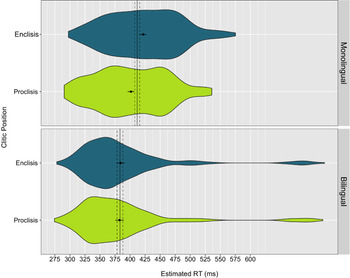
For the purpose of data visualization, we present posterior distributions visually as violin plots of predicted response latency. Each violin plot is marked with a shape and horizontal line delimiting the mean and 95% confidence interval for the distribution, respectively. In addition, visual representations are accompanied by vertical lines marking the mean across all the data (solid line) and the 95% confidence interval around that mean (dashed lines). This allows the reader to determine whether a significant difference among two or more levels of a given dependent variable represents a main or simple effect relative to the grand mean across all data.
No effect of Animacy was found, and Animacy did not significantly interact with any other predictor; as such, we do not discuss this predictor further.Footnote 11 The model did produce a significant effect for Clitic Position, such that constructions with enclisis were read more slowly than those with proclisis (M = 13.84, SD = 4.13; see Table 3). Figure 1, which presents a violin plot of the predicted response latencies by Clitic Position, confirms this effect. Such an effect is in line with distributional frequencies in corpus studies, which have shown that enclisis is less common than proclisis overall and should pose greater processing difficulty, especially in the ROI examined here. We found an effect of Verb, such that response latencies to ir a were lower than for the other verbs (M = –19.79, SD = 4.15; see Figure 2). However, we did not find any interaction between Verb and Clitic Position nor Verb and Group.
Factors predicting RTs to critical regions in the self-paced reading task

Note: The point estimates are descriptive statistics of the sampled posterior distribution and are presented for ease of interpretation. The means can be interpreted analogously to the beta coefficients (mean) from the results of non-Bayesian regression models in that they represent an average predicted change per unit of measure for a given parameter (or, for the intercept, the predicted value of the dependent variable when all predictors are at zero values). In this case, a positive mean for a given predictor indicates a predicted increase in response latency and a negative mean indicates a predicted decrease in response latency.
Predicted response latencies by Clitic Position. (Horizontal lines indicate 95% confidence intervals for a given clitic position; vertical lines delimit the 95% confidence interval across all data).

Predicted response latencies by Verb. (Horizontal lines indicate 95% confidence intervals by finite verb; vertical lines delimit the 95% confidence interval across all data).

We did find an interaction between Clitic Position and Group, which indicates that the cost of reading enclisis was lower in the bilingual group compared to the monolingual group (M = –18.59, SD = 8.16; see Figure 3). The interaction also suggests that there was facilitation at a site where English and Spanish overlap in surface word order.
Predicted response latencies by Language Background and Clitic Position. (Horizontal lines indicate the 95% confidence interval of predicted response latency for a given clitic position and language group; Vertical lines delimit the 95% confidence intervals by language background).

Discussion
The present study set out to better understand the link between production and comprehension through the lens of bilingual experience, investigating how language use impacts the processing of morphosyntactic variation in the L1. More specifically, we explored whether partial overlap created by morphosyntactic variation in Spanish (L1) VCP can constitute a site for cross-linguistic effects in nonimmersed proficient learners of an L2 that shows more categorical behavior. The two research questions that guided our study were
-
a. Do the production asymmetries reported in the literature find a correlate in speed of processing for comprehension in monolingual speakers of Spanish living in Spain?
-
b. Are the same asymmetries in (a) among monolingual speakers also found in proficient learners of English (L2) living in Spain?
Below we discuss each question by homing in on the link between production and comprehension (Question a), and the role of language variation as a site for L2→L1 CLI in morphosyntactic processing (Question b).
The link between production and comprehension
Jakubowicz and Nash (Reference Jakubowicz and Nash2001) and Prévost (Reference Prévost2006) have suggested that postverbal clitics (i.e., enclisis) should be easier to interpret than preverbal clitics (i.e., proclisis) due to the surface overlap between postverbal clitics and the canonical position of object dependent phrases, which is also postverbal. However, following proposals that patterns of use during production impact processing during comprehension, we predicted a greater processing cost when the clitic occurs in a position that is dis-preferred in naturalistic production (i.e., enclisis). The results presented here support our prediction. A main effect of clitic position indicates that processing of the ROI was faster after proclisis than enclisis. Following experience-based accounts of language processing, however, we could attribute this effect to the high frequency of proclisis in spoken Spanish (Davies, Reference Davies1995). Items and constructions that are more frequently used in production are processed faster. In modern Spanish, proclisis is also more common outside the variable context examined here, as it is obligatory in finite clauses without compound verb constructions (e.g., Bouzouita, Reference Bouzouita2009; MacKenzie, Reference MacKenzie2017; Rossi et al., Reference Rossi, Diaz, Kroll and Dussias2017). Consistent with that research, the finding that stimuli with proclisis were processed more quickly than those with enclisis could be explained by facilitatory effects stemming from the high frequency of proclisis in production. Thus, our results signal strong links between production and processing for comprehension (Guzzardo Tamargo, Valdés Kroff, & Dussias, Reference Guzzardo Tamargo, Valdés Kroff and Dussias2016) and provide support for experience-based models of language processing (e.g., Boland, Tanenhaus, Carlson, & Garnsey, Reference Boland, Tanenhaus, Carlson and Garnsey1989; Gennari & MacDonald, Reference Gennari and MacDonald2009).
It could alternatively be the case that the cost found with enclisis (where the ROI appeared immediately after the clitic) results from the cognitive demand of both identifying the lexicosemantic features of the nonfinite verb and inferring the syntactic relationship between the clitic and its referent within the same window in the experimental design, as has been suggested by Rossi et al. (Reference Rossi, Diaz, Kroll and Dussias2017). Given that it is not methodologically possible to control for the distance between the clitic and the ROI (a postverbal ROI will always exhibit closer distance from the clitic in the enclisis condition than with proclisis), we examine whether the cost of reading enclisis varied by verb and across groups in order to better understand the effect.
The effect of verb suggests that phrases with ir a were read faster than those with the other two verbs. Faster processing after ir a could be related to the high frequency of this verb as a grammaticalized marker of future tense. The periphrastic future with ir a is the preferred form for expressing futurity in modern Spanish (as opposed to the synthetic future, which is marked morphologically on the verb; Blas Arroyo, Reference Blas Arroyo2008; Lastra & Butragueño, Reference Lastra and Butragueño2010). The facilitation of ir notwithstanding, we did not find any verb-specific preferences regarding clitic position in perception, contrary to our prediction. This may suggest that more global production patterns like verb frequency or overall co-occurrence of VCP with a given clitic position are robust and find parallels in production, but subtler distributional frequencies like verb-specific clitic position preferences do not. However, it could also be the case that the data set was not sufficiently large to detect smaller effects that may be underlyingly present, so we leave this as a question for future research regarding the relationship between language production and perception.
In general, our results provide support for proposals that posit a link between production and comprehension. In the case of VCP, usage-based proposals (e.g., Bybee & Scheibman, Reference Bybee and Scheibman1999) and the PDC model (e.g., MacDonald, Reference MacDonald2013) would predict that due to increased frequency of use, the Clitic+Verb construction (i.e., proclisis) would establish itself as highly a accessible construction that is to be expected in comprehension. The fact that enclisis showed a greater cost than proclisis could indicate that comprehenders use regularities form the input acquired through statistical learning in order to guide their expectations during comprehension, resulting in faster processing of VPs with proclisis (Wells et al., Reference Wells, Christiansen, Race, Acheson and MacDonald2009, p. 252).
Language variation as a site for cross-linguistic effects in morphosyntactic processing
Under a shared syntax account of bilingualism, structures with similar linear word order across the two languages should be processed more quickly by Spanish–English bilinguals relative to monolinguals (see Hopp, Reference Hopp2017; Salamoura & Williams, Reference Salamoura and Williams2007). Evidence that Spanish enclisis represents a shared structure can be found in syntactic priming experiments, where English sentences with similar complex verb constructions to those in the current study only prime postverbal clitics (e.g., Bernolet, Hartsuier, & Pickering, 2007; Meijer & Fox Tree, Reference Meijer and Fox Tree2003). In this study, we have capitalized on the similar surface word order between Spanish enclisis and English categorical postverbal direct object pronouns to study if L2 use could affect L1 processing.
The interaction between Clitic position and Group suggests that bilinguals were less affected by the dis-preferred enclitic condition in Spanish than were monolinguals. This finding confirms the hypothesis of processing facilitation when L2 learners read enclisis compared to monolingual speakers. The effect, however, seems at odds with corpus data on bilingual production, which do not show an increased prevalence of enclisis in bilinguals relative to monolingual communities. Corpus studies with Spanish–English bilingual adults and children reveal production patterns that resemble monolingual use (see Requena & Dracos, Reference Requena, Dracos, Bertolini and Kaplan2018; Shin, Requena, & Kemp, Reference Shin, Requena, Kemp, Auza Benavides and Schwartz2017), thus restricting the effect found here to the processing domain and not to frequencies of use in bilingual production. This would suggest that Spanish–English bilinguals display VCP frequencies of use like those employed by monolingual speakers in naturalistic conversation; however, their reliance on clitic position when processing VCP seems weakened compared to monolinguals.
The Competition Model (Bates & MacWhinney, Reference Bates and MacWhinney1981) would posit that the attenuated cost when reading enclisis in the bilingual group reflects a process by which bilinguals no longer used clitic position as a reliable processing cue when reading in their L1. Previous studies have documented weakening of L1 cues in bilinguals as a reduction of bilingual speakers’ trust in the existing way of processing the L1 (Cook, Iarossi, Stellakis, & Tokumaru, Reference Cook, Iarossi, Stellakis, Tokumaru and Cook2003).
To further examine the attenuated processing affect for VCP in bilinguals, we conducted a post hoc Bayesian linear mixed-effects model. This model included a fixed effect term for Clitic position, random intercepts for Subject and Item, and a random slope for Clitic Position × Subject. In addition, because the model fit suggested that the difference in means response latencies between proclisis and enclisis in the bilingual group neared zero, we set a Gaussian prior with a mean of zero and a scale of 100. Taking the more informative prior into account, we also divided the 4,000 iterations distinctly from the previous model, using 1,000 warm-up steps and 3,000 sampling steps. The results suggest that there is more to the interaction between clitic position and group that was originally found: rather than simply showing an attenuated cost to enclisis relative to monolinguals, bilinguals do not differ in their response latencies across clitic positions at all (M = 3.60, SD = 5.78).Footnote 12 This observation suggests that, unlike monolinguals, bilinguals may not use clitic position as a processing cue in their L1.
It is important to note that the bilinguals’ apparent suspension of clitic position as a processing cue does not represent a disadvantage in performance; their reaction times are not significantly different from the monolingual group. It could be hypothesized that suspending the cue of clitic positioning allowed the bilingual group to be more flexible in their interpretations before contextual integration, thus speeding up processing of the complex VP + clitic (i.e., enclisis). A reasonable conjecture is that exposure to English, where assigning the referent cannot occur preverbally and necessitates delay in integration, increased the usage of a late closure strategy in parsing (cf. Carreiras & Clifton, Reference Carreiras and Clifton1999; Cuetos, Reference Cuetos1988), to the effect that for the bilingual group the constituents remain open until all necessary information is obtained. This has been found at the syntactic level with relative clause attachment (cf. Dussias & Sagarra, Reference Dussias and Sagarra2007).
The bilingual group’s flexibility in reading enclisis and proclisis appears to have facilitated processing, especially in the case where no other information was present to cue them that the upcoming syntactic structure was a verbal complex rather than a single, finite verb. Effectively, by using a strategy of waiting until all disambiguating information was present before linking clitics to the appropriate antecedent, bilinguals could read the sentences more quickly without being affected by parsing errors. Experience speaking and reading English, which forces the listener or reader to wait until the direct object pronoun is presented in order to infer its referent, could have reduced the likelihood of generating parsing errors due to temporary morphosyntactic ambiguity. Ultimately, this is driven by naturalistic linguistic variation present in the local environment.
Given the context in which the participants were tested—immersed in their L1 (Spanish) and in their native country (Spain)—a language-selective account of processing would hypothesize that little influence from their L2, if any, should occur. Even a language nonselective account that privileges lexical information would hypothesize little to no L2 influence on L1 processing. However, we find robust evidence to suggest the opposite: in the enclisis condition, where English and Spanish surface structures overlap, bilinguals showed facilitation relative to the monolingual group, which could suggest that morphosyntactic information in their L2 influenced their processing strategies in the L1 (see Dussias & Sagarra, Reference Dussias and Sagarra2007). This finding is supported by usage-based accounts of language representation and processing where cues are tuned and retuned because of continued exposure to ambient linguistic variation (e.g., Bates & MacWhinney, Reference Bates, MacWhinney, MacWhinney and Bates1989; Dietrich, Reference Dietrich2014; Kilborn, Reference Kilborn1989; McClelland & Rumelhart, Reference McClelland and Rumelhart1986; Roland, Dick, & Elman, Reference Roland, Dick and Elman2007).
Limitations and other considerations
We selected three verbs as the basis of our experimental stimuli because they have been demonstrated to show distinct distributions of occurrence with proclisis and enclisis in verbal complexes in corpus data. The verbs selected, which represent critical points along the distribution from primarly proclisis to primarily enclisis, should represent an ideal scenario for identifying processing effects correlated to distributional effects in production, and they represent a key first step in uncovering the interaction of usage patterns with processing. That said, it is possible that the effects reported here are limited to these three verbs and may not speak to clitic positioning more generally. The three verbs analyzed here, however, account for 42% (5,916/14,135) of all the VCP contexts found in a large corpus study of VCP (Davies, Reference Davies1995). Consistent with the effects of frequency assumed by usage-based models of language, frequent verbs like those selected in this study may become associated with either proclisis or enclisis as a result of entrenched usage patterns, whereas less frequent constructions might be impacted by other mechanisms (e.g., analogy).
Another limitation of the study is that the word following the critical region, which was used to calculate processing effects, was not always from the same part of speech: four stimuli for querer and four stimuli for tener que contained adverbs in the ROI, while all other stimuli contained prepositions. It is possible that these two parts of speech are processed distinctly, which could affect response latencies and bias the results. To explore this possibility, we conducted an analysis on a subset of the data excluding those stimuli containing adverbs in the ROI; all effects remained the same. Thus, while we cannot ignore the possibility that distinct parts of speech may modulate processing, we do not have evidence that variation in the part of speech in the ROI affected the results of the current study.
Conclusion
We find strong evidence that very high proficiency in English (L2) modulates native language processing of VCP in Spanish (L1), a phenomenon of surface cross-linguistic convergence where the L1 displays variable (optional) word order but the L2 does not. A second finding of this study is that, unlike monolinguals, bilinguals seem not to rely on lexical preferences on VCP in comprehension. The qualitative difference between the two language groups could result from experience with a nonvariable L2, where lexically specific preferences do not play a role, but future research is needed to distinguish between effects frequency and integration difficulty. Broadly, we take these findings as support for experience-based accounts of language, where linguistic representations are shared across languages and the coactivation of a bilingual’s two languages facilitates processing where structures overlap (e.g., Kroll et al., Reference Kroll, Bobb and Hoshino2014, Reference Kroll, Dussias, Bice and Perrotti2015; Midgley, Holcomb, & Grainger, Reference Midgley, Holcomb and Grainger2011).
Acknowledgments
The research reported here was supported by funding from the College of the Liberal Arts (Pennsylvania State University). We gratefully acknowledge the assistance of Karen Miller and Giuli Dussias at the time of planning the study, as well as the help of Teresa Bajo, who graciously provided laboratory space in Granada. We thank Jorge Valdes Kroff and the audience at the 2017 Bilingualism in the Hispanic and Lusophone World conference for feedback on the study. In writing this manuscript, we received invaluable feedback from Barbara Malt, Kinsey Bice, and Jason Gullifer. We are also thankful to the editors and anonymous reviewers for their insightful comments.
Appendix A. Correlation among proficiency measures