



1. Introduction
In this paper, as a continuation of [Reference Oeda and Kuto32], we consider the following Lotka–Volterra prey–predator model with a strongly coupled diffusion term:
 \begin{equation*} \begin{cases} u_{t}=d_{1}\Delta u+u(m_{1}-u-cv),\ \ \ & (x,t)\in\Omega\times (0,T),\\ v_{t}=\nabla\cdot\biggl[ d_{2}\nabla v+\alpha u^{2}\,\nabla\biggl(\dfrac{v}{u}\biggr)\biggr] +v(m_{2}+bu-v),\ \ \ & (x,t)\in\Omega\times (0,T),\\ u=v=0,\ \ \ & (x,t)\in\partial\Omega\times (0,T),\\ u(x,0)=u_{0}(x)\ge 0,\ \ v(x,0)=v_{0}(x)\ge 0,\ \ \ & x\in\Omega, \end{cases} \end{equation*}
where  $\Omega \,(\subset \mathbb {R}^{N})$ is a bounded domain with a smooth boundary
 $\partial \Omega$; unknown functions
 $u(x,t)$ and
 $v(x,t)$ stand for the population densities of prey and predator at location
 $x\in \Omega$ and time
 $t>0$, respectively; positive constants
 $d_1$ and
 $d_2$ stand for random diffusion rates of each individual of prey and predator, respectively; constants
 $m_{1}$ and
 $m_{2}$ stand for growth rates of each species, where
 $m_{1}$ is a positive constant, but
 $m_{2}$ is a real constant which is allowed to be negative; positive constants
 $b$ and
 $c$ denote the rate of increase of predator and the rate of decrease of prey due to the predation, respectively. The strongly coupled diffusion term
 $\alpha \nabla \cdot [u^{2}\nabla (v/u)]$ describes an ecological tendency that each individual of predator has to chase in densely populated regions of prey. In terms of the diffusion process in ecology, the strongly coupled diffusion term microscopically models a situation where the transition probability of each individual of predator depends on the density of prey at the point of arrival [Reference Okubo and Levin33, § 5.4].
This paper focuses on the effect of the strongly coupled diffusion term on the set of stationary solutions. Then we study the stationary problem which consists of the nonlinear elliptic equations
 \begin{align} &d_{1}\Delta u+u(m_{1}-u-cv)=0 \ \ &\mbox{in}\ \Omega, \end{align}
 \begin{align} &\nabla\cdot\biggl[ d_{2}\nabla v+\alpha u^{2}\,\nabla\biggl(\dfrac{v}{u}\biggr)\biggr] +v(m_{2}+bu-v)=0 \ \ &\mbox{in}\ \Omega, \end{align}
subject to the homogeneous Dirichlet boundary conditions
 \begin{equation} u=v=0\ \ \mbox{on}\ \partial\Omega \end{equation}
and the non-negative conditions
 \begin{equation} u\ge 0\ \ \mbox{and}\ \ v\ge 0\ \ \mbox{in}\ \Omega. \end{equation}
Throughout this paper, we call  $(u,v)$ a positive solution if
 $(u,v)$ satisfies (1.1a)–(1.1c) and
 $u>0$ and
 $v>0$ in
 $\Omega$. Hence a positive solution corresponds to a coexistence steady state of prey and predator.
In the case of linear diffusion with  $\alpha =0$, the stationary problem has been discussed in a lot of papers. Among them, in the pioneering papers by Blat and Brown [Reference Blat and Brown1, Reference Blat and Brown2], Dancer [Reference Dancer5], López-Gómez and Pardo [Reference López-Gómez and Pardo23] and Li [Reference Li19], they initiated the study to describe a sufficient region on the
 $(m_{1}, m_{2})$ plane for the existence of positive solutions. In the last 20 years or so, there has been an increase in the number of papers dealing with the effects of the chemotaxis term or the cross-diffusion term (appearing in the Shigesada–Kawasaki–Teramoto model) on positive steady-state solutions (e.g. [Reference Kuto and Tsujikawa16, Reference Wang, Gai and Yan38, Reference Wang, Wu and Shi39] for the stationary problem with the chemotaxis term, e.g. [Reference Kan-on9–Reference Kuto15, Reference Kuto and Yamada17, Reference Kuto and Yamada18, Reference Li and Wu20, Reference Li and Wu21, Reference Lou and Ni25–Reference Mimura, Nishiura, Tesei and Tsujikawa31, Reference Ryu and Ahn34, Reference Ryu and Ahn35, Reference Shigesada, Kawasaki and Teramoto37] for the stationary Shigesada–Kawasaki–Teramoto model). In a cerebrating book [Reference Okubo and Levin33] on the diffusion process in ecology, the strongly coupled diffusion term
 $\nabla \cdot [u^{2}\nabla (v/u)]$ is introduced in parallel to the abovementioned chemotaxis and cross-diffusion. In spite of such a description in [Reference Okubo and Levin33], there seems to be no paper (except [Reference Oeda and Kuto32]) which studies the effect of the strongly coupled diffusion term
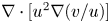 $\nabla \cdot [u^{2}\nabla (v/u)]$ on the bifurcation structure of stationary solutions of the diffusive Lotka–Volterra model.
Then, this paper studies the bifurcation structure of positive solutions of (1.1) in a case when  $\alpha$ is sufficiently large. We introduce semitrivial solutions as a basic preparation for explaining the structure of positive solutions. Here a semitrivial solution denotes a solution
 $(u,v)$ of (1.1a)–(1.1d) such that one of components is positive in
 $\Omega$ but the other component identically vanishes. Obviously, any semitrivial solution satisfies the logistic equation
 \begin{equation} \begin{cases} d_{i}\Delta U+U(m_{i}-U)=0 \ \ & \mbox{in}\ \ \Omega,\\ U=0\ \ & \mbox{on}\ \ \partial\Omega, \end{cases} \end{equation}
for  $i=1$ or
 $2$. It is well known that (1.2) has a positive solution if and only if
 $m_{i}>d_{i}\lambda _{1}$, where
 $\lambda _{1}$ denotes the least eigenvalue of
 $-\Delta$ with homogeneous Dirichlet boundary condition on
 $\partial \Omega$. Furthermore, for each
 $m_{i}>d_{i}\lambda _{1}$, (1.2) has a unique positive solution, and therefore, the positive solution will be denoted by
 $\theta _{d_{i}, m_{i}}$. As discussed in [Reference Oeda and Kuto32], (1.1) has a semitrivial solution
 \[ (u,v)=(\theta_{d_{1},m_{1}}, 0) \ \ \mbox{if}\ m_{1}>d_{1}\lambda_{1} \]
and another semitrivial solution
 \[ (u,v)=(0,\theta_{d_{2},m_{2}}) \ \ \mbox{if}\ m_{2}>d_{2}\lambda_{1}. \]
Throughout this paper, regarding  $m_{2}$ as a real parameter, we study the set
 \[ \mathcal{S}(\alpha ):= \{\,(u,v,m_{2})\in X\times\mathbb{R}\,:\, (u,v)\mbox{ is a positive solution of (1.1)}\,\} \]
for any  $\alpha \ge 0$ and
 $(m_{1}, d_{1}, d_{2}, b, c)\in \mathbb {R}^{5}_{+}$, where
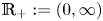 $\mathbb {R}_{+}:=(0,\infty )$ and
 \begin{equation} X:=(W^{2,p}(\Omega )\cap W^{1,p}_{0}(\Omega ))\times (W^{2,p}(\Omega )\cap W^{1,p}_{0}(\Omega )) \end{equation}
with  $p>N$. It is noted that all elements of
 $\mathcal {S}(\alpha )$ become classical solutions of (1.1) by virtue of the elliptic regularity and the Sobolev embedding ([Reference Gilbarg and Trudinger7]).
Our previous paper [Reference Oeda and Kuto32] obtained the following result:
• if
 $0< m_{1}\le d_{1}\lambda _{1}$, then $\mathcal {S}(\alpha )$ is empty;
• if
$m_{1}>d_{1}\lambda _{1}$, there exist two real numbers $f(m_{1}, \alpha )$ and $g(m_{1})\,(>d_{2}\lambda _{1})$ such that $\mathcal {S}(\alpha )$ contains a bounded set which bifurcates from a semitrivial solution $(u,v)=(\theta _{d_{1}, m_{1}}, 0)$ at $m_{2}=f(m_{1}, \alpha )$ and joins the other semitrivial one $(u,v)=(0,\theta _{d_{2}, m_{2}})$ at $m_{2}=g(m_{1})$ (see figure 1).









Sufficient regions for the existence of positive solutions of (1.1).

Furthermore, in [Reference Oeda and Kuto32], we studied the asymptotic behaviour of positive solutions  $(u_{n},v_{n})$ of (1.1) with
 $\alpha =\alpha _{n}\to \infty$ and showed that
 $(u_{n},v_{n})$ satisfy either of the following two convergence situations passing to a subsequence:
(i)
$(u_{n}, v_{n})$ converge to a positive solution $(u,v)$ of the first-limiting system consisting of equal diffusive Lotka–Volterra competition equations and an integral constraint:
(1.4)\begin{equation} \begin{cases} d_{1}\Delta u+u(m_{1}-u-cv)=0 & \mbox{in}\ \Omega,\\ d_{1}\Delta v+v(m_{1}-u-cv)=0 & \mbox{in}\ \Omega,\\ u=v=0 & \mbox{on}\ \partial\Omega,\\ \dfrac{d_{2}}{d_{1}}\displaystyle\int_{\Omega }v(m_{1}-u-cv)= \displaystyle\int_{\Omega}v(m_{2}+bu-v); \end{cases} \end{equation}(ii)
$(\alpha _{n}u_{n}, v_{n})$ converge to a positive solution $(w,v)$ of the second-limiting system:
(1.5)\begin{equation} \begin{cases} d_{1}\Delta w+w(m_{1}-cv)=0 \ \ \ & \mbox{in}\ \Omega,\\ \Delta v+\dfrac{v}{d_{2}+w}\biggl\{ \dfrac{w}{d_{1}}(m_{1}-cv)+m_{2}-v\biggr\}=0 \ \ \ & \mbox{in}\ \Omega,\\ w=v=0\ \ & \mbox{on}\ \partial\Omega. \end{cases} \end{equation}


Concerning the first-limiting system, the set of positive solutions with parameter  $m_{2}$ forms a segment
 $\varGamma ^{\infty }_{1}$ which connects
 \[ (u,v,m_{2})=(\theta_{d_{1}, m_{1}}, 0, f^{\infty}(m_{1})) \ \ \mbox{with}\ \ (u,v,m_{2})= \biggl(0, \dfrac{\theta_{d_{1}, m_{1}}}{c}, h(m_{1})\biggr), \]
where  $f^{\infty }(m_{1}):= \lim _{\alpha \to \infty } f(m_{1},\alpha )$ and
 $h(m_{1})$ are some real numbers (see figure 2(b)). Here we remark that
 $(u,v)=(\theta _{d_{1}, m_{1}}, 0)$ is a semitrivial solution of (1.1), but
 $(u,v)=(0, \theta _{d_{1}, m_{1}}/c)$ is not a semitrivial solution of (1.1).
Bifurcation branches in case  $f(m_{1},\alpha )< g(m_{1})< h(m_{1})$.

The first purpose of this paper is to study the second-limiting system (1.5). It will be shown that the branch (connected set) of positive solutions of (1.5) bifurcates from the semitrivial solution  $(w,v)=(0,\theta _{d_{2}, m_{2}})$ at
 $m_{2}=g(m_{1})$ and the
 $w$ component of the branch blows up at
 $m_{2}=h(m_{1})$ (see figure 2(a)).
The second purpose of this paper is to construct a bifurcation branch of positive solutions of (1.1) with large  $\alpha$ by perturbing the sets of solutions of two limiting systems (1.4) and (1.5). In § 4, we construct the bifurcation branch
 $\varGamma ^{\alpha }$ with the following profile:
 $\varGamma ^{\alpha }$ bifurcates from the semitrivial solution
 $(u,v)=(\theta _{d_{1}, m_{1}}, 0)$ at
 $m_{2}=f(m_{1},\alpha )$ and goes in a tubular domain around the segment
 $\varGamma ^{\infty }_{1}$ for a while, however,
 $\varGamma ^{\alpha }$ never attains the other end
 $(u,v,m_{2})=(0,\theta _{d_{1}, m_{1}}/c, h(m_{1}))$ of the segment
 $\varGamma ^{\infty }_{1}$ because this end point is not a solution of (1.1). A main result will show that
 $\varGamma ^{\alpha }$ leaves the tubular domain near the end point
 $(u,v,m_{2})=(0,\theta _{d_{1}, m_{1}}/c, h(m_{1}))$ after that
 $\varGamma ^{\alpha }$ is characterized by solutions to (1.5) in the second-limiting case (ii) and attains another semitrivial solution
 $(u,v)=(0,\theta _{d_{2}, m_{2}})$ at
 $m_{2}=g(m_{1})$ (see figure 2(b)).
The paper is structured as follows: in § 2, main results of this paper are presented. In § 3, we give a bifurcation structure of positive solutions of the nonlinear elliptic system in the second-limiting case (ii). In § 4, we construct a bifurcation branch of positive solutions of (1.1) when  $\alpha$ is sufficiently large.
Throughout this paper, the usual norms of the spaces  $L^{p}(\Omega )$ for
 $p\in [1,\infty )$ and
 $C(\overline {\Omega })$ are defined by
 \[ \| u\|_{p}:= \left(\displaystyle\int_{\Omega }|u(x)|^{p}\right)^{1/p}\ \ \mbox{and}\ \ \|u \|_{\infty }:=\displaystyle\max_{x\in\overline{\Omega }}|u(x)|. \]
2. Main results
In this section, we state main results of this paper. The first result is concerned with the bifurcation structure of the second-limiting system (1.5). It is easy to check that all semitrivial solutions of (1.5) with  $m_{1}>d_{1}\lambda _{1}$ are restricted to
 \[ (w,v)=(0, \theta_{d_{2}, m_{2}}) \ \ \ \mbox{if}\ \ \ m_{2}>d_{2}\lambda_{1}. \]
We obtain the next result on a bifurcation branch of positive solutions of (1.5).
Theorem 2.1 If  $0< m_{1}\le d_{1}\lambda _{1}$, then (1.5) has no positive solution. If
 $m_{1}>d_{1}\lambda _{1}$, positive solutions with parameter
 $m_{2}$ of (1.5) bifurcate from
 $(w,v)=(0, \theta _{d_{2}, m_{2}})$ at
 $m_{2}=g(m_{1})$. Furthermore the connected set
 $\varGamma ^{\infty }_{2}\, (\subset X\times \mathbb {R})$ of positive solutions bifurcating from
 $(w,v, m_{2})=(0, \theta _{d_{2}, m_{2}}, g(m_{1}))$ satisfies the following properties:
(i) the
$(v,m_2)$ component of $\varGamma ^{\infty }_{2}$ is uniformly bounded in $W^{2,p}(\Omega )\times \mathbb {R}$, whereas the $w$ component of $\varGamma ^{\infty }_{2}$ is unbounded in $L^{p} (\Omega )$ for any $p\ge 1$;(ii) any unbounded sequence
$\{(w_{n}, v_{n}, m_{2,n})\}\subset \varGamma ^{\infty }_{2}$ satisfies
by passing to a subsequence if necessary, where\begin{align*} &\lim_{n\to \infty}\|w_{n}\|_{p}=\infty\ \mbox{for any}\ p\ge 1,\ \mbox{and}\\ &\lim_{n\to \infty}(\widetilde{w}_{n}, v_{n}, m_{2,n})= \biggl(\dfrac{\theta_{d_{1}, m_{1}}}{\| \theta_{d_{1}, m_{1}}\|}_{\infty}, \dfrac{\theta_{d_{1}, m_{1}}}{c},\, h(m_{1})\biggr) \ \ \mbox{in}\ \ \ C^{1}(\overline{\Omega })\times C^{1}(\overline{\Omega })\times \mathbb{R} \end{align*}$\widetilde {w}_{n}:=w_{n}/\|w_{n}\|_{\infty }$ and
(2.1)\begin{equation} h(m_{1}):=\dfrac{d_{2}}{d_{1}}m_{1}-\biggl( \dfrac{d_{2}}{d_{1}}-\dfrac{1}{c}\biggr) \dfrac{\|\theta_{d_{1}, m_{1}}\|^{2}_{2}} {\|\theta_{d_{1},m_{1}}\|_{1}}. \end{equation}


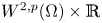






We give a possible profile of the bifurcation branch  $\varGamma ^{\infty }_{2}$ in figure 2(a). It is noted that any positive solution of (1.1) can be characterized by an element of
 $\varGamma ^{\infty }_{1}$ or
 $\varGamma ^{\infty }_{2}$ when
 $\alpha$ is sufficiently large. The next result is to construct a portion of
 $\mathcal {S}(\alpha )$ as a perturbation of
 $\varGamma ^{\infty }_{1}$. In the case when
 $\alpha$ is large enough, the portion forms a curve that lies in a tubular domain as a neighbourhood of
 $\varGamma ^{\infty }_{1}$, see also figure 2(b).
Theorem 2.2 If  $\alpha >0$ is sufficiently large, there exists a bounded connected set
 $\varGamma ^{\alpha } (\,\subset X\times \mathbb {R}\,)$ of positive solutions of (1.1). There exists a small
 $\delta >0$ such that
 $\varGamma ^{\alpha }$ contains a simple curve parameterized as
 \[ \varGamma^{\alpha}_{1}:= \{\,(u(\,\cdot\,,\xi, \alpha ), v(\,\cdot\,,\xi, \alpha ), m_{2}(\xi, \alpha ))\,:\, 0<\xi <1-\delta\,\}, \]
where
 \begin{equation*} \begin{split} & \lim\limits_{\alpha\to\infty} (u(\,\cdot\,,\xi, \alpha ), v(\,\cdot\,,\xi, \alpha ), m_{2}(\xi, \alpha ))\\ & \quad=(1-\xi) (\theta_{d_{1},m_{1}}, 0, f^{\infty }(m_{1}))+\xi \biggl( 0,\dfrac{\theta_{d_{1}, m_{1}}}{c}, h(m_{1})\biggr) \in\varGamma^{\infty}_{1}, \end{split} \end{equation*}
where
 \[ f^{\infty}(m_{1}):=\lim\limits_{\alpha\to\infty} f(m_{1}, \alpha)= \dfrac{d_{2}}{d_{1}}m_{1}-\biggl( \dfrac{d_{2}}{d_{1}}+b\biggr) \dfrac{\|\theta_{d_{1}, m_{1}}\|^{2}_{2}} {\|\theta_{d_{1}, m_{1}}\|_{1}}. \]
Furthermore,  $\varGamma ^{\alpha }$ is characterized as a maximal extension of
 $\varGamma ^{\alpha }_{1}$ from the endpoint of
 $\varGamma ^{\alpha }_{1}$:
 \[ (u(\,\cdot\,,1-\delta, \alpha), v(\,\cdot\,,1-\delta, \alpha), m_{2}(1-\delta,\alpha ))\in\partial\varGamma^{\alpha}_{1}, \]
and  $\varGamma ^{\alpha }$ reaches a semitrivial solution
 $(u,v,m_{2})=(0, \theta _{d_{2}, m_{2}}, g(m_{1}))$.
Thanks to theorems 2.1 and 2.2, we can say that an effect of the strongly coupled diffusion term  $\alpha \nabla \cdot [u^{2}\nabla (v/u)]$ produces an almost line part perturbed by
 $\varGamma ^{\infty }_{1}$ and the other part perturbed by a scaling of
 $\varGamma ^{\infty }_{2}$. Then, for example, in a case when
 $f(m_{1}, \alpha )< g(m_{1})< h(m_{1})$, (1.1) admits at least two positive solutions if
 $g(m_{1})< m_{2}< h(m_{1})-\delta$ with some small
 $\delta >0$. In the linear diffusion case
 $\alpha =0$, the uniqueness of positive solutions was proved in the one-dimensional case by López-Gómez and Pardo [Reference López-Gómez and Pardo24]; in the case when
 $\Omega$ is a ball or an annuli by Dancer, López-Gómez and Ortega [Reference Dancer, López-Gómez and Ortega6].
3. Bifurcation structure of the second-limiting system
In this section, we study positive solutions of (1.5) to prove theorem 2.1. It is noted that the second equation of (1.5) can be expressed as
 \begin{equation} d_{2}\Delta v+w\Delta v -v\Delta w+ v(m_{2}-v)=0 \ \ \mbox{in}\ \ \Omega. \end{equation}
3.1 A priori estimates of positive solutions
We begin with a priori estimates of the  $v$ component of any positive solution
 $(w,v)$ of (1.5):
Lemma 3.1 If  $0< m_{1}\le d_{1}\lambda _{1}$ or
 $m_{2}\le 0$, then there is no positive solution of (1.5). Furthermore, if (1.5) admits a positive solution
 $(w,v)$ of (1.5), then
 $v$ satisfies
 \[ \|v\|_{2}< m_{2}|\Omega |^{1/2},\ \ \ \ \|v\|_{\infty}\le \max\biggl( \dfrac{m_{1}}{c}, m_{2}\biggr). \]
Proof. Let  $(w,v)$ be any positive solution of (1.5). Then it follows that
 \[ ({-}d_{1}\Delta +cv-m_{1})w=0 \ \ \mbox{in}\ \Omega,\quad w=0\ \ \mbox{on}\ \partial\Omega. \]
Since  $w>0$ and
 $v>0$ in
 $\Omega$, then
 \[ 0=\sigma_{1}({-}d_{1}\Delta +cv-m_{1})> \sigma_{1}({-}d_{1}\Delta -m_{1})=d_{1}\lambda_{1}-m_{1}, \]
where  $\sigma _{1}(-d_{1}\Delta +q(x))$ represents the least eigenvalue of
 $-d_{1}\Delta +q(x)$ with homogeneous Dirichlet boundary condition on
 $\partial \Omega$. Consequently, there is no positive solution if
 $0< m_{1}\le d_{1}\lambda _{1}$.
Thanks to the Gauss–Green theorem and boundary conditions, we integrate (3.1) to obtain
 \[ d_{2}\int_{\partial\Omega}\dfrac{\partial v}{\partial \nu}\,\textrm{d}\sigma + \int_{\Omega }v(m_{2}-v)=0. \]
Since  $\partial v/\partial \nu <0$ on
 $\partial \Omega$ by the Hopf lemma, one can see
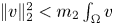 $\|v\|^{2}_{2}< m_{2}\int _{\Omega }v$. Hence there exists no positive solution when
 $m_{2}\le 0$. If
 $m_{2}>0$, the Schwarz inequality gives
 $\|v\|_{2}< m_{2}|\Omega |^{1/2}$.
Let  $x_{1}\in \Omega$ be a maximum point of
 $v$, namely,
 $\|v\|_{\infty }=v(x_{1})>0$. Hence
 ${\Delta v(x_{1})\le 0}$ follows. Thus the second equation of (1.5) gives
 \[ \dfrac{w(x_{1})}{d_{1}}(m_{1}-cv(x_{1}))+m_{2}-v(x_{1})\ge 0. \]
Setting a function  $M(\xi ):=(m_{1}\xi +d_{1}m_{2})/(c\xi +d_{1})$, we see
 $v(x_{1})\le M(w(x_{1}))$. It follows from
 $\sup _{\xi >0}M(\xi )\le \max ( m_{1}/c, m_{2})$ that
 \[ v(x_{1})\le M(w(x_{1}) ) \le \max\biggl( \dfrac{m_{1}}{c}, m_{2}\biggr). \]
The proof of lemma 3.1 is accomplished.
Furthermore, we obtain a necessary condition of coefficients for the existence of positive solutions of (1.5):
Lemma 3.2 If (1.5) admits a positive solution, then  $m_{1}>d_{1}\lambda _{1}$ and
 \[ \min\biggl(\dfrac{1}{c}, \dfrac{d_{2}}{d_{1}}\biggr) \le\dfrac{m_{2}}{m_{1}}\le \max\biggl(\dfrac{1}{c}, \dfrac{d_{2}}{d_{1}}\biggr), \]
where equalities hold only in case  $1/c=d_{2}/d_{1}$.
Proof. Suppose that (1.5) has a positive solution  $(w,v)$. Then lemma 3.1 ensures
 $m_{1}>d_{1}\lambda _{1}$. Subtracting the
 $L^{2}$ inner product of the second equation of (1.5) with
 $d_1 w$ from the inner product of the first equation with
 $v$, we obtain
 \[ \int_{\Omega}vw(m_{1}-cv)- d_{1}\int_{\Omega} \dfrac{vw}{d_{2}+w} \biggl\{\dfrac{w}{d_{1}}(m_{1}-cv)+m_{2}-v\biggr\}=0, \]
which is reduced to
 \begin{equation} \int_{\Omega} \dfrac{vw}{d_{2}+w} \biggl\{ \dfrac{d_{2}}{d_{1}}m_{1}-m_{2} +c\biggl( \dfrac{1}{c}-\dfrac{d_{2}}{d_{1}}\biggr)v\biggr\}=0. \end{equation}
In case of  $1/c> d_{2}/d_{1}$, (3.2) and the positivity of
 $(w,v)$ yield
 \begin{equation} \dfrac{d_{2}}{d_{1}}m_{1}-m_{2} < 0 < \dfrac{d_{2}}{d_{1}}m_{1}-m_{2} +c\biggl( \dfrac{1}{c}-\dfrac{d_{2}}{d_{1}}\biggr)\|v\|_{\infty}. \end{equation}
The right inequality with the  $L^{\infty }$ estimate of
 $v$ obtained in lemma 3.1 implies
 \begin{equation} 0< \dfrac{d_{2}}{d_{1}}m_{1}-m_{2} +c\biggl( \dfrac{1}{c}-\dfrac{d_{2}}{d_{1}}\biggr) \max\biggl( \dfrac{m_{1}}{c}, m_{2}\biggr). \end{equation}
Assume for contradiction that  $m_{2}\ge m_{1}/c$. Then (3.4) gives
 \[ 0< \dfrac{d_2}{d_1}(m_{1}-cm_{2}), \ \ \mbox{that is},\ \ m_{2}< \dfrac{m_{1}}{c}. \]
This contradicts our assumption. Together with the left inequality of (3.3), we can conclude that
 \begin{equation} \dfrac{d_{2}}{d_{1}}m_{1}< m_{2}< \dfrac{m_{1}}{c} \ \ \ \mbox{if}\ \ \ \dfrac{1}{c}>\dfrac{d_{2}}{d_{1}}. \end{equation}
On the other hand, in case  $1/c< d_{2}/d_{1}$, hence the reverse inequalities of (3.3) hold true. Then a similar procedure enables us to obtain
 \begin{equation} \dfrac{m_{1}}{c}< m_{2}<\dfrac{d_{2}}{d_{1}}m_{1} \ \ \ \mbox{if}\ \ \ \dfrac{1}{c}<\dfrac{d_{2}}{d_{1}}. \end{equation}
Furthermore, one can easily verify that
 \begin{equation} m_{2}=\dfrac{d_{2}}{d_{1}}m_{1}\,\biggl(= \dfrac{m_{1}}{c}\biggr) \ \ \ \mbox{if}\ \ \ \dfrac{1}{c}=\dfrac{d_{2}}{d_{1}}. \end{equation}
3.2 Parameterization of the branch near the bifurcation point
We recall that (1.5) has the semitrivial solution  $(w.v)=(0, \theta _{d_{2},m_{2}})$ if
 $m_{2}>d_{2}\lambda _{1}$. In this section, we regard the coefficient
 $m_{2}$ as a bifurcation parameter and construct a local curve of positive solutions which bifurcates from the branch of the semitrivial solution
 $(w.v)=(0, \theta _{d_{2},m_{2}})$ at
 $m_{2}=g(m_{1})$, where
 $g(m_{1})$ is the inverse function of
 \[ m_{1}=d_{1}\sigma_{1}\biggl( -\Delta + \dfrac{c\theta_{d_{2},m_{2}}} {d_{1}}\biggr) \]
and it is monotone increasing for  $m_{1}\in (d_{1}\lambda _{1}, \infty )$ with
 \[ \lim_{m_{1}\to d_{1}\lambda_{1}}g(m_{1})=d_{2}\lambda_{1} \quad\mbox{and}\quad \lim_{m_{1}\to\infty} g(m_{1})=\infty, \]
see [Reference Oeda and Kuto32, lemma 4.5]. To do so, we introduce a change of variables
 \begin{equation} z:= v-\theta_{d_{2}, m_{2}}\ \ \ \mbox{for}\ \ \ m_{2}>d_{2}\lambda_{1}, \end{equation}
which transforms the semitrivial solution  $(w,v)=(0,\theta _{d_{2}, m_{2}})$ to
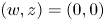 $(w,z)=(0,0)$. By substituting (3.8) and
 $-d_2 \Delta \theta _{d_{2},m_{2}}= \theta _{d_{2},m_{2}}(m_{2}-\theta _{d_{2},m_{2}})$ into (1.5), we know that
 $(w,z)$ satisfies the following semilinear problem:
 \begin{equation} \begin{cases} d_1 \Delta w+ q_{1}(w,z,m_{2}) =0 \ \ \ & \mbox{in}\ \Omega, \\ \Delta z+ q_{2}(w,z,m_{2}) =0 \ \ \ & \mbox{in}\ \Omega, \\ w=z=0\ \ & \mbox{on}\ \partial\Omega, \end{cases} \end{equation}
where  $q_{1}$ and
 $q_{2}$ are defined by
 \begin{equation} \begin{split} q_{1}(w,z,m_{2}):=\ & w\{\,m_{1}-c(z+\theta_{d_{2},m_{2}})\,\}, \\ q_{2}(w,z,m_{2}):=\ & \dfrac{1}{d_{2}+w}\biggl[\, \biggl(z-\dfrac{\theta_{d_{2},m_{2}}w}{d_{2}}\biggr) (m_{2}-\theta_{d_{2},m_{2}})\\ & + (z+\theta_{d_{2},m_{2}}) \biggl(\, \dfrac{w}{d_{1}}\{\,m_{1}-c(z+\theta_{d_{2},m_{2}})\,\} -z\biggr)\,\biggr]. \end{split} \end{equation}
If we can construct a branch of positive solutions of (3.9) bifurcating from the trivial solution 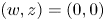 $(w,z)=(0,0)$ for some
 $m_{2}$, then the required branch of positive solutions of (1.5) bifurcating from the semitrivial solution
 $(0, \theta _{d_{2},m_{2}})$ can be obtained by (3.8). Thus our analysis will use the simple bifurcation theorem by Crandall and Rabinowitz [Reference Crandall and Rabinowitz3, theorem 1.7] to construct a curve of positive solutions bifurcating form
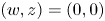 $(w,z)=(0,0)$ at some
 $m_{2}$. For the functional space
 $X$ defined by (1.3) and
 $Y:=L^{p}(\Omega )\times L^{p}(\Omega )$, we define an operator
 $F\,:\,X\times (d_{2}\lambda _{1},\infty )\to Y$ associated with (3.9) by
 \begin{equation} F(w,z,m_{2}):= \left[ \begin{array}{l} d_1 \Delta w +q_{1}(w,z,m_{2})\\ \Delta z + q_{2}(w,z,m_{2}) \end{array} \right]. \end{equation}
We denote the linearized operator of  $F$ around
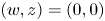 $(w,z)=(0,0)$ by
 \[ L(m_{2}):=F_{(w,z)}(0,0,m_{2})\,:\,X\to Y. \]
By straightforward computations, one can see that
 \begin{equation} L(m_{2})\left[ \begin{array}{c} \phi\\ \psi \end{array} \right] = \left[ \begin{array}{l} d_{1}\Delta\phi+(m_{1}-c\theta_{d_{2},m_{2}})\phi\\ \dfrac{1}{d_2}\{ d_{2}\Delta\psi +\theta_{d_{2},m_{2}}\Big( -\dfrac{m_{2}-\theta_{d_{2},m_{2}}}{d_{2}}+ \dfrac{m_{1}-c\theta_{d_{2},m_{2}}}{d_{1}}\Big)\phi\\ \quad + (m_{2}-2\theta_{d_{2},m_{2}})\psi \} \end{array} \right]. \end{equation}
In order to get  $\mbox {Ker}\,L(m_{2})$, we see the first component to solve the Dirichlet problem of the linear elliptic equation:
 \begin{equation} \begin{cases} -d_{1}\Delta\phi +c\theta_{d_{2},m_{2}}\phi=m_{1}\phi \ \ & \mbox{in}\ \Omega,\\ \phi=0 \ \ & \mbox{on}\ \partial\Omega. \end{cases} \end{equation}
Hence (3.13) admits positive solutions if  $m_{1}/d_{1}$ is the least eigenvalue of
 $-\Delta +c\theta _{d_{2},m_{2}}/d_{1}$ under the homogeneous Dirichlet boundary condition, that is,
 \begin{equation} \dfrac{m_{1}}{d_{1}}= \inf\biggl\{ \|\nabla\varphi\|^{2}_{2}+\dfrac{c}{d_{1}} \displaystyle\int_{\Omega} \theta_{d_{2},m_{2}}\varphi^{2}\ :\ \varphi\in H^{1}_{0}(\Omega ),\ \ \|\varphi\|_{2}=1\,\biggr\}. \end{equation}
In [Reference Oeda and Kuto32], it is shown that all  $(m_{1},m_{2})$ satisfying (3.14) consist of the monotone increasing curve
 $m_{2}=g(m_{1})$
 $(m_{1}>d_{1}\lambda _{1})$. Therefore, if
 $m_{1}>d_{1}\lambda _{1}$ and
 $m_{2}=g(m_{1})$, then all solutions of (3.13) are expressed as
 $\phi =C\phi ^{*}$ for any constant
 $C$, where
 $\phi ^{*}$ is the
 $L^{\infty }$ normalized positive solution satisfying
 $\phi ^{*}>0$ in
 $\Omega$ and
 $\|\phi ^{*}\|_{\infty }=1$. Then our task is to solve the second equation with
 $\phi =\phi ^{*}$:
 \begin{equation} \begin{cases} -d_{2}\Delta\psi+(2\theta_{d_{2},g(m_{1})}-g(m_{1}))\psi\\ \quad = \theta_{d_{2},g(m_{1})}\biggl( -\dfrac{g(m_{1})-\theta_{d_{2},g(m_{1})}}{d_{2}}+ \dfrac{m_{1}-c\theta_{d_{2},g(m_{1})}}{d_{1}} \biggr)\phi^{*} \ & \mbox{in}\ \Omega,\\ \psi=0 \ & \mbox{on}\ \partial\Omega. \end{cases}\end{equation}
By the fact that  $-d_{2}\Delta \theta _{d_{2},g(m_{1})}+(\theta _{d_{2},g(m_{1})}-g(m_{1})) \theta _{d_{2},g(m_{1})}=0$ in
 $\Omega$, and the monotone property of the least eigenvalue, we know that the least eigenvalue of
 $-d_{2}\Delta +(2\theta _{d_{2},g(m_{1})}-g(m_{1}))$ with the homogeneous Dirichlet boundary condition is positive, and thereby, invertible. Then (3.15) admits a solution
 \begin{align*} \psi^{*}&:= [{-}d_{2}\Delta +(2\theta_{d_{2},g(m_{1})}-g(m_{1}))]^{{-}1} \theta_{d_{2},g(m_{1})}\\ &\quad \times \biggl( -\dfrac{g(m_{1})-\theta_{d_{2},g(m_{1})}}{d_{2}}+ \dfrac{m_{1}-c\theta_{d_{2},g(m_{1})}}{d_{1}} \biggr)\phi^{*}. \end{align*}
Consequently, we obtain
 \begin{equation} \mbox{Ker}\,L(g(m_{1}))=\mbox{Span}\{\,(\phi^{*}, \psi^{*})\,\} \ \ \mbox{for}\ m_{1}>d_{1}\lambda_{1}. \end{equation}
Then, in order to use the simple bifurcation theorem [Reference Crandall and Rabinowitz3, theorem 1.7], we need to check the condition that
 \begin{equation} \mbox{codim}\, \mbox{Ran}\,L(g(m_{1}))=1 \end{equation}
and so-called the transversality condition
 \begin{equation} F_{(w,z),m_{2}}(0,0,g(m_{1})) \biggl[ \begin{array}{@{}c@{}} \phi^{*}\\ \psi^{*} \end{array} \biggr] \not\in\mbox{Ran}\,L(g(m_{1})).\end{equation}
To verify (3.17), we take any  $(h,k)\in \mbox {Ran}\,L(g(m_{1}))$. Then there exists
 $(\phi , \psi )\in X$ such that
 $L(g(m_{1}))\,^{t}(\phi ,\psi )=\,^{t}(h,k)$, hence (3.12) implies
 \begin{equation} \begin{cases} d_{1}\Delta\phi+(m_{1}-c\theta_{d_{2},g(m_{1})})\phi =h \ \ & \mbox{in}\ \Omega,\\ \dfrac{1}{d_{2}}\{ d_{2}\Delta\psi +\theta_{d_{2},g(m_{1})}\bigg( -\dfrac{g(m_{1})-\theta_{d_{2},g(m_{1})}}{d_{2}}+ \dfrac{m_{1}-c\theta_{d_{2},g(m_{1})}}{d_{1}}\bigg)\phi\\ \quad + (g(m_{1})-2\theta_{d_{2},g(m_{1})})\psi \} =k \ \ & \mbox{in}\ \Omega,\\ h=k=0\ \ & \mbox{on}\ \partial\Omega.\end{cases}\end{equation}
By the Riesz-Schauder theory, we know that the first equation of (3.19) is solvable if and only if  $\int _{\Omega }h\phi ^{*}=0$. Therefore, the above
 $h$ need to satisfy
 $\int _{\Omega }h\phi ^{*}=0$, the first equation gives the solution
 $\phi$ and the second equation of (3.19) gives the solution
 \begin{align*} \psi&= [{-}d_{2}\Delta+(2\theta_{d_{2},g(m_{1})}-g(m_{1}))]^{{-}1} \\ &\quad \times \biggl[ \theta_{d_{2},g(m_{1})}\biggl( -\dfrac{g(m_{1})-\theta_{d_{2},g(m_{1})}}{d_{2}}+ \dfrac{m_{1}-c\theta_{d_{2},g(m_{1})}}{d_{1}}\biggr)\phi-d_{2}k\biggr]. \end{align*}
Hence this fact means (3.17).
Next we check the transversality condition (3.18). By straightforward calculations, one can see that the first component  $F^{(1)}_{(w,z),m_{2}}(0,0,g(m_{1}))$ of
 $F_{(w,z),m_{2}}(0,0,g(m_{1}))$ satisfies
 \[ F^{(1)}_{(w,z),m_{2}}(0,0,g(m_{1})) \left[ \begin{array}{c} \phi^{*}\\ \psi^{*} \end{array} \right] ={-}c\dfrac{\partial\theta_{d_{2},m_{2}}} {\partial m_{2}}\bigg|_{m_{2}=g(m_{1})} \phi^{*}. \]
Here it should be noted that
 \begin{equation} \dfrac{\partial\theta_{d_{2},m_{2}}} {\partial m_{2}}>0 \ \ \mbox{for any}\ x\in\Omega,\ \ m_{2}>d_{2}\lambda_{1} \end{equation}
(see e.g. [Reference Gui and Lou8]). Suppose for contradiction that
 \[ F_{(w,z),m_{2}}(0,0,g(m_{1})) \left[ \begin{array}{c} \phi^{*}\\ \psi^{*} \end{array} \right] \in\mbox{Ran}\,L(g(m_{1})). \]
Then the first component of (3.12) ensures some  $\varphi \in W^{2,p}(\Omega )\cap W^{1,p}_{0}(\Omega )$ such that
 \[ \begin{cases} d_{1}\Delta\varphi+(m_{1}-c\theta_{d_{2},g(m_{1})})\varphi={-}c\dfrac{\partial\theta_{d_{2},m_{2}}} {\partial m_{2}}\bigg|_{m_{2}=g(m_{1})} \phi^{*} \ \ & \mbox{in}\ \Omega,\\ \varphi=0 \ \ & \mbox{on}\ \partial\Omega. \end{cases} \]
By taking the inner product of the above differential equation with  $\phi ^{*}$, we see
 \[ 0=c\displaystyle\int_{\Omega} \dfrac{\partial\theta_{d_{2},m_{2}}} {\partial m_{2}}\bigg|_{m_{2}=g(m_{1})} (\phi^{*})^{2}. \]
However it is impossible because the right-hand side is positive by (3.20). Then the transversality condition (3.18) is shown by the contradiction argument.
Consequently, we have checked all conditions for use of the simple bifurcation theorem [Reference Crandall and Rabinowitz3, theorem 1.7] to obtain a local curve of solutions of (3.9) which bifurcates from the trivial solution 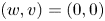 $(w,v)=(0,0)$ at
 $m_{2}=g(m_{1})$. Hence (3.8) gives a local curve of positive solutions of (1.5), which bifurcates from the semitrivial solution
 $(w,z)=(0,\theta _{d_{2},m_{2}})$ at
 $m_{2}=g_{m_1}$ as follows:
Proposition 3.3 Positive solutions of (1.5) bifurcate from the semitrivial solution  $(w,v)=(0,\theta _{d_{2},m_{2}})$ if and only if
 $m_{2}=g(m_{1})$. More precisely, there exist a neighbourhood
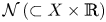 $\mathcal {N}\,(\subset X\times \mathbb {R})$ of
 $(0,\theta _{d_{2},g(m_{1})},g(m_{1}))$ and a positive number
 $\delta$ such that all positive solutions contained in
 $\mathcal {N}$ form a smooth simple curve
 \[ \mathcal{C}^{+}_{p}\ :\ \ \ \left[ \begin{array}{c} w\\ v\\ m_{2} \end{array} \right] (s) = \left[ \begin{array}{c} 0\\ \theta_{d_{2},g(m_{1})}\\ g(m_{1}) \end{array} \right] + \left[ \begin{array}{l} s(\phi^{*}+\widetilde{\phi}(s))\\ s(\psi^{*}+\widetilde{\psi}(s))\\ \mu(s) \end{array} \right] \ \ \ (0< s<\delta), \]
where 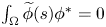 $\int _{\Omega }\widetilde {\phi }(s)\phi ^{*}=0$ and
 $(\widetilde {\phi }(0), \widetilde {\psi }(0), \mu (0))=(0,0,0)$.
3.3 Completion of the proof of theorem 2.1
This subsection is devoted to the completion of the proof of theorem 2.1.
Proof of theorem 2.1. Let  $\varGamma ^{\infty }_{2}$ be the connected component of
 \[ \{ (w,v,m_2 )\in (X\times \mathbb{R})\setminus \{ (0,\theta_{d_{2},g(m_{1})},g(m_{1}))\} :F(w,v-\theta_{d_{2},m_{2}},m_{2})=0\} \]
which contains  $\mathcal {C}^{+}_{p}$, where
 $F$ is the operator defined by (3.11) and
 $\mathcal {C}^{+}_{p}$ is the local bifurcation branch obtained in proposition 3.3. We define
 \[ P:=\{ (w,v)\in X\,:\, w>0,\ v>0\ \mbox{in}\ \Omega\ \ \mbox{and}\ \ \partial_{\nu}w<0,\ \partial_{\nu}v<0 \ \mbox{on}\ \partial\Omega\}, \]
where  $\nu$ is the outer unit normal vector on
 $\partial \Omega$. First we will show
 \begin{equation} \varGamma^{\infty }_{2}\subset P\times \mathbb{R} \end{equation}
by contradiction. Suppose that 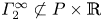 $\varGamma ^{\infty }_{2}\not \subset P\times \mathbb {R}$. Then
 $\varGamma ^{\infty }_{2}$ reaches a point
 \begin{equation} (w^{*} ,v^{*}, m_{2}^{*})\in (\partial P\times\mathbb{R})\setminus \{ (0,\theta_{d_{2},g(m_{1})},g(m_{1}))\} . \end{equation}
By virtue of the elliptic regularity theory and the strong maximum principle (e.g. [Reference Gilbarg and Trudinger7]), one of the following (a)–(c) must occur:
(a)
$w^{*} =v^{*} =0$ in $\Omega$;(b)
$w^{*} >0$ and $v^{*} =0$ in $\Omega$;(c)
$w^{*} =0$ and $v^{*} >0$ in $\Omega$.


Note that  $(w^{*} ,v^{*} )$ is a solution of (1.5) with
 $m_2 =m_{2}^{*}$. Then case (b) cannot occur because of the assumption
 $m_1 >d_1 \lambda _1$. If case (c) holds, then
 $(w^{*} ,v^{*} )=(0,\theta _{d_{2},m_{2}^{*}})$, and
 $m_{2}^{*}=g(m_1 )$ by proposition 3.3, namely,
 $(w^{*} ,v^{*}, m_{2}^{*})=(0,\theta _{d_{2},g(m_{1})},g(m_{1}))$. This contradicts (3.22). Furthermore, we can show that case (a) gives a contradiction by the same argument as in the proof of theorem 4.7 in the previous paper [Reference Oeda and Kuto32]. Therefore, the assertion (3.21) holds true.
Next we will prove the assertion (i) of theorem 2.1. According to the unilateral global bifurcation theorem by López-Gómez [Reference López-Gómez22, theorem 6.4.3] (see also [Reference Shi and Wang36]),  $\varGamma ^{\infty }_{2}$ satisfies one of the following:
(a)
$\varGamma ^{\infty }_{2}$ is not compact in $X\times \mathbb {R}$;(b)
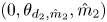
$\varGamma ^{\infty }_{2}$ contains a point $(0, \theta _{d_{2}, \hat {m}_{2}}, \hat {m}_{2})$ with $\hat {m}_{2}\neq g(m_{1})$;(c)
$\varGamma ^{\infty }_{2}$ contains a point $(h, \theta _{d_{2}, m_{2}}+k, m_{2})\in X\times \mathbb {R}$ with some $(h, k, m_{2})\in (X\setminus \{(0, 0)\})\times \mathbb {R}$ satisfying $\int _{\Omega }h\phi ^{*}=0$, where $\phi ^{*}$ is the positive function stated in proposition 3.3.







By (3.21), the second alternative (b) cannot occur. The third alternative (c) is also impossible because of (3.21) and  $\phi ^{*}>0$. Therefore, the first alternative (a) must hold. By lemmas 3.1 and 3.2, the
 $(v, m_{2})$ component of
 $\varGamma ^{\infty }_{2}$ is uniformly bounded in
 $L^{\infty }(\Omega )\times \mathbb {R}$. Then by applying the elliptic estimate (e.g. [Reference Gilbarg and Trudinger7]) to the second equation of (1.5), we find that the
 $(v, m_{2})$ component of
 $\varGamma ^{\infty }_{2}$ is uniformly bounded in
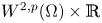 $W^{2,p}(\Omega )\times \mathbb {R}$ for any
 $p>1$. Hence the
 $w$ component of
 $\varGamma ^{\infty }_{2}$ must be unbounded in
 $W^{2,p}(\Omega )$ for any
 $p>1$. Moreover, applying the elliptic estimate to the first equation of (1.5), we see that for any
 $p>1$, there exist two positive constants
 $C_1$ and
 $C_2$ such that
 \[ \| w\|_{W^{2,p}}\le C_1 \left\| \dfrac{w(m_{1}-cv)}{d_{1}}\right\|_p \le C_2 \| w\|_p \]
for any  $(w,v)$ with
 $(w,v,m_{2})\in \varGamma ^{\infty }_{2}$. Consequently, the
 $w$ component of
 $\varGamma ^{\infty }_{2}$ is unbounded in
 $L^{p} (\Omega )$ for any
 $p>1$. This completes the proof of the assertion (i).
Finally, we will prove the assertion (ii). Let  $\{(w_{n}, v_{n}, m_{2,n})\}\subset \varGamma ^{\infty }_{2}$ be any unbounded sequence. Since we have already shown the assertion (i), it holds that
 $\lim _{n\to \infty }\| w_n \|_p =\infty$ by passing to a subsequence if necessary. In addition, the assertion (i) and the Sobolev embedding theorem yield the uniform boundedness of
 $\{ \| v_n \|_{C^{1} (\overline {\Omega })}\}$. Thus, by passing to a subsequence if necessary,
 $\lim _{n\to \infty }v_n =v_{\infty }$ in
 $C^{1} (\overline {\Omega })$ for some non-negative function
 $v_{\infty }\in C^{1} (\overline {\Omega })$. We set
 $\widetilde {w}_{n}:=w_{n}/\|w_{n}\|_{\infty }$. Then
 $\widetilde {w}_{n}$ is a positive solution of
 \begin{equation} d_{1}\Delta \widetilde{w}_{n}+\widetilde{w}_{n}(m_1 -cv_n )=0\ \ \mbox{in}\ \Omega,\qquad \widetilde{w}_{n}=0\ \ \mbox{on}\ \partial\Omega . \end{equation}
It follows from lemmas 3.1 and 3.2 that
 \[ \| \widetilde{w}_{n}(m_1 -cv_n )\|_{\infty} \le \| m_1 -cv_n \|_{\infty}\le C \]
for some positive constant  $C$ independent of
 $n$. Hence we see from the elliptic estimate and the Sobolev embedding theorem that
 $\lim _{n\to \infty }\widetilde {w}_{n}=\widetilde {w}_{\infty }$ in
 $C^{1} (\overline {\Omega })$ for some non-negative function
 $\widetilde {w}_{\infty }\in C^{1} (\overline {\Omega })$ by passing to a subsequence if necessary. Setting
 $n\to \infty$ in (3.23), we have
 \begin{equation} d_{1}\Delta \widetilde{w}_{\infty}+\widetilde{w}_{\infty}(m_1 -cv_{\infty})=0\ \ \mbox{in}\ \Omega,\qquad \widetilde{w}_{\infty}=0\ \ \mbox{on}\ \partial\Omega . \end{equation}
Since  $\widetilde {w}_{\infty }\ge 0$ in
 $\Omega$ and
 $\| \widetilde {w}_{\infty }\|_{\infty }=1$, we obtain
 $\widetilde {w}_{\infty }>0$ in
 $\Omega$ by the strong maximum principle. Then it holds that
 \begin{equation} \lim_{n\to \infty}w_n =\lim_{n\to \infty}\|w_{n}\|_{\infty}\widetilde{w}_{n}=\infty\ \ \mbox{uniformly in any compact subset of } \Omega \end{equation}
because of  $\lim _{n\to \infty }\|w_{n}\|_{\infty }=\infty$ by passing to a subsequence if necessary. Therefore, together with lemma 3.2, we obtain
 \[ \lim_{n\to \infty}\dfrac{v_{n}}{d_{2}+w_{n}}\biggl\{ \dfrac{w_{n}}{d_{1}}(m_{1}-cv_{n})+m_{2,n}-v_{n}\biggr\}=\dfrac{v_{\infty}}{d_{1}}(m_{1}-cv_{\infty}) \]
uniformly in any compact subset of  $\Omega$. Setting
 $n\to \infty$ in (1.5) with
 $(m_{2},w,v)=(m_{2,n},w_{n},v_{n})$, we see that
 $v_{\infty }$ is a weak non-negative solution of
 \begin{equation} d_{1}\Delta v_{\infty}+v_{\infty}(m_1 -cv_{\infty})=0\ \ \mbox{in}\ \Omega,\qquad v_{\infty}=0\ \ \mbox{on}\ \partial\Omega . \end{equation}
The Schauder estimate ensures 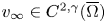 $v_{\infty }\in C^{2,\gamma }(\overline {\Omega })$ for any
 $\gamma \in (0,1)$. By (3.26), we have
 \[ d_{1}\Delta (cv_{\infty})+cv_{\infty}(m_1 -cv_{\infty})=0\ \ \mbox{in}\ \Omega,\qquad cv_{\infty}=0\ \ \mbox{on}\ \partial\Omega . \]
Thus it holds that  $v_{\infty }=\theta _{d_{1},m_{1}}/c$ or
 $v_{\infty }=0$ in
 $\Omega$. If
 $v_{\infty }=0$, then
 $m_{1}=d_{1}\lambda _{1}$ must hold because of (3.24) and
 $\widetilde {w}_{\infty }>0$ in
 $\Omega$. This contradicts the assumption
 ${m_{1}>d_{1}\lambda _{1}}$. Hence
 $v_{\infty }=\theta _{d_{1},m_{1}}/c$. It follows from (3.24) that
 \[ \begin{cases} d_{1}\Delta \widetilde{w}_{\infty}+\widetilde{w}_{\infty}(m_{1}-\theta_{d_{1},m_{1}})=0\ \ \mbox{in}\ \Omega,\qquad \widetilde{w}_{\infty}=0\ \ \mbox{on}\ \partial\Omega,\\ \widetilde{w}_{\infty}>0\ \ \mbox{in}\ \Omega,\qquad \|\widetilde{w}_{\infty}\|_{\infty}=1. \end{cases} \]
Therefore,  $\widetilde {w}_{\infty }=\theta _{d_{1},m_{1}}/\|\theta _{d_{1},m_{1}}\|_{\infty }$. Thus it only remains to show that
 $\lim _{n\to \infty }m_{2,n}=h(m_{1})$ by passing to a subsequence if necessary. By the Gauss–Green theorem, we integrate (3.1) with
 $(w,v,m_{2})=(w_{n},v_{n},m_{2,n})$ over
 $\Omega$ to obtain
 \[ d_{2}\int_{\Omega}\Delta v_{n}+\int_{\Omega}v_{n}(m_{2,n}-v_{n})=0 \]
for any  $n\in \mathbb {N}$. Then by (1.5), we have
 \[{-}d_{2}\int_{\Omega}\dfrac{v_{n}}{d_{2}+w_{n}}\biggl\{ \dfrac{w_{n}}{d_{1}}(m_{1}-cv_{n})+m_{2,n}-v_{n}\biggr\}+\int_{\Omega}v_{n}(m_{2,n}-v_{n})=0 \]
for any  $n\in \mathbb {N}$. Setting
 $n\to \infty$ in the above equality, we find from lemma 3.2, (3.25) and
 $\lim _{n\to \infty }v_{n}=\theta _{d_{1},m_{1}}/c$ in
 $C^{1} (\overline {\Omega })$ that
 \[ -\dfrac{d_{2}}{d_{1}}\int_{\Omega}\dfrac{\theta_{d_{1},m_{1}}}{c}(m_{1}-\theta_{d_{1},m_{1}})+\int_{\Omega}\dfrac{\theta_{d_{1},m_{1}}}{c}\left( \lim_{n\to \infty}m_{2,n}-\dfrac{\theta_{d_{1},m_{1}}}{c}\right) =0. \]
In view of (2.1), we obtain  $\lim _{n\to \infty }m_{2,n}=h(m_{1})$. Therefore, the proof of theorem 2.1 is complete.
Remark 3.4 We should refer to a global bifurcation result by Lopez-Gomez [Reference López-Gómez22, theorem 7.2.2], which exhibits all the possible behaviours of the branch of positive solutions bifurcating from a semitrivial solution to a class of the diffusive Lotka–Volterra systems. Although the proof of theorem 2.1 can be slightly simplified by using [Reference López-Gómez22, theorem 7.2.2] directly, we have given the proof in a way that uses his unilateral global bifurcation theorem [Reference López-Gómez22, theorem 6.4.3] with respect, which is one of the origins of [Reference López-Gómez22, theorem 7.2.2].
4. Perturbation of solutions of limiting systems
In this section, we give a proof of theorem 2.2.
Proof of theorem 2.2. To construct the bifurcation branch of positive solutions of (1.1), we employ a Lyapunov–Schmidt reduction procedure with a perturbation parameter
 \begin{equation*} \varepsilon=\dfrac{1}{\alpha}. \end{equation*}
It is easy to check that the original system (1.1) is equivalent to the following form:
 \begin{equation} \begin{cases} d_{1}\Delta u+u(m_{1}-u-cv)=0\ \ & \mbox{in}\ \Omega,\\ d_{1}\Delta v+v(m_{1}-u-cv)\ + \dfrac{\varepsilon v}{\varepsilon d_{2}+u}\\ \quad\times \left\{{-}d_{2} (m_{1}-u-cv)+ d_{1} (m_{2}+bu-v) \right\}=0 \ \ & \mbox{in}\ \Omega,\\ u=v=0\ \ & \mbox{on}\ \partial\Omega,\\ u\ge 0,\ \ v\ge 0\ \ & \mbox{in}\ \Omega. \end{cases}\end{equation}
In view of the first-limiting case (i) stated in § 1, we recall the asymptotic behaviour of solutions  $(u_{n}, v_{n}, m_{2})$ of (4.1) converges to a point on the segment
 $\varGamma ^{\infty }_{1}$ as
 $\varepsilon =\varepsilon _{n}\to +0$. As the perturbation when
 $\varepsilon >0$ is small, near the segment
 $\varGamma ^{\infty }_{1}$:
 \[ (u,v,m_{2})= \left((1-s)\theta_{d_{1},m_{1}}, \dfrac{s}{c}\theta_{d_{1},m_{1}}, (1-s)f^{\infty}(m_{1})+sh(m_{1})\right), \]
we seek for solutions of (4.1) in the form
 \begin{equation} (u,v)=\biggl(1-s,\dfrac{s}{c}\biggr)\theta_{d_{1},m_{1}}+ \varepsilon\,(U, V). \end{equation}
Substituting the above decomposition into the left-hand side of (4.1), we introduce the operator  $G\,:\,X\times \mathbb {R}\times \mathbb {R}\times [0,1] \to Y$ by
 \begin{equation} G(U,V,m_{2}, \varepsilon, s) := L(s) \left[ \begin{array}{c} U\\ V \end{array} \right] +\left[ \begin{array}{l} 0\\ q(U,m_{2},\varepsilon, s) \end{array} \right] +\varepsilon\left[ \begin{array}{l} r_{1}(U,V)\\ r_{2}(U,V,m_{2}, \varepsilon, s) \end{array} \right], \end{equation}
where
 \begin{equation} L(s)\left[ \begin{array}{cc} U\\ V \end{array} \right] = \left[ \begin{array}{l} d_{1}\Delta U+(m_{1}-\theta_{d_{1},m_{1}})U- (1-s)\theta_{d_{1},m_{1}}(U+cV)\\ d_{1}\Delta V+(m_{1}-\theta_{d_{1}, m_{1}})V- \dfrac{s}{c}\theta_{d_{1}, m_{1}}(U+cV) \end{array} \right] \end{equation}
and
 \begin{equation} \begin{split} q(U,m_{2},\varepsilon,s) := & \dfrac{s\theta_{d_{1},m_{1}}} {c(\varepsilon d_{2}+(1-s)\theta_{d_{1}, m_{1}} +\varepsilon U)} \bigg[{-}d_{2}(m_{1}-\theta_{d_{1},m_{1}} )\\ & +d_{1}\biggl\{ m_{2}+\biggl( b(1-s)-\dfrac{s}{c}\biggr)\theta_{d_{1}, m_{1}} \biggr\}\bigg] \end{split} \end{equation}
and
 \begin{equation*} \begin{cases} & r_{1}(U,V):={-}U(U+cV),\\ & r_{2}(U,V,m_{2},\varepsilon,s):={-}V(U+cV)\\ & + \dfrac{V} {\varepsilon d_{2}+(1-s)\theta_{d_{1}, m_{1}}+\varepsilon U} \bigg[{-}d_{2}\{m_{1}-\theta_{d_{1},m_{1}} -\varepsilon (U+cV) \}\\ & \quad+d_{1}\biggl\{ m_{2}+\biggl( b(1-s)-\dfrac{s}{c}\biggr)\theta_{d_{1}, m_{1}} +\varepsilon (bU-V) \biggr\}\bigg]\\ & + \dfrac{s\theta_{d_{1},m_{1}}} {c(\varepsilon d_{2}+(1-s)\theta_{d_{1}, m_{1}}+\varepsilon U)} \left\{ d_{2}(U+cV)+d_{1}(bU-V)\right\}. \end{cases} \end{equation*}
Here we note that  $q$ is independent of
 $V$. Our strategy is to construct solutions of the equation
 $G(U,V,m_{2}, \varepsilon ,s)=0$ by a combination of the Lyapunov–Schmidt reduction and a perturbation procedure. As the first step of the method, we consider the linear operator
 $L(s)\,:\,X\to Y$ defined by (4.4) for each
 $s\in [0,1]$. In order to obtain
 $\mbox {Ker}\,L(s)$, we solve the Dirichlet problem of the following linear elliptic equations
 \begin{equation} \begin{cases} d_{1}\Delta\phi+(m_{1}-\theta_{d_{1},m_{1}})\phi-(1-s) \theta_{d_{1},m_{1}}(\phi+c\psi)=0\ \ & \mbox{in}\ \Omega,\\ d_{1}\Delta\psi+(m_{1}-\theta_{d_{1},m_{1}})\psi-\frac{s}{c}\theta_{d_{1},m_{1}}(\phi+c\psi)=0\ \ & \mbox{in}\ \Omega,\\ \phi=\psi=0\ \ & \mbox{on}\ \partial\Omega. \end{cases} \end{equation}
Multiplying the second equation by  $c$ and adding the first equation, we see
 \[ \begin{cases} -d_{1}\Delta (\phi +c\psi) +2\theta_{d_{1},m_{1}}(\phi+c\psi )=m_{1}(\phi+c\psi) \ \ & \mbox{in}\ \Omega,\\ \phi=\psi=0\ \ & \mbox{on}\ \partial\Omega. \end{cases} \]
Since  $m_{1}$ is the least eigenvalue of
 $-d_{1}\Delta +\theta _{d_{1},m_{1}}$ with the Dirichlet boundary condition, then
 $m_1$ is less than the least eigenvalue of
 $-d_{1}\Delta +2\theta _{d_{1},m_{1}}$ with the Dirichlet boundary condition, that is,
 $-d_{1}\Delta +2\theta _{d_{1},m_{1}}-m_{1}$ is invertible. Therefore, we see that
 $\phi +c\psi =0$ in
 $\Omega$. In view of (4.6), we know that
 $\phi =\tau c\theta _{d_{1},m_{1}}$ and
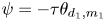 $\psi =-\tau \theta _{d_{1},m_{1}}$ for any
 $\tau$, namely,
 \begin{equation} \mbox{Ker}\,L(s)=\mbox{Span} \{\boldsymbol{e}\}, \quad\mbox{where}\quad \boldsymbol{e}:= \biggl[\begin{array}{c} c\\-1\end{array}\biggr]\theta_{d_{1},m_{1}}. \end{equation}
We recall (4.2) to note that
 \begin{equation} (u,v)=(\theta_{d_{1,m_1}},0)+ s\underbrace{\biggl({-}1,\dfrac{1}{c}\biggr) \theta_{d_1,m_1}}_{{\in}\,{\scriptsize \mbox{Ker}}\,L(s)}+ \varepsilon (U,V). \end{equation}
Then for the application of the Lyapunov–Schmidt reduction for
 \begin{equation} G(U,V,m_{2},\varepsilon,s)=0, \end{equation}
we employ a reasonable decomposition in (4.8) as follows:
 \[ (U,V)\in X_{1}:=\{(U,V)\in X\,|\, \langle\,^{t}(U,V),\boldsymbol{e}\rangle=0\,\}. \]
Concerning  $\mbox {Ran}\,L(s)$, the Fredholm alternative theorem enables us to see that
 \begin{equation} \mbox{Ran}\,L(s)=\mbox{Ker}\,L^{*}(s)^{\bot} \quad\mbox{in}\quad Y, \end{equation}
where  $L^{*}(s)$ is the adjoint operator of
 $L(s)$ as follows:
 \begin{equation*} \begin{split} L^{*}(s)\left[ \begin{array}{c} \phi\\ \psi \end{array} \right] =\left[\begin{array}{l} d_{1}\Delta\phi+(m_{1}-\theta_{d_{1},m_{1}})\phi-(1-s) \theta_{d_{1},m_{1}}\phi-\dfrac{s}{c}\theta_{d_{1},m_{1}}\psi\\ d_{1}\Delta\psi+(m_{1}-\theta_{d_{1},m_{1}})\psi-s\theta_{d_1,m_1}\psi -c(1-s)\theta_{d_1,m_1}\phi \end{array}\right]. \end{split} \end{equation*}
By the same procedure to get  $\mbox {Ker}\,L(s)$, we obtain
 \begin{equation} \mbox{Ker}\,L^{*}(s)=\mbox{Span} \{{\boldsymbol{e}}^{*}(s)\}, \quad\mbox{where}\quad {\boldsymbol{e}}^{*}(s):= \biggl[\begin{array}{c} s\\-c(1-s)\end{array}\biggr]\theta_{d_{1},m_{1}}. \end{equation}
By virtue of (4.7)–(4.11), we define a projection  $P(s)\,:\,Y\to L(s)$ by
 \begin{equation} \begin{split} P(s)\left[\begin{array}{c} y\\ z \end{array}\right] & = \dfrac{\langle\,^{t}[y,z],{\boldsymbol{e}}^{*}\rangle} {\langle{e}, {e}^{*}\rangle}{\boldsymbol{e}}\\ & = \dfrac{1}{c\|\theta_{d_{1},m_{1}}\|^{2}_{2}}\biggl( s\int_{\Omega}\theta_{d_{1},m_{1}}y-c(1-s)\int_{\Omega}\theta_{d_{1},m_{1}}z\biggr)\,{\boldsymbol{e}}. \end{split} \end{equation}
Then it is easy to check that 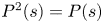 $P^{2}(s)=P(s)$ and
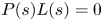 $P(s)L(s)=0$ for any
 $s\in [0,1]$. Equation (4.9) is decomposed into the one-dimensional
 $\mbox {Span}\,\{\boldsymbol {e}\}$ component:
 \begin{equation} P(s)G(U,V,m_{2},\varepsilon,s)=0, \end{equation}
and the infinitely dimensional  $\mbox {Ran}\,L(s)$ component:
 \begin{equation} G^{\bot}(U,V,m_{2},\varepsilon,s):= (I-P(s))G(U,V,m_{2},\varepsilon,s)=0. \end{equation}
We first solve (4.13)–(4.14) in the case when  $\varepsilon =0$. By setting
 $\varepsilon =0$ in (4.3), we see that
 \[ P(s)G(U,V,m_{2},0,s)=P(s) \biggl[ \begin{array}{c} 0\\ q(U,m_{2},0,s) \end{array} \biggr] \]
because of 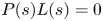 $P(s)L(s)=0$. It follows from (4.5) and (4.12) that
 $P(s)G(U,V, m_{2},0,s)=0$ is equivalent to
 \begin{equation*} \begin{split} & -c(1-s)\displaystyle\int_{\Omega} \theta_{d_{1}, m_{1}} q(U,m_{2},0,s)\\ & \quad= s\displaystyle\int_{\Omega} \biggl[d_{2}(m_{1}-\theta_{d_{1},m_{1}}) -d_{1}\biggl\{ m_{2}+\biggl( b(1-s)-\dfrac{s}{c}\biggr)\theta_{d_{1},m_{1}}\biggr\} \biggr] \theta_{d_{1},m_{1}}=0, \end{split} \end{equation*}
which is solved by
 \[ m_{2}=(1-s)f^{\infty}(m_{1})+sh(m_{1})\, (=:m_{2}^{0}(s)) \]
for any  $(U,V)\in X_{1}$ and
 $s\in (0,1)$. Then it suffices to solve
 \[ (I-P(s))G(U,V,m_{2}^{0}(s),0,s)=0, \]
which is expressed as
 \begin{align*} L^{\bot}(s)\left[ \begin{array}{c} U\\ V \end{array} \right]&= \dfrac{s}{c(1-s)}(I-P(s)) \\ &\quad \times\left[ \begin{array}{l} 0\\ d_{2}(m_{1}-\theta_{d_{1},m_{1}}) -d_{1}\biggl\{ m_{2}^{0}(s)+\biggl( b(1-s)-\dfrac{s}{c}\biggr)\theta_{d_{1}, m_{1}} \biggr\} \end{array} \right], \end{align*}
where
 \[ L^{\bot}(s):=L(s)|_{X_{1}}\,:\, X_{1}\to Y \]
is an isomorphism. Therefore, we know that
 \begin{equation} G(U_{0}(s), V_{0}(s), m_{2}^{0}(s), 0, s)=0 \ \ \mbox{for any}\ \ s\in (0,1), \end{equation}
where
 \begin{align*} \left[ \begin{array}{c} U_{0}(s)\\ V_{0}(s) \end{array} \right]&:= \dfrac{s}{c(1-s)}(L^{\bot})^{{-}1}(s)(I-P(s))\\ &\quad \times \left[ \begin{array}{l} 0\\ d_{2}(m_{1}-\theta_{d_{1},m_{1}}) -d_{1}\biggl\{ m_{2}^{0}(s)+\biggl( b(1-s)-\dfrac{s}{c}\biggr)\theta_{d_{1}, m_{1}} \biggr\} \end{array} \right].\end{align*}
In view of (4.3) and the left-hand side of (4.14), we note that
 \[ G^{\bot}(U,V,m_{2},\varepsilon,s)\,:\, X_{1}\times\mathbb{R}\times\mathbb{R}\times [0,1]\to \mbox{Ran}\,L(s) \]
is represented as
 \begin{equation*} \begin{split} G^{\bot}(U,V,m_{2}, \varepsilon, s)= & L^{\bot}(s) \left[ \begin{array}{c} U\\ V \end{array} \right] +(I-P(s))\left[ \begin{array}{c} 0\\ q(U,m_{2},\varepsilon, s) \end{array} \right]\\ & +\varepsilon (I-P(s))\left[ \begin{array}{c} r_{1}(U,V)\\ r_{2}(U,V,m_{2}, \varepsilon, s) \end{array} \right]. \end{split} \end{equation*}
It follows that the Fréchet derivative  $G^{\bot }_{(U,V)}(U_{0}(s), V_{0}(s), m^{0}_{2}(s), 0, s)$ satisfies
 \begin{equation*} \begin{split} G^{\bot}_{(U,V)}(U_{0}(s),V_{0}(s),m_{2}^{0}(s),0,s) \left[ \begin{array}{c} \phi\\ \psi \end{array} \right] & = L^{\bot}(s)\left[ \begin{array}{c} \phi\\ \psi \end{array} \right] +(I-P(s)) \left[ \begin{array}{c} 0\\ q_{U}^{0}\phi \end{array} \right]\\ & =L^{\bot}(s)\left[ \begin{array}{c} \phi\\ \psi \end{array} \right] \end{split} \end{equation*}
since (4.5) implies  $q^{0}_{U}:= q_{U}(U_{0}(s),m_{2}^{0}(s),0,s)=0$. Therefore, we know that
 $G^{\bot }(U_{0}(s), V_{0}(s), m_{2}^{0}(s), 0, s)=0$, and moreover,
 \[ G^{\bot}_{(U,V)} (U_{0}(s), V_{0}(s), m_{2}^{0}(s), 0, s)\,:\, X_{1}\to Y \]
is invertible for  $s\in (0,1)$. Then the implicit function theorem with usual compactness arguments ensures that, for any fixed small
 $\delta >0$, there exists a tubular neighbourhood
 $\mathcal {N}_{\delta } \subset X_{1}\times \mathbb {R}\times \mathbb {R} \times \mathbb {R}$ of
 \[ \{ (U_{0}(s),V_{0}(s),m_{2}^{0}(s),0,s)\,|\, s\in [\delta,1-\delta]\} \]
such that all solutions of  $G^{\bot }(U,V,m_{2},\varepsilon ,s)=0$ in
 $\mathcal {N}_{\delta }$ can be expressed as
 \[ U=U(m_{2}, \varepsilon, s) \ \ \mbox{and}\ \ V=V(m_{2}, \varepsilon, s), \]
where  $U$ and
 $V$ are functions of
 $C^{1}$ class satisfying
 \[ U(m_{2}^{0}(s), 0 ,s)=U_{0}(s) \ \ \mbox{and}\ \ V(m_{2}^{0}(s), 0, s)=V_{0}(s) \]
for all  $s\in [\delta , 1-\delta ]$. Then substituting these
 $U$ and
 $V$ into the left-hand side of (4.13), we define a function
 $G^{1}(m_{2},\varepsilon ,s)$ as
 \[ G^{1}(m_{2},\varepsilon,s)\boldsymbol{e}:= P(s)G(U(m_{2}, \varepsilon, s), V(m_{2}, \varepsilon, s), m_{2}, \varepsilon, s). \]
By (4.3), (4.12) and the fact 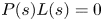 $P(s)L(s)=0$, we see
 \begin{equation*} \begin{split} G^{1}(m_{2},\varepsilon,s) & ={-}\dfrac{1-s}{\|\theta_{d_{1},m_{1}}\|^{2}_{2}} \displaystyle\int_{\Omega} \theta_{d_{1}, m_{1}}\, q(U(m_{2}, \varepsilon, s), m_{2}, \varepsilon, s) +O(\varepsilon )\\ & =\dfrac{s(1-s)}{c\|\theta_{d_{1},m_{1}}\|^{2}_{2}} \displaystyle\int_{\Omega} \dfrac{\theta_{d_{1},m_{1}}^{2}} {\varepsilon d_{2}+(1-s)\theta_{d_{1},m_{1}}+ \varepsilon U(m_{2},\varepsilon ,s)}\\ & \quad\times \biggl[d_{2}(m_{1}-\theta_{d_{1},m_{1}}) -d_{1}\biggl\{ m_{2}+\biggl( b(1-s)-\dfrac{s}{c}\biggr)\theta_{d_{1},m_{1}}\biggr\} \biggr] +O(\varepsilon ). \end{split} \end{equation*}
Therefore, we see that
 \[ G_{m_{2}}^{1}(m_{2}^{0}(s), 0, s)={-}\dfrac{d_{1}s\|\theta_{d_{1},m_{1}}\|_{1}} {c\|\theta_{d_{1},m_{1}}\|^{2}_{2}}<0. \]
In addition, (4.15) implies  $G^{1}(m_{2}^{0}(s),0,s)=0$ for any
 $s\in (0,1)$. Then by the implicit function theorem, for any fixed
 $s_{*}\in (0,1)$, there exist small positive numbers
 $\delta _{*}$,
 $\varepsilon _{*}$ and
 $\sigma _{*}$ such that all solutions of
 $G^{1}(m_{2},\varepsilon ,s)=0$ in
 \begin{equation} \mathcal{N}_{*}:= \{(m_{2}, \varepsilon, s)\in\mathbb{R}^{3}\,:\, |m_{2}-m_{2}^{0}(s_{*})|,\ |\varepsilon|,\ |s-s_{*}|<\delta_{*}\} \end{equation}
can be expressed as
 \begin{equation} m_{2}=m_{2}(\varepsilon, s) \ \ \mbox{for}\ \ |\varepsilon|<\varepsilon_{*},\ |s-s_{*}|<\sigma_{*}, \end{equation}
where  $m_{2}(\varepsilon , s)$ is a function of
 $C^{1}$ class satisfying
 $m_{2}(0,s_{*})=m_{2}^{0}(s_{*})$. Here we recall the local curve of positive solutions of (4.1) bifurcating from the semitrivial solution
 $(u,v)=(\theta _{d_{1},m_{1}}, 0)$ at
 $m_2=f(m_{1},1/\varepsilon )$ as follows:
Lemma 4.1 Let  $\varepsilon >0$ and
 $m_{1}\in (d_{1}\lambda _{1},\infty )$ be given arbitrarily. Positive solutions of (4.1) bifurcate from
 $(u,v)=(\theta _{d_{1},m_{1}}, 0)$ if and only if
 $m_{2}=f(m_{1},1/\varepsilon )$. To be precise, there exists a neighbourhood
 $\mathcal {O}_{1}$ of
 $(u,v,m_{2})=(\theta _{d_{1},m_{1}}, 0, f(m_{1}, 1/\varepsilon ))\in X\times \mathbb {R}$ such that all positive solutions of (4.1) in
 $\mathcal {O}_{1}$ form a curve of
 $C^{1}$ class as follows
 \begin{equation} \varGamma_{\varepsilon}\ :\ \left[ \begin{array}{c} u\\ v\\ m_{2} \end{array} \right](s) = \left[ \begin{array}{c} \theta_{d_{1},m_{1}}\\ 0\\ f(m_{1},1/\varepsilon ) \end{array} \right] + \left[ \begin{array}{c} s(\phi_{\varepsilon }^{*}+\tilde{u}_{\varepsilon}(s))\\ s(\psi_{\varepsilon }^{*}+\tilde{v}_{\varepsilon}(s))\\ \mu_{\varepsilon}(s) \end{array} \right] \ \ \ \mbox{for}\ \ s\in (0, \sigma_{\varepsilon} ) \end{equation}
with some  $\sigma _{\varepsilon } >0$. Here
 $(\phi ^{*}_{\varepsilon },\psi ^{*}_{\varepsilon })\in X$ is some function with
 $\psi ^{*}_{\varepsilon }>0$ in
 $\Omega$ and
 $(\tilde {u}_{\varepsilon }, \tilde {v}_{\varepsilon }, \mu _{\varepsilon } )(s)\in X\times \mathbb {R}$ is continuously differentiable for
 $s\in (0, \sigma _{\varepsilon } )$ satisfying
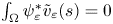 $\int _{\Omega }\psi ^{*}_{\varepsilon }\tilde {v}_{\varepsilon }(s)=0$ for all
 $s\in (0, \sigma _{\varepsilon })$ and
 $(\tilde {u}_{\varepsilon }, \tilde {v}_{\varepsilon }, \mu _{\varepsilon } )(0)=(0,0,0)$.
It follows from (4.8) and (4.18) that all positive solutions of  $G(U,V,m_{2},\varepsilon ,s)=0$ near
 $s=0$ can be expressed by
 \[ \left[ \begin{array}{c} U\\ V \end{array} \right]= \dfrac{s}{\varepsilon} \left( \biggl[ \begin{array}{c} \phi_{\varepsilon }^{*}+\widetilde{u}_{\varepsilon}(s)\\ \psi_{\varepsilon }^{*}+\widetilde{v}_{\varepsilon}(s) \end{array} \biggr] - \left[ \begin{array}{c} -1\\ 1/c \end{array} \right] \theta_{d_{1},m_{1}} \right) \]
and
 \[ m_{2}(s)=f(m_{1},1/\varepsilon)+\mu_{\varepsilon }(s). \]
By virtue of a perturbation theorem in the local bifurcation theory [Reference Crandall and Rabinowitz4, remark 3.3], we see that, as  $\varepsilon \to 0$, the local curve
 $\varGamma _{\varepsilon }$ converges to
 \begin{equation*} \left[ \begin{array}{c} u\\ v\\ m_{2} \end{array} \right](s) = \left[ \begin{array}{c} \theta_{d_{1},m_{1}}\\ 0\\ f^{\infty}(m_{1}) \end{array} \right] +s \left[ \begin{array}{c} -\theta_{d_{1},m_{1}}\\ \theta_{d_{1},m_{1}}/c \\ - f^{\infty}(m_{1})+h(m_{1}) \end{array} \right] \ \ \ \mbox{for}\ \ s\in (0, \sigma_{0} ) \end{equation*}
with some  $\sigma _{0}>0$. For any small
 $\eta >0$,
 \[ \{\,(m_{2}^{0}(s), 0, s)\in\mathbb{R}^{3}\,:\, s\in [0,1-\eta]\,\} \subset \mathcal{N}_{0}\cup\bigcup_{0< s_{*}<1-\eta} \mathcal{N}_{s_{*}}, \]
where  $\mathcal {N}_{0}:=\{(m_{2}, \varepsilon , s)\,:\, |m_{2}-m_{2}^{0}(0)|<2\sigma _{0}, \ |\varepsilon |<2\sigma _{0},\ |s|<2\sigma _{0}\}$. Thanks to the combination of the segment on the left-hand side, there exist
 \[ 0< s_{1}< s_{2}<\cdots< s_{n}<1-\eta, \]
with some integer  $n=n(\eta )$ such that
 \begin{equation} \begin{cases} \{\,(m_{2}^{0}(s), 0, s)\in\mathbb{R}^{3}\,:\, s\in [0,1-\eta]\,\}\subset \bigcup\limits_{j=0}^{n}\mathcal{N}_{j},\\ \mathcal{N}_{j-1}\cap\mathcal{N}_{j}\neq\emptyset,\ \ j=1,2,\ldots,n, \end{cases} \end{equation}
where  $s_{0}:=0$ and each
 $\mathcal {N}_{j}$ represents the set defined by (4.16) with
 $s_{*}$ is replaced by
 $s_{j}$. As mentioned below (4.16), all solutions of
 $G^{1}(m_{2},\varepsilon ,s)=0$ in
 $\mathcal {N}_{j}$ are expressed as
 \[ \{(m_{2},\varepsilon, s)\in\mathbb{R}^{3}\,:\, m_{2}=m_{2}(\varepsilon, s),\ |\varepsilon|< \varepsilon_{j},\ |s-s_{j}|<\sigma_{j}\,\}. \]
Here we set  $\varepsilon _{\eta }:=\min \{\varepsilon _{1}, \varepsilon _{2},\ldots , \varepsilon _{n}\}$, where
 $\varepsilon _{j}$ is obtained by (4.17) in case
 $s_{*}=s_{j}$. Then in view of (4.19), a usual patchwork procedure implies that all solutions of
 $G^{1}(m_{2},\varepsilon , s)=0$ in
 $\cup ^{n}_{j=0}\,\mathcal {N}_{j}$ can be expressed as
 \[ \{(m_{2},\varepsilon, s)\in\mathbb{R}^{3}\,:\, m_{2}=m_{2}(\varepsilon, s),\ |\varepsilon|< \varepsilon_{\eta},\ 0< s<1-\eta'\,\} \]
with some small  $\eta '>0$. Consequently, we deduce that
 \begin{equation*} G(U(\varepsilon , s), V(\varepsilon, s), m_{2}(\varepsilon, s), \varepsilon, s)=0\ \ \mbox{for any}\ |\varepsilon|< \varepsilon_{\eta},\ s\in [0, 1-\eta'], \end{equation*}
where we denote  $U(m_{2}(\varepsilon , s),\varepsilon , s)$ and
 $V(m_{2}(\varepsilon , s), \varepsilon , s)$ by
 $U(\varepsilon , s)$ and
 $V(\varepsilon , s)$, respectively. Then we know that for any
 $\varepsilon \in (0,\varepsilon _{\eta }]$, the set
 \begin{equation} \begin{split} & \bigg\{\,(u(\varepsilon, s),v(\varepsilon, s), m_{2}(\varepsilon,s),\varepsilon, s)\,:\, 0<\varepsilon<\varepsilon_{\eta},\ s\in[0,1-\eta'],\\ & (u(\varepsilon, s) ,v(\varepsilon, s))=(\theta_{d_{1},m_{1}}, 0)+ s\biggl({-}1,\dfrac{1}{c}\biggr) \theta_{d_1,m_1}+ \varepsilon (U(\varepsilon ,s),V(\varepsilon, s)) \,\bigg\} \end{split} \end{equation}
consists of positive solutions of (4.1), equivalently, (1.1). Therefore, for any fixed  $\varepsilon \in (0,\varepsilon _{\eta }]$, the set (4.20) forms a curve bifurcating from the semitrivial solution
 $(u,v,m_{2})=(\theta _{d_{1},m_{1}},0,f(m_{1},1/\varepsilon ))$ and lies in a cylindrical domain as a perturbation of the segment
 \[ \{(u,v,m_{2})=(1-s)(\theta_{d_{1},m_{1}},0,f^{\infty}(m_{1}))+s(0,\theta_{d_{1},m_{1}}/c, h(m_{1}))\,:\,s\in [0,1-\eta']\,\}. \]
We remark that this bifurcation curve cannot attain  $(u,v,m_{2})=(0,\theta _{d_{1},m_{1}}, h(m_{1}))$ because this point does not satisfy (4.1). So from the viewpoint of the global bifurcation theorem, the above bifurcation curve must attain the another semitrivial solution
 $(u,v)=(0,\theta _{d_{2},m_{2}})$ at
 $m_{2}=g(m_{1})$. Then the proof of theorem 2.2 is complete.
Acknowledgements
The first author was supported by JSPS KAKENHI Grant-in-Aid for Scientific Research (C) Grant Number 19K03581.



