Having Never Been Human
The science of epigenetics perhaps only reaffirms what some of us already, viscerally, ancestrally know: trauma is transgenerational (Leary Reference Leary2005; Kowal and Warin Reference Kowal and Warin2018). Epigeneticists study inheritable changes in gene expression, or phenotype, that occur without changes in the underlying genetic code, or genotype. These changes are wrought by all manner of traumatic environmental phenomena, from famine to sleep deprivation to toxic exposure (Barker Reference Barker2007; Wadhwa et al. Reference Wadhwa, Buss, Entringer and Swanson2009; Bellet and Sassone-Corsi Reference Bellet and Sassone-Corsi2010; Sagiv et al. Reference Sagiv, Bruno, Baker, Palzes, Kogut, Rauch, Gunier, Mora, Reiss and Eskenazi2019). In addition to decentering the role of genetic code in determining life, as feminist science scholars have long demonstrated (Keller Reference Keller2002; Reardon Reference Reardon2005; Nelson Reference Nelson2016), epigenetics also destabilizes the hegemonic, Eurocentric ontology of the human. The notion that Christian, White, heterosexual Man is the ultimate figure from whom all “Others” are derived, and thus less than, is an ideology that Black theorists have critiqued since at least the turn of the twentieth century (Du Bois Reference Du Bois1903; Fanon Reference Fanon1967; Wynter Reference Wynter2003; Keel Reference Keel2018). I do not mean to evoke a linear movement here, as if contemporary epigenetics is “catching up” with critical theory. However, recent advances in epigenetics underscore the need for dominant science to be radically rethought—the tools by which we measure and make the world are often complicit in its mismeasure and mismaking (Lorde Reference Lorde1984; Gould Reference Gould2008). In this article I turn to the insights of queer and Black feminist science and technology studies (STS) for such a radical rethinking. I posit that toxicology and epigenetics need queer and Black feminist theory, and that this need is existential. My discursive analysis focuses on toxicological texts about endocrine-disrupting chemicals (EDCs), a class of toxicants that catalyze epigenetic changes (Diamanti-Kandarakis et al. Reference Diamanti-Kandarakis, Bourguignon, Giudice, Hauser, Prins, Soto, Thomas Zoeller and Gore2009). I further suggest that Black feminist biopolitics is especially illuminating, and liberating, because of the ways that Black feminism reconceives the human. Rather than reify what Alexander Weheliye calls the “Western Liberal Man Master-Subject” (Weheliye Reference Weheliye2014), the study of toxicity might refuse the very onto-episteme that rationalized toxic production and deployment in the first place. Queer and Black feminist conceptions, I argue, are necessary for alleviating ongoing toxic inheritances, and for prefiguring more pleasurable, livable lives.
First, I review queer and Black feminist critiques of Eurocentric onto-epistemology, bringing these critiques to bear on the historical emergence of both hormones and toxicants. This review also wrestles with the injustices that the epigenetic effects of EDCs reproduce: because society is racially and sexually stratified, racialized and sexualized groups are disproportionately burdened by toxic substances like EDCs (Zota and Shamasunder Reference Zota and Shamasunder2017). This social stratification, one that makes marginalized peoples “systematically more vulnerable to premature death” (Gilmore Reference Gilmore2007), threatens to turn cultural constructions of race and sex into biological realities. Diseases caused by EDC exposure manifest more frequently, and are less well-treated, in disadvantaged communities. Black women in the United States, for example, have a “significantly higher total paraben burden” than White women in the US (James-Todd, Chiu, and Zota Reference James-Todd, Chiu and Zota2016, 3). Paraben is a ubiquitous EDC frequently found in what the biomedical literature calls “personal care products.” This toxin has been linked to early menarche, which is associated with heart disease and other serious health concerns. Through such intertwined social and biological processes, fictions of race and sex become facts of physiological harm.
After this multifaceted review, I elaborate briefly upon EDCs in general, summarizing their widespread prevalence yet unevenly distributed dangers. Then I present my critical feminist analysis of key toxicology texts on EDCs and epigenetics. I contend that the Eurocentric, universalized human infiltrates these texts, and that this dominant, if implicit, figure reproduces two major problems. First, the “Master-Subject” (Weheliye Reference Weheliye2014) engenders the uneven distributions of EDCs to begin with. Second, through his Othering, the Master-Subject occludes potentially life-saving knowledge about EDCs’ effects. I close with a short discussion of how Black feminism especially expands what it means to be human, and therefore allows for more expansive scientific visions of toxicants and epigenetics. Pivoting from the premise that epigenetics “proves” trauma, I ask: what new, reparative, human–chemical relations are possible—what Sylvia Wynter might call an “Augustinian turn” (Wynter and McKittrick Reference Wynter, McKittrick and McKittrick2015)Footnote 1—through a Black feminist study of toxicity?
Black Feminist Theories of the Human
From W. E. B. Du Bois to Aimé CésaireFootnote 2 and Frantz Fanon, among many others (Du Bois Reference Du Bois1903; Césaire Reference Césaire1950; Fanon Reference Fanon1967),Footnote 3 Black intellectuals were among the first to name Science as particularly positioned storytelling. Like religion, Eurocentric science may be understood as a knowledge-power system, and one that has similarly naturalized colonialism, enslavement, capitalism (homo economicus), and other violent hierarchies. Contemporary scholars like Sylvia Wynter, Katherine McKittrick, and Alexander Weheliye bring specifically Black feminist standpoints to critiques of Eurocentric onto-epistemology (Wynter Reference Wynter2003; Reference Wynter, Gordon and Gordon2006; Weheliye Reference Weheliye2014; McKittrick Reference McKittrick and McKittrick2015a; Reference McKittrick2015b). Their analyses unveil the universalized “Western Liberal Man Master-Subject” (Weheliye Reference Weheliye2014) lurking within Darwinian theories of evolution, for example.Footnote 4 Unsettling the supposedly neutral realm of the biological sciences, Black feminist theory posits instead that “evolution, dysselection, and [biological determinism] are origin stories with an ontological effect” (Mignolo Reference Mignolo and McKittrick2015, 107, original emphasis). In other words, Darwinian theories of evolution naturalize the dysselection of those conceived as unfit, undesirable, or otherwise less than. People (and other-than-human life) marginalized by Eurocentric onto-epistemology—Black, Red, Brown, Yellow, female, queer, differently-abled, neuro-diverse, sick, elderly, and so on—thus struggle to be in a world where their very being is deemed “naturally” inferior (Fanon Reference Fanon1967). Critiquing both social and physical sciences’ “acceptance of categories based on white supremacy and colonialism, as well as normative genders and sexualities” (Weheliye Reference Weheliye2014, 77), Weheliye applies the term “racializing and sexualizing assemblage” to modern social institutions, including Eurocentric science. In this article I think primarily through these Black feminist biopolitical concepts—racializing and sexualizing assemblage; origin stories as ontological—to critically reread toxicology texts on EDCs and epigenetics. Important to note is that Black feminist theories of the human are “not a claim for recognition within the hegemonic concept of Humanity but a claim for recognition that the imperial (racist and patriarchal) concept of Man/Humanity is no longer sustainable” (Mignolo Reference Mignolo and McKittrick2015, 119, original emphasis).
Certainly, other critical traditions also reject, rather than seek inclusion within, the dominant onto-episteme, including queer and Indigenous STS (TallBear Reference TallBear2011; Roughgarden Reference Roughgarden2013; Cipolla, Gupta, and Rubin Reference Cipolla, Gupta and Rubin2017). I draw from queer and Indigenous STS here as well, but emphasize Black feminist STS especially because of its refusal of Man. Moreover, Black feminism insists that centering the needs of those most marginalized by “interlocking systems of oppression” is the surest way toward justice for all (Combahee River Collective 1977; Crenshaw Reference Crenshaw1989; Visperas, Brown, and Sexton Reference Visperas, Brown and Sexton2016). These hallmarks make Black feminist STS particularly salient for analyzing toxicology, a science that assumes a universal human and rationalizes toxic exposures. Before bringing Black feminist biopolitics to toxicology specifically, in the following section I offer a brief, critical history of hormones and toxicants.
The Racialized Sexuality of Sex
Critical STS scholars have shown how objects of scientific knowledge, including biological matter, are also racialized and sexualized, not simply the subjects of science (TallBear Reference TallBear2011; Tompkins Reference Tompkins2016; Willey Reference Willey2016). Scientific knowledge of hormones and the endocrine system is no exception. These fields emerged out of sexualized and racialized sociopolitical histories, encompassing the knowledge-producers as well as the knowledge produced (Oudshoorn Reference Oudshoorn1994; Fausto-Sterling Reference Fausto-Sterling2000; Briggs Reference Briggs2003). For example, in Beyond the Natural Body, Nelly Oudshoorn reveals the material and political development of the concept of the hormonal body, a model and discourse that was illegible before 1905. When European scientists first named and isolated hormones in the early twentieth century, the biomedical fields were poised to take a potentially revolutionary turn: “The new model of sex in which sex differences are ascribed to hormones as chemical messengers of masculinity and femininity, agents that are present in female as well as male bodies, made possible a revolutionary change in the biological definition of sex. The model suggested that, chemically speaking, all organisms are both male and female” (Oudshoorn Reference Oudshoorn1994, 39). Oudshoorn's research documents how these European scientists faced a crossroads: pursue this new, chemical perspective moment—hormones are sexually unspecific and all organisms are both male and female—or continue on their more familiar path—hormones are sexually specific and the male/female binary holds. The latter route won out: “scientists attributed to the substances they had just isolated, and which they had named sex hormones, the properties predicted by the biological paradigm in which sex hormones were defined as the chemical messengers of masculinity and femininity. Consequently, female sex hormones became related to female sexual organs and male sex hormones to male sexual organs and characteristics” (53).
Today, hormones like estrogen remain associated with organisms and organs categorized as female, and conventionally feminine characteristics such as nurturing. Meanwhile, hormones like testosterone remain associated with organisms and organs categorized as male, and stereotypically masculine characteristics like aggression. This binary endures despite biologists’ observations that female- and male-marked organisms contain both hormones (among others), and despite scientific findings that said hormones are necessary for processes other than reproduction (Sapolsky Reference Sapolsky1998; Karkazis et al. Reference Karkazis, Jordan-Young, Davis and Camporesi2012). Important is that these dominant conceptions of normative femininity and masculinity are always already racialized as well (Davis Reference Davis1983; Stepan Reference Stepan1986; McClintock Reference McClintock1995; Collins Reference Collins2000; Markowitz Reference Markowitz2001; Karkazis et al. Reference Karkazis, Jordan-Young, Davis and Camporesi2012; Lugones Reference Lugones and Harcourt2016; Patil Reference Patil2018).
The historical emergence of Eurocentric science about hormones helps explain why today, EDCs are studied predominantly for their effects on sex organs and sexualized behaviors. Scientific (and media) focus on EDCs’ sexualized effects as necessary harms or abnormalities tends to further stigmatize nonnormative sexual practices and presentations (Lambert and Packer Reference Lambert and Packer2019). Such studies of EDCs also reinforce problematic concepts like “sexual behavior” and “sex itself” (Richardson Reference Richardson2013; Monk et al. Reference Monk, Giglio, Kamath, Lambert and McDonough2019). Giovanna Di Chiro coined the phrase “heteronormative sex panic” (Di Chiro Reference Di Chiro, Mortimer-Sandilands and Erickson2010) in reference to the large amount of research and media attention paid to EDCs because of their observed effects on sex organs and sexualized behaviors. Di Chiro and other critical scientist feminists are not unconcerned about EDCs, but contend that the inordinate focus on exposure outcomes relating to infertility, sterility, skewed sex ratios, and genital “abnormalities”—as opposed to other illnesses associated with EDC exposure, including cancer, metabolic dysfunction, and heart disease—reinforces heterosexist and ableist norms (Ah-King and Hayward Reference Ah-King and Hayward2013; Pollock Reference Pollock and Behar2016; Shotwell Reference Shotwell2016). In turn, these norms impede scientific knowledge-production and biomedical practice more broadly, while also alienating potential allies in struggles for environmental justice. As Alexis Shotwell argues: “We need ways to talk about why . . . chemicals . . . might be bad for us and the world that do not rely on the assumption that sexual bodily transformations, nonstraight sexuality, and disability are wrongs that must be avoided” (Shotwell Reference Shotwell2016, 93).
Vanessa Agard-Jones calls attention to the ways that racialization intersects with this sexualization of EDCs (Agard-Jones Reference Agard-Jones2013; Reference Agard-Jones2014; Reference Agard-Jones2015). Focusing on a US-made EDC (chlordécone in French, kapone in English) deployed by the colonial government in the French Antilles, Agard-Jones analyzes the continued stigmatization of queer sexualities in Martinique and Guadeloupe. This homophobia persists within a Caribbean context of alarming rates of prostate cancer and male infertility.Footnote 5 Her analysis highlights the need to take chemical violence seriously without either reinforcing heteronormativity or letting imperialism off the hook. Heeding such calls from Black feminist and queer scholarship, my analysis of toxicology, EDCs, and epigenetics takes the racial-sexual legacies of Eurocentric science into account. Specifically, I question toxicology's conceptions of normal bodies, sexual behavior, and evolutionary fitness.Footnote 6 My critical reading finds that toxicology teachings on the epigenetic effects of EDCs are imbricated with heteronormative and eugenicist fears about the degradation of Man. After presenting my textual analysis, below, I elaborate on how Black feminist theories of the human can resist these violent framings and foreclosures. Before turning to the texts, I provide a condensed description of EDCs and their unevenly distributed dangers.
Becoming with Endocrine-Disrupting Chemicals
Endocrine-disrupting chemicals (EDCs) are ubiquitous and persistent in our environments. They may be found in such prevalent yet differently distributed materials as pesticides and pharmaceuticals, plastics and personal care products, electrical coolants and receipt paper, nonstick surfaces and disposable food containers. Widely circulating since at least the 1940s, the proliferation and bioactivity of EDCs means that generations of human bodies have already, and will continue to, become with (Haraway Reference Haraway2008) these slippery synthetics.Footnote 7 This becoming with prompts a revisiting and revisioning of traditional feminist questions about where, how, and by whom the boundaries of “our” bodies may be drawn (Haraway Reference Haraway1985; Birke Reference Birke2000; Alaimo and Hekman Reference Alaimo and Hekman2008; Alaimo Reference Alaimo2010; Bennett Reference Bennett2010).
Eurocentric science observed that synthetic chemicals interfere with naturally occurring hormones as early as the 1960s, as made famous by Rachel Carson's searing critique of the pesticide DDT in Silent Spring (Carson Reference Carson1962; see also Davis Reference Davis2014).Footnote 8 However, it was not until the 1991 Wingspread Conference, a professional gathering, that scientists developed the label “endocrine-disrupting chemicals” (Krimsky Reference Krimsky2001). This class of chemicals is understood as disruptive to the endocrine system because these substances so closely mimic naturally occurring hormones that hormone receptors bind to the chemical lookalikes rather than to the organic originals. EDCs can also block hormone receptors by overloading them, causing a sort of gridlock wherein the body's naturally occurring hormones cannot course through the crowd of copycat chemicals to reach their receptors. Notably, researchers at this 1991 conference focused on the “demasculinizing” and “feminizing” effects of EDC exposure, as well as the consequences of such alterations in terms of animals’ “sexual behavior” and species survival (Colborn and Clement Reference Colborn and Clement1992).
Putting aside for the moment the problematics of demasculinization, it is worth noting that even small doses of EDCs can adversely affect developmental and metabolic processes. Endocrine disruption has been associated with reproductive dysfunctions as well as cancers, stroke, and diabetes, among other potentially fatal diseases (Vogel Reference Vogel2008; Diamanti-Kandarakis et al. Reference Diamanti-Kandarakis, Bourguignon, Giudice, Hauser, Prins, Soto, Thomas Zoeller and Gore2009). What is more, because EDCs can catalyze epigenetic changes—inheritable gene expressions that do not modify the genetic code—the adverse effects of EDC exposure may not manifest until future generations. This latency is particularly alarming given how racially and sexually marginalized people bear disproportionate body-burdens of EDCs, both materially and rhetorically (Ranjit, Siefert, and Padmanabhan Reference Ranjit, Siefert and Padmanabhan2010; Ruiz et al. Reference Ruiz, Becerra, Jagai, Ard and Sargis2017; Conching and Thayer Reference Conching and Thayer2019). Such health disparities have prompted some scientists to call for an “environmental injustice of beauty” approach, arguing that women of color bear higher concentrations of EDCs in their bodies, and transgenerationally, due to racist pressures for lighter skin (via skin-lightening creams) and straighter hair (via hair-straightening chemicals). These “beauty” exposures are in addition to more conventional forms of environmental racism, wherein communities of color are disproportionately exposed to toxicants emitted from factories and freeways (Taylor Reference Taylor2014; Zota and Shamasunder Reference Zota and Shamasunder2017). Keeping this racial-sexual distribution of toxic chemicals in mind, let us now take a closer, critical look at US toxicology's conception of what makes a poison, and what makes a person.
Rationalizing Toxicity: How “The Basic Science of Poisons” Conceives the Human
The scientific discipline of toxicology emerged in direct response to the plethora of synthetic toxicants that petrochemical companies began manufacturing around the turn of the twentieth century. These industrial chemicals were often developed for state departments of defense, but also simply for profit and under the guise of progress—“better living through chemistry,” as DuPont Corporation widely advertised (Sellers Reference Sellers1997; Davis Reference Davis2014; Packer Reference Packer2020). Previous studies have revealed toxicology's inherent bias toward industrial capitalism and imperialism (Nash Reference Nash2008; Harrison Reference Harrison2011; Boudia Reference Boudia, Boudia and Jas2014), inclusive of the racialized sexism embedded into its methods (Murphy Reference Murphy2006). More recently, STS scholars have explored how chemicals’ epigenetic mechanisms compel scientists to rethink such tropes as “personal responsibility” or even “genetic predisposition” when it comes to health issues (Landecker Reference Landecker2011; Guthman Reference Guthman2014; Weasel Reference Weasel and Pitts-Taylor2016). As Lisa Weasel writes: “experiences in the social realm, such as raced, class, and gendered configurations of [chemical exposure], both during and prior to—sometimes many generations prior to—conception and birth are active co-participants in the material formation of the fetus and later adult body” (Weasel Reference Weasel and Pitts-Taylor2016, 113). Although they are increasingly attentive to the implications of “embodying intersectionality” (Weasel Reference Weasel and Pitts-Taylor2016), few researchers have critically reexamined the production of scientific knowledge itself—toxicology in this case—in terms of what I understand as a racial-sexual-chemical becoming with. In other words, this article asks whether hegemonic science, the very same onto-episteme that rationalizes the manufacture and deployment of industrial toxicants to begin with, both makes race/sex more biological and continues to obscure what we might come to know about these toxicants, emergent as it is from “categories based on white supremacy and colonialism, as well as normative genders and sexualities” (Weheliye Reference Weheliye2014, 77).
I now turn to the authoritative textFootnote 9 on toxicology in the US, Casarett and Doull's Toxicology: The Basic Science of Poisons (Klaassen Reference Klaassen2019), as well as scientific review articles from academic journals of toxicology and endocrinology, to discern how EDCs and their epigenetic capacities are conceived by the dominant onto-episteme. After a close reading of these scientific texts, I revisit my claim that there is an existential need for, and emancipatory potential in, Black feminist approaches to transgenerational toxicity.
The Specter of EDCs: Species Survival and “Sexual Behavior”
Overall, EDCs’ interference in hormonal signaling produces a great many adverse effects, but my concerns here center on the norms against which toxicology defines the abnormal. In what follows, I first discuss toxicological takes on EDCs, then turn to epigenetic effects. Across the nine-edition Casarett and Doull's Toxicology series, I focus on the introductory chapters, which cover fundamental concepts of toxicology, as well as the chapters titled “Toxic Responses of the Reproductive System” and “Toxic Responses of the Endocrine System.” Because I compare different editions of these same chapters, in some cases authored by different contributors, I include the edition number, year of publication, and author names somewhat redundantly in an attempt to reduce confusion. I also critically analyze two scientific reviews on EDCs, from a toxicology journal and an endocrinology journal (both based in the US). Although these scientific texts are less explicit about race than about sex, I ask my readers to recall that normative genders and sexualities are always already racial ideologies (Combahee River Collective 1977; Collins Reference Collins2000; Weheliye Reference Weheliye2014; Gay Reference Gay2020).
The fifth edition of Casarett and Doull's Toxicology: The Basic Science of Poisons (1996) is the first version to be published after the 1991 Wingspread Conference that named EDCs (see above). This edition is therefore the earliest one might expect to find discussion of EDCs specifically. Indeed, chapter 19, “Toxic Responses of the Reproductive System,” written by professor of pharmacology John A. Thomas, begins with references to Theo Colborn. (She is the scientist widely credited with bringing EDCs to professional and public attention at the 1991 Wingspread Conference.) Thomas also devotes a great deal of space to hormonal disruptions caused by industrial toxicants. He is clear about the dangers posed by synthetic chemicals, naming what toxicants disrupt whose endocrine systems, and in what industry settings. For example:
In the United States, male factory workers occupationally exposed to 1,2-dibromo3- chloropropane (DBCP) became sterile . . . Factory workers in battery plants in Bulgaria, lead mine workers in the state of Missouri, and workers in Sweden who handle organic solvents (toluene, benzene, and xylene) suffer from low sperm counts, abnormal sperm, and varying degrees of infertility. (Thomas Reference Thomas and Klaassen1996, 547)
However, his frank discussion elides the political-economic preconditions that make such exposures possible. Instead, the bulk of his chapter presents distanced, scientific interpretations that reify Eurocentric, heteronormative models of sexual behavior and physiological development. Thomas's stated concern about industrial toxicants primarily because of perceived reproductive dysfunction, without mention of the power asymmetries these toxicants emerge from and re-entrench, seems to characterize even the most public-health-friendly toxicology teachings on EDCs.
Consider the two sentences with which Thomas boldly begins his chapter: “The endocrine function of the gonads is primarily concerned with perpetuation of the species. The survival of any species depends on the integrity of its reproductive system” (Thomas Reference Thomas and Klaassen1996, 547). Organisms do seem to have a will to live and reproduce, but as the reproductive justice movement insists,Footnote 10 “perpetuation of the species” may be far more dependent upon social conditions than on biological ones (for human and nonhuman life alike). Or rather, the social and the biological, to the extent these concepts may be separated (Fausto-Sterling Reference Fausto-Sterling2005; Reference Fausto-Sterling2008), are interdependently fundamental to “the survival of any species.” Sexual acts, moreover, are not necessarily for procreation (Mortimer-Sandilands and Erickson Reference Mortimer-Sandilands and Erickson2010; Monk et al. Reference Monk, Giglio, Kamath, Lambert and McDonough2019).
In addition to perpetuating the sexualization and racialization of hormones (see Oudshoorn Reference Oudshoorn1994 and Briggs Reference Briggs2003, respectively), this toxicology textbook also naturalizes heteronormative sexual behaviors, which are set against the “abnormal” responses prompted by EDC exposure:
Physiologic processes that account for sexual behavior are poorly understood. The external environment greatly affects sexual behavior, and the libido's contribution to reproductive activity depends on a close interplay between neural and endocrine events. . . . This complexity varies even among higher vertebrates. Thus, in reproductive studies involving rodents, the investigator must determine whether the animals actually mate. In the rat, this can be determined by inspecting females each day for vaginal plugs. . . . It is also important to determine whether the male animal mounts females or other males. . . . Failure to copulate suggests either a neuromuscular and/or behavioral defect in the experimental animal. (Thomas Reference Thomas and Klaassen1996, 559–60)
Thomas's ostensibly descriptive paragraph contains a cascade of overlapping assumptions, beginning with the idea that sexual behavior and libido are scientifically knowable things, which may be discerned from/projected onto laboratory rodents. Male rats are assumed to be exhibiting normal sexual behavior only if they attempt to mate with female rats—it remains unclear whether female rats attempt to mate with male rats and if the female rats’ taking this initiative would be deemed normal.Footnote 11 Thomas's allusion to males (abnormally) mounting other males suggests at least that male rodents are caged with other males in the lab. According to my colleagues in the animal behavior sciences, experimental animals are often caged only in different-sex pairings, thus precluding the very possibility of same-sex sexual acts (see also Monk et al., Reference Monk, Giglio, Kamath, Lambert and McDonough2019). Rodents are furthermore considered to have neuromuscular or behavioral “defects” if they fail to copulate at all in a given experiment, despite Thomas's own acknowledgment that “the external environment greatly affects sexual behavior.” (If I were a lab rat, I probably would not be in the mood for sex either, but here I am projecting my human perspective onto rodent experience too.)
The “Toxic Responses of the Endocrine System” chapter first appeared in the fifth edition (1996) of Casarett and Doull's Toxicology: The Basic Science of Poisons, perhaps in response to the 1991 Wingspread Conference on EDCs. However, unlike the reproductive chapter discussed immediately above, this endocrine chapter barely addresses reproduction, and does not explicitly engage the concept of hormonal interference, never mind existential threats to species survival. Something shifted in the decades following, such that EDCs became synonymous with gonads and genitalia, even though hormones are necessary for nearly all bodily functions, and despite scientific observations that EDCs disrupt much more than sexual development.
The eighth edition “Toxic Responses of the Reproductive System” chapter (Foster and Gray Reference Foster, Earl Gray, Klaassen, Casarett and Doull2013) assumes the same female/male sex binary, sexualized and racialized hormones, and heteronormativity problematized above, but this edition's “Toxic Responses of the Endocrine System” (Hoyer and Flaws Reference Hoyer, Flaws, Klaassen, Casarett and Doull2013) offers an entirely new section on EDCs. The 2013 authors review such common yet nefarious substances as pesticides, perfluorinated chemicals (PFAS, used to make nonstick surfaces), phthalates and parabens (found in personal care products), and bisphenol A (BPA, a plastics hardener). First, I critically analyze the reproductive chapter (Foster and Gray Reference Foster, Earl Gray, Klaassen, Casarett and Doull2013), then turn to the endocrine chapter (Hoyer and Flaws Reference Hoyer, Flaws, Klaassen, Casarett and Doull2013).
Just as in 1996, the textbook's 2013 authors project Eurocentric visions of racialized sexuality and heteronormativity onto their experimental models. For instance, while detailing the differences between rat and human reproductive systems—important considerations for assessments of human reproductive toxicity because toxicology experiments are generally performed upon rodents—US government toxicologists Paul M. D. Foster and L. Earl Gray, Jr. include some telling examples. Listed under rat/human reproductive physiology similarities are the characteristics: “hormone-dependent mating and other sexually dimorphic behavior.” Foster and Gray qualify that: “‘Rough and tumble’ play behavior is sexually dimorphic behavior being imprinted by early androgens” (Foster and Gray Reference Foster, Earl Gray, Klaassen, Casarett and Doull2013, n.p.).Footnote 12 Toxicology thus considers “rough and tumble play,” which goes undefined, as clearly male, not female (that is, “sexually dimorphic”) behavior, and, moreover, biologically imprinted by “male hormones.” Foster and Gray express confidence that this scientific fact of rat sexual behavior is significant for human sexual behavior. Indeed, one of reproductive toxicology's central claims is that: “Male and female rat mating behavior is sufficiently stereotyped that it can be easily quantified to assess the effects of toxicants on these behaviors” (Foster and Gray Reference Foster, Earl Gray, Klaassen, Casarett and Doull2013, n.p.). Toxicology thereby assumes that rats and humans “naturally” engage in sexualized behaviors, that is, “male-like” play, which EDCs then threaten to de/masculinize:
[I]n many mammalian species, including humans and rats, males of the species engage in more aggressive play than do females . . . exposure to antiandrogens such as flutamide or vinclozolin shortly after birth demasculinizes this behavior such that treated males engage in female-like play. . . . In contrast, neonatal androgen treatments masculinize female rat play behavior such that they will engage in male-like levels of rough and tumble play. In humans, sexually dimorphic play behaviors are displayed fairly early in life. Congenital adrenal hyperplasia (CAH) daughters exposed to high levels of adrenal androgens in utero display male-like play. (Foster and Gray Reference Foster, Earl Gray, Klaassen, Casarett and Doull2013, n.p.)
This excerpt illustrates but one of many Eurocentric, heteronormative assumptions within toxicology. I am suggesting that these “sufficient stereotypes” of sexual behavior call into question scientific assessments of toxicity. As Anne Pollock provocatively queries, even if animals “are affected by endocrine disruption in this way, does that necessarily mean they are harmed?” (Pollock Reference Pollock and Behar2016, 192). I agree with Pollock that queerness is not an abnormality to be avoided. I would also heed her words of caution: the heteronormative and racial capitalist systems these chemicals are embedded within “point toward a danger in embracing the queer products of our toxic environment” (192). Regarding the exposure outcomes quoted above, people with congenital adrenal hyperplasia (CAH) “lack an enzyme the adrenal glands need . . . and often overproduce androgens . . . females with a severe form of the condition may have ambiguous genitalia at birth and if not properly diagnosed, develop dehydration, poor feeding, diarrhea, vomiting and other health problems. . . . Treatment for CAH varies but may include medication and/or surgery” (NIH 2020). Ambiguous genitalia are not necessarily bad (Shotwell Reference Shotwell2016), though this NIH description suggests otherwise, but clearly, hormonal imbalances can generate serious health problems. I wonder then whether “male-like play” is the appropriate CAH-related concern for this authoritative toxicology textbook to highlight. What if toxicology's heteronormative (and depoliticized) frames are blinding toxicologists to important findings relating to health and equity more broadly? Toxicology's outsized focus on EDCs’ potential to de/masculinize may be obscuring other, more harmful, outcomes of EDC exposure, never mind their political preconditions.Footnote 13
The eighth edition Casarett and Doull's Toxicology chapter, “Toxic Responses of the Endocrine System,” written by Patricia B. Hoyer, professor of physiology and Jodi A. Flaws, professor of comparative biosciences, avoids overtly gendered language. For example, Hoyer and Flaws refrain from labeling hormones female or male, or even as “sex hormones,” demonstrating their awareness that estrogen and testosterone are necessary beyond genitalia and other sexed traits (Hoyer and Flaws Reference Hoyer, Flaws, Klaassen, Casarett and Doull2013). Modeling a way to discuss chemicals’ effects on the endocrine system without resorting to “heteronormative sex panics” (Di Chiro Reference Di Chiro, Mortimer-Sandilands and Erickson2010), Hoyer and Flaws eschew appeals to de/masculinization in their descriptions of adverse outcomes. They write, for instance: “The herbicide atrazine has been demonstrated in vitro to . . . have direct pituitary effects by binding to the growth hormone releasing hormone receptor and inhibiting [growth hormone] expression” (Hoyer and Flaws Reference Hoyer, Flaws, Klaassen, Casarett and Doull2013, n.p.). The toxicological studies Hoyer and Flaws cite are likely as “haunted” (Subramaniam Reference Subramaniam2014; Karkazis and Jordan-Young Reference Karkazis and Jordan-Young2020) by racial-sexual histories as those that Foster and Gray reference (Foster and Gray Reference Foster, Earl Gray, Klaassen, Casarett and Doull2013). Nevertheless, Hoyer and Flaws's chapter demonstrates that scientists can describe EDCs’ effects without explicitly heteronormative and ableist biases. However, arguably, Hoyer and Flaws's clinical tone still reduces material injustices to scientized abstractions. Questions of why the herbicide atrazine is under study, or whose hormone receptors and expressions are affected, remain unraised and unanswered.
Rather than leaving such preconditions implicit, we might follow a Black feminist approach to adverse outcomes of toxic exposure. A Black feminist study of toxicants might lead with the social and political context, modeled after the aforementioned reproductive justice movement (Luna and Luker Reference Luna and Luker2013; SisterSong n.d.), then provide the technical details. Whether toxicology textbooks will begin contextualizing knowledge-production in its sociopolitical histories remains to be seen. I now turn to Eurocentric scientific views of epigenetics, in terms of EDCs, drawing first from review articles and next returning to Casarett and Doull's Toxicology.
The Eugenics of Epigenetics: Evolutionary Fitness and Monstrous Methylation
Environmental toxicants can generate a wide variety of cell mutations that are ultimately harmful. Epigenetic changes occur because of a process termed “DNA methylation”Footnote 14—not mutations so much as alterations, or alternate signals. DNA methylation is what enables certain gene expressions to be activated and others to be silenced. Science journalist David Klinghoffer helpfully explains with the metaphor of playing piano (Klinghoffer Reference Klinghoffer2010; Reference Klinghoffer2012). The keys of the piano are the DNA (also known as genotype, or genetic code), and DNA methylation is the pianist, determining which keys are played. The resulting tune is the phenotype, or genetic expression. Similar to those on EDCs, toxicology's teachings on epigenetics reflect oppressive social norms. Epigeneticists join toxicologists in pathologizing the abnormal, even characterizing certain DNA methylations as monstrosities, as illustrated below.
An Endocrinology review of the scientific literature on epigenetic mechanisms for endocrine disruption coarsely states: “Because manipulation of methylation patterns is often lethal, or at the least results in maladaptive traits or monsters, this method of research illuminates normal development by creating abnormalities or anomalies” (Crews and McLachlan Reference Crews and McLachlan2006, S5). Regarding such “maladaptive traits or monsters,” and as opposed to “normal development,” this same review follows with:
In nature, individuals (particularly females) atively discriminate and choose among potential mates; successful mating requires a reciprocal synchronicity in behavior and physiology among males and females. We know that EDCs influence the behavior of animals both in nature and in the lab; might they also influence the embryo's developing nervous system such that, in adulthood, the individual's ability to discriminate and choose between possible mates is compromised? Extrapolating from altered behaviors to evolutionary significance is straightforward. (S6)
I read proto-eugenicist fears in Crews and McLachlan's concern that “the individual's ability to discriminate and choose between possible mates is compromised,” particularly after their abrupt and unelaborated close to that paragraph: “Extrapolating from altered behaviors to evolutionary significance is straightforward” (Crews and McLachlan Reference Crews and McLachlan2006).
A review of the epigenetics literature in Toxicological Sciences, “Epigenetics and DNA Methylation Come of Age in Toxicology,” demonstrates a similar sort of vaguely eugenicist assessment of “evolutionary fitness.” The authors list such examples as: “One of the first mental disorders to be linked to errors in methylation was fragile-X syndrome, a predominantly male form of mental retardation. . . . An additional mental disorder linked to alterations in methylation is Rett syndrome, an X-linked disorder responsible for a predominantly female form of mental retardation” (Watson and Goodman Reference Watson and Goodman2002, 13). The two syndromes Watson and Goodman highlight, separated along the male/female binary, are not described or explained further, a brevity that is perhaps acceptable in a review article. Fragile X syndrome is characterized by “mild to moderate intellectual disability,” often with anxiety or hyperactivity, and placed along the autism spectrum (USNLM 2020a). Rett syndrome appears a bit more severe, for in addition to similar mental health challenges, Rett syndrome may also include losing the use of one's hands, breathing difficulty, seizures, and painful curvature of the spine, or scoliosis (USNLM 2020b). The severity of these syndromes may stem more from widespread ableism than from the characteristics themselves, as critical disability scholars and activists argue (Thomas Reference Thomas2007; Shakespeare Reference Shakespeare2015). Watson and Goodman's “retardation” qualification suggests that these DNA methylations are scientifically deemed monstrosities to be avoided.
Two review articles are not meant to represent all of toxicology or EDC science, but these selections evince a eugenicist undertone to environmental epigenetics research. Toxicological and epigenetic studies of EDCs seem to rely upon Eurocentric, heterosexist characterizations of normalcy, sexual behavior, and evolution. In the excerpt quoted above, Crews and McLachlan describe “successful” mating between males and females, extrapolating from “[nonhuman] animals in nature and in the lab,” to suggest that embryonic DNA methylations compromise human—“particularly females”—mate choices (Crews and McLachlan Reference Crews and McLachlan2006). Meanwhile, Watson and Goodman re-entrench an oversimplified male/female binary, and racial standards of intelligence, in their discussion of Fragile X and Rett syndromes (Watson and Goodman Reference Watson and Goodman2002; see Karkazis Reference Karkazis2019 on the misuses of “biological sex”; see Jordan-Young Reference Jordan-Young2011 and Eugenics Archives 2015 for the sexualized and racialized science of intelligence quotients [IQ]).
I do not mean to suggest that the ways in which EDCs might influence behavior or alter DNA methylation are either nonexistent or unconcerning. Rather, I mean to emphasize that the onto-episteme through which such outcomes are interpreted—the same onto-episteme that reproduces White male supremacy and rationalizes toxicants—occludes broader, more justice-centric understandings of the harmful effects (and causes) of EDCs. What might this focus on “mate choice,” “male/female forms of retardation,” and “maladaptive monsters” be blurring in the background? And whose conception of the human makes monsters of the rest?
Ruha Benjamin's critique of human genetic engineering is illuminating here. Underscoring the disability justice slogan “nothing about us, without us,” she urges proponents of human gene editing not to assume particular medical conditions are universally reviled. “Gene editing techniques are seeded with values and interests—economic as well as social—and without careful examination, they will easily reproduce existing hierarchies, including assumptions about which lives are worth living and which are worth ‘editing’ out of existence” (Benjamin Reference Benjamin2016a, 52). Epigeneticists and toxicologists too would do well to heed the calls of disability activists and of Benjamin, whom I will return to at the end of this essay.
Revisiting the authoritative toxicology text for a moment: like its previous editions’ descriptions of EDCs, the most recent, ninth edition of Casarett and Doull's Toxicology (2019) presents a depoliticized vision of epigenetics. Toxicologists are trained to understand “Adverse Outcome Pathways” or AOPs, as they learn to identify a variety of mechanisms of toxicity (Lehman-McKeeman Reference Lehman-McKeeman and Klaassen2019). The AOP abstractly begins when the toxicant touches the skin, is metabolized by the liver, or signals a DNA methylation. Demonstrating this depoliticized, abstract view of EDCs’ epigenetic effects, author Lois D. Lehman-McKeeman clinically instructs:
DNA methylation is . . . an important process in genomic imprinting that takes place during formation of germ cells. . . . Because imprinted genes have only a single active copy [of either maternal or paternal alleles], they are especially susceptible for epigenetic dysregulation. Prenatal exposure to chemicals such as TCDD, ethanol, and bisphenol A has been implicated in altered genomic imprinting and adverse effects in adulthood including endocrine disruption and obesity. (Lehman-McKeeman Reference Lehman-McKeeman and Klaassen2019, n.p.)
In toxicological terms, the first “key event” in an AOP is the mechanistic delivery of the toxicant under study. Said delivery is cropped at the cellular level, not, say, at the level of the factory, farm, or household where toxicant exposure occurs, nor at the level of the government institution making toxicants legal. As with Thomas's industrial factory examples in 1996 (see above), the sociopolitical context and historical emergence of a given “exposure scenario” remains unaddressed in 2019. Who tends to suffer from the adverse effects listed, why one would be in a position to experience prenatal exposure to EDCs, or what these EDCs are used for—TCDD: “Agent Orange,” a US chemical weapon-turned-pesticide; ethanol: gasoline; BPA: plastic—are vital facts not included in this foundational chapter for toxicologists in training.Footnote 15
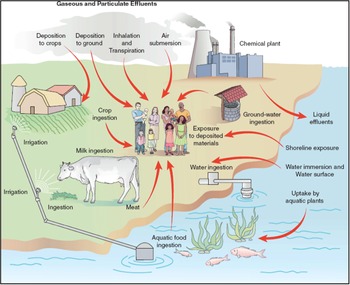
Although not exclusive to EDCs or their epigenetic effects, the following “risk scenario” from the eighth edition's chapter on chemical regulation (“Risk Assessment” [Faustman and Omenn Reference Faustman, Omenn, Klaassen, Casarett and Doull2013]), a figure that reappears in the ninth edition's corresponding chapter (Faustman Reference Faustman and Klaassen2019), illustrates toxicology's depoliticized and Eurocentric vision quite starkly (Fig. 1).
“Risk Scenario” (Faustman and Omenn Reference Faustman, Omenn, Klaassen, Casarett and Doull2013).

In their discussion of this diagram, chemical regulation experts Elaine M. Faustman and Gilbert S. Omenn refrain from questioning how and why this representative chemical plant is legally and materially situated in its particular place (Faustman and Omenn Reference Faustman, Omenn, Klaassen, Casarett and Doull2013; Faustman Reference Faustman and Klaassen2019). Nor do they discuss how and why its gaseous and particulate effluents came to be legally and materially released. Most pertinent to my discussion here, through this cartoon image, the authoritative US toxicology textbook represents toxically exposed humans in a White, heteronormative nuclear-family formation (visually and spatially associated with the more pastoral, rural scene on the left), alongside a mirroring, yet still different, Black, heteronormative nuclear-family formation (visually and spatially associated with the more polluted, urban scene on the right).Footnote 16
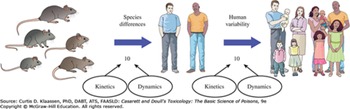
Another, preceding graphic from this same chapter is even more visually explicit, depicting straight lines of toxicological knowledge-production, from laboratory rodents to multicultural men to their heteronormative and racially homogeneous nuclear families (Fig. 2).
Toxic dynamics (Faustman Reference Faustman and Klaassen2019).

Oddly, toxicology both rationalizes and fears toxicants like EDCs—these industrial substances simultaneously indicate and threaten the implicit superiority of the Western Liberal Man Master-Subject.
The Toxicological Paradigm: “Robust” and “Seminal”
When the endocrine-disruptor thesis first emerged in the early 1990s, Sheldon Krimsky wondered whether the term “endocrine-disrupting chemicals” may be considered a mere neologism. After all, researchers had observed since at least the 1960s that synthetic toxicants interfere with hormonal signaling. He asked, does “endocrine disruption” bring “a new etiology of chemically induced disease or represent variations of traditional chemical toxicology?” (Krimsky Reference Krimsky2001, 130). Krimsky subsequently concluded that toxicology considers itself “robust” enough to encompass the “seminal” endocrine disruptor concept. In other words, toxicologists saw no need to reconceive their discipline in light of this newish class of toxicants (131–132). Twelve years later, Kasia Tolwinski likewise found that epigenetics researchers did not necessarily view their field's new insights about gene–environment interactions as revolutionary. Despite critical theorists’ excitement over the potential for epigenetics to implode the dominant scientific onto-episteme, epigenetic discourse among epigeneticists suggests, ambiguously, that epigenetics “may or may not support anti-deterministic views” (Tolwinski Reference Tolwinski2013, 1). Historians of science also caution that the environment's influence on phenotype is not exactly a new concept in biology: “The idea that environmental influences could ‘damage’ biology . . . played a key role in concerns about ‘degeneration,’ which focused on how the living conditions of industrial societies might affect the hereditary material of nations and so-called races; such concerns culminated in the eugenics movements of the early 20th century” (Müller et al. Reference Müller, Hanson, Hanson, Penkler, Samaras, Chiapperino and Dupré2017, 1678).
In general, epigenetic mechanisms are not particularly emphasized in Casarett and Doull's Toxicology. The ninth and most recent edition's introductory chapter on “mechanisms of toxicity” mentions epigenetics only four times in its 132 pages.Footnote 17 Curiously, this ninth edition's version of “Toxic Responses of the Endocrine System” (Hoyer and Flaws Reference Hoyer, Flaws and Klaassen2019) does not once use the term epigenetic, nor does the most recent iteration of “Toxic Responses of the Reproductive System” (Foster and Gray Reference Foster, Earl Gray and Klaassen2019). These silences suggest that epigenetic science has not fundamentally altered toxicological ways of knowing.
In sum, toxicology's depoliticized, heteronormative, and proto-eugenicist—in short, Eurocentric—scientific vision of EDCs’ epigenetic effects leads me to question toxicology's knowledge claims. How can this inherently flawed science be relied upon for such laudable goals as environmental justice reparations? If what we think we know about the epigenetic fallout of EDC exposure remains so imbricated with racialized and sexualized norms and harms, then arguably toxicology requires a radical undoing and redoing before its findings may be leveraged for justice.
An Augustinian Turn for Toxicity?
“Augustinian turn” is what Sylvia Wynter names the work of “taking and revising . . . an existing system of knowledge, in order to create that which is imperatively emancipatorily new” (Wynter, as cited in McKittrick Reference McKittrick2015b, 21). Black feminist theories of the human offer just such a radical, unique intervention into toxicology and epigenetics (among other fields). Beyond rupturing the hegemonic onto-episteme, Black feminist biopolitics also open up liberatory possibilities for truly new ways of being and knowing, “giving humanity a different, species-inclusive future” (Wynter and McKittrick Reference Wynter, McKittrick and McKittrick2015, 72–73). Co-creating a different, species-inclusive future has perhaps never been more urgent. In Wynter's words: “we cannot allow ourselves to continue thinking in [our present episteme]. This way of thinking is linked to the same ethno-class mode of behavior-regulatory and cognitively closed order of knowledge that has led to our now major collectively human predicament: the ongoing process of global warming, climate instability, and ecosystemic catastrophe” (Wynter and McKittrick Reference Wynter, McKittrick and McKittrick2015, 20, original emphasis).
What would it mean for toxicology to take an Augustinian turn, centering Black feminist theories of the human, in order to differently produce knowledge on the epigenetic effects of EDCs? The inheritable, ill-health outcomes of EDC exposure bring into cellular relief the legacies of sexualized and racialized oppression. Positioned to be “systematically more vulnerable to premature death” (Gilmore Reference Gilmore2007), marginalized populations are not only unduly burdened by EDCs but perhaps also unevenly co-constituted by these toxicants. African Americans, for example, are at 77% higher risk for type II diabetes, a serious metabolic disorder highly associated with EDC exposure, as compared to Whites (Ruiz et al. Reference Ruiz, Becerra, Jagai, Ard and Sargis2017), who, notably, remain the norm against which racialized populations are compared.
Some scholars suggest overtly politicizing epigenetics, referring to the field as the “Developmental Origins of Health and Disease” (DOHaD). These proponents argue: “based on its key assumptions—that life circumstances, health and disease are closely linked on a molecular scale—DOHaD is an inherently political research field” (Penkler et al. Reference Penkler, Hanson, Biesma and Müller2019, 268). Reproductive justice advocates have likewise deepened their collaborations with public health researchers, leveraging scientific findings about chemical links to transgenerational health issues to augment their campaigns (Endocrine Disruptors Action Group 2017; Lappé, Jeffries Hein, and Landecker Reference Lappé, Hein and Landecker2019). Though promising and welcome, these approaches do not necessarily challenge Eurocentric scientific epistemology and the ontology of the human in ways that Black feminism proposes (notable exceptions include critical feminist STS such as Chen Reference Chen2011; Hoover Reference Hoover2018; Liboiron, Tironi, and Calvillo Reference Liboiron, Tironi and Calvillo2018).
Following Wynter's provocations (Wynter 2015),Footnote 18 what if we rewrote our cosmogonies such that racial and sexual differences were not naturalized in service of power?Footnote 19 And, as Benjamin reminds us, to do so such that differently formed bodies and neurologies were not necessarily deemed disabled, unfit, or monstrous? (Benjamin Reference Benjamin2016a). Moreover, as French philosopher Catherine Malabou asks, what if we understood biopolitical matter as resistant, rather than merely acted upon? In more conventional theorizations of biopolitics, and, I would add, of endocrine disruption and epigenetics, “the biological is deprived of the right to respond and appears to flow simply into the mold of power” (Malabou Reference Malabou2016, 430). Yet the epigenetic effects of EDCs show that: “The living being does not simply perform a program. . . . the structure of the living being is an intersection between a given and a construction” (435–36). We organisms have always been susceptible/open to epigenetic changes, and have thus always become with our environments, material and semiotic. Notably, epigenetic changes via DNA methylation are reversible, allowing for “the possibility of going back to a time before difference” (437, original emphasis), if such a time exists.Footnote 20 What if we could go “back to the future,” conjuring a prepatriarchal, precolonial, preraced, presexed moment of multispecies relations?
Even as dominant science learns to eschew such labels as “monstrous” or “abnormal,” there is real suffering in the present and future chemical aftermath (Murphy Reference Murphy2017). Benjamin's work on race as technology, to which I might add sex as technology, invites a vital reimagining of how Black feminism could intervene in toxicological and epigenetic knowledge-production. Critically analyzing the eugenic impulses behind gene editing, she notes: “The insights and expertise of those who have been harmed and exploited in the name of progress offer us a more rigorous foundation by which to democratize science than the current model” (Benjamin Reference Benjamin2016a, 54). When it comes to EDC exposure and epigenetic mechanisms, the “racializing and sexualizing assemblage” (Weheliye Reference Weheliye2014) is so thorough and deep that racial-sexual ideologies not only set up the racial-sexual relations that make some people and places but not others more vulnerable to premature death, but also the biochemical matter itself remains racialized and sexualized, via Eurocentric knowledge-production, even as it simultaneously racializes and sexualizes the organisms becoming with it.Footnote 21 Following from Benjamin then, perhaps the crucial philosophical and ethical issues are not so much about knowing race and sex, but rather about whose lived experiences are making knowledge (Benjamin Reference Benjamin2016a; Reference Benjamin2016b; see also Chun Reference Chun2009). She insists: “those who seek radical transformation . . . towards freedom and justice, must continuously re-examine the default settings, rather than the routine breakdowns” (Benjamin Reference Benjamin2016b, 2232). The routine breakdowns in my study of toxicology may be understood as the serious health outcomes that EDCs can generate, sometimes epigenetically and frequently disproportionately. The default settings, meanwhile, may be understood as the “normal” sexual behaviors, cognitive abilities, and physiological development that well-meaning toxicologists hope to conserve against the threats posed by EDCs. Benjamin's and other Black feminist STS scholarship pushes toxicologists and epigeneticists to delete these default settings. This deletion is not because routine breakdowns do not matter, but because we need more politically accountable understandings of “adverse outcome pathways” and traumatic transgenerational inheritances. Rather than use epigenetics to measure monstrosity and naturalize normalcy, toxicologists might be trained to place EDCs and their ill-health outcomes in sociopolitical and historical context. “The basic science of poisons” might include such fundamental inquiries as: who manufactures and legalizes EDCs, why are certain populations more exposed, and how might we prosecute perpetrators while caring for the victimized?
These complex questions would be best answered through truly collaborative work, enrolling biomedical researchers and scholar-activists in the social sciences and humanities (Müller et al. Reference Müller, Hanson, Hanson, Penkler, Samaras, Chiapperino and Dupré2017). I would not expect a toxicologist to become an expert in critical feminist theory any more than I could become an expert in toxicology—nonhierarchical conversations are necessary. As McKittrick writes, engaging Wynter, “scientific racism cannot have the last word because this analytical frame refuses collaborative insights. While the natural sciences are certainly informed by monumental racial histories—and this is not to be dismissed—noticing conversations and connections between black creative texts and scientific knowledge will . . . breach analytical barriers and open up meaningful ways of imagining and honoring ‘a new contestatory image of the human’” (McKittrick Reference McKittrick and McKittrick2015a, 150). Only when a wider diversity of knowledge-producers has creatively reconceived the default human—prompting an Augustinian turn (Wynter 2015) in toxicology—can EDCs be better understood, appropriately contained, and those unduly burdened be justly compensated.
Echoing Shotwell: we need ways of thinking and talking about EDCs and epigenetics that do not universalize the Western Liberal Man Master-Subject (Shotwell Reference Shotwell2016; and see Weheliye Reference Weheliye2014). The hegemonic, Eurocentric onto-episteme produced this precarious moment of unavoidable and uneven toxic exposures; we must effect radical revolutions in knowledge and praxis in the hopes of fomenting more livable futures. Thankfully, there is a rich trove of Black feminist traditions from which to learn and carry forward. Celebrating Sylvia Wynter's contributions specifically, Walter D. Mignolo summarizes: “What she proposes, overall, is a shattering of the imperial concept of Humanity based on the ideal of White Man, and to re-conceptualize it not by providing a new definition or image but by starting with the question: What does it mean to be Human?” (Mignolo Reference Mignolo and McKittrick2015, 121–22).
Outro: What Would It Mean to Be Human?
Chemical, sexual, and racial traumas are undeniably damaging to socioecological relations. The harms precipitated by disproportionate EDC exposure burden future generations with the racialized and sexualized “slow violence” (Nixon Reference Nixon2013) inflicted upon their ancestors. If epigenetic alterations can thus make the cultural categories of race and sex more biological, the present and future challenge, as I see it, is how to avoid neo-biological essentialism and neo-environmental determinism—that is, race-based medicine (see critiques by Roberts Reference Roberts1999); babies born prepolluted (for example, Colborn, Dumanoski, and Myers Reference Colborn, Dumanoski and Myers1996, cf. Chen Reference Chen2011)—while also attending to the visceral realities of toxicity. Because of their capacities to generate illness, skew populations’ sex ratios, and interrupt cultural reproduction, EDCs threaten marginalized communities at individual, social, and existential levels (Murphy Reference Murphy2013; Hoover Reference Hoover2018).
Pathways from toxic exposures (among other traumas) to ill health are neither linear nor singular, however. And as Malabou writes, biological matter may be reconceived as resistant to biopolitical control, rather than flowing “simply into the mold of power” (Malabou Reference Malabou2016). I see liberatory potential in Black feminist reconfigurations of toxicology, especially in terms of EDCs and their epigenetic effects. Unfortunately, students of and experts in the biological sciences tend not to encounter, never mind receive training in, Black feminist STS. This disconnect may be especially true in the current political moment, wherein interrogating science is equated with denial of climate catastrophe. Nevertheless, I submit that toxicology cannot be effectively leveraged for environmental and reproductive justice unless the field dethrones its Western Liberal Man Master-Subject. Toxicologists who study epigenetic changes, or the developmental origins of health and disease, would do well to learn from Black feminist biopolitics. This engaged theoretical tradition compels scientists to contextualize toxic exposures in their cultural and political economic histories. Black feminist STS also challenges the very onto-episteme that builds and buttresses the structural preconditions for uneven toxic exposures to begin with, from racial and sexual categories to chemical manufacturing and deployment. Until Eurocentric science deletes the default, universalized human, a presumptive ideal whom toxicants threaten to degrade, this dominant scientific way of knowing remains delimited by its own eugenic logics. However unclear or unknown, the emancipatory possibilities of a Black feminist response to transgenerational toxicity are endless. Let us begin by unveiling the Master-Subject, and then unequivocally ousting him from power.
Acknowledgments
I thank my colleagues Annie Shattuck, Ashton Wesner, Laura Dev, and Anila Daulatzai for reading and responding to various iterations of this article. I am also indebted to the editors and two anonymous reviewers whose insightful comments and constructive criticisms greatly enriched my thinking and writing. All errors are my own.
Melina Packer is Chancellor's Postdoctoral Fellow in the Department of Gender and Sexuality Studies at the University of California-Riverside. Her queer feminist scholarship traverses entanglements of toxins and bodies, engaging primarily critical race theory and political ecology. She is currently working on a book about US toxicology, or the co-constitution of peoples and poisons.