Introduction
Skills for careers in classical music
The debate regarding the rapid transformation of careers in music in the early 21st century and the responsibility of higher education institutions to respond to these changes and adapt curricula to prepare graduates for such careers is becoming increasingly urgent around the world. In the UK, researchers such as Burnard (Reference BURNARD and Burnard2014), and Gaunt and Westerlund (Reference GAUNT, WESTERLUND, Gaunt and Westerlund2013) have called for the re-evaluation of skills needed for careers in music. In the USA, a national report on undergraduate curricula recommended major changes such as including skills more relevant to future employment (Sarath et al., Reference SARATH2014). Similarly, in Australia, research has highlighted the lack of evidence as to the skills required for careers in music (Bartleet et al., Reference BARTLEET2012) and encouraged institutions to re-consider the content of the courses offered and how they are delivered to prepare graduates more appropriately for work (Bennett, Reference BENNETT2016). A recent examination of factors contributing to the successful careers of Australian pianists emphasised diversity of musical skills, the ability to learn music quickly and experience of accompanying and playing chamber music (Zhukov, Reference ZHUKOV, Rowley, Bennett and Schmidt2019).
A variety of musical careers is open to music students in higher education. Students should consider those that are possible for them, realistically, and focus on developing the most relevant skills. Gaunt and co-workers (Reference GAUNT, CREECH, LONG and HALLAM2012) demonstrated that in the UK many students at conservatoires still concentrate on developing their technique and repertoire in the hope of becoming solo performers, often failing to engage with wider opportunities in the music profession and building their own networks within it. In Australia, Bennett (Reference BENNETT2016) has warned that the majority of music students still conceptualise their future careers in terms of performance and composition, when the reality of their professional lives is likely to be very different and consist of a broad range of activities. A recent commentary on the state of play in the USA suggests that ‘career definitions are changing quickly… [the way we] play and teach music have been completely transformed in this century… even graduates of major conservatories don’t usually expect to have careers of pure solo playing’ (Kirk, Reference KIRK2014, p. 43).
A survey of 82 institutions in the USA awarding bachelor’s degrees in piano performance (Walker, Reference WALKER2008) showed that 89% offered piano pedagogy, 84% keyboard literature, 77% accompanying classes, 60% required chamber music, 24% included functional keyboard skills for pianists and 5% provided instruction in jazz and improvisation. We agree with Walker that these figures indicate that many US institutions did not, at the time, require piano students to gain experience in accompanying and chamber music, which would have helped them to develop the collaborative playing skills needed for professional lives post-college. Skills such as sight-reading, transposition and improvisation were also reported to be neglected in many US institutions, leaving graduates under-prepared for diverse and multi-faceted careers (Walker, Reference WALKER2008). The situation had not improved 5 years later, as demonstrated by a thesis exploring undergraduate piano curricula in North America that confirmed a discrepancy between what is taught and the skills required for most musicians’ careers today (Choi, Reference CHOI2013). Choi’s findings were corroborated by a survey of 109 professional musicians in the USA, including pianists, which showed that they regularly utilised three essential skills when playing the piano or keyboard in their working lives: reading accompaniments at sight, playing scales and transposing melodies (Young, Reference YOUNG2013). The respondents all reported wishing that they had had more training during their undergraduate studies in harmonising melodies, improvising, transposing, sight-reading and accompanying, since these were the skills they found most useful in their careers.
In Australia, too, a survey of 107 piano graduates showed that, although they valued sight-reading and improvisation, they were not trained in these skills during their studies at Australian higher education institutions (Michalski, Reference MICHALSKI2008). This finding was corroborated by subsequent survey of the musical skills of 74 Australian undergraduate pianists (Zhukov, Reference ZHUKOV2014a), which found that sight-reading skills were under-developed and the majority of respondents lacked accompanying experience, even though they perceived sight-reading ability to be important for their careers.
The situation may be different in the UK, with at least some institutions offering classes in sight-reading and quick study to first- and second-year pianists (Paul Janes, personal communication, May 2016). The skills developed in these classes are assessed in examinations, with first-year pianists being given a sight-reading test as part of their technical examination in the second term of study, and second-year students a quick-study test – learning an unfamiliar piano work in the 30 min immediately prior to the examination – in the fourth term. Ensuring that undergraduate pianists develop sight-reading and quick-study skills, and assessing their progress formally also gives the clear signal that these skills are vital for their careers. Research has shown that the ability to learn quickly is an important characteristic of expert musicians and should be nurtured during undergraduate study (Jarvin & Subotnik, Reference JARVIN and SUBOTNIK2010).
Student learning in higher education is largely driven by assessment requirements, and the first author (Zhukov, Reference ZHUKOV, Lebler, Carey and Harrison2015) has argued that approaches to the assessment of performance in classical music have remained stubbornly fixed despite the innovations that have been made in the assessment of performance in and the composition of popular and contemporary music. In particular, Australian institutions of higher education tend to assess piano performance via solo repertoire, offering classes in chamber music as electives only in the later stages of undergraduate degrees and accompanying courses at master’s level (Zhukov, Reference ZHUKOV and Hannan2010). This suggests that institutional assessment regimes can have an impact on the types of repertoire students practise on a regular basis, which in turn can affect the skills they develop while studying for their degrees and embarking on their future careers.
We argue that pianists, if they are to have successful professional careers in the 21st century, have to be as competent to perform as chamber musicians and accompanists as they are to play solo repertoire and concertos. If students are to develop the practical skills they need for collaborative music making, many undergraduate degree courses will have to be restructured to offer classes in sight-reading and quick study, as well as chamber music and accompaniment. If students are to recognise the importance of these skills, examination requirements will have to be revised so they can be assessed formally.
Context of pre-tertiary training of sight-reading
Pre-tertiary music examination systems in both UK and Australia do require students to pass a sight-reading test as part of the practical assessment: in the UK, it continues up to Diploma ABRSM level and in Australia, this ends at Grade 8 level, Australian Music Examinations Board. Trinity College music examinations are prevalent in both countries, with sight-reading tests being optional up to and including Grade 5, but compulsory in Grades 6–8.
It may be that the continuation of sight-reading testing up to a higher examination level in the UK results in an increased focus on sight-reading skills in pre-tertiary teaching and a higher level of the sight-reading skills in incoming students. Both countries have large intakes of international students, particularly from Asia, at the undergraduate level; little is known about these students’ previous training in terms of their approaches to practising and the importance placed by their teachers on sight-reading and collaborative rehearsal and performance.
Differences between higher education institutions for music in UK and Australia
In higher education in the UK, there used to be a clear distinction between undergraduate curricula in music conservatoires and university departments of music: while the former focused on preparation for performing careers, the latter emphasised academic study and research to a greater extent. While several UK conservatoires remain independent, all Australian conservatoires are now part of large universities and have added more academic study and research to their curricula (Dawkins, Reference DAWKINS1988). Conversely, the Australian schools of music within universities are promoting more performance training for undergraduates in order to compete with conservatoires’ offerings. Currently, the major difference between the two types of Australian higher education music institutions is in the size of the undergraduate cohort: conservatoires typically have a very large cohort, while the schools of music usually offer a more intimate learning context. Nevertheless in both Australia and the UK, such distinctions have blurred over the past 15–20 years, particularly since music conservatoires began to offer BMus degrees rather than diplomas post-1992.
Developing broad keyboard skills
Most higher education institutions worldwide have accepted that basic keyboard skills are necessary for all graduates in music performance and typically, therefore, offer group keyboard classes to non-pianists during their undergraduate studies. By contrast, they often assume that the specific skills pianists develop through playing virtuosic solo and concerto repertoire represent the broader set of keyboard skills required in other contexts, such as chamber music and teaching. For this reason, they fail to provide appropriate classes designed for pianists.
As one-to-one instrumental tuition is expensive and the availability of individual lessons to prepare students for practical examinations limited, small group tuition is now also considered a viable option for developing pianists’ keyboard skills beyond the solo and concerto repertoire (Daniel, Reference DANIEL2004). For example, Coats (Reference COATS2006) suggests that group piano classes could help pianists develop ‘[the] ability to sight-read complex scores, play scales and arpeggios with ease, harmonise lead lines, play by ear, improvise, and transpose’ (p. 61).
Evidence is beginning to emerge that group piano tuition is not just an economic solution to some of the educational and financial challenges facing many higher education music institutions worldwide but could lead to positive musical and social outcomes for learners. A small study in the UK demonstrated that a group piano class had a positive impact on ‘individual practice, technique, musicianship, analytical and performance skills’ and also on the well-being and creativity of the participants (Haddon, Reference HADDON2017, p. 57). A report from Finland suggests that ‘working collaboratively in a group lesson can greatly enrich the learning environment and offer a platform for sharing and learning from fellow students’ (Aho, Reference AHO, Gaunt and Westerlund2013, p. 165). This study showed that the positive impact of group piano lessons was transferred to one-to-one lessons with the same teacher by making students more actively engaged in the learning process.
Group classes in keyboard skills require more structure, planning and resources than typical individual piano lessons in order to develop the wide range of skills discussed above. Many existing textbooks and new emerging approaches tend to focus on curricula for non-pianists (e.g., Yi, Reference YI2015). Tutors who teach keyboard skills classes to pianists often have to rely on their own experience and resources to structure course content and assessment procedures. The first author has developed a research-based higher education curriculum that can be implemented in small group classes and individual piano lessons to foster the development of diverse keyboard skills in advanced pianists and, in particular, the skill of sight-reading (Zhukov, 2014a, 2014b, 2016, Reference ZHUKOV2017).
While evaluation of these curricula demonstrates an improvement in students’ sight-reading skills after training, it is still not clear whether better sight-reading could have a measurable impact on other aspects of undergraduate pianists’ studies. For example, Lehmann and Ericsson (Reference LEHMANN and ERICSSON1996) found that the accompanists and répétiteurs who took part in their study possessed better sight-reading skills than pianists with less experience of accompanying. However, the question as to whether accompanists and répétiteurs were drawn to careers in collaborative music making because of their exceptional sight-reading skills, or if they developed high level sight-reading skills as the result of their collaborative music making is yet to be answered (Melck, Reference MELCK2019; Wristen, Reference WRISTEN2005). It is therefore necessary to investigate the potential impact of deliberately developing sight-reading skills on undergraduate pianists’ choices of repertoire to practise, and its implications for their educational experiences more generally.
Rationale and aims
It is clear from our review of the literature that the skills needed for careers in classical music, besides the ability to play, are under discussion in higher music education institutions around the world. One of the most important skills identified by researchers, teachers and students is sight-reading, which – among other benefits – facilitates access to repertoire both for pure interest and for further study. Consideration must therefore be given as to how and in what context(s) this skill can be developed. While research-evidenced pedagogy for improving sight-reading skills has been developed (Zhukov, Reference ZHUKOV2016), little is known as to its potential impact on undergraduate pianists’ experiences throughout their studies. For example, the literature suggests that those who engage in collaborative rehearsal and performance have higher-level sight-reading skills, but it is not known if developing students’ competence in sight-reading could lead to their greater participation in collaborative music making activities such as accompanying and chamber music. One way of finding out is to identify the types of repertoire they choose to practise and how much time they spend on practising each type.
It is also unknown whether implementing targeted sight-reading training in higher education settings has an impact on undergraduate pianists’ choices of repertoire to practise, and if so to what extent. We have outlined above both the similarities between the UK and Australian pre-tertiary music examination systems and the differences between the emphases placed on quick-study and sight-reading skills in the two countries’ higher music education institutions. These suggest that it would also be worth exploring potential similarities and differences between the responses of undergraduate pianists at UK and Australian institutions to a bespoke sight-reading training intervention.
The intervention described in this article was developed in response to on-going debates as to the skills required for professional careers in music (e.g., Burnard, Reference BURNARD and Burnard2014, Reference BENNETT2016; Sarath et al., Reference SARATH2014) and students’ recent criticisms of curricula currently available in higher education institutions of music, specifically in relation to career-relevant training (Choi, Reference CHOI2013; Zhukov, Reference ZHUKOV2014a). Typically, interventions are evaluated by measuring improvements in the particular skills being developed. In an earlier study with different participants, an intervention using the same curriculum was shown to be effective insofar as the sight-reading skills of undergraduate pianists who underwent the training improved significantly relative to those of a no-intervention control group (Zhukov et al., Reference ZHUKOV2016). It was not known, however, if improved sight-reading as a result of undergoing the training would influence the types of repertoire chosen for practice and/or how long each type of repertoire would be practised; we therefore selected these as outcome measures in the present study.
Specifically, the aim of the study was to evaluate the potential effects of undergoing sight-reading training on undergraduate pianists’ choices of types of repertoire (solo, concerto, chamber and accompanying), in comparison with the choices made by those who did not undergo the training. In addition, we considered the potential effects of national and institutional differences. We therefore addressed the following research questions: What were the effects of the 1) intervention, 2) country and 3) institution, if any, on participants’ choices of repertoire for practice and the length of time they spent practising each type of repertoire? The subsidiary aim was to document the implementation of the curriculum in the three institutions. It was hoped that the findings would be useful to higher education institutions in providing them with evidence to support additional investment in practical, career-relevant skills training.
Method
Design
The research involved an intervention study in which the intervention consisted of sight-reading training, whereby one piano teacher at each of three institutions (a university school of music and a music conservatoire in Australia and a music conservatoire in the UK) used the curriculum developed by the first author (Zhukov, Reference ZHUKOV2014c) with an intervention group of undergraduate pianists in small tutorials and/or individual lessons. At each institution, there was also a control group of undergraduate pianists who did not receive the training. The curriculum is described in the Materials, below.
Each institution operated under its own assessment regime during the research project: at an Australian university school of music pianists were preparing for the end of the year practical examinations consisting of a 20-min solo programme of varied repertoire; at the Australian conservatoire students were required to play scales, arpeggios, a Scarlatti Sonata and a Chopin Etude for their upcoming technical examination, with a 20-min solo recital at the end of the year; and at a music conservatoire in the UK pianists were working towards their technical examination consisting of two studies, with a 35-min programme of varied solo repertoire required by the end of their academic year. Concertos were not required in any of the assessments, so any concertos practised by the participating pianists would have been chosen voluntarily. Accompanying and chamber music classes were not part of the formal degree structure for first-year students in any of the three institutions. However, opportunities for informal participation in such activities did exist at all sites.
Participants
Two piano teachers, one at an Australian conservatoire and the other at a UK conservatoire, responded to invitations from the authors to participate in the study by recruiting volunteer students and teaching the intervention group. As the first author works as a researcher in a third institution, an Australian university school of music, the researchers were able to recruit volunteers directly. Convenience samples were recruited at each institution from which intervention and control groups were initially matched for size, age and sex. The samples were small by comparison with the size of the cohorts of undergraduate piano students at each institution but were nonetheless representative insofar as they included both domestic and international students. They also provided an opportunity to explore the subtle differences between institutional and national cultures in the two countries. Since entry audition information is confidential in both countries, and in any case sight-reading is not typically tested during auditions for Australian higher education institutions, it was not possible to obtain any independent measures of the participants’ pre-tertiary levels of skill in sight-reading. It was assumed that individuals who volunteered to take part in the study recognised that sight-reading was likely to be important for their future careers and wanted to improve their skills in this area.
Uptake of the offer to take part in the intervention was a comparative low. This can be attributed to an evident lack of interest from staff in teaching sight-reading, and students in taking part in a study that required them to engage in learning other than for their normal commitments. It can, perhaps, be seen as indicative of the general disregard in which the important skill of sight-reading is held. Furthermore, participants, having been recruited, dropped out of the study for a variety of reasons, resulting in incomplete data collection at all three sites. Ultimately, a total of 24 first-year undergraduate pianists (13 female, 11 male) studying for BMus degree with a median age of 20.6 years (range 18–27) took part in the study. Six female and six male students were assigned randomly to intervention groups. There were three participants at the UK conservatoire (five controls), five at the first author’s home institution (four controls) and four at the Australian conservatoire (three controls).
Materials
The sight-reading curriculum was developed by the first author (Zhukov, Reference ZHUKOV2014c) and consists of 10 weeks’ worth of materials. Each week, students are expected to play through and work on rhythmic exercises, four solo pieces from a range of periods and a piano duet. The introduction to the materials outlines the research that underpins the curriculum, and notes for each week’s work are designed to help students understand the form, harmony and particular challenges of the repertoire presented. Templates for weekly activity diaries were prepared, requiring the participants to list the repertoire they had practised each week under specific headings: solo, concerto, chamber music and accompaniment.
Procedure
All participants, teachers and students, gave their informed consent to take part in the study (ethical approval was sought and granted by the first author’s home institution and the Conservatoires UK Research Ethics Committee). The teachers taught the participants in small class tutorials and individual lessons, as indicated in sight-reading curriculum. The participants completed the diaries after each practice session and submitted them to the authors for analysis at the end of the 10-week period of the study.
Analyses
Miksza and Tan (Reference MIKSZA and TAN2015) caution against relying on participants’ reported estimates of their practice time as this can be exaggerated deliberately or inadvertently. The duration of each item of repertoire listed by each participant was therefore calculated as follows. Five representative video-recordings of the item played by different performers were identified on YouTube and an average duration was calculated for each item (including single movements of larger works as appropriate). Each participant listed the number of times they practised each item during the period of the study. Each participant’s time spent practising repertoire in each category (solo, concerto, chamber music and accompanying) and all categories was calculated by multiplying the average duration of each item by the number of times the participant reported practising it. SPSS 22 was used to conduct a t-test to assess the significance of differences between the lengths of time participants spent practising solo and concerto, and chamber music and accompanying repertoire, and to conduct analyses of variance to evaluate the potential effects of the sight-reading training course, the country in which participants studied and the institution at which they studied, on the lengths of time they spent practising each type of repertoire and all repertoire. Potential effects of teacher were not explored, since all the participants at each institution were taught by a single teacher.
Results
Exploratory data analysis
Preliminary analyses revealed the presence of two univariate outliers. Both students, one in each country, undertook much more solo and concerto practice over the 10-week period than their peers, in preparation for upcoming competitions (zs > 2.32; ps < .01). This is typical of undergraduate pianists and as such, represented a meaningful variation. Two sets of analyses were carried out, with and without the outliers. The results did not differ significantly so data from these two participants were retained in the analyses reported below.
While participants were asked, in their weekly activity diaries, to list four categories of repertoire (solo, concerto, chamber and accompanying), the pianistic skills required to master solo and concerto repertoire are quite similar, as are the skills developed in playing chamber music and accompanying repertoire. The former are often virtuosic, while the latter are collaborative, requiring in addition to sight-reading and quick-study abilities, familiarity with playing with other instrumentalists and vocalists, and highly developed listening and interpersonal skills. The authors therefore decided to treat solo and concerto repertoire, combined, and chamber and accompanying repertoire, combined, as two categories rather than four.
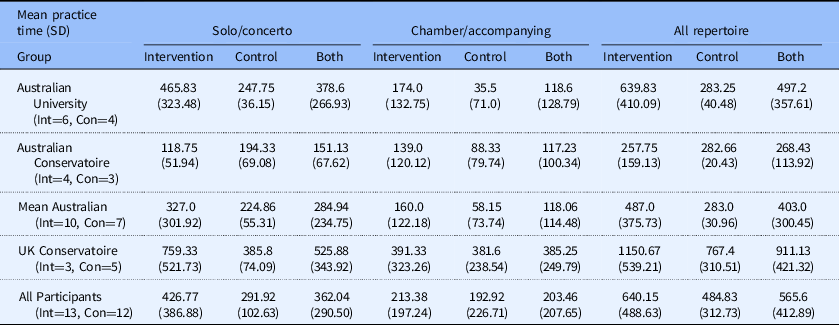
Descriptive statistics are shown in Table 1: the mean numbers of minutes participants in the intervention and control groups at the three institutions spent practising (a) solo and concerto, (b) chamber and accompanying repertoire and (c) all repertoire over the 10-week period of the study.
Mean practice time in minutes

The distribution for the time dedicated to practising solo works and concerti was found to be significantly positively skewed, z = 5.09, p < .001. For the purposes of conducting inferential statistical tests, the data were transformed using a non-linear logarithmic (square root) transformation, bringing the distribution within the acceptable z = ±3.29 (p < .001) limits recommended by Tabachnick and Fidell (Reference TABACHNICK and FIDELL2013) and enabling parametric analyses to be performed.
Solo-concerto vs chamber-accompanying repertoire
The lengths of practice time devoted to solo-concerto and chamber-accompanying repertoire respectively were significantly correlated, r(25) = .415, p = .039, and different, t(24) = 3.79, p = .001, such that regardless of participants’ country, institution or whether they undertook the sight-reading training course, solo-concerto repertoire received more minutes of practice time (M = 362.04, SD = 290.51) than chamber music-accompanying repertoire (M = 203.56, SD = 207.65).
Effects of intervention, country and institution on practice time
There were no main effects of the intervention on practice, but there were significant main effects of country on all practice (F [1,1] = 16.46, p = .001, η = 0.439) such that participants in the UK undertook more combined solo-concerto, M = 525.88, SD = 343.92 (F [1,1] = 8.36, p = .009, η = 0.285), and more combined chamber-accompaniment practice, M = 385.25, SD = 249.79 (F [1,1] = 14.07, p = .001, η = 0.401), than participants in Australia, M = 284.94, SD = 234.75 and M = 118.06, SD = 114.48, respectively.
The main effects of country were attributable to significant main effects of institution on all practice (F [1,2] = 8.72, p = .002, η = 0.442), including combined solo-concerto (F [1,2] = 7.1, p = 0.004, η = 0.392) and combined chamber-accompaniment practice (F[1,2] = 5.85, p = .009, η = 0.347).
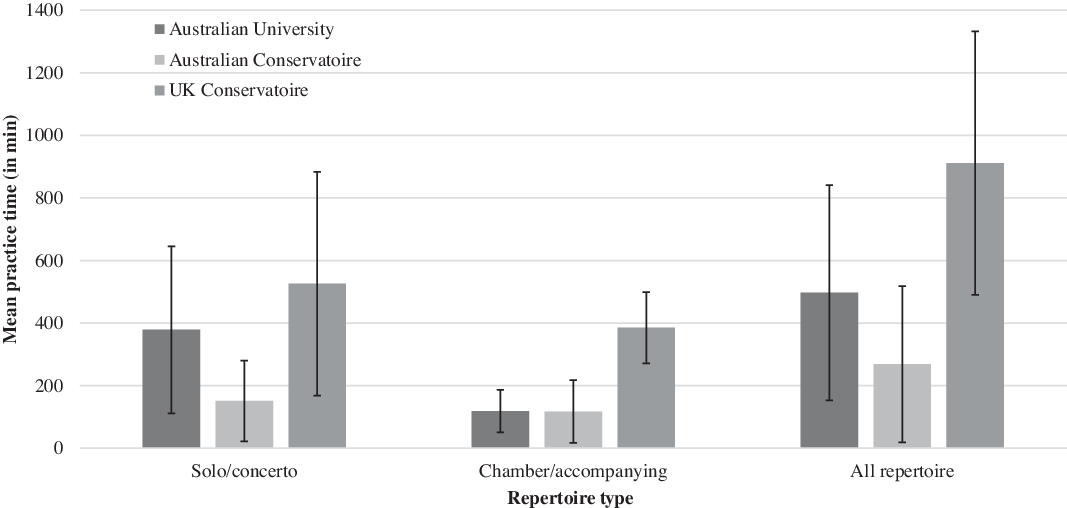
Post-hoc comparisons (illustrated in Figure 1) showed that, overall, participants at the UK conservatoire undertook significantly more practice than participants at the Australian conservatoire M = 283.25, SD = 40.48 (Tukey’s HSD = 8.22, p = .031) and university, M = 282.66, SD = 20.43 (Tukey’s HSD = 13.45, p = .001). While participants at the UK conservatoire undertook more solo-concerto practice than those at the Australian conservatoire M = 151.13, SD = 67.62 (Tukey’s HSD = 10.16, p = .003), participants at the Australian university also undertook significantly more solo-concerto practice than those at the conservatoires M = 378.60, SD = 266.93 and M = 151.13, SD = 67.62, respectively (Tukey’s HSD = 6.63, p = .046). Finally, participants at the UK conservatoire undertook more chamber-accompaniment practice than those at the Australian university, M = 118.60, SD = 128.79 (Tukey’s HSD = 10.32, p = .01) and conservatoires M = 117.23, SD = 100.34 (Tukey’s HSD = 9.56, p = .04).
Mean practice time in minutes as a function of repertoire type and institution attended. Error bars represent standard deviations (±1 SD).

Discussion
The study aimed to assess the potential effects on undergraduate students’ choice of type of repertoire (solo, concerto, chamber music and accompanying repertoire), and the length of time they spent practising it over the 10-week period of the study, of 1) their participation in sight-reading training; 2) the country in which they study and 3) the institution in which they study. The subsidiary aim was to document the use of the curriculum given that it had been developed in response to on-going debates as to the skills required for professional careers in music and the students’ recent criticisms of curricula currently available in higher education institutions of music in relation to career-relevant training.
For participants in both intervention and control groups, time spent practising solo and concerto repertoire was considerably, and significantly, longer than that spent practising chamber music and accompanying repertoire. There were effects of country, such that those at the UK conservatoire undertook significantly more practice, overall, than participants at the two Australian institutions. There were also effects of institution, such that participants at the Australian university spent more time practising solo and concerto repertoire than did participants at the Australian conservatoire. There was no significant effect of the sight-reading training, however, on the amount of practice undertaken.
One possible explanation for the non-significant effect of the intervention might be that improved sight-reading could have had an impact on students’ approaches to practising. Rather than extending the time students spend practising repertoire, efficient sight-reading may reduce it in the long term, as students are able to master the basics of repertoire quicker and more efficiently: improved sight-reading could well produce a higher quality of practice in the time already allocated to practice tasks. This highlights the need for research following up participants at appropriate intervals such as 6 months or a year after they have undertaken skill-training interventions to evaluate their impact on career development in the longer term. It would also be wise in future to employ mixed-methods approaches including interviews with participants so as to understand their choices of repertoire.
In the Introduction, we highlighted the differences between approaches to keyboard skills training in the UK conservatoire whose students and staff participated in the study and approaches at Australian institutions (Michalski, Reference MICHALSKI2008; Zhukov, Reference ZHUKOV2014a; Paul Janes, personal communication, May 2016). These differences may explain the effects of country and institution on length of time spent practising, as the norms of the student cohort and the expectations and standards of the institution – that is, its culture – are likely to be influential on the ‘work ethic’ of individual students, outweighing the potential effects of participating in the sight-reading training course. As Perkins (Reference PERKINS2013) has shown in her study of tertiary-level music education institutions in the UK, institutional cultures influence the attitudes of students towards approaches to learning how to perform, and the positions they take in relation to their future careers, whether these are conceptualised in terms of ‘vocation’ or ‘profession’. While this area is under-researched globally, our results do indicate the existence of different institutional cultures and their influence on students’ attitudes and beliefs in conservatoires and university music departments throughout the world.
We might have expected to see a difference between the cultures of conservatoires on the one hand, and university music departments, on the other, but the results of our study did not support this: participants at the Australian university spent significantly longer than participants at the Australian conservatoire practising solo and concerto repertoire. While this finding may be specific to our sample, it nonetheless supports the blurring of differences between curricula in the two types Australian higher education institution highlighted in the Introduction. In addition, differences between the approaches used by staff to teaching the content of the intervention may have had an impact on student responses in the three institutions. In the present study, it may be that students at the Australian university were more motivated to practise solo and concerto repertoire than students at the Australian conservatoire due to a very small sample and/or specific assessment requirements at these institutions (Zhukov, Reference ZHUKOV and Hannan2010).
By contrast, participants at the UK conservatoire spent significantly more time practising chamber music and accompanying repertoire than did students at the two Australian institutions. This suggests that the institution’s emphasis on the importance of developing sight-reading and quick-learning skills in the first two years of the bachelor’s degree course, as described in the Introduction, was effective in encouraging students to engage in collaborative music-making from the outset instead of regarding it as an aspiration for subsequent or even postgraduate studies. Development of these skills has been described as essential to professional pianists by Jarvin and Subotnik (Reference JARVIN and SUBOTNIK2010), Young (Reference YOUNG2013) and Zhukov (Reference ZHUKOV, Rowley, Bennett and Schmidt2019).
The present study involved a very small sample of students in just three institutions, in two countries, of two types: a UK conservatoire of music, an Australian university and an Australian conservatoire. While we took precautions to minimise the effects of large individual differences on the results of our analyses, standard deviations were large and effect sizes small. Nevertheless, the findings indicate that it would be well worth undertaking similar intervention studies in future, to explore the effect of specific skills-training programmes on relevant behaviours in the long as well as the short term, with larger samples in a wider range of institutions of different types in different countries.
Conclusions
Overall, participants in the present study practised solo and concerto repertoire for longer than they practised chamber and accompanying repertoire. This finding needs to be replicated with larger samples, in more institutions in a variety of countries; also, the instructional methods used in given programmes should be examined further. We can speculate that students’ practice time on particular types of repertoire may reflect institutional demands, which in turn reflect institutional values. Given the landscape of the contemporary music profession, in which pianists’ opportunities to perform solo recitals and play concertos are limited, tertiary-level institutions of higher education such as conservatoires and university music departments would be wise to re-focus their curricula so as to promote collaborative music making more energetically and more explicitly, in the form of chamber music and accompaniment.