




No CrossRef data available.
Article contents
Attachment patterns across multiple family relationships in adulthood: Associations with maternal depression
Published online by Cambridge University Press: 01 September 2004
Abstract
We explored attachment in a family context by applying family systems principles to the investigation of multiple attachment relationships within families. This study focused on maternal adult attachment with respect to family of origin experiences (assessed using the Adult Attachment Interview [AAI]) as well as maternal marital attachment (assessed using the Marital Attachment Interview [MAI]). We examined associations between maternal adult attachment (or marital attachment) and three levels of family functioning including individual maternal depression symptoms, dyadic marital satisfaction (reported by mothers), and family unit functioning. We also examined associations between combined attachment security (consistent secure, AAI secure/MAI insecure, AAI insecure/MAI secure, and consistent insecure) and family outcomes. Finally, we assessed the extent to which attachment representations operate differently in the context of family stress, namely maternal depression. We found that attachment security with respect to particular relationships was differentially associated with different levels of family functioning. Examination of the security of combined adult and marital attachment further supported the multilevel organization of the family system.
Information
- Type
- Research Article
- Information
- Copyright
- © 2004 Cambridge University Press
Families are complex, dynamic, multilevel systems. Examination of patterns of family functioning yields important information about a variety of individual and relationship outcomes of interest including child social competence, parent–child interaction, and individual variation in course and intensity of maternal depression. Attachment relationships comprise one component of a family system, patterns of which also have been linked with children's social competence outcomes, quality of parent–child interaction, and maternal depression. To date, virtually all of the empirical work guided by theoretical underpinnings of the development of attachment patterns (and associated internal working models) has centered on the quality of the dyadic attachment relationship, without incorporating the family context. As such, research conducted from an attachment perspective has failed to fully realize the contextual underpinnings by not addressing potentially important links with attachment inherent in the family system (Cicchetti, Cummings, Greenberg, & Marvin, 1990).
The purpose of this paper is to explore attachment in a family context by applying family systems principles to the investigation of multiple attachment relationships within families. Attachment theory and family systems theory share a considerable degree of conceptual overlap (Cicchetti & Howes, 1991; Marvin & Stewart, 1990; Minuchin, 1985), although there has been little theoretical exploration or empirical investigation of these links. We specifically focus on maternal adult attachment with respect to family of origin experiences (assessed using the Adult Attachment Interview [AAI]; Main & Goldwyn, 1994, 1996) as well as maternal marital attachment (assessed using the Marital Attachment Interview [MAI]; Dickstein, 1993) to examine (a) associations of attachment in these two relationship domains with outcomes on multiple levels of family functioning (individual, dyadic, and family unit), (b) the correspondence of attachment security across relationship domains to assess interdependence among family system functions, and (c) maternal depression as a potentially important moderator of the association between attachment representation patterns and family functioning.
Attachment perspective
Attachment theory has become a hallmark approach from which to conceptualize interpersonal interaction that has meaning across generational boundaries and relationship contexts (Cohn, Cowan, Cowan, & Pearson, 1992; Crowell, Treboux, & Waters, 2002; Owens, Crowell, Pan, Treboux, O'Connor, & Waters, 1995; van IJzendoorn, 1992; Waters, Vaughn, Posada, & Kondo–Ikemura, 1995). A fundamental proposition of attachment theory is the construct of the internal working model (Bretherton, 1990, 1991; Crittenden, 1990). Internal working models characterize how individuals behave in dyadic interactions based on a relationship history that provides the structure for development of a sense of self and sense of others. They develop over time (in line with developmental capabilities of the individual), and they tend to maintain a fixed pattern with which to meet the world. Briefly, secure (vs. insecure) working models reflect balance (vs. imbalance) between the attachment system and other behavioral systems (e.g., exploratory, affiliative, fear), which in adults is manifest as the ability to describe early relationships with caregivers in a coherent and consistent manner. Secure adults convey a strong sense of personal identity, and emphasize the importance of early experiences and current relationships. Insecure adult attachment is reflected in descriptions of relationships with caregivers that are incoherent, inconsistent, confused, and/or conflicted. Insecure adults may limit, deactivate, or devalue the influence of attachment relationships; alternatively, they become overwhelmed with respect to the relationship, displaying passivity, fear, or overinvolving anger. Taken together, both patterns of insecure adult attachment reflect an imbalance that is often interpreted as interruptions in the person's ability to rely on trusted and intimate relationship partners to effectively explore the social world in the service of accomplishing important tasks of adult development.
Adult attachment
Recent methodological developments have facilitated assessment of adults' internal working models of their past relationships, termed adult attachment (George, Kaplan, & Main, 1985; Main & Goldwyn, 1994, 1996). This adult interview method employs narrative structure to characterize attachment in contrast to the behavior observations employed in child attachment assessments. To date, most of this work has examined attachment relationships in the realm of adults' conceptualization of their own early childhood relationships with their parents, mainly assessed using the AAI (Main & Goldwyn, 1994, 1996). In particular, adult attachment relationships have been the focus of attention when attempting to elucidate processes that might help explain attachment status in children born to these adults.
As such, theoretical and empirical work suggests that mothers' working models of their early relationships with their own parents (reflected in adult attachment classifications) greatly influence interaction patterns they develop with their children. Perhaps of most interest to attachment researchers, parents' working models of relationships developed early in life have been found to be related to the attachment relationships they develop with their own children, with concordance rates ranging from 66% to 75% of secure versus insecure attachment (Benoit, Vidovic, & Roman, 1991; Eichberg, 1987; Fonagy, Steele, & Steele, 1991; Main & Goldwyn, 1996; Ward, Botyanski, Plunkett, & Carlson, 1991; Zeanah & Emde, 1994). Furthermore, maternal insecure adult attachment is related to the development of behavior problems in their children (Crowell & Feldman, 1991), sleep disorders in their toddlers (Benoit, Zeanah, Boucher, & Minde, 1989), failure to thrive in their infants (Benoit, Zeanah, & Barton, 1989), and dysregulations in mother–infant affect attunement (Haft & Slade, 1989). Although important associations have been established between adult attachment representations and dyadic (parent–child) interactions, links with other important family relationships (i.e., marriage) have been less well investigated.
Adult attachment and marriage
Marriage is an intimate adult relationship embedded within a family system that is linked with quality of functioning in numerous other aspects of family life. For example, marriage quality is related to a host of outcomes including how parents interact with their infants, how young children express and regulate emotion, and how episodes of depression in women are experienced, maintained, and resolved (Barnett & Gotlib, 1988; Hooley & Teasdale, 1989; Jacobson, Dobson, Fruzzetti, Schmaling, & Salusky, 1991; Kowalik & Gotlib, 1987).
Within the last decade or so, adult attachment patterns (with respect to family of origin relationships) have been examined in association with marital functioning (Berman, Marcus, & Berman, 1994; Collins & Read, 1990; Paley, Cox, Burchinal, & Payne, 1999; Raskin–Esquer, Burnett, Baucom, & Epstein, 1997; Simpson, 1990). Cohn, Silver, Cowan, Cowan, & Pearson (1992) found no relation between adult attachment (of family of origin relationships) classifications and self-reports of marital satisfaction provided by both husbands and wives. For husbands, however, adult attachment security was related to more positive (as opposed to conflictual) behavior in the marriage. The authors speculated that a secure partner may, in fact, buffer negative effects of insecure working models established concerning early experience (i.e., adult attachment) vis-à-vis current marital behavior. Further, Cowan, Cohn, Cowan, and Pearson (1996) extended this investigation to examine correspondence of couples' adult attachment histories in relation to child behavioral outcomes, emphasizing the importance of including each partner's attachment history as well as quality of marital functioning to better understand child outcomes. Taken together, such findings support a working hypothesis that the nature of the attachment relationship between the partners may be linked both to marital behavior (within generations) and parent–child relationship patterns (across generations). This line of work begins to extend attachment concepts into the family context, and would be strengthened by more fully examining the marital relationship specifically within an attachment framework, by evaluating adult attachment representations of the marriage, per se.
Marital attachment
There has been ongoing examination of the processes by which marriage influences (and is influenced by) various family subsystem functions. Crowell, Treboux, Gao, Fyffe, Pan, and Waters (2002) examined links between adult attachment representations and secure base behavior in couples engaged to be married, and found evidence for the presence of a secure base phenomenon in couples' relationships, a core component of attachment system functioning. Given all the connections that mimic those found in other attachment relationships, including secure base behavior, we propose that marriage also functions as an attachment relationship that is reflected in working models incorporating organized representations of the self and of social relationships, which can be revealed in narrative form. Along these lines, we propose that marital attachment is a concept that is broader in its cognitive–affective scope than appraisal of current marital satisfaction. Consistent with the study of other attachment relationships, assessment of marital attachment is designed to infer the working model of the marriage. Similar to infant and adult attachment, marital attachment involves the extent to which partners operate from a secure base to accomplish developmentally appropriate tasks within adult domains such as effective parenting or employment, return to a safe haven during times of stress or distress, and use of the relationship partner (the spouse, in this case) to regulate affect (e.g., Crowell, Treboux, & Waters, 2002; Hazen & Shaver, 1990; Shaver, Hazen, & Bradshaw, 1988). Thus, we suggest that marriage, as a close relationship, may be examined in terms of attachment representations, and that family systems theory helps to elaborate this inquiry by considering special components of marriage that attachment does not.
Applying family systems theory to the study of attachment
Family systems theory is in many ways a natural basis for extending attachment relations to the family system, and some have already explored these theoretical links (Marvin & Stewart, 1990; Stevenson–Hinde, 1990). In formulating an empirical test, we specifically conceptualize two tenets of family systems theory as particularly important (Minuchin, 1985). First, families are comprised of subsystems (smaller relationship units with different levels of organization) each with its own unique properties, interaction rules, and boundary distinctions. In previous research we found unique information about families evident in all the levels assessed, within a core of common information across measures (Hayden, Schiller, Dickstein, Seifer, Sameroff, Keitner, Miller, & Rasmussen, 1998; Dickstein, Seifer, Hayden, Schiller, Sameroff, Keitner, Miller, Rasmussen, Matzko, & Dodge–Magee, 1998). For example, with respect to the risk posed by maternal depression, we found clear associations between mental illness and dyadic (parent–child and marital) level functioning, although these became less clear when the family unit functioning was considered. As is the case with attachment research, ongoing family research in our laboratory, as well as recent published work, indicates the relatively large association of family-level factors with individual child adaptation (Dickstein et al., 1998; McHale & Cowan, 1996). These include child behavior problems, social relatedness, attachment, and school failure (Goldberg & Easterbrooks, 1984; Stevenson–Hinde, 1990; Thompson, Merritt, Keith, Murphy, & Johndrow, 1993). Family functioning is also consistently related to individual adult adaptation (Keitner, Ryan, Miller, Kohn, Bishop, & Epstein, 1995; Dickstein et al., 1998). As such, we examine patterns of attachment security in multiple relationship domains (including marriage) related to outcomes on a variety of levels of family functioning (e.g., individual, dyad, and family unit).
The second family systems principle we apply to the study of attachment is that the whole is greater than the sum of its parts. It can be argued that for the whole family to function well, multiple roles, tasks, interactions and transactions need to be coordinated and integrated across a variety of individuals and subsystems. By extension, quality of attachment with respect to one significant family relationship is embedded in the context of other important relationships serving attachment functions within the family (e.g., adult attachment with respect to family of origin or marital attachment).
We highlight several points of comparison between attachment theory and family systems. First, family systems theory extends study of attachment beyond the emphasis on continuity and stability of working models across time and across generations, and sharpens our focus on the dynamic processes that occur within the family. Such processes are expected to drive change depending on the developmental stage of the family, unique family membership at different points in time, and circumstances that influence family experience. Second, family systems principles provide mechanisms for characterizing (and stimulating) change in relationship dynamics to improve individual, subsystem, and/or family unit functioning. Third, family systems principles guide us to consider the working model construct as dynamic and context sensitive, such that an individual's working model of relationships operates differentially in different relationship contexts. That is, internal working models are regarded as sensitive to the particular set of relationship dynamics at hand, with differential activation of attachment behaviors as warranted by the relationship context. Thus, quality of adult attachment would be expected to be consistent with behavioral interaction in various relationship domains.
Specifically in the study of attachment and marriage, family systems theory guides us to consider the interplay between security in adult attachment and marital attachment relationships, as well as the links between attachment security and family functioning. For example, it is possible that security with respect to one relationship domain (e.g., marriage) uniquely predicts family functioning independent of adult attachment security with respect to family of origin relationships because marital attachment is presumed to involve security in the relationship that is more proximal to current family life. Alternatively, it may be that the correspondence of attachment security across domains (e.g., a consistent secure–secure pattern) is associated with healthy family functioning. We empirically examine these hypotheses in this report.
Maternal depression as a moderator of links between attachment and family functioning
Maternal depression is an important factor to include in our family systems model approach to attachment. In the adult literature, clear and convincing links between depression and family functioning have been made. For example, using the McMaster Model of Family Functioning, Keitner, Miller, and colleagues (Keitner, Miller, Epstein, & Bishop, 1986; Miller et al., 1985) have focused on the processes occurring within the family system that generate behaviors disruptive to everyday functioning of the family unit. Their results suggest that families with a depressed mother have more impaired family functioning compared to control families and to families of other diagnostic groups, with a greater proportion of depressed families falling into the unhealthy range of family functioning (Keitner, Miller, Epstein, & Bishop, 1986; Miller et al., 1985). Depressed individuals in families rated as unhealthy, based on clinician and self-report of family functioning, have more severe depressive symptoms and lower rates of recovery compared to those depressed individuals in families rated as healthy (Miller & Keitner, 1992). Further, patients who recovered from major depression were more likely, at the time of hospitalization, to perceive their families as functioning within the healthy range, whereas patients who did not recover reported unhealthy family functioning (Keitner et al., 1995). Finally, more positive overall level of perceived family functioning was a significant predictor of recovery from depression at 12 months following discharge from the hospital (Keitner, Ryan, Miller, & Norman, 1992).
With respect to both marriage and parent–child attachment, maternal depression has also been implicated in relationship disturbance. Researchers have found that depressed mothers display disruptions in parenting behavior (different from nondepressed mothers) in that they are more negative, less positive, less contingently responsive, and more disengaged in interaction with their young children (e.g., Bettes, 1988; Field, Healy, Goldstein, Perry, Bendell, Schanberg, Zimmerman, & Kuhn, 1988; Field, Healy, Goldstein, & Guthertz, 1990). Children of depressed mothers exhibit a variety of impairments in social, psychological, and affective functioning (Cummings & Davies, 1994; Weissman, Gammon, John, Merikangas, Warner, Prusoff, & Sholomskas, 1987). In addition, maternal depression has been related to increased rates of insecure infant–mother attachment relationships (Donovan & Leavitt, 1989; Gaensbauer, Harmon, Cytryn, & McKnew, 1984; Radke–Yarrow, Cummings, Kuczynski, & Chapman, 1985; Seifer, Sameroff, Dickstein, Keitner, Miller, Rasmussen, & Hayden, 1996). In addition, initiation, maintenance, and recovery from major depression have been associated with quality of marriage (Barnett & Gotlib, 1988; Hooley & Teasdale, 1989; Jacobson et al., 1991; Kowalik & Gotlib, 1987). Other work has suggested that, within the context of maternal psychopathology, poor-quality marital interaction is associated with adverse child outcomes (Fendrich, Warner, & Weissman, 1990). Thus, depression has profound effects on various levels of family functioning. As such, the links between attachment representations in adulthood (marital and adult attachment) and family functioning may differ in the context of depression.
Research questions
Taken together, our approach to examine attachment patterns with a family systems lens yields a model to examine unique questions associated with selected family systems principles including the following:
- What are the boundaries and linkages between different family relationship systems? Specifically, are marital attachment and adult attachment representations uniquely associated with family functioning (on various levels)?
- Is the whole different than the sum of its parts? Specifically, do different combinations of adult and marital attachment representations differentially predict family functioning? Do secure marital representations serve restorative or protective functions (moderate) in associations between insecure adult attachment representations and family functioning? Or, vice versa, do secure adult representations serve restorative or protective functions (moderate) in associations between insecure marital attachment representations and family functioning?
- Do attachment representations operate differently in the context of family stress, namely maternal depression? That is, is depression a moderator of the links between attachment representation and family functioning. Does the magnitude of association between adult and marital attachment vary as a function of depression status? Does the magnitude of association between representation patterns and family functioning vary as a function of depression status?
Method
The Family Relationships Study (FRS) is a longitudinal investigation of associations among family attachment patterns, maternal depression, family functioning, and infant development during the first year of life. Families entered the study during the third trimester of pregnancy, and were followed longitudinally when infants were 4 and 14 months of age. Further, throughout the course of the study, we collected information regarding family-unit functioning, based on clinical interview as well as maternal and paternal self-report, maternal mental illness status, and basic demographic information including socioeconomic status and IQ.
Recruitment
Families were recruited through prenatal childbirth classes at a local birthing hospital in the Providence, Rhode Island, region. Approximately 90% of all births in Rhode Island take place at this hospital. A research assistant visited each class to provide a brief summary of the study, to mention participant requirements, and to obtain names and contact information from those families interested in learning more about the study. We then contacted these families by telephone to provide details of the study and to conduct a brief screening interview to assess for history of depression as well as exclusion diagnoses (current substance use disorders and psychotic symptoms not associated with depression). A total of 120 mothers who passed this diagnostic screen (i.e., who did not meet exclusion criteria), and who had live-in partners willing to participate, were recruited into the study.
Description of families
The current report provides information on a subsample of 74 women during the prenatal assessment for whom both AAI and MAI data were available. Of these 74 women, 66 (89%) were married at the time of recruitment. The eight others who were not married at study entrance all were living with partners: one mother was previously divorced, one was separated, and six had never been married. There was minimal ethnic and racial diversity in the sample, although characteristics are consistent with the local region: 70 (95%) of the mothers were white, 1 (1%) was Asian, 2 (3%) were Hispanic, and 1 (1%) identified other racial/ethnic background. The average socioeconomic status of the families was 2.0 on the Hollingshead (1975) Four Factor Index (with 74% in levels I or II). Virtually all mothers had completed high school (97%), and most had some college experience (84%).
Procedure
A brief overview of the FRS is provided, with aspects relevant to this report described in detail. To summarize the overall study protocol, during the prenatal period, mothers and fathers participated in AAIs, MAIs, structured diagnostic interviews (mothers only), and completed several questionnaires regarding individual, dyadic, and family functioning. At 4 months postpartum, families participated in a structured family assessment including a birth narrative, parent–child play observation, and completed questionnaires regarding individual, child, and family functioning; mothers participated in a follow-up diagnostic interview. At 14 months postpartum, families participated in parent–child laboratory assessments and completed questionnaires regarding individual, child, and family functioning; mothers participated in follow-up diagnostic and attachment interviews.
For this report, we examine mothers' prenatal AAI and MAI classifications associated with self-report and objective interview measures of maternal depression, self-report of maternal marital satisfaction, and self-report and observational measures of family-unit functioning.
Attachment assessment
Mothers completed AAI and MAI interviews on separate occasions (and independent of their partners). Clinical psychologists or child psychiatrists conducted all attachment interviews. For both attachment interview protocols, clinicians were trained to be thoroughly familiar with the interview material, format, and general scoring principles to adhere to the interview structure while maintaining a conversation-like and empathic style. Interviews were conducted in a comfortable and private setting in the laboratory, with assurances given that no information would be disclosed to the partner. Different interviewers conducted the AAI and MAI protocols for each participant.
AAI and scoring
For this narrative-based interview, adults were requested to provide specific memories of early relationship experiences with their parents and other significant attachment figures, separations, losses, rejections, and threats. All interviews were audiotaped for subsequent verbatim transcription, which were then used to make classification judgments (George et al., 1985; Main & Goldwyn, 1994, 1996).
The transcripts were rated on thirteen 9-point scales measuring the adult's probable early experiences with attachment figures and the current “state of mind” with respect to attachment. To determine a final classification, raters coded five scales to assess Experience, with each parent including the extent to which the subject described experiences that were Loving, Rejecting, and Role Reversing, Pressure to Achieve, and Neglecting. Raters also coded a second set of seven scales to assess Present State of Mind, including Idealization, Anger, Derogation, Insistence Upon Lack of Recall, Metacognitive Process, Passivity, and Fear of Loss. Finally, raters coded an overall score for Narrative Coherence.
As with other attachment scoring systems (including infant, preschool, and adult), there is no specific algorithm from which to compute final classifications from scale scores although some guidance from scale scores is incorporated. For example, on the 9-point coherence scale, scores of 1–4 yield a classification of insecure or cannot classify, 6–9 require a secure classification, and a score of 5 may go in either direction. The final classifications are provided by incorporating information obtained from the scales with impressions of the overall narrative; reliability is established following extensive training and studying of the attachment scoring system. Rating scales focus on salient information in two domains, including actual relationship characteristics and narrative characteristics. Classification does not emphasize the content of the narrative, but rather the organization of thoughts and feelings and the qualitative aspects of the narrative. Thus, descriptions of good or bad experiences early in childhood are less important than the extent to which the person has integrated these experiences, as evidenced by accessible memories and coherent descriptions of past events. Transcripts were then classified as Secure (Autonomous), Insecure (Dismissing or Preoccupied), or Cannot Classify (no organized working model pattern can be detected or clear evidence of two discrepant models is provided); and for the presence of Unresolved with Respect to Mourning or Trauma.
MAI and scoring
The MAI (Dickstein, 1993) is a direct extension of the AAI. It is a structured narrative interview designed to assess the security of the marital attachment by rating the person's recollections and descriptions of the current marital partner. Some information from past intimate relationships is also incorporated. There is evidence to suggest that the MAI is a useful narrative-based method for collecting information about current intimate adult relationships. The distribution of MAI primary classifications has been found to be similar to the standard norms for AAI classifications (van IJzendoorn & Bakermans–Kranenburg, 1996), suggesting that the MAI taps into a working model system that is similar to the AAI, such that the information obtained via the MAI is considered to be relevant to attachment (Dickstein, Seifer, St Andre, & Schiller, 2001).
The Marital Attachment scoring system uses the same basic principles as the Adult Attachment system for making attachment classifications (described above) from the transcribed interviews, with some modest modifications. For the MAI, Loving and Rejection scales are scored consistent with their counterparts in the AAI system. The Loving scale assesses the extent to which the person describes experiences in the current significant adult relationship as loving or unloving, and maintains a firm sense that the partners are emotionally supportive and available. The Rejection scale assesses the extent to which the person describes experiences in the relationship as rejecting and/or avoiding of the person's attachment behaviors, as being emotionally distant or aloof, and/or as desiring to be out of the relationship altogether. Given the adult–adult nature of the marital relationship, these scales are considered bidirectionally; thus, a rating is made based on the person's experience of being rejected by the partner and/or the person's experience of rejecting the partner. Similar to AAI scoring, experience scales are ultimately scored based on the rater's judgments about the quality of the relationship in each domain.
The scales rating Narrative Characteristics include Coherence, Idealization, Anger, Derogation, Lack of Specificity (the analogue of AAI Lack of Recall), Metacognitive Process, Passivity of Thought Processes, and Fear of Loss. These scales are consistent with their AAI counterparts, with Coherence being the primary scale upon which classification is based. Three of these scales were modified to better reflect the current nature of the marital relationship. The Anger scale assesses the extent to which the person indicates anger toward or about the partner during the interview, which reflects current involvement in feelings of anger. This scale is intended to assess thematic and pervasive anger, or anger that is presented in an overwhelming manner. Thus, a person who discloses currently felt anger with the partner related to a recent fight, but in an organized and reflective manner would not receive a high score on this scale. The Lack of Specificity scale corresponds to the AAI Lack of Recall scale. The MAI scale is modified to address the current nature of the marital relationship, and thus emphasis is placed on specificity of disclosure (i.e., ability to provide rich and detailed description of experience) rather than memory for distal events. The Fear of Loss scale was modified to address overwhelming anxiety about the possibility of the partner's death or abandonment (rather than a child as in the AAI scoring).
Similar to the AAI, MAI classifications are made of Secure (Autonomous) or Insecure (Dismissing or Preoccupied). In addition, a classification of Unresolved with Respect to Loss or Trauma may be assigned. The MAI Loss classification reflects lack of resolution with respect to the dissolution (due to separation, divorce or death) of past intimate adult relationships. The MAI Trauma classification reflects lack of resolution with respect to abusive experiences with past or current partners. Also similar to the AAI system, Cannot Classify is assigned when no organized working model pattern can be detected or when clear evidence of two discrepant models is provided within the transcript.
Attachment classification and reliability
For this report we present data for 74 women for whom we had complete information with respect to adult attachment and marital attachment classifications. Prior to scoring, all interviews were relabeled with a code that was independent of subject identifiers so that raters were blind to family source. All adult and marital attachment interviews were scored by one of two raters, both of whom participated in a 2-week AAI training institute, and both of whom achieved reliability with a senior institute leader on adult attachment scoring (exact agreement > 80%). Further, these two coders achieved interrater reliability on the AAI (90% exact agreement; κ = .83) and MAI (81% exact agreement; κ = .71). Transcripts that were difficult to score were reviewed by both coders and resolved by conference. Coders were blind to all other study data; AAI coding was conducted blind to MAI coding, and vice versa.
For purposes of the current report, all AAI and MAI transcripts that were provided a Cannot Classify rating were reviewed to determine whether they met criteria for placement in the Insecure category (i.e., at least one narrative coherence scale was scored above 5); in all cases, the transcripts met these criteria, and were placed in the Insecure classification group.
Depression diagnosis and symptom intensity
Structured Clinical Interview (SCID) for Diagnostic and Statistical Manual of Mental Disorders Fourth Edition (DSM-IV) diagnosis
The SCID (First, Spitzer, Gibbon, & Williams, 1996) was administered to women during the third trimester of pregnancy to assess Axis I clinical syndromes as described in the DSM-IV (American Psychiatric Association, 1994). Diagnosis of Major Depressive disorder was identified for both current and lifetime assessment of the syndrome. In the current sample, 30 (41%) women met criteria for a diagnosis of lifetime Major Depression and 44 (59%) women did not meet criteria for Major Depression. Excellent reliability has been demonstrated using this interview structure (Riskind, Beck, Berchick, Brown, & Steer, 1987).
Hamilton Rating Scale for Depression (HRSD)
The HRSD (Miller, Bishop, Norman, & Maddever, 1984) is a 17-item clinician-rated interview assessing current severity of depressive symptoms. It was administered by the clinician as part of the prenatal SCID interview during the third trimester of pregnancy. For the sample as a whole, the mean HRSD score was 7.28 (SD = 7.23; range = 0–45).
Beck Depression Inventory (BDI)
The BDI (Beck, 1978) is a 21-item self-report questionnaire assessing severity of depression symptoms. Women completed the questionnaire during the prenatal assessment. For the sample as a whole, the mean BDI score was 7.23 (SD = 5.73; range = 0–30).
Marital satisfaction
Dyadic Adjustment Scale (DAS)
The DAS (Spanier, 1976) is a 32-item instrument that has been widely used to assess dyadic satisfaction, cohesion, consensus, and expression of affection within the current partner relationship, and yields an overall Marital Satisfaction score for each spouse. Women completed the questionnaire during the prenatal assessment. For the sample as a whole, the mean DAS score was 112.32 (SD = 13.77, range = 72–139).
Family unit functioning
The McMaster model of family functioning (Epstein & Bishop, 1981) focuses on the processes occurring within the family system that generate behaviors disruptive to everyday functioning of the family unit. Family functioning is conceptualized along six problem-focused dimensions: Problem Solving, Communication, Roles, Affective Responsiveness, Affective Involvement, and Behavior Control. We used information from interview and self-report measures in this study.
McMaster Structured Interview of Family Functioning (McSIFF) and Clinical Rating Scale (CRS)
The clinician-conducted McSIFF (Bishop, Epstein, Keitner, Miller, & Zlotnick, 1987) yields information from which CRS (Epstein, Baldwin, & Bishop, 1982; Miller, Kabacoff, Epstein, Bishop, Keitner, Baldwin, & van der Spuy, 1994) scores are assigned on the six McMaster domains as well as for Overall Family Functioning. CRS scores range from 1 (very unhealthy) to 7 (very healthy); families with clinically disturbed functioning receive scores below 5. In previous research, the McSIFF Interview has proven reliable and valid, and distinguished mentally ill from nonill samples (Dickstein et al., 1998; Keitner et al., 1992). This interview was conducted when infants were 4 months of age. The Overall Family Functioning score was used in the current analyses. Mean overall family functioning in this sample was 4.83 (SD = 1.5; range = 2–7).
Family Assessment Device (FAD)
The FAD (Epstein, Baldwin, & Bishop, 1983) is a 60-item self-report questionnaire based on the McMaster model to assess the six domains of family functioning (listed above) as well as a General Family Functioning score. Mothers rated the 60 items on a four-point scale ranging from very healthy (1) to very unhealthy (4). The General Family Functions scale has a clinical cutoff of 2 (i.e., scores of 2 or more indicate unhealthy functioning in the clinical range). The FAD distinguishes families rated by clinicians as healthy or unhealthy (Miller, Epstein, Bishop, & Keitner, 1985) and between families with a recovered versus nonrecovered depressed member who have rated themselves as healthy or unhealthy (Keitner, Ryan, Miller, Epstein, & Bishop, 1990). Mothers completed this during the third trimester of pregnancy. The General Family Functioning score for mothers was used in the current analyses, with mean score of 1.67 (SD = 0.52; range = 1–3.3).
Results
In this section, as guided by our hypotheses, we present data to address (a) the correspondence of adult attachment and marital attachment classification in depressed and nondepressed women; (b) associations between adult attachment (or marital attachment) and three levels of family functioning including individual maternal depression symptoms, dyadic marital satisfaction (reported by mothers), and family unit functioning; and (c) associations between patterns of attachment (consistent secure, AAI secure/MAI insecure, AAI insecure/MAI secure, and consistent insecure) and the three levels of family functioning indicated above.
Correspondence of AAI and MAI
For the sample as a whole, 62% of women were rated Secure on the AAI (38% Insecure), and 62% were rated Secure on the MAI (38% Insecure). Of women with Secure AAI status, 74% also had Secure MAI status; of women with Insecure AAI status, 43% also had Insecure MAI status. Overall, there was 68% agreement between AAI and MAI classification (κ = .31, p < .01). Of the 32% of women who had nonconcordant AAI and MAI classifications, equal numbers had a pattern of AAI Secure/MAI Insecure (16%) and AAI Insecure/MAI Secure (16%).
Depression group
In the group of mothers (n = 30) diagnosed with lifetime history of DSM-IV Major Depression, 63% of women were rated Secure on the AAI (37% Insecure), and 70% were rated Secure on the MAI (30% Insecure). Of women with Secure AAI status, 74% also had Secure MAI status; of women with Insecure AAI status, 36% also had Insecure MAI status. Overall, there was 60% agreement between AAI and MAI classification (κ = .11, ns). Of the 40% of women who had nonconcordant AAI and MAI classifications, 17% changed from AAI secure to MAI insecure, and 23% changed from AAI insecure to MAI secure.
Nondepressed group
In the group of mothers (n = 44) with no lifetime history of Major Depression, 61% of women were rated Secure on the AAI (39% Insecure), and 57% were rated Secure on the MAI (43% Insecure). Of women with Secure AAI status, 74% also had Secure MAI status; of women with Insecure AAI status, 71% also had Insecure MAI status. Overall, there was 73% agreement between AAI and MAI classification (κ = .44, p < .01). Of the 27% of women who had nonconcordant AAI and MAI classifications, 16% changed from AAI secure to MAI insecure, and 11% changed from AAI insecure to MAI secure. In comparing the kappa coefficients of the depressed (.11) and nondepressed (.44) groups in terms of agreement between AAI and MAI classification, the difference (.33) is approximately 2.1 times the average standard error of the kappa coefficients, indicating that a difference this large is likely to occur less than 5% of the time by chance alone.
Associations between attachment classification (AAI or MAI) and individual, dyadic, and family functioning
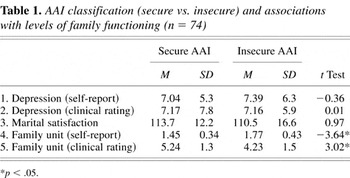
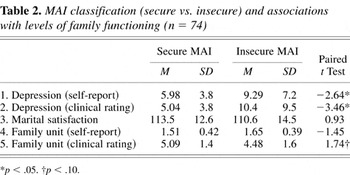
Direct associations between security of adult attachment (or marital attachment) and the three levels of family functioning that were assessed are presented in Tables 1 and 2. As shown, security of adult attachment was not related to intensity of depression symptoms on self-report (BDI) or clinician assessment (HRSD), although security of marital attachment was associated with less intense symptoms of depression assessed using both measurement devices. Maternal self-report of dyadic marital satisfaction was not associated with attachment security with respect to either adult or marital relationship domains. Finally, adult attachment security (but not marital attachment security) was associated with healthier family unit functioning.
AAI classification (secure vs. insecure) and associations with levels of family functioning (n = 74)

MAI classification (secure vs. insecure) and associations with levels of family functioning (n = 74)

Similar associations are maintained between security of attachment in each relationship domain with outcomes even after accounting for variance associated with the other relationship domain. Thus, after accounting for the variance associated with security of adult attachment, marital attachment continued to be significantly associated with maternal depression symptoms from self-report, partial r (71) = .30, p < . 01, and clinical interview, partial r (71) = .39, p < .01. After accounting for the variance associated with security of marital attachment, adult attachment continued to be significantly associated with family unit functioning from self-report, partial r (71) = .36, p < .01, and clinical interview, partial r (71) = −.29, p < . 01.
Security of combined adult and marital attachment classification associated with individual, dyadic, and family functioning
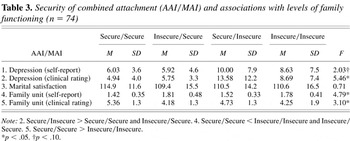
Subjects were divided into four groups based on security of combined adult and marital attachment classifications. Thus, we created four groups including AAI Secure/MAI Secure (n = 34), AAI Secure/MAI Insecure (n = 12), AAI Insecure/MAI Secure (n = 12), and AAI Insecure/MAI Insecure (n = 16). We conducted a series of ANOVAs to determine the extent to which patterns of attachment were associated with levels of family functioning. As shown in Table 3, patterns of attachment were associated with different aspects of family functioning depending on the level of analysis. That is, individual maternal symptoms of depression were most intense in the group with a pattern of AAI Secure/MAI Insecure (when assessed using maternal self-report and clinical judgment). Maternal report of dyadic marital satisfaction was unrelated to any attachment pattern. Also, healthier family unit functioning was associated with a consistent secure pattern of attachment (compared with a consistent insecure pattern) assessed with maternal self-report and clinical judgment.
Security of combined attachment (AAI/MAI) and associations with levels of family functioning (n = 74)

Discussion
Application of family systems principles to extend empirical investigation of attachment allowed for a unique series of study questions that focused on the interplay between attachment security across multiple relationship domains as well as across multiple levels of family functioning. In general, we found barely more than chance levels of concordance between attachment security in adult and marital relationship domains (based on AAI and MAI attachment classifications, respectively). Further, we found that attachment security with respect to particular relationships was differentially associated with different levels of family functioning. That is, we found that neither maternal depression nor dyadic marital satisfaction was associated with security of adult attachment, although family functioning at the whole family unit level was related to adult attachment security. We also found that neither marital satisfaction nor family unit functioning was associated marital attachment security, although intensity of maternal depression was associated with marital attachment security. Finally, examination of the security of combined adult and marital attachment further supported the multilevel organization of the family system. That is, we found that security of marital attachment (combined with either security or insecurity of adult attachment) was associated with lower maternal depression. With respect to family unit functioning, as expected, we found that the combination of attachment security in both adult and marital relationship domains was associated with significantly healthier family unit functioning compared with attachment insecurity in both domains (measured by both maternal self-report and clinical interview). Interestingly, based on maternal self-report, combined attachment security in both adult and marital relationship domains was similarly associated with healthy family unit functioning even if adult attachment security was combined with marital attachment insecurity. However, when adult attachment insecurity was combined with marital attachment security, family functioning faltered. We discuss these findings in more detail below.
Concordance and discordance of AAI and MAI
Of the women with secure AAI classification, 74% were also classified secure with respect to marital attachment working models; of women with insecure AAI classification, 43% were classified insecure with respect to both relationship domains (63 and 39% would have been expected by chance). This suggests that working models regarding early childhood experiences are useful, yet not fully explanatory, mechanisms with respect to predicting attachment within marital relationships. Despite finding more consistency of secure, as opposed to insecure, patterns across relationship domains, these findings suggest that organization of working models across different important relationships can be distinguished (Bretherton, 1991).
AAI/MAI correspondence and maternal depression diagnosis
Unexpectedly, correspondence between AAI and MAI classification differed when maternal depression diagnosis was considered. That is, there was moderate (yet significant) concordance between AAI and MAI classification in the nondepressed group, compared with small (and nonsignificant) concordance in the depressed group. This may be indicative that psychopathology processes are associated with more transformations of working models across relationship domains. Direction of effect cannot be ascertained from this study, and each direction is plausible. Women who experience cognitive/emotional consistency across relationships may have more predictability in these important functional domains, which in turn, is supportive of good mental health. Conversely, women experiencing depression may be more inclined to reject past relationship working models as ineffective, resulting in less concordance across domains. These, and other, speculations could guide future studies of this phenomenon.
Patterns of AAI/MAI attachment security and functioning of family subsystems
Our findings suggest that organization of representations of different attachment relationships are related to different levels of family functioning in distinct ways. First, security of adult attachment (not marital attachment) was associated with healthy family unit functioning. In fact, not only did we find significant mean differences between adult attachment secure and insecure groups, the absolute mean scores fell into nonclinical and clinical ranges of family functioning, respectively. Further, by applying family systems principles to the study of attachment relationships, we found that it was security in both adult attachment and marital attachment domains (i.e., consistent secure pattern) that was associated with healthy family unit functioning. It may be that to accomplish all the necessary tasks to function well at a family unit level, it is important to have come to an integrated understanding of past and current intimate relationships, setting the stage for the current family to be the foundation of relationship experiences for the next generation (today's family is tomorrow's family of origin).
Unlike adult attachment, marital attachment security was associated with maternal depression symptom severity. The application of family systems principles allowed for fuller understanding of these associations. That is, when we examined the combined patterns of attachment security we found that at an individual (depression symptom) level, marital insecurity is a particular risk, even when considered in the context of adult attachment security. Thus, it may be that the temporal concurrence (i.e., expression of depression symptoms in the context of a current marital relationship) highlights the links between these processes.
Veroff and colleagues (e.g., Veroff, Sutherland, Chadiha, & Ortega, 1993) applied symbolic interactionist theory using a reality construction perspective to address a similar issue. They evaluated themes derived from marital narratives with respect to how couples arrive at consensual meanings about their relationship to predict marital satisfaction and individual well-being. They found that couples who were able to describe and integrate relationship experiences over time (or to “reconstruct” these experiences into a current relationship awareness) reported better quality relationships and individual satisfaction. Thus, specific relationship experiences within marriages may be important predictors of security. Not only does this perspective provide support for the potential importance of marital attachment for individual functioning, it also places emphasis on the “couple-ness” aspects of the narrative, whereas the attachment approach typically focuses on the individual's construction of the relationship. Applications of working models to further explore couple's constructions of attachment narratives would likely yield exciting and important information for the field.
Cautions and limitations
Directionality of effects
There is a natural tendency to assume that adult attachment with respect to early caregiving relationships precedes marital attachment, even when assessed at the same time, given the relationship domain. However, it is important to acknowledge that both are current constructions. As such, we also have no basis from which to determine causal directions with respect to outcomes of interest. Perhaps representations affect appraisal, but it is equally reasonable that appraisal (the extent to which mothers rate the family unit as well functioning) is one basis for construction of marital attachment representations. To untangle these issues, we need to examine these constructions over time, as they may change or evolve with family transitions that occur as a natural part of the family life cycle and/or fluctuations in depression symptoms.
Depression and narrative construction
Assessment of working models of attachment has relied, for the most part, on narrative methodology in which the coherence of the narrative plays a major role in determining security. It is important to consider depression as a relevant contextual aspect when evaluating narrative coherence. For example, it is possible that depressed women more often provide negatively distorted perceptions of their childhood relationships by virtue of the current or immediate severity of their illness. This may be viewed as troublesome because of the presumed inaccuracy of the reports. However, any distortions that depressed adults might have about relationships can be seen as a valid (and accurate) indication of the current working model of those relationships, even if the facts of their childhood are incorrect. In addition, the quality of the narratives produced by depressed women may be more impoverished or otherwise biased by virtue of immediate depressive symptomatology. That is, the presence of serious depressive symptoms (such as psychomotor retardation, concentration difficulties, and/or sleep disturbances) may influence the level of verbal production as well as the coherence and consistency of the narrative, by interfering with the ability to relate memories about past experience. To date, research on adult (and marital) attachment has not addressed these issues.
Finally, more work is needed to examine maternal depression as one context in which a dynamic working model of attachment is embedded. For example, we could begin to explore models in which marital attachment security is examined as a protective factor in the link between maternal depression and poor child outcomes, while insecure marital attachment may exacerbate the risk of maternal depression through its association with the infant–parent attachment relationship. For example, it may be that women with secure working models of attachment benefit from therapeutic relationships potentially resulting in quicker recovery from depressive episodes and/or longer latency to relapse. Further, it may be that risks of depression are minimized with respect to child outcomes in the context of attachment security due to better family functioning reflected in decreased family conflict and increased parental sensitivity toward the child. This dynamic approach to attachment encourages researchers to embrace the complexity of the family system, and provides a framework for developing models that include its richness.
Limited sample
We only focused on women in this study, and did not examine the partners' current data. It is possible that the correspondence of attachment patterns between partners is a relevant contextual factor associated with outcomes of interest. In fact, we have collected data to explore these issues, which is currently being processed. Although most of the literature to date has focused on mothers, recent work has highlighted the importance of examining fathers' working models of relationships. van IJzendoorn and Bakermans–Kranenburg (1996) found that the distribution of attachment representations in fathers is remarkably similar to that of mothers, yet mothers' and fathers' representations may differentially correspond with child outcomes (Cowan, Cohn, Cowan, & Pearson, 1996; van IJzendoorn, 1992).
Conclusions
In sum, we identified rates of security that were similar whether past caregiving relationships or marital relationships were considered, but with modest correspondence across these relationship domains. Patterns of discordance were associated with other aspects of functioning within different family subsystems. Our results support an early formulation of attachment processes described in Sroufe and Waters' (1977) organizational construct requiring a highly dynamic working model to link the functional equivalence of different behaviors (from the perspective of set goals of the attachment system) with the response of the caregiving context. Surely, marriage is an important relationship context that has bearing on a person's generalized working model of attachment with respect not only to the relationship with one's spouse, but also regarding conceptualization of past relationship experiences and relationships with children. We speculate that a theoretical approach emphasizing a dynamic, contextualized working model (which is suggested both by family systems theory and early treatments of attachment theory) will best guide future understanding of the complex multigenerational phenomena explored in our research.
References
REFERENCES
American Psychiatric Association.
(1994).
Diagnostic and statistical manual of mental disorders
(4th ed.).
Washington, DC:
Author.
Barnett, P. A., &
Gotlib, I. H.
(1988).
Psychosocial functioning and depression: Distinguishing among
antecedents, concomitants, and consequences.
Psychological Bulletin
104,
97–126.CrossRefGoogle Scholar
Beck, A. T.
(1978).
Beck Depression Inventory.
San Antonio, TX:
Psychological Corporation.
Benoit, D.,
Vidovic, D., &
Roman, J.
(1991, April).
Transmission of attachment across three generations.
Paper presented at the Biennial Meeting of the Society for Research
in Child Development.
Benoit, D.,
Zeanah, C. H., &
Barton, M. L.
(1989).
Maternal attachment disturbances in failure to thrive.
Infant Mental Health Journal
3,
185–202.3.0.CO;2-0>CrossRefGoogle Scholar
Benoit, D.,
Zeanah, C. H.,
Boucher, C., &
Minde, K.
(1989).
Sleep disorders in early childhood: Association with insecure
maternal attachment.
Journal of the American Academy of Child and Adolescent Psychiatry
31,
86–93.Google Scholar
Berman, W. H.,
Marcus, L., &
Berman, E. R.
(1994).
Attachment in marital relations. In
M. B. Sperling &
W. H. Berman (Eds.),
Attachment in adults: Clinical and developmental perspectives (pp.
204–231).
New York:
Guilford Press.
Bettes, B. A.
(1988).
Maternal depression and motherese: Temporal and intonational
features.
Child Development
59,
1089–1096.CrossRefGoogle Scholar
Bishop, D.,
Epstein, N.,
Keitner, G.,
Miller, I., &
Zlotnick, C.
(1987).
McMaster Structured Interview of Family Functioning (McSIFF).
Unpublished manuscript,
Brown University, Department of Psychiatry and Human Behavior.
Bretherton, I.
(1990).
Communication patterns, internal working models, and the
intergenerational transmission of attachment relationships.
Infant Mental Health Journal
11,
237–252.3.0.CO;2-X>CrossRefGoogle Scholar
Bretherton, I.
(1991).
Updating the ‘internal working model’ construct: Some
reflections.
Attachment and Human Development
1,
343–357.Google Scholar
Cicchetti, D.,
Cummings, E. M.,
Greenberg, M. T., &
Marvin, R. S.
(1990).
An organizational perspective on attachment beyond infancy:
Implications for theory, measurement, and research. In
M. T. Greenberg,
D. Cicchetti, &
E. M. Cummings (Eds.),
Attachment in the preschool years: Theory, research, and
intervention (pp.
3–50).
Chicago:
University of Chicago.
Cicchetti, D., &
Howes, P.
(1991).
Developmental psychopathology in the context of the family:
Illustrations from the study of child maltreatment.
Canadian Journal of Behavioural Science
23,
257–281.CrossRefGoogle Scholar
Cohn, D. A.,
Cowan, P. A.,
Cowan, C. P., &
Pearson, J. L.
(1992).
Mothers' and fathers' working models of childhood
attachment relationships, parenting styles, and child behavior.
Development and Psychopathology
4,
417–431.CrossRefGoogle Scholar
Cohn, D. A.,
Silver, D. H.,
Cowan, C. P.,
Cowan, P. A., &
Pearson, J.
(1992).
Working models of childhood attachment and couple relationships.
Journal of Family Issues
13,
432–449.CrossRefGoogle Scholar
Collins, N. L., &
Read, S. J.
(1990).
Adult attachment, working models, and relationship quality in
dating couples.
Journal of Personality and Social Psychology
58,
644–663.CrossRefGoogle Scholar
Cowan, P. A.,
Cohn, D. A.,
Cowan, C.P., &
Pearson, J. L.
(1996).
Parents' attachment histories and children's
externalizing and internalizing behaviors: Exploring family systems
models of linkage.
Journal of Consulting and Clinical Psychology
64,
53–63.CrossRefGoogle Scholar
Crittenden, P. M.
(1990).
Internal representational models of attachment relationships.
Infant Mental Health Journal
11,
259–277.3.0.CO;2-J>CrossRefGoogle Scholar
Crowell, J. A., &
Feldman, S. S.
(1991).
Mothers' working models of attachment relationships and mother
and child behavior during separation and reunion.
Developmental Psychology
27,
597–605.CrossRefGoogle Scholar
Crowell, J. A.,
Treboux, D.,
Gao, Y.,
Fyffe, C.,
Pan, H., &
Waters, E.
(2002).
Assessing secure base behavior in adulthood: Development of a
measure, links to attachment, and relations to couples'
communication and reports of relationships.
Developmental Psychology
38,
679–693.CrossRefGoogle Scholar
Crowell, J. A.,
Treboux, D., &
Waters, E.
(2002).
Stability of attachment representations: The transition to
marriage.
Developmental Psychology
38,
467–479.CrossRefGoogle Scholar
Cummings, E. M., &
Davies, P. T.
(1994).
Maternal depression and child development.
Journal of Child Psychology and Psychiatry
35,
73–112.CrossRefGoogle Scholar
Dickstein, S.
(1993).
Marital Attachment Interview.
Unpublished manuscript.
Dickstein, S.,
Seifer, R.,
Hayden, L. C.,
Schiller, M.,
Sameroff, A. J.,
Keitner, G.,
Miller, I.,
Rasmussen, S.,
Matzko, M., &
Dodge–Magee, K.
(1998).
Levels of family assessment II: Impact of maternal psychopathology
on family functioning.
Journal of Family Psychology
12,
23–40.CrossRefGoogle Scholar
Dickstein, S.,
Seifer, R.,
St Andre, M., &
Schiller, M.
(2001).
Marital attachment interview: Adult attachment assessment of
marriage.
Journal of Social and Personal Relationships
18,
651–672.CrossRefGoogle Scholar
Donovan, W. L., &
Leavitt, L. A.
(1989).
Maternal self-efficacy and infant attachment: Integrating
physiology, perceptions, and behavior.
Child Development
60,
460–472.CrossRefGoogle Scholar
Eichberg, C. G.
(1987, April).
Quality of infant–parent attachment: Related to mother's
representation of her own relationship history.
Paper presented at the biennial meeting of the Society for Research in
Child Development, Baltimore, MD.
Epstein, N. B.,
Baldwin, L. M., &
Bishop, D. S.
(1982).
McMaster Clinical Rating Scale.
Providence, RI:
Brown/Butler Family Research Program.
Epstein, N. B.,
Baldwin, L. M., &
Bishop, D. S.
(1983).
The McMaster Family Assessment Device.
Journal of Marital and Family Therapy
9,
171–180.CrossRefGoogle Scholar
Epstein, N. B., &
Bishop, D. S.
(1981).
Problem-centered systems therapy of the family. In
A. S. Gurman &
D. P. Kniskern (Eds.),
Handbook of family therapy.
New York:
Brunner/Mazel.
Fendrich, M.,
Warner, V., &
Weissman, M. M.
(1990).
Family risk factors, parental depression, and psychopathology in
offspring.
Developmental Psychology
26,
40–50.CrossRefGoogle Scholar
Field, T. M.,
Healy, B.,
Goldstein, S., &
Guthertz, M.
(1990).
Behavior-state matching and synchrony in mother–infant
interactions of nondepressed versus depressed dyads.
Development Psychology
26,
7–14.CrossRefGoogle Scholar
Field, T. M.,
Healy, B.,
Goldstein, S.,
Perry, S.,
Bendell, D.,
Schanberg, S.,
Zimmerman, E. A., &
Kuhn, C.
(1988).
Infants of depressed mothers show “depressed” behavior
even with nondepressed adults.
Child Development
59,
1569–1579.CrossRefGoogle Scholar
First, M. B.,
Spitzer, R. L.,
Gibbon, M., &
Williams, J. B.
(1996).
Structured clinical interview for DSM-IV Axis I
disorders—Nonpatient edition
(SCID-I/NP, Version 2.0).
New York:
Biometrics Research Department.
Fonagy, P.,
Steele, H., &
Steele, M.
(1991).
Maternal representations of attachment during pregnancy predict the
organization of infant–mother attachment at one year of age.
Child Development
62,
891–905.CrossRefGoogle Scholar
Gaensbauer, T. J.,
Harmon, R. J.,
Cytryn, L., &
McKnew, D. H.
(1984).
Social and affective development in infants with a manic-depressive
parent.
American Journal of Psychiatry
141,
223–229.Google Scholar
George, C.,
Kaplan, N., &
Main, M.
(1985).
Adult Attachment Interview.
Berkeley, CA:
University of California at Berkeley.
Goldberg, W. A., &
Easterbrooks, M. A.
(1984).
The role of marital quality in toddler development.
Child Development
20,
504–515.CrossRefGoogle Scholar
Haft, W., &
Slade, A.
(1989).
Affect attunement and maternal attachment: A pilot study.
Infant Mental Health and Development
10,
157–172.3.0.CO;2-3>CrossRefGoogle Scholar
Hayden, L. C.,
Schiller, M.,
Dickstein, S.,
Seifer, R.,
Sameroff, A. J.,
Keitner, G.,
Miller, I., &
Rasmussen, S.
(1998).
Levels of family assessment I: Family, marital, and
parent–child interaction.
Journal of Family Psychology
12,
7–22.CrossRefGoogle Scholar
Hazen, C., &
Shaver, P.
(1990).
Love and work: An attachment–theoretical perspective.
Journal of Personality and Social Psychology
39.CrossRefGoogle Scholar
Hollingshead, A. B.
(1975).
Four Factor Index of Social Status.
Unpublished manuscript,
Yale University.
Hooley, J. M., &
Teasdale, J. D.
(1989).
Predictors of relapse in unipolar depressives: Expressed emotion,
marital distress, and perceived criticism.
Journal of Abnormal Psychology
98,
229–235.CrossRefGoogle Scholar
Jacobson, N. S.,
Dobson, K.,
Fruzzetti, A. E.,
Schmaling, K. B., &
Salusky, S.
(1991).
Martial therapy as a treatment for depression.
Journal of Consulting and Clinical Psychology
59,
547–557.CrossRefGoogle Scholar
Keitner, G. I.,
Miller, I. W.,
Epstein, N. B., &
Bishop, D. S.
(1986).
The functioning of families in patients with major depression.
International Journal of Family Psychiatry
7,
11–16.Google Scholar
Keitner, G. I.,
Ryan, C. E.,
Miller, I. W.,
Epstein, N. B., &
Bishop, D. S.
(1990).
Family functioning and recovery from depression.
Paper presented at the First International Conference on The McMaster
Model of Family Functioning, Providence, RI.
Keitner, G. I.,
Ryan, C. E.,
Miller, I. W.,
Kohn, R.,
Bishop, D. S., &
Epstein, N. B.
(1995).
Role of the family in recovery and major depression.
American Journal of Psychiatry
152,
1002–1008.Google Scholar
Keitner, G. I.,
Ryan, C. E.,
Miller, I. W., &
Norman, W. H.
(1992).
Recovery and major depression: Factors associated with twelve-month
outcome.
American Journal of Psychiatry
149,
93–99.Google Scholar
Kowalik, D. L., &
Gotlib, I. H.
(1987).
Depression and marital interaction: Concordance between intent and
perception of communication.
Journal of Abnormal Psychology
96,
127–134.CrossRefGoogle Scholar
Main, M., &
Goldwyn, R.
(1994, 1996).
Adult attachment scoring and classification system.
Unpublished manuscript,
University of California Berkeley, Department of Psychology.
Marvin, R. S., &
Stewart, R. B.
(1990).
A family systems framework for the study of attachment. In
M. T. Greenberg,
D. Cicchetti, &
E. M. Cummings (Eds.),
Attachment in the preschool years: Theory, research, and
intervention (pp.
51–86).
Chicago:
University of Chicago Press.
McHale, J. P., &
Cowan, P. A. (Eds.).
(1996).
Understanding how family-level dynamics affect children's
development: Studies of two-parent families. New directions in child
development
(Vol. 74).
San Francisco, CA:
Jossey–Bass.
Miller, I. W.,
Bishop, S.,
Norman, W. H., &
Maddever, H.
(1984).
The Modified Hamilton Rating Scale for Depression: Reliability and
validity.
Psychiatry Research
14,
131–142.Google Scholar
Miller, I. W.,
Epstein, N. B.,
Bishop, D. S., &
Keitner, G. I.
(1985).
The McMaster Family Assessment Device: Reliability and validity.
Journal of Marital and Family Therapy
11,
345–356.CrossRefGoogle Scholar
Miller, I. W.,
Kabacoff, R. I.,
Epstein, N. B.,
Bishop, D. S.,
Keitner, G. I.,
Baldwin, L. M., &
van der Spuy, H. I. J.
(1994).
The development of a clinical rating scale for the McMaster Model
of Family Functioning.
Family Process
33,
53–69.CrossRefGoogle Scholar
Miller, I. W., &
Keitner, G. I.
(1992).
Depressed patients with dysfunctional families: Description and
course of illness.
Journal of Abnormal Psychology
101,
637–646.CrossRefGoogle Scholar
Minuchin, P.
(1985).
Families and individual development: Provocations from the field of
family therapy.
Child Development
66,
2889–302.Google Scholar
Owens, G.,
Crowell, J. A.,
Pan, H.,
Treboux, D.,
O'Connor, E., &
Waters, E.
(1995).
The prototype hypothesis and the origins of attachment working
models: Adult relationships with parents and romantic partners.
Monographs of the Society for Research in Child Development
60(2–3,
Serial No. 244).CrossRefGoogle Scholar
Paley, B.,
Cox, M. J.,
Burchinal, M. R., &
Payne, C. C.
(1999).
Attachment and marital functioning: Comparison of spouses with
continuous-secure, earned-secure, dismissing, and preoccupied
attachment stances.
Journal of Family Psychology
13,
580–597.CrossRefGoogle Scholar
Radke–Yarrow, M.,
Cummings, E. M.,
Kuczynski, L., &
Chapman, M.
(1985).
Patterns of attachment in two- and three-year-olds in normal
families and families with parental depression.
Child Development
56,
884–893.CrossRefGoogle Scholar
Raskin–Esquer, L. A.,
Burnett, C. K.,
Baucom, D. H., &
Epstein, N.
(1997).
Autonomy and relatedness in marital functioning.
Journal of Marital and Family Therapy
23,
175–190.CrossRefGoogle Scholar
Riskind, J. H.,
Beck, A. T.,
Berchick, R. J.,
Brown, G., &
Steer, R. A.
(1987).
Reliability of DSM-III diagnoses for major depression and
generalized anxiety disorder using the Structured Clinical Interview
for DSM-III.
Archives of General Psychiatry
44,
817–820.CrossRefGoogle Scholar
Seifer, R.,
Sameroff, A. J.,
Dickstein, S.,
Keitner, G.,
Miller, I.,
Rasmussen, S., &
Hayden, L. C.
(1996).
Parental psychopathology, multiple contextual risks, and one-year
outcomes in children.
Journal of Clinical Child Psychology
25,
423–435.CrossRefGoogle Scholar
Shaver, P.,
Hazen, C., &
Bradshaw, D.
(1988).
Love as attachment: The integration of three behavioral systems.
In
R. J. Stenberg &
M. L. Barnes (Eds.),
The psychology of love.
New Haven, CT:
Yale University Press.
Simpson, J. A.
(1990).
Influence of attachment styles on romantic relationships.
Journal of Personality and Social Psychology
59,
971–980.CrossRefGoogle Scholar
Spanier, G. B.
(1976).
Measuring dyadic adjustment: New scales for assessing the quality
of marriage and similar dyads.
Journal of Marriage and the Family
38,
15–28.CrossRefGoogle Scholar
Sroufe, L. A., &
Waters, E.
(1977).
Attachment as an organizational construct.
Child Development
48,
1184–1199.CrossRefGoogle Scholar
Stevenson–Hinde, J.
(1990).
Attachment within family systems: An overview.
Infant Mental Health Journal
11,
218–226.3.0.CO;2-1>CrossRefGoogle Scholar
Thompson, R. J.,
Merritt, K. A.,
Keith, B. R.,
Murphy, L. B., &
Johndrow, D. A.
(1993).
The role of maternal stress and family functioning in maternal
distress and mother-reported and child-reported psychological
adjustment of non-referred children.
Journal of Clinical Child Psychology
22,
78–84.CrossRefGoogle Scholar
van IJzendoorn, M. H.
(1992).
Intergenerational transmission of parenting: A review of studies in
non-clinical populations.
Developmental Review
12,
76–99.CrossRefGoogle Scholar
van IJzendoorn, M. H., &
Bakermans–Kranenburg, M. J.
(1996).
Attachment representations in mothers, fathers, adolescents, and
clinical groups: A meta-analysis and search for normative data.
Journal of Consulting and Clinical Psychology
64,
8–21.CrossRefGoogle Scholar
Veroff, J.,
Sutherland, L.,
Chadiha, L. A., &
Ortega, R. M.
(1993).
Predicting marital quality with narrative assessments of marital
experience.
Journal of Marriage and the Family
55,
326–337.CrossRefGoogle Scholar
Ward, M. J.,
Botyanski, N. C.,
Plunkett, S. W., &
Carlson, E. A.
(1991, April).
The concurrent and predictive validity of the AAI for adolescent
mothers.
Paper presented at the biennial meeting of the SRCD, Seattle,
WA.
Waters, E.,
Vaughn, B. E.,
Posada, G., &
Kondo–Ikemura, K.
(1995).
Caregiving, culture, and cognitive perspectives on secure-base
behavior and working models: New growing points of attachment theory
and research.
Monographs of the Society for Research in Child Development
60(2–3.
Serial No. 244).Google Scholar
Weissman, M. M.,
Gammon, G. D.,
John, K.,
Merikangas, K. R.,
Warner, V.,
Prusoff, B. A., &
Sholomskas, D.
(1987).
Children of depressed parents.
Archives of General Psychiatry
44,
847–852.CrossRefGoogle Scholar
Zeanah, C. H., &
Emde, R. N.
(1994).
Attachment disorders in infancy and childhood. In
M. Rutter,
L. Hersov, &
E. Taylor (Eds.),
Child and adolescent psychiatry: Modern approaches.
Oxford:
Blackwell.
AAI classification (secure vs. insecure) and associations with levels of family functioning (n = 74)
MAI classification (secure vs. insecure) and associations with levels of family functioning (n = 74)
Security of combined attachment (AAI/MAI) and associations with levels of family functioning (n = 74)
 You have
Access
- 15
- Cited by