Interactions between marine mammals and fishing activities involve the use of many different types of gear and can frequently result in negative economic, ecological and social consequences. Other remarkable issues resulting from marine mammal–fisheries interactions include the mutilation and mortality of marine mammals and the damage or loss of fishing gear (see Gilman et al., Reference Gilman, Brothers, McPherson and Dalzell2006 for a review). Marine mammals, seabirds, sea turtles, sharks and other fish may be particularly vulnerable to increased mortality rates above natural levels because of their life history traits, which can lead to unsustainable levels of removal, affecting biodiversity (Gilman et al., Reference Gilman, Boggs and Brothers2003; Croxall et al., Reference Croxall, Butchart, Laslecelles, Stattersfield, Sullivan, Symes and Taylor2012).
The interaction between baleen whales and longline fisheries is poorly known worldwide and likely underestimated, mainly due to underreporting by fishermen and a low probability of discovery at sea (Cassoff et al., Reference Cassoff, Moore, McLellan, Barco, Rotstein and Moore2011). A few cases involving baleen whales have been documented to date, including records from the U.S. East Coast pelagic longline fishery (Garrison, Reference Garrison2007). Even less information on this issue is available from tropical environments, where most of the whales come to breed and raise their calves.
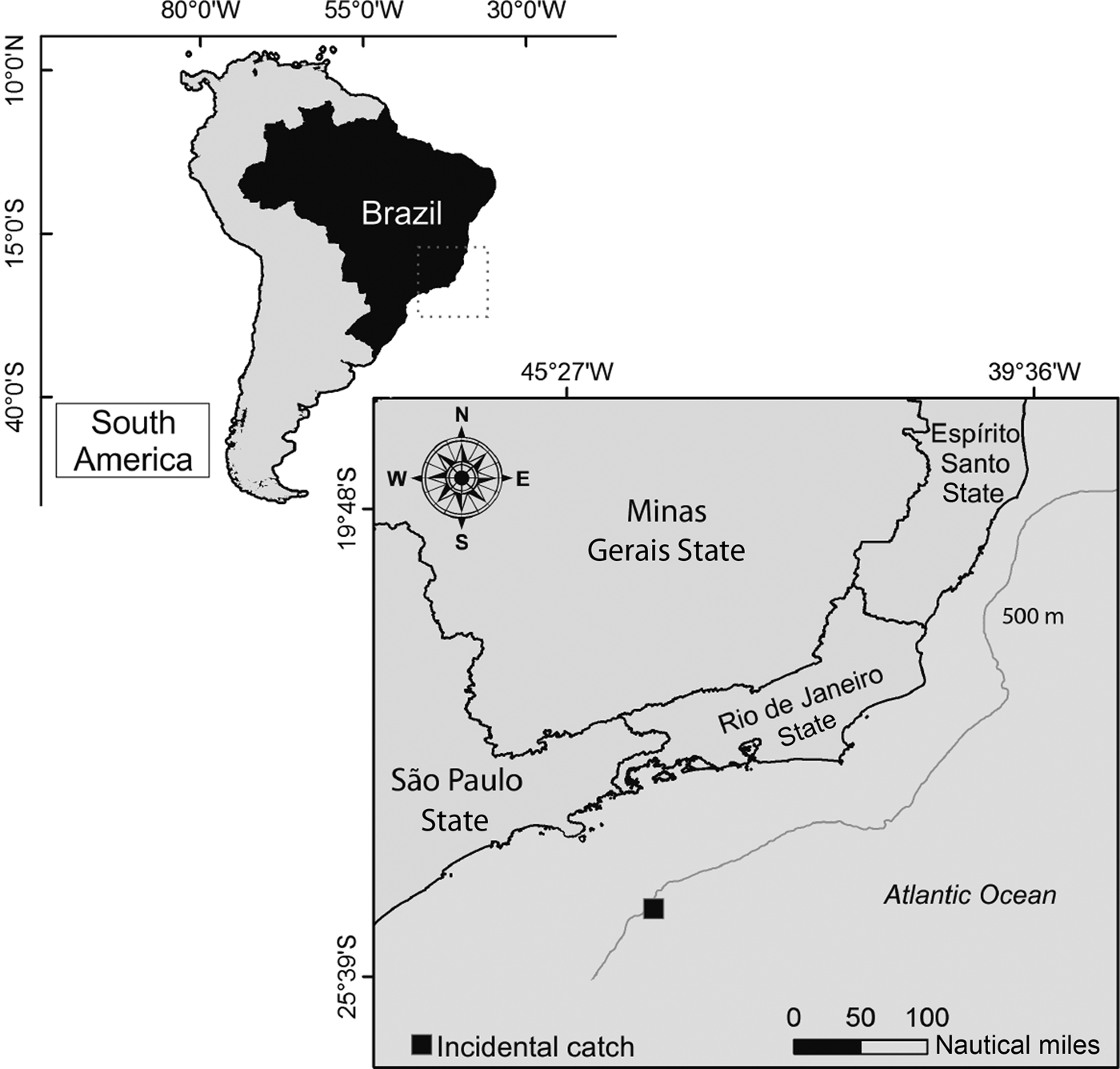
With this in mind, we present a rare record of an incidental catch of a baleen whale from the Brazilian coast (Figure 1), by longline fisheries operated by the Itaipava fleet. Currently, the Itaipava longliners operate approximately 170 wooden boats measuring 12–16 m. The fishing boats are based in the locality of Itaipava, a district of Itapemirim, on the southern coast of Espírito Santo State, Brazil. The fishery of the Itaipava fleet is characterized as semi-industrial and operates in a large area, from 10° to 27°S, using both longline and single lines, targeting mainly dolphin fish, tuna, swordfish, sharks and related fishes. Additional information on the Itaipava longline fishery fleet is available in Martins et al. (Reference Martins, Olavo, Costa, Costa, Martins and Olavo2005) and at http://www.geoprof.org/pdf/pub_49.pdf.
Approximate location of the reported incidental capture of a small whale by a longline fishing boat, off the south-eastern coast of Brazil, 29 April 2011.

The incidental capture of this small-to-medium-sized baleen whale was documented in April 2011, ~80 NM south of São Sebastião (23°48′S 45°23′W), off São Paulo state, Brazil (Figure 1). The longline was set in surface water at 04:30 pm on the previous day and recovered at 05:00 am. The total length of the longline was 24 NM and it had one buoy/float every five hooks and a high-flyer every 2 NM. Bonito (Scombridae) and mullets (Mugilidae) were used as bait. The targeted fish were swordfish (Xiphias gladius) and sharks.
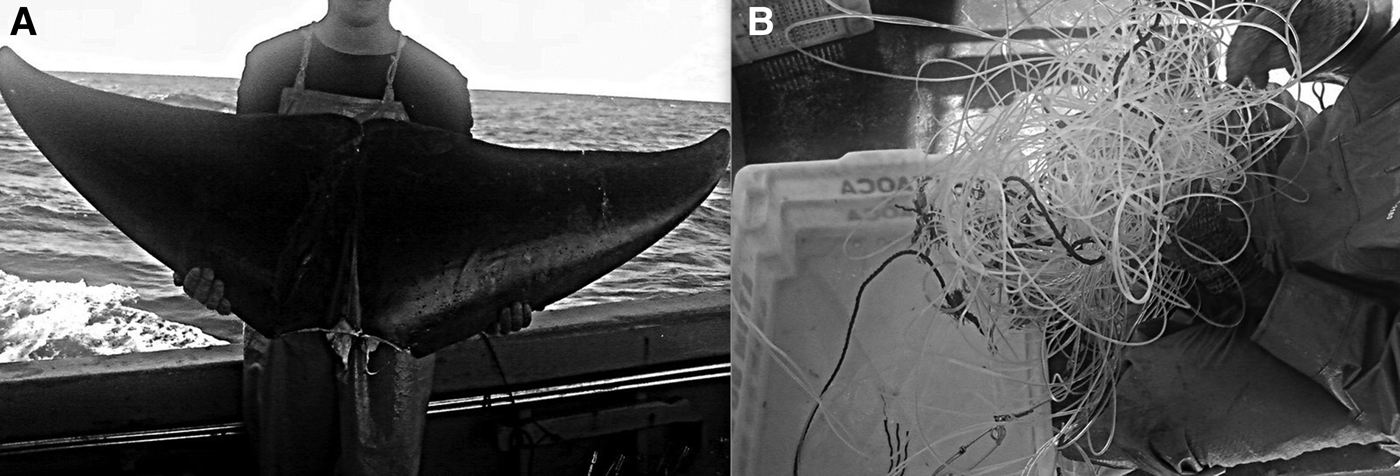
Early in the morning of 29 April 2011, the fishermen observed that the fishing gear was removed from its initial position, where it was re-sighted by the high-flyer. While checking the longline gear, it was observed that it had been heavily damaged and most of the gear was lost. While taking the gear onboard, it was noticed by the fishermen that a fluke of a whale was entangled in the lines. The fluke was loaded onboard by curiosity and some pictures were taken (Figure 2A). Fishermen reported that the fluke was kept onboard for a few hours and later discarded. The damaged longline gear is shown in Figure 2B. During the interviews, no report was given regards the remains of the carcass of the whale.
(A) The fluke of the baleen whale found entangled in longline fishing gear. (B) Damaged longline gear removed from the entangled fluke of the baleen whale.
During the entanglement process, it is common that a part of the fishing gear remains affixed to the caudal peduncle of the whale (Cassoff et al., Reference Cassoff, Moore, McLellan, Barco, Rotstein and Moore2011). In the Gulf of Maine, 57% of humpback whales observed had entanglement scars on their caudal peduncle (Robbins & Mattila, Reference Robbins and Mattila2004). Exacerbating this problem, some records show that the gear can be wrapped so tightly that it pierces the bone (Cassoff et al., Reference Cassoff, Moore, McLellan, Barco, Rotstein and Moore2011). The present record reveals one of the most severe scenarios of this interaction, where the entire fluke of the whale was mutilated. Most likely, a combination of the gear dragging and the natatory movement exerted by the whale led to the mutilation of the fluke. The whale would probably have then sunk and drowned with the remaining gear.
Interactions between small whales and fishing gear have been previously recorded from the Brazilian coast, during the beginning of the migration period of balaenopterids (Zerbini et al., Reference Zerbini, Secchi, Siciliano and Simões-Lopes1997), including incidences involving southern right whales (Santos et al., Reference Santos, Siciliano, Pacheco de Souza and Pizzorno2001).The fluke of the whale recorded herein measured some 2.0 m in width (tip to tip) and was dark black in colour on at least one of its surfaces. Considering the cetacean species previously recorded for the São Sebastião region (Souza & Begossi, Reference Souza and Begossi2007), in addition to the specimen's morphological characteristics such as shape, pointed edges, and indentation and colour of the fluke, we strongly suggest that this species was a small balaenopterid, most likely a dwarf minke whale (Balaenoptera acutorostrata). Moreover, the possibility of regarding it as a juvenile baleen whale cannot be discarded. The lack of a serrated edge, a distinct indentation in the middle of the fluke and other features excludes its identification as a humpback whale. On the other hand, false-killer whales (Pseudorca crassidens) are also known to get involved with pelagic longline fisheries at lower latitudes in Brazil (Dalla Rosa & Secchi, Reference Dalla Rosa and Secchi2007) and worldwide (Hamer et al., Reference Hamer, Childerhouse and Gales2012). However, according to previous data, measurements of the fluke width (tip to tip) in P. crassidens range from 75 to 85 cm (Kastelein et al., Reference Kastelein, Mosterd, Schooneman and Wiepkema2000), 81 cm (Qian et al., Reference Qian, Xiang, Mu and Yumiao2008), 96.5 cm (Baird et al., Reference Baird, Langelier and Stacey1989) and 1.16 m (Zylber & Le Bas, Reference Zylber, Failla and Le Bas2002). The specimen presented here had a larger fluke than those reported for the false-killer whales, reaching approximately 2.0 m in length. This strongly supports the identification of the specimen as a baleen whale rather than as a false-killer whale.
The impact of fishing on baleen whales is far from being fully understood. Whether it was an accident or whether the baleen whale was somehow attracted to the longline is a matter of speculation. Despite such uncertainty in the identification of the whale, the episode documented herein seems to be the very first in its nature, resulting in the severe mutilation of the peduncle of a small whale entangled in longline fishing gear, off the coast of Brazil. As such, this report represents, at the very least, the need for further investigation into the magnitude of such interactions in the south-west Atlantic Ocean.
ACKNOWLEDGEMENTS
We thank Projeto Albatroz and the Itaipava local fishermen for their collaboration. We are also grateful to H.T. Pinheiro and E. Secchi for their early comments on the manuscript. D.C. Tavares and F.C.F. Pinheiro were supported by Coordenação de Aperfeiçoamento de Pessoal de Nível Superior-CAPES.