INTRODUCTION
A complex interaction exists between pregnancy and eating disorders. Early studies suggested that pregnancy in women with anorexia nervosa (AN) was rare due to the endocrinological, psychological and psychosocial features of the disorder (Weinfeld et al. Reference Weinfeld, Dubay, Burchell, Mellerick and Kennedy1977; Strimling, Reference Strimling1984). However, some, but not all, outcome studies of AN and bulimia nervosa (BN) suggest that fertility may not differ from the general population in those who survive the illness (Kohmura et al. Reference Kohmura, Miyake, Aono and Tanizawa1986; Bulik et al. Reference Bulik, Sullivan, Fear, Pickering, Dawn and McCullin1999; Crow et al. Reference Crow, Thuras, Keel and Mitchell2002). No population-level studies exist that explore the course of eating disorders during pregnancy.
Our current knowledge about pregnancy and eating disorders comes primarily from clinical samples. These studies suggest that the impact of eating disorders on the pregnant woman and her unborn child can be significant, especially when the eating disorder is not detected or persists despite treatment (Abrams & Laros, Reference Abrams and Laros1986; Lacey & Smith, Reference Lacey and Smith1987; Stewart et al. Reference Stewart, Raskin, Garfinkel, MacDonald and Robinson1987; Brinch et al. Reference Brinch, Isager and Tolstrup1988; Treasure & Russell, Reference Treasure and Russell1988; van der Spuy et al. Reference van der Spuy, Steer, McCusker, Steele and Jacobs1988; Conti et al. Reference Conti, Abraham and Taylor1998). Increased complications from conception to the postpartum period have been described that adversely impact maternal and fetal well-being. Maternal complications that have been noted to occur at a higher prevalence in women with AN include miscarriages and cesarean deliveries (Bulik et al. Reference Bulik, Sullivan, Fear, Pickering, Dawn and McCullin1999; Franko et al. Reference Franko, Blais, Becker, Delinsky, Greenwood, Flores, Ekeblad, Eddy and Herzog2001). High cesarean rates have also been reported in women with BN (Mitchell et al. Reference Mitchell, Seim, Glotter, Soll and Pyle1991). Features that are characteristic of eating disorders such as low prepregnancy weight and low gestational weight gain are associated with adverse birth outcomes as well (Abrams & Newman, Reference Abrams and Newman1991; Siega-Riz et al. Reference Siega-Riz, Adair and Hobel1996) and a higher incidence of congenital malformations (van der Spuy et al. Reference van der Spuy, Steer, McCusker, Steele and Jacobs1988). Poor birth outcomes that impact the infants of women with eating disorders include stillbirth, low birthweight, low Apgar scores, higher occurrence of breech presentation, and cleft lip and palate (Lacey & Smith, Reference Lacey and Smith1987; Stewart et al. Reference Stewart, Raskin, Garfinkel, MacDonald and Robinson1987; Brinch et al. Reference Brinch, Isager and Tolstrup1988; Treasure & Russell, Reference Treasure and Russell1988; Conti et al. Reference Conti, Abraham and Taylor1998). Crow et al. (Reference Crow, Keel, Thuras and Mitchell2004) reported that bulimic symptoms tended to improve during pregnancy, pregnant women with past or active BN have been reported to be at greater risk for hyperemesis, and delivering infants with smaller head circumference, microcephaly, and who are small for gestational age compared to healthy controls (Kouba et al. Reference Kouba, Hallstrom, Lindholm and Hirschberg2005). Less is known about the course and impact on pregnancy of eating disorders not otherwise specified (EDNOS). In this study we have focused on the impact of two forms of EDNOS, namely binge eating disorder (BED) and a clinical presentation marked by self-induced purging behavior in the absence of binge eating, which we refer to as EDNOS-P. Although only recently the subject of scientific inquiry, this presentation has been described as a clinically significant phenomenon (Keel et al. Reference Keel, Haedt and Edler2005) and identified in a population-based sample of Australian twins (Wade, Reference Wade2007).
Most studies of eating disorders and pregnancy have been retrospective reports on clinical samples. Some women with active eating disorders report a temporary or permanent improvement in eating disorders symptomatology during pregnancy (Namir et al. Reference Namir, Melman and Yager1986; Lacey & Smith, Reference Lacey and Smith1987; Lemberg & Phillips, Reference Lemberg and Phillips1989; Morgan et al. Reference Morgan, Lacey and Sedgwick1999). However, the eating disorder, and a renewed obsession with slimness, may become acute in the postpartum period (Lacey & Smith, Reference Lacey and Smith1987; Willis & Rand, Reference Willis and Rand1988; Lemberg & Phillips, Reference Lemberg and Phillips1989; Morgan et al. Reference Morgan, Lacey and Sedgwick1999). This may be offset by successful treatment, as we have previously found improved symptomatology in women with BN who became pregnant in the interval following treatment (Carter et al. Reference Carter, McIntosh, Joyce and Bulik2003).
Although the aforementioned studies are intriguing, they have important methodological limitations (e.g. clinical samples, retrospective data) and are therefore unable to shed adequate light on illness course during pregnancy. The present study advances this body of preliminary knowledge with information from the initial assessments in a prospective population-based birth cohort study. The Norwegian Mother and Child Cohort Study (MoBa) was designed to recruit a sample of 100 000 pregnant women between 1999 and 2008 or until the target is reached. This study collected information on eating disorders and eating disordered behavior of mothers assessed during pregnancy about their behavior prior to and during pregnancy. We report the prevalence of eating disorders and disordered eating behavior prior to pregnancy as well as the patterns of remission, continuation and incidence of eating disorders during pregnancy of 41 157 women entered into this cohort.
METHOD
Participants
The data collection was conducted as part of the MoBa at the Norwegian Institute of Public Health (Magnus et al. Reference Magnus, Irgens, Haug, Nystad, Skjaerven and Stoltenberg2006). The study has been approved by the appropriate regional committees for ethics in medical research and the Norwegian National Data Inspectorate. In brief, MoBa is a prospective pregnancy cohort study. Pregnant women are recruited through a postal invitation after registering for a routine prenatal ultrasound at about 18 weeks' gestation. Participating women give their informed consent to take part in a longitudinal study, donate blood and urine samples, and receive a questionnaire. The present study is based on the first questionnaire, and includes assessment of a range of exposures and health outcome variables. The MoBa cohort is linked to Norwegian health registries, particularly the Medical Birth Registry of Norway (MBRN; Irgens et al. Reference Irgens, Bergsjø and Lie2000), to capture pregnancy outcome variables.
The analysis population for this report included MoBa participants who: (a) had information from both the MoBa questionnaire 1 and the MBRN, (b) did not complete an early pilot version of questionnaire 1 (n=2599), (c) had valid values for self-reported age, weight and height, (d) returned questionnaire 1 before delivery, and (e) had a singleton birth. If a woman enrolled in MoBa more than once (due to additional pregnancies), only the first pregnancy was included. Of the initial 54 714 pregnancies enrolled in MoBa, 41 157 (75%) met the five criteria above and were included in this report. Overall, from 1999 to 2006, approximately 42% of invited mothers have agreed to participate in MoBa.
Measures
The MBRN
The MBRN was established in 1967 (Irgens et al. Reference Irgens, Bergsjø and Lie2000). All stillbirths and live births after 16 weeks of pregnancy are reported to the MBRN through mandatory notification by midwives and doctors. National identification numbers of child and mother are recorded for all births. Variables from the MBRN used for this report included maternal age, marital status, region of birth, and gestational age of baby at birth. Of all MoBa pregnancies, 4·5% did not have an MBRN record and were excluded. Data from the MBRN have been used for prior biomedical research (Lie et al. Reference Lie, Wilcox and Skjaerven2001; Skjaerven et al. Reference Skjaerven, Wilcox and Lie2002, Reference Skjaerven, Vatten, Wilcox, Ronning, Irgens and Lie2005).
MoBa questionnaire 1
Questionnaire 1 included items on eating disorders and behaviors that were previously used for studies of eating disorders by the Norwegian Institute of Public Health Twin Panel (Harris et al. Reference Harris, Magnus and Tambs2002; Reichborn-Kjennerud et al. Reference Reichborn-Kjennerud, Bulik, Kendler, Maes, Roysamb, Tambs and Harris2003, Reference Reichborn-Kjennerud, Bulik, Kendler, Roysamb, Tambs, Harris and Torgeson2004a, Reference Reichborn-Kjennerud, Bulik, Tambs and Harrisb) and were designed in accordance with DSM-IV criteria for AN, BN and EDNOS (APA, 1994). Diagnostic algorithms were constructed from the questionnaire items to define eating disorder subtypes: broadly defined anorexia nervosa, defined as meeting DSM-IV criteria for AN [with the exception of amenorrhea and also endorsing a body mass index (BMI) <18·5 at the time of low weight]; broadly defined bulimia nervosa (endorsing at least weekly frequency of binge eating and purging and categorized as BN any type, BN purging type, BN non-purging type); broadly defined binge eating disorder (BED, at least weekly frequency of binge eating in the absence of compensatory behaviors), and EDNOS-P (purging at least weekly in the absence of binge eating). Questions for binge eating included both eating an unusually large amount of food and feeling out of control. AN was assessed only before pregnancy because of practical difficulties in determining low weight in the presence of pregnancy-related weight gain. BN, BED and EDNOS-P were assessed for 6 months prior to pregnancy (retrospective assessment) and at the time of survey completion. The respondents were specifically asked to distinguish between pregnancy-related nausea and vomiting and self-induced vomiting as a purging method. Self-reported weight and height were used to calculate prepregnancy BMI (kg/m2) and BMI at the time of assessment. Respondents completed questionnaire 1 at a median of 18·1 weeks' gestation (interquartile range 16·7–20·1 weeks and range 5·3–41·9 weeks).
Eating disorder classifications
In this report, we studied 16 diagnostic groupings defined by diagnosis and time in relation to pregnancy. Fifteen of these are defined by the combinations of five broad diagnoses (BN any type, BN purging type, BN non-purging type, BED, and EDNOS-P) and three periods of time (before pregnancy, during pregnancy, and before and during pregnancy). Each criterion had missing observations. If a person was missing one of the diagnostic criteria and if there were no negative responses to any of the other criteria, then that eating disorder group for that person was classified as missing.
According to the DSM-IV criteria, BED and BN are mutually exclusive diagnoses, as are BN purge and BN non-purge. The category BN any type is not a simple summation of BN purging and BN non-purging types as individuals who responded to questions that defined non-purging BN (i.e. fasting and exercise) but had missing values for the questions that defined purging BN (i.e. laxatives and vomiting) were included in the BN any type category.
Definition of remission, incidence and continuation
Remission refers to those individuals who reported an eating disorder before pregnancy and no eating disorder during pregnancy. Specifically with reference to core symptoms, for BN, this means the absence of binge eating and the absence of compensatory behaviors, and for BED, the absence of binge eating. Partial remission refers to those individuals who met criteria for BN prior to pregnancy, but who reported the absence of compensatory behaviors but the continued presence of binge eating during pregnancy. Continuation refers to those individuals who reported having had an eating disorder before pregnancy and continued to have the same eating disorder during pregnancy. Finally, incidence refers to the number of new cases of broadly defined eating disorders occurring during early pregnancy in the group of mothers who reported no eating disorder in the 6 months before pregnancy.
Statistical analysis
We had four analytic goals for this report. First, we described the demographic characteristics using contingency tables. Second, we described the prevalence of the eating disorder diagnoses at 16 time points (as defined above) using contingency tables.
The third goal was more complex, as we wanted to report remission, continuation and incidence rates (defined above) for eating disorders during pregnancy. These rates are measured in events per person-weeks, and must account for (a) the different ages of subjects and (b) the different gestational weeks at which respondents completed the surveys. The most appropriate statistical technique was Poisson regression because it can produce estimates of discrete counts divided by units of exposure (Stokes et al. Reference Stokes, Davis and Koch2000). In this paper, events represent the discrete counts and ‘weeks of gestation until survey completion’ represents the units of exposure. For example, a model to estimate incidence densities has an incident case as an event and units of exposure equal to the total number of gestational weeks until the survey for those without an eating disorder before pregnancy. Age was included as a covariate to correct for any possible age confounding. To determine robust standard errors for the Poisson regression coefficients of interest, generalized estimating equations (GEE) were used. Our use of GEE here is different from the more typical use of GEE to account for clustered data (e.g. measures on the same subject at multiple time points or for twin pairs). We used GEE to estimate robust standard errors, using its ‘empirical’ (rather than model-based) approach (Stokes et al. Reference Stokes, Davis and Koch2000; Zou, Reference Zou2004; Carter et al. Reference Carter, Lipsitz and Tilley2005).
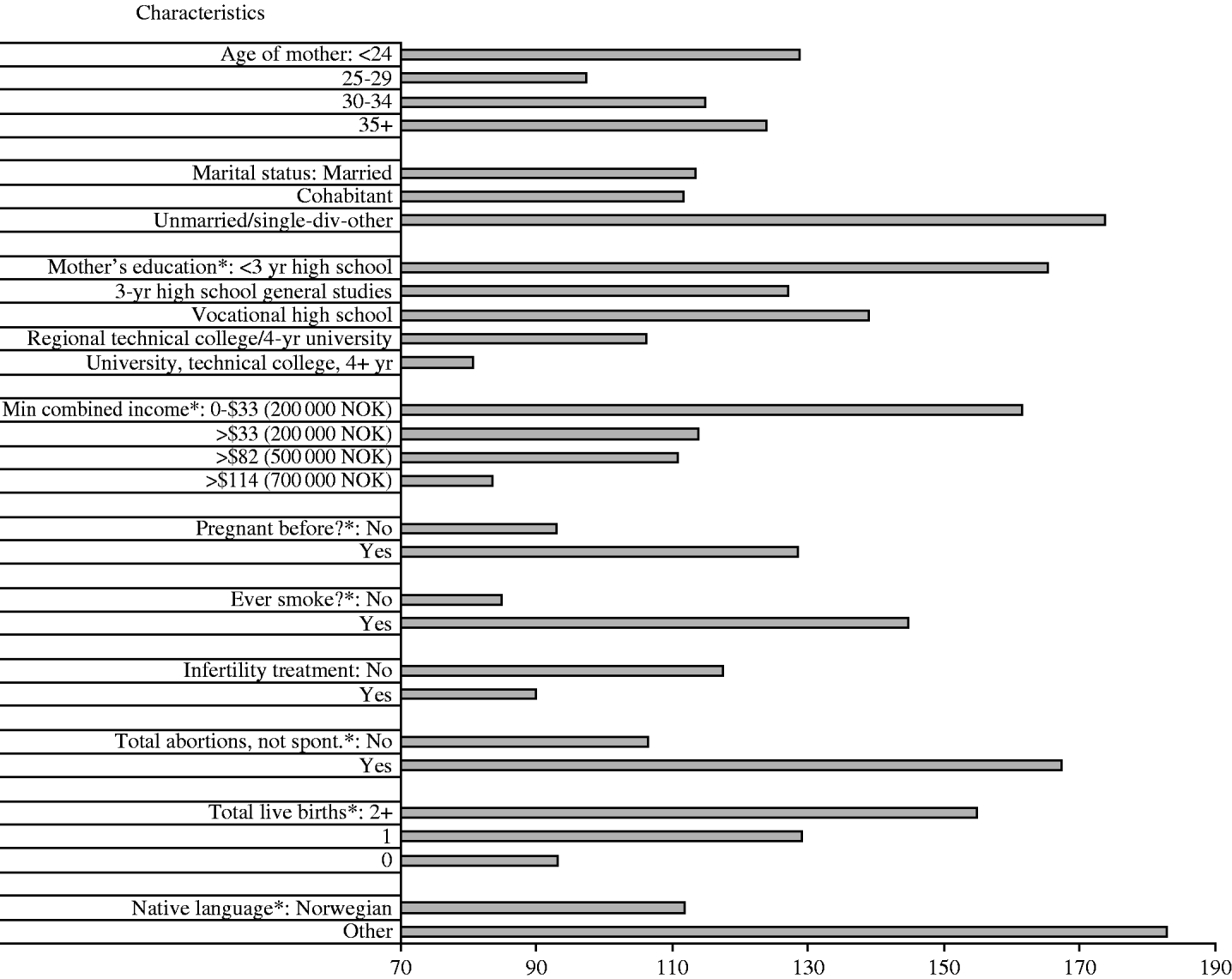
The fourth goal was to investigate the correlates of remission, continuation and incidence. To do this, we again used Poisson regression (with GEE) by adding the term of interest as a covariate to the regression models described above. The null hypothesis was that the effect is the same across all levels in the group (Fig. 1). As this goal included a sizeable number of statistical tests, we controlled for multiple comparisons using the false discovery rate (FDR; Benjamini & Hochberg, Reference Benjamini and Hochberg1995; Westfall et al. Reference Westfall, Tobias, Rom, Wolfinger and Hochberg1999).
Binge eating disorder (BED) incidence rates (per 100 000 person-weeks) by sociodemographic characteristics. BED incidence rates were estimated separately for each group of characteristics and adjusted for age of mother. * At least one significant difference exists between the groups at an α-level of 0·05. False discovery rate (FDR) correction used.

All analyses were performed using SAS/STAT® software for Windows and Solaris, Version 9.1 (SAS Institute Inc., 2004).
RESULTS
Sample demographics
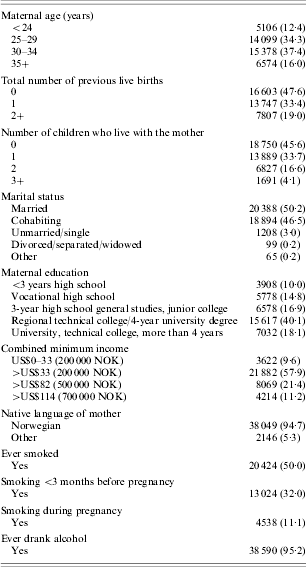
Table 1 presents the demographic composition of the sample. Consistent with initial reports on the MoBa sample (Magnus et al. Reference Magnus, Irgens, Haug, Nystad, Skjaerven and Stoltenberg2006), the majority of the 41 157 women represented here were between the ages of 25 and 34, 94·7% were native Norwegian speakers, 52% had at least one live birth before the index child (born prior to the MoBa study), and 97% were married or cohabitating. In addition, the sample was relatively highly educated, with 58% attending some form of college and over 91% reporting a combined income greater than the equivalent of US$33 000 per year. Behaviorally, whereas 50% reported having smoked at some time, 32% reported smoking (occasionally or daily) in the 3 months before pregnancy and 11% during pregnancy. Over 95% reported having ever consumed alcohol.
Demographic characteristics of the 41 157 women

Values are presented as n (%).
Prevalence of eating disorders
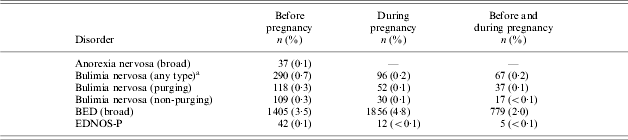
As shown in Table 2, 37 women (0·1%) reported the presence of broadly defined AN prior to pregnancy. BN was more common with 290 women (0·7%) reporting BN prior to pregnancy, 96 women (0·2%) reporting BN during pregnancy, and 67 women (0·2%) reporting BN both before and during pregnancy. Broadly defined BED was the most commonly reported eating disorder, with 1405 (3·5%) of women reporting its presence prior to pregnancy, 1856 (4·8%) during pregnancy, and 779 (2·0%) both prior to and during pregnancy. EDNOS-P was reported in 42 women (0·1%) prior to pregnancy and in 12 (<0·1%) women during pregnancy.
Prevalence of eating disorders before and during pregnancy

BED, Binge eating disorder; EDNOS-P, eating disorders not otherwise specified (purging at least weekly in the absence of binge eating).
a BN any type also includes those individuals who could not reliably be categorized as purging or non-purging because of missing data.
Remission, continuation and incidence
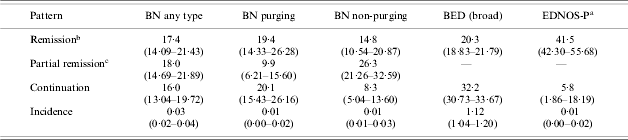
Table 3 presents age-adjusted rates of remission, continuation and incidence for five categories of eating disorders (BN any type, BN purging type, BN non-purging type, BED, and EDNOS-P). Rates of remission varied across disorders and were highest for EDNOS-P (42 per 1000 person-weeks) followed by BED (20 per 1000 person-weeks), BN purging (19 per 1000 person-weeks), BN any (17 per 1000 person-weeks), and BN non-purging (15 per 1000 person-weeks). The percentages of individuals remitted were: EDNOS-P (78%), BN purging (40%), BED (39%), BN any (34%), and BN non-purging (29%). The lowest continuation rates during pregnancy were for EDNOS-P (6 per 1000 person weeks) and BN non-purging type (8 per 1000 person-weeks), followed by BN any type (16 per 1000 person-weeks) and BN purging (20 per 1000 person-weeks). Notably, continuation rates in individuals with BED were considerably higher (32 per 1000 person-weeks). The percentage of individuals continuing were: EDNOS-P (10%), BN non-purging (16%), BN any type (29%), BN purging (38%), and BED (61%). The percentages of individuals with BN achieving partial remission (i.e. absence of compensatory behaviors) were: BN non-purging (53%), BN any (34%), and BN purging (18%). Incident cases during pregnancy for all types of BN and EDNOS-P were rare. For BED, incident cases were more common (1·1 per 1000 person-weeks), equating to 711 new cases of BED in the sample during the observation period.
Age-adjusted rates of remission, continuation and incidence in 1000 person-weeks (95% confidence interval)

BN, Bulimia nervosa; BED, binge eating disorder; EDNOS-P, eating disorders not otherwise specified (purging at least weekly in the absence of binge eating).
a EDNOS-P and incidence calculations except for BED not age adjusted because of small sample size.
b Remission indicates rate of no eating disorder at time of survey completion during pregnancy.
c Partial remission in BN indicates absence of compensatory behaviours during early pregnancy.
Characteristics associated with remission, continuation and incidence
In exploratory analyses, we determined whether specific demographic factors were associated with remission, continuation and incidence of BN and BED. These analyses were not conducted for EDNOS-P because of the small number of incident cases. Variables tested included maternal age, pregravid maternal BMI and BMI at the time of assessment, maternal education, median combined household income, ever smoked, previous pregnancies, total number of births, total number of abortions, native language (Norwegian or other), and region of birth. For BN, no demographic variables were significantly associated with either remission, continuation or incidence with the exception of a negative association between remission and smoking (FDR p=0·05). For BED, higher BMI both before and during pregnancy was associated with remission (FDR p<0·001), lower BMI prior to and during pregnancy was associated with continuation (FDR p<0·001), and higher BMI during pregnancy only was associated with incidence (FDR p=0·019). Several additional variables were associated with BED incidence (Fig. 1). Lower maternal education (FDR p<0·001), ever smoked (FDR p<0·001), at least one pregnancy (FDR p<0·001), at least one abortion (FDR p<0·001), at least one live birth (FDR p<0·001), lower minimum combined income (FDR p=0·009), and a native language other than Norwegian (FDR p=0·009) were associated with new onsets of BED.
DISCUSSION
To our knowledge, this is the first investigation to document both the prevalence and the patterns of remission, continuation and incidence of broadly defined eating disorders in a large cohort of pregnant women. In this sample, prepregnancy prevalence estimates were 0·1% for AN, 0·7% for BN, 3·5% for BED, and 0·1% for EDNOS-P. Because of the complications of assessing the weight criterion for AN during pregnancy, we only have prevalence data for BN, BED and EDNOS-P during pregnancy. The estimates were 0·2% for BN, 4·8% for BED and <0·1% EDNOS-P. Previous reports from Norway in the general population (i.e. not selected for pregnancy) reported prevalences of 0·3% for AN, 0·7% for BN and 1·5% for BED (Götestam & Agras, Reference Götestam and Agras1995).
Our observed prepregnancy prevalence of AN is on the low end of that reported in epidemiologic investigations of women not selected on the basis of pregnancy (Hoek, Reference Hoek2006). This may reflect the fact that at least some individuals with AN have impaired fertility and/or social/interpersonal deficits, decreasing their likelihood of becoming pregnant (Weinfeld et al. Reference Weinfeld, Dubay, Burchell, Mellerick and Kennedy1977; Strimling, Reference Strimling1984; Stewart et al. Reference Stewart, Robinson, Goldbloom and Wright1990), or alternatively, the stress of pregnancy in individuals with AN could make them less likely to agree to participate in a study such as MoBa.
Examining the course of eating disorders during pregnancy, we found the most common pattern for BN and EDNOS-P to be remission or partial remission of symptoms during pregnancy, with combined remission rates surpassing continuation rates for all types of BN and EDNOS-P. This suggests that, for many, but clearly not all women, pregnancy is a powerful stimulus to decrease bulimic symptomatology. This can take the form of reductions in both binge eating and compensatory behavior, or in the case of those partially remitted women, elimination of compensatory behaviors only (which may be viewed as potentially more harmful to the fetus). This parallels similar observations of spontaneous quitting in pregnancy for both alcohol use and smoking (Kruse et al. Reference Kruse, Le Fevre and Zweig1986; Bruce et al. Reference Bruce, Adams, Shulman and Martin1993; Ockene et al. Reference Ockene, Ma, Zapka, Pbert, Valentine Goins and Stoddard2002; Solomon & Quinn, Reference Solomon and Quinn2004). Whether the observed decreases are limited to the period of pregnancy or are more lasting will be addressed in future waves of the MoBa study. In addition, although incident cases of BN during pregnancy were reported, they were rare.
Unexpectedly, we found the course of BED to be different than that of BN. For BED, continuation of symptoms during pregnancy was more common than remission. Most notably, new onsets of BED were much more common than the other eating disorders (1·12 per 1000 person-weeks) or 711 new cases in our sample. We are unaware of previous reports of incident BED during pregnancy and our finding raises the important issue of the validity of questions regarding binge eating during pregnancy. An important topic for further detailed investigation is whether the terms associated with the evaluation of binge eating (e.g. eating an unusually large amount of food, feeling out of control) are more likely to be endorsed by women who are experiencing appetite changes associated with pregnancy. The magnitude of our observed incident cases suggests that this is an important area of inquiry to determine the extent to which the reported behavior truly represents pathological eating behavior.
Although our analyses were unable to detect any demographic parameters associated with the course of BN except for smoking, for BED, new cases were associated with an array of variables reminiscent of the ‘matrix of disadvantage’ (Mullen et al. Reference Mullen, Martin, Anderson, Romans and Herbison1993). Women with higher BMI during pregnancy, more previous pregnancies, at least one abortion, lower income and education, greater smoking, and whose native language was not Norwegian were more likely to report developing BED during pregnancy. Although additional data are needed to characterize these individuals more fully, from this assessment it appears that general indices of economic and social disadvantage may be associated with the development of this symptom cluster during pregnancy.
Pregnancy is a powerful biopsychosocial event. For some, pregnancy appears to be a window of opportunity for discontinuing bulimic behaviors that could be harmful to both mother and child. For a smaller number of women, however, their bulimic behaviors (binge eating and purging) persist during pregnancy. We will explore the impact of these persistent behaviors on pregnancy outcome and child development in future waves of data analysis in this cohort.
The somewhat surprising number of incident cases of BED during pregnancy raises several questions. For these women, rather than a window of opportunity, pregnancy appears to be a window of vulnerability. Several potential explanations for the emergence of BED during pregnancy emerge. Biologically, the myriad adaptive neuroendocrine changes that occur in pregnancy that affect multiple brain functions influencing metabolism, appetite and mood (Russell et al. Reference Russell, Douglas and Ingram2001) may render pregnancy a high-risk period for developing binge eating. Behaviorally, women who fail to increase food intake according to the increased metabolic needs of pregnancy may experience unexpected and intense hunger that may lead to compensatory overeating and ultimately trigger a pattern of appetite dysregulation. This is perhaps less likely given that changes were seen relatively early in pregnancy prior to appreciable increases in metabolic requirements. Psychologically, especially given the pattern of social disadvantage associated with incident cases in this sample, the psychosocial stress of pregnancy may serve as an environmental trigger for binge eating.
These findings must be considered within the context of several limitations. First, although the diagnostic questions we used had been used in previous epidemiologic studies in Norway, they nonetheless were self-report questions and targeted broadly defined disorders. Direct diagnostic interviews may have yielded richer diagnostic information; however, given the magnitude of the sample, this was not practical. Second, although our frequency criteria for binge eating and purging differed from current DSM criteria, we emphasize that the established criteria have not been empirically supported (Sullivan et al. Reference Sullivan, Bulik and Kendler1998). Third, women may have been hesitant to admit to eating disorder behaviors during pregnancy, which would have led to an underestimation of continuation rates and an overestimation of remission. Fourth, BMI measures were self-reported rather than measured; a common approach given the logistical complications and cost of measured weight in larges samples such as MoBa. Although there are no comparable data from Norway, data from other large samples suggest a correlation of 0·94 between measured and self-reported height and 0·98 between measured and self-reported weight for women (Bulik et al. Reference Bulik, Wade, Heath, Martin, Stunkard and Eaves2001). Fifth, 42% of women invited agreed to participate in MoBa. Although this response rate is low, it is not uncommon to large epidemiologic studies and does not necessarily imply a biased sample (Hartge, Reference Hartge2006). The determination of bias is complex and would occur only if individuals who chose not to participate in this study differed markedly from those who did participate on the variables of interest. Initial comparisons of the MoBa cohort to the Norwegian population indicate lower rates of preterm birth (7·2% v. 7·7%) and low birthweight (<2500 g) (4·6% v. 5·1%), possibly reflecting a socio-economic gradient associated with participation (Magnus et al. Reference Magnus, Irgens, Haug, Nystad, Skjaerven and Stoltenberg2006). Further exploration of this, using education data, suggests that the MoBa participants may be somewhat more educated than the general Norwegian population, with 58% attending some form of college, in comparison to 46% of women between 25 and 29 years and 43% of women between 30 and 39 years reported to have higher education in 2005 by Statistics Norway (http://www.ssb.no/utniv_en/). Finally, our data reflect changes in eating disorder symptomatology in the early stages of pregnancy. It is possible that such changes may not reflect patterns of remission, continuation and incidence across the entire gestational period.
Nonetheless, our results point to additional questions and cautions. Using data that are currently being collected, in future papers we will explore personality and psychiatric features that are associated with remission, continuation and incidence of eating disorders during pregnancy. Clinically, given that some data suggest that women who have eating disorders are unlikely to report them to their obstetricians (Lemberg & Phillips, Reference Lemberg and Phillips1989), our results suggest that physicians, nurses and midwives working with pregnant women should be alert to the possibility of enduring and emergent eating disorder symptoms. For women with known eating disorders, the onset of pregnancy does not necessarily ensure discontinuation of symptoms, and regular follow-up regarding persistence of symptoms should be considered. Moreover, as part of routine prenatal inquiries about nutrition, health-care providers should also ask about the presence of binge eating. As we do not yet know the impact of binge eating during pregnancy, detection is a minimum first step that could facilitate referral for appropriate intervention if clinically indicated.
ACKNOWLEDGMENTS
This research was supported by National Institutes of Health Grants (HD047186) to C.M.B. and the MoBa study is supported by the Norwegian Ministry of Health, NIH/NIEHS (grant no. N01 ES-85433), NIH/NINDS (grant no. 1 UO1 NS 047537-01) and the Norwegian Research Council/FUGE (grant no. 151918/S10). The provision of questionnaire data and biological material from MoBa participants is gratefully acknowledged.
DECLARATION OF INTEREST
None.