1. Introduction
One critique of capitalismFootnote 1 goes as follows:
-
(1) Distributive justice requires that people receive in proportion to their merit.
-
(2) In capitalist economies, capitalists receive more and workers receive less than what they merit.
-
(3) Therefore, capitalist economies are distributively unjust.
Some defenders of capitalism argue that what matters is maximizing social prosperity, and so deny (1).Footnote 2 Others argue that (suitably idealizedFootnote 3 ) capitalist economies deliver a meritocratic distribution of benefits and burdens, and so deny (2).Footnote 4 Their claim is not that actual capitalist economies are fair by the meritocratic standard, but that a capitalist economy free from market failures and undue regulatory interference will tend to a distribution of the product that reflects productive contributions. That is, such meritocratic defences of capitalism argue that:
-
(I) Distributive justice requires that people are rewarded in proportion to their merit.
-
(II) The relevant standard of merit for participants in economic cooperation is contribution to the product.
-
(III) In (suitably idealized) capitalist economies, capitalists and workers receive compensation commensurate with their contribution to the product.
-
(IV) Therefore, in (suitably idealized) capitalist economies, capitalists and workers receive what they merit.
-
(V) So, (2) is false.
I argue that this meritocratic defence of capitalism fails due to a dilemma:
Either the argument relies on an interpretation of contribution that arguably will be reflected by the capital-labour split in a capitalist economy (making premise (III) true), but cannot serve as a plausible standard of merit (so, premise (II) is false).
Or the argument relies on an interpretation of contribution that is a plausible standard of merit (making premise (II) true), in which case it won’t be reflected by the capital-labour split that we can expect from a capitalist economy (so, premise (III) is false).
Thus, if (II) is true, (III) is false; if (III) is true, (II) is false.
This conclusion increases the attraction of the utilitarian defence of capitalism (i.e. denying (1)). However, the utilitarian defence appears to show insignificant concern for fairness – in effect, justifying an economy where workers receive an unfairly small share of the product. This worry invites us to consider a social democratic approach to distributive fairness, where the fairness of the capital-labour split is a function of how capital and labour are situated in the struggle that determines the distribution of the burdens and benefits of production. If capital and labour are situated as equals in this struggle, then the resulting distribution can be fair, even if the split does not track relative contributions.
Section 2 clarifies the question. Section 3 articulates the meritocratic critique of capitalism. Sections 4 and 5 discuss two types of meritocratic defences of capitalism; the first relies on the marginalist theory of distribution, the second relies on solution concepts from game theory (the Nash bargaining solution and the Shapley value). Section 6 draws together the results of these discussions. Section 7 offers the concluding thought that defenders of capitalism might rely on a proceduralist conception of distributive fairness.
2. Clarifying the question
As used in this essay, merit is not the same as desert. Desert is about the agent and her choices and merit is about the results of those choices.Footnote 5 Desert is a function of a person’s character, the motives she acts from, and her efforts. Merit, by contrast, is a function of the person’s accomplishments.Footnote 6 To be clear, desert is about the cause (the agent) and merit is about the effect (the results of her choices).
Desert and merit are both three-placed concepts: some subject should receive some object (e.g. accolades or punishments), based on some quality or accomplishment.Footnote 7 The concepts support distinct normative principles (people should get what they deserve or merit), where the contents of the principles are defined in terms of who the subjects are, what they should receive, and why they should receive it. The principles of desert and merit can issue contradictory prescriptions. A person might be honest, talented, and work hard (she deserves to win the race), but have an off day so that another person might cross the finish-line first (she won the race) and so carries the merit.Footnote 8
Desert and merit can be further distinguished from entitlement and eligibility, which are claims persons can make based on the existing rules of some practice or institution (the winner can claim the prize).Footnote 9
This essay is about a disagreement that centres on a particular concept and principle of merit. The shared normative assumption in the critique and defences of capitalism that I discuss in this essay is the principle that participants in cooperation should receive a share of the product commensurate with their contribution to its production: the share of the product they receive should reflect the share of the product that is produced through their activities.Footnote 10 This principle relies on a concept of merit where the subjects are cooperators (capitalists and workers), the object is (a share of) the product of their cooperation, and the basis is their respective contributions to its production.Footnote 11
The corresponding principle of merit ties the benefit-burden functions into a neat knot. Rather than ‘From each according to …’ and ‘to each according to …’, this principle says ‘to each according to contribution’, or simply:
‘To each according to from each.’
Clearly, this is a principle of merit rather than desert. In a cooperative relationship where a dishonest slacker contributes the same as an honest and hardworking person, most principles of desert would say that the latter should get more than the former; this principle of merit says that they should get the same.
The question of this essay is whether the distribution of entitlements to shares of the product of cooperation that we can expect from capitalists and workers interacting within the rules of a suitably idealized capitalist economy can be expected to reflect this principle of merit, so that the shares of the product that go to capital and labour (the capital-labour split) reflect their respective contributions to its production, whether we conceive of this share and contribution at the level of the economy, the firm, or particular capitalists and workers.
3. Two critiques of capitalism: exploitation and unfairness
This section outlines the argument that capitalism is unjust because the capital-labour split violates the principle of merit. To present this argument I begin (in section 3.1) with a short discussion of the socialist argument that workers in a capitalist economy are exploited by capitalists. This argument relies on a series of controversial assumptions, and so has limited force; it works only for those accepting the assumptions, and most defenders of capitalism do not. However, I show (in section 3.2) that the argument can be restated without relying on the controversial assumptions, articulating the challenge that meritocratic defences of capitalism must meet.
3.1. Exploitation
The socialist argument that capitalism is exploitative can be summarized as follows:Footnote 12
-
(1) Producers should receive value equivalent to the value they produce.
-
(2) The surplus value of production is produced by the workers. (This premise is the labour theory of value.)
-
(3) So, workers should receive the surplus value of production.
-
(4) In a capitalist society, most (if not all) of the surplus value of production goes to capitalists, not to workers.
-
(5) Therefore, capitalism is exploitative and unjust.
The notion of surplus value can be defined as the value of the product minus the costs of production. The underlying idea is that productive activities are, well, productive; they create more than they consume, and this ‘more’ is surplus value.Footnote 13
One controversial premise in this socialist argument is the labour theory of value (premise (2)). Marginalist defenders of capitalism (see section 4) simply deny this premise, arguing instead that capitalists and entrepreneurs also contribute to the product, and that (in the normal case) workers, capitalists and entrepreneurs receive value equivalent to their respective contributions.
We might wonder whether the more basic part of this socialist critique of capitalism has anything to do with merit or exploitation.Footnote 14 Candidate injustices include the unequal distribution of the means of production, the pressures by which workers are incentivized to seek and maintain employment, or the misery of the unemployed that is part of these coercive pressures. No matter how we view their order of normative priority, these other injustices also explain why capitalists can extract surplus value, and this explanation adds moral gravity to the alleged exploitation. Yet, that capitalists extract some surplus value does not mean that they extract all of it, and as defenders of capitalism deny premise (2) it is unclear why the share that workers receive is insufficient. So, defenders of capitalism can easily deny premises (2) and (4).
3.2. The meritocratic critique of capitalism
Even if we abandon the labour theory of value and the claim that workers are forced to work for capitalists, the first premise of the socialist argument sketched above supports an alternative critique of capitalism, namely, the argument that capitalism is unfair (and unjust), because it tends to divide the product disproportionately among the contributors to its production. In overview, the argument goes:
-
(i) Contributors to shared production should receive a share of the product commensurate with their contribution.
-
(ii) In a capitalist society the wages of workers are less than commensurate with their contribution to the product.
-
(iii) So, in capitalist societies workers do not get what they merit.
-
(iv) So, capitalist societies are unjust.
Two challenges for this argument are, first, to define ‘commensurate to contribution’ and, second, to establish the empirical generalization that workers tend to receive less than what is commensurate to their contribution (there would also be injustice if they received more than this, but that’s usually not the complaint).Footnote 15 These are tough challenges, but if they can be met, the argument seems to show that the capital-labour split is unjust – without relying on the labour theory of value, the iron law of wages, or claims about coercion that are easily rejected by defenders of capitalism. Indeed, the restated argument is not about exploitation, but about merit as contribution – and thus based on a normative principle that meritocratic defenders of capitalism accept.
So, to defeat this argument, meritocratic defenders of capitalism must show that workers in a capitalist economy are, in fact, normally paid wages that are commensurate with their contribution to the product (for then premise (ii) is false).
4. The marginalist reply
Some defenders of capitalism accept the normative premises of the revised argument, but deny the factual premise; they deny that workers receive less than what is commensurate to their contribution to the product. This section focuses on the marginalist version of this defence offered by J.B. Clark (1847–1938), but Clark’s argument is merely one (elaborate) version of the argument standardly offered by marginalist economists.Footnote 16
Clark accepts the normative premise of the argument (premise (i) above):
To each agent a distinguishable share in production, and to each a corresponding reward – such is the natural law of distribution. … The right of society to exist in its present form, and the probability that it will continue so to exist, are at stake. (Clark Reference Clark1908: Ch. 6)
Clark, accordingly accepts the need to establish the descriptive premise (premise (ii) above): ‘Whether labor gets its product or not is a question of fact; but if it does not, the laborer is robbed’ (Clarke Reference Clark1908: xiii). If this premise cannot be established, ‘every right-minded man should become a socialist; and his zeal in transforming the industrial system would then measure and express his sense of justice’ (Clark Reference Clark1908: 4).
Clark aims to defeat the argument by showing that ‘the universal laws of economics’ (Clark Reference Clark1908: 39) and ‘the law of wages’ (Clark Reference Clark1908: 94) secure the normatively required distribution of the product:
where the natural laws have their way, the share of income that attaches to any productive function is gauged by the actual product of it. In other words, free competition tends to give to labor what labor creates, to capitalists what capital creates, and to entrepreneurs what the coordinating function creates. (Clark Reference Clark1908: 3)
Clark defines the factors of production functionally. Capital is the material input for production, and those who provide this input – the capitalists – receive in return interest (Clark Reference Clark1908: 2–3, 5–6, 116, 123–124). The materials must be turned into commodities; the persons who serve this role are workers and what they receive for this function are wages (Clark Reference Clark1908: 2–3, 5–6). Finally, someone has to facilitate the process whereby the material input is coordinated with workers to create products. Clark calls persons who serve this coordinating function entrepreneurs, and their rewards are profits (Clark Reference Clark1908: 2–3, 5–6). He claims that each of these factors (and the persons providing them) will receive income equivalent to their contribution to the product – both in the micro cases of individual firms and in the macro case of society as a whole: ‘what a social class gets is, under natural law, what it contributes to the general output of industry’ (Clark Reference Clark1891: Ch. 5, 289–316, 313). Clark aims to show that all who serve a role in production – capitalists, entrepreneurs, workers – receive a share of the product commensurate with their contribution to the product.
Clark’s argument begins with the familiar marginalist insight that across sufficiently homogeneous labourers in a firm, wages tend to equal the value of the marginal revenue product of the final unit of labour, which simply is the market value of the product of this final unit of labour (Clark Reference Clark1908: Chs 7 and 8; 1914: 16–17). So, ‘a shop representing a hundred thousand dollars’ worth of capital and a hundred men produces a hundred cases of goods in a week, and if the same shop with ninety men produces ninety-three cases per week, then seven cases are attributable to the labor of ten men, and the weekly pay of each man should be the value of seventh-tenths of a case’ (Clark Reference Clark1902: 559–560).
A simple example illustrates why wages tend to equal the value of the marginal product of the final unit of labour. Imagine a firm that produces a widget selling for $4 per widget. Assume a competitive labour market, so the price of labour is set by the market for labour – the firm is in this respect a price-taker with a constant marginal factor cost for labour at $16. Ignoring capital costs and contribution, Table 1 lists the firm’s possible hiring (QL), product (QP), marginal product for labour (MPL), marginal revenue product (MRP), revenue, wage bill, and profit as a function of labour only.
Example of Simple Production

Profits are maximized by hiring 4 units of labour, producing 28 widgets for a total revenue of $112 and a wage bill of $64, earning $48 of profit for the firm.Footnote 17 The example can be illustrated in Figure 1.
Simple Production Graphs.

The neat result is that the firm hires four units of labour at $16 per unit. The marginal product of the final (fourth) unit of labour is four widgets, for a marginal revenue product of $16, which is the value of their wage. In other words, each unit of labour is paid the market value of the marginal revenue product of the final unit of labour. The side-by-side graphs in Figure 1 illustrate that this is a general phenomenon: assuming competition, rationality, and so on, labour is paid the value of the marginal product of the final unit of labour. This general identity is simply the identities for final unit of labour:
 $$\matrix{
{{\rm{Wage}} = {\rm{MRPL}},} \cr
{{\rm{MRPL}} = {\rm{MPL*Price}},{\mkern 1mu} {\rm{so}}} \cr
{{\rm{Wage}} = {\rm{MPL*Price}}.} \cr
} $$
Clark further argues that what is true for the firm is true for the economy, so that ‘General wages tend to equal the actual product created by the last labor that is added to the social working force’ (Clark Reference Clark1889: Ch. 4, 49).
So, not only can we rejoice at the marvellous power of capitalism and its ‘constantly increasing power over nature – an ability to turn out, in greater and greater abundance, the things which make life comfortable’ (Clark Reference Clark1914: 14), nay, free market capitalism carries the promise of (divine) justice: ‘A New Jerusalem may actually arise out of the fierce contentions of the modern market. The wrath of men may praise God and his Kingdom may come, not in spite of, but by means of the contests of the economic sphere’ (Clark Reference Clark1914: 22).
One worry about this argument is that the wage is set by the market for labour, and the price-point set by supply and demand for labour does not seem to be a function of the productivity of the final unit of labour in any particular firm or the economy as a whole. The issue is illustrated by imagining various exogenous influences on market supply or demand. Imagine an influx of labour that shifts the supply curve to the right and pushes the equilibrium wage down to, say, $8/unit. Then the firm will hire another unit of labour and pay each unit the market price of $8, increasing their profits to $80. The marginal product of the additional unit is two widgets, so it would remain true that all the units of labour are paid the value of the marginal product of the final unit of labour, but the example illustrates that workers generally are not paid for the value of their product. If the units are individual workers, then the fourth worker, who was the final worker before the change in labour supply, still has a marginal product of four widgets for a marginal revenue product of $16, but she is now paid only $8. I return to this issue in the discussion of the normative attraction of the marginalist concept of merit in section 4.1.
A more immediate worry, however, concerns the positive marginalist claim: that capitalist economies tend to pay wages equal to the marginal revenue product of labour as illustrated by the simple model above. As suggested by the previous paragraph, the general wage rate is set by the supply and demand functions for labour, but these functions are determined by variables that are unconnected to the marginal product of labour. In particular, it might be true that the equilibrium wage remunerates labour in strict proportion to the marginal product of the last worker if we assume a steady-state economy with no changes to the inputs or outputs, consumer preferences, production methods, or technology; but these assumptions are false.
Clark’s reply to this worry is that the tendencies of a dynamic economy, that is, an economy where the supply and demand functions for labour fluctuate, are towards the laws that govern a static economy: an economy with no changes to its production possibilities, constant demand for consumer goods, and no variations to the supply and demand functions for labour and capital (Clark Reference Clark1902: Chs 3–6). The idea of a static economy is, of course, a pure fiction, but Clark insists that we must investigate the laws that work in this fictional state – engage in ‘heroic theorizing’ (Clark Reference Clark1902: 29–30, 60, 268) – in order to understand the tendencies of a dynamic economy. The investigation of statics will reveal the ‘natural’ or ‘normal’ price of capital goods (the natural rent) and labour (the natural wage). There are no profits in a static economy, for the entrepreneur only has a function by virtue of dynamic movements of the economy (Clark Reference Clark1902: 111–112, 201, 290–291). These static prices are natural relative to the supply and demand functions for a given economy; that is, there is no natural price for capital or labour in general, but a natural price for capital and labour relative to any actual, particular economy.
To illustrate the distinction between statics and dynamics, Clark uses various watery metaphors (Clark Reference Clark1902: vi, 61, 63–68): to understand the behaviour of water in a lake, stream or ocean, we have to understand the behaviour of water when unperturbed; though water is never truly unperturbed, it tends to the unperturbed condition. Similarly, the economy tends towards the equilibrium it would reach if not for the dynamic forces, and it is this tendency (and what it tends towards) that matters when we assess the normative merits of the natural distribution of wealth and income – hence, an understanding of dynamics is crucial to understand what sorts of economic policies we should implement.
I am unsure whether Clark’s reply to this worry is adequate, and the watery metaphors seem to backfire (water, like capital, moves in constantly changing cycles).Footnote 18 But even if we grant the descriptive claim that, in a capitalist society, workers tend to be paid the marginal revenue product of the final unit of labour,Footnote 19 we should question the plausibility of the marginalist proposal as a normative standard of merit.
4.1. Assessment of marginal productivity as a measure of merit
Recall that the marginalist argument seeks to establish the premise that, in a capitalist economy, labour receives value equal to its contribution to the product. However, even if we grant the marginalist claim that labour is paid the equivalent of the marginal contribution of the final unit of labour, there are several reasons to question whether this premise is established.
To start with the obvious: the marginal contribution of the final unit of labour is not the contribution of other (inframarginal) units of labour. Indeed, by the assumption of diminishing marginal productivity of the factors of production, other units of labour produce more than the final unit of labour, which also means that the average revenue product of labour is higher than the marginal revenue product that labour is paid. If each unit of labour should receive the equivalent of its contribution to the product, then most units should be paid more than the marginal contribution of the final unit. So, if the marginalist claim that labour is paid the equivalent of the marginal product of the final unit of labour is true, then it is false that labour is paid the equivalent of its contribution to production.Footnote 20
Notice that this argument allows that capital is productive and should be paid according to its contribution to the product. However, the fact that capital contributes to the product is grounds for another critique of the marginalist claim that labour is paid the value of its contribution when it receives the value equivalent of the marginal product of the final unit of labour.
Even the final unit of labour employs capital in its productive effort. This capital remains contributory to the product, even if, as Clark argues, the final unit of labour tends to work with capital that is also on the margin of productivity (Clark Reference Clark1908: Ch. 8). The marginalist argument, in short, fails to distinguish between the marginal product of the final unit of labour which is remunerated as the value of its product, and the specific share of the marginal product of the final unit of labour attributable to that unit of labour alone.Footnote 21 This lack of distinction leads to a paradoxical outcome; the marginalist theory of wages establishes that (at the margin) labour exploits capital (or the capitalist that provides the capital), since the final unit of labour is paid the whole value of their joint product, so that capital (or the capitalist) contributes to production without receiving anything in return.
The general problem, called the disentanglement problem, is that capital and labour are entangled in the process of production in a manner that makes it impossible to disentangle their respective shares of contribution to the product.Footnote 22 Marginalist defenders of capitalism must find a way to disentangle the factors of production to establish that they are remunerated according to their respective contributions, but this is very hard to do, as Clark recognized:
Let a man fish from a dugout, with the simplest line and hook that he can make. The fish that he will bring to the shore are the product of labor and capital. … How much of the catch is due to the man, and how much to the canoe and fishing tackle? Not for his life can the man himself tell. … Every single fish is a joint product – indeed, every fin or scale of a fish is so. (Clark Reference Clark1908: 83–84)
Clark offers this observation in the context of what he calls a ‘primitive economy’ (Clark Reference Clark1908: 84); an economy where labourers do not work for capitalists, but own the capital they employ. In such an economy the disentanglement problem does not imply any injustice in the distribution of the product, for all expenses and all revenue accrue directly to the individual that owns both capital and labour-power. In a non-primitive society, where there is class distribution of capital-ownership, the disentanglement problem is rough on the meritocratic argument. How can we satisfy the demand that the product be divided according to productive contribution when labour and capital are so entangled that it makes no sense to distinguish between their contributions? The problem is not merely epistemic – that we cannot accurately ascertain the respective contributions of capital and labour – it is ontological; these are no longer separate contributions, but have become a unified productive factor, separable only in theory.
Another problem is that defining merit as marginal revenue product is inadequate, since it ties contribution to the product’s market value, which is not a plausible measure of merit. What should matter for distributive justice is not merely the market value of goods and services produced, but the degree to which one’s efforts are socially productive – which is not measured by market value. Care-work is as socially useful as coding, but the marginal revenue product of the final or average coder is much higher than the marginal revenue product of the final or average care-worker, wherefore coders are paid much more than care-workers per time-unit of labour. This complaint is less about the injustice of the capital-labour split, and more about the distribution among different types of labourers, only some of whom receive any remuneration for their efforts (there is much productive work done in capitalist societies that has no market-value and is not receiving a wage). This challenge says that the standard of merit that matters is distinct from the merit that markets measure, without thereby turning merit into desert – for it maintains that one should receive the value of one’s socially valuable activities, not that the virtuous or harder-working persons should be rewarded for their virtues or efforts.
It might be objected that market prices do tend to offer a social or collective evaluation of merit.Footnote 23 In the idealized case of a competitive economy under consideration here, the competitive equilibrium prices of goods and services reflect aggregate demand, so prices constitute a collective appraisal of the relative value of goods and services to the members of society. Moreover, the aggregate valuation of members of society seems to be the proper measure of the value of products, and thus of the merit of producers (though externalities need to be factored as well). The price of an apple reveals the value of the apple to the members of society, and the prices of slices of the factors of production reveal their value to producers.
This objection raises a number of interesting questions of economic theory, aggregation, interpersonal comparisons, and the relation between value, valuation and merit. Without discussing all of these questions, I see two reasons to doubt that the valuations aggregated in prices reflect merit as (productive) contribution. The first reply focuses on the relation between prices and valuations.Footnote 24 It is true, in a sense, that the price of a product reflects the valuation of the buyers who purchase it. Yet, in the normal case, the price of a product is lower than some buyers would be willing to pay for it, and also high enough that other prospective buyers are priced out of buying it. In other words, the aggregate demand for a product at any given price point hides both consumer surplus and consumer deficit – the utilities of buyers who would have paid more for the product and those who do not buy it, because the price is too high.Footnote 25 The relation between consumer surplus and consumer deficit varies for different goods. When Marshall discusses consumer surplus and collective valuation, he compares salt and pineapples (Marshall Reference Marshall1890: Bk. 3, Ch. 6, sec. 3): salt is an essential commodity that trades even at very high prices, whereas pineapples are a luxury, suggesting that there is a much higher consumer surplus for salt than for pineapples. The prices of salt and pineapples thus do not reflect their relative social valuations, and so do not reflect their social values. Or consider again the case of care-work. Care-work is essential for most families, and many families would be willing to allocate a larger share of their wealth to care-work than they do, yet a host of factors (including the nature of the work, social norms, stereotypes and gender roles) mean that care-work is cheap in the sense that the price of daycare, schooling, and care for the infirm and elderly is lower than many families would be willing to pay. So, the price point of a commodity or service does not reflect the social or collective valuation of that commodity or service.
The second reply starts by drawing attention to a difference between goods and services and labour power as factor of production. The market value of factors of production does not reflect the collective valuation of these factors by society as a whole, but the collective valuation of these factors by capitalists (or entrepreneurs as defined by Clark). It might be ‘democratically attractive’ to outsource the standard of merit and process of appraisal to the aggregate demand of society as a whole, since it tracks with egalitarian, universalist and anti-paternalistic commitments. Yet the attraction wanes as the subset of members whose demand is aggregated narrows. Capitalists (including here entrepreneurs) are a privileged subset of society defined by their opportunities to employ factors of production in the pursuit of profits, and in reality this subset is a minority of society.Footnote 26 So, the demand-side of the pricing of labour power reflects the valuation of only this privileged subset, which means that the prices do not reflect a collective or ‘democratic’ valuation of the value of labour power. Of course, the capitalist demand for labour power is a function of aggregate demand for commodities, but reflection is not identity.
In sum, there are several independently sufficient reasons for rejecting the marginalist notion of contribution as the standard of merit employed in the normative principle of merit. In the following section I look at two alternatives.
5. Nash and Shapley
Two solution concepts from cooperative game theory might be advanced as standards of marginal contribution to the product instead of the ‘marginal contribution of the final unit of labour’ discussed (and rejected) as a standard of productive contribution in the previous section. These are the Nash bargaining solution and the Shapley value. Both concepts can be shown to satisfy axioms of distributive fairness, and each could be offered as a way to tie together the concepts of contribution and merit.Footnote 27
5.1. The Nash bargaining solution
John F. Nash (Reference Nash1950) shows that a two-person bargaining game – such as negotiations between an employer and a labour union where the parties are bargaining for the split of a surplus value of cooperation – has a unique solution, if these assumptions are satisfied:
The utilities over outcomes are measurable on an interval cardinal scale.Footnote 28
The division should be efficient, meaning that it should divide the whole of the surplus among the bargainers.
Interchangeable contributors should receive the same share of the product.Footnote 29
The outcomes are independent of irrelevant alternatives.Footnote 30
If these assumptions are satisfied, the expected outcome from a bargain where the bargainers have equal bargaining power is the one that maximizes the product of the utilities of the bargaining parties. With linear utility for the value of the product, the utilities can be understood as the share of the product that the parties receive minus their (opportunity) costs of entering into the bargain, that is, what they could expect to receive without the bargain (their so-called BATNAs: best alternative to a negotiated agreement). So, for two-player games, the outcome maximizes (x − a)*(y − b), where x and y are the values received by each player, x + y is the total value of cooperation (v), and a and b are the opportunity costs of cooperation for the bargainers.
Bargaining strengths are not always equal. For unequal power games, we can let k and h express the relative bargaining advantage of the players (h + k = 1 and 0 < h, k < 1), in which case the expression to maximize is
 ${(x - a)^k}{(y - b)^h}$$$
. The share that goes to each player can then be calculated from:
 $${{(y - b)} \over {(x - a)}} = {k \over h}$$
If we assume equal bargaining advantage (h = k = ½), then the sharing of product becomes a pure function of the total utility of cooperation and BATNAs of the cooperators. And if the bargaining parties have equal BATNAs, the result is an equal distribution of the product.Footnote 31
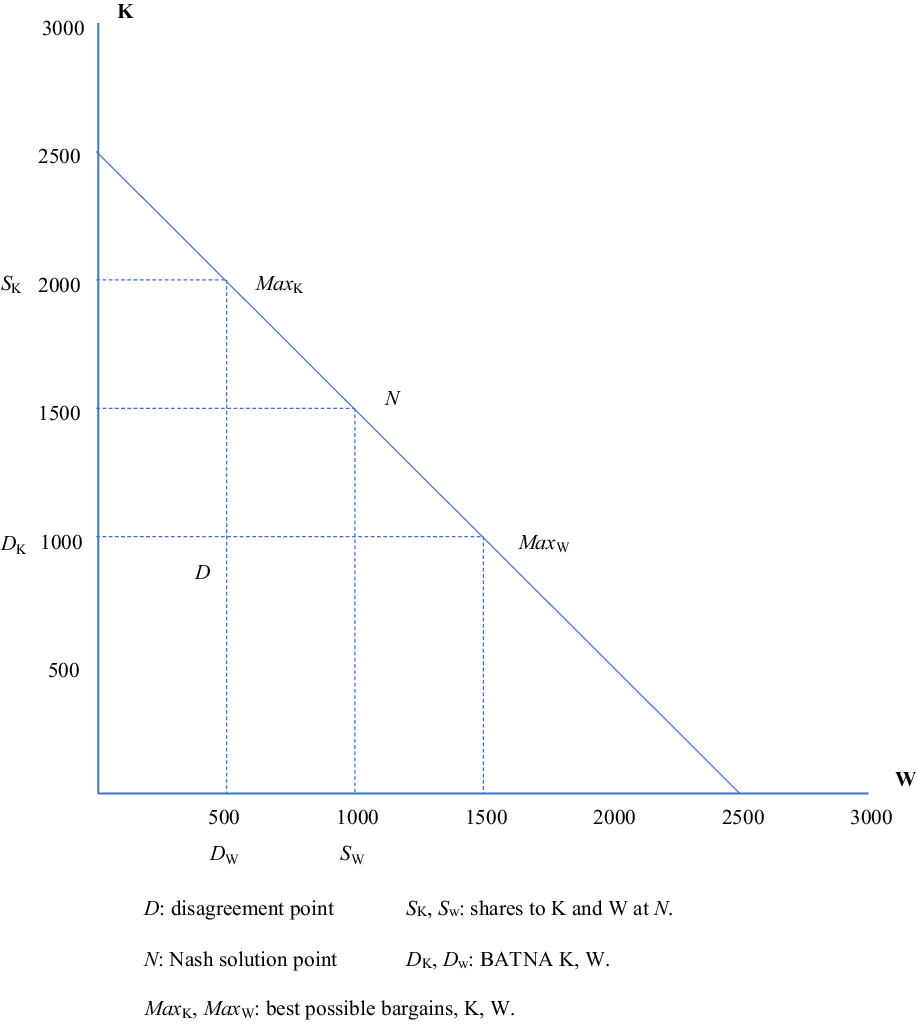
If we assume that bargaining takes place among equals with different BATNAs, then the division of the product can be determined directly from the BATNAs via the Nash bargaining solution. For example, a capitalist (K) and a worker (W) are considering cooperation. On their own, the capitalist can make $1,000 and the worker $500; together they can make $2,500. So, the question is how they should share the product (with shares S k + S w = $2,500). Plugging in these values, the Nash solution provides $1,500 to the capitalist and 1,000 to the worker.Footnote 32 Figure 2 illustrates the case and thus also the Nash solution.Footnote 33
Illustration of Nash Solution.

The area (Max K -Max W -D) is the set of mutually advantageous bargains; the line (Max K -Max W) is the set of mutually advantageous and efficient bargains. Max k is the best possible bargain for the capitalist, and what they could get if their bargaining advantage is complete (k approaches 1, h approaches zero); Max w is the best possible bargain for the worker, and what they could get if their bargaining advantage is complete (h approaches 1, k approaches zero). When, as in our example, the bargainers have equal bargaining advantage, the slope of the line that connects D and N is 1.
The Nash bargaining solution is more complicated for n player games,Footnote 34 and difficult to apply to a complex economic system. Yet we could imagine that capital and labour are two blocs, and then the Nash bargaining solution could compute the capital-labour split as it would for any other two-player game. This would leave us with the question of the proper distribution of the shares that go to capital and labour respectively within the blocs that receive them, but the Nash bargaining solution seems to offer a sensible reply to how the surplus of production in a capitalist economy should be divided between capital and labour.
There are, however, three problems with using the Nash bargaining solution as a measure of productive contribution, which is the definition of merit shared by critics and defenders of capitalism.Footnote 35 (One of these problems is shared by the Shapley value, and is discussed below.)
First, the Nash bargaining solution involves no measure of productive contribution, and so cannot be said to distribute the product as a function of contribution to the product. The Nash bargaining solution varies with bargaining power and opportunity costs of cooperation for the producers (the a and b values). One might regard opportunity costs as a measure of the efforts that the cooperators bring to the cooperative relationship, for opportunity costs measure the sacrifice made by cooperators. Thus construed, the Nash bargaining solution offers an answer to the problem of constructing a measure of effort that could be used in a desertist theory of distributive fairness, for (assuming equal bargaining power), the distribution it recommends is then a function of the differential efforts.Footnote 36 However, though a desertist standard of merit as effort might be attractive, it is not the standard of merit as contribution to the product that is the standard of merit shared by meritocratic critics and defenders of capitalism.
The second problem is that the Nash bargaining solution assumes that we have a way to value the BATNAs of the bargaining parties (the values a and b in the formula above). When it comes to the capital-labour split, we seem to have two options. We can abandon the project, for how on earth could we calculate the value to capital or labour of not being part of a capitalist economy? The alternative is to say that the value of non-cooperation is the same for both capital and labour, namely, zero, for there is no alternative to cooperation – by assumption, in a capitalist society, nothing is produced without both capital and labour.Footnote 37 That proposal immediately yields the result that capital and labour should share the full product of cooperation equally. An interesting result, but unacceptable to most defenders of capitalism.
5.2. The Shapley value
The Shapley value, developed by Lloyd S. Shapley (Reference Shapley and Roth1989) calculates the expected payoff for a player entering into a multiplayer cooperative game as a function of the values of the coalitions that can be created with and without that player.Footnote 38 It can be shown that the Shapley value is the only measure of expected utility from such a cooperative relationship that satisfies the following axioms:Footnote 39
Efficiency: the entire product should be distributed among the producers.
Symmetry: interchangeable contributors should receive the same share of the product.Footnote 40
Null player: a player that contributes no value to any coalition should receive no share of the product.
Additivity: a transfer of an amount x utility between two players decreases the utility of the sender by x and increases the utility of the receiver by x.Footnote 41
The Shapley value assumes that utilities of players can be translated into a medium of exchange so that it can be transferred between the players (e.g. money), that the cooperative relationship can be characterized without reference to non-cooperators, that coalitions can be characterized by their total value, and that supply costs (the costs of creating, monitoring and enforcing coalitions) can be ignored (Roth Reference Roth1989: 2).
Remarkably, the expected value for each player turns out to also be the value of his or her expected marginal contribution to a cooperative relationship when calculated and weighted across all possible configurations of that relationship (Young Reference Young and Roth1989: 268–269). This marginal contribution is calculated as the average marginal contribution that players provide across all permutations of the coalition – where the marginal contribution for a given permutation is the value they add to the cooperation at their point of entry.
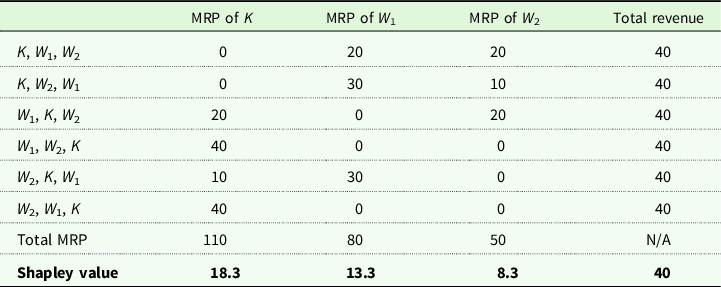
To illustrate, take an example with one capitalist (K) and two workers (W 1 and W 2).Footnote 42 The capitalist can produce nothing without the workers, but the workers can produce nothing without capital. Working together, K and W 1 can produce $20 worth of goods, K and W 2 can produce $10 worth of goods, and all three working together can produce $40 worth of goods. Seeing that the total value of cooperation exceeds what they could produce on their own or in pairs, they decide to cooperate and share the product.
Their respective Shapley values are calculated as the average of their marginal contribution across all permutations of the cooperative relationship. That is, they might enter in the order K, W 1, W 2 or in the order W 1, K, W 2, or in the order W 1, W 2, K, and so on through the six possible permutations. In the first case, the marginal contribution of K is 0, in the second it is $20, and in the third it is $40. Table 2 shows permutations, marginal contributions and Shapley values (measured in $).
Contribution Permutations and Shapley Values

The Shapley value tells us the worth of the contributions of capitalist and workers, and thus also what share of the product each should receive, if we accept the principle of distribution according to contribution.
Why does the capitalist receive almost half of the revenue? Because the capitalist is marginally productive as the second in any two-person coalitions they could be part of, whereas the workers make no marginal contribution without the capitalist. So, the capitalist is marginally productive in four of the coalitions, whereas the workers are marginally productive in three each. The example thus illustrates a capitalist bargaining advantage that is a general feature of capitalist economies – the ratio of capitalists to workers is less than one, so there are more productive coalitions available to the capitalist.
The above example also illustrates how the Shapley value as a measure of contribution avoids the problems of Clark’s marginalist proposal discussed in section 4, and, therefore, how a wage system that reflects Shapley values might be said to satisfy the principle of merit.
If wages track Shapley values, it is no longer the case that labour is paid the value of the marginal revenue product of the final unit of labour; rather, labour is paid the value of its marginal revenue product independently of where it actually is in the schedule of hiring or what the final unit of labour is paid (in fact, it no longer matters which unit of labour is the final unit, for even the least productive unit of labour is factored in with other units in terms of its marginal productivity averaged across the cooperative possibilities). In addition, the Shapley value avoids the disentanglement problem, since it calculates the specific marginal contributions of capital and labour as functions of what they add to the productivity of each other.
So, by contrast with Clark’s marginalist proposal, the Shapley value offers a measure of productive contribution that can serve as a satisfactory standard of merit. And, by contrast with the Nash bargaining solution, the Shapley value is a function of productive contribution rather than the (opportunity) costs of cooperation. So, the Shapley value offers the attractive and substantive notion of productive contribution needed to substantiate the principle of merit.
One problem, though, is that the Shapley value varies with different partitions of the units. This problem is especially troubling if we want to use the Shapley value as a way to measure the relative productivities of capital and labour. If, for example, we measure the productivity of capital rather than the capitalist in the example above, and say that we divide capital into two parts (K 1 and K 2), both of which are necessary for workers to do their work (say, resources and technology), then the Shapley values would be (see Appendix for calculations):
 $${K_1}{:}12.5\,\,\,\,{K_2}{:}12.5\,\,\,{W_1}{:}9.2\,\,\,\,{W_2}{:}5.8$$
While the total product is constant and capital and labour make the same contributions as before, simply counting the capital differently changes the Shapley value and adds almost $7 to the capitalist share of the product – and subtracts an equal amount from the share that goes to workers. Without the partition, the capital-labour split is 18.3:21.7, which delivers 46% of the product to the capitalist; after the partition the capital-labour split is 25:15, which delivers 62.5% of the product to the capitalist. Surely, the contribution of the capitalist did not increase (nor did that of the workers decrease) merely by partition, but the Shapley value issues that result.
A more general problem – and this is also the third problem for the Nash bargaining solution flagged above – is that we have no reason to believe that the capital-labour split in a (suitably idealized) capitalist economy would tend to track either the Shapley value or the Nash bargaining solution. In other words, the Shapley value and the Nash bargaining solution can serve as prescriptions for the capital-labour split that we should want an economy to satisfy, but they are not predictions of the capital-labour split that we can expect to result from a capitalist economy working without external interference. The Nash solution presumes that capital and labour have equal bargaining power, an equality we cannot assume that capitalism supplies of itself. The Shapley value measures marginal contribution as a function of possible cooperative relations, whereas wages in a capitalist economy are a function of actual cooperative relations; (average) possibility is not actuality.
6. Trouble for meritocratic defenders of capitalism
Here, again, is the meritocratic defence of capitalism:
-
(I) Distributive justice requires that people receive in proportion to their merit.
-
(II) The relevant standard of merit for participants in economic cooperation is contribution to the product.
-
(III) In (suitably idealized) capitalist economies, capitalists and workers receive compensation commensurate with their contribution to the product.
-
(IV) Therefore, in (suitably idealized) capitalist economies capitalists and workers receive what they merit.
-
(V) So, (suitably idealized) capitalist economies satisfy the requirement of distributive justice that people receive in proportion to their merit.
The preceding two sections establish that this argument suffers from a dilemma. Defenders of capitalism have to choose between descriptive and prescriptive power; they cannot have both.
If they follow the route exemplified by Clark, they adopt the standard economic understanding whereby wages equal the marginal revenue product of the final unit of labour. If we understand contribution as the marginal revenue product of the final unit of labour in this way, then premise (III) is true. However, in section 4 I argued that the marginal revenue product of the final unit of labour cannot serve as the relevant standard of contribution as merit, so this route makes premise (II) false.
The alternative is the route travelled by adopting either the Nash bargaining solution or the Shapley value as standards of contribution. Either of these can be said to offer a relevant measure of contribution as merit: the Nash solution can be viewed as a principle of distribution according to the efforts of producers (measured as opportunity costs), whereas the Shapley value is a principle of distribution according to the marginal product of producers (measured as the average of marginal product across possible cooperative relationships). However, neither of these prescribe distributions that can be expected from capitalist economies working on their own. So, these understandings of contribution make premise (III) false.
In sum, if (II) is true, (III) is false; if (III) is true, (II) is false; so, either (II) or (III) or both (II) and (III) are false. The meritocratic defence of capitalism, therefore, fails.
This result is a disaster for meritocratic defenders of capitalism. And it gets worse. Earlier, we found that the revised critique of capitalism on meritocratic grounds works only if, first, it can offer a plausible account of what it means for wages to be ‘commensurate with contribution’ and, second, if it is plausible that workers won’t receive wages that are commensurate to their contribution thus construed. Section 5 shows a way to supply the needed measure and argument. Critics of capitalism can adopt the Shapley value as the measure contribution, and thus, of what is owed to merit. Since wages won’t reflect Shapley values in a capitalist economy, it follows that we can expect workers to get less than the value of their contribution to the product. Thus, capitalism (even suitably idealized) is unjust when measured by the principle of merit.
7. Conclusion
The principle of merit says that cooperators should receive a share of the product of cooperation that matches their contribution. Meritocratic defenders of capitalism argue that capitalist economies tend to satisfy this principle, but their argument fails. Either the argument relies on a concept of contribution whereby we can expect wages to match contribution in (suitably idealized) capitalist economies – a concept that is not a plausible standard of merit; or the argument relies on a concept of contribution that is a plausible standard of merit, but which wages won’t tend to match. So, capitalism is unfair, if we define fairness as distribution according to contribution.
But should defenders of capitalism abandon the claim that capitalism can be fair? Must we choose between capitalism and distributive fairness? No. There is an alternative, proceduralist standard of fairness that defenders of capitalism might embrace. Instead of ‘distribution according to contribution’, we can view fairness as a function of the process by which the distribution is created. If all members of society are enabled to engage in cooperation, have equal opportunity for access to the cooperative schemes, and the sharing of the burdens and benefits of cooperation is the result of a negotiation that situates capital and labour as equals in the bargaining process, the resulting distribution can be fair, even if this distribution does not match contribution.
Acknowledgements
I’ve presented this paper to the members of the Ethics Working Group at the University of Richmond and at the PPE Society Meeting in New Orleans in March 2020. I am grateful to the organizers and participants in these events. Javier Hidalgo and Thomas Mulligan provided helpful written comments. The comments from two anonymous reviewers for Economics & Philosophy led to numerous improvements in the essay, so I’m especially grateful to them and to the editors of the journal. Finally, I’m thankful to Lauren McGillicuddy for her unfailingly splendid editorial assistance.
Jeppe von Platz is Assistant Professor in the Department of Philosophy at University of Richmond. His work on economic justice can be found in Theories of Distributive Justice: Who Gets What and Why (Routledge, 2020) and journals such as Politics, Philosophy & Economics, Public Affairs Quarterly, Journal of Social Philosophy and Ethics. URL: vonplatz.org
Appendix
Shapley values with partitioned capital