I. INTRODUCTION
Lithium/thionyl chloride batteries are widely used due to their high specific capacity, low self-discharge rate, and long life in the storage, but their discharge voltage and low temperature discharge performance still need to be improved.Reference Ko and Lee1–Reference Zhang, Xu, Wang, Zhao and Zhang3
The shortages greatly impede their practical applications in some fields, especially the fields of urgently requiring high power batteries.Reference Xu, Zhang and Cao4–Reference Liu, Zhuang and Shi6 The Li/SOCl2 battery treats carbon membrane as the cathode, lithium as the anode, and tetrachloride aluminum lithium and thionyl chloride (LiAlCl4/SOCl2) as the electrolyte. And the battery reactions are as follows:
 $${\rm{Anode\!\!:}}\;4{\rm{Li}} \to 4{\rm{L}}{{\rm{i}}^ + } + 4{{\rm{e}}^ - }\quad .$$
 $${\rm{Cathode\!\!:}}\;2{\rm{SOC}}{{\rm{l}}_2} + 4{{\rm{e}}^ - } \to {\rm{S}} \downarrow + {\rm{S}}{{\rm{O}}_2} \uparrow + 4{\rm{C}}{{\rm{l}}^ - }\quad .$$
Simultaneously, Li+ will combine with Cl− to form the LiCl precipitate:
 $$4{\rm{L}}{{\rm{i}}^ + } + 4{\rm{C}}{{\rm{l}}^ - } \to 4{\rm{LiCl}} \downarrow \quad .$$
 $${\rm{Overall}}\;{\rm{reaction\!\!:}}\;2{\rm{SOC}}{{\rm{l}}_2} + 4{\rm{Li}} \to {\rm{S}} \downarrow + {\rm{S}}{{\rm{O}}_2} \uparrow + 4{\rm{LiCl}} \downarrow \quad .$$
During the discharging, the active molecule SOCl2 that is absorbed by the electrode could give rise to a disproportionation reaction. Meanwhile, Li+ could turn into the LiCl film through reacting with Cl−, which reduces the self-discharge and improves the storage period of the battery. However, the S sediment and LiCl film that are gradually accumulated on the surface of anode will form a compact passivation layer so that retard and prevent the permeation of ions, and further result in an increase in internal resistance and a decrease in actual capacity in terms of Li/SOCl2 battery. It is especially necessary to improve Li/SOCl2 batteries by an effective means. However, based on the emergence of phthalocyanine catalystsReference Reddy, Keshavayya and Swamy7–Reference Wen, Xie, Chen and Li10 which contain macrocylic aromatic conjugation system with 18 π electrons,Reference Shrestha, Kohn and Imamura11–Reference Royer, Kappe and Zhang18 it has already developed and applied in many high-tech fields,Reference Pillay and Vilakazi19–Reference Zhao, Tang, Guo and Lei24 such as semiconductor, electrochromism device, nonlinear optical element, sensor, PDT, and especially as a powerful candidate in catalytic field. So it has been the master key to relieve the bottleneck of the batteries. Not only they are relatively cheap but also they are endowed with wonderful electrochemical properties. As is well known, phthalocyanines possess peculiar donor–acceptor structure, fairly good chemical stability, and predominant photoelectric property so that they could be applied to Li/SOCl2 batteries. The previous research studies revealed that phthalocyanine complexes can act as the electrocatalysts to improve the overall performance of the battery.Reference Xu, Zhang and Wang25–Reference Su, Cheng, Li, Liu and Li29
For further evaluating the catalytic performance of phthalocyanines to Li/SOCl2 batteries, two series of binuclear metal phthalocyanine complexes M2(PcTN)2Nap and M2(PcTA)2Nap (M = Mn2+, Fe2+, Co2+, Cu2+) were synthesized and characterized first. Then, all the compounds were added to the battery systems for discharge performance tests, as well as three-electrode systems for cyclic voltammetry (CV) measurements. The relationships between central metal ions or substituent groups of phthalocyanines and catalytic performance have been analyzed and discussed. The order of the catalytic performances of the samples with diverse central metal ions is Mn2+ > Co2+ > Fe2+ > Cu2+. It is found that battery capacity catalyzed by M2(PcTA)2Nap can be effectively improved more than that catalyzed by M2(PcTN)2Nap. In addition, combined with CV tests and electrode reactions, the suggested catalysis mechanism has been put forward reasonably.
II. EXPERIMENTAL
A. Materials and characterization
1,4,5,8-Naphthalenetetracarboxylic dianhydride and 3-nitrophthalic anhydride were obtained from J&K Chemicals and Aladdin, respectively, and all other reagents were of analytical grade without further purification.
LiAlCl4/SOCl2 electrolyte, lithium plate, and carbon film were all battery grade and obtained from the Xi’an Institute of Electrical and Mechanical Services Information. Certainly, aviation kerosene was first grade and all the other reagents were analytically pure. Elemental analysis of the end-products (C, H, and N) was performed on a PE2400 analyzer (PerkinElmer Corporation, Norwalk, Connecticut). IR spectra were determined on a BRUKER VECTOR 22 spectrophotometer (Bruker Optics, Inc., Karlsruhe, Germany). UV-vis absorption spectra that regarded DMF as reference solution were recorded on a PE-40P UV spectrometer (PerkinElmer Corporation, Norwalk, Connecticut). Eventually, discharge performance tests were detected by using an electrochemical workstation (RST 5000, Zhengzhou Shiruisi Technology Co., Ltd., Zhengzhou, China), and CV was performed on a three-electrode system with the help of an RST 5000 electrochemical workstation.
B. Synthesis of binuclear metal phthalocyanine
Metal phthalocyanines M2(PcTN)2Nap (M = Mn2+, Fe2+, Co2+, Cu2+) were synthesized by using the liquid solvent method (Scheme 1). 3-Nitrophthalic anhydride, 1,4,5,8-naphthalenetetracarboxylic dianhydride, urea, ammonium chloride, ammonium molybdate, and metal salts were pumped into a continuously stirring three-necked flask including 120 mL aviation kerosene which possesses favorable thermal stability. pH, temperature, and stirring speed of the mixture in the reactor were set to be 7, 130 °C, and 500 rpm, respectively. After 15 h reacting at 130 °C, the aviation kerosene was wiped off. Followed by alternately refluxing the crude product for 24 h using deionized water and 2% HCl (aq). The primary product was cooled to room temperature naturally and was refluxed timely. The final product was obtained by drying in a vacuum for 24 h.
Synthetic route of M2(PcTN)2Nap (M = Mn2+, Fe2+, Co2+, Cu2+).

The series of M2(PcTN)2Nap have been reduced by Na2S 9H2O in DMF (Scheme 2). 100 mL round-bottom flask was charged with 1.0 mmol M2(PcTN)2Nap and 30 mL DMF one-by-one. Under the conditions of moderate agitation, reaction systems were heated up to 80 °C; simultaneously, excess Na2S·9H2O were added. After thermostatic reaction with 14 h, the mixtures were completely precipitated in ice water. By the suction filtration, the filter cakes were washed with distilled water and tetrachloromethane for many times until pH turned from alkaline to neutral. Then, undergoing purification processes by ethyl acetate and ethyl alcohol, the purified products were dried in an oven, and finally dried in the vacuum for 24 h to obtain M2(PcTA)2Nap (M = Mn2+, Fe2+, Co2+, Cu2+).
Synthetic route of M2(PcTA)2Nap (M = Mn2+, Fe2+, Co2+, Cu2+).

The results of elemental analysis and IR spectra of these compounds were given to demonstrate the proposed structures.
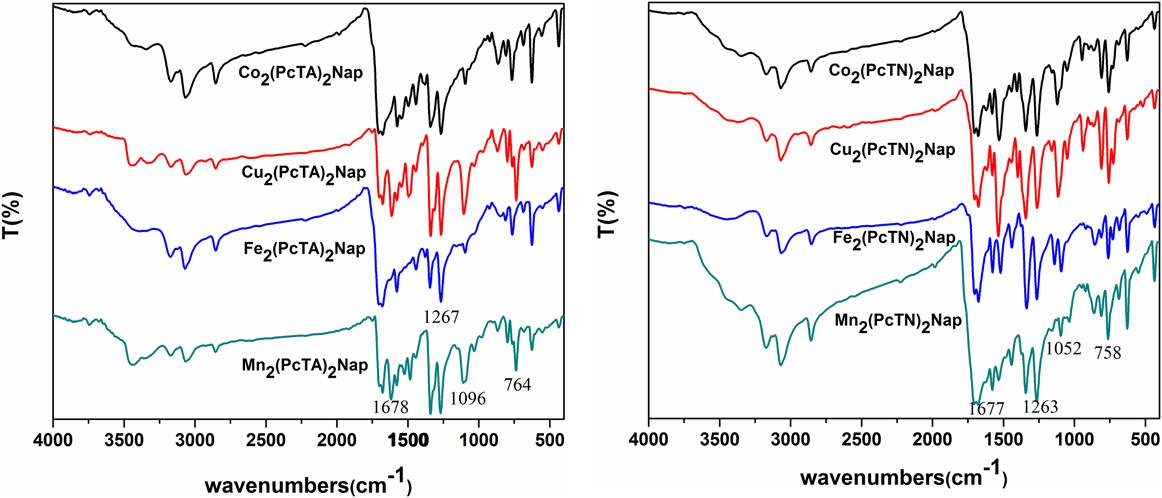
Cu2(PcTN)2Nap: blue solid, yield 2.4894 g (71.20%), m.p. > 300 °C; Anal. for C62H22N22O12Cu2: Calcd. (%). C 53.42, H 1.59, N 22.10; Found (%). C 53.67, H 1.60, N 22.27. IR (KBr pellet, cm−1): 1676 (C=C), 1399 (C=N), 1536 and 1343 (–NO2), 1263, 1115, 1050, 938, and 757 (cycle of Pc).
Co2(PcTN)2Nap: dark blue solid, yield 2.0515 g (59.24%), m.p. > 300 °C; Anal. For C62H22N22O12Co2: Calcd. (%). C 53.77, H 1.60, N 22.25; Found (%). C 53.66, H 1.58, N 22.43. IR (KBr pellet, cm−1): 1677 (C=C), 1405 (C=N), 1530 and 1343 (–NO2), 1264, 1120, 1052, 918, and 758 (cycle of Pc).
Mn2(PcTN)2Nap: blown blue solid, yield 1.2059 g (35.02%), m.p. > 300 °C; Anal. For C62H22N22O12Mn2: Calcd. (%). C 54.08, H 1.61, N 22.38; Found (%). C 53.77, H 1.60, N 22.27. IR (KBr pellet, cm−1): 1678 (C=C), 1443 (C=N), 1533 and 1343 (–NO2), 1266, 1121, 1095, 921, and 762 (cycle of Pc).
Fe2(PcTN)2Nap: deep green solid, yield 1.8928 g (54.71%), m.p. > 300 °C; Anal. For C62H22N22O12Fe2: Calcd. (%). C 54.01, H 1.61, N 22.35; Found (%). C 53.82, H 1.67, N 21.87. IR (KBr pellet, cm−1): 1676 (C=C), 1440 (C=N), 1520 and 1337 (–NO2), 1264, 1140, 1093, 919, and 761 (cycle of Pc).
Cu2(PcTA)2Nap: deep green solid, yield 1.0043 g (82.55%), m.p. > 300 °C; Anal. For C62H34N22Cu2: Calcd. (%). C 61.33, H 2.82, N 25.38; Found (%). C 61.47, H 2.88, N 25.57. IR (KBr pellet, cm−1): 1677 (C=C), 1444 (C=N), 3436 and 3169 (–NH2), 1266, 1105, 971, and 764 (cycle of Pc).
Co2(PcTA)2Nap: deep green solid, yield 0.9497 g (78.78%), m.p. > 300 °C; Anal. For C62H34N22Co2: Calcd. (%). C 61.80, H 2.84, N 25.57; Found (%). C 61.91, H 2.85, N 25.41. IR (KBr pellet, cm−1): 1679 (C=C), 1446 (C=N), 3442 and 3171 (–NH2), 1268, 1101, 927, and 763 (cycle of Pc).
Mn2(PcTA)2Nap: dark blue solid, yield 0.4147 g (57.60%), m.p. > 300 °C; Anal. For C62H34N22Mn2: Calcd. (%). C 62.21, H 2.86, N 25.74; Found (%). C 61.73, H 2.94, N 25.72. IR (KBr pellet, cm−1): 1678 (C=C), 1443 (C=N), 3343 and 3169 (–NH2), 1266, 1095, 923, and 766 (cycle of Pc).
Fe2(PcTA)2Nap: deep green solid, yield 0.7060 g (58.74%), m.p. > 300 °C; Anal. For C62H34N22Fe2: Calcd. (%). C 62.12, H 2.86, N 25.71; Found (%). C 62.43, H 2.77, N 25.58. IR (KBr pellet, cm−1): 1679 (C=C), 1442 (C=N), 3391 and 3173 (–NH2), 1267, 1096, 925, and 764 (cycle of Pc).
C. Electrochemistry and CV
1. Electrochemistry
The electrochemical measurements of binuclear metal phthalocyanine complexes were conducted in simulated Li/SOCl2 batteries that were made from special materials. The battery was principally consisted of anode, cathode, electrolyte, and separator. The cathode was a carbon film, which was composed of conductive agent and acetylene black in a certain proportion (10 wt%/90 wt%) dispersed in the diluted Teflon emulsion. Then, the mixture was repeatedly churned and rolled into a certain thick film (<0.5 mm) by using a heated roller machine. After desiccation, the film was cut into a positive plate with the dimensions of 1.00 cm2. The anode material was made of polished lithium foil whose plane area was the same as the carbon film. The solution of LiAlCl4/SOCl2 (1.47 mol/L, 1 mL) containing the prepared binuclear phthalocyanine (2 mg) was used as the electrolyte. The separator was made from polypropylene before the assembling processes of the simulated battery, all battery accessories and catalysts should be dried in the vacuum oven at 70 °C for 4 h, and all the experiments for the assembling battery were implemented in the glove box under argon atmosphere in dry external conditions, which the relative humidity was controlled below 1%. The discharge tests for assembled batteries were actualized at an ambient temperature of 23–25 °C, a constant resistance of 40 Ω, and an average current density of 70 mA/cm2 conditions until the battery voltage discharged to 2 V continuously. The whole discharge process of simulation batteries was displayed visually through the discharge curves.
2. CV
The CV tests were executed in a three-electrode system. As the working electrode, glassy carbon electrode with an area of 0.25 cm2 should be polished and dried before being fastened in polytetrafluoroethylene. In addition, Li foil was regarded as both the auxiliary electrode and reference electrode, and copper was taken as conductor wire. The electrolyte was also used with LiAlCl4/SOCl2 containing the catalysts. To eliminate the LiCl film, the electrodes were polarized at least 3 min at 5 V. All the tests that were operated with a scanning rate of 0.1 V/s should be conducted at room temperature with a dry environment.
III. RESULTS AND DISCUSSION
A. Solubility
At room temperature, M2(PcTN)2Nap and M2(PcTA)2Nap (M = Mn2+, Fe2+, Co2+, Cu2+) are insoluble in water, 2% hydrochloric acid, methyl alcohol, absolute ethyl alcohol, acetone, trichloromethane, tetrachloromethane, ethyl acetate, and aviation kerosene; freely soluble in concentrated sulfuric acid, chromic acid, DMF, thionyl chloride, dimethyl sulfoxide, and tetrahydrofuran.Reference Karaoğlan, Gümrükçü and Koca30,Reference Arıcı, Arıcan and Uğur31 The results suggest that binuclear metal phthalocyanines are extremely stabilized in most common solvent, which signifies that the compounds can be used effectively in catalytic fields.
B. IR spectra
The typical bands for the compounds are shown in the IR spectra of M2(PcTN)2Nap and M2(PcTA)2Nap (M = Mn2+, Fe2+, Co2+, Cu2+) (Fig. 1). The bending vibration peaks of C=C in benzenes are in the range of 1670–1680 cm−1. The characteristic peaks of phthalocyanine rings for the stretching vibrations of C=N in inner skeleton are at 1450–1450 cm−1 regions. The absorption peaks occuring at 1265, 1130, 1100, 923, and 770 cm−1 are assigned to skeletal vibration of M2(PcTN)2Nap and M2(PcTA)2Nap, which indicate the formation of phthalocyanine rings. The vibration absorption peaks of the coordination bond (M–N) between metallic ion and phthalocyanine ring inner N in the range of 904–950 cm−1. For M2(PcTN)2Nap, the strong absorption peaks of –NO2 are in the range of 1520–1540 cm−1 and 1330–1350 cm−1, which belong to asymmetric and symmetric stretching vibrations of aromatic nitro, respectively. Furthermore, there appears two novel absorption peaks at around 3420 and 3230 cm−1 for M2(PcTA)2Nap instead of the absorption peaks of –NO2, which indicates that all the nitro are reduced to amino. In conclusion, all the characteristic absorption peaks conform to the accurate structures of binuclear metal phthalocyanines.
IR spectra of M2(PcTN)2Nap and M2(PcTA)2Nap.

C. UV-vis spectra
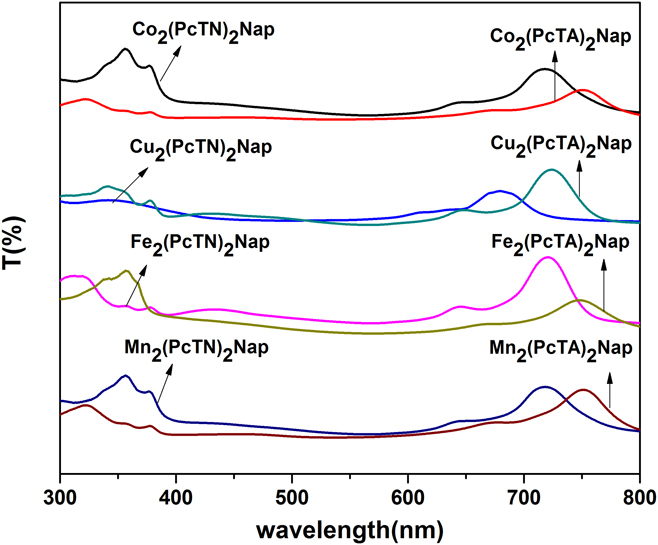
UV-vis absorption spectra of M2(PcTN)2Nap and M2(PcTA)2Nap (M = Mn2+, Fe2+, Co2+, Cu2+) are studied with the range of 200–800 nm in DMF, which could demonstrate the microstructures of the phthalocyanine compounds. The results are shown in Fig. 2 and Table I. All compounds showed two absorption peaks corresponding to the characteristic B band and Q band of phthalocyanines in the regions of 310–410 nm and 640–776 nm. The UV-vis absorption spectra of all these compounds exhibit two significant characteristic absorption bands that are closely related to π-electron transition of the phthalocyanine rings.Reference Ray and Vasudevan32–Reference Mukherjee, Ghorai and Samanta35 In addition, almost all of the Q bands appear two absorption peaks, which may be caused by the vibration coupling of the binuclear metal phthalocyanine. As a consequence of the different energy level between the highest occupied molecular orbital (HOMO) and the lowest unoccupied molecular orbital (LUMO) being reduced, the Q band that is formed by π → π* transitions exhibits an obvious red shift.Reference Karaoğlan, Gümrükçü and Koca30,Reference Xiao, Zhu and Li36,Reference Li, Shen, Ma, Chen and Xie37 And compared with M2(PcTN)2Nap, the electron-donating effect of amino group can result in a distinct shift of Q bands of M2(PcTA)2Nap, which are provided in Fig. 2. It should be noticed that the greater conjugated system gives rise to the lower energy of the molecular orbital. At the same time, B band is observed due to the transitions from the deeper π levers to LUMO and remains unchanged.
UV/vis spectra of M2(PcTN)2Nap and M2(PcTA)2Nap containing same metal ions.

UV-vis data of binuclear metal phthalocyanines M2(PcTN)2Nap and M2(PcTA)2Nap (λ/nm).

D. Catalytic performance
For the sake of evaluating the performance, binuclear metal phthalocyanines M2(PcTN)2Nap and M2(PcTA)2Nap (M = Mn2+, Fe2+, Co2+, Cu2+) are added into Li/SOCl2 battery systems. In reality, the immense acceptor–donor phthalocyanine systems postpone the accumulation of the LiCl film on the C electrode and release the internal resistance of the battery. Therefore, the battery capacity has been improved to a greater extent as shown in Fig. 4. For the purpose of performing quantitative research studies of the catalytic performances of these compounds, it is assumed that the internal and conductor resistances of the battery are infinitesimally relative to the load resistance, and numerical analyses in allusion to average voltage (U av) and battery capacity (C) have been quantified by the following formulae:
The average voltage of the battery is
 $${U_{{\rm{av}}}} = \int_0^t {U{\rm{d}}t} \quad .$$
Under the condition of constant resistance, the capacity of the battery is
 $$C = \int_0^t {I{\rm{d}}t} = {1 \over R}\int_0^t {U{\rm{d}}t} \quad .$$
For approximate calculation:
 $$C = {1 \over R}{U_{{\rm{av}}}}t\quad .$$
And the relative capacity is
 $$\omega \left( C \right) = {{\left( {C - {C_0}} \right)} / {{C_0} \times 100\% \quad .}}$$
In the above formulae, t represents the discharge time from the beginning to the moment when voltage suddenly drops to 2 V and I stands for the discharge current of the battery. R represents the constant resistance of 40 Ω. C 0 represents the battery capacity in the absence of binuclear metal phthalocyanines compared with C.
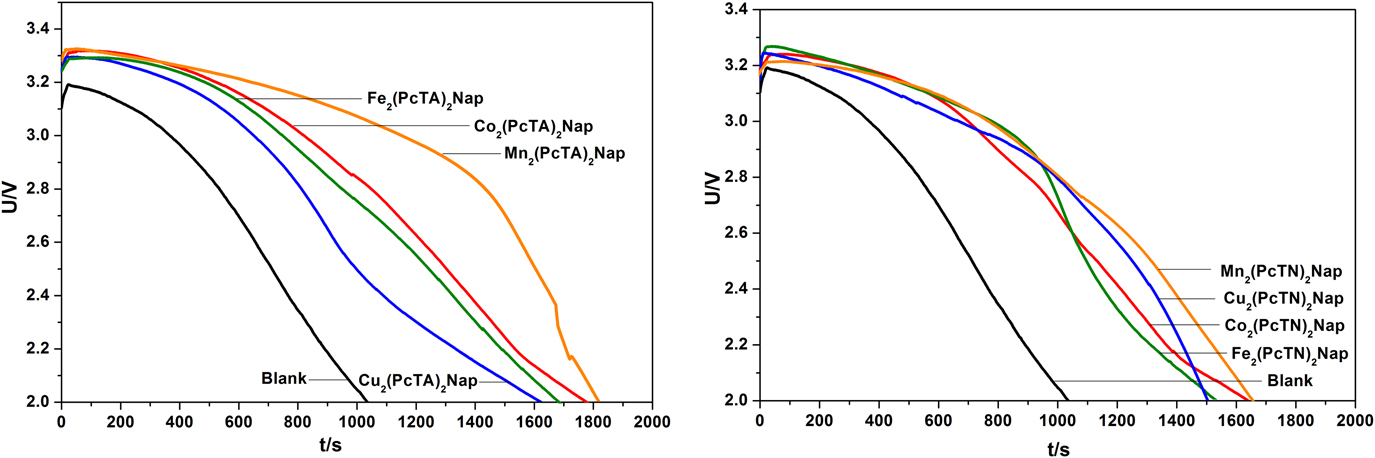
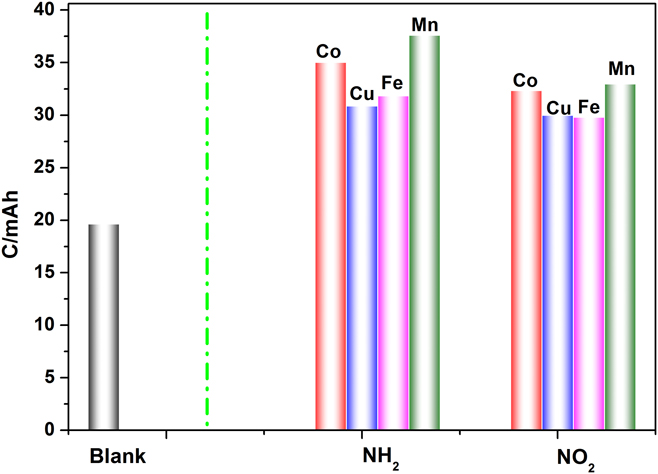
The discharge curves of the Li/SOCl2 battery catalyzed by M2(PcTN)2Nap and M2(PcTA)2Nap (M = Mn2+, Fe2+, Co2+, Cu2+) are shown in Fig. 3. The capacities of the battery can further reflect the catalytic performance of phthalocyanine complexes, which are revealed in Fig. 4.
Discharge curves of the Li/SOCl2 battery catalyzed by M2(PcTN)2Nap and M2(PcTA)2Nap.

Battery capacity of M2(PcTN)2Nap and M2(PcTA)2Nap.

Data indicate that the whole performances of the Li/SOCl2 battery catalyzed by phthalocyanines have been greatly improved compared with that of the Li/SOCl2 battery in the absence of these additives. The discharge time of Li/SOCl2 battery M2(PcTN)2Nap and M2(PcTA)2Nap (M = Mn2+, Fe2+, Co2+, Cu2+) can be prolonged 58.89% and 78.28%, respectively. Simultaneously, battery capacities containing M2(PcTN)2Nap and M2(PcTA)2Nap can be improved 51.78%–67.98% and 57.23%–91.62%, respectively. For binuclear phthalocyanines containing diverse central metal ions, the orders of the capacity are as follows, M2(PcTN)2Nap: Mn2+ > Co2+ > Cu2+ > Fe2+; the sequence of M2(PcTA)2Nap in terms of the capacity has a little difference from that of the first mentioned, Mn2+ > Co2+ > Fe2+ > Cu2+. Thus, it means that the central metal ions Mn2+ and Co2+ are beneficial for the battery in enhancing the discharge performances and maintaining a relatively stable state of voltage, especially for the electrolyte which contains Mn2+. That's benefited from the flexibility of the outershell electrons of low valent state transition metal ions, making more electron transfer to phthalocyanine rings, thereby enhancing the electronic cloud density of the rings and expanding the conjugative effect.Reference Kim and Choi38 It is also found that the stand or fall of the catalytic performance is connected with the location of the redox reaction. For instance, the oxidation–reduction processes of Fe2+ occur in the phthalocyanine rings which go against the redistribution of electrons resulting in relatively lower catalytic performances. Cu2+ has more nuclear charge numbers than any other ions; its outermost shell electrons undergo more attractive force. Moreover, the phthalocyanine core which comprises of Cu2+ tends to become a stable structure of 3d 10 through obtaining an electron rather than losing an electron, becoming 3d 8 in reality. So it counts against the redistribution of electrons in the aromatic systems and thereby Cu2+ is inactive. So the conclusion can be reached, the catalytic performance of the binuclear metal phthalocyanines are associated with the d orbital structures of the metal ions. As is shown by the experiment, peripheral substituents are other active sites when phthalocyanines act on the Li/SOCl2 battery. A comparison of catalytic performances of binuclear metal phthalocyanines with the identical central metal ions indicates that the properties of the Li/SOCl2 battery catalyzed by M2(PcTA)2Nap are higher than those of M2(PcTN)2Nap, referring to the battery capacities. Compared with the electron-withdrawing group NO2, the electron-donating effect of NH2 resulted in shortened bond lengths, which shows the greater conjugate system of phthalocyanine. Meanwhile, the electron-donating effect of NH2 increased the density of the electron cloud of phthalocyanines, which is more favorable for the electron transfer. As a matter of fact, the larger electron density and conjugation the catalysts possess, the better catalytic performance the catalysts exhibit.Reference Chen, Feng and Li39 Therefore, M2(PcTA)2Nap hold more excellent catalytic performance.
E. Cyclic voltammetric analysis
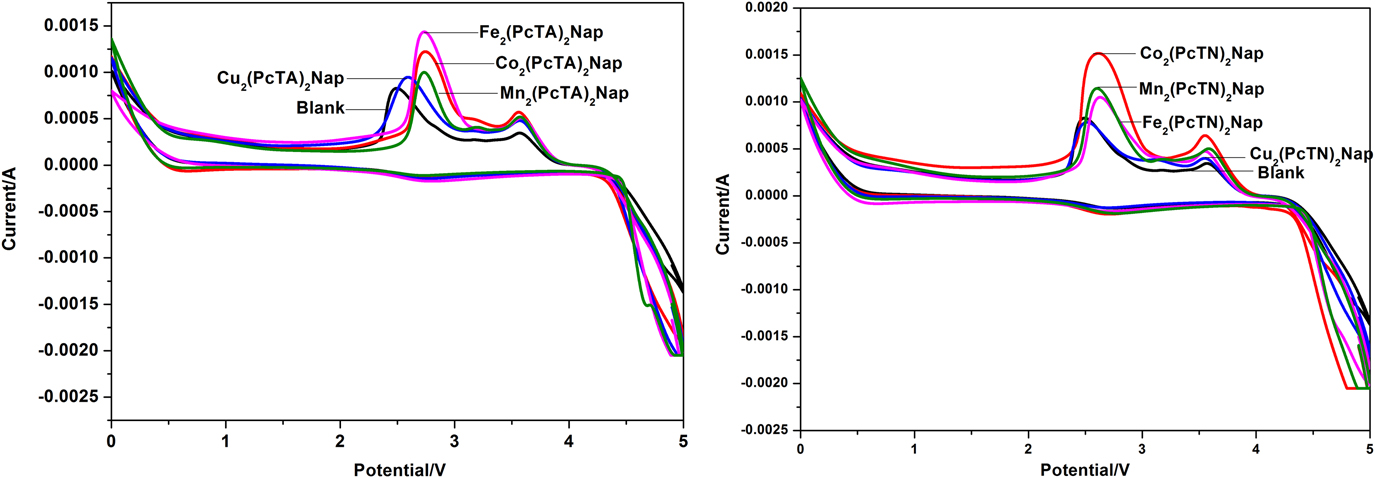
The cyclic voltammetric analysis is recorded with a scan rate of 0.1 V/s from 0 to 5 V, which is used for further evaluating the catalytic performance of phthalocyanines to the Li/SOCl2 battery and providing preliminary basis to catalytic mechanism. As can be seen from the linear CV curves (Fig. 5), there are no oxidation peaks appearing in the scanning process, whereas there are two peaks (2.6 and 3.6 V) at the part of cathode curves which are attributable to the reduction of SOCl2. And for each catalyst, both peak potentials shift positively compared with the blank battery, as well as the peak currents increase. The evidence reveals that the whole catalytic processes are irreversible and battery systems come about two-step electron transport during the reduction processes. The results of CV further manifest that the phthalocyanines are conducive to the enhancement of performances for the Li/SOCl2 battery. And there exists some difference in terms of performances because of the diverse center metal ions and the peripheral substituents. Furthermore, the results of CV and discharge curves are basically consistent for the stand or fall of catalytic performance.
CV curves of the Li/SOCl2 battery catalyzed by M2(PcTN)2Nap and M2(PcTA)2Nap.

F. Catalytic mechanism
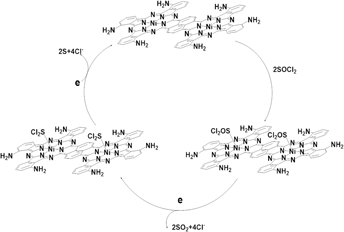
Based on the analyses and evaluations of catalytic performances, the proposal mechanism is speculated with respect to binuclear metal phthalocyanines which are applied to the Li/SOCl2 battery. It is mainly the following three steps (Fig. 6).
 $${{\rm{M}}_2}{\rm{P}}{{\rm{c}}_2}{\rm{Nap}} + 2{\rm{SOC}}{{\rm{l}}_2} \to {{\rm{M}}_2}{\rm{P}}{{\rm{c}}_2}{\rm{Nap}} \cdot 2{\rm{SOC}}{{\rm{l}}_2}\quad .$$
 $$2{{\rm{M}}_2}{\rm{P}}{{\rm{c}}_2}{\rm{Nap}} \cdot 2{\rm{SOC}}{{\rm{l}}_2} + 4{{\rm{e}}^ - } \to 2{{\rm{M}}_2}{\rm{P}}{{\rm{c}}_2}{\rm{Nap}} \cdot 2{\rm{SC}}{{\rm{l}}_2} + 2{\rm{S}}{{\rm{O}}_2} + 4{\rm{C}}{{\rm{l}}^ - }\quad .$$
 $${{\rm{M}}_2}{\rm{P}}{{\rm{c}}_2}{\rm{Nap}} \cdot 2{\rm{SC}}{{\rm{l}}_2} + 4{{\rm{e}}^ - } \to {{\rm{M}}_2}{\rm{P}}{{\rm{c}}_2}{\rm{Nap}} + 2{\rm{S}} + 4{\rm{C}}{{\rm{l}}^ - }\quad .$$
Catalytic mechanism of M2Pc2Nap for the Li/SOCl2 battery.

First, under the synergistic effect of huge electron clouds and central ions, SOCl2 may easily acquire electrons from the highest occupied orbital of phthalocyanine rings promoting to form SOCl2·MPc-Nap-MPc·SOCl2, which is the rate-determining step in the overall catalytic reduction reaction. In the second step, the adduct decomposes into M2Pc2Nap·2SCl2, SO2, and Cl− by gaining four electrons (Fig. 6). In the third step, M2Pc2Nap·s2SCl2 gains four electrons quickly by the fast electron transfer reaction in the catalyst, accompanying with the return of the catalyst. Viewed from another perspective, on the basis of “DASM”,Reference Xu, Zhao and Li40 central ions and phthalocyanine rings present adequate synergistic effect, which promotes the formation of adducts produced in the first step reaction. By the reason of better conjugation and higher density of electron clouds, the systems will be activated and reach a stabilized state, which leads to the lower activation energy, and finally will improve the catalytic properties of phthalocyanine complexes. Ultimately, the consequence of the catalysis is that the LiCl film has been found to decrease dramatically as well as the internal resistance, making the electrode reaction more quickly and thoroughly, and the overall performance of the Li/SOCl2 battery have been improved to the greatest extent.
IV. CONCLUSIONS
Two novel series of binuclear metal phthalocyaines M2(PcTN)2Nap and M2(PcTA)2Nap (M = Mn2+, Fe2+, Co2+, Cu2+) have been prepared. Characterizations and research studies of catalytic performances for Li/SOCl2 batteries have been conducted. Compared with the blank test, all the evidence suggest that binuclear metal phthalocyanine complexes in this paper can improve the performance to a certain extent when operated in the electrolyte of the battery. As for capacities of the batteries, they are also found to have an improvement of 51.78–91.62%, especially for the central ions containing Mn2+ and Co2+. It is also found that battery capacities catalyzed by M2(PcTA)2Nap can be effectively improved more than those of M2(PcTN)2Nap due to the electron donor effect of amino. Eventually, combined with CV and electrode reactions, the suggested catalysis mechanism of the complexes for catalyzing the Li/SOCl2 battery has already been proposed reasonably.
ACKNOWLEDGMENTS
The authors thank the National Natural Science Foundation of China (No. 21401149) and the Key Laboratory Research and Establish Program of Shaanxi Education Section (No. 17JS130) for the financial support of this work.