Introduction
Avian coccidiosis is a complex intestinal disease caused by obligatory protozoan parasites belonging to genus Eimeria. One recent estimate is that coccidiosis may cost the US chicken industry about $127 million annually (Chapman, Reference CHAPMAN2009) and proportionally similar losses may occur in other parts of the world. Thus coccidiosis is probably the most expensive and wide spread infectious disease in commercial poultry systems. Thus far, chemoprophylaxis and anticoccidial feed additives have controlled the disease but the situation has been complicated by the emergence of drug resistance (Abbas et al., Reference ABBAS, IQBAL, SINDHU, KHAN and ARSHAD2008; Abbas et al., Reference ABBAS, IQBAL, BLAKE, KHAN and SALEEMI2011a) and their potentially toxic effects on the animal health (Nogueira et al., Reference NOGUEIRA, FRANCA and PEIXOTO2009). Furthermore, drug or antibiotic residues in poultry products may be potentially hazardous to consumers. Another approach for coccidiosis control is the vaccination of birds with live Eimeria oocysts, but, in cases of poor management, these vaccines can trigger severe reactions that may affect the performance of flocks, mainly in broilers because of their rearing period (Chapman, Reference CHAPMAN2000). As a result of this drawback of live vaccines, attenuated vaccines (with reduced pathogenicity) have been developed, but these are expensive to produce.
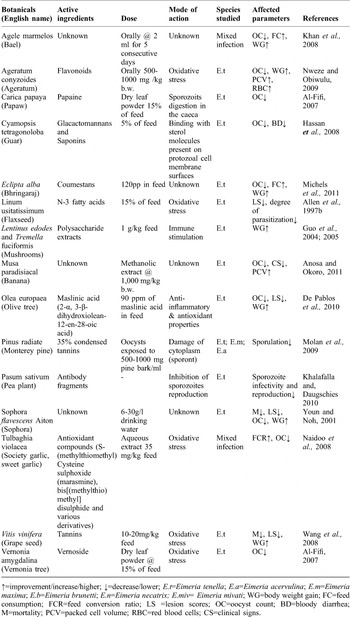
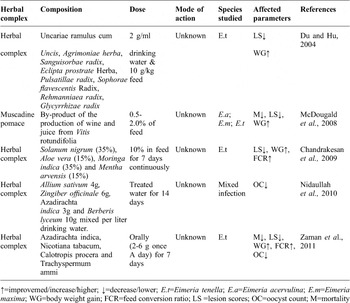
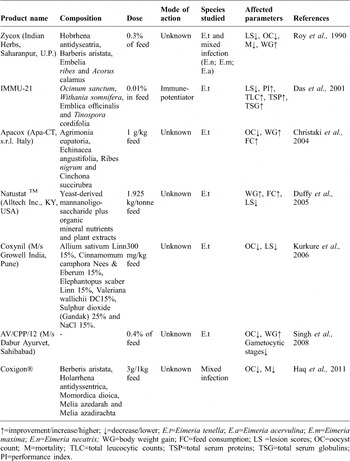
Cost effective alternative strategies are being sought for more effective and safer control of avian coccidiosis (Abbas et al., Reference ABBAS, MUNAWAR, MANZOOR, IQBAL, KHAN, SALEEMI, ZIA and YOUSAF2011b, Reference ABBAS, MANZOOR, MUNAWAR, IQBAL, KHAN, SALEEMI, ZIA and A.2011c). The use of botanicals has played a major role in the control of avian coccidiosis, as they are not only natural products but may comprise new therapeutic molecules to which resistance has not yet developed. The use of botanicals as anticoccidial remedies, therefore, holds promise as an alternate in the control of coccidiosis. A number of botanicals, herbal complexes and commercial herbal anticoccidials with promising anticoccidial effects have been reported in the literature. Some of these are summarized in Tables 1, 2 and 3, and various potential botanical candidates are discussed in the following sections.
Aloe species
Aloes are believed to have several medicinal properties and are used to treat various ailments. There are more than 360 known aloe species, but the most recommended type of aloe in controlling coccidiosis is Aloe excelsa (Gadzirayi et al., Reference GADZIRAYI, MUPANGWA and MUTANDWA2005). Gadzirayi et al. (Reference GADZIRAYI, MUPANGWA and MUTANDWA2005) reported that the anticoccidial effects of A. excelsa were comparable with sulphachlopyrazine sodium monohydrate in terms of improved live weight gains and reducing oocyst output in broiler chickens. Other species of aloe plant such as Aloe vera have also been reported as having anticoccidial activities. A. vera treatments show tonic effects on the intestinal tract by benefiting microflora and reducing bowel putrefaction as well as reducing inflammation (Bland, Reference BLAND1985). An in vitro trial was undertaken to determine the effect of three concentrations (15%, 30%, and 45%) of A. vera and A. spicata on the inhibition of the sporulation of avian coccidia oocysts (Marizvikuru et al., Reference MARIZVIKURU, EVISON, MICHAEL and TINYIKO2006). Both aloe extracts showed a concentration-dependant anticoccidial effect, however, A. spicata inhibited sporulation to a greater extent than A. vera. In another study (Yim et al., Reference YIM, KANG, KIM, KIM, LILLEHOJ and MIN2011) dietary supplementation of A. vera resulted in significantly lower gut lesion scores and reduced faecal oocyst shedding of E. maxima in broiler chickens. These authors (Yim et al., Reference YIM, KANG, KIM, KIM, LILLEHOJ and MIN2011) suggested that reduced faecal oocyst shedding, a protective role against Eimeria infection, in Aloe-based chicken diets could be associated more with cell-mediated responses than antibody responses.
Artemisia species
Artemisia is a large, diverse genus of plants with between 200 to 400 species belonging to the daisy family Asteraceae. The most common species is Artemisia annua which has been reported for its antiparasitic activities. A. annua is a common type of wormwood that is native to temperate Asia, but has become common throughout the world. Oh et al. (Reference OH, YOUN, NOH, JANG and KANG1995) conducted the first experimental trial to evaluate the anticoccidial activity of A. annua extracts against E. tenella in chickens. A. annua extracts showed the anticoccidial activity in terms of improved weight gain, improved feed conversion ratio and reduced lesion scores. Later, Allen et al. (Reference ALLEN, LYDIN and DANFORTH1997a) reported a significant anticoccidial effect of A. annua against E. tenella, measured as reduced lesion scores, when fed to broiler chickens for three weeks as dried leaves at a dietary concentration of 5% (equivalent to 17 ppm pure artemisinin). The pure form of artemisinin, fed for a period of 4 weeks at levels of 2, 8.5 and 17 ppm, significantly reduced oocyst output from single and dual species infection with E. tenella and E. acervulina. Moreover, artemisinin isolated from A. sieberi was also found to be effective against E. tenella and E. acervulina but not against E. maxima (Arab et al., Reference ARAB, RAHBARI, RASSOULI, MOSLEMI and KHOSRAVIRAD2006). So far, a limited amount of work has been carried out to determine the anticoccidial effect of Artemisia spp. in layer chickens. Brisibe et al. (Reference BRISIBE, UMOREN, OWAI and BRISIBE2008) studied the effect of feeding 20% dried pulverized A. annua leaves against E. tenella both in broiler and layer chickens. The anticoccidial effects of diets containing A. annua leaves were almost equal to the commercial anticoccidials both in broiler and layer chickens.
The proposed mechanism of action of artemisinin involves cleavage of endoperoxide bridges by iron producing free radicals (hypervalent iron-oxo species, epoxides, aldehydes, and dicarbonyle compounds) which damage biological macromolecules causing oxidative stress in the cells of the parasite (Allen et al., Reference ALLEN, DANFORTH and AUGUSTINE1998).
Azadirachta indica
Azadirachta indica (neem) plant is commonly available in Asian and African countries and is well known in the therapy of a number of infectious diseases including coccidiosis. Neem fruit, at a concentration of 150 g/50 kg feed, has been found to have anticoccidial effects against E. tenella infection by reducing oocyst excretion and mortality in broiler chickens (Tipu et al., Reference TIPU, PASHA and ALI2002). Abbas et al. (Reference ABBAS, IQBAL, AKHTAR, KHAN, JABBAR and SANDHU2006) reported an anticoccidial effect of neem fruit against mixed Eimeria species in terms of reducing the oocyst per gram of faeces. In addition to the anticoccidial effect of neem fruit, some reports have shown the anticoccidial activity of an aqueous extract of neem leaves against E. tenella alone (Toulah et al., Reference TOULAH, ISMEEL and KHAN2010) as well as in a mixed infection (Biu et al., Reference BIU, YUSUF and RABO2006), which was comparable to the commercial anticoccidials Amprolium and Baycox. So far, the exact mechanism of action of neem against coccidian parasites is unknown, but a report by the National Research Council (Reference NATIONAL RESEARCH COUNCIL1992) suggested that aqueous neem leaf extract, when taken orally, produces an increase in red cells, white blood cells and lymphocyte counts thus enhancing the cellular immune response, increasing antibody production and so most pathogens can be eliminated before they cause the symptoms associated with disease. Further research is needed to determine the maximum safe levels of neem supplementation because the higher doses, due to its bitterness, may show adverse effects on feed intake which will influence the performance parameters of birds.
Beta vulgaris
The beneficial effects of incorporating sugar beet (Beta vulgaris) solids in animal feeds on livestock growth and overall performance have been known for a long time. One of the active ingredients is betaine which protects cells against osmotic stress by stabilising cell membranes enabling the maintenance of osmotic pressure in the cells and ensuring normal metabolic activity (Ko et al., Reference KO, SMITH and SMITH1994). Augustine et al. (Reference AUGUSTINE, MCNAUGHTON, VIRTANEN and ROSI1997) reported that betaine, in combination with the ionophore salinomycin, had a significant positive effect on the performance of chickens infected with E. acervulina, E. maxima and E. tenella, the effect being greater than that mediated by betaine or salinomycin alone. Moreover, the combination resulted in a slight decrease in the development and invasion of the epithelium by E. acervulina, while there was an increase in the invasion of E. tenella. Later this effect was elucidated by Klasing et al. (Reference KLASING, ADLER, REMUS and CALVERT2002) when they found the accumulation of more lymphocytes in the epithelium and lamina propria during E. acervulina infection in chickens supplemented with betaine compared to those not supplemented. This effect of betaine could result in more effective clearance of sporozoites which would explain the decreased numbers of sporozoites in the epithelium as observed by Augustine et al. (Reference AUGUSTINE, MCNAUGHTON, VIRTANEN and ROSI1997). Additionally, betaine feeding has been reported (Kettunen et al., Reference KETTUNEN, TIIHONEN, PEURANEN, SAARINEN and REMUS2001) to stabilise the intestinal epithelium structure in chickens against E. maxima infection, and therefore the anticoccidial effect of betaine might be due to inhibition of coccidial invasion as well as by stabilising intestinal structure and function (Augustine et al., Reference AUGUSTINE, MCNAUGHTON, VIRTANEN and ROSI1997).
Camellia sinensis
Camellia sinensis is a rich source of natural flavonoides which are known to have anticoccidial effects due to their antioxidant properties (Jang et al., Reference JANG, JUN, LILLEHOJ, DALLOUL, KONG, KIM and MIN2007, Chen et al., Reference CHEN, ZHANG, QU and XIE2008). Other than flavonoides, C. sinensis also contains alkaloids, carotenoids, minerals, amino acids (especially l-theanine), carbohydrates, lipids, and volatiles/aroma compounds (Engelhardt, Reference ENGELHARDT2010). The prophylactic anticoccidial effects (faecal oocyst shedding and weight gain parameters) of C. sinensis (green tea) ground leaves (0.5% and 2.0% in diets) were evaluated against E. maxima infection in chickens (Jang et al., Reference JANG, JUN, LILLEHOJ, DALLOUL, KONG, KIM and MIN2007). The anticoccidial effect of these green tea-based diets in chickens infected with E. maxima was limited to a reduction in the numbers of oocysts shed, with no improvement in the body weight. On the basis of these results against E. maxima, authors suggested the need of further investigations for the anticoccidial effects of C. sinensis against other species of chicken coccidia.
Curcuma longa
Curcuma longa L. (Zingiberaceae), commonly known as turmeric, is a medicinal plant widely used and cultivated in the tropical regions. In developing countries like Pakistan, poultry farmers provide turmeric powder as a feed additive for the control of coccidiosis in broilers (Abbas et al., Reference ABBAS, IQBAL, KHAN, ZAFAR and ZIA2010). The active compound of turmeric is the phenolic compound curcumin, which has been shown to have antioxidative, anti-inflammatory and immunomodulatory properties (Allen et al., Reference ALLEN, DANFORTH and AUGUSTINE1998). In an experimental study, the anticoccidial effect of dietary supplementation of 1% curcumin was observed in chickens after infection of E. maxima and E. tenella species. Improved weight gain, reduced lesion scores and oocyst counts were shown only against E. maxima. A significant reduction of plasma NO2¯ and NO3¯ was found only in E. maxima infected and curcumin treated birds, and hence provides a possible explanation for the difference in anticoccidial activity found for both Eimeria species (Allen et al., Reference ALLEN, DANFORTH and AUGUSTINE1998). Later Abbas et al. (Reference ABBAS, IQBAL, KHAN, ZAFAR and ZIA2010) reported that dietary supplementation with 3% C. longa powder was effective against a mild infection of E. tenella. The proposed mechanism of action of C. longa (curcumin) involves the induction of oxidative stress against coccidia. Further studies are required to determine the possible anticoccidial activity of different concentrations of whole C. longa and its active ingredient curcumin against different Eimeria species in poultry.
Echinacea purpure
Echinacea and its different preparations contain a variety of active substances such as flavonoids, polysaccharides, glycoproteins, alkamides, cinnamic acids, essential oils and phenolic compounds (Liu et al., Reference LIU, ZENG, CHEN and YAO2007; Zhai et al., Reference ZHAI, YI, WU, SENCHINA, WURTELE, MURPHY, KOHUT and CUNNIK2007) which are effective in treatment of various ailments and are proven to be beneficial in promoting immunity (Bauer, Reference BAUER1999). This plant is known to have anti-inflammatory, antioxidant and immunomodulating properties that may be linked to its anticoccidial effects (Zhai et al., Reference ZHAI, YI, WU, SENCHINA, WURTELE, MURPHY, KOHUT and CUNNIK2007). In an experimental study (Allen, Reference ALLEN2003), ground root preparations of E. purpurea (0.1% - 0.5%) were offered to broilers for two weeks which ameliorated weight gain reduction and birds had fewer coccidial lesions after a mixed challenge infection with E. acervulina, E. maxima, E. tenella and E. necatrix. The exact mechanism of action is still unknown, but because of its antioxidant properties Echinacea therapy may induce a state of oxidative stress against Eimeria species.
Origanum vulgare
The essential oils of Origanum vulgare are well known for their antiprotozoal activity (Milhau et al., Reference MILHAU, VALENTIN, BENOIT, MALLIE, BASTIDE, PELISSIER and BESSIERE1997). Giannenas et al. (Reference GIANNENAS, FLOROU-PANERI, PAPAZAHARIADOU, CHRISTAKI, BOTSOGLOU and SPAIS2003) carried out a study to examine the effect of dietary supplementation of oregano (O. vulgare) essential oil on performance of broiler chickens experimentally infected with E. tenella. It was concluded that oregano essential oils, mainly carvacrol and thymol, had anticoccidial effects against E. tenella. Some studies suggest that vaccination against coccidiosis, in combination with oregano containing compounds, may be an alternative control method for intestinal health in chickens (Waldenstedt, Reference WALDENSTEDT2003). In addition, some studies suggest the use of dried oregano leaves as a natural herbal growth promoter for early maturing of birds (Bampidis et al., Reference BAMPIDIS, CHRISTOUDOULOU, FLOROU-PANERI, CHRISTAKI, CHATZPOULOU, TSILIGIANNI and SPAIS2005). The dietary supplementation of oregano containing plants like O. vulgare, therefore, seems equally effective for maintaining the performance and pathogenic parameters of birds in case of coccidiosis.
Saccharum officinarum
Sugar cane (Saccharum officinarum) extract (SCE), a well known natural immunostimulant, is reported to have protective effects against E. tenella infection in chickens (El-Abasy et al., Reference EL-ABASY, MOTOBU, NA, SHIMURA, NAKAMURA, KOGE, ONODERA and HIROTA2003). Some studies (Hikosaka et al., Reference HIKOSAKA, EL-ABASY, KOYAMA, MOTOBU, KOGE, ISOBE, KANG, HAYASHIDANI, ONODERA, WANG, MATSUMURA and HIROTA2007) showed a significant increase in the number of IgM- and IgG-plaque forming cell responses of peripheral blood leukocytes (PBL), intestinal leukocytes, splenocytes, and significantly higher phagocytic activity of PBL and antibody responses in chickens that had been orally administered with either sugar cane extract (SCE) or the polyphenol-rich fraction (PRF). Most recently, Awais et al. (Reference AWAIS, AKHTAR, MUHAMMAD, HAQ and ANWAR2011) reported the immunotherapeutic effects of sugar cane extract against mixed Eimeria species in broiler chickens. The results of these studies suggested that sugar cane extract has an immunostimulating effect in chickens and their administration may augment protective immunity against coccidiosis.
Triticum aestivum
The supplementation of whole Triticum aestivum (wheat) grains in broiler feeds is common practice in Europe (Forbes and Covasa, Reference FORBES and COVASA1995) because dietary fibre anti-oxidants may actually quench the soluble radicals that are continuously formed in the intestinal tract (Bao and Choct, Reference BAO and CHOCT2010). Some reports (Allen et al., Reference ALLEN, DANFORTH and AUGUSTINE1998) have noted the protective effects of whole cereal grains against coccidiosis in broiler chickens measured as a reduction of oocyst output. However, Waldenstedt et al. (Reference WALDENSTEDT, ELWINGER, HOOSHMAND-RAD, THEBO and UGGLA1998) and Banfield et al. (Reference BANFIELD, KWAKKEL and FORBES2002) investigated the effects of whole wheat inclusion in broiler feeds with or without access to grit, and observed no significant differences in oocyst counts of mixed Eimeria species. They concluded that the reduction in output of oocysts by supplementation with whole cereals in the diet was not a result of the crushing of oocysts by an active gizzard or the increase in the viscosity of the digesta. Furthermore, they concluded that the whole wheat supplementation provided no control of coccidiosis in broiler chickens.
Yucca schidigera
Plant extracts with high saponin content are a good source of natural antimicrobial compounds. Yucca schidigera is a major source of natural saponins that cause the inhibition of protozoan development by interacting with the cholesterol present on the parasite cell membrane, thus resulting in parasite death (Wang et al., Reference WANG, MCALLISTER, NEWBOLD, RODE, CHEEKE and CHENG1998). Some studies have shown a beneficial and synergistic effect between the coccidiosis vaccine and the Y. schidigera extract in improving weight gains, feed conversion ratio and maintaining the integrity of the intestinal villi in chickens (Alfaro et al., Reference ALFARO, SILVA, BORGES, MAIORKA, VARGAS and SANTIN2007). These improvements in the performance parameters of birds may be the result of the potential for saponins (extracted from the Y. schidigera) to improve the absorption of nutrients by the intestinal mucosal surface (McAllister et al., Reference MCALLISTER, WANG, HRISTOV, OLSON and CHEEKE1998). These saponins are steroidal glycosides with strong surfactant activity, reducing the superficial tension of fluids and allowing better absorption of nutrients by the intestinal epithelium.
Overview of the anticoccidial effect of botanicals against avian coccidiosis.

↑=improvement/increase/higher; ↓=decrease/lower; E.t=Eimeria tenella; E.a=Eimeria acervulina; E.m=Eimeria maxima; E.b=Eimeria brunetti; E.n=Eimeria necatrix; E.miv= Eimeria mivati; WG=body weight gain; FC=feed consumption; FCR=feed conversion ratio; LS =lesion scores; OC=oocyst count; BD=bloody diarrhea; M=mortality; PCV=packed cell volume; RBC=red blood cells; CS=clinical signs.
Miscellaneous
A number of other plants and their combinations have been reported to have anticoccidial effects. Their details, including names, active ingredients, mode of actions and species studied are summarised in Tables 1 and 2. Most of these plants are rich in antioxidant compounds like saponins, flavonoids, papaine, n-3 fatty acids, vernoside and tannins, and therefore may be lethal to the parasites by inducing oxidative stress.
Overview of the anticoccidial effect of herbal complexes against avian coccidiosis.

↑=improvemed/increase/higher; ↓=decrease/lower; E.t=Eimeria tenella; E.a=Eimeria acervulina; E.m=Eimeria maxima; WG=body weight gain; FCR=feed conversion ratio; LS =lesion scores; OC=oocyst count; M=mortality
Commercially available herbal anticoccidials
A number of plant-derived compounds and natural products appear to have anticoccidial activities against the Eimeria species commonly found in poultry (Allen et al., Reference ALLEN, DANFORTH and AUGUSTINE1998; Alfaro et al., Reference ALFARO, SILVA, BORGES, MAIORKA, VARGAS and SANTIN2007; Naidoo et al., Reference NAIDOO, MCGAW, BISSCHOP, DUNCAN and ELOFF2008). Therefore, in some countries plant based formulations, such as Apacox, Natustat and Zycox are used for the control of coccidiosis in chickens (Table 3). Most botanicals and plant-derived products are being extensively tested to establish the efficacy of their parasiticidal activity, their mechanism of action and target parasite species (Athanasiadou et al., Reference ATHANASIADOU, GITHIORI and KYRIAZAKIS2007).
Overview of the anticoccidial effect of commercial preparations of botanicals against avian coccidiosis.

↑=improvement/increase/higher; ↓=decrease/lower; E.t=Eimeria tenella; E.a=Eimeria acervulina; E.m=Eimeria maxima; E.n=Eimeria necatrix; WG=body weight gain; FC=feed consumption; LS =lesion scores; OC=oocyst count; M=mortality; TLC=total leucocytic counts; TSP=total serum proteins; TSG=total serum globulins; PI=performance index.
Conclusions
Use of botanical anticoccidials provide a novel approach for the effective control of coccidiosis, whilst meeting the urgent need for new solutions due to the widespread emergence of drug-resistant coccidian strains in commercial poultry production. Feeding botanical supplements to birds to enhance their innate defence mechanisms against coccidiosis could effectively reduce or eliminate the need for synthetic drug therapy of these enteric infections. The use of commercially available botanical anticoccidials is an appealing approach that can be used in anticoccidial therapy. However, most of the studies that have been intended to demonstrate the anticoccidial effect of plants and plant derived products have been poorly designed, lack appropriate controls, and have insufficient replication. Further extensive and appropriate experimental studies are needed to establish the efficacy of their anticoccidial activity, their mechanism of action and target parasite species by following standardised bioassays.