Introduction
Rice (Oryza sativa L.) is the primary food source for a major portion of the world population. The constantly growing population, shrinking agricultural land and global climatic changes pose a serious threat to rice productivity. Among the various environmental stresses, water deficit adversely affects yields worldwide, because of its high water requirement. So to curtail these losses, it is necessary to generate high-yielding climate-smart rice varieties. But the grain yield cannot be the only basis of selection for stress-tolerant genotypes due to trait complexity as well as the involvement of multiple environmental factors (Oladosu et al., Reference Oladosu, Rafii, Magaji, Abdullah, Miah, Chukwu, Hussin, Ramli and Kareem2018). Genetic enhancement for plant architecture plays a significant role in improving the yield prospect in rice (Khush, Reference Khush1995; Yuan Reference Yuan1997). Flag leaf morphological traits (width, length and area), which are governed by polygenes, are important components in ideal plant type selection and are often used by rice breeders as primary selection indices (Xuebiao et al., Reference Xuebiao, Yuepeng, Zongxiang and Hongxi2004). Flag leaf structure plays a very important role in canopy photosynthesis as well as grain yield in rice. More than 50% of photosynthetic carbohydrate reserved in spikelets is supplied through flag leaves in rice (Gladun and Karpov, Reference Gladun and Karpov1993). A larger flag leaf area (FLA) positively impacts the grain yield, grain weight and canopy development in rice crops due to increased chlorophyll percentage and fresh flag leaf weight (Al-Tahir Reference Al-Tahir2014). Grain yield in cereal crops is enhanced by a larger leaf area intercepting more light (Watson, Reference Watson1952) and most yield attributing traits exhibit a positive association to FLA (Ashrafuzzaman et al., Reference Ashrafuzzaman, Islam, Ismail, Shahidullah and Hanafi2009). When exposed to drought stress during the vegetative phase, the rice crop shows decreased interception in photosynthetically active radiations (Inthapan and Fukai, Reference Inthapan and Fukai1988). Water stress critically affects flag leaf physiology, organ temperature and canopy, eventually causing a loss in yield and quality of the final product. It also leads to reduced leaf expansion, leaf area, plant height, total biomass and tiller abortion, ultimately leading to arrest in leaf elongation following leaf death (Cutler et al., Reference Cutler, Steponkus, Wach and Shahan1980). To challenge such severe situations, genetic manipulation of leaf morphological traits is of utmost importance for developing varieties possessing good drought tolerance. As traditional plant breeding is time-consuming and laborious, marker-assisted selection (MAS) may facilitate faster identification of desired genomic regions governing polygenic traits such as flag leaf traits.
Previous reports suggest that the quantitative trait loci (QTL) qLSCHL4, which is linked to flag leaf shape when overexpressed in transgenic rice lines, showed enhanced panicle type and flag leaf size, thereby demonstrating higher yields compared to the wild type (Zhang et al., Reference Zhang, Li, Wang, Ye, Zeng, Rao, Peng, Hu, Yang, Xu and Ren2002). Exploring and assembling alleles responsible for yield-contributing traits can prove a breakthrough in increasing yields in cultivars. This led to identifying QTL linked to leaf size (flag leaf length (FLL) and flag leaf width (FLW)) while breeding novel varieties of rice with adaptation to moisture stress. However, very few QTL are known for traits like flag leaf morphology under drought stress (Yang et al., Reference Yang, Wang, Lei, Wang, JunaidSubhani, Liu, Sun, Zheng, Zhao and Zou2018; Barik et al., Reference Barik, Pandit, Pradhan, Mohanty and Mohapatra2019) and they show limited allelic diversity valuable in breeding due to the information derived from a single mapping population. Moreover, their stability and interaction with QTL or genes in different environments and their role in breeding rice have not been extensively investigated. Association mapping, on the other hand, employs natural populations effectively in plant genetic studies to identify novel allelic variations and can facilitate greater mapping resolution by precisely detecting genes linked with different traits. The assessment of diverse genetic resources could unveil novel QTL/alleles associated with leaf shape, aiding its wider utilization in rice crop improvement through pyramiding. There are a few studies that reported employing an association mapping approach to identify QTL linked to leaf traits (Wu et al., Reference Wu, Qi, Hu, Li, Li and Zhang2017) in general, and no report on utilizing diverse ahu rice germplasm to detect marker–trait associations (MTAs) for the leaf traits in particular.
The ahu rice cultivars from northeast India are landraces known to naturally harbour traits such as early maturity, photo-insensitivity and drought tolerance. Adapted to rainfed upland conditions, these landraces exhibit tremendous genetic variability and are grown during the autumn/ahu season from February/March to June/July in Assam, India. Hence locally it is known as ‘ahu’ rice. They have been maintained by farmers using selective breeding from time immemorial and are known to retain valuable genes for tolerance to abiotic stresses (Verma et al., Reference Verma, Borah and Sarma2019). Exploring them for leaf morphological traits can generate important insights into the phenotypic and genetic make-up of these traits. These landraces are underexplored in identifying the genetic architecture of flag leaf physiology.
Therefore, the present study was conducted using 273 diverse ahu rice germplasm accessions to record the variation for FLL, FLW, FLA and leaf rolling under drought and irrigated conditions. As a starting point for future genome-wide association mapping, 95 polymorphic SSR markers randomly distributed throughout 12 chromosomes were used to detect the QTL for leaf morphology. Here, we report that an increase in FLL is a good indicator for drought adaptability and identify 11 MTAs for an ahu rice panel under drought stress conditions.
Material and methods
The panel of 267 ahu rice cultivars was employed in our study using drought-tolerant checks Sahbhagi-Dhan, Bangalami and Dehangi and two susceptible check varieties IR64 and Lachit (Basu et al., Reference Basu, Jongerden and Ruivenkamp2017; Verma et al., Reference Verma, Chetia, Dey, Baruah and Modi2017; Maheswari et al., Reference Maheswari, Sarkar, Vanaja, Srinivasa Rao, Prasad, Prabhakar, Ravindra Chary, Venkateswarlu, Ray Choudhury, Yadava and Bhaskar2019). The germplasm was collected from the gene bank of the Regional Agricultural Research Station (RARS), Assam Agricultural University (AAU), Titabor, Assam. The panel chiefly comprised of traditional ahu cultivars and local Assam varieties with few breeding lines for comparing germplasm alleles. The traditional panel is known for its adaptability to upland conditions and drought tolerance and mainly sown during the rainfed ahu season in Assam.
Phenotyping for morpho-physiological traits
All the details including the list of accessions, experimental design and hydrological conditions were maintained in irrigated and artificial drought stress areas as per Mahalle et al. (Reference Mahalle, Dey, Chetia, Baruah, Ahmed, Sarma, Kaldate, Kumar, Singh and Modi2020). The drought stress was generated in a rainout shelter in the ahu season (February–July 2017) by withholding irrigation before panicle appearance (vegetative stage) in an augmented randomized complete block design (Federer, Reference Federer1956). During the initial establishment and vegetative growth period, the stress plot was watered twice a week employing a sprinkler. The control plants were maintained in irrigated conditions 45 d after seedling transplantation with 20 cm spacing between the hills in the row between each plant. While the irrigated plots were watered regularly to the field capacity, the stress plots were sprinkled as the soil water tension is dropped below 50 kPa and moisture content to 10% at 30 cm of soil depth. FLA was measured in a non-destructive way by calculating FLL and FLW of the main flag leaf shoot using a ruler at maturity in both water management environments for four replications. The FLA was calculated using the following formula:

Leaf rolling score (LRS) was taken at maturity using a standard rice evaluation system under drought stress. Phenotypic data under both conditions for all accessions are provided in online Supplementary Tables S1 and S2.
Phenotypic data analysis
The data range, mean and standard deviation (SD) were calculated using Microsoft Excel tools. The trait variance analysis (ANOVA), CV (coefficient of variance), CD (critical difference) and Pearson correlation coefficient were calculated using the R-statistical package and IBM SPSS Statistics (version2.0). All the yield trait data from Mahalle et al. (Reference Mahalle, Dey, Chetia, Baruah, Ahmed, Sarma, Kaldate, Kumar, Singh and Modi2020) were used to perform a correlation study with leaf traits. The phenotypic coefficient of variation (PCV) and genotypic coefficient of variation (GCV) were studied according to Singh and Choudhury (Reference Singh and Chaudhary1977) using the R-statistical program. The Pearson correlation coefficient was calculated using IBM SPSS statistics.
Molecular analysis of marker data
Genotypic data reported by Mahalle et al. (Reference Mahalle, Dey, Chetia, Baruah, Ahmed, Sarma, Kaldate, Kumar, Singh and Modi2020) from SSR markers were utilized to associate with flag leaf traits using TASSEL standalone version 4.0. The same marker information was also used for principal component analysis (PCA) and the molecular variance study. To measure the gene diversity distribution, and to evaluate the variant components in the populations, analysis of molecular variance (AMOVA) based on SSR marker loci was conducted using GenAlEx (Peakall and Smouse, Reference Peakall and Smouse2012). Genetic relationships among the genotypes were also studied by PCA using the DARwin Version 5.0.158. Candidate gene analysis was carried out as per Mahalle et al. (Reference Mahalle, Dey, Chetia, Baruah, Ahmed, Sarma, Kaldate, Kumar, Singh and Modi2020). The microsatellite markers linked with leaf traits were aligned to the IRGSP 1.0 genome on Ensembl plants (https://plants.ensembl.org/Oryza_sativa/Info/ Index) to retrieve the genes coupled with them. The linked marker sequence was extended from 500 kb left and 500 kb right to locate the genes coupled with the QTL region. The proteins encoded by the identified genes were explored at Uniprot (https://www.uniprot.org/). These intervals associated with the SSR regions (QTL are not true) can be called as intervals of QTL genome as per Kumar et al. (Reference Kumar, Dixit, Ram, Yadaw, Mishra and Mandal2014).
Results and discussion
Phenotypic study
The ANOVA showed significant differences for FLL and FLA under drought stress (Table 1), explaining a wide variation in germplasm for the traits studied. The CD and CV in both hydrological regimes (online Supplementary Table S6) were very high, signifying ample variation for the leaf traits within the panel. The PCV and GCV values ranged from moderate to high (above 10%) further establishing the leaf size variability in the panel (online Supplementary Table S6).
Mean squares of ANOVA for the ahu rice germplasm under water stress (left) and in an irrigated environment (right)

FLL, flag leaf length (cm); FLW, flag leaf width (cm); FLA, flag leaf area (cm2).
Significant codes: nsP > 0.05; *P ≤ 0.05; **P ≤ 0.01; ns, non-significant; df, degrees of freedom.
The FLL in the stress regime ranged from 13.8 cm (G-179) to 59.7 cm (Kehong ahu) with a mean of 31.57 cm, and the FLW varied from 0.4 cm (AS-305/2) to 1.6 cm (SD-360) and a mean of 0.87 cm. The average FLA recorded was 19.72 cm2 (ranging from 4.39 cm2 for AS-305/2 to 49.07 cm2 for Rongajira). The moisture stress caused a severe reduction in mean FLL, FLW and FLA compared to a well-watered state.
Water scarcity leads to decreased mitosis, cell expansion and elongation, causing a decrease in the leaf area of plants (Nonami, Reference Nonami1988). The leaf traits for most of the tolerant accessions like Koniahu, Garamahu 2, Rikhoijoi (1), Bengonagtiya, Kola Bengonagutiya, Raja ahu, DauKolamaghi, Ahujoha, Guborguniand tolerant check Sahbhagi-Dhan were least affected by drought stress (online Supplementary Tables S1 and S2). There was no considerable reduction for the traits under study in these entries. More particularly, we did not detect any change in leaf characteristics for an entry ‘Koniahu’ in both water stress and controlled conditions, indicating its wider adaptability for various water regimes. This entry proved to be highly tolerant and exhibited the lowest yield reduction under drought in our prior study (Mahalle et al., Reference Mahalle, Dey, Chetia, Baruah, Ahmed, Sarma, Kaldate, Kumar, Singh and Modi2020). This might be an effect of its morphological adaptation to a water deficit by expressing an enlarged green leaf area (Sahebi et al., Reference Sahebi, Hanafi, Rafii, Mahmud, Azizi, Osman, Abiri, Taheri, Kalhori, Shabanimofrad and Miah2018).
The leaf area of the traditional high-yielding accessions like Heera (50.89%), Bairing (27.52%) and Kosamoni (32.22%), and improved breeding lines like IR630 (15.51%), Pathak23 (44.35%), Pathak26 (32.54%) and Pathak34 (39.41%) recorded the highest mean reduction in leaf area in drought conditions compared to irrigated conditions. Water depletion in rice leads to a greater reduction of leaf area signifying more sensitivity of leaf expansion and elongation due to the drought stress (Cabuslay et al., Reference Cabuslay, Ito and Alejar2002). The reduced leaf size because of water deficit may denote an increase in xeromorphy (Stocker, Reference Stocker1960). However, under irrigated conditions, the FLL, FLW and FLA ranged from 18.17 to 65.8 cm, 0.6 to 1.5 cm and 11.45 to 57.63 cm with a mean of 40.35, 0.99 and 28.08 cm, respectively. Under irrigated conditions, no significant variation was observed among the traits except for check versus accessions. It might be because under optimum conditions, gene expression levels among varieties remain the same.
Correlation of flag leaf traits with yield attributes
Considering the effect of flag leaf traits on yield traits, Pearson correlation analysis was conducted to study the association between them in our core set which could benefit the breeders in selecting superior plant types. The study could also assist in the identification of suitable cultivars for different breeding programmes targeted to improve drought response.
The FLL showed a significantly positive correlation with plant height (PH), panicle length (PL), LW and relative leaf water content (RLWC) under the drought stress environment (Table 2) and negative association with harvest index (HI). On the other hand, LW exhibited a positive association with PH, PL, RLWC, number of tillers (NOT), number of productive tillers (NPT), and negative correlation with HI. The LA did not explain any association with any yield attributing traits.
Pearson correlation of leaf traits with yield traits in a drought stress environment

DFF, days to 50% flowering; PH, plant height; NOT, number of tillers; NPT, number of productive tillers; PL, panicle length; FLL, flag leaf length (cm); FLW, flag leaf width (cm); FLA, flag leaf area (cm2); SF, spikelet fertility; HI, harvest index; RLWC, relative leaf water content; GYP, grain yield per plant.
*Correlation is significant at the 0.05 level (two-tailed); **correlation is significant at the 0.01 level (two-tailed).
Through various studies, it has been confirmed that the flag leaf physiology positively influences the yield-related traits directly or indirectly (Yoshida, Reference Yoshida1981; Misra, Reference Misra1987; Ashrafuzzaman et al., Reference Ashrafuzzaman, Islam, Ismail, Shahidullah and Hanafi2009). Intensive investigations were carried out to study the impact of cutting the flag leaf and their proximal leaf on rice yield (Abou-Khalifa et al., Reference Abou-Khalifa, Misra and Salem2008). Fujita et al. (Reference Fujita, Santos, Ebron, Telebanco-Yanoria, Kato, Kobayashi, Uga, Araki, Takai, Tsunematsu and Imbe2009) had also identified a set of IR64 NILs showing unique FLW and FLL features and the lines tend to be more productive in a water-limited environment. It is evident from our study that longer and broader leaves positively influenced a majority of the traits and these traits also have a beneficial effect on grain yield under drought. The larger leaves might tend to store more water and thereby improve relative leaf water content and supply it to a maturing spikelet indirectly, influencing grain yield. Hence a positive association of all the leaf traits with RLWC is apparent under both scenarios in the results.
Broader leaves accumulate more biomass, which explains the negative correlation of leaf length with harvest index under drought. Such negative correlations of FLL and FLW with HI were also reported by Mukesh et al. (Reference Mukesh, JhaVidyabhushan, Mankesh and Shweta2018) and Abebe et al. (Reference Abebe, Alamerew and Tulu2019). A rice plant with broader leaves shows better performance under drought stress compared to one with narrow leaves, due to improved transpiration efficiency and reduced stomatal conductance (Farooq et al., Reference Farooq, Kobayashi, Ito, Wahid and Serraj2010). In well-watered conditions, all the leaf traits showed a significant correlation with almost all the yield attributes like days to 50% flowering (DFF), PH, NOT, NPT, PL, LW, LA and RLWC (online Supplementary Table S4). The LW showed a positive significant association with NOT, LL, LA, spikelet fertility (SF) and RLWC. Similarly, LA also showed a significant positive connection with the majority of traits, including PH, NOT, PL, LL, LW, SF and RLWC in a well-watered situation. For a complex trait like yield, direct selection of grain yield might not prove quite effective. The correlation analysis demonstrated that under well-watered conditions, leaf traits including FLL, FLW and FLA can be considered important for the selection of grain yield per plant (Fig. 1).
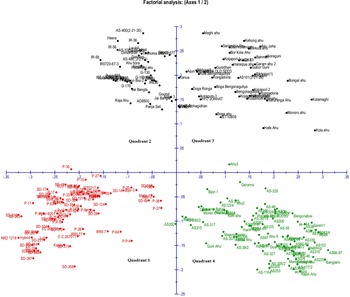
Principal component analysis (PCA) representing germplasm distribution in different subgroups.

Marker-based genetic variability analysis
The marker polymorphism values along with population structure estimates were considered as per Mahalle et al. (Reference Mahalle, Dey, Chetia, Baruah, Ahmed, Sarma, Kaldate, Kumar, Singh and Modi2020). Based on population structure estimates, molecular variance present between and within the populations was assessed via AMOVA, employing the program GenAlex 6.0 (Peakall and Smouse, Reference Peakall and Smouse2006). The populations formed through structure analysis showed clear genetic differentiation through molecular variability analysis. AMOVA illustrated that 11% of the variation in germplasm was due to the difference between populations, while the remaining 89% of variation can possibly be attributed to dissimilarity within groups (Table 3). Similar results were obtained by Nachimuthu et al. (Reference Nachimuthu, Muthurajan, Duraialaguraja, Sivakami, Pandian, Ponniah, Gunasekaran, Swaminathan, Suji and Sabariappan2015), where they reported that 14% of the variation was between populations and 86% variation within populations. The summary results of AMOVA were in agreement with the results derived via STRUCTURE and phylogenetic analysis and established the existence of statistically moderate genetic diversity with a higher population structure, which should be vital.
Summary of the analysis of molecular variance

df, Degrees of freedom; SS, sum of squares; MS, mean squares; Est. Var, estimated variance.
The PCA findings validated the outcomes of our STRUCTURE study as the germplasm samples were distributed similarly in both analyses (Mahalle et al., Reference Mahalle, Dey, Chetia, Baruah, Ahmed, Sarma, Kaldate, Kumar, Singh and Modi2020). The 273 accessions are represented in a two-dimensional graphical view (Fig. 1). Using PCA, it was possible to separate 273 cultivars into subgroups that supported the STRUCTURE module. All the genotypes were widely scattered across different quadrants. Among the 273 cultivars, 203 formed a separate cluster in the lower half of the graph, which included 112 accessions in quadrant 1 (lower-left corner) and 91 accessions in quadrant 4 (lower-right corner), respectively, showing a clear distinction of the genotypes in two-dimensional dispersion of all cultivars. Quadrant 1 consisted of all the short duration accessions which are high yielding in comparison to other germplasm. Quadrant 4 consisted of 69 local landraces of Assam. The 70 accessions which were designated as admixture in the structure analysis are separated in the upper half (i.e. quadrant 2 and quadrant 3). Two subgroups were seen in the admixture group – one present in quadrant III and the other in quadrant IV. A similar separation of the admixture group was also seen in the UPGMA analysis (Mahalle et al., Reference Mahalle, Dey, Chetia, Baruah, Ahmed, Sarma, Kaldate, Kumar, Singh and Modi2020). This separation of the admixture group can be explained by the fact that some accessions of this group had more POP1 like traits, whereas the other had more POP2 like traits (Mahalle et al., Reference Mahalle, Dey, Chetia, Baruah, Ahmed, Sarma, Kaldate, Kumar, Singh and Modi2020).
Many of the drought-tolerant accessions like Sahabhagi-dhan, Ahujoha, Kola bengonagutiya and Garamahu 2 (Fig. 1), with longer and broader flag leaves, were found in quadrant 3. This was because the drought-tolerant lines behaved like high-yielding accessions in their yield attributes and like traditional accessions in their adaptability to drought. A similar pattern of molecular variance was observed by Zhang et al. (Reference Zhang, Li, Li, Liu, Zhao and Lu2011) for two population subgroups.
Marker–trait association study
The analysis using TASSEL4.0 showed 18 MTAs employing microsatellite markers for four leaf physiology traits in two environments via a mixed linear model (MLM) function. In drought stress conditions, 11 MTAs were obtained and the irrigated environment showed seven MTAs (Table 4). In stress conditions, the R 2 value ranged from 4.46 to 19.97% at P > 0.001 for all four traits. The marker, RM280 on chromosome 4 associated with FLL and FLA explained the highest phenotypic variance (19.97 and 14.53%, respectively). This marker is within the confidence interval of the QTL detected by Qiao et al. (Reference Qiao, Qi, Cheng, Su, Li, Sun, Ren, Zheng and Yang2016) and Zeng et al. (Reference Zeng, Hu, Dong, Liu, Zeng, Zhang, Guo, Zhou and Qian2009) for traits like FLL (qLFL4-1), plant height (qPH4-1) and leaf ligule length (qLL-4). Under stress scenario, the association of this marker with FLW has not been reported. Though the gene survey did not hit any known stress-responsive gene around this marker, there is a possibility that some genes present may have a stress-responsive function but are yet to be revealed. The marker was also found associated with NPT under stress conditions in our previous report (Mahalle et al., Reference Mahalle, Dey, Chetia, Baruah, Ahmed, Sarma, Kaldate, Kumar, Singh and Modi2020).
Marker–trait associations by MLM with leaf traits under both environments

R 2, phenotypic variance (effect of MTA); Chr no., chromosome number; P, significant probability value; FLL, flag leaf length (cm); FLW, flag leaf width (cm); FLA, flag leaf area (cm2).
Another marker, RM184 localized on chromosome 10 was linked with both FLW and FLA and showed R 2 values of 11.13 and 11.34%, (Table 4), respectively. The association seems to be novel for FLA and FLW under drought. However, under an irrigated environment, it was reported by Dong et al. (Reference Dong, Li, Hu, Liang, Wu, Zeng, Liu, Wu, Wang, Bhanbhro and Dang2018) to be associated with FLA by the association mapping approach. There are several genes coupled with RM184 in response to abiotic stress and a stimulus like salt stress, which responds to stress with lyase activities, lipid biosynthesis, iron ion binding, oxidoreductase activity, wax biosynthesis, salt stress, abscisic acid, cuticle development, etc. FLL was linked to RM337 on chromosome 8 with a PV of 10.29%. The marker was consistently associated with FLL through the general linear model. It showed an R 2 value of 8.82%, which explains the reliability of the marker. An MTA on chromosome 8 (qtl 8.1) within the marker interval RM337-RM3664 and peak on RM8020 was associated with grain yield under well-watered upland conditions (Bernier et al., Reference Bernier, Kumar, Ramaiah, Spaner and Atlin2007) that overlapped with meta QTL MQTL8.1 (RM337-RM902) for drought grain yield (Swamy et al., Reference Swamy, Vikram, Dixit, Ahmed and Kumar2011). This marker region was also reported to be linked with leaf rolling (Barik et al., Reference Barik, Pandit, Pradhan, Mohanty and Mohapatra2019) under drought stress. The co-localization of the associated regions for leaf length under drought stress along with leaf rolling might reflect the importance of FLL in drought tolerance in this population, and the value of this potential genomic region for MAS.
Some small effect MTAs for FLL were also found on chromosome 4 (RM127) and chromosome 9 (RM296). These showed a PV of 5.92 and 4.96%, respectively. The marker, RM296 was common for both the environments and is a minor QTL explaining PV of 5.79 and 4.34%. For leaf rolling, two associations were recorded, RM1352 on chromosome 3, and RM519 at chromosome 12, showing PV of 7.23 and 4.46%, respectively. RM1352 has not been reported to be associated with any traits yet under drought stress. In our earlier study, we found its association with GYP, NPT and PH under drought stress. The association seems to be novel and important as it has various drought-responsive genes in its vicinity like lipoxygenase (LOX gene), ethylene response sensor I, rRNA plasma membrane ATPase, N-glycosidase and uncharacterized stress-related proteins.
The marker, RM519 was linked to a minor MTA for leaf rolling, explaining an R 2 value of 4.46%. The irrigated conditions showed seven MTAs at P > 0.01 and the marker R 2 values ranged from 4.34 to 8.74%. The markers RM316, RM167, RM296 were associated with FLL on chromosome 9, 11 and 9 explained PV of 5.56, 5.86 and 8.74%, respectively (Table 3). The small effect QTLs like RM316 were earlier reported by Yue et al. (Reference Yue, Xue, Luo and Xing2008) for FLW, relative plant height and leaf rolling under stress conditions and for grain per panicle (qGPP9-1), leaf width (qFLW9-1) in irrigated conditions (Sahu et al., Reference Sahu, Sunil, Vishwakarma, Verulkar and Chandel2017).
The diverse ahu rice germplasm can serve as a means of studying leaf morphology under drought stress. The marker density used to analyse the population is low; otherwise, the population size is quite ideal for our study. Employing more microsatellite markers in our investigation might have an impact on locating new QTL as nowadays single nucleotide polymorphisms (SNPs) provide higher precision and mapping resolution in GWAS (genome-wide association studies). Therefore, the MTAs identified can be validated by increasing marker density along with the SNP marker system. The structured association mapping within the population can prove as a viable method to pinpoint major QTL allied to drought tolerance.
Supplementary material
The supplementary material for this article can be found at https://doi.org/10.1017/S1479262121000587.
Acknowledgements
The authors are grateful to the Department of Biotechnology-Assam Agriculture University Centre (DBT-AAU) for providing the required facilities for conducting research and to the Chief Scientist, Regional Agricultural Research Station (RARS), Titabor, for providing the logistic support for phenotyping.