Introduction
Over the last years, collective entrepreneurship (CE) has gained increasing attention in the entrepreneurship literature (e.g., Hjorth & Johannisson, Reference Hjorth and Johannisson2003; Johannisson, Reference Johannisson2000, Reference Johannisson2003; Yan & Sorenson, Reference Yan and Sorenson2003; Ribeiro Soriano & Comeche, Reference Ribeiro Soriano and Comeche2007; Ribeiro Soriano & Urbano, Reference Ribeiro Soriano and Urbano2009, Reference Ribeiro Soriano and Urbano2010; Comeche & Loras, Reference Comeche and Loras2010; Ratten, Reference Ratten2014). For defining the concept, Stewart’s (Reference Stewart1989) seminal writing understands CE as cooperation among entrepreneurial teams within an organisation. It embraces decision-making, estimating the effects of possible actions, allocating appropriate resources, etc. Here, acceptance of change is an essential precondition (Stewart, Reference Stewart1989). CE is based on the very interaction between a set of actors, albeit with different individual capabilities (Johannisson, Reference Johannisson2003). These actors might include employees, teams and owners within a firm, sharing cognitive frames to promote innovation (Miles, Snow, & Miles, Reference Miles, Snow and Miles2000) and being connected by networks (Johannisson, Reference Johannisson2000, Reference Johannisson2003).
In this paper, we conceive CE as the ability of several individuals to jointly innovate and create within organisations. Under these premises, we use CE as a conceptually more specific and detailed construct within the realm of corporate entrepreneurship, focussing on the entrepreneurial action of employees in small- and medium-sized enterprises (SMEs). In general, the role of CE is often underestimated (Stewart, Reference Stewart1989). However, as noted by Yan and Sorenson (Reference Yan and Sorenson2003), today more and more organisations draw their competitive advantages from continuous and incremental innovation in the form of CE. Thus, CE may also be important to sustain the continuity and growth of SMEs. To promote CE, firms are not only challenged to encourage individual talent and creativity, but also to optimise the collective as a whole. However, this is still an underresearched field, and the present study aims to shed more light on how CE can be stimulated.
In this connection, Stewart (Reference Stewart1989) suggested that leadership is a crucial part of CE. Certainly, for a long time scholars have addressed the impact of leadership styles on business-related outcomes (e.g., Bowers & Seashore, Reference Bowers and Seashore1966; Kahai, Sosik, & Avolio, Reference Kahai, Sosik and Avolio1997; Sorenson, Reference Sorenson2000; Waldman, Ramirez, House, & Puranam, Reference Waldman, Ramirez, House and Puranam2001; Vera & Crossan, Reference Vera and Crossan2004). Nevertheless, to our knowledge only a few empirical studies (Yan & Sorenson, Reference Yan and Sorenson2003; Ribeiro Soriano & Comeche, Reference Ribeiro Soriano and Comeche2007) have been undertaken relating leadership styles to CE. In addition, Comeche and Loras (Reference Comeche and Loras2010) and Yan and Sorenson (Reference Yan and Sorenson2003) scrutinised attitudinal and behavioural prerequisites for CE; however, with sometimes contradictory findings. The task remains to reconcile the research so far.
Consequently, the objective of our paper is to fill this research gap by combining these previous studies from a more holistic perspective. Our central research question is as follows: Is the relationship between employees’ perceptions of leadership styles and more effective CE affected by attitudinal and behavioural moderators? To provide answers, we performed an exploratory study in a Portuguese group of SMEs in the area of information technology (IT) systems, investigating employees’ perceptions of some specific leadership styles and the occurrence of CE. Following Baron and Kenney’s (Reference Baron and Kenny1986) definition of moderators, we particularly considered attitudinal and behavioural factors that might influence the relationship of leadership and more effective CE. Our contribution lies in advancing knowledge and in providing a better understanding of how leaders can influence and enhance CE.
The remainder of the paper is structured as follows: second section contains a literature review about leadership and potential moderators on CE. It also develops our research hypotheses. Following this, in third section, we describe the methodology, that is, sample, measurement, data gathering and analysis. Afterwards, fourth section presents the sample characteristics, research model evaluation and the outcomes of hypothesis testing. Fifth section discusses the findings and draws up the implications and limitations of our study.
Literature Review and Hypotheses
CE as a research field
Recognition and exploitation of opportunities is the key fulcrum on which entrepreneurship is based (Stevenson & Jarillo, Reference Stevenson and Jarillo1990; Short, Ketchen, Shook, & Ireland, Reference Short, Ketchen, Shook and Ireland2010). Identification of opportunities includes such activities as scanning both internal and external environments for new markets, unmet needs, existing problems in work processes and new product ideas (Sandberg, Reference Sandberg1991). In this respect, a firm’s entrepreneurial competence is mostly equated with that of its owner. However, this historically conceptualised individualistic view of entrepreneurship fails to recognise that in many cases this phenomenon is a collective effort.
The academic literature of the 1980s already took into account this collective character of entrepreneurship, labelled as ‘intrapreneurship’ (Pinchot, Reference Pinchot1985) or ‘corporate entrepreneurship’ (Miller, Reference Miller1983). This refers to people who depart from traditional organisational cultures in order to create new businesses (Pinchot, Reference Pinchot1985), with innovation, risk-taking and proactiveness as its most important and distinguishing elements (Miller, Reference Miller1983). From that point on, the last two decades have witnessed a growing interest in researching entrepreneurial activities within established organisations (e.g., Guth & Ginsberg, Reference Guth and Ginsberg1990; Kuratko, Montagno, & Hornsby, Reference Kuratko, Montagno and Hornsby1990; Covin & Slevin, Reference Covin and Slevin1991; Zahra, Reference Zahra1993; Zahra & Covin, Reference Zahra and Covin1995; Covin & Miles, Reference Covin and Miles1999, Reference Covin and Miles2007; Sharma & Chrisman, Reference Sharma and Chrisman1999; Zahra, Jennings, & Kuratko, Reference Zahra, Jennings and Kuratko1999; Antoncic & Hisrich, Reference Antoncic and Hisrich2001, Reference Antoncic and Hisrich2004; Kemelgor, Reference Kemelgor2002; Dess, Ireland, Zahra, Floyd, Janney, & Lane, Reference Dess, Ireland, Zahra, Floyd, Janney and Lane2003; Hayton, Reference Hayton2005; Phan, Wright, Ucbasaran, & Tan, Reference Phan, Wright, Ucbasaran and Tan2009; Toledano, Urbano, & Bernadich, Reference Toledano, Urbano and Bernadich2010).
As a result, the field of corporate entrepreneurship has become progressively more complex. More recent concepts use broader definitions to capture its nature, comprising the following activities (Guth & Ginsberg, Reference Guth and Ginsberg1990, p. 5): (1) the birth of new businesses within existing organisations; and (2) the transformation of organisations through renewal of the key ideas on which they are built. Based on this approach and following Sharma and Chrisman’s (Reference Sharma and Chrisman1999) hierarchy of terminology, corporate entrepreneurship can be divided into ‘corporate venturing’ and ‘strategic renewal’, both implying innovation-driven changes in either the structure or strategy of an existing organisation. According to Ribeiro Soriano and Urbano (Reference Ribeiro Soriano and Urbano2010), these processes also require organisational learning, determined by collaboration and commitment.
In addition to this conceptualisation, corporate entrepreneurship may be internally or externally oriented (Zahra, Jennings, & Kuratko, Reference Zahra, Jennings and Kuratko1999). In fact, it arises from the collaboration efforts of innovation-minded players (Kemelgor, Reference Kemelgor2002); independent of the environment in which they are embedded. Researchers suggest that corporate entrepreneurship may exist in teams (e.g., Reich, Reference Reich1987; Stewart, Reference Stewart1989; Slevin & Covin, Reference Slevin and Covin1992), organisations such as small and large firms (e.g., Jelinek & Litterer, Reference Jelinek and Litterer1995; Mourdoukoutas, Reference Mourdoukoutas1999; Comeche & Loras, Reference Comeche and Loras2010) and networks of organisations (e.g., Mourdoukoutas, Reference Mourdoukoutas1999; Johannisson, Reference Johannisson2003; Toledano, Urbano, & Bernadich, Reference Toledano, Urbano and Bernadich2010). From this, two different research streams have arisen: ‘collaborative entrepreneurship’ as the capacity to cooperate outside, and ‘collective entrepreneurship’ as the ability to collaborate inside the organisation (Ribeiro Soriano & Urbano, Reference Ribeiro Soriano and Urbano2009). The present paper takes the latter perspective.
CE and leadership
CE is based on the sum of individual intelligence within an organisation, involving both subordinates and leaders in unison. Nevertheless, the latter are the ones responsible for creating the necessary conditions to encourage followers’ behaviour and attitudes favourable to CE (Lounsbury, Reference Lounsbury1998). In this context, leadership plays a crucial role. For several decades, many authors in different fields have comprehensively researched leadership. Studying this phenomenon is relevant, inasmuch as it is considered fundamental for the entrepreneurial process of the team (Stewart, Reference Stewart1989) and a critical factor in explaining an organisation’s success in general. Despite the importance of leadership, the complexity of the subject leads to the absence of a complete and universally accepted definition (Van Vugt, Hogan, & Kaiser, Reference Van Vugt, Hogan and Kaiser2008).
Among the unifying premises underlying this concept, it appears that leadership is a social process containing relationships between individuals (Barker, Reference Barker2001). It is therefore a group process of social interaction, embracing the dyadic relationship between formally designated leaders and their subordinates. Taking these arguments further, Cyert (Reference Cyert2006), Vardiman, Houghston, & Jinkerson (Reference Vardiman, Houghston and Jinkerson2006) and Yukl (Reference Yukl2012) specify leadership as a process of influence on followers’ behaviour towards the accomplishment of specifically identified objectives. In order to exert this influence, leaders apply particular styles of leadership.
With regard to the relationship between leadership styles and CE, only a few studies have been carried out to tackle this subject. Yan and Sorenson (Reference Yan and Sorenson2003) undertook an empirical study of 271 small family businesses in the United States and found that relations-oriented and participative leadership have positive, indirect effects on CE. Again, Ribeiro Soriano and Comeche (Reference Ribeiro Soriano and Comeche2007) interviewed 114 entrepreneurs in Spain and also revealed positive relationships between these leadership styles and CE; however, in their study, leadership based on relationships showed an impact with an intensity of more than double that of participative leadership. Nonetheless, the role of moderators in this process remains underresearched or ambiguous.
In fact, leadership styles based on shared decision-making and collaboration are probably the most promising predictors when it comes to fostering collectively entrepreneurial organisations. In fact, as CE is a complex phenomenon, top-down or vertical leadership seems to be unrealistic and maladaptive to achieve the necessary organisational change (Bennis, Reference Bennis1999). The same applies, in our perception, to situational leadership styles that combine levels of directive and supportive behaviour (Goleman, Reference Goleman, Boyatzis and McKee2002; Blanchard, Reference Blanchard2007). CE requires voluntary action, which can be achieved better through mutual adjustment than command and control. Moreover, collaborative or shared leadership has frequently been advocated as favourable to influencing followers through communication (Kramer & Crespy, Reference Kramer and Crespy2011). Hence, in our study we consider two main types of leadership styles: relations-oriented and participative.
To investigate the relationship between these leadership styles and more effective CE, we refer to moderators inherent to relations-oriented and participative leadership. To categorise these moderators, we follow Yan and Sorenson’s (Reference Yan and Sorenson2003) division into attitudinal and behavioural variables. Regarding attitudinal variables, in our study, we consider organisational commitment and job satisfaction, the latter interpreted as the level of general contentment with the working team and conditions. For behavioural variables, we focus our attention on collaboration. In the next section, we explain how these factors act as moderators between leadership styles and CE, and their shaping might explain and impact on the effectiveness of CE in an organisation.
Hypotheses development
Relations-oriented leadership
Managers who adopt a relationship-oriented style are truly interested in people and their social interaction (Sorenson, Reference Sorenson2000). They are empathetic and skilled at sensing their followers’ needs (Derue, Nahrgang, Wellman, & Humphrey, Reference Derue, Nahrgang, Wellman and Humphrey2011). Relationship-oriented leaders are not dominant and do not tend to manipulate subordinates, rather showing concern and respect for individual team members. They are sociable and approachable, accept opinions from others and treat all subordinates as equals (Bass & Bass, Reference Bass and Bass2008). Similarly, Yukl (Reference Yukl2012) stresses the importance of consultation with individuals, along with developing, supporting and recognising subordinates’ commitment to the organisation as the main components of this leadership behaviour.
Despite environmental factors being the main predictors of job satisfaction (Abdulla, Djebarni, & Mellahi, Reference Abdulla, Djebarni and Mellahi2011), leadership also influences job satisfaction in psychological terms through subordinates’ notion of being treated with respect and having their well-being maximised (Spector, Reference Spector1997; Ellickson & Logsdon, Reference Ellickson and Logsdon2001). Regarding collaboration as a behavioural dimension, Yan and Sorenson (Reference Yan and Sorenson2003) revealed a positive and significant relationship with relations-oriented style. Furthermore, a relationship-oriented leadership style is not only likely to increase teamwork and creative collaboration (Haskins, Liedtka, & Rosenblum, Reference Haskins, Liedtka and Rosenblum1998); it also positively impacts on employees’ satisfaction with the job they perform (Madlock, Reference Madlock2008). Additionally, relations-oriented leaders’ tendency to develop, recognise and reward employees increases the likelihood of employees being committed to the organisation. Therefore, we propose the following hypotheses:
Hypothesis 1 : Organisational commitment (Hypothesis 1a), collaboration (Hypothesis 1b) and job satisfaction (Hypothesis 1c) moderate the relationship between results-oriented leadership and more effective CE.
Participative leadership
Participative leadership style has some similarities with the relationship-oriented one (Kahai, Sosik, & Avolio, Reference Kahai, Sosik and Avolio1997), but many studies characterise participative as different from relationship-oriented management (Bass & Bass, Reference Bass and Bass2008). The main distinguishing aspect is that participative leaders are not only open to input from followers, they also actually encourage their subordinates to speak up in the case of disagreement (Cammann, Finchman, Jenkins, & Klesh, Reference Cammann, Finchman, Jenkins and Klesh1983). Moreover, such leaders practise empowerment and share the decision-making process with subordinates (Vroom & Jago, Reference Vroom and Jago1988; Ribeiro Soriano & Comeche, Reference Ribeiro Soriano and Comeche2007). This implies fomenting and facilitating subordinates’ active involvement and partaking in managerial decisions (Bass & Bass, Reference Bass and Bass2008).
The highest level of participative leadership is delegation of decision-making to subordinates (Ribeiro Soriano & Comeche, Reference Ribeiro Soriano and Comeche2007). Here, they are provided with goals and given the freedom to achieve them, assuming responsibility for their own work (Cammann et al., Reference Cammann, Finchman, Jenkins and Klesh1983). Such involvement implies close collaboration among leaders and followers; the resulting greater emotional bond is also likely to increase staff members’ job satisfaction. It is also supposed to enhance commitment to the organisation. In particular, affective commitment seems to be highly dependent on the leader’s behaviour. Management based on information sharing, the right to a say and respectful treatment enhances commitment (Meyer & Herscovitch, Reference Meyer and Herscovitch2001). In fact, Mathieu and Zajac (Reference Mathieu and Zajac1990) found a positive correlation between participative leadership and organisational commitment. Also Yan and Sorenson (Reference Yan and Sorenson2003) found a significantly positive relationship between commitment and participative leadership style. For this purpose, we formulate the following set of hypotheses:
Hypothesis 2 : Organisational commitment (Hypothesis 2a), collaboration (Hypothesis 2b) and job satisfaction (Hypothesis 2c) moderate the relationship between participative leadership and more effective CE.
Organisational commitment
Organisational commitment, according to Mowday, Porter, and Steers (Reference Mowday, Porter and Steers1982), is an organisational member’s strong desire for permanence and great will to maintain high levels of effort. This goes along with acceptance of the organisation’s values and objectives (Mowday, Porter, & Steers, Reference Mowday, Porter and Steers1982), belief in the organisation, a sense of pride and a feeling of loyalty (Kanter, Reference Kanter1968; Haskins, Liedtka, & Rosenblum, Reference Haskins, Liedtka and Rosenblum1998). More specifically, Allen and Meyer (Reference Allen and Meyer1990) and Meyer and Allen (Reference Meyer and Allen1991) typify three components of organisational commitment: affective, continuance and normative commitment. While the latter two refer to pecuniary/occupational and moral attachments to the organisation, respectively, affective commitment is considered as the ‘psychological bond’ an employee has with the organisation (Meyer & Allen, Reference Meyer and Allen1997, p. 14). This emotional aspect is the most important element of organisational commitment, because it drives individuals to get involved, fulfil their role and enjoy membership/working in the organisation (Allen & Meyer, Reference Allen and Meyer1990; Meyer & Allen, Reference Meyer and Allen1991). As a consequence, committed organisational members feel a desire to invest mental and physical energy in helping the organisation achieve its goals (Kanter, Reference Kanter1968; Meyer & Allen, Reference Meyer and Allen1997) and in detecting and diagnosing organisational problems and searching for better ways to do their work (Yan & Sorenson, Reference Yan and Sorenson2003). Comeche and Loras (Reference Comeche and Loras2010), studying 114 firms and 228 collaborators in these firms in Spain, concluded that organisational commitment, in their study referred to as the team, is a factor having a direct and positive effect on CE. Interestingly, Yan and Sorenson (Reference Yan and Sorenson2003) did not find such a relationship, so that the empirical evidence remains ambiguous. However, in light of the arguments previously mentioned, organisational commitment is likely to be one of the major links with CE. In particular, affective commitment seems to be highly dependent on the leader’s behaviour. Management based on information sharing, the right to a say and respectful treatment enhances commitment (Meyer & Herscovitch, Reference Meyer and Herscovitch2001).Thus, we suggest the following relationship:
Hypothesis 3 : Employees’ organisational commitment is positively associated with more effective CE.
Collaboration
Collaboration is organisational members’ ability to work together for mutual benefit (Haskins, Liedtka, & Rosenblum, Reference Haskins, Liedtka and Rosenblum1998; Scott, Reference Scott1999). It is a recursive process (Martínez-Moyano, Reference Martínez-Moyano2006) in which individuals actively and conscientiously decide to cooperate to achieve common or even identical goals. It is based on the tenet that the joint effort of all organisational members is greater than the sum of their individual contributions (Comeche & Loras, Reference Comeche and Loras2010). Collaboration grounds on interpersonal understanding and communication, and is a mechanism to coordinate ideas, exchange information, share knowledge and build consensus between the members of an organisation. Collaboration is an internal process that is positively related to business performance and effectiveness (Sorenson, Reference Sorenson2000). Good collaboration reflects people’s ability to work together for mutual benefit (Haskins, Liedtka, & Rosenblum, Reference Haskins, Liedtka and Rosenblum1998; Scott, Reference Scott1999). Yan and Sorenson (Reference Yan and Sorenson2003) said that collaboration may be the most important mechanism for transferring the ‘energy’ of attitude into interaction that produces collective synergy. In collaboration, individuals strive to understand the talents, thoughts and emotions of one another; such interpersonal understanding is the wellspring of the creation, preservation and enhancement of collective excellence (Haskins, Liedtka, & Rosenblum, Reference Haskins, Liedtka and Rosenblum1998). According to Soriano and Martínez (Reference Ribeiro Soriano and Comeche2007), CE must emerge from individuals’ collaboration, not from coercion or contracts. Again, Yan and Sorenson (Reference Yan and Sorenson2003) found collaboration to be an important predictor of CE. Based on these grounds, we hypothesise the following:
Hypothesis 4 : Employees’ collaboration is positively associated with more effective CE.
Job satisfaction
Another potential attitudinal factor is job satisfaction. This concept has received a lot of attention in the scientific literature, and within the field of organisational behaviour it is the most important and frequently scrutinised attitude. However, there is no general definition in the literature. Job satisfaction is a multidimensional construct consisting of overall job satisfaction and a variety of job satisfaction facets (Cranny, Smith, & Stone, Reference Cranny, Smith and Stone1992). It is conditioned for instance by the nature of the work itself, salary level, promotion opportunities and satisfaction with coworkers (Reiner & Zhao, Reference Reiner and Zhao1999; Lambert, Hogan, & Barton, Reference Lambert, Hogan and Barton2001; Schermerhorn, Hunt, & Osborn, Reference Schermerhorn, Hunt and Osborn2005). Already in the 1930s, Hoppcock (Reference Hoppcock1935) described it as any combination of psychological and environmental circumstances that make individuals satisfied with their employment. Similarly, Cranny, Smith, and Stone (Reference Cranny, Smith and Stone1992) stated that job satisfaction describes a person’s overall affective reaction to a set of work and work-related factors. Locke says it is ‘a pleasurable or positive emotional state from the appraisal of one’s job or experiences’ (Reference Locke1976, p. 1297). Job satisfaction as the psychological effect of work experiences is also reflected by Brief, who speaks of ‘an internal state that is expressed by affectively and cognitively evaluating an experienced job with some degree of favor or disfavor’ (Reference Brief1998, p. 86). As a result and for the purposes of our research, we interpret job satisfaction as the level of general contentment based on experiences of teamwork and working conditions, being influenced by the style of management. Regarding job satisfaction, studies highlight its link not only with overall job performance (Judge, Thoresen, Bono, & Patton, Reference Judge, Thoresen, Bono and Patton2001), but also with business performance and effectiveness in general (e.g., Ostroff, Reference Ostroff1992; Sorenson, Reference Sorenson2000; Ellickson & Logsdon, Reference Ellickson and Logsdon2001; Harter, Schmidt, & Hayes, Reference Harter, Schmidt and Hayes2002; Whitman, Van Rooy, & Viswesvaran, Reference Whitman, Van Rooy and Viswesvaran2010). With respect to CE, Comeche and Loras (Reference Comeche and Loras2010) also found job satisfaction to be an essential driver, that is, job satisfaction in the team is a factor that has a direct and positive effect on CE. Thus, our last hypothesis is:
Hypothesis 5 : Employees’ job satisfaction is positively associated with more effective CE.
Method
Participants
The participants and unit of analysis were staff members of an important Portuguese group of SMEs in the area of IT systems, mainly dealing with the development, implementation and support of communication software and hardware. This firm group has a presence in four continents (Europe, Africa, Asia and America, particularly in Brazil), around 70 million customers all over the world and is a market leader in certain segments. From a universe of 783 employees making up the 12 SMEs in the selected group, we built up a random sample of 415 employees in Portugal. They belonged to all corporate hierarchical levels, covering all management, technical and other positions in the SMEs.
Materials
We used an online questionnaire containing a series of different dimensions regarding our research objective. The questionnaire was written in Portuguese and divided in two main blocks. The first addressed general information about the individual, whereas the second part contained specific questions about the constructs and indicators included in our research model.
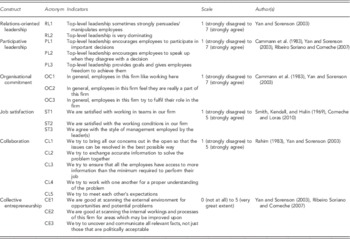
The variables on which our research model is based are latent, because they are rather difficult to observe and capture directly. For this reason, we decided to establish a set of items or indicators as indirect measures of these latent variables. The questionnaire included 19 items building up six constructs that aim to capture the latent variables of the research model. Table 1 illustrates the constructs (latent variables), indicators (manifest variables) and scales used. As specified, the scales resulted in part from those already tested in previous studies. Note that the two items of relations-oriented leadership style were reversely scored. As increasing the number of points in the scale allows a reduction in skewness (Fornell, Reference Fornell1992), we employed interval scales of five and seven points, respectively.
Set of constructs and indicators

Procedure
Based on the random sample of 415 employees in Portugal, we created a list of all their e-mail addresses. This list served as the basis for sending and later management of the number of participations and respective answers. Participants were asked to rate their leader, namely the director, manager or CEO of the SME for which they work. Uniqueness of respondents was guaranteed by personalised links to the questionnaire, that is, only those who received an e-mail with the respective access link to the questionnaire were able to answer. In this way, the answer control code created by the system is unique, which implies that each respondent could only answer the questionnaire once. The questionnaire was administered by e-mail in October 2009. After 1 week, we again mailed the questionnaire to all nonrespondents. A total of 204 usable completed questionnaires were returned (13 were returned as undeliverable), yielding a response rate of 49%.
For data analysis, we used partial least squares (PLS) path modelling (Wold, Reference Wold1966, Reference Wold1985) with the bootstrap resampling procedure, which is especially suited to exploratory studies where data is not normally distributed and sample size is relatively small. Our PLS path model estimates potential relationships between the following latent variables: leadership styles (relations-oriented and participative) as the exogenous (i.e., independent) variables, and CE as the endogenous (i.e., dependent) variable. The moderator variables in our model, which may alter the strength of a relationship between exogenous and endogenous variables (Baron & Kenney, Reference Baron and Kenny1986), are employees’ commitment, collaboration and job satisfaction. PLS aims at maximising the amount of explained variance of the endogenous latent variable by estimating partial model relationships in an iterative sequence of ordinary least squares regressions (Chin, Reference Chin1998; Hair, Ringle, & Sarstedt Reference Hair, Ringle and Sarstedt2011).
In order to ensure the measures used are valid and that they adequately reflect the underlying constructs, we followed a two-stage analytical procedure (Anderson & Gerbing, Reference Anderson and Gerbing1988; Hair, Anderson, Tatham, & Black, Reference Hair, Anderson, Tatham and Black1998). The strength of the measurement was assessed by looking at the individual constructs’ reliability and internal consistency (composite reliability, Cronbach’s α, average variance extracted and significance of loadings with bootstrap procedure) as well as by evaluating discriminant validity (Hulland, Reference Hulland1999).
Results
Demographic characterisation
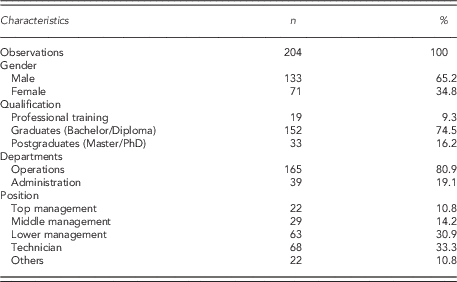
From the completed questionnaires, it was possible to obtain a demographic and professional characterisation of the sample, shown in Table 2. Employees present an average age of 34.5 years. In terms of specialisation, 62.3% of employees are educated in computing science, which is not surprising as the branch is IT systems. As for employees’ length of service in the IT sector, we found an average of 7.5 years. The SMEs in our sample possess different hierarchical levels, so that respondents ranged from technician, lower, middle to top management.
Sample composition

Model evaluation
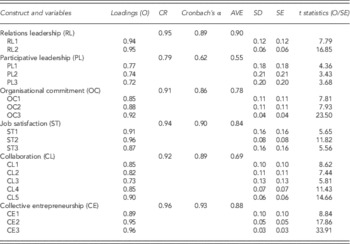
The internal consistency of the constructs can be evaluated using the composite reliability index (Fornell & Larcker, Reference Fornell and Larcker1981). The composite reliability shows that all values were close to, or above 0.70, which stands for good reliability of the constructs used (Carmines & Zeller, Reference Carmines and Zeller1979). Again to confirm the internal consistency of the constructs, examination of the Cronbach’s α reveals values exceeding the minimum threshold of 0.70 (Nunnally, Reference Nunnaly1978; Hair et al., Reference Hair, Anderson, Tatham and Black1998), with the exception of participative leadership. However, according to Churchill (Reference Churchill1979), for the type of exploratory study undertaken here, Cronbach’s α values of 0.60 or higher are interpreted as acceptable.
Average variance extracted assesses the amount of variance a construct captures from its indicators relative to the amount due to measurement error (Fornell & Larcker, Reference Fornell and Larcker1981). The average variance extracted scores for the six constructs are above the generally recognised cut-off value of 0.50, meaning that 50% or more variance of the indicators is accounted for, which demonstrates convergent validity. Therefore, our model has an acceptable fit. The model evaluation parameters are presented in Table 3.
Model evaluation

Note. Based on a bootstrap procedure with 500 subsamples, all t-tests were significant at p<0.001.
AVE=average variance extracted; CR=composite reliability.
Convergent validity was similarly examined with the significance of loadings to each variable, also shown in Table 3. The significance of loadings was checked with a bootstrap procedure (500 subsamples) to obtain t-statistic values. All items are significant at 99% level (based on t(499), two-tailed test) with high loadings (all above 0.70 and most above 0.90), providing additional evidence of convergent validity (Barclay, Thompson, & Higgins, Reference Barclay, Thompson and Higgins1995). In fact, using the rule of thumb of accepting items with loadings of 0.70 or more, all indicators reach the level of acceptable reliability (Barclay, Thompson, & Higgins, Reference Barclay, Thompson and Higgins1995; Chin, Reference Chin1998). Thus, our model possesses a satisfactory degree of convergent and discriminant validity (Hair et al., Reference Hair, Anderson, Tatham and Black1998).
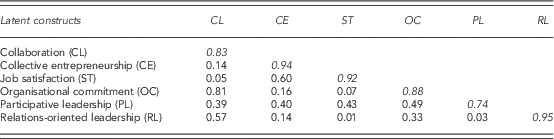
The next stage is discriminant validity evaluation. Discriminant validity indicates the extent to which a given construct is different from all other constructs. One criterion for adequate discriminant validity is showing that the construct shares more variance with its measures than it does with other constructs in the model (Barclay, Thompson, & Higgins, Reference Barclay, Thompson and Higgins1995). This was assessed comparing the square roots of the average variance extracted scores, that is, the diagonal elements of Table 4, which are all higher than the correlations among the constructs, demonstrating discriminant validity (Fornell & Larcker, Reference Fornell and Larcker1981; Fornell, Reference Fornell1987). Furthermore, all our constructs were more strongly correlated with their own measures than with any other construct, providing additional support for discriminant validity (Chin, Reference Chin1998).
Discriminant validity coefficients and correlations between latent constructs

Note. Diagonal elements (in italics) are square roots of the average variance extracted.
Analyses
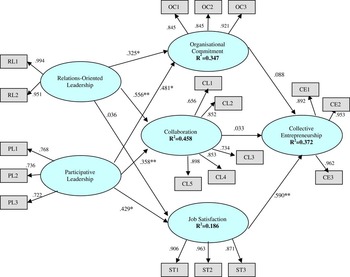
After assuring validity of the research model, we can look at the hypothesised relationships between latent variables. As the primary objective of PLS is prediction, the aptness of a theoretical model is established by the strength of each structural path (the hypotheses) and the combined predictiveness (R 2) of its exogenous latent variables (Chin, Reference Chin1998). Figure 1 shows the nomological network, in which the latent variables are coded as ellipses and the manifest variables as boxes. It includes overall explanatory power (R 2) and path coefficients for relationships between the latent variables. Our model explains 37.2% of the variance in CE with some path coefficients being significant, providing strong support for the research model.
Outcomes of the partial least squares (PLS) model. *p<0.05; **p<0.001

In PLS, the hypotheses are tested by examining path coefficients and their significance levels. Following Chin (Reference Chin1998), bootstrapping (with 500 resamples) was performed to obtain estimates of t-statistic values to examine the statistical significance of the path coefficients.
As for the outcomes of hypotheses testing the potential moderator variables of CE, a significant relationship was found between relations-oriented leadership style and employees’ organisational commitment (β=0.325, t=2.17, p<0.05). Thus, Hypothesis 1a cannot be rejected. Relations-oriented leadership style was also positively and significantly related to collaboration (β=0.556, t=4.01, p<0.001), so there was also support for our Hypothesis 1b. However, a nonsignificant relationship was detected between relations-oriented leadership style and job satisfaction (β=0.036, t=0.27). Thus, Hypothesis 1c must be rejected.
Regarding participative leadership style and the three potential moderators, we revealed that our data support the respective Hypotheses (2a, 2b and 2c). Participative leadership style was positively and significantly linked to employees’ organisational commitment (β=0.481, t=2.61, p<0.001), collaboration (β=0.358, t=2.20, p<0.05) and job satisfaction (β=0.429, t=2.10, p<0.05).
Our Hypotheses 3–5 aimed to explore the role of these factors as moderator variables between leadership styles and more effective CE. Concerning Hypothesis 3, we found that employees’ organisational commitment was not significantly related to more effective CE (β=0.088, t=0.37). Nor was Hypothesis 4 supported, that is, collaboration was not significantly related to more effective CE (β=0.033, t=0.14). However, our Hypothesis 5 cannot be rejected, as job satisfaction was found to be positively and significantly related to more effective CE (β=0.590, t=3.29, p<0.001).
Discussion
The objective of the present paper was to investigate how employees’ perception of leadership styles is linked with more effective CE. In this vein, our intention was to investigate the role of moderator variables. We therefore built and tested a research model which contained two current leadership styles and three attitudinal and behavioural factors as potential moderators of more effective CE. Overall, the proposed model seems to be able to explain the occurrence of CE. We found support for six out of the nine hypotheses we developed.
We found that leadership does seem to play a fundamental role in fostering CE. However, the results partially contradict the findings of Yan and Sorenson (Reference Yan and Sorenson2003), who found both leadership styles to be relevant. In light of our results and contrary to Ribeiro Soriano and Comeche (Reference Ribeiro Soriano and Comeche2007), we conclude that participative management behaviour appears to be more important for effective CE. In our model, participative leadership style had the highest joint and indirect effect on the organisation’s CE, with job satisfaction as an important moderator for more effective CE. This can be explained by the inherent behaviour of participative leaders, characterised by the active involvement of followers through shared decision-making and empowerment (Vroom & Jago, Reference Vroom and Jago1988; Bass & Bass, Reference Bass and Bass2008). This leads to higher levels of creativity and the feeling of appraisal, resulting in higher job satisfaction.
As for our research question, that is, what moderator variables are influential in promoting CE, we first tested the dependencies between leadership styles and the potential attitudinal and behavioural moderators. As expected, we found empirical evidence for all supposed relationships between relations-oriented and participative leadership styles on the one hand, and organisational commitment and collaboration on the other. This reconciles previous unsettled findings by Yan and Sorenson (Reference Yan and Sorenson2003), who found relations-oriented leadership and organisational commitment not significantly linked. In our research model, only job satisfaction as a new moderator variable we included was not linked with relations-oriented leadership.
Nevertheless, this insight is the most promising outcome of our study, because the degree of job satisfaction was detected to be essential in directly encouraging CE in the firm group studied. It corroborates the findings of Comeche and Loras (Reference Comeche and Loras2010), who also revealed job satisfaction as an extremely important factor, despite their research not referring to leadership styles. Regarding this moderator variable, our research clearly differentiates between the two leadership behaviours studied here, as relations-oriented management was not related to job satisfaction. Thus, when employees are not inclined to be entrepreneurial, enhancing the level of job satisfaction through adopting a participative leadership style is recommendable to create favourable conditions for more effective CE.
Regarding organisational commitment as another potential moderator, its impact on CE is rather weak in our model. This, on the one hand, confirms the previous empirical evidence found by Yan and Sorenson (Reference Yan and Sorenson2003). On the other hand, especially affective commitment strongly influences employees’ involvement, role fulfilment and work enthusiasm (Allen & Meyer, Reference Allen and Meyer1990; Meyer & Allen, Reference Meyer and Allen1991). These attributes are closely linked with job satisfaction as a main driver of more effective CE. In fact, Comeche and Loras (Reference Comeche and Loras2010) revealed commitment to the team as a predictor of CE. For the employees studied in our research, one explanation for this lack of relationship between organisational commitment and CE probably lies in the nature of the sector we analysed: the IT sector tends to have project-based employment, so that commitment to a particular software or hardware development and implementation project is more likely than commitment to the organisation itself. Concerning collaboration, this organisational behaviour was not significantly linked to more effective CE in our research context. This stands in contrast to the previous findings by Yan and Sorenson (Reference Yan and Sorenson2003), who found a positive significant relationship between the two constructs.
In the light of these outcomes, our study contributes to advancing knowledge in the fields of organisational psychology and entrepreneurship. In addition, this combination and extension of previous research allows us to reconcile the sometimes contradictory findings so far concerning leadership and CE. In practical terms, the results shed more light on the issue of how leaders can influence and enhance employees’ CE. In particular, enhancing the degree of job satisfaction through adopting a participative leadership style is recommendable to create favourable conditions for CE. Thus, leaders who respect and share their followers’ opinion, give them responsibility for their own work and provide them with freedom to demonstrate their abilities and talents are likely to increase job involvement, engagement and, consequently, job satisfaction. This is especially encouraged by participative leadership, which is reflected by shared decision-making with subordinates and by even delegating decision-making to them (Ribeiro Soriano & Comeche, Reference Ribeiro Soriano and Comeche2007). Such an atmosphere stimulates the joint creation and development of innovative ideas within organisations, a key fulcrum of CE.
Finally, it should be noted that our study has some limitations that open up possibilities for future research. The findings are taken from the Portuguese context and a particular though important industry, with its idiosyncratic structure, business practices and managerial behaviour. There is certain evidence that for instance organisational commitment and job satisfaction are highly determined by national cultural values and norms (Kirkman & Shapiro, Reference Kirkman and Shapiro2001; Huang & Van de Vliert, Reference Huang and Van de Vliert2004), so that research into other geographical areas focussing on intercultural aspects in CE is recommended.
Moreover, we derived our conclusions from analysis of a specific though not homogenous firm group, in which organisational and group dynamics may differ depending on the particular business activity, such as software or hardware development, implementation and support. In addition, there might be other variables such as function, hierarchical level, age and gender of the respondents as well as firm size and industry influencing the view of leadership and the occurrence of CE. Therefore, generalisation should be made cautiously and we suggest further research to contrast our results with those from other organisations.
We only focussed on two leadership styles, namely relations-oriented and participative, which we were convinced supported more effective CE. However, inclusion of other styles such as paternalistic or authoritative would enrich understanding of the leader’s influence on CE. Lastly, our outcomes are probably affected by common method bias. This could be the socially desirable response bias (Arnold & Feldman, Reference Arnold and Feldman1981) on self-reporting surveys, and the responses might also be influenced by differences in demographic profiles of the respondents. Likewise, the positive relationship between job satisfaction and more effective CE could be a multidirectional phenomenon in such a way that a high level of CE also makes people more satisfied with their job. Consequently, the limitation is that we cannot draw any causal conclusions from our data. Nonetheless, we hope this study sparks off further interest in exploring the important issue of CE.
Acknowledgements
The authors are pleased to acknowledge financial support from Fundação para a Ciência e a Tecnologia (grant UID/ECO/04007/2013) and FEDER/COMPETE (POCI-01-0145-FEDER-007659).