





Introduction
Psychotic experiences (PEs), such as hallucinations, paranoia, and delusional thinking, occur across a continuum of severity, ranging from mild and transient phenomena in the general population (Kelleher & Cannon, Reference Kelleher and Cannon2011; Staines et al., Reference Staines, Healy, Murphy, Byrne, Murphy, Kelleher, Cotter and Cannon2023), to subclinical experiences in individuals receiving mental health care (Clauss et al., Reference Clauss, Foo, Leonard, Dokholyan, Cather and Holt2025), to severe and persistent symptoms in individuals with chronic psychotic disorder. This dimensional conceptualization considers psychosis as a spectrum of experiences (Johns & Van Os, Reference Johns and Van Os2001) with psychotic disorders representing the most severe manifestations (Hanssen et al., Reference Hanssen, Krabbendam, Vollema, Delespaul and Van Os2006; McGorry et al., Reference McGorry, Keshavan, Goldstone, Amminger, Allott, Berk, Lavoie, Pantelis, Yung, Wood and Hickie2014; McGorry & van Os, Reference McGorry and van Os2013). In line with this approach, the clinical staging model of psychosis (McGorry et al., Reference McGorry, Hickie, Yung, Pantelis and Jackson2006) offers a structured framework that conceptualizes the progression of psychotic disorders through subsequent stages, ranging from an asymptomatic at-risk state (stage 0) to chronic, persistent illness (stage 4), reflecting increasing illness severity over time. This framework has shifted research and clinical focus toward early psychosis stages, with the goal of understanding the factors that drive the progression toward more severe stages and tailoring targeted early interventions. Early treatment has been shown to reduce long-term impairment (Brooke, Lin, Ntoumanis, & Gucciardi, Reference Brooke, Lin, Ntoumanis and Gucciardi2019; Killackey & Yung, Reference Killackey and Yung2007) and mental health care costs (Firth et al., Reference Firth, Carney, Jerome, Elliott, French and Yung2016). Although the model has significantly advanced research, gaining a better understanding of the processes underlying psychosis development and how these processes might differ across the early stages may provide crucial insights into vulnerability and prevention.
Most previous studies have focused on factors that increase the risk of illness progression, but more recently, attention has shifted toward factors that may protect against such unfavorable developments. One potential protective factor is positive affect (PA), defined as the subjective experience of pleasant emotional states such as enthusiasm, alertness, and contentment (Clark, Watson, & Leeka, Reference Clark, Watson and Leeka1989; Watson, Clark, & Tellegen, Reference Watson, Clark and Tellegen1988). In line with recent work adopting a multidimensional understanding of affect (Van der Tuin et al., Reference van der Tuin, Staines, Morosan, Raposo de Almeida, van den Berg, Booij, Oldehinkel and Wigman2024), this study focuses on the positive dimension of core affect, as conceptualized within the circumplex model (Yik, Russell, & Steiger, Reference Yik, Russell and Steiger2011). PA has been theorized to play a protective role in stress-related processes; for example, affective-buffering theories posit that individuals who experience higher levels of PA may show reduced sensitivity to stress and a lower likelihood of stress-related symptoms (Fredrickson, Reference Fredrickson2001). This perspective suggests that PA may not only reflect current well-being but also contribute to resilience in the face of daily challenges. Recent work suggests that PEs can likewise be conceptualized as fluctuating states that emerge from dynamic affective systems rather than as static traits (Hamaker & Wichers, Reference Hamaker and Wichers2017; Li, Schiffman, & Martin, Reference Li, Schiffman and Martin2022). From this perspective, increasing affective instability may reflect growing system vulnerability and, in some cases, may function as an early warning signal of an impending transition to more severe symptom states (Wichers, Smit, & Snippe, Reference Wichers, Smit and Snippe2020). In psychosis research, this idea remains largely theoretical, but recent dynamic-systems accounts have proposed that early warning signals in self-disturbance and related processes may anticipate the onset or recurrence of psychotic episodes (Feyaerts, Brar, Sass, & Nelson, Reference Feyaerts, Brar, Sass and Nelson2026). Individuals with psychotic disorders also show increased affective instability in daily life, characterized by frequent and pronounced emotional fluctuations (Nowak, Krkovic, Kammerer, & Lincoln, Reference Nowak, Krkovic, Kammerer and Lincoln2022), and greater affective variability has been linked to positive psychotic symptoms across contexts (Li et al., Reference Li, Schiffman and Martin2022). Both PA and PEs are dynamic constructs that fluctuate within individuals over short time periods; therefore, they can be examined using intensive longitudinal data (ILD), where participants repeatedly report their affective states and symptoms across multiple time points. This approach captures within-person variability and temporal relationships between variables, providing a more fine-grained understanding of affective processes. Using the same dataset as the current study, Van der Tuin et al. (Reference van der Tuin, Staines, Morosan, Raposo de Almeida, van den Berg, Booij, Oldehinkel and Wigman2024) previously explored the association between PA and PEs in individuals in early risk stages of psychosis using ILD over a period of 90 days. The findings showed that higher levels of PA were associated with lower levels of PEs, and vice versa. They found this effect only during the same day, but not from one day to the next. Additionally, the results showed significant between-person effects: individuals who experienced higher average levels of PA across the 90 days of the study reported fewer PEs on average. These effects were particularly pronounced within the group presenting more severe psychotic symptoms (ultra-high-risk [UHR] group), suggesting that PA may be especially relevant as a resilience factor in more advanced risk stages of psychosis.
Several studies (Sewart et al., Reference Sewart, Zbozinek, Hammen, Zinbarg, Mineka and Craske2019; Teismann, Brailovskaia, & Margraf, Reference Teismann, Brailovskaia and Margraf2019; Trompetter, de Kleine, & Bohlmeijer, Reference Trompetter, de Kleine and Bohlmeijer2017; van der Tuin et al., Reference van der Tuin, Staines, Morosan, Raposo de Almeida, van den Berg, Booij, Oldehinkel and Wigman2024) have emphasized the protective role of PA in the development of mental health problems, yet the underlying mechanisms remain insufficiently understood in the context of PEs. PA may exert a direct influence on PEs, as reported by van der Tuin et al. (Reference van der Tuin, Staines, Morosan, Raposo de Almeida, van den Berg, Booij, Oldehinkel and Wigman2024), or act as a possible moderator that attenuates the adverse impact of stress on the occurrence or intensity of PEs. This is a relevant pathway to explore, given extensive evidence of the impact of stress on PEs and mental health in general.
The stress-vulnerability model (Zubin & Spring, Reference Zubin and Spring1977) posits that psychiatric disorders arise from the interaction between individual vulnerability and exposure to stress. While the original model focused on major life events, recent research suggests that the subjective experience of daily stress can also influence PEs (Vaessen et al., Reference Vaessen, Reininghaus, van Aubel, Beijer-Klippel, Steinhart, Myin-Germeys and Waltz2023). For example, studies employing ILD (Myin-Germeys et al., Reference Myin-Germeys, van Os, Schwartz, Stone and Delespaul2001; Myin-Germeys, Delespaul, & van Os, Reference Myin-Germeys, Delespaul and van Os2005) have demonstrated that higher levels of stress are associated with increases in PEs (Muddle, Jones, Taylor, & Jacobsen, Reference Muddle, Jones, Taylor and Jacobsen2022; Vaessen et al., Reference Vaessen, Viechtbauer, van der Steen, Gayer-Anderson, Kempton, Valmaggia, McGuire, Murray, Garety, Wykes, Morgan, Lataster, Lataster, Collip, Hernaus, Kasanova, Delespaul, Oorschot and Claes2019; van der Steen et al., Reference van der Steen, Gimpel-Drees, Lataster, Viechtbauer, Simons, Lardinois, Michel, Janssen, Bechdolf, Wagner and Myin-Germeys2017; Xenaki, Dimitrakopoulos, Selakovic, & Stefanis, Reference Xenaki, Dimitrakopoulos, Selakovic and Stefanis2024). The experience of stress or exposure to (cumulative) risk factors has been suggested to interact with subclinical PEs, increasing the likelihood of symptom persistence and, ultimately, need for care (Cougnard et al., Reference Cougnard, Marcelis, Myin-Germeys, De Graaf, Vollebergh, Krabbendam, Lieb, Wittchen, Henquet and Spauwen2007). Within this framework, affect plays a central role: fluctuations in positive and negative affect may mediate or buffer the impact of daily stress as it is subjectively experienced. Importantly, this model also implies that the consequences of stress are not uniform across individuals; rather, the emotional response to stress may vary depending on protective psychological factors, such as PA.
Against this background, PA has been proposed as a potential buffer that may attenuate the impact of experienced daily stress on PEs by reducing stress sensitivity and supporting adaptive emotional regulation (Fredrickson, Reference Fredrickson2001). In other words, elevated PA appears to buffer or mitigate any stress-related effects (Van Steenbergen, De Bruijn, Van Duijvenvoorde, & Van Harmelen, Reference Van Steenbergen, De Bruijn, Van Duijvenvoorde and Van Harmelen2021). Therefore, building on the study of van der Tuin et al. (Reference van der Tuin, Staines, Morosan, Raposo de Almeida, van den Berg, Booij, Oldehinkel and Wigman2024), who examined a direct effect of PA on PEs, the present study investigates an indirect mechanism, where PA is hypothesized to have a moderating effect on the association between experienced stress and PEs (Klippel et al., Reference Klippel, Myin-Germeys, Chavez-Baldini, Preacher, Kempton, Valmaggia, Calem, So, Beards, Hubbard, Gayer-Anderson, Onyejiaka, Wichers, McGuire, Murray, Garety, van Os, Wykes, Morgan and Reininghaus2017, Reference Klippel, Viechtbauer, Reininghaus, Wigman, van Borkulo, MERGE, Myin-Germeys and Wichers2018). The present study focuses on positive symptoms as they manifest in daily life, conceptualizing PEs as momentary experiences of suspiciousness, perceived social threat, unusual thought content, derealization, and altered sense of control.
In addition, we aim to explore whether this buffering effect differs across early risk stages of psychosis (Booij et al., Reference Booij, Wichers, De Jonge, Sytema, Van Os, Wunderink and Wigman2018; Wigman et al., Reference Wigman, van der Tuin, van den Berg, Muller and Booij2022). A better understanding of how mechanisms underlying progression of illness severity can help to fine-tune and improve current interventions.
First, we examined the contemporaneous associations (i.e. on the same day, denoted t) among experienced stress, Pes, and PA. More precisely, we tested whether: (1) experienced stress t is associated with PEs t; (2) this association differs between early risk stages; (3) the association between experienced stress t and PEs t is moderated by PA t; and (4) the potential moderating effect of PA t differs across early risk stages.
Second, we focused on temporal (i.e. from the previous day to the next day, denoted t − 1) associations. We tested whether: (5) experienced stress t−1 is associated with PEs t; (6) this association differs between early risk stages; (7) the association between experienced stress t−1 and PEs t is moderated by PA t−1; and (8) any potential moderating effect of PA t−1 differs across early risk stages.
Methods
Sample
The Mapping Individual Routes of Risk and Resilience (MIRORR) study (Booij et al., Reference Booij, Wichers, De Jonge, Sytema, Van Os, Wunderink and Wigman2018; Wigman et al., Reference Wigman, van der Tuin, van den Berg, Muller and Booij2022) was designed to assess the development of psychopathology in young individuals at different risk stages for psychosis. MIRORR consists of four subgroups that reflect successive stages along the psychosis risk continuum, characterized by increasing severity of PEs and ranging from an asymptomatic at-risk state (stage 0) to a UHR state for psychosis (stage 1b) as defined by the clinical staging model (McGorry et al., Reference McGorry, Hickie, Yung, Pantelis and Jackson2006). Individuals in the first subgroup were recruited in the general population from a sample of 100 individuals who completed the Community Assessment of Psychotic Experiences questionnaire (CAPE; Konings et al., Reference Konings, Bak, Hanssen, Van Os and Krabbendam2006). Individuals scoring in the top 25% of the positive CAPE subscale were assigned to subgroup 1 (n = 25). Subgroups 2 (n = 27), 3 (n = 24) and 4 (n = 20) were recruited from mental health services and classified based the Prodromal Questionnaire-16 (PQ-16; Ising et al., Reference Ising, Veling, Loewy, Rietveld, Rietdijk, Dragt, Klaassen, Nieman, Wunderink, Linszen and van der Gaag2012) and the Comprehensive Assessment of At-Risk Mental States (CAARMS; Yung et al., Reference Yung, Yuen, McGorry, Phillips, Kelly, Dell’Olio, Francey, Cosgrave, Killackey, Stanford, Godfrey and Buckby2005): Subgroup 2 corresponded to stage 1a with low symptoms, subgroup 3 to stage 1a with moderate symptoms, and subgroup 4 to stage 1b (UHR). The selection procedure is shown in the Supplementary Materials (Supplementary Figure S1). Inclusion criteria were as follows: age between 18 and 35 years, Dutch fluency in reading and speaking, ability to comply with the research procedures, and providing written informed consent. Exclusion criteria were as follows: having a history of/or currently experiencing a psychotic episode according to the DSM-IV criteria, substantial hearing or vision impairment, and pregnancy. Participants were not allowed to miss more than 22 diary entries, and/or no more than 5 consecutive entries. Participation in the study was discontinued if either criterion was exceeded. Participants were also called biweekly to discuss their progress and maintain engagement. Financial compensation increased according to the number of diary entries completed, thereby incentivizing participants to complete as many entries as possible. A flowchart of the recruitment and inclusion process is presented in the Supplementary Materials (Supplementary Figure S2).
Study design
MIRORR combines a 90-day daily diary study with yearly evaluations (questionnaires and interviews) at baseline, 1-, 2-year, and 3-year follow-up (Booij et al., Reference Booij, Wichers, De Jonge, Sytema, Van Os, Wunderink and Wigman2018). The current study used the questionnaire data and the daily diary data collected at baseline. For the diary study, participants received a text message on their smartphone every evening, with a 24-hour interval, which included a secure link to a questionnaire assessing thoughts, emotions, symptoms, and behaviors of the past day, including PEs, experienced stress, and PA. The data collection began in 2015 and concluded in 2019. Participants completed an average of 84 daily diary entries (range: 69–90), resulting in a total of 7,977 entries and an overall completion rate of 92.33%.
The local medical ethical committee of the University Medical Centre Groningen has approved the MIRORR study (ABR no. NL52974.042.15), and all participants have provided written informed consent.
Instruments
Baseline questionnaires
Psychotic experiences.
Psychotic experiences were assessed with the Community Assessment of Psychic Experiences (CAPE; Konings et al., Reference Konings, Bak, Hanssen, Van Os and Krabbendam2006), a self-report questionnaire that consists of three subscales (i.e. negative, positive, and depressive subscales). The CAPE total score (42 items) and the positive subscale score (20 items) were used as measures of severity of overall psychotic symptomatology and positive PEs, respectively. The CAPE is a reliable and valid instrument to assess frequency of self-reported PEs in the general population (Mark & Toulopoulou, Reference Mark and Toulopoulou2015).
Psychological distress.
General psychological distress was assessed with the Symptom Checklist-90-Revised (SCL-90-R; Derogatis and Unger [Reference Derogatis and Unger2010]). The SCL-90 is a self-reported, 90-item questionnaire used to measure several dimensions of psychopathology (e.g. anxiety and depression). The sum score (sum score range: 90–450) was used as an index of general psychological distress (Kuranova et al., Reference Kuranova, Booij, Oldehinkel, Wichers, Jeronimus and Wigman2023). Scores ≥174 are considered indicative of psychopathology or categorized as (very) high global psychological distress (Arrindell & Akkerman, Reference Arrindell and Akkerman2004).
Education.
The level of education was evaluated based on 10 distinct categories, consolidated into 3 groups as specified by the Standard Education Division 2016 of the Netherlands into: low (primary education/lower secondary education), middle (higher secondary education), and high (university/college education) (Central Bureau for Statistics, 2016).
Diary measurements
Psychotic experiences (PEs).
Similar to previous work (van der Tuin et al., Reference van der Tuin, Groen, Castro-Alvarez, Oldehinkel, Booij and Wigman2021), we used the average score of five items, scored on a 100-point VAS-scale (0 = ‘not at all’, 100 = ‘very much’), to reflect daily measures of PEs. These items were: ‘I felt suspicious today’, ‘Today I had a feeling that others did not like me’, ‘I felt that others could read my thoughts today’, ‘I felt unreal today’ and ‘I felt that others could control me today’. These items primarily targeted paranoid ideation and unusual experiences. Although we also evaluated hallucinations, we excluded them from the present analyses because they were infrequently endorsed, resulting in highly skewed data that contributed minimally to the findings. Previous studies assessed slightly different yet comparable daily constructs of PEs (e.g. Myin-Germeys et al., Reference Myin-Germeys, Marcelis, Krabbendam, Delespaul and van Os2005; Oorschot, Kwapil, Delespaul, & Myin-Germeys, Reference Oorschot, Kwapil, Delespaul and Myin-Germeys2009). To assess whether the PE items reflected a single underlying factor, we calculated both within- and between-level omega coefficients, taking the multilevel structure of the data into account (Geldhof, Preacher, & Zyphur, Reference Geldhof, Preacher and Zyphur2014). This measure of composite reliability indicated that the within-level omega for PEs was 0.60, and the between-level omega was 0.90 (van der Tuin et al., Reference van der Tuin, Booij, Muller, van den Berg, Oldehinkel and Wigman2023).
Positive affect (PA).
Similar to other work on this sample (van der Tuin et al., Reference van der Tuin, Staines, Morosan, Raposo de Almeida, van den Berg, Booij, Oldehinkel and Wigman2024), we used the average score of six items, scored on a 100-point VAS-scale (0 = ‘not at all’, 100 = ‘very much’), to reflect daily measures of PA. These items were: ‘I felt relaxed today’, ‘I felt calm today’, ‘I felt satisfied today’, ‘I felt energetic today’, ‘I felt enthusiastic today’, and ‘I felt cheerful today’. The items were selected on the basis of the 12-point circumplex model of affect (Yik et al., Reference Yik, Russell and Steiger2011). The composite PA score for each day was computed as the average of six items. The omega reliability scores for PA were calculated using the same multilevel approach as for PEs. The within-level omega for PA was 0.89, and the between-level omega was 0.98 (van der Tuin et al., Reference van der Tuin, Staines, Morosan, Raposo de Almeida, van den Berg, Booij, Oldehinkel and Wigman2024).
Experienced daily stress.
The experience of stress was conceptualized as the daily subjective experience of emotional strain and pressure, using one item: ‘How stressed were you today?’, scored on a 100-point VAS-scale (0 = ‘not at all’, 100 = ‘very much’). Stress was measured using a single-item measure, which is common in ILD studies where it is important to be mindful of participant burden. Prior work suggests that single-item measures can show good predictive validity (Song, Howe, Oltmanns, & Fisher, Reference Song, Howe, Oltmanns and Fisher2023) and previous studies assessed slightly different, yet comparable, daily constructs of stress using one or more items (Vaessen, Reininghaus, & Myin-Germeys, Reference Vaessen, Reininghaus, Myin-Germeys, Fauquet-Alekhine and Erskine2023).
Statistical analysis
We calculated descriptive statistics for age, gender, education level, and psychopathology for each subgroup, as well as for the total sample. Subgroups were compared on sociodemographic characteristics, overall psychotic experiences (CAPE total score), positive psychotic experiences (CAPE positive subscale), and general psychological distress (SCL-90-R) using version 4.5.0.
For each participant, the person-level mean or median score was calculated over the 90 diary days for PA, Pes, and experienced stress. The choice between mean and median was based on the observed distributions. As PA was normally distributed, person-level means were used, whereas the skewed distribution of PEs and the downward-trending distribution of experienced stress warranted the use of person-level medians. These individual-level values were subsequently compared across subgroups.
To assess group differences in PA, a one-way analysis of variance (ANOVA) was conducted. For PEs and experienced stress, which violated normality assumptions, the Kruskal–Wallis test was employed. When the Kruskal–Wallis test indicated significant differences, post-hoc pairwise Wilcoxon rank-sum tests were performed. The Benjamini–Hochberg correction was applied to adjust for multiple comparisons and to control the false discovery rate.
Finally, Spearman’s rank correlation coefficients were calculated between the person-level mean and median for PA, Pes, and experienced stress, for the total sample and within each subgroup.
Multilevel analyses
To examine the contemporaneous (same-day) and temporal (from one day to another) associations among the study variables, multilevel modeling was employed. Multilevel modeling is needed, as it accounts for the non-independence of repeated daily measurements nested within individuals (Snijders & Bosker, Reference Snijders and Bosker2012). After comparing different error covariance structures (AR[1], diagonal, compound symmetry, and identity), the AR(1) structure was selected given its lowest AIC/BIC values. Contemporaneous and temporal effects were tested in four separate models. For the lagged analyses, a lag period of one day (lag1) was chosen. All time-varying predictors (i.e. daily PEs, PA and experienced stress) were included as person mean-centered variables, calculated by subtracting each participant’s person mean score (averaged over 90 days per individual) from their raw daily scores. This approach isolates within-person fluctuations from between-person differences. The subgroup variable, representing the psychosis risk groups, was included as a set of dummy-coded indicators. To test interaction effects, comparisons among the subgroups were conducted by changing the reference category of the subgroup variable. Time was entered as a covariate in all models to control for linear temporal trends. In models assessing lagged effects, the previous-day score of the dependent variable (PE t−1) was added as a covariate to account for potential autoregressive effects. All models incorporated random slopes for predictors and covariates to allow for individual variability in these associations.
To examine the contemporaneous association between experienced stress and PEs (research question [RQ]1), a linear mixed-effects model was used to regress PEs at t on experienced stress at t. To test if the contemporaneous association between experienced stress and PEs differs across the subgroups (=between-person moderation; RQ2), the abovementioned model was extended to include a double interaction between experienced stress at t and subgroups as a predictor for PEs at t. To investigate if the contemporaneous association between experienced stress and PEs is buffered by PA (=within-person moderation; RQ3), a linear mixed-effects model was fitted to regress PA at t on the interaction between experienced stress at t and PEs at t. Finally, for RQ4, to assess whether PA moderates the contemporaneous association between experienced stress and PEs, we specified a linear mixed-effects model with PEs at time t regressed on the three-way interaction between experienced stress at t, PA at t, and subgroup.
For RQ5-8, the same sequence of linear mixed-effects models were used to examine temporal (from one day to another) effects. In these models, all predictors were lagged by one day (t − 1) to assess the effects of experienced stress at t − 1, PA at t − 1, on PEs at t.
Power
The power of our within-person analyses is determined by the number of observations per individual. Rosmalen et al. (Reference Rosmalen, Wenting, Roest, de Jonge and Bos2012) indicate that at least 60 measurements per participant are required to reliably detect reciprocal within-person relationships among multiple variables. Regarding cross-level interactions, a simulation analysis of Wardenaar (Reference Wardenaar2021) suggests that comparing subgroups with 25 participants and 60 measurements per individual provides sufficient power (>0.8) to detect medium effect sizes (0.30). Between-person power primarily depends on sample size; around 50 participants are typically needed for reliable estimates (Maas & Hox, Reference Maas and Hox2005). With 96 participants and 90 measurements each, the study has sufficient power to detect within-person effects, cross-level interactions, and between-person differences.
Sensitivity analyses
To examine the robustness of our findings given the skewed and downward-trending distribution of daily experienced stress, two sensitivity analyses were conducted. First, stress was linearly detrended within each person by regressing experienced stress on time (day) and extracting the residuals, thereby removing the individual time trend before person-mean centering. Second, experienced stress scores were rank-normalized using a Blom transformation, approximating a normal distribution within each person. Rank-based inverse normal (Blom) transformation normalizes skewed distributions while preserving the rank order of observations, thereby improving the robustness of parametric analyses to non-normality (Beasley, Erickson, & Allison, Reference Beasley, Erickson and Allison2009; Blom, Reference Blom1958). Both sensitivity analyses were run for all main models, and results are reported in the Supplementary Materials.
Results
The sample consisted of 96 individuals (mean age 24.7 years [SD = 4.2] and N = 73 [76%] female). There were no significant differences between the subgroups in terms of age, gender, and educational level. There were significant subgroup differences in PA (F[3, 92] = 6.75, p < 0.001), PEs (χ 2 = 19.93, p < 0.001), and experienced stress (χ 2 = 18.10, p < 0 .001). Subgroup 1 reported significantly higher PA than subgroups 2, 3, and 4 (p < 0.01); there were no significant differences among subgroups 2, 3, and 4. Subgroup 4 had significantly higher PEs than all other subgroups (p < 0.01). For experienced stress, subgroups 3 and 4 reported higher levels than subgroup 1 (p < 0 .05).
Across the total sample, there was a moderate positive correlation between PEs and experienced stress (rho = 0.53, p < 0.001), but no significant association between PEs and PA (rho = −0.19, p = 0.057). Within subgroups, correlations between PEs and PA ranged from slightly negative to slightly positive (rho = −0.18 to 0.14, all p > 0.38), while the correlation between PEs and experienced stress was positive and stronger in subgroup 2 (rho = 0.64, p < 0.001). An overview of the sample characteristics is presented in Table 1.
Demographic and clinical information per subgroup and for the total sample

Table 1. Long description
The table is divided into two main sections: Cross-sectional measurements and Diary domain.
Header Row: Subgroup 1 (n = 25), Subgroup 2 (n = 27), Subgroup 3 (n = 24), Subgroup 4 (n = 20), Total sample (n = 96), and Difference (Diff.).
Cross-sectional measurements section:
- Age (mean [S D]): Subgroup 1: 23.3 [3.4]; Subgroup 2: 24.8 [3.9]; Subgroup 3: 26.1 [4.1]; Subgroup 4: 24.8 [5.3]; Total: 24.7 [4.2]. Difference: ns.
- Gender (% Female): Subgroup 1: 80.0; Subgroup 2: 74.1; Subgroup 3: 70.8; Subgroup 4: 80.0; Total: 76. Difference: ns.
- Completed education (Low/Middle/High/Other %): Total sample shows 14.6% Low, 54.2% Middle, 29.2% High, and 2.1% Other. All differences are ns.
- C A P E Total score (median [I Q R]): Subgroup 1: 60.0 [13.0]; Subgroup 2: 64.0 [15.0]; Subgroup 3: 74.5 [16.0]; Subgroup 4: 76.0 [22.7]; Total: 68.0 [22.0]. Difference: 4, 3 > 2, 1.
- S C L-90 (median [I Q R]): Subgroup 1: 136.0 [52.0]; Subgroup 2: 170.0 [64.0]; Subgroup 3: 205.5 [69.2]; Subgroup 4: 223.5 [87.5]; Total: 177.0 [77.7]. Difference: 4, 3, 2 > 1 and 4, 3 > 2.
Diary domain section:
- Positive affect (mean [S D]): Subgroup 1: 57.8 [16.9]; Subgroup 2: 44.6 [19.3]; Subgroup 3: 45.1 [20.2]; Subgroup 4: 43.9 [18.3]; Total: 48.1 [13.6]. Difference: 4, 3, 2 < 1.
- Psychotic experiences (median [I Q R]): Subgroup 1: 6.4 [3.7]; Subgroup 2: 6.6 [6.7]; Subgroup 3: 6.98 [11.3]; Subgroup 4: 22.9 [14.9]; Total: 7.8 [9.7]. Difference: 4 > 3, 2, 1.
- Experienced stress (median [I Q R]): Subgroup 1: 19.9 [27.8]; Subgroup 2: 30.9 [35.3]; Subgroup 3: 43.1 [39.8]; Subgroup 4: 47.6 [41.4]; Total: 29.9 [26.5]. Difference: 4 > 3 > 2 > 1.
- Spearman’s rho correlations are provided for P Es - P A, P Es - experienced stress, and P A - experienced stress across all subgroups.
Note: Diff, Difference. * significant at p < 0.05, ** significant at p < 0.01, ns, nonsignificant; SD, standard deviation; IQR, interquartile range. Subgroup 1 = stage 0, subgroup 2 = stage early 1a, subgroup 3 = stage early 1a, subgroup 4 = stage 1b.
Multilevel analyses
Contemporaneous effects (RQ 1–4)
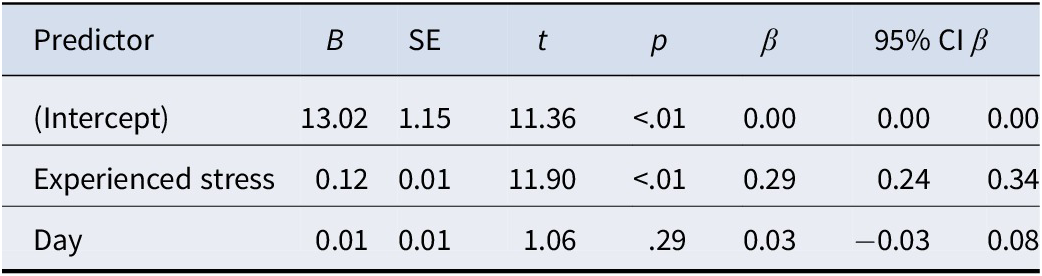
There was a significant contemporaneous effect of experienced stress on PEs (B = 0.12, p < 0.01; Table 2). There was a significant double interaction between experienced stress × subgroup (F[3, 7876] = 9.01, p < 0.01), indicating that the effect of stress on PEs differed across subgroups (Figure 1). Pairwise contrasts showed that this association was stronger in subgroup 4 compared to subgroup 1 (B = 0.13, p < 0.01), subgroup 2 (B = 0.10, p < 0.01), and subgroup 3 (B = 0.08, p < 0.01). Also, the association was stronger in subgroup 3 compared to subgroup 1 (B = 0.05, p = 0.04) (Table 3).
Experienced stress (t) predicting psychotic experiences (t) – RQ 1

Table 2. Long description
The table contains eight columns: Predictor, B, S E, t, p, beta, and a 95% C I for beta consisting of two sub-columns for the lower and upper bounds.
* Row 1 (Intercept): B is 13.02, S E is 1.15, t is 11.36, p is less than .01, beta is 0.00, and the 95% C I is 0.00 to 0.00.
* Row 2 (Experienced stress): B is 0.12, S E is 0.01, t is 11.90, p is less than .01, beta is 0.29, and the 95% C I is 0.24 to 0.34.
* Row 3 (Day): B is 0.01, S E is 0.01, t is 1.06, p is .29, beta is 0.03, and the 95% C I is minus 0.03 to 0.08.
Do same-day associations between experienced stress and psychotic experiences differ among subgroups? – RQ 2.

Figure 1. Long description
The line graph plots Daily Stress on the x-axis with values ranging from minus 20 to 20 against P E s on the y-axis with values ranging from 10 to 30. Four linear data series represent different subgroups, all showing a positive linear increase where higher stress correlates with higher P E s.
* Subgroup 1 (red line) is the lowest, starting at approximately 6 on the y-axis and rising to 11.
* Subgroup 2 (blue line) starts at approximately 8 and rises to 14.
* Subgroup 3 (green line) starts at approximately 11 and rises to 19.
* Subgroup 4 (light orange line) is the highest and has the steepest slope, starting at approximately 16 and rising to 29.
The vertical distance between the lines increases as Daily Stress increases, particularly for Subgroup 4 compared to the others.
Do same-day associations between experienced stress and psychotic experiences differ among subgroups? – RQ 2

Table 3. Long description
The table presents a double interaction analysis of experienced stress and subgroup on P E s, with F (3, 7876) = 9.01 and p < 0.01. It is divided into four sections based on the reference group.
* Section 1: Subgroup 1 as reference group. Significant predictors include Experienced stress (B = 0.07, p < 0.01), Subgroup 3 (B = 6.52, p = 0.03), Subgroup 4 (B = 13.75, p < 0.01), and the interaction Experienced stress times Subgroup 4 (B = 0.13, p < 0.01).
* Section 2: Subgroup 2 as reference group. Significant predictors include Experienced stress (B = 0.10, p < 0.01), Subgroup 4 (B = 11.34, p < 0.01), and the interaction Experienced stress times Subgroup 4 (B = 0.10, p < 0.01).
* Section 3: Subgroup 3 as reference group. Significant predictors include Experienced stress (B = 0.13, p < 0.01), Subgroup 1 (B = -6.52, p = 0.03), Subgroup 4 (B = 7.24, p = 0.02), and the interaction Experienced stress times Subgroup 4 (B = 0.08, p < 0.01).
* Section 4: Subgroup 4 as reference group. Significant predictors include Experienced stress (B = 0.21, p < 0.01), Subgroup 1 (B = -13.75, p < 0.01), Subgroup 2 (B = -11.34, p < 0.01), and Subgroup 3 (B = -7.24, p = 0.02). All interaction terms with Subgroup 4 as reference are significant (p < 0.01).
Columns for all sections include Predictor, B, S E, t, p, beta, and 95% C I beta.
Additionally, the results show a significant double interaction effect of experienced stress × PA on PEs, showing that PA moderated the effect of experienced stress on PEs (B = −0.002, p < 0.01; Table 4). This moderation effect indicates that on days when participants experienced higher than average PA, the association between experienced stress and PEs was weaker than during the days when they experienced lower than average PA.
Does positive affect buffer the effect of same-day experienced stress on psychotic experiences? – RQ 3

Table 4. Long description
The table contains eight columns: Predictor, B, S E, t, p, beta, and a two-column 95 percent C I for beta.
* Intercept: B 12.76, S E 1.12, t 11.44, p less than .01, beta 0.00, C I 0.00 to 0.00.
* Experienced stress: B 0.08, S E 0.01, t 9.28, p less than .01, beta 0.19, C I 0.15 to 0.23.
* P A: B minus 0.10, S E 0.01, t minus 7.22, p less than .01, beta minus 0.18, C I minus 0.22 to minus 0.13.
* Day: B 0.01, S E 0.01, t 1.16, p .24, beta 0.03, C I minus 0.02 to 0.09.
* Experienced stress times P A: B minus 0.0016, S E 0.0002, t minus 6.93, p less than .01, beta minus 0.07, C I minus 0.09 to minus 0.05.
The results did not show a significant three-way interaction between experienced stress × PA × subgroup on PEs (F[3, 7868] = 2.56, p = 0.053), indicating that the overall moderating effect of PA on the experienced stress × PEs association did not differ significantly across subgroups (Supplementary Figure S3). Exploratory post hoc comparisons are reported in the Supplementary Materials for completeness (Supplementary Table S1).
Lagged effects (RQ 5–8)
There was no significant temporal effect of experienced stress on PEs (B = 0.00, p = 0.80), and this effect also did not differ across subgroups (F[3,7213] = 0.66, p = 0.57). Additionally, PA did not buffer the temporal effect of experienced stress on PEs (B = −0.01, p = 0.19), and this buffering effect also did not differ across subgroups (F[3,7205] = 0.34, p = 0.80). All lagged effect tables and figures of interaction plots are presented in the Supplementary Materials (Supplementary Tables S2–S4 and Supplementary Figures S4 and S5).
Sensitivity analyses
Sensitivity analyses using linearly detrended and rank-normalized experienced stress values yielded results consistent with the main analyses. The results were fully consistent with the main analyses across all models; results of the sensitivity analyses are reported in Supplementary Tables S6–S20.
Discussion
This study examined the potential moderating effect of positive affect (PA) in the association between experienced stress and psychotic experiences (PEs) in individuals who are in early risk stages of psychosis, as defined by the clinical staging model. We investigated whether daily stress was associated with PEs both contemporaneously (within the same day) and temporally (from one day to the next), whether PA buffers these associations, and whether these effects differ across early psychosis risk stages. Our results revealed a contemporaneous association between experienced stress and PEs, which varied across subgroups. As hypothesized, PA had a buffering effect, but this did not differ between subgroups.
Our findings confirm that experienced stress affects PEs on the same day, consistent with Vaessen et al. (Reference Vaessen, Reininghaus, Myin-Germeys, Fauquet-Alekhine and Erskine2023). This is relevant in light of extensive evidence showing that heightened stress reactivity plays a central role in psychosis onset (Xenaki et al., Reference Xenaki, Dimitrakopoulos, Selakovic and Stefanis2024). The effect differed across subgroups: in particular, subgroup 4 (UHR, stage 1b) exhibited a significantly stronger association between experienced stress and PEs compared with the other subgroups. Moreover, subgroup 3 (moderate risk) also showed a stronger association relative to subgroup 1 (psychometric risk, stage 0). These findings suggest a gradual pattern in which individuals in higher risk subgroups (i.e. those with more pronounced symptoms) appear more sensitive to the impact of stress on these PEs. The present findings extend previous knowledge by demonstrating such differences across several (very) early risk stages (Klippel et al., Reference Klippel, Myin-Germeys, Chavez-Baldini, Preacher, Kempton, Valmaggia, Calem, So, Beards, Hubbard, Gayer-Anderson, Onyejiaka, Wichers, McGuire, Murray, Garety, van Os, Wykes, Morgan and Reininghaus2017). In addition, our study shows that PA moderates the same-day buffering effect on the association between experienced stress and PEs. These findings align with prior research demonstrating that PA is associated with fewer same-day PEs (Cristóbal-Narváez et al., Reference Cristóbal-Narváez, Sheinbaum, Rosa, de Castro-Catala, Domínguez-Martínez, Kwapil and Barrantes-Vidal2020). PA may buffer stress through broadened attention and cognitive control (Paul et al., Reference Paul, Pourtois, van Steenbergen, Gable and Dreisbach2021), and faster physiological recovery (Van Steenbergen et al., Reference Van Steenbergen, De Bruijn, Van Duijvenvoorde and Van Harmelen2021), and is consistent with broaden-and-build theory, which proposes that positive emotions broaden cognitive and behavioral repertoires and build lasting psychological resources such as resilience (Fredrickson, Reference Fredrickson2001; Fredrickson & Joiner, Reference Fredrickson and Joiner2018), thereby reducing the extent to which daily stress translates into PEs. In addition, PA may support more adaptive appraisals of stressors (Riepenhausen et al., Reference Riepenhausen, Wackerhagen, Reppmann, Deter, Kalisch, Veer and Walter2022), which could interrupt immediate stress reactivity in daily life. These mechanisms are consistent with contemporaneous associations between PA and PEs in the early risk stages of psychosis (van der Tuin et al., Reference van der Tuin, Staines, Morosan, Raposo de Almeida, van den Berg, Booij, Oldehinkel and Wigman2024), suggesting that PA may play a protective role not only in risk stages but also in mental health more broadly. The absence of significant differences among the subgroups in the buffering effect of PA suggests that PA may operate as a general, stage-independent protective factor that attenuates the impact of experienced stress on PEs also in individuals in whom psychosis has already progressed to a more severe stage (Ader et al., Reference Ader, Schick, Simons, Delespaul, Myin-Germeys, Vaessen and Reininghaus2022).
Contrary to our expectations, we found no evidence for a temporal effect (from one day to another) of experienced stress on PEs. Additionally, we observed no buffering effect of PA on this relationship, consistent with results reported by van der Tuin et al. (Reference van der Tuin, Staines, Morosan, Raposo de Almeida, van den Berg, Booij, Oldehinkel and Wigman2024) nor subgroup differences in the stress–PE association or in the moderating role of PA. Absence of temporal effects does imply no relationship over time; rather, it may indicate that such associations unfold on shorter time scales than those captured by the 24-hour measurement interval used in the present design (Fried & Cramer, Reference Fried and Cramer2017). Prior research using ILD with multiple measurements per day has demonstrated that shorter, moment-to-moment assessments can detect more dynamic and context-dependent affective processes (Anić & Tončić, Reference Anić and Tončić2024; Asutay, Genevsky, Hamilton, & Västfjäll, Reference Asutay, Genevsky, Hamilton and Västfjäll2022). If the protective influence of PA is primarily momentary, or maybe situation-specific, it may reflect an immediate affective response that helps individuals regulate stress as it occurs, rather than exerting prolonged or cumulative effects over time (Ong, Dejonckheere, & Ram, Reference Ong, Dejonckheere and Ram2025). Future research could further investigate this possible short-term regulatory mechanism by examining affective reactivity and recovery processes using ecological momentary assessments with smaller timeframes. Such approaches would allow for a more precise understanding of the timescale over which PA interacts with experienced stress and PEs, and potentially clarify how these momentary processes might be targeted.
From a theoretical perspective, our findings can be interpreted in light of stress–vulnerability (Myin-Germeys & van Os, Reference Myin-Germeys and van Os2007) and affective reactivity in psychosis models (Muddle et al., Reference Muddle, Jones, Taylor and Jacobsen2022), which propose that heightened emotional responses to daily stress reflect an underlying liability for PEs. In this context, PA may function as a proximal affective mechanism that contributes to resilience by facilitating adaptive emotion regulation (Abid et al., Reference Abid, Hamrick, Mach, Hager and Judah2025), coping (Gloria & Steinhardt, Reference Gloria and Steinhardt2016), and social connectedness (Wickramaratne et al., Reference Wickramaratne, Yangchen, Lepow, Patra, Glicksburg, Talati, Adekkanattu, Ryu, Biernacka, Charney, Mann, Pathak, Olfson, Weissman and Pan2022), thereby dampening the impact of stress on PEs. Within stress-buffering frameworks, internal positive emotional states (Sewart et al., Reference Sewart, Zbozinek, Hammen, Zinbarg, Mineka and Craske2019) and external social resources (Morosan et al., Reference Morosan, Raposo de Almeida, van der Tuin, van den Berg, Booij and Wigman2024) are both thought to attenuate the effects of stress on psychopathology, even though PA (internal emotional state; Okely, Weiss, & Gale, Reference Okely, Weiss and Gale2017) and social support (external relational resource; Ditzen & Heinrichs, Reference Ditzen and Heinrichs2014) represent distinct constructs operating on partly overlapping regulatory pathways.
At the same time, alternative explanations must be considered. More effective emotion regulation, coping, and social connectedness may themselves increase PA (Gurnani & Georgiades, Reference Gurnani and Georgiades2025; Li et al., Reference Li, Vaessen, Lafit, van Aubel, Hiekkaranta, Houben, Beijer-Klippel, de Haan, Schirmbeck, Reininghaus and Myin-Germeys2024; Liu et al.,Reference Liu, Liu, Chen, Ren and Tian2024), rather than PA being the primary driver of these processes. Also, PEs may increase stress (Muddle et al., Reference Muddle, Jones, Taylor and Jacobsen2022), with PA potentially moderating this reverse pathway. Given the contemporaneous nature of our data, the directionality of these associations cannot be determined, and future research is needed to clarify the ordering.
Clinically, our findings highlight that PA may represent a potentially protective mechanism in individuals at early risk stages for psychosis, whether via direct or indirect mechanisms, and PA may act as a rapid, momentary buffer. If future research can confirm a causal directionality from PA to PEs, interventions designed to cultivate positive emotions, strengthen psychological resources and personal strengths, enhance well-being, and foster social engagement (within the positive psychology framework) could be a promising avenue to reduce risk in these early stages (Bolier et al., Reference Bolier, Haverman, Westerhof, Riper, Smit and Bohlmeijer2013; Chakhssi, Kraiss, Sommers-Spijkerman, & Bohlmeijer, Reference Chakhssi, Kraiss, Sommers-Spijkerman and Bohlmeijer2018; Hendriks et al., Reference Hendriks, Schotanus-Dijkstra, Hassankhan, de Jong and Bohlmeijer2020; Valiente et al., Reference Valiente, Espinosa, Contreras, Trucharte, Duque, Nieto, Lozano and Chaves2020). Positive psychology interventions may increase PA and reduce emotional distress; potentially, enhancing individuals’ capacity to generate or sustain PA in daily life may help them better withstand the impact of stressors and prevent an increase or persistence of PEs, suggesting that interventions can also be designed to target short-timescale affect regulation rather than focusing solely on long-term mood change.
A key strength of this study is the inclusion of participants across different early clinical risk stages of psychosis, and with the relatively long, 3-month period of time-intensive longitudinal daily assessments of experienced stress, Pes, and PA. This design of the MIRORR study allowed the investigation of contemporaneous and temporal within- and between-person associations, enabling examination of individual patterns and multiple interactions across early stages of psychosis. The current study combined within-person interactions (moderating effect of PA) with between-person interactions (moderating effect of risk stage), allowing us to explore the association between PA and PEs not only within individuals over time but also between different risk stages. Several limitations should also be considered when interpreting our results. First, our study did not examine gender-specific effects. When interpreting the findings, it should be kept in mind that our sample was predominantly female (76%), as prior work has shown sex- and gender-related differences in the experience of subclinical and clinical psychosis (Carter et al., Reference Carter, Wootten, Archie, Terry and Anderson2022; Willhite et al., Reference Willhite, Niendam, Bearden, Zinberg, O’Brien and Cannon2008) and also within our sample (Muller et al., Reference Muller, de Almeida, van der Tuin, Balafas, van den Berg, Núñez, Eisma, Schoevers, Wang, Veling, Booij and Wigman2026). Future research should therefore use sex- and gender-sensitive research questions and designs (Shannon et al., Reference Shannon, Jansen, Williams, Cáceres, Motta, Odhiambo, Eleveld and Mannell2019). Second, the exclusive reliance on daily self-reports may introduce recall and reporting biases. Third, the 24-hour sampling interval may be too coarse to capture the rapid, short-lived fluctuations in experienced stress and PA, as well as their dynamic interplay that characterizes early psychosis risk, and it also precludes any conclusions about the direction of the association because no temporal associations were detected. Studies using multiple prompts per day and integrating passive/physiological sensing may further unravel the temporal dynamics of stress, affect, and PEs on a more fine-grained time grid.
Fourth, it is important to keep in mind that our measure of psychotic experiences (PEs) did not capture the full range of PE phenomena, but primarily assessed paranoid ideation and bizarre experiences. Hallucinations were intentionally excluded because they were infrequently reported in our sample (Wigman et al., Reference Wigman, van der Tuin, van den Berg, Muller and Booij2022), resulting in highly skewed data that were unlikely to contribute meaningful information to the analyses. As a result, the associations observed in this study cannot be generalized to other types of PE, such as hallucinations. Future studies should investigate the associations between stress, PA, and hallucinations. Fifth, only linear associations were examined, whereas psychiatric phenomena may follow nonlinear dynamics (Bystritsky, Nierenberg, Feusner, & Rabinovich, Reference Bystritsky, Nierenberg, Feusner and Rabinovich2012; Nelson et al., Reference Nelson, McGorry, Wichers, Wigman and Hartmann2017). Future research should therefore also explore potential nonlinear relationships between stress, positive affect, and psychotic experiences.
These nonlinear dynamics also point to a broader consideration regarding the theoretical framing of this study. Future studies should integrate clinical staging with complementary network and phenomenological perspectives to provide a more comprehensive understanding of psychotic experiences and the risk and protective factors that shape their manifestation in daily life (McGorry et al., Reference McGorry, Hickie, Kotov, Schmaal, Wood, Allan, Altınbaş, Boyce, Bringmann, Caspi, Cuthbert, Gawęda, Groen, Guloksuz, Hartmann, Krueger, Mei, Nieman, Öngür, Raballo, Scheffer, Schreuder, Shah, Wigman, Yuen and Nelson2025). Alternative models conceptualize psychosis as a dynamic and context-sensitive process. Network and complex systems approaches view psychotic experiences as emerging from interactions between symptoms and affective states over time, rather than from a single underlying disorder (Borsboom, Reference Borsboom2017). These models emphasize feedback loops, such as the reciprocal interplay between stress, affect, and psychotic experiences. Furthermore, phenomenological perspectives highlight the lived experience of psychosis, particularly in early stages, characterized by disturbances in self-experience, heightened salience, and a disrupted sense of reality (Fusar-Poli et al., Reference Fusar-Poli, Estradé, Stanghellini, Venables, Onwumere, Messas, Gilardi, Nelson, Patel, Bonoldi, Aragona, Cabrera, Rico, Hoque, Otaiku, Hunter, Tamelini, Maschião, Puchivailo and Maj2022). It is important to recognize that multiple perspectives can be used to understand symptoms and disorders. While the present study is grounded in the clinical staging model, research highlights the value of integrating complementary frameworks that emphasize dynamic processes and subjective experience in the development and progression of psychosis (van der Tuin et al., Reference van der Tuin, Balafas, Oldehinkel, Wit, Booij and Wigman2022). Such approaches may enrich our understanding of psychosis by capturing personalized and dynamic symptom trajectories, including interactions that unfold across multiple timescales and may follow both linear and nonlinear patterns.
In summary, our findings indicate that experienced stress is contemporaneously associated with psychotic experiences in individuals in early risk stages of psychosis, and that positive affect buffers this association. This buffering effect did not vary across these early stages. As no evidence of temporal effects was found, the underlying processes may unfold on shorter timescales than can be captured by a 24-hour interval, possibly mostly at the same moment. Taken together, these results highlight the importance of examining not only risk factors but also protective factors in the early risk stages of psychosis. A better understanding of momentary resilience factors, such as positive affect, may offer valuable avenues for prevention efforts that aim to reduce stress, promote emotional stability, and, ultimately, delay or prevent progression along the psychosis-risk continuum. Studying protective factors is therefore essential for more precise, person-centered, and stage-appropriate early intervention strategies.
Supplementary material
The supplementary material for this article can be found at http://doi.org/10.1017/S0033291726105558.
Data availability statement
The data that support the findings of this study are available from the corresponding author, MK Muller, upon reasonable request.
Acknowledgments
The authors would like to thank everyone who contributed to the research in the broadest sense, including all research assistants and interns who were part of the MIRORR team, and those who helped us with logistics, recruiting, and data management. Finally, the authors would like to thank all MIRORR participants for their participation in the study.
Funding statement
This work was supported by grants from the Netherlands Organization for Scientific Research (NWO) to J.T.W.W. (Veni grant: no. 016.156.019). The funding sources had no involvement in the study design, the collection, analysis, and interpretation of data. Open access funding provided by University Medical Center Groningen.
Competing interests
All authors declare that they have no conflicts of interest to disclose.
Ethical standards
The study was conducted in accordance with the Helsinki Declaration. MIRORR study has been approved by the local medical ethical committee (ABR no. NL52974.042.15). All participants from the MIRORR study provided written informed consent.
Declaration of generative AI and AI-assisted technologies in the writing process
During the preparation of this work, the author(s) used ChatGPT for grammatical corrections. After using this tool/service, the author(s) reviewed and edited the content as needed and take(s) full responsibility for the content of the publication.






 Open access

