The European debt crisis that erupted in late 2009 triggered impassioned debate over, among other things, the relatively abstruse issue of Trans-European Automated Real-time Gross Settlement Express Transfer system (TARGET2) imbalances. The imbalances in question emerged from the interaction of cross-border transactions and central bank operations in the euro area's real-time gross settlement system known as TARGET2.Footnote 1 As the crisis in the euro area intensified, banks in the countries of the euro area “periphery” experienced capital outflows, including to “core” euro area countries. Unable to finance those outflows on private markets, they turned to euro area national central banks for funding against collateral. Their national central banks thereby accumulated TARGET2 liabilities, while central banks in other euro area countries acquired TARGET2 claims.
There were two popular interpretations of this phenomenon. One was that TARGET2 balances simply reflected the European Central Bank's intermediating role, were as secure as domestic claims, and were integral to the smooth functioning of a monetary union in which €1 deposited at a central bank in one euro area country equals €1 deposited at a central bank in another euro area country. The opposing view was that TARGET2 imbalances represented disguised bailouts of troubled euro area banks and sovereigns, risked creating taxpayer losses for the “core” countries, and were indicative of convertibility risk within the euro area.Footnote 2
Participants in this debate (e.g., Bijlsma and Lukkezen Reference Bijlsma and Lukkezen2012; James Reference James2013; Koning Reference Koning2012; Schubert and Weidensteiner Reference Schubert and Weidensteiner2012; Sinn Reference Sinn2012a and Reference Sinn2012b) regularly invoked the United States as inspiration for possible remedies to the problems of Europe's intra-country settlement system. Imbalances in high-powered money flows among the 12 Federal Reserve districts are recorded in the Interdistrict Settlement Account (ISA) and netted each year in the spring.Footnote 3 Bookkeeping adjustments are then used to cleanse the balance sheets of individual Reserve Banks of accumulated surpluses or deficits. The clock is thereby re-set each year in the United States but not in Europe.
Impressed by the contrast and troubled by the accumulation of intra-Euro Area claims, observers have discussed the costs and benefits of importing this mechanism into Europe. Hans-Werner Sinn and Timo Wollmershäuser (Reference Sinn and Wollmershäuser2012) suggest that debtor countries should redeem their TARGET2 liabilities by periodically handing over marketable assets, such as national government bonds backed by real estate property, to creditor countries. Others propose using caps or surcharges to limit the growth of TARGET2 balances (e.g., Sinn Reference Sinn2011). They too draw inspiration from U.S. experience. Prior to 1975, imbalances accumulated through interdistrict settlements were not automatically eliminated at the conclusion of the annual settlement round. Instead, settlements in gold were drawn from the reserve holdings of individual Reserve Banks on a daily basis. This practice would seem to resemble the second approach to reforming the TARGET2 system, where imbalances are capped at a specified level (here zero) over a specified period (here a day).
Given the difficulty of adjustment by countries unable to obtain market financing, how did individual Reserve Banks satisfy the budget constraints imposed by capping daily interdistrict settlement at zero without imparting large money and credit shocks to their local economies? The answer is that daily settlement was more appearance than reality. In practice, liquidity problems or bank runs leading to reserve losses by a Federal Reserve district prompted the extension of assistance by other Reserve Banks. Reserve Banks mutualised (or shared) their gold reserves in emergencies, in what were known as interdistrict accommodation operations, producing large compensatory gold flows from districts with payment surpluses to those with deficits. Between World War I and the Great Depression these mainly took the form of rediscounts. Subsequently they also took the form of sales of participations in open market operations. They did not require physical transfers of gold but only bookkeeping operations. Official flows across districts in these exceptional situations were similar to liquidity flows via TARGET2 from the euro area “core” to the euro area “periphery.”
This said, the history of interdistrict accommodation remains understudied. We therefore assemble data on accommodation operations by the 12 Federal Reserve districts between 1913 and 1960 (the last year for which such data are available, although the practice of daily settlements continued, as previously mentioned, through 1975). We show that mutual assistance between Reserve Banks was common in response to asymmetric shocks. But fortunes could change, with earlier recipients of gold turning into providers. Imbalances did not grow without limit but narrowed once shocks subsided. As a result, mutual assistance did not agitate experts or the public. In practice, cooperation between Federal Reserve Banks was essential to the stability and smooth operation of the U.S. monetary union.
There are obvious parallels between this earlier history and the more recent situation in Europe. United States regional payment imbalances were affected by shocks arguably as severe as today's global economic and financial crisis: the post-WWI slump, the Great Depression, and World War II. The regional impact of those shocks was uneven. At the time of the first major shocks that led to a surge in regional payment imbalances—1920–21 and the Great Depression—the monetary union was little more than ten years old, like the euro area when it suffered its crisis. In this sense this earlier era offers an opportunity to compare regional payment imbalances in two monetary unions at similar stages of development.Footnote 4
INSTITUTIONAL FRAMEWORK
The early Federal Reserve System was decentralized. Each Federal Reserve Bank was “semi-autonomous,” in the language of the time. It conducted its own monetary policy operations, had its own discount policy, and held its own gold reserves.Footnote 5 Each Reserve Bank and not just the System as a whole was required to hold gold in sufficient quantity against its liabilities. Section 16 of the Federal Reserve Act of 1913 specified that “every Federal reserve bank shall maintain reserves in gold or lawful money of not less than thirty-five per centum against its deposits and reserves in gold of not less than forty per centum against its Federal reserve notes in actual circulation.”
The gold reserves of Reserve Banks consisted of coin and bullion stored in their vaults but also of certificates, in other words book credits in a ledger account at the U.S. Treasury.Footnote 6 A Reserve Bank whose gold holdings fell short of these 35 and 40 percent minima would be unable to settle with other Reserve Banks. And if it could no longer settle, commercial banks in its district could no longer maintain business relations with other districts. Checks and payments from a district with inadequate gold might then trade at a discount to par. A dollar from this district would be worth less than a dollar from another district, which would be inconsistent with Section 16(13) in the Federal Reserve Act requiring “par clearing” between Federal Reserve Banks.
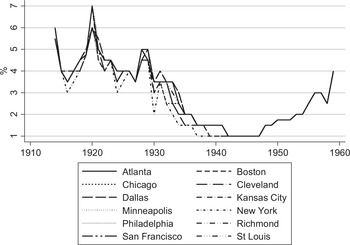
To prevent this, the Reserve Bank short of gold would be forced to increase its policy rate and thereby reduce its discounts and other lending to member banks in its district, reducing its own liabilities and restoring the specified minimum reserve ratio. Figure 1 shows that discount rates across the 12 Federal Reserve Banks differed by as much as 100 basis points in the early 1920s, against 150 basis points in the mid-1930s.Footnote 7
FEDERAL RESERVE BANK DISCOUNT RATES

Increasing the discount rate might cause difficulties for member banks in the affected district, not to mention their customers. But, importantly, the need for disruptive adjustments and violations of the commitment to maintain clearing at par was obviated by mutual assistance between Reserve Banks. The strict decentralization foreseen in the Federal Reserve Act, according to which each Reserve Bank was a distinct bookkeeping entity required to maintain its own gold reserves, was relaxed in practice through procedures for sharing reserves. A Reserve Bank would rediscount a bill on behalf of another Reserve Bank that had previously discounted the bill in question. Section 11b of the Act of 1913 foresaw that such rediscounting might be authorized and if necessary compelled by the Federal Reserve Board. It empowered the Board “to permit, or, on the affirmative vote of at least five members of the Reserve Board to require Federal Reserve Banks to rediscount the discounted paper of other Federal Reserve banks at rates to be fixed by the Federal Reserve Board.”Footnote 8
Rediscount rates were not always higher than discount rates. In other words, lending by Reserve Banks to their partners in the System did not automatically occur at penalty rates. It was recommended in 1920 that “the rate of such rediscounts should be variable and fixed by the Board from time to time as the situation may appear to require and without any special regard either for the profit or loss to the contracting banks. In the present situation, we approve the action of the Board in fixing the rate of such rediscounts at 7 per cent” (Board of Governors of the Federal Reserve System 1921, p. 607). David McCalmont (Reference McCalmont1963, p. 33) describes how the rate fixed by the Board likely created losses for the Dallas and St. Louis Reserve Banks (which charged their member banks only 6 percent on 60 to 90 day commercial paper) while other Reserve Banks broke even.Footnote 9 This was mutual insurance by another name.
Congress actively debated whether rediscounting should be compulsory prior to voting the Federal Reserve Act of 1913 (see Hackley Reference Hackley1973). Some of these discussions were similar to those concerning TARGET2 balances.Footnote 10 A key concern in the United States then was that compulsory rediscounting might encourage free-riding. When the gold reserves of a Reserve Bank declined significantly, some critics complained, that bank could simply borrow from Reserve Banks rather than curtailing discounts to local commercial banks presumably engaged in dubious practices. The incentive to adjust would be diminished, while Reserve Banks compelled to extend accommodation would be saddled with dubious collateral.
Members of the U.S. House of Representatives understood that compulsory rediscounts had a redistributive aspect.Footnote 11 Objections were also voiced in the Senate, where Senator Burton argued that compulsory rediscounts would “accentuate the rivalry between sections [in other words Federal Reserve districts] for the accumulation of reserves” and create “unlimited irritation and friction.”Footnote 12
Reserve Banks generally acquiesced to the recommendations of the Board and to requests for rediscounting from their partners. Contemporaries stressed that WWI fostered solidarity.Footnote 13 As a result “It was easy for the Board to insist, in the determination of the inter-district shifting of funds, upon principles which ordinarily might have created some objection” (ibid). The Federal Reserve Board noted in 1920 that “there has […] been such a spontaneous spirit of cooperation between the Federal Reserve Banks [during the period of the war] […] and in no case has the Board found it necessary to exercise its statutory power” (Board of Governors of the Federal Reserve 1920, pp. 5–6).
Only once, in fact, did the Board find it necessary to use its power of compulsion, in the 1933 episode discussed later. That episode had serious repercussions, prompting changes in the structure of the Federal Reserve System that vested more power with the Board and reduced the decision-making autonomy of the Reserve Banks. A powerful Federal Open Market Committee (FOMC) was created by the Banking Act of 1933. Membership of that committee was then revised by the Banking Act of 1935, as amended in 1942, which created the present 12 member committee of seven members of the Board of Governors and five Reserve Bank Presidents.Footnote 14 Under the 1935 Act, Federal Reserve Banks were prohibited from purchasing or selling securities except under instructions from this Committee. The FOMC was further empowered to instruct Reserve Banks to sell or transfer any securities held or purchased to a joint System account.Footnote 15
Another consequence of the Banking Act of 1935 was that the System Open Market Account (SOMA) became the principal means of sharing gold reserves. The System Account, managed by the Federal Reserve Bank of New York (New York Fed), with direction from the FOMC, is the joint account through which open market operations are executed. Open market operations are thus a possible source of payment imbalances across districts, despite the centralization of security transactions in New York, given how the geographical location of U.S. banks' headquarters differs. For instance, even if the New York Fed buys U.S. Treasury bills from a broker located in New York, the high-powered money created may flow to an account maintained at the Federal Reserve Bank of Chicago if the bank of the seller of the bills in question is one of its members.
Operations undertaken by the New York Fed on behalf of the Federal Reserve System were therefore allocated among Reserve Banks. The formula used for this purpose was originally intended to ensure that all Reserve Banks had sufficient holdings of interest-bearing government securities and adequate earnings.Footnote 16 But it was also used to even out reserve ratios across Federal Reserve districts. The FOMC determined that Federal Reserve Banks short of gold and liquidity could be exempted from participating in open market operations. To this end, they could sell their participation in these operations to other Reserve Banks against gold certificates. This was collateralized lending (loans of gold certificates collateralized by treasury bonds) by another name.Footnote 17 These reallocations became the mechanism for reserve sharing between Reserve Banks from the end of the 1930s.
The year 1936 saw the introduction of the formula used to undertake reallocations within the SOMA. That formula specified a floor for the reserve ratio of each Reserve Bank. A FOMC directive of 25 May 1936 “authorized and directed [its] executive committee to make thereafter from time to time such readjustments as may be necessary to maintain the distribution of government securities among the Federal Reserve Banks in accordance with such formula [that of February 1935]: provided that if at any time the reserve ratio of any Federal Reserve Bank should fall below 50 percent or would be reduced below 50 percent by reason of the operation of such formula, the executive committee shall make such readjustments in the allotments as shall be necessary to raise the reserve ratio of such bank to 50 percent by allocating the necessary amount of securities to the other Federal Reserve Banks in accordance with the formula” (see McCalmont Reference McCalmont1963, p. 85).
CONCEPTUAL FRAMEWORK
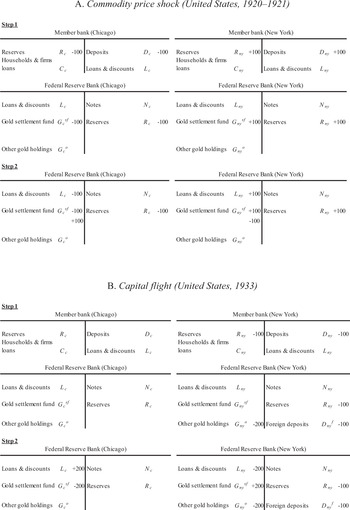
To understand how mutual assistance worked in practice, consider a stylized model with two Reserve Banks (Chicago and New York) and one member bank in each district (in the spirit of Alexander Wolman Reference Wolman2014). Assume that customers of the Chicago member bank purchase $100 million of goods from customers of the New York member bank. Assume also that the value of the latter's purchases from customers of the Chicago member bank are zero.Footnote 18 The reserve account and deposits of the Chicago commercial bank then decline by $100 million, while those of the New York commercial bank increase by the corresponding $100 million. These interdistrict transactions are settled through the Gold Settlement Fund, with the Chicago Fed transferring $100 million in gold (or in gold certificates held by the U.S. Treasury on behalf of the Chicago Fed) to the New York Fed (see step 1 of Figure 2, Panel A).Footnote 19
T-ACCOUNT MODELS OF PAYMENT IMBALANCES ACROSS REGIONS: UNITED STATES THEN VS. EURO AREA NOW


If the Chicago Fed's gold holdings look to become insufficient (i.e., if  or
 , it could maintain its minimum gold reserve ratio by reducing loans and discounts to its member banks, ignoring the potentially disruptive consequences for the member bank and its customers. Alternatively, it could request assistance from the New York Fed. It could sell $100 million worth of discounted securities to New York and receive $100 million in gold via the Gold Settlement Fund. In turn the New York Fed would receive the discounted securities and transfer gold to the Chicago Fed via the Gold Settlement Fund (see step 2 of Figure 2's Panel A). The transaction would reduce the reserve ratio of the New York Fed, which would earn interest on the discounted paper. It would raise the reserve ratio of the Chicago Fed, allowing it to maintain its required minimum reserve ratio and confidence in its district.Footnote
20
Consider now, in contrast to the previous example of current account imbalances, the case of capital account imbalances (capital flight). Imagine that foreigners liquidated $200 million of deposits with both the commercial bank in the New York district and the New York Fed and repatriated their funds.Footnote 21 This would lead to a $200 million decline in the gold holdings of the New York Fed (see step 1 of Figure 2, Panel B). If the New York Fed's gold cover looked to become insufficient, it could ask for assistance from the Chicago Fed. It would sell $200 million of discounted securities to Chicago and receive $200 million in gold or gold certificates via the Gold Settlement Fund. In turn Chicago would receive the discounted securities and transfer gold via the Gold Settlement Fund (see step 2 of Figure 2, Panel B).
After 1935–1936, following reforms to the Federal Reserve Act undertaken in response to the Great Depression, mutual assistance would have taken place instead through the SOMA and the reallocation of participations in open market operations.Footnote 22 The New York Fed would sell $200 million worth of participations in joint purchases of securities booked on the SOMA to the Chicago Fed and receive $200 million in gold via the Interdistrict Settlement Fund, the successor to the Gold Settlement Fund. In turn the Chicago Fed would receive SOMA securities and transfer gold via the Interdistrict Settlement Fund (see step 2 of Figure 2, Panel C).
To see the contrast with TARGET2 balances in the euro area, consider again a stylized representation, with two National Central Banks (Banca d'Italia in Italy and the Bundesbank in Germany) and one commercial bank in each country.Footnote 23 Assume that customers of the Italian bank purchase €100 million worth of goods from customers of the German commercial bank. The reserve account and deposits of the Italian commercial bank then decline by €100 million, while those of the German commercial bank rise by the corresponding €100 million. These cross-border transactions are settled through TARGET2. The Italian firm discounts eligible collateral with the Banca d'Italia, and the Banca d'Italia transfers euro proceeds to the Bundesank, which credits the account of the German firm.Footnote 24 The Banca d'Italia's TARGET2 liability position and the Bundesbank's TARGET2 claims both rise by €100 million (see step 1 of Figure 2, Panel D). TARGET2 claims then reside on the books of the respective central banks, as liabilities and assets, respectively, and are cleared at the level of the Eurosystem by the European Central Bank (ECB).
Prior to the outbreak of the global financial crisis, Italy's payment outflows tended to be offset by payment inflows, which limited the overall size of TARGET2 imbalances. For instance, the Italian commercial bank would raise funds in the cross-border interbank market (i.e., from the German commercial bank) to replenish its reserves. But interbank markets stopped functioning with the crisis in 2008–2009. German banks would no longer lend to Italian banks. Instead Italian banks were forced to borrow from the Banca d'Italia. TARGET2 imbalances thus mirrored the uneven distribution of Eurosystem liquidity (see step 2 of Figure 2, Panel D).Footnote 25
There are differences, therefore, between the situation in the United States then and the euro area today. In the U.S. case, settlement of transactions between central bank branches in different regions was in the form of a real asset (gold), whereas the equivalent settlement in the euro area is in fiat money. In the U.S. case, imbalances in cross-border payments were limited to the stock of gold available for reserve sharing. In the euro area, in contrast, it is constrained by the stock of collateral eligible for central bank refinancing, where rules for eligibility are set by the ECB.
But there are also similarities. Both Gold Settlement Fund and TARGET2 imbalances reflect imbalances in private payment flows across regions. Both helped to prevent otherwise disruptive adjustments. Settlements through the Gold Settlement Fund allowed Reserve Banks to maintain their statutory gold cover while avoiding the abrupt tightening of monetary conditions. Settlements through TARGET2 similarly reflected the accommodation of bank funding needs in the absence of functioning money markets while avoiding sharp changes in interest rates.
DATA
The pioneer in studying these questions is McCalmont (Reference McCalmont1960, Reference McCalmont1963). McCalmont compiled his estimates from studies by contemporaries and reports by the Federal Reserve Board and Reserve Banks. The Board provided assistance, with its staff going to “unusual lengths to seek out and make available […] technical material.”Footnote 26 McCalmont's investigations were complemented with interviews with Federal Reserve staff and Board members. The Board expressed satisfaction with the result, noting “the meticulous way” information had been gathered.
Some items reported by McCalmont had been calculated and harmonized by the Federal Reserve System itself. But other items required adjustment, which McCalmont undertook. Still other data available as time series were of varying frequency. Finally, some data were snapshots of accommodation operations undertaken in specific crisis episodes. In a few cases (e.g., for 1922, 1923, 1925, 1926), information was available on the balance sheets of Reserve Banks providing accommodation but not of those receiving it.
McCalmont was aware of the importance of distinguishing stocks and flows, noting that stocks differ from cumulated flows insofar as the maturities of securities transacted by Reserve Banks varied, and securities acquired previously could mature and roll off balance sheets. He was able to construct estimates of the relevant stocks except for 1916–1918 and 1922–1926, when for reasons of data availability only estimates of flows were possible.
We used these data to construct time series of quarterly interdistrict accommodation operations undertaken by the 12 Reserve Banks from 1913:Q4 through 1959:Q4. For the period after 1936, no further transformations were required. Before 1936, formats varied. While data for 1920–1921 and March 1933, two episodes during which interdistrict accommodation operations reached high levels, were available in the appropriate format, data for other years required more extensive transformations (see Appendix). Where possible, we constructed end-of-quarter observations of stocks. We also cumulated monthly observations in each quarter to obtain estimates of quarterly stocks.Footnote 27 We assumed uniform distributions where information was missing. For instance, when data were available for providers only, we assumed that the remaining districts were recipients of identical amounts.Footnote 28
EMPIRICAL ANALYSIS
We use our data to shed light on the scale and determinants of mutual assistance between Federal Reserve Banks; the changing composition of the “core” and “periphery” of the U.S. monetary union; the persistence in regional imbalances; and the political economy of gold reserve sharing.Footnote 29
Scale and Determinants of Mutual Assistance
A first insight from the first 50 years of interdistrict settlement is that there was extensive mutual assistance between Reserve Banks in general and in response to liquidity crises and bank runs in particular.
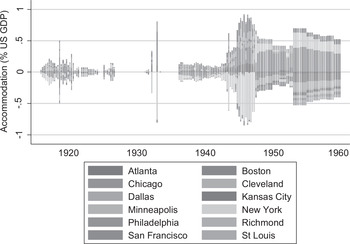
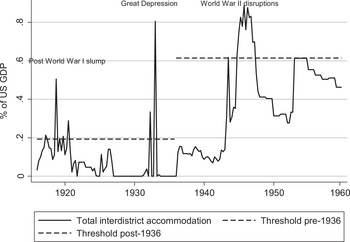
Figure 3 shows the evolution of outstanding interdistrict accommodation over the period 1913–1960, scaled by gross domestic product (GDP). Amounts are broken down by Federal Reserve district and type (in other words, whether a district was a net provider or a recipient of gold). Figure 4 then shows the evolution of the total volume of accommodation operations jointly undertaken by the 12 Reserve Banks, again scaled by U.S. GDP. Accommodation peaked at more than 0.8 percent of U.S. GDP in 1933 and again in 1946.Footnote 30
INTERDISTRICT ACCOMMODATION OPERATIONS—1913–1960
(Breakdown by district)

EPISODES OF EXCEPTIONAL INTERDISTRICT ACCOMMODATION

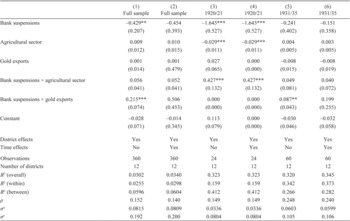
These interdistrict accommodation operations were often associated with banking sector tensions. Table 1 reports estimates of the impact on interdistrict accommodation operations of all commercial bank suspensions, using data from Mark Flood (Reference Flood1998).Footnote 31 These estimates control for the share of the agricultural sector in district GDP (a measure of a district's exposure to commodity price shocks), net shipments of gold to the rest of the world (a metric of exposure to external financial disturbances), and the interactions between bank suspensions and the latter two variables.Footnote 32 They are obtained using a panel estimator that controls for time and random district effects. The equation estimated on the full time period yields a coefficient on bank suspensions that is negative, large, and significant (see column 1 of Table 1).Footnote 33 This suggests that an additional 1,000 bank suspensions in a district was associated with a transfer of gold reserves on the order of 0.4 percent of U.S. GDP in that district.
ESTIMATED IMPACT OF BANKING SECTOR TENSIONS ON INTERDISTRICT ACCOMMODATIONS OPERATIONS

* = Significant at the 10 percent level.
** = Significant at the 5 percent level.
*** = Significant at the 1 percent level.
Notes:
The table reports estimates for the full sample and selected sub-periods of the impact of commercial bank suspensions (in 1,000s) on (U.S. GDP-scaled) interdistrict accommodation operations controlling for the share of the agricultural sector in district GDP, net shipments of gold to the rest of the world (U.S. GDP scaled), and the interactions between bank suspensions and the latter two variables. A minus sign on the dependent variable means more gold borrowing from other districts. The estimates are obtained with a random-effects (at the district level) panel estimator and controlling for time effects. The estimates reported in column (3) also control for an outlier observation for the Chicago district in 1933.
Sources:
See the text.
The importance of bank suspensions stands in contrast with developments in Europe in recent years. Only few banks have been closed in Europe since the beginning of the financial crisis in 2007/08, compared to thousands of banks in the United States during the Great Depression and 400 since the onset of the recent financial crisis.Footnote 34 To the extent that regional payment imbalances emerged because of capital flight, this suggests that the latter was due to deposit flight in the United States then, unlike in the euro area now, where it partly reflects, as some have argued, a generalized flight from low quality (bank and nonbank) assets to high quality assets.Footnote 35
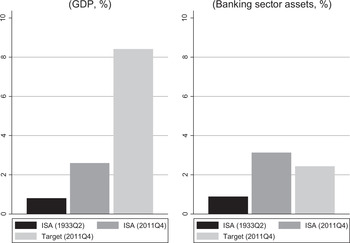
Figure 4 highlights episodes when accommodation was large, defined as quarters in which total accommodation exceeded its sample mean by one standard deviation in the pre-1936 and post-1936 periods, respectively, while Figure 5 compares the relative size of TARGET2 and ISA balances, now and then.Footnote 36 So defined, mutual assistance was large on three occasions: after WWI (1920/21); during the Great Depression (especially around March 1933); and after WWII. It was large in 19 quarters over our sample period, or about 11 percent of the time. On average there was a surge in gold reserve sharing every nine years.
RELATIVE SIZE OF TARGET2 AND ISA BALANCES—NOW VS. THEN

Interdistrict accommodation operations first surged during the 1920/21 slump.Footnote 37 Several districts were hit by adverse commodity price shocks, creating financial distress and bank failures (Alston, Grove, and Wheelock Reference Alston, Grove and Wheelock1994). The Atlanta, Dallas, Richmond, and St. Louis districts were adversely affected by declines in the price of cotton and tobacco, while the Chicago, Kansas City, and Minneapolis districts were hit by declines in the price of grain, wool, and other agricultural products (Hackley Reference Hackley1973). All 12 Reserve Banks took part in accommodation operations on one side or the other (ten of them participated on both sides at different points in time). Gold reserves were shared by rediscounting bankers' acceptances in the portfolios of hard-pressed Reserve Banks. The borrowers were Reserve Banks from agricultural areas in the interior of the country (including Kansas City, Dallas, and St. Louis, Chicago, and Minneapolis), while Reserve Banks from coastal areas (Boston, New York, Philadelphia, and San Francisco) were lenders.
Interdistrict accommodation operations were associated with banking sector tensions. When the sample is restricted to 1920/21, the impact of bank suspensions on accommodation is negative, significant, and even larger than the estimate for the full sample. They suggest that an additional 1,000 bank suspensions in a district were associated with a transfer of gold reserves on the order of 1.6 percent of U.S. GDP in that district (see columns 3 and 4 of Table 1). Accommodation was more pronounced in agricultural areas: an increase of 10 percentage points of GDP in the share of the agricultural sector in a district is associated with a transfer of gold reserves on the order of 0.2 percent of U.S. GDP.
During the Great Depression, interdistrict accommodation operations were larger still. While the gold reserves of the Federal Reserve System as a whole never fell below the statutory minima, some Reserve Banks skated close to the edge. Interdistrict accommodation operations occurred in mid-1931, when commodity prices had fallen significantly. Heavily agricultural districts where bank failures were widespread, such as Atlanta, Dallas, Kansas City, and Richmond, were the principal participants on the borrowing side. These operations consisted mainly of reallocations of government securities (McCalmont Reference McCalmont1963, p. 72).
Much larger reallocation operations then took place in mid-1932. Significant accommodation was extended to the New York Fed, from virtually all the other Reserve Banks (ibid., p. 74), reflecting New York's loss of gold to foreigners.
Events in March 1933 were especially dramatic. Markets were demoralized, and gold hemorrhaged from the vaults of New York banks to an extent such that the reserve ratio of the New York Fed fell to barely 25 percent in early March (as described by Wigmore Reference Wigmore1987). Yet the gold reserves of the Federal Reserve System as a whole, on the order of $3 billion, were more than sufficient to meet gold demands and statutory requirements. Evidently, gold losses were spread unevenly among Reserve Banks. Pressure on New York was intense because it was the first port of call for foreign investors, both private and official, seeking to repatriate U.S. gold. New York lost 61 percent ($584 million) of its reserves between 1 February and 4 March, whereas the System as a whole lost only 18 percent ($571 million).
The fall in New York's reserve ratio led Randolph Burgess, the deputy governor of the New York bank in charge of securities transactions, to contact the Chicago, Boston, Cleveland, St. Louis, and Kansas City Reserve Banks on 3 March and request that they take government securities in exchange for gold. The Minutes of the Board of Directors of the Federal Reserve Bank of New York for 7 March describe how Burgess was not able to secure the desired cooperation “largely due to the refusal of the Federal Reserve Bank of Chicago to purchase a suggested $100,000,000 of Government securities from us.”Footnote 38 As one contemporary later explained: “some of the member banks of Chicago threatened to pull all their deposits out of the Federal Reserve Bank the next morning […] They did not want the gold transferred to the New York district.”Footnote 39 The Chicago Fed had a history of independence within the System. It resisted the de facto leadership of the New York Fed in the 1920s, and its governor had repeatedly sparred with the influential governor of the New York Bank, Benjamin Strong, over Strong's desire to cut interest rates to help the United Kingdom first to return and then stay on the gold standard. The Chicago district also experienced exceptionally severe banking problems in late 1932 and early 1933, notably the prominent difficulties of Charles Dawes' Central Republic Trust and Henry Ford's Guardian Group of banks. It was therefore anxious to husband its gold reserves and not share them with New York.
With the New York Fed unable to provide assistance to local banks, New York State Governor Herbert Lehman was forced to declare, at the New York Fed's urging, a bank holiday at 2:30 AM on the morning of Saturday, 4 March on the grounds that the New York district would otherwise “run out of gold” (Wigmore Reference Wigmore1987, p. 749).
Later that same day, Burgess contacted Eugene Meyer of the Board of Governors to suggest “the possibility of the Federal Reserve Board bringing pressure to bear on the Federal Reserve Bank of Chicago to buy Government securities from this bank or of the Board's ordering sufficient inter-district rediscounting to rectify our reserve position.” Governor Meyer reported back that the Board was not prepared to invoke its authority to require inter-district rediscount “at that time.”Footnote 40 This left the new president, Franklin Delano Roosevelt, little choice but to invoke the Trading with the Enemy Act and suspend gold transactions on his first full day in office, Sunday 5 March. There then followed what was initially supposed to be a four-day bank holiday.
The suspension of interstate payments thus led to additional bank failures and disrupted credit flows.Footnote 41 It resulted in a generalized bank holiday in which the par clearing of deposits between, and for that matter within, districts was disrupted for an extended period.
Burgess later reported to his fellow directors that while he next took up the issue on Monday 6 March, the Board of Governors once more took no action. Burgess again telephoned Meyer to press on him the urgency of acting, and Meyer suggested that the directors of the New York bank “formally request the Federal Reserve Board to require other Federal reserve banks to rediscount the discounted paper of this bank,” which it then did.Footnote 42 On 7 March the Board then telegraphed the other Reserve Banks, instructing them to rediscount paper on behalf of the New York Fed for the first and only time in the System's history, in accordance with Section 11(b) of the Federal Reserve Act of 1913.Footnote 43
It will be evident that these interdistrict accommodation operations were associated with exceptional banking sector tensions: “Early in 1933,” the Board noted, “with the recurrence of bank failures and deposit withdrawals the Federal Reserve System was called upon to meet large demands for currency and gold […] The crisis of February and March 1933 […] was not a currency crisis but a banking crisis, and was occasioned not by a shortage of currency but by loss of confidence in the solvency of banks and by a depreciation in bank assets […] caused by the depression […]” (Board of Federal Governors 1934, pp. 1–26).Footnote 44 The impact of banking sector tensions changed when external financial disturbances occurred in this period, as reflected in the significant estimate of the interaction coefficient between bank suspensions and net shipments of gold to the rest of the world when the sample is restricted to 1931–1935 (see column 5 of Table 1).Footnote 45
This episode thus highlights how cooperation between Reserve Banks was essential to the stability of the U.S. monetary union. Milton Friedman and Anna Schwartz note that “In the final two months prior to the banking holiday [of 6–15 March 1933], there was nothing that could be called a System policy. The System was demoralized. Each [Federal Reserve] Bank was operating on its own. All participated in the general atmosphere of panic […] The leadership which an independent central bank system was supposed to give the market […] [was] conspicuous by [its] absence.” Ultimately the response to this crisis was the Federal Reserve Act of 1935, which gave the Board of Governors in Washington DC full control of purchases and sales of securities of regional Reserve Banks via the System account, which significantly facilitated interdistrict accommodation.
Large accommodation operations again took place after WWII. Government security purchases by the Federal Reserve during wartime had lowered the System's gold cover ratio toward its legal minimum. To ensure that no Reserve Bank's reserve ratio fell below the regulatory floor (45 percent since 1944), the FOMC reallocated Treasury bills held in the System Account.Footnote 46 When this proved insufficient, Congress reduced gold reserve requirements to 25 percent, while the FOMC reduced the floor at which Federal Reserve Banks could cease to participate in open market purchases from 45 percent to 35 percent.
New York was the largest recipient of gold reserves in mid-1946, but Boston and Philadelphia also received significant amounts; other districts were gold providers. The New York Fed's reserve ratio fell as foreign central banks and governments liquidated their dollar deposits, converting them into gold that they were now in a position to repatriate (or to instruct the Fed to hold under earmark). According to the Board of Governors, “At the end of the year foreign-owned dollar deposits, earmarked gold, and securities held for all accounts, including accounts maintained by foreign depositors with the Federal Reserve Bank of New York acting as fiscal agent of the United States amounted to 5,330 million dollars, as compared with 6,830 million dollars at the end of 1945” (Board of Governors of the Federal Reserve System Reference Schubert and Weidensteiner1947, p. 56). This was a large fall in foreign deposits, implying a large fall in reserves and requiring large amounts of interdistrict accommodation, insofar as deposits could be subsequently converted into gold. Again, however, the direction of accommodation reversed after two years, as this process of foreign repatriation subsided, with New York becoming a net creditor and, for example, Atlanta, Boston, Cleveland, Kansas City, and San Francisco taking its place on the borrowing side.Footnote 47
Location of the “Core” and “Periphery”
An important observation from the first 50 years of the Federal Reserve System is that the pattern of regional imbalances was not carved in stone. Districts that were emergency recipients of gold could subsequently become providers. The identity of the borrowers depended on the nature of the shock, and the nature of the shock varied from commodity price shocks in 1920/21 and 1930/31 to external financial disturbances in 1933 and 1946. It depended on whether gold transfers occurred because of inter-state current account imbalances (i.e., reflecting real goods transactions) or because of capital flight. Hence, there was no well-defined “core” or “periphery” of the Federal Reserve System in its first five decades.
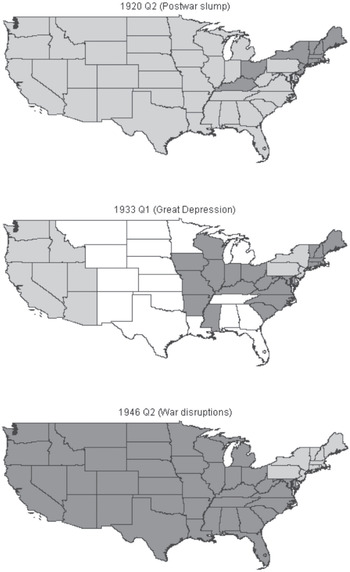
This is illustrated in Figure 6, which maps the geographical distribution of interdistrict accommodation operations in the second quarter of 1920, first quarter of 1933, and second quarter of 1946. Districts that were gold reserve providers are shown in dark grey, gold reserve recipients in light grey, and nonparticipants in white.Footnote 48 That fortunes could change is apparent. Although the New York and Boston districts provided substantial amounts of gold to other districts in the second quarter of 1920, this situation was reversed in March 1933 when New York was an interdistrict borrower and five other regional Reserve Banks, now including Chicago, were called on to assist it.
GEOGRAPHY OF INTERDISTRICT ACCOMMODATION OPERATIONS— “CORE” VS. “PERIPHERY”

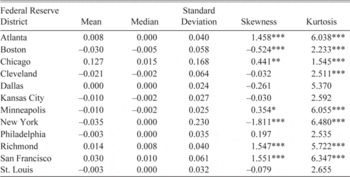
Figure 7 shows the distribution by size of GDP-scaled interdistrict accommodation operations by each of the 12 Reserve Banks. It confirms that the same districts could be both providers and recipients of gold at different points in time. But statistical tests suggest that the distribution is significantly skewed (see Table 2). Operations undertaken by the New York and Boston districts show a significant negative skew. This means that New York and Boston had a larger than average probability of being recipients of accommodation. In contrast, the operations of the Atlanta, Chicago, Minneapolis, Richmond, and San Francisco districts display a significant positive skew. These districts had a larger than average probability of being on the lending side.Footnote 49
HISTOGRAM OF INTERDISTRICT ACCOMMODATION OPERATIONS
(Breakdown by District)

INTERDISTRICT ACCOMMODATION OPERATIONS—DESCRIPTIVE STATISTICS

* = Significant at the 10 percent level.
** Significant at the 5 percent level.
*** = Significant at the 1 percent level.
Notes:
The table reports selected descriptive statistics on the outstanding amounts (scaled by U.S. GDP) of interdistrict accommodation operations undertaken by each of the 12 Federal Reserve districts over the period 1913–Reference Meltzer1959.
Sources:
See the text.
Persistence in Regional Imbalances
Regional payment imbalances did not grow endlessly but stabilized and reversed once the initial liquidity shocks and bank runs subsided. In the five decades considered here, interdistrict accommodation declined to low levels after each local peak. It took a quarter of a calendar year for accommodation operations to revert to pre-crisis levels following the 1920/21 and the 1933 episodes. The post-WWII episode was more long-lasting in that it took 16 quarters for accommodation to revert to pre-crisis levels.
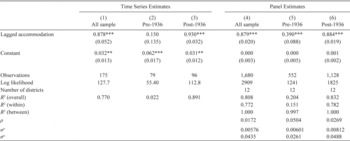
Table 3 reports time series estimates when the total volume of accommodation is regressed on its lag and a constant. It also reports panel estimates (in columns (4) to (6)) when the net accommodation received by each of the 12 Reserve districts is regressed on its own lag, a constant and district and time effects. For the full sample the coefficient on the lagged dependent variable is on the order of 0.9, which points to a half-life of slightly more than five quarters. Hence only 50 percent of a typical shock to accommodation operations remained after 1.3 years. Considering only the period before 1936 (when rediscounting was the principal vehicle for accommodation operations) points to even faster adjustment, with a coefficient on the lagged dependent variable of less than 0.4, and a half-life of less than a quarter.
ESTIMATES OF PERSISTENCE EFFECTS IN THE DYNAMICS OF INTERDISTRICT ACCOMMODATION OPERATIONS

* = Significant at the 10 percent level.
** = Significant at the 5 percent level.
*** = Significant at the 1 percent level.
Notes:
The table reports estimates of persistence effects in the dynamics of interdistrict accommodation operations. Columns (1) to (3) provide times series estimates obtained when the total volume of accommodation (shown in Figure 3) is regressed on its lag and a constant. Columns (4) to (6) provide panel estimates obtained when the net accommodation received by each of the 12 Federal Reserve districts is regressed on its lag, a constant and fixed and time effects. The estimates are obtained using the full sample period (i.e., 1913Q1–1959Q4). The standard errors reported are robust to heteroskedasticity.
Sources:
See the text.
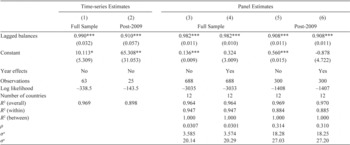
Table 4 reports similar estimates for the euro area now. For the full sample (1999–2014) the coefficient on the lagged dependent variable is close to unity, suggesting that the dynamics in TARGET2 balances are close to a random walk. However, this is largely due to the influence of pre-crisis observations, when TARGET2 balances were low and stable. If the period considered is limited to the crisis (i.e., 2009–14), we obtain a lagged dependant coefficient on the order of 0.9, similar to that obtained for the full U.S. sample then.
ESTIMATES OF PERSISTENCE EFFECTS IN THE DYNAMICS OF TARGET2 BALANCES

* = Significant at the 10 percent level.
** = Significant at the 5 percent level.
*** = Significant at the 1 percent level.
Notes:
The table reports estimates of persistence effects in the dynamics of TARGET2 balances. Columns (1) and (2) provide times series estimates obtained when euro area-wide balances are regressed on their lag and a constant. Columns (3) to (6) provide panel estimates obtained when the TARGET2 balances of each of the 12 euro area reporting countries are regressed on their lag, a constant and fixed and time effects. The estimates are obtained using the full sample period (i.e., 1999Q1–2014Q4) in columns (1), (3), and (4). Estimates restricted to the crisis period (2009Q1–2014Q4) are reported in the remaining columns. The standard errors reported are robust to heteroskedasticity.
Sources:
See the text.
The Political Economy of Reserve Sharing
Sharing gold reserves between Reserve Banks was important for overcoming liquidity shocks. Contemporaries understood that adjustment could be difficult in their absence. Referring to the 1920 episode, the Board of Governors noted that “The table of reserve ratios indicates clearly why interbank accommodation was necessary in 1920 and what banks were in need of it, as well as what banks were in a position to extend accommodation” (Board of Federal Governors Reference Reed1922, p. 26). Contemporaries were also aware that accommodation operations were crucial for avoiding widespread failures and their spread across U.S. regions. The Governor of the Federal Reserve Bank of Atlanta observed of the strains created by the 1920/21 downturn that: “If this bank [the Cleveland Fed] had failed to stand as a buffer between the business of this section [the Atlanta Federal Reserve district] and disaster […] it would have permitted a situation to develop which would have seriously affected all other sections of the country and every other reserve bank. This district, if made bankrupt through the necessity of immediate liquidation […] would react upon every section of the country […]. The mere publication of our actual reserve ratio might possibly have the effect of causing the failure of numerous banks, not only in this district, but in others as well, and bring on a panic of great magnitude [italics added]” (unpublished letter to the Federal Reserve Board, 9 December 1920; quoted in McCalmont Reference McCalmont1963, p. 26).Footnote 50
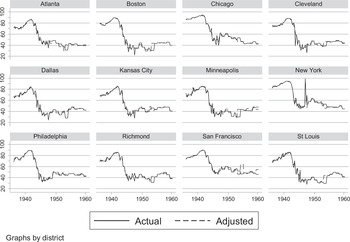
The relief afforded by accommodation operations is evident in Figure 8, which shows the evolution between mid-1936 and end-1959 of the reserve ratios of the 12 Federal Reserve banks as well as of the ratios that would have prevailed without interdistrict accommodation. That these two ratios could be very different in some instances—that some Reserve banks would have had much lower gold coverage of their liabilities in the absence of interdistrict accommodation—comes out clearly.
EXTENT OF THE RELIEF AFFORDED BY INTERDISTRICT ACCOMMODATION OPERATIONS
(Breakdown by District of Gold Reserve Ratios, Percent)

This mutual assistance left even informed opinion largely unmoved. It did little to inflame tensions between regions. Typically, gold reserve sharing between Reserve Banks went unnoticed by the public. McCalmont (Reference McCalmont1963, p. 1) notes the “surprising contrast between the great worry over our national loss of gold reserves [to foreign countries] and the complete absence of worry over the possible loss of gold reserves by one Federal Reserve district to another… Why,” he asked, “is there never any alarm over actual or feared deficiencies in the gold reserves of individual Reserve Banks?”
There were, however, three prominent exceptions. There was opposition to rediscounting in the wake of the first such operation in December 1917, when commercial banks in Chicago complained that the reserves they had provided to the Chicago Fed were being “siphoned off” by Reserve Banks in Southern States in order to make loans to firms which would “otherwise have borrowed money in Chicago” (see McCalmont, Reference McCalmont1963, p. 23). World War I and its imperatives helped overcome this dissatisfaction, however, as noted previously. It brought home to the boards of the individual Reserve Banks that they were in this foxhole together. As Henry Willis put it, “the determination of the United States to enter the war brought [this] early period to a close” (Willis Reference Willis1923, p. 22).
Next there were tensions among Reserve Banks in 1932, when the executive committee of the Open Market Policy Conference began to expand member bank reserves through open market operations. These arose, for example, because of New York's reluctance to undertake the bulk of the security purchases at a time when it feared large gold losses to Europe without further support from Boston and Chicago.Footnote 51
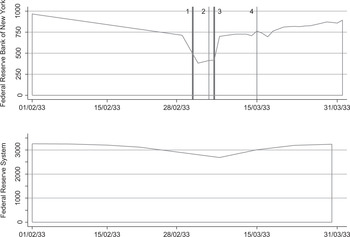
The third exception is March 1933, the episode described previously, when commercial banks in Chicago pressured the Chicago Fed not to assist the New York Fed—which then haemorrhaged gold to foreigners—on concerns that doing so would weaken their own position (see also Figure 9).
INTERDISTRICT COOPERATION BREAKDOWN—FEBRUARY–MARCH 1933
(Gold Reserves, USD Million)

One reason why gold reserve sharing was the subject of limited public attention and objection was the strong spirit of cooperation between the regional Reserve Banks. In this view, the explanation of the “puzzling fact that the public is never aware of any worry by any Federal Reserve district over the loss of gold reserves to any other district […] lies, not in the fact that all parts of the US make use of a common monetary unit, but rather in the cooperative relationships which the twelve legally separate Reserve banks have established” (McCalmont Reference McCalmont1963, p. 231). In addition, cooperation was in the interest of all insofar as sharing gold reserves provided hard-pressed districts with the leeway to smooth adjustment to payment imbalances. Finally, that no district could foresee—under a veil of ignorance—whether or not it would need assistance worked to further bolster cooperation.
CONCLUSION
Mutual assistance among Reserve Banks is an underappreciated aspect of the early history of the Federal Reserve System. It was common in response to liquidity crises and bank runs, when Reserve Banks regularly pooled their gold reserves. Fortunes could change quickly, as Reserve Banks took turns as emergency recipients and providers of gold. Payments imbalances did not grow without bound, instead narrowing when shocks subsided, with half of the effect of a shock to interdistrict accommodation typically dissipating after five quarters. Mutual assistance triggered high tension between regional Reserve Banks in only one noteworthy instance, immediately before the bank holiday proclaimed by President Roosevelt in March 1933. As a counterexample, this suggests that cooperation between regional Reserve Banks was essential to the cohesion and stability of the U.S. monetary union.
While the situation in Europe today differs in important ways, part of the interest of this story lies in the light it sheds on the controversy over TARGET2 balances. That mutual assistance between Reserve Banks was common during liquidity crises and bank runs suggests that the increase in TARGET2 balances since the outbreak of the global economic and financial crisis, far from being abnormal, is in fact a standard feature of currency areas and an intrinsic feature of the adjustment mechanism in a working monetary union. That fortunes could change quickly, with earlier gold recipients turning subsequently into gold providers, indicates that the notion of “core” or “periphery” regions within a monetary union is not necessarily carved in stone—something that, to the extent it is true, provides scope for co-insurance or risk sharing. The fact that imbalances tended to narrow once shocks subsided is at variance with concerns that TARGET2 imbalances might grow without bound. And that cooperation between regional Reserve Banks was essential to the cohesion of U.S. monetary union and its stability indicates that maintaining such cooperative spirit will be important for the smooth operation of the euro area.
Appendix 1: Data Sources and Transformations
This Appendix describes the data available from McCalmont (Reference McCalmont1963) along with the assumptions and transformations needed to obtain quarterly amounts outstanding of interdistrict accommodation operations undertaken by the 12 Federal Reserve Banks between 1913:Q4 and 1959:Q4.
1916: McCalmont reports detailed data on monthly participation by Federal Reserve Banks in open-market purchases of acceptances made by the Boston and New York Federal Reserve Banks but without specifying whether these data were stocks or flows. To err on the cautious side, we assumed that these were flow data and cumulated monthly participations within each quarter to obtain estimates of the corresponding stocks (as noted before, these are imperfect estimates given that the residual maturities of the underlying securities could vary).Footnote 52 In doing so, we further assumed that gold provided to the Federal Reserve Banks of New York and Boston originated uniformly from other regional Reserve Banks.
1917: As in 1916, McCalmont provides detailed data on monthly participations by Federal Reserve Banks in open market purchases of acceptances made by the Boston and New York Reserve Banks, as well as data on re-rediscounts and purchases of acceptances for that year. To the first category of data, we apply the same transformation as in 1916. For the second category, we assume a residual security maturity of three months (in line with McCalmont's observation that this was the typical maturity of bankers' acceptances at the time) and estimated quarterly amounts outstanding by dividing by four the (posited) annual stock of rediscounts and purchases of acceptances.
1918: More complete data are available, including records of daily and monthly flows, together with the identity of the Federal Reserve Banks involved in these transactions. To transform flow data into stocks, we cumulated monthly flows within each quarter to obtain rough estimates of the corresponding stocks (subject to the caveat noted before).
1919: Outstanding accommodation operations provided and received by each Federal Reserve Bank are available as stocks at a monthly frequency. We took March, June, September, and December observations as our estimates of quarterly amounts outstanding of interdistrict accommodation operations.
1920/21: McCalmont (1963, p. 149) indicates that “the published information is in most respects so satisfactory and complete that we need only reproduce it here exactly as it appeared in the Federal Reserve Bulletin vol. 8, Jan. 1922, pp. 27–31.” The reported outstanding amounts are monthly. We therefore took March, June, September, and December observations as our estimates of quarterly amounts outstanding of interdistrict accommodation operations.
1922/23: The volume of interdistrict accommodation in these years appears to have been smaller than in 1920/21. The Board appears to have compiled or preserved less information as a result. Flow data are available only on an annual basis and only for accommodation providers. We divided these annual flow data by four to obtain a rough estimate of quarterly data. Federal Reserve districts unidentified as accommodation providers were considered as recipient of accommodation, again assuming a uniform distribution.
1924–1926: Based on the information in McCalmont (Table 4, p. 164) on providers and recipients of accommodation, we assumed that throughout 1924 the Cleveland, Minneapolis, Kansas, and Dallas districts were providers of gold and other districts were recipients. There was limited information from which to identify providers of gold for 1925 and 1926. As for 1922/23, Federal Reserve districts not identified as accommodation providers were classified as recipient of accommodation, again assuming a uniform distribution.
1927–1930: McCalmont notes that there were no rediscounts in this period. Whether any accommodation by means of interbank purchases of acceptances or government securities occurred is not known (McCalmont Reference McCalmont1963, p. 1965).
1931–1935: Snapshots of stock data on interdistrict accommodation operations as of selected months (e.g., November 1931) or date (e.g., 7 March 1933) appear in Board letters and memoranda. We assigned these amounts to the quarter to which they refer. There is no record of accommodations between November 1931 and April 1932 (McCalmont concludes that “very likely they were none”).
1936–1959: Quarterly stock data on (re)allocations are readily available from the Board and require no additional transformation. The data reported by McCalmont between 1944 and 1959 may slightly underestimate or overestimate actual interdistrict operations, since the sum of all the providers' and recipients' positions do not net out (accounting for roughly 10–25 percent of their cumulated amount in absolute terms).