The role of the first language (L1) in the acquisition of the second language (L2) has been addressed in numerous studies, and across different theoretical approaches (Dechert & Raupach, Reference Dechert and Raupach1989; Ellis, Reference Ellis2006; Gass & Selinker, Reference Gass and Selinker1992; Odlin, Reference Odlin1989; Schwartz & Sprouse, Reference Schwartz, Sprouse, Hoekstra and Schwartz1994, Reference Schwartz and Sprouse1996). Although L1-transfer has been examined primarily in reference to syntactic structure (for overviews, see Hawkins, Reference Hawkins2001; White, Reference White2003), many studies in recent years have examined the role of L1 transfer at the syntax/semantics interface, in such areas as tense and aspect, quantifier scope, argument structure, and article semantics (for an overview, see Slabakova, Reference Slabakova2008). These studies examine whether learners transfer form/meaning mappings from their L1 to the L2, and whether, in cases where the L1 and L2 form/meaning mappings differ, targetlike attainment can be achieved by adult L2 learners. The present study aims to add to the literature on the L2 acquisition of form/meaning mappings by considering how L2 learners of English and Spanish interpret plural noun phrases (NPs) with and without definite articles.
The problems of acquiring the meaning of English articles when the learners’ native language lacks articles are fairly well documented (Huebner, Reference Huebner1983; Ionin, Ko, & Wexler, Reference Ionin, Ko and Wexler2004; Master Reference Master1987; Thomas Reference Thomas1989; Trenkic Reference Trenkic2008). What is less well studied is how L2 acquisition proceeds when both the L1 and the L2 have articles, but the meanings encoded by articles in the two languages are subtly different. Compared to L2 learners from article-less L1s, L2 learners from L1s that have articles have generally been found to be fairly accurate both in article suppliance (Murphy, Reference Murphy1997; Thomas, Reference Thomas1989), and in article appropriateness in a discourse context (Ionin, Zubizarreta, & Bautista Maldonado, Reference Ionin, Zubizarreta and Bautista Maldonado2008). However, these studies did not focus specifically on those areas of article semantics where the L1 and the L2 differ.
Although English and Spanish share many similarities of article use (such as having definite and indefinite articles, and requiring a determiner with singular count NPs), they differ when it comes to the use and interpretation of definite articles with plural NPs. In English, plural NPs with definite articles have a specific interpretation: The tigers eat meat is necessarily a statement about specific tigers, the maximal group of tigers currently in the discourse context. In contrast, plural NPs with definite articles in Spanish have both specific and generic interpretations: Los tigres comen carne, literally “The tigers eat meat” can be a statement either about the specific tigers in the discourse context, or about tigers in general. In English, the generic reading is expressed via articleless plural NP, as in Tigers eat meat.
This contrast in plural NP interpretation between English and Spanish (and Romance languages more generally) has received much attention in the semantic literature (Chierchia, Reference Chierchia1998; Longobardi, Reference Longobardi2001, among many others). The consequences of this contrast for acquisition have been examined in studies with both monolingual and bilingual children (Pérez-Leroux, Munn, Schmitt, & DeIrish, Reference Pérez-Leroux, Munn, Schmitt and DeIrish2004; Serratrice, Sorace, Filiaci, & Baldo, Reference Serratrice, Sorace, Filiaci and Baldo2009). In adult L2 acquisition, the interpretation of article-less plural NPs in English versus Romance was examined by Slabakova (Reference Slabakova2006), but that study did not consider the interpretation of plural NPs with definite articles. The present study examines how Spanish-speaking learners of English and English-speaking learners of Spanish interpret definite plurals and article-less plurals. Our goals are (a) to determine if L1 transfer of form/meaning mappings takes place in the domain of plural NP interpretation, in both English → Spanish and Spanish → English directions; (b) to determine whether targetlike attainment is possible in this domain; and (c) to determine which aspects of plural NP interpretation are especially challenging to adult L2 learners. In particular, we attempt to separate out the learning task that is about (un)grammaticality (learning which NP forms are (un)grammatical in the target language) from the learning task that is about interpretation (learning what the NP forms in the target language mean). Drawing on convergent results from two separate methodologies, a meaning-focused task in Study 1 and a more metalinguistic form-focused task in Study 2, we provide evidence that L2-learners at lower proficiency levels transfer the form-meaning mappings from their L1 to their L2, whereas L2 learners at higher proficiency levels exhibit more targetlike behavior. We furthermore argue that learning about interpretation is more difficult than learning about (un)grammaticality, and draw parallels between the performance of adult L2 learners in our study and that of the bilingual children tested by Serratrice et al. (Reference Serratrice, Sorace, Filiaci and Baldo2009).
PLURAL NP INTERPRETATION IN MATURE AND DEVELOPING GRAMMARS
Crosslinguistic differences in the interpretation of plural NPs
It is well known that English contrasts with (most) Romance languages on the interpretation of plural NPs. In English, generic readings are available to bare plurals, but not definite plurals, as illustrated in (1). Although (1a), with a bare plural (i.e., an articleless plural NP), is a statement about tigers in general, (1b), with a definite plural (i.e., a plural NP preceded by a definite article), cannot be a statement about tigers in general. The only reading available to (1b) is that some salient, specific tigers (e.g., the tigers in this zoo) eat meat, the same reading that is available to the demonstrative plural (i.e., a plural NP preceded by a demonstrative determiner) in (1c). We term the reading of the NP in (1a) the generic reading, and reading of the NP in (1b), the specific reading. The specific reading is not available to (1a), which cannot be a statement about a specific group of tigers: bare plurals in English cannot have specific reference.Footnote 1
(1)


Unlike English, Spanish uses definite plurals for generic readings, as shown in (2). Preverbal bare plurals are ungrammatical in Spanish, as in (2a), whereas definite plurals have both specific and generic readings, as in (2b), in contrast to demonstrative plurals, which have only specific (nongeneric) readings available to them, as in (2c). The same is observed for other Romance languages, including Italian and French (Zamparelli, Reference Zamparelli, Beyssade, Bok-Bennema, Drijkoningen and Monachesi2002).
(2)

In the theoretical literature on cross-linguistic differences with generics, two major approaches can be identified: syntactic and semantic. On the syntactic approach (espoused by Longobardi Reference Longobardi1994, Reference Longobardi2001; Vergnaud & Zubizarreta, Reference Vergnaud and Zubizarreta1992, among others), the differences between English and Romance are placed in the syntax: Romance languages require overt determiners for syntactic reasons, whereas English allows null determiners. This syntactic requirement has consequences for other aspects of the language besides generic reference, such as article use in inalienable possession constructions (Vergnaud & Zubizarreta, Reference Vergnaud and Zubizarreta1992) and article use with proper names (Longobardi, Reference Longobardi1994, Reference Longobardi2001).
On an alternative semantic approach (Chierchia, Reference Chierchia1998; Dayal, Reference Dayal2004), definite articles in Romance languages encode a slightly different semantics than the English definite article. Definite articles in both English and Spanish lexicalize maximality: the tigers in (1b) denotes the maximal set of tigers in the discourse (e.g., the tigers just mentioned, the tigers visually present, etc.), and the same reading is available to los tigres in (2b). However, definite articles in Romance languages, in addition, encode kind-formation: los tigres in (2b) can denote either the maximal salient set of tigers (the definite/specific reading), or the entire category/kind of tigers (the generic/kind reading). This argument receives support from the fact that plural NPs behave the same with true kinds readings as with generic readings: with kind predicates such as be extinct or be common, English requires bare plurals ((#The) tigers are common in these woods), whereas Romance languages require definite plurals.Footnote 2
Interpretation of plural NPs in child language acquisition
Several recent studies have examined the interpretation of bare versus definite plurals in child language acquisition. Gelman and Raman (Reference Gelman and Raman2003) tested 2- to 4-year-old English-acquiring children on their ability to use determiners as a cue to NP interpretation. The children would be shown a picture of two tiny elephants, and asked either a specific question (“Are the elephants big or small?,” target answer “small”) or a generic question (“Are elephants big or small?,” target answer “big”). Gelman and Raman (Reference Gelman and Raman2003) found that the children appropriately differentiated between the specific and generic questions most of the time, interpreting bare plurals as generic and definite plurals as specific. However, the children did exhibit error rates in both directions: specific questions received generic responses between 5% and 10% of the time, whereas generic questions received specific responses between 16% and 27% of the time. As Gelman and Raman (Reference Gelman and Raman2003) state, the specific (nongeneric) reading was the more salient one in this task, because it was supported by a picture of the specific referents. The saliency of the specific reading in comparison to the generic reading may explain why the children were more accurate answering specific questions than answering generic questions.
In a study with older children (ages 4–7), Pérez-Leroux et al. (Reference Pérez-Leroux, Munn, Schmitt and DeIrish2004) probed the interpretation of definite plurals in the L1 acquisition of both English and Spanish. In this study, the children would be told a story, accompanied by pictures, about two animals that were unusual for their kind—for example, tigers that preferred carrots to meat, or zebras that had spots instead of stripes. The children would then be asked a question such as “Do the zebras have spots?” On the specific interpretation, the target response is “yes”; on the generic interpretation (not available in English, but available in Spanish), the target response is “no.” The opposite question, “Do the zebras have stripes?” was also asked: here, the target response is “no” on the specific interpretation, and “yes” on the generic interpretation.
Pérez-Leroux et al. (Reference Pérez-Leroux, Munn, Schmitt and DeIrish2004) found that both groups of children had a preference for the generic interpretation of definite plurals: the Spanish-acquiring children gave a response consistent with the generic interpretation about 85% of the time, whereas the English-acquiring children did so about 70% of the time, unlike a control group of native English-speaking adults, who allowed definite plurals to have generic readings less than 10% of the time (the English-acquiring children also correctly assigned the generic interpretation to bare plurals, answering questions like “Do zebras have spots?” correctly more than 90% of the time). Strikingly, the rates of generic interpretation for English definite plurals were much higher in the Pérez-Leroux et al. (Reference Pérez-Leroux, Munn, Schmitt and DeIrish2004) study than in the Gelman and Raman (Reference Gelman and Raman2003) study, even though Pérez-Leroux et al. (Reference Pérez-Leroux, Munn, Schmitt and DeIrish2004) tested older children. The task differences are most likely to blame. The task used by Gelman and Raman (Reference Gelman and Raman2003) was biased in favor of the specific reading of the plural, as noted above. In contrast, the task used by Pérez-Leroux et al. (Reference Pérez-Leroux, Munn, Schmitt and DeIrish2004) was biased in favor of the generic reading of the plural (see the critique in Serratrice et al., Reference Serratrice, Sorace, Filiaci and Baldo2009). One potential methodological confound of Pérez-Leroux et al.'s (Reference Pérez-Leroux, Munn, Schmitt and DeIrish2004) study was the fact that the animals in the pictures were introduced by name, as in “Zippy the zebra and Suzy the zebra are spotted.” As a result, it would be most natural to refer back to the zebras as “Zippy and Suzy.” Referring back to them as “the zebras” was infelicitous, and this could have led the children to misinterpret “the zebras” as referring to the entire kind of zebras, instead. Pérez-Leroux et al. (Reference Pérez-Leroux, Munn, Schmitt and DeIrish2004) corrected this problem in a second experiment, in which first names were omitted (instead, the animals would be introduced simply as “two zebras”). In this experiment (with 3- to 5-year-old English-speaking children), the rate of generic responses went down to 40%, which, however, is still higher than the result obtained by Gelman and Raman (Reference Gelman and Raman2003).
Serratrice et al. (Reference Serratrice, Sorace, Filiaci and Baldo2009) examined the interpretation of both bare and definite plurals in English and Italian. They tested 6- to 10-year-old children, English–Italian and Spanish–Italian bilinguals as well as English-speaking and Italian-speaking monolinguals. Unlike the studies described above, which used meaning-focused tasks, Serratrice et al. (Reference Serratrice, Sorace, Filiaci and Baldo2009) used a form-focused, metalinguistic task, in which the children were asked to make judgments about the grammatical acceptability of the sentences (presented in the context of pictures). Sentences targeting the specific interpretation began with “Here,” as in “Here, the strawberries are red” (acceptable in both English and Italian) versus “Here, strawberries are red” (unacceptable in both English and Italian). Sentences targeting the generic interpretation began with “In general,” as in “In general, sharks are dangerous” (acceptable in English, but unacceptable in Italian) versus “In general, the sharks are dangerous” (acceptable in Italian, but unacceptable in English).
In the English version of the study, both English monolingual and English–Italian bilingual children were successful at accepting definite plurals with specific readings and bare plurals with generic readings. However, they also incorrectly overaccepted bare plurals with specific readings and definite plurals with generic readings, with the latter error being particularly common (more than 70% overacceptance for the younger children). Age rather than learning situation appeared to be the relevant factor: younger children (ages 6–7) made more errors than older children (ages 8–10), but monolingual and bilingual children within each age group performed quite similarly. All children were significantly worse than adults at rejecting ungrammatical sentences (although even adults were not at ceiling in their rejections). Serratrice et al. (Reference Serratrice, Sorace, Filiaci and Baldo2009) suggest that the children had difficulty integrating the semantics of the adjunct (here vs. in general) with the semantics of bare versus definite plurals.
In the Italian version of Serratrice et al.'s (Reference Serratrice, Sorace, Filiaci and Baldo2009) study, monolingual Italian adults, monolingual Italian children, and bilingual Spanish–Italian children were all at or near ceiling in accepting definite plurals with both generic and specific readings, and rejecting bare plurals with both: in the Italian version of the study, the test items with bare plurals were ungrammatical regardless of the adjunct, so no integration of adjunct and NP interpretation was necessary, and even younger children did quite well. Because Spanish and Italian pattern the same in this aspect of the grammar, the Spanish–Italian child bilinguals were as accurate as the Italian monolinguals. In contrast, the English–Italian bilinguals did quite poorly: although they correctly accepted the grammatical sentences with definite plurals, they had difficulty rejecting sentences with bare plurals. They had a particularly high rate of overacceptance of bare plurals with generic readings (which are grammatical in English), but they also overaccepted bare plurals with specific readings (which are ungrammatical in English as well as Italian). Thus, the English–Italian bilinguals appeared to be transferring the generic readings of bare plurals from English to Italian; according to Serratrice et al., (Reference Serratrice, Sorace, Filiaci and Baldo2009) the children's overacceptance of bare plurals with specific readings may have been due to difficulty integrating the semantics of the adjunct with that of the plural NP (as in the case of the English version of the study).
To sum up, the literature on child language acquisition of plural NP interpretation is somewhat inconclusive. Both Gelman and Raman (Reference Gelman and Raman2003) and Pérez-Leroux et al. (Reference Pérez-Leroux, Munn, Schmitt and DeIrish2004) used meaning-focused tasks, yet obtained quite different results, most likely because of methodological differences. Serratrice et al.'s (Reference Serratrice, Sorace, Filiaci and Baldo2009) findings from a form-focused task indicate that children have difficulty with metalinguistic judgments that involve integrating the meaning of the NP form with that of the adjunct; this difficulty, which was attested for both bilingual and monolingual children in the English study, obscured potential effects of cross-linguistic influence from Italian to English. In the case of the Italian study, transfer effects were in evidence, with bilingual English–Italian children overaccepting bare plurals with a generic interpretation.
Interpretation of plural NPs in adult L2 acquisition
In the case of adult L2 acquisition, early studies of English articles typically grouped generic NPs separately from nongeneric ones (Huebner, Reference Huebner1983; Master, Reference Master1987; Thomas, Reference Thomas1989), but did not otherwise examine generic interpretation in any detail, and did not specifically examine the interpretation of plural NPs. More recently, Slabakova (Reference Slabakova2006) examined the interpretation of bare plurals by L1-Italian L2-English and L1-English L2-Italian learners, using a truth–value judgment task (TVJT). English allows bare plural subject NPs such as white elephants to have both generic readings (the entire kind of white elephants) and existential readings (some white elephants), whereas Italian allows bare plurals to have only existential readings (generic readings are expressed with definite plurals, as discussed above). Thus, L1-Italian L2-English learners need to acquire a new interpretation of bare plurals: they have to learn that English bare plurals can be generic as well as existential. In contrast, L1-English L2-Italian learners have to unlearn an existing interpretation: they have to learn that Italian bare plurals cannot be generic, only existential. Slabakova (Reference Slabakova2006) found that learning was easier than unlearning. The L1-Italian L2-English learners were fully targetlike in allowing the generic reading for bare plurals; like the native English controls, they exhibited a preference for the generic reading over the existential reading. In contrast, the L1-English L2-Italian learners were not very successful at rejecting the generic readings of bare plurals. At the same time, unlearning was possible, and some L1-English L2-Italian learners were able to unlearn the generic reading of bare plurals. Slabakova (Reference Slabakova2006) argued that this unlearning was triggered by input from a different part of the grammar: according to Longobardi's (Reference Longobardi2001) proper name/bare noun parameter, the availability of bare plurals with generic readings (a semantic property) is directly related to noun–adjective order (a syntactic property). Slabakova (Reference Slabakova2006) predicted that the noun–adjective order in Italian (e.g., Roma antica, “ancient Rome”) would serve as a trigger informing L1-English L2-Italian learners that Italian has a different setting of the proper name/bare noun parameter than English does; once the learners had acquired this syntactic property, they should acquire the corresponding semantic property, and restrict bare plural NPs in Italian to existential readings. Slabakova's (Reference Slabakova2006) findings were consistent with this prediction, in that most of the learners who were successful on the interpretation of Italian bare plurals were also successful with noun–adjective order. Thus, Slabakova (Reference Slabakova2006) found evidence for L1 transfer as well as recovery from L1 transfer, and proposed a mechanism for this recovery; however, Slabakova's (Reference Slabakova2006) study considered only bare plurals, and did not examine how the acquisition of bare plurals might relate to the acquisition of definite plurals.Footnote 3
Objectives of the present study
The main goal of the present paper is to examine the interpretation and judgments of both definite plurals and bare plurals in L2 acquisition bidirectionally, with Spanish-speaking learners of English and English-speaking learners of Spanish. Our research questions are given in (3).
(3) Research questions:
a. Is L1 transfer attested in learners’ interpretation and judgments of plural NPs in English and Spanish?
b. Is targetlike attainment in the interpretation and judgments of plural NPs in L2 acquisition possible, in both English and Spanish?
c. What presents the greatest learning challenge: learning about the (un)grammaticality of bare plurals in English versus Spanish, or learning the target interpretation of definite plurals?
Descriptively, the Spanish/English difference can be characterized as follows. First, there is a difference of grammaticality: in English, bare plural NPs are grammatical in preverbal subject position, whereas in Spanish, they are typically ungrammatical.Footnote 4 In contrast, definite plurals in preverbal subject position are grammatical in both languages. Second, there is a difference of interpretation: definite plurals have both generic and specific readings in Spanish, but only specific readings in English, where generic readings are expressed via bare plurals.
The extent to which these two differences—the (un)grammaticality of bare plurals and the interpretation of definite plurals—are viewed as related depends on the theoretical approach. In Chierchia's (1998) approach, the fact that bare plurals are ungrammatical in Spanish is directly tied to the fact that definite plurals have a generic reading: the definite article must be used precisely because bare NPs cannot appear in argument position. Furthermore, in Chierchia's view, the fact that English freely allows bare plurals in subject position is directly related to the fact that the generic reading is unavailable to definite plurals. According to Chierchia's avoid structure principle, an interpretation that can be encoded by a bare NP should be unavailable to a definite NP, because additional structure (in the form of a determiner phrase projection) should be avoided.
Other accounts (including Dayal, Reference Dayal2004; Longobardi, Reference Longobardi1994, Reference Longobardi2001) do not posit a direct link between the ungrammaticality of bare plurals and the generic readings of definite plurals. For example, Dayal's (Reference Dayal2004) approach allows for the coexistence of bare and definite plurals with generic readings within a single language; this account receives support from Brazilian Portuguese, in which both bare and definite plurals have generic readings (Schmitt & Munn, Reference Schmitt, Munn, Tamanji, Hirotani and Hall1999, Reference Schmitt and Munn2002; empirical support for this proposal is found in Ionin, Montrul, & Santos, Reference Ionin, Montrul, Kim and Philippov2011).
In light of these differences in the theoretical accounts, we do not assume a relationship between bare and definite plurals in learners’ Interlanguage grammars, but instead focus on the two learning tasks: learning whether preverbal bare plurals are (un)grammatical in the target language, and learning the interpretation of definite plurals in the target language. If L1 transfer is attested in this domain, then L1-English L2-Spanish learners should overaccept bare plurals as grammatical in Spanish, and in particular grammatical with generic interpretation (which is available to bare plurals in English); in addition, these learners should disallow definite plurals with generic interpretation, because this interpretation is not available to definite plurals in English. In the other direction, L1-Spanish L2-English learners should reject English bare plurals in preverbal position as ungrammatical, and should furthermore allow definite plurals to have generic as well as specific readings.
Consider next how the learners might become targetlike, in terms of both (un)grammaticality of bare plurals and interpretation of definite plurals. With regard to learning about (un)grammaticality of bare plurals, both classroom learners of English and classroom learners of Spanish receive much explicit instruction in the matter. Spanish textbooks such as Iguina and Dozier (2008) and Alonso Raya et al. (Reference Alonso Raya, Castañeda, Martínez Gila, Miquel López, Ortega Olivares and Ruiz Campillo2008) (used in the Spanish program at the US university where our L2-Spanish learners were tested) emphasize the ungrammaticality of bare NPs in preverbal position, and the requirement for a definite article (although a textbook used in more advanced courses, King & Suñer (Reference King and Suñer1998), shows that the rule is not quite as simple as that, see also Note 4). With regard to learners of English in Argentina, where our L2-English learners were tested, more grammar-oriented textbooks, such as Cunningham and Moor (Reference Cunningham and Moor2007), discuss the “zero article,” and provide examples of grammatical English sentences with bare (article-less) plural NPs in subject position. Although the books focus primarily on (un)grammaticality, they also address interpretation, albeit to a limited degree. Cunningham and Moor note that the zero article is used to talk about “things in general,” whereas the Spanish textbooks discussed above give examples of plural NPs with definite articles used with generic as well as specific meanings.
Turning to theoretical considerations, there is reason to expect learning about (un)grammaticality to be easier than learning about interpretation. A number of recent proposals have argued that narrow syntactic phenomena (which involve (un)grammaticality) are easier for L2 learners to acquire, and less vulnerable to transfer, than phenomena at the interface between syntax and semantics/pragmatics, which involve interpretation (Slabakova, Reference Slabakova2008; Tsimpli & Sorace, Reference Tsimpli, Sorace, Caunt-Nulton, Kulatilake and Woo2006; White, Reference White, Ritchie and Bhatia2009). For example, Montrul (Reference Montrul2010), looking at the acquisition of clitics and Differential Object Marking in L2-Spanish learners and Heritage Spanish speakers (with English the L1/dominant language in both cases) found that a purely syntactic phenomenon (clitic placement) was acquired more successfully, and was less subject to transfer, than a phenomenon at the syntax/semantics interface (the semantic conditions under which the differential object marker a must be inserted before direct objects). Similarly, the Serratrice et al. (Reference Serratrice, Sorace, Filiaci and Baldo2009) study described above found that children, monolingual as well as bilingual, had an easier time learning about the (un)grammaticality of bare plurals in Italian, than about the target interpretation of definite versus bare plurals in English.
In light of these considerations, we hypothesize that L2 learners will also have more difficulty with interpretation than with (un)grammaticality when it comes to the interpretation of plural NPs. For L1-English L2-Spanish learners, we predict that they will be fairly successful in learning that preverbal bare plurals are ungrammatical in Spanish, and that definite plurals must be used instead of bare plurals, to express generic as well as specific readings. At the same time, L1 transfer may cause these learners to prefer the specific readings of definite plurals when given a choice between specific and generic readings. In the case of L1-Spanish L2-English learners, we predict that these learners will be successful at learning that English, unlike Spanish, allows bare plurals; however, we expect learners to have difficulty acquiring the target interpretation of bare versus definite plurals. In particular, L1 transfer should lead these learners to allow the generic interpretation of English definite plurals.
Study 1, reported below, used a meaning-focused task to investigate which reading—generic or specific—L2 learners of English and Spanish prefer for definite plurals. Study 2 used a form-focused, metalinguistic task to examine how L2 learners of English and Spanish judge sentences with definite versus bare plurals in generic versus specific contexts.
STUDY 1: INTERPRETATION OF PLURAL NPs
Study 1 is part of a larger project examining the interpretation of definite plurals among different learner groups. Two versions of the study were created: one in English and the other in Spanish. The results of the L1-Spanish L2-English learners, and the native English controls, are reported in Ionin and Montrul (Reference Ionin and Montrul2010), where the L1-Spanish L2-English learners are compared to L1-Korean L2-English learners, in order to examine the role of the presence versus absence of articles in the L1. The results of a subset of the L1-English L2-Spanish learners, and the native Spanish controls, are reported in Montrul and Ionin (in press), where the L2-Spanish learners are compared to Heritage Spanish speakers, in order to examine the effects of acquisition context on article interpretation. In the present article, we focus on comparing L2-English and L2-Spanish learners, in order to examine the role of transfer bidirectionally.
Methodology
All participants, in both the English and the Spanish versions of the study, completed the following tasks: a proficiency test (described below for each language); a TVJT that examined interpretation of English/Spanish plurals; a metalinguistic acceptability judgment task (AJT) that examined overall knowledge of English/Spanish articles (but without specifically focusing on generic interpretation); and a picture-matching testing inalienable possession (participants in the Spanish study also completed a sentence-selection task on inalienable possession). In the present paper, we report only on the proficiency tests and the TVJT. For results of the other tasks, see Ionin and Montrul (Reference Ionin and Montrul2010) on English, Montrul and Ionin (in press) on Spanish. The TVJT, a meaning-focused task, was administered prior to the AJT, in order to prevent learners from explicitly focusing on articles.
The participants in the English version of the study were 40 L1-Spanish learners of L2-English and 19 native English controls. The participants’ proficiency in English was estimated using a forced-choice cloze test in which every seventh word was removed and replaced by three choices, only one of them appropriate for the context (maximum score: 39). The text passage used for the cloze test was adapted from American Kernel Lessons: Advanced Students’ Book by O'Neill, Cornelius, and Washburn (Reference O'Neill, Cornelius and Washburn1981).Footnote 5 The Cronbach α for this cloze test was 0.817, indicating that the test is reliable.
Twenty-seven of the L2-English learners were classroom learners of English at a university in Argentina. They were divided into low and intermediate groups on the basis of their cloze test scores. The remaining 13 L2-English participants were English as a second language (ESL) learners, who were studying or working at a large midwestern university in the United States. Based on their cloze test scores and their learning situation, we term this group the high-ESL group. Members of this group came from a variety of Spanish-speaking countries, with the most common being Argentina, Venezuela, Honduras, and Mexico. The learners in this group had first been exposed to English in childhood or adolescence (in this resembling most of the learners in the low and intermediate groups), and did not move to the United States until they were adults, between the ages of 22 and 28. Length of US residence ranged from a few months to 7 years, with the mean being 3 years. The high-ESL group learners were engaged in study or work that was not directly related to language (e.g., medicine and engineering). The native English controls (the native group) were students at the same midwestern university as the learners in the high-ESL group.
The participants in the Spanish version of the study were 43 L1-English L2-Spanish and 17 native Spanish controls. In order to independently assess proficiency in Spanish, we used a proficiency test that consisted of a cloze passage (with three multiple-choice response options for each blank) from a version of the Diploma de Español como Lengua Extranjera and a multiple choice vocabulary part from an Modern Language Assessement placement test. The maximum possible score on the proficiency test was 50. The same test was used in Slabakova and Montrul (Reference Slabakova and Montrul2003). The Cronbach α for this cloze test was 0.827, indicating reliability.
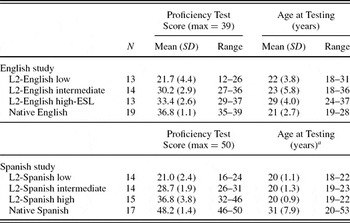
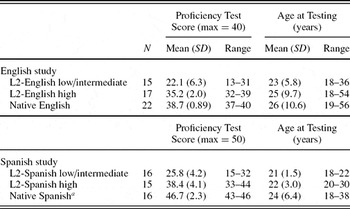
The L2-Spanish learners were all studying Spanish at the undergraduate level at a large midwestern university in the United States. They were divided into low, intermediate, and high groups, based on their cloze test scores. The native Spanish controls (the native group) came from two sources: 8 of the 17 were university students in Argentina, and the remaining 9 were tested in the United States, where they were students and/or instructors of Spanish at the same midwestern university as the L2-Spanish participants. They had all moved to the United States as adults, from a variety of Spanish-speaking countries, including Mexico, Spain, Argentina, and Puerto Rico. The phenomena we are investigating are the same in all varieties of Spanish, and we did not find any differences between Spanish speakers of different varieties for either the native group in the Spanish study or the high-ESL group in the English study. We therefore report participants’ data together for each group, without separating them by country of origin. Table 1 reports the ages and cloze test scores for all participants in the English study and the Spanish study.
Background information for participants in Study 1

Note: L2, second language; ESL, English as a second language.
a In the Spanish study, information about age at testing is missing for two participants: one from the intermediate group and one from the native group, as a result of an electronic malfunction in the recording of the background questionnaire data. The means, standard deviations, and ranges are based on the remaining subjects.
All tasks, as well as a language background questionnaire, were placed on the Internet using the FrontPage program. Participants were tested individually, either in a lab or on a laptop computer, but always in the presence of a research assistant. They entered their responses on the computer screen, and the responses were automatically recorded. All tests were untimed.
TVJT: Test categories and predictions
We probed learners’ interpretation of plural NPs by using a written TVJT, whose format was loosely modeled on the oral task used by Pérez-Leroux et al. (Reference Pérez-Leroux, Munn, Schmitt and DeIrish2004) with child L1 learners. Each TVJT item consisted of a story accompanied by a picture and followed by a test sentence. The participants had to judge the test sentence as true or false in the context of the story. As in Pérez-Leroux et al.'s (Reference Pérez-Leroux, Munn, Schmitt and DeIrish2004) task, each test story juxtaposed a specific reading with a generic reading, by describing animals that bear a characteristic unexpected for their species. A sample story from the English version of the task is given in (4), and the corresponding story from the Spanish version is given in (5). There was a total of eight target stories, and each appeared three times in the test, each time with a different target sentence.
In the English version, each story appeared once with a target sentence containing a bare plural (4a); once with a target sentence containing a definite plural (4b); and once with a target sentence containing a demonstrative plural (4c). The target interpretation is generic for bare plurals, and specific for definite plurals and demonstrative plurals. The demonstrative plural was a control item, because the specific reading is the only possible interpretation for it in Spanish as well as English. Target truth values were counterbalanced across items. For the item in (4), the sentences with bare and definite plurals (4a–b) are designed to be true, whereas the sentence with a demonstrative plural (4c) is designed to be false. This was the case for half of the target items, whereas for the other half, the sentences with bare and definite plurals were false, and the sentences with demonstrative plurals were true.
In the Spanish version, the setup was somewhat different. Because a bare plural in preverbal position is ungrammatical in Spanish, it was not possible to test target sentences analogous to (4a): participants cannot be asked to judge an ungrammatical sentence as true or false. Instead, each target item appeared once with a test sentence containing a definite plural, and designed to be false on the specific reading and true on the generic reading (5a); once with a test sentence containing a definite plural, and designed to be true on the specific reading and false on the generic reading (5b); and once with a test sentence containing a demonstrative plural (5c). Half of the demonstrative plural sentences were designed to be true on the specific reading, as in (5c), and half were designed to be false.
(4) Sample test story: English study
Everyone knows that a zebra always has stripes. But not in our zoo! Our zoo has two zebras, and they are really unusual: they have spots instead of stripes! That's really strange.
(5) Sample test story: Spanish study
El zoológico de Buenos Aires tiene dos cebras nuevas. Estas cebras no son comunes: tienen manchas en vez de rayas. ¡Son muy extrañas!
a. Las cebras tienen rayas. [The zebras have stripes.] TRUE generic, FALSE specific
b. Las cebras tienen manchas. [The zebras have spots.] FALSE generic, TRUE specific
c. Estas cebras tienen rayas. [These zebras have stripes.] FALSE
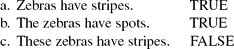
Thus, there was a total of 24 test items: in the English test version, 8 contained bare plurals, 8 contained definite plurals, and 8 contained demonstrative plurals; in the Spanish test version, 16 items contained definite plurals, and 8 contained demonstrative plurals. There were also 36 filler items in each test version, for 60 items total. The fillers consisted of stories juxtaposing either two different aspectual interpretations or two different temporal interpretations. All filler items had proper personal names or determinter phrases with possessive pronouns in subject position, to avoid a focus on the presence versus absence of articles.
The TVJT is designed to focus learners’ attention on the meaning of the sentence, rather than the (un)grammaticality of the plural NP. At the same time, the learners’ responses of TRUE versus FALSE provide information about whether the learners are interpreting the plural NP specifically or generically, because the stories are set up to juxtapose the specific and generic reading: if one is true, the other is false, and vice versa. In coding the data, we therefore scored each response as either generic or specific: for example, for (4a) and (5a), a response of TRUE would be scored as generic (because it is true that zebras as a kind have stripes) but a response of FALSE would be scored as specific (because it is false that the specific zebras in the story have stripes). For (4b) and (5b), a response of FALSE would be scored as generic (because it is false that zebras as a kind have spots), whereas a response of TRUE would be scored as specific (because it is true that the zebras in the story have spots). Recall that target truth values were counterbalanced across NP types. The dependent measure was the proportion of generic responses, out of all responses (generic + specific), for each category.
For the English version of the TVJT, we can make the following predictions. For native English speakers, we expect all sentences with bare plurals to receive generic responses, and all sentences with definite plurals and with demonstrative plurals to receive specific responses, regardless of target truth value. In contrast, L1-Spanish L2-English learners who transfer the interpretation of Spanish definite plurals onto English may give generic as well as specific responses to English definite plurals. Because Spanish definite plurals can have both generic and specific readings, and because all our test items made the target sentence true on either the generic or the specific reading, the learners may always judge sentences with definite plurals as TRUE, resulting in 50% generic responses (given to items where the generic reading is true) and 50% specific responses (given to items where the specific reading is true).
The design of the Spanish TVJT was somewhat different from that of the English TVJT: recall that there were no items with bare plurals in the Spanish TVJT, and therefore twice as many items with definite plurals. Native Spanish speakers are expected to provide only specific responses for demonstrative plurals, but to provide both generic and specific responses for definite plurals. A possible response pattern is that the native speakers would always judge sentences with definite plurals as TRUE, because they are always true on either the generic reading or the specific readings, and both readings are available to definite plurals. In that case, we would expect a 50% rate of generic responses to definite plurals for native Spanish speakers. In contrast, L1-English L2-Spanish learners who transfer the interpretation of definite plurals from English are expected to give specific responses only, regardless of target truth value.
Results of the English TVJT
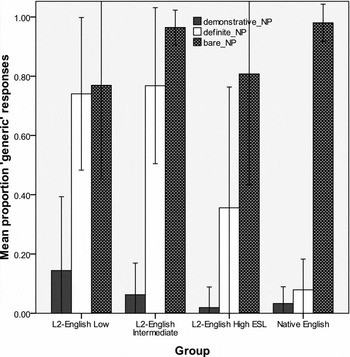
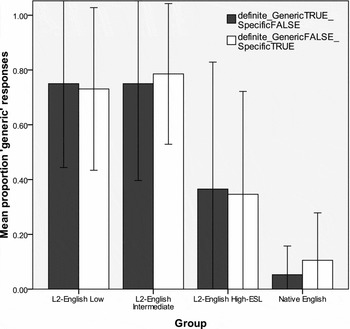
The overall proportion of generic responses in the English TVJT, by group, are given in Figure 1, with means and standard deviations. As this figure shows, all groups had high proportions of generic responses for bare plurals, and very low proportions of generic responses (i.e., high proportions of specific responses) for demonstrative plurals, as expected. In contrast, performance on definite plurals differed across groups, with the three learner groups giving considerably more generic responses than the native control group; for the low and intermediate groups, the generic interpretation was in fact more common than the specific interpretation. Note that the near-native performance on bare plurals and demonstrative plurals for even the lowest proficiency groups indicates that learners were not simply responding randomly. Rather, their low performance is confined to the category that is different in English and Spanish: definite plurals. Furthermore, the two lower proficiency groups gave the generic response to definite plurals close to 80% of the time: well above the 50% than we would expect if the participants always judged the sentences with definite plurals as TRUE. In fact, the target truth value played no role in the judgments, as shown by Figure 2, which breaks down the responses to the definite plural category by target truth value (sentences where the generic interpretation made the sentence true, vs. where the specific interpretation made the sentence true). As Figure 2 shows, the lower proficiency learners gave the generic response close to 80% of the time, both when this response made the sentence true, and when it made the sentence false; target truth value also did not affect the response patterns of the high-ESL learners, or the native speakers, who opted for the specific reading. Thus, participants’ responses appear to be guided by which interpretation they prefer (specific in the case of the native and high-ESL groups, generic in the case of the low and intermediate groups), rather than by any truth bias.
English Study 1, truth-value judgment task (TVJT) results: mean proportion “generic” responses, by category. Error bars ±1 SD.

English Study 1, truth-value judgment task (TVJT) results: mean proportion “generic” responses on the definite plural category, by target truth value. Error bars ±1 SD.

We conducted a mixed analysis of variance (ANOVA) on the proportion of generic responses, with NP type (bare vs. definite vs. demonstrative) and target truth value (TRUE vs. FALSE) as the within-subjects variables, and group membership as the between-subjects variable. There was a significant effect of NP type, F (2, 110) = 255, p < .001; pairwise Bonferroni comparisons indicated that all three NP types differed significantly from one another: that is, definite plurals received significantly more generic responses than demonstrative plurals but significantly fewer generic responses than bare plurals. There was no effect of target truth value, F (1, 55) = 2.7, p = .11, which indicates that there was no truth bias in the participants’ responses. There was a significant effect of group membership, F (3, 55) = 8.9, p < .001, with both native and high-ESL groups performing significantly different from the low and intermediate groups, and a significant group by NP type interaction, F (6, 110) = 18, p < .001. There were no other significant interactions. The group by NP type interaction was due to the fact that all three groups were equally accurate on demonstrative plurals, and quite similar on bare plurals (although the low and intermediate groups were slightly less accurate on bare plurals than the other two groups), but differed significantly on definite plurals, as revealed by a follow-up one-way ANOVA on the category of definite plurals, F (3, 55) = 25, p < .001. Post hoc tests (Tukey) indicated that the native group gave significantly fewer generic responses to definite plurals than each of the three learner groups, and the high-ESL group gave significantly fewer generic responses than each of the intermediate and low groups, which did not differ from one another.
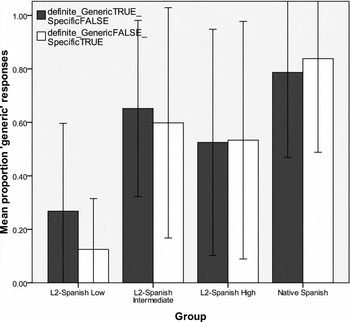
Results of the Spanish TVJT
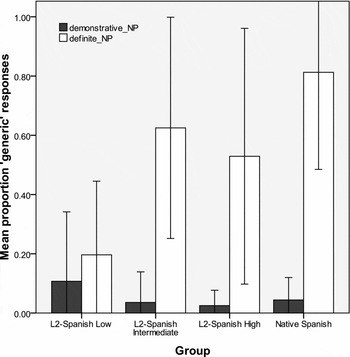
Figure 3 reports the means and standard deviations for the proportion of generic responses for both categories across proficiency groups in the Spanish TVJT. All groups correctly interpreted demonstrative plurals as specific, but differed on definite plurals. The native Spanish group overwhelmingly preferred the generic reading of definite plurals, but the low group preferred the specific reading. The intermediate and high groups were in between, allowing both generic and specific readings for definite plurals. As shown by the breakdown in Figure 4, the target truth value did not make a difference: the native Spanish speakers opted for the generic reading even if it made the sentence false; rather than responding TRUE to all sentences with definite plurals, the native speakers gave mostly TRUE responses if the generic reading was true (and the specific reading false), and mostly FALSE responses if the generic reading was false (and the specific reading true). This is highly reminiscent of the performance pattern of lower-proficiency L1-Spanish L2-English learners in the English TVJT (see Figure 2): there is a strong preference on the part of Spanish speakers for the generic reading of definite plurals, both in Spanish and (for lower proficiency L2-English learners) in English. The low L2-Spanish group showed the opposite pattern: their strong preference was for the specific reading of definite plurals, regardless of whether it made the sentence true or false. Again, this is consistent with performance in English (compare the native English group in Figure 2, and the Low L2-Spanish group in Figure 4). The intermediate and high L2-Spanish groups pattern in between, opting for the specific reading of definite plurals about half the time, and for the generic reading about half the time. As shown by Figure 4, this split is not a result of these learners always saying TRUE: the learners gave the generic response about 50% of the time when the generic reading was true, but also when the generic reading was false. An individual subjects analysis suggests that the 50% performance of the intermediate and high groups is in fact the result of a largely bimodal subject distribution. Of the 28 learners in these two groups, 14 consistently opted for the generic reading (choosing it at least 75% of the time), nine consistently opted for the specific reading (choosing it at least 75% of the time), and only five went back and forth between the two readings. (In contrast, the majority of the participants in the low group—10 out of 13—consistently opted for the specific reading, and the majority of native speakers—14 out of 17—consistently opted for the generic reading.)
Spanish Study 1, truth-value judgment task (TVJT) results: mean proportion “generic” responses, by category. Error bars ±1 SD.

Spanish Study 1, truth-value judgment task (TVJT) results: mean proportion “generic” responses on the definite plural category, by target truth value. Error bars ±1 SD.

We conducted a mixed ANOVA on the group results, with NP type (definite vs. demonstrative) and target truth value (TRUE vs. FALSE) as the within-subjects variables, and group as the between-subjects variable. There was a significant effect of determiner type, F (1, 56) = 110, p < .001, but no effect of target truth value, F (1, 56) = 0.20, p = .66, which indicates that there was no truth bias in the participants’ responses. There was a significant effect of group, F (3, 56) = 5.2, p < .01, which was due to the native group being significantly different from the low group (there were otherwise no significant group differences). Group interacted significantly with NP type, F (3, 56) = 9.6, p < .001, and there was also a significant interaction between NP type and target truth value, F (1, 56) = 4.3, p < .05, as well as a three-way significant interaction between NP type, target truth value, and group, F (3, 56) = 6.2, p < .01. The interaction between NP type, target truth value, and group had the following source: the low and intermediate groups were more likely to treat definite plurals as generic if the generic reading was true, and more likely to treat definite plurals as specific if the generic reading was false; that is, they had a slight tendency to opt for the reading that made the definite plural sentence true. The high and native groups did not exhibit any truth bias, and none of the groups exhibited a truth bias for demonstrative plurals, which were interpreted as specific regardless of the target truth value.
The interaction between group and NP type was due to the fact that all groups performed similarly on demonstrative plurals, but differed on definite plurals, as revealed by a follow-up one-way ANOVA on definite plurals, F (3, 56) = 8.1, p < .001. Post hoc tests (Tukey) revealed significant differences between the low group and each of the intermediate and native groups on definite plurals, and no other significant differences between any pair of groups.
Discussion of Study 1 findings
Consider first the performance of the native group in each language. The native English speakers opted for the specific reading of definite plurals, whereas the native Spanish speakers opted for the generic reading of definite plurals. Although the native English speakers’ performance is fully expected, because English allows only specific readings of definite plurals, the native Spanish speakers’ performance is somewhat surprising: even though Spanish allows definite plurals to have both specific and generic readings, the native Spanish speakers consistently opted for the generic readings. The most likely explanation is methodological: it is possible that the task biased participants in favor of the generic reading of definite plurals. Note that the same pattern was observed by Pérez-Leroux et al. (Reference Pérez-Leroux, Munn, Schmitt and DeIrish2004), who, using a similar methodology, found an overwhelming preference for generic readings of definite plurals on the part of Spanish-acquiring children (they did not test Spanish-speaking adults). A possible reason for this task bias is that it is more natural to refer to the specific individuals in the story using a demonstrative plural, rather than a definite plural. Note that native English speakers were not affected by this bias: because English definite plurals lack generic readings, English speakers consistently opted for the specific reading. In Spanish, both generic and specific readings of definite plurals are possible, so the native Spanish speakers opted for the reading that was more natural in the context, that is, the generic reading.
In light of these native-speaker preferences, we can observe the effects of L1 transfer in both directions. Consider first the Spanish → English direction. Although English allows only the specific reading of definite plurals, learners at the lower proficiency levels (in the low and intermediate groups) allowed, and in fact preferred, the generic reading of definite plurals; they have not yet learned that English does not allow generic readings for definite plurals. The high-ESL group, although not fully targetlike, was more likely to give the target specific response to definite plurals (going against the task bias), suggesting recovery from L1 transfer.
Consider next the English → Spanish direction. The L1-English L2-Spanish learners in the Low group opted for the specific reading of definite plurals, going against the task bias, whereas learners in the intermediate and high group exhibited the native-speaker preference in favor of generic readings. In the case of the Spanish task, we are ultimately dealing with preferences rather than absolute judgments: the higher proficiency learners who opted for the generic response presumably knew that Spanish definite plurals, like English ones, also allow specific readings; nevertheless, the task format led them to choose the generic reading. Similarly, the lower proficiency learners who gave the specific reading of definite plurals may have been aware that Spanish definite plurals also have generic readings. Nevertheless, even looking at preferences rather than absolute judgments, we can see effects of L1 transfer, as well as recovery from transfer: for lower proficiency learners, transfer from English (where definite plurals have only specific readings) overrode the task bias (which was to treat definite plurals as generic). In contrast, higher proficiency learners had overcome the influence of English and exhibited the same preference for the generic reading as the native speakers.
Overall, we might characterize the performance in Study 1 as follows. Participants whose grammar allows both specific and generic readings of definite plurals opt for the generic reading of definite plurals in the TVJT, because of the task bias; this captures the behavior of native Spanish speakers and higher level L1-English L2-Spanish learners tested in Spanish, as well as of lower level L1-Spanish L2-English learners tested in English. Participants whose grammar restricts definite plurals to specific readings opt for the specific readings of definite plurals in the TVJT, going against the task bias; this captures the behavior of native English speakers and higher level L1-Spanish L2-English learners tested in English, as well as lower level L1-English L2-Spanish learners tested in Spanish.
This said, it is important to probe learners’ absolute judgments of plural NP interpretation as well as their preferences. Furthermore, the format of the TVJT did not allow us to examine how learners might judge bare plurals in Spanish, which are ungrammatical in preverbal position. For these reasons, we conducted a second study, where a form-focused task was used to probe learners’ judgments of bare and definite plurals.
STUDY 2: JUDGMENTS OF PLURAL NPs
The goal of Study 2 was to further investigate the interpretation of plural NPs in English and Spanish, using a metalinguistic acceptability judgment task, in an attempt to get at absolute judgments rather than preferences. The overall structure of our task was similar to that of Serratrice et al. (Reference Serratrice, Sorace, Filiaci and Baldo2009): our study, like theirs, asked learners to provide metalinguistic judgments of the acceptability of bare versus definite plurals in generic versus specific contexts. However, unlike Serratrice et al. (Reference Serratrice, Sorace, Filiaci and Baldo2009), we used story-based contexts rather than single adjuncts in order to establish the target interpretation as generic versus specific.
Methodology
As in Study 1, two versions of Study 2 were created, one in English and one in Spanish. All participants, in both the English and the Spanish versions of the study, completed an AJT targeting judgments of different NP types in generic and specific environments. In addition to completing the AJT, all participants in the English version of the study completed a proficiency test (the same as in Study 1) and a TVJT investigating the relationship between genericity and aspect (not reported here). The L2 learner participants in the Spanish study, as well as some of the native Spanish speakers (those tested in the United States), completed the Spanish version of the AJT as well as a proficiency test (same as in Study 1). The majority of the native Spanish speaker controls (those tested in Argentina) completed the AJT only (these participants were originally tested as part of an experimental semantics study that compared the interpretation of different NP types in English and Spanish to those in Brazilian Portuguese; see Ionin et al., Reference Ionin, Montrul and Santos2011). All participants, in both English and Spanish, completed the AJT prior to any other tasks, so the total number of tasks in the studies did not influence AJT performance.
The participants in Study 2 were not the same individuals as the participants in Study 1. However, they were recruited in the same locations. The participants in the English version of Study 2 were 32 L1-Spanish L2-English learners and 22 native English controls. All L2-English participants were university students in Argentina, at the same university as the L2-English learners in Study 1. The participants’ proficiency in English was estimated using the same forced-choice cloze test as in Study 1 (maximum score: 40). The L2-English learners were divided into two groups: the low/intermediate L2-English group in Study 2 spanned roughly the same range of proficiency test scores as the low and intermediate groups in Study 1; the high L2-English group in Study 2 had somewhat higher proficiency than the high-ESL group in Study 1, but the high group in Study 2, unlike that in Study 1, was not in an ESL context. The native English controls were students at the same midwestern university as the native English controls in Study 1, and, in a few cases, members of the local community.
The participants in the Spanish version of the study were 31 L1-English learners of Spanish and 16 native Spanish controls. The same Spanish proficiency test was used as in Study 1 (maximum score: 50). The L2-Spanish learners were studying Spanish at the undergraduate level at a large midwestern university in the United States, the same population as in Study 1. They were divided into two groups: the low/intermediate L2-Spanish group in Study 2 spanned the same range of proficiency as the low and intermediate L2-Spanish groups in Study 1, and the high L2-Spanish group in Study 2 was comparable in proficiency to the high L2-Spanish group in Study 1. The native Spanish controls came from two sources: 10 of them were university students in Argentina, and the remaining 6 were tested in the United States, where they were students or spouses of students at the same midwestern university as the L2-Spanish participants. These 6 participants had all moved to the United States as adults, from a variety of Spanish-speaking countries, including Mexico, Bolivia, Venezuela, Honduras, and Peru. Table 2 reports the ages and cloze test scores for the groups in Study 2, for both English and Spanish.
Background information for participants in Study 2

Note: L2, second language.
a In the Spanish study, information about proficiency test scores for the native Spanish speakers is based on 6 out of the 16 participants, because the other 10 native Spanish speakers did not complete the proficiency test.
All tasks, as well as a language background questionnaire, were placed on the Internet using the online survey gizmo tool. Participants were tested individually, either in a lab or on a laptop computer, but always in the presence of a research assistant (the only exception were the native Spanish controls in Argentina, who took the test in their own homes, without a research assistant). The participants entered their responses on the computer screen, and the responses were automatically recorded. All tests were untimed.
AJT: Task categories and predictions
The AJT consisted of 40 items, and each item in turn consisted of a paragraph-long story followed by five different test sentences. The participants were instructed to rate the acceptability of each test sentence in the context of the preceding story, using a scale from 1 (unacceptable) to 4 (acceptable). The instructions specifically stated that two or more sentences could receive the same rating, that is, responses did not need to be ranked; the availability of four scale points and five target sentences necessitated that at least two sentences receive the same rating. It took participants about 45 min to complete this task.
The use of a 4-point rating scale, instead of a binary yes/no scale, allowed us to probe participants’ responses to fairly subtle distinctions. Although it would have been ideal to present each story with only one target sentence underneath it, repeating each story five times with different sentences, we opted for the presentation of multiple test sentences after the same story instead. We made this decision because presenting each story five times would have made the test too long and taxing on participants’ attention, and would have caused participants to become bored with reading the same stories multiple times.
Of the 40 test items, one-half (20 items) contrasted the interpretation of nominal expressions (the other 20 items were fillers, and contrasted types of aspectual interpretation rather than nominals). The 20 test items that focused on nominals were further broken down into five categories, four items per category. Here, we focus on two of the categories, which are directly related to the categories tested in Study 1. The specific-plural category tested the acceptability of different NP types when the context set up a specific reading of a plural NP, and the generic category tested the acceptability of different NP types when the context set up a generic reading. The other three test categories were specific-singular (analogous to specific-plural, but for specific readings of singular NPs), mass-noun, and kind-reference. The kind-reference category examined judgments of different NPs types in combination with a kind predicate (such as be extinct). As mentioned earlier, kind readings, like generic readings, are expressed by bare plurals in English but by definite plurals in Spanish; for reasons of space, we do not discuss the kind-reference category here, but we note that the results were very similar across the generic and kind-reference categories, for both native speakers and L2 learners.
For each test category, each item was a story followed by five different target sentences, which contrasted in the form of the NP subject: bare plural (chairs), definite plural (the chairs), indefinite singular (a chair), definite singular (the chair), and bare singular (chair). We discuss here only the first two NP types, bare plurals and definite plurals, because our focus is on the interpretation of plural NPs. Singular NPs have the same characteristics in English and Spanish, in both generic and specific contexts, and in fact, both the L2-English and the L2-Spanish learners in the present study were largely accurate with singular NPs. See Ionin et al. (Reference Ionin, Montrul and Santos2011) for the results of the native English and native Spanish controls on all five NP types, and Ionin, Montrul, Kim and Philippov (Reference Pérez-Leroux, Munn, Schmitt and DeIrish2011) on the L2-acquisition of these five NP types by L2-English learners whose L1s (Russian and Korean) lack articles.
We now discuss each of our target categories in turn. Below, we present a sample item for each category, followed by the two relevant continuations, bare plurals and definite plurals. The target sentence variant (the one expected to be rated high by native speakers) is highlighted here; it was not highlighted in the actual test instrument. In the specific-plural category, exemplified in (6) and (7), each item consisted of a story that mentioned two NPs, one singular and the other plural.Footnote 6 Each continuation sentence included second mention of the target NP. As illustrated by (6), the specific-plural category always discussed unusual/noncharacteristic properties of the relevant individual(s), such as birds that bark, or chairs that are bright orange in color. This was done on purpose, to ensure that the variant with the bare plural, in English, would not be interpreted generically, for example, (6a) is not acceptable on the generic reading, because chairs are not, as a rule, orange.
(6) Specific-plural category (English). My friend Gilbert bought some furniture for his kitchen: two chairs and one table. Gilbert likes colorful furniture: for instance . . .
(7) Specific-plural category (Spanish). Mi amigo Gilberto compró muebles para la cocina: dos sillas y una mesa. A Gilberto le gustan los muebles de colores brillantes. Por ejemplo . . .


The generic category in (8)–(9) tests the availability to generic readings to definite versus bare plurals. The stories in the generic category are set up to ensure that no specific entities are under discussion: for example, no specific toy animals are mentioned in (8)–(9). The target sentences in (8)–(9) are generic sentences that discuss the typical properties of the referent of the subject NP; for example, toy animals are typically/usually/as a rule good children's gifts.
(8) Generic category (English). It's my niece's birthday this Saturday—she is going to be 3 years old. I'm not sure what to get her. Maybe I'll just get her some toy, like a stuffed dog or bear. I can't go wrong with that. We all know that . . .
(9) Generic category (Spanish). Este sábado es el cumpleaños de mi sobrina y cumple 3 años. No sé qué comprarle. A lo mejor le compro un juguete, como un osito de peluche o un perrito. Creo que eso le va a gustar. Todos sabemos que . . .


L1 transfer should lead L1-Spanish L2-English learners to rate definite plurals high and bare plurals low in the generic category in (8), whereas L1-English L2-Spanish learners should rate definite plurals low and bare plurals high in (9). L1 transfer should not affect the specific-plural category in (6)–(7), where English and Spanish behave the same. If interpretation is more of a learning challenge than (un)grammaticality, as we hypothesized, then the L2-Spanish learners are expected to be fairly targetlike: as long as they have learned that bare plurals are ungrammatical in Spanish, and definite plurals are grammatical, they should rate (9a) as well as (7a) low, and rate (9b) as well as (7b) high. In contrast, L2-English learners would have learned that both bare and definite plurals are grammatical in English, so their task is more difficult: they need to decide which form, definite plurals and/or bare plurals, is acceptable in the context in (6) vs. (8).
Results of the English AJT
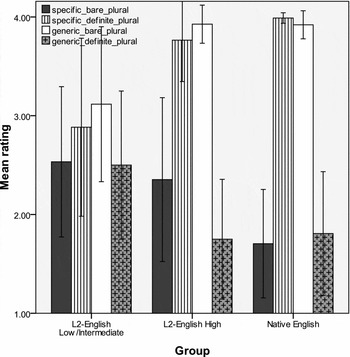
Figure 5 presents the mean ratings for bare and definite plurals in the specific-plural and generic categories in the English AJT. As this figure shows, all three groups rated definite plurals above bare plurals in the specific-plural category, and rated bare plurals above definite plurals in the generic category. However, the contrasts were numerically much weaker in the low/intermediate group than the high and native groups.
English Study 2, acceptability judgment task (AJT) results: mean ratings on a scale from 1 to 4. Error bars ±1 SD.

We conducted a mixed ANOVA on the results, with category (specific-plural vs. generic) and NP type (bare plural vs. definite plural) as the within-subject variables, and group as the between-subjects variable. There was no significant effect of category, F (1, 51) < 1, and no significant effect of NP type, F (1, 51) = 2.2, p = .14, but category interacted significantly with NP type, F (1, 51) = 335, p < .001, a result of the fact that definite plurals were rated higher in the specific-plural than the generic category, whereas the reverse was the case for bare plurals. Group did not have a significant effect, F (2, 51) = 1.58, p = .22, but there was a significant three-way interaction between group, category, and NP type, F (2, 51) = 38.9, p < .001. There were no other significant interactions.
In order to isolate the source of the three-way interaction, we conducted two separate mixed ANOVAs comparing the three groups on the two NP types in the specific-plural category and in the generic category. To avoid inflating the Type I error rate by conducting two separate analyses, we set the α level at 0.025 (Bonferroni correction, 0.05 divided by 2, the number of contrasts). In the specific-plural category, there was a significant effect of NP type, F (1, 51) = 98, p < .001, due to definite plurals being rated above bare plurals. There was also a marginally significant effect of group, F (2, 51) = 3.5, p = .038 (marginal at the Bonferroni-corrected α level of 0.025), with the low/intermediate group performing differently from the other two groups. There was also a significant NP by group interaction, F (2, 51) = 17, p < .001. Interaction plots revealed that while all three groups rated definite plurals above bare plurals in the specific-plural category, the low/intermediate group made the smallest distinction between bare and definite plurals, the native group made the largest distinction, and the high group was in between: as group proficiency increased (from low/intermediate to high to native), ratings of definite plurals went up while ratings of bare plurals went down.
In the generic category, there was a significant effect of NP type, F (1, 51) = 203, p < .001, but no significant effect of group, F (2, 51) < 1. Group interacted significantly with NP type, F (2, 51) = 18, p < .001; interaction plots revealed that although all three groups rated bare plurals above definite plurals in the generic category, this contrast was stronger in the high and native groups than in the low/intermediate group: the low/intermediate group rated definite plurals higher, and bare plurals lower, than did the other two groups (which did not differ from each other).
Results of the Spanish AJT
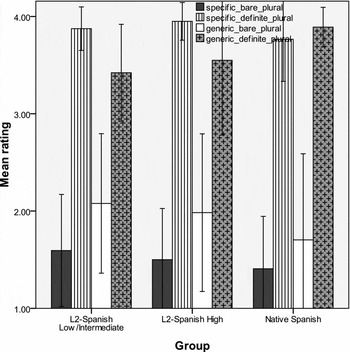
Figure 6 presents the mean ratings for bare and definite plurals in the specific-plural and generic conditions in the Spanish AJT. As this figure shows, both learner groups were remarkably similar to the native group, with all three groups rating definite plurals much higher than bare plurals in both specific-plural and generic categories.
Spanish Study 2, acceptability judgment task (AJT) results: mean ratings on a scale from 1 to 4. Error bars ±1 SD.

We conducted a mixed ANOVA on the results, with category (specific-plural vs. generic) and NP type (bare plural vs. definite plural) as the within-subject variables, and group as the between-subjects variable. There was no significant effect of category, F (1, 44) = 1.4, p = .24, but there was a significant effect of NP type, F (1, 44) = 431, p < .001, with definite plurals rated higher than bare plurals. Category interacted significantly with NP type, F (1, 44) = 32, p < .001, a result of the fact that the distinction between definite and bare plurals was bigger in the specific-plural than the generic category. Group did not have a significant effect, F (2, 44) < 1, but there was a significant three-way interaction between group, category and NP type, F (2, 44) = 4.5, p < .05. There were no other significant interactions.
In order to isolate the source of the three-way interaction, we conducted two separate mixed ANOVAs comparing the three groups on the two NP types in the specific-plural category and in the generic category. To avoid inflating the Type I error rate by conducting two separate analyses, we set the alpha level at 0.025 (Bonferroni correction, 0.05 divided by 2, the number of contrasts). In the specific-plural category, there was a significant effect of NP type, F (1, 44) = 699, p < .001, with definite plurals rated above bare plurals. There was no significant effect of group, F (2, 44) = 1.1, p = .35, and group did not interact with NP type, F (2, 44) < 1. Thus, in the specific-plural category, the two learner groups performed just like the Native group.
In the generic category, there was a significant effect of NP type, F (1, 44) = 160, p < .001, with definite plurals rated above bare plurals. There was no significant effect of group, F (2, 44) < 1, but group interacted with NP type, F (2, 44) = 3.6, p = .036, marginal at the Bonferroni-corrected α level of 0.025. Interaction plots revealed that although all three groups rated definite plurals above bare plurals, the magnitude of the contrast increased with proficiency: as proficiency went up (from low/intermediate to high to native), ratings of definite plurals went up, while ratings of bare plurals went down.
Discussion of Study 2 findings
Study 2 found more targetlike performance in L2-Spanish than in L2-English. In the Spanish study, the learners were fully targetlike in the specific-plural category (rating definite plurals above bare plurals to the same extent as native speakers), but less targetlike on the generic category. Like native speakers, learners at both proficiency levels rated definite plurals well above bare plurals in the generic category, which indicates that they are aware that Spanish, unlike English, uses definite plurals for generic interpretation. At the same time, the learners rated bare plurals higher, and definite plurals lower, in the generic category than did native speakers. This difference was particularly pronounced for the low/intermediate group. These results are fully consistent with L1-transfer from English, where bare plurals rather than definite plurals are used for generic readings. At the same time, the fact that even the low/intermediate group rated definite plurals well above bare plurals indicates that they were in the process of recovering from L1-transfer. In the specific-plural category, where Spanish and English behave alike, learners were fully targetlike even at the lowest proficiency levels.
The results from the English study present a rather different picture. The findings from the generic category are fully consistent with L1-transfer: the L2-English learners, especially those in the low/intermediate group, rated definite plurals too high and bare plurals too low, in comparison with native speakers (although even the low/intermediate group correctly rated bare plurals above definite plurals, like the natives). However, the results on the specific-plural category are not expected under L1-transfer: even though English behaves just like Spanish with regard to specific readings, the learners rated bare plurals unexpectedly high, and definite plurals unexpectedly low. A possible explanation is that the learners had learned the basic grammatical fact about English—that in English, unlike Spanish, bare plurals are grammatical in subject position—but had not yet fully acquired the interpretation of bare versus definite plurals in English, in particular which are required for generic versus specific interpretation.Footnote 7
The results of Study 2 are highly reminiscent of Serratrice et al.'s (Reference Serratrice, Sorace, Filiaci and Baldo2009) findings, despite the differences in test populations and task formats. Both our study and Serratrice et al.'s (Reference Serratrice, Sorace, Filiaci and Baldo2009) study find that learners have difficulty making metalinguistic judgments about bare and definite plurals in English; although problems judging plural NPs in generic contexts might be attributable to transfer from Italian/Spanish, transfer cannot account for performance in the specific contexts, where English behaves just like Italian/Spanish. Furthermore, recall that Serratrice et al. (Reference Serratrice, Sorace, Filiaci and Baldo2009) found similar difficulties among monolingual children, where transfer cannot possibly play a role. Thus, there is reason to think that different types of learners (monolingual children, bilingual children, adult L2 learners) have difficulty deciding which contexts in English are compatible with definite plurals and which, with bare plurals. As children get older and/or get more input, or as adults become more proficient, performance becomes more targetlike. At the same time, our results are not entirely parallel to Serratrice et al. (Reference Serratrice, Sorace, Filiaci and Baldo2009): whereas the children in their study made primarily errors of overacceptance (i.e., they correctly accepted grammatical sentences but also overaccepted ungrammatical ones), the adult learners in our study made errors of overrejection as well as overacceptance. There are many possible reasons for this difference, given the methodological differences between the studies; one possible explanation is that child learners, more than adult learners, exhibit a “yes” bias, which leads them to (over)accept all test sentences.
GENERAL DISCUSSION
We are now in a position to revisit our research questions:
1. Is L1 transfer attested in learners’ interpretation and judgments of plural NPs in English and Spanish?
2. Is targetlike attainment in the interpretation and judgments of plural NPs in L2 acquisition possible, in both English and Spanish?
3. What presents the greatest learning challenge: learning about the (un)grammaticality of bare plurals in English versus Spanish, or learning about the interpretation of definite plurals?
The answer to Question 1 is a qualified YES. Study 1 found that learners’ preferences in interpreting definite plurals were influenced by their respective L1s: L1-English L2-Spanish learners were more likely to opt for the specific reading than native Spanish speakers, even though the task appeared to be biased in favor of the generic reading; L1-Spanish L2-English learners were quite likely to opt for the generic reading of definite plurals, which is not allowed in English. Study 2 found some evidence of L1 transfer at the level of metalinguistic judgments: in the generic category, L1-English L2-Spanish learners rated definite plurals lower, and bare plurals higher, than native Spanish speakers, consistent with transfer from English. In contrast, the learners were fully targetlike in the specific-plural category, where English behaves just like Spanish. However, any potential transfer effects in the Spanish → English direction were obscured by more general difficulties in making metalinguistic judgments: the L2-English learners appeared to have difficulty deciding when definite plurals versus bare plurals are allowed in English, and were just as inaccurate in the specific-plural as in the generic category.
The answer to Question 2 is also positive: in both studies, and in both languages, fairly targetlike performance was attested at the higher proficiency levels. Learners are clearly not permanently constrained by the grammar of their L1 in this domain. Our results do not allow us to determine how the recovery from L1-transfer takes place—to what extent it results from the input and instruction that learners receive, and/or to their underlying sensitivity to the semantics of specific versus generic reference, and/or to general cognitive mechanisms. However, our results do suggest that learners are more successful in acquiring the facts of (un)grammaticality in their target languages than in achieving targetlike interpretation.
The answer to Question 3 is that learning about (un)grammaticality is easier than learning about interpretation. This is evidenced by the results of Study 2: learners of Spanish were quite accurate (if not fully targetlike), even at the lower proficiency levels, at rejecting bare plurals and accepting definite plurals. They had largely acquired the fact that bare plurals are ungrammatical in Spanish. The learners of English, likewise, have learned that bare plurals are grammatical in English, as evidenced by the fact that they rated bare plurals above definite plurals in the generic category. However, success with plural NPs in English involves more than an understanding that bare plurals are grammatical: learners need to learn that the specific interpretation is expressed by definite plurals, and the generic interpretation—by bare plurals. The Study 2 results suggest that the learners, especially at the lower proficiency levels, have not fully matched each form to the target meaning.
The interpretation/grammaticality differences are also seen in a cross-study comparison. In the English → Spanish direction, there is evidence that the lowest proficiency learners know that bare plurals are ungrammatical in Spanish, and that definite plurals have generic interpretations (Study 2), yet learners at the lowest proficiency level nevertheless exhibit a preference for interpreting definite plurals specifically rather than generically (Study 1). Similarly, in the Spanish → English direction, even though learners rate bare plurals above definite plurals in generic contexts (Study 2), they still allow definite plurals to have generic readings, even at higher proficiency levels (Study 1). Thus, knowing which forms are (un)grammatical in the target language does not automatically translate into having a fully nativelike interpretation. At the same time, any cross-task comparison must be done with caution, because Studies 1 and 2 tested different individuals (albeit at similar proficiency levels, and recruited in the same learning contexts). In the future, it would be fruitful to test the same learners using both meaning-focused and form-focused tasks.
The finding that learning about (un)grammaticality is easier than learning about interpretation is consistent with the view that acquisition of phenomena at the syntax/semantics interface is harder than acquisition of purely syntactic phenomena. The question is still open as to whether this difference is an outcome of learners’ natural learning abilities, and to what extent it is influenced by classroom instruction, which may emphasize (un)grammaticality over interpretation.
CONCLUSION
The findings in this paper have a number of important implications. First, they show that both L1-transfer and recovery from L1-transfer exist in a previously relatively unexplored semantic domain. This implies that, although the L1 influences the learning of the L2, differences between the L1 and the L2 do not necessarily present a permanent obstacle to successful L2 acquisition. Second, the findings provide evidence that learning about which NP types are (un)grammatical in the target language is easier than learning what interpretation the different NP types have. In theoretical terms, this finding suggests that syntactic and semantic knowledge are to some extent developmentally dissociated, and that purely syntactic knowledge is easier to acquire than knowledge lying at the interface between syntax and semantics. Third, a comparison with the Serratrice et al. (Reference Serratrice, Sorace, Filiaci and Baldo2009) study provides suggestive evidence that child and adult learners experience similar types of difficulties in learning about plural NP interpretation; this in turn suggests that learning difficulty is traceable to the precise details of how a given language encodes meaning via NP forms, rather than to age or context of acquisition.
This study raises a number of both conceptual and methodological questions for further study. It is important to gather more evidence about how L2 learners interpret plural NPs in different linguistic environments: it would be productive to examine plural NP interpretation with other types of meaning-focused as well as form-focused methodologies, testing the same group of learners, in order to obtain additional convergent evidence (beyond what is shown by the present work) across different data collection methods. In addition, the domain of inquiry should be extended to other linguistic environments. For example, it would be fruitful to examine the different readings of bare plurals (e.g., generic vs. existential, cf. Slabakova, Reference Slabakova2006) and the different readings of definite plurals within the same study. This would allow us to determine whether learning about (un)grammaticality is always easier than learning about interpretation, regardless of which NP form, or which interpretation (generic vs. specific vs. existential) is being targeted. Inquiry should also be extended to other syntactic environments, such as plural NPs in object position, in postverbal subject position, and/or with adjectival modification, because these factors are known to influence both the grammaticality and the interpretation of bare plurals in Romance languages.
A different direction in which this research could be extended would be into an investigation of how age, acquisition context, and classroom instruction influence learners’ behavior. Specifically, it would be fruitful to determine to what extent learners’ behavior is influenced by classroom instruction and to what extent it is a result of developmental learning mechanisms that are independent of specific instruction types; a classroom intervention study could potentially address this issue. Finally, in light of the observed similarities between Serratrice et al.'s (Reference Serratrice, Sorace, Filiaci and Baldo2009) findings with children, and our findings with adult L2 learners, it would be productive to test different learner groups using the same methodologies, in order to determine whether the same factors are at work.
To sum up, our findings, taken together with those of prior studies, point to similarities in how child and adult learners acquire syntax/semantics mappings (for other such observed similarities, also in the domain of NP interpretation, see Ionin, Zubizarreta, & Philippov, Reference Ionin, Zubizarreta and Philippov2009; Ko, Ionin & Wexler, Reference Ko, Ionin and Wexler2010; Unsworth, Reference Unsworth2005, among others). If these findings hold up once the same data collection methods are applied to child and adult populations, this would provide evidence that, at least in the domain of syntax/semantics mappings, child and adult language acquisition are not qualitatively different, but rather proceed along similar developmental paths (cf. Schwartz, Reference Schwartz, Beachley, Brown and Conlin2003); this in turn would provide evidence that there is no age cutoff after which the acquisition of target syntax/semantics mappings becomes impossible. However, more work remains to be done before such a conclusion can be definitively reached.
ACKNOWLEDGMENTS
The research reported here was partially supported by a University of Illinois Campus Research Board award to Tania Ionin and Silvina Montrul. We are grateful to our research assistants, Lucia Alzaga, Eunice Chung, Ji-Hye Kim, and Alyssa Martoccio (Study 1), and Justin Davidson, Tatiana Luchkina, and Gretchen Shaw (Study 2), for recruiting and testing participants in the United States. Thanks to Cecilia Pasman for her assistance with data collection in Argentina, and to Ji-Hye Kim, Rachel Yoon, and James Yoon for drawing the pictures used in Study 1. Thanks to the audiences of the 2nd Heritage Language Summer Institute (June 2008), the McGill University Linguistics Colloquium (November 2008), the University of Iowa Mind–Context Divide Workshop (April 2009), and the 2010 Second Language Research Forum (October 2010), where portions of this work were presented, for their comments and suggestions. We are also grateful to three anonymous Applied Psycholinguistics reviewers for their comments. Any remaining errors are our own.