


‘Yes, we do have a plan [for the discovery of extraterrestrial intelligence]. It starts with champagne’.
–Jill Tarter, Bernard M. Oliver Chair for SETI (Zielinski, Reference Zielinski2010)
‘If the verification process confirms… that a signal or other evidence is due to extraterrestrial intelligence, the discoverer shall report this conclusion in a full and complete open manner to the public, the scientific community, and the Secretary General of the United Nations’.
–Declaration of Principles Concerning the Conduct of the Search for Extraterrestrial Intelligence (SETI, 2010, p. 1)
‘[D]iscovery in astronomy… [i]s an extended process. It's not like you point your telescope and say, ‘Oh, I made a discovery’. It's always an extended process: you have to detect something, you have to interpret it, and it takes a long time to understand it’.
–Stephen J. Dick, Baruch S. Blumberg NASA/Library of Congress Chair in Astrobiology (former) (Howell, Reference Howell2015)
Introduction: science-fictional narratives, scientific realities
Scientific discovery is an extended process, including methodological processes of phenomenon detection, identification and interpretation, as well as social processes of narrative propagation and paradigm integration, that may proceed over decades or more (Kuhn, Reference Kuhn1970[1962]; Latour, Reference Latour1987; Dick, Reference Dick and Vakoch2013). As a domain, astronomy exemplifies this extended discovery process. Novel phenomena tend to first appear at the uncertainty-ridden edge of observational capability, only slowly yielding to repeated observations, consensus acknowledgement of their existence, and compelling interpretation (Dick, Reference Dick1982, Reference Dick1998, Reference Dick and Vakoch2013). Even once interpreted, observations remain amenable to significant reclassification and reconstruction in light of new data and theory (Dick, Reference Dick and Vakoch2013).
Considering the prevalence of culturally influential fictional portrayals of dramatic first contact (e.g. Wells's War of the Worlds) and cultural ideals of scientific progress, it's perhaps unsurprising that mass-audience media tends to discuss a prospective extraterrestrial life (ETL) discovery as a discrete, relatively sudden event. It seems stranger that practicing astronomers and astrobiologists are seen to portray it the same way, both in general-audience interviews and in the published, peer-reviewed literature. I don't seek to explain this phenomenon here; though I suspect it may be driven by the same factors which shape non-expert portrayals. I aim simply to suggest some dissonance between the way discovery usually occurs in astronomy and the ways in which researchers talk about ETL discovery; and to suggest some implications of this dissonance for science communication and astrosociological inquiry. Overly simplistic imaginations of the discovery process among scientists may both impair research on discovery processes' societal components and effects; and propagate public misperception. The latter may, in turn, lead to unrealistic public expectations around the discovery process, and around science more generally.
This is not to say that obvious discovery scenarios (e.g. a dramatic ‘first contact’ with alien lifeforms) are impossible or unworthy of discussion, but merely that they may be overrepresented in media and literature relative to indirect and contested, hence more historically and scientifically plausible, discovery processes. In academic work, this overrepresentation means that much social science research on the potential impacts of ETL discovery focuses on abrupt ‘discovery shocks’ rather than on slow processes of socio-cultural evolution through public awareness of ongoing scientific claim and counter-claim. In mass media, it means that researchers' comments can support portrayals of scientific discovery as a rapid or instantaneous process, when it is rarely or never so.
Discovery in astronomy: an extended, contested process
Despite common cultural narratives about geniuses and breakthroughs, scientific progress occurs through extended, incremental processes of observation, replication, testing and interpretation (Popper, Reference Popper1968; Kuhn, Reference Kuhn1970[1962]; Latour, Reference Latour1987). Even (or perhaps especially) ‘revolutions’ usually take decades or centuries to remake scientific, let alone lay, conceptions of the world. There's no hard line between hypothesis and truth; the distinction builds upon granular, mutable consensus. Along the tangle of pathways between observation, hypothesis and established, contextually situated fact lie many whole or partial missteps, false starts, and contesting interpretations.
The history of the ETL search is marked by false positives and ambiguous data, generated as scientists grappled with the frontiers of observational methods and the inevitable uncertainty of scientific practice. Such 17th-century luminaries as Johannes Kepler, John Wilkins, and Christiaan Huygens all believed that telescopic observations suggested the presence of ETL in our solar system; it took roughly two centuries from Kepler's day for consensus to solidify around a barren moon, and we're still unsure about other in-system bodies.
Following rejection of lunar life over the mid- to late-19th century, debate turned to Mars, where it remains today. Giovanni Schiaparelli first observed canal-like formations on Mars in 1879 CE, and Percival Lowell declared they must be artificial canals in 1894 CE. It took until 1909 CE for consensus to accrue against his interpretation, and until 1975 CE to disconfirm his observations (Sagan and Fox, Reference Sagan and Fox1975; Dick, Reference Dick1998). Over the remainder of the century, we've seen support for a vegetated Mars from William W. Coblentz's 1924 CE observation of water vapour and above-freezing temperatures; a month-long possibility that pulsars represented extraterrestrial intelligence after S. Jocelyn Bell Burnell's 1967 CE discovery thereof; and, beginning following the Viking landers' 1976 CE Martian landings, a decade-long debate about whether or not their experimental results could demonstrate ETL. A possibility of ETL microfossils in the Allan Hills 84001 Martian meteorite, first discussed by David McKay's team in 1996 CE, prompted U.S. President Bill Clinton to announce a possible ETL discovery; and spawned a debate still continuing, albeit in attenuated form, today (Dick, Reference Dick1998).
Though most were eventually rejected, many of these claims and hypotheses represented the cutting edge of science for their time, often advanced by scholarly titans. The ETL debate's difficult history speaks not to incompetence or cynical motives on the parts of those involved, but to the nature of observation, interpretation, and discovery at the ever-expanding limits of science. The ETL search operates at the edges of human observational capacity, where errors are easy, truth is provisional, and uncertainty dies hard. Each new observational tool – from Galileo's first telescope to NASA's Transiting Exoplanet Survey Satellite (see National Aeronautics and Space Administration, 2018) – generates an inchoate deluge of new data. Researchers argue about what's signal, what's noise, and how to define and interpret signal over decades of additional observation and refinement. Reasonable and even brilliant minds can disagree for decades over observational interpretations, and each technical advance brings with it a whole new dataset over which to argue. We aren't just searching for a needle in a haystack – we don't necessarily know how to tell needle from hay.
Some ‘needles’, of course, would be easy to identify: living, Earthlike organisms, for example, or structures of obviously non-natural design (provided they could be clearly observed), or possibly even a resolved artificial pattern in a received electromagnetic signal. But such unambiguous signs of ETL seem unlikely compared with indicators akin to earlier false starts. In the case of true discovery, consensus would simply accrue towards an ETL explanation for observations rather than towards alternative ones. In the interim, though, the ‘discovery’ would be indistinguishable from any of the numerous false positives in astronomy's history – that is, occasionally dramatic on first observation, contested among the scientific community for years after the news cycle moved on, and eventually resolved via additional observation, testing and argument. It can take a long time for one of many plausible interpretations to triumph over the rest.
Methods
To begin to map out how practicing researchers portray a prospective ETL discovery, I queried databases of scholarly and general-audience databases (named below) with terms relating to ETL discovery, and manually read search results from the past decade, retaining those which made explicit claims or implicit but clear presumptions about the rapidity of ETL discovery. I included pieces treating prospective discoveries of both in-system and extrasolar life because, despite significant differences in methods of data collection and analysis between the two domains, these different sorts of ETL discovery would still both the subject to the incremental contestation characteristic to construction of scientific knowledge.
While compiling this sample of convenience, I coded surveyed items according to whether they suggested or explicitly posited a discrete, rapid discovery process, implied or constituted a potential part of a more extended discovery process or explicitly acknowledged an extended discovery process. For illustration of ‘rapid discovery’ narratives in the scholarly literature, see, e.g. Kwon et al.'s (Reference Kwon, Bercovici, Cunningham and Varnum2018) psychological survey on how respondents would react to a credible announcement of ETL discovery; and Jones's (Reference Jones and Vakoch2013) discussion of how rapid social-media propagation of such an announcement might affect societal reactions. In contrast, an example of ‘extended discovery’ acknowledgement in the scholarly literature is Dick's (Reference Dick and Vakoch2013) statement that even ‘discovery of a signal from extraterrestrial intelligence… [would likely] entail the detection of an unusual narrow-band signal, followed by a more-or-less extended period of interpretation before understanding gels, perhaps many years later’ (p. 237). Examples of ‘rapid discovery’ narratives in general-audience media include senior SETI astronomer's Seth Shostak's wager that ‘the existence of intelligent extraterrestrials will be confirmed within the next two decades’ (Osborne, Reference Osborne2017) or Saplakoglu's (Reference Saplakoglu2018) discussion of whether humanity is ready for a rapid discovery scenario (Table 1).
Statements exemplifying codes from scholarly and general-audience publications

Scholarly sources were found by querying JSTOR and Academic Search Premier with the terms ‘(“extraterrestrial life”) AND (discover OR discovery)’, supplemented with sources found in preparation for this piece. Mass-audience sources were found by querying Nexis Uni (formerly LexisNexis Academic)'s news section and Google News with the terms ‘(“extraterrestrial life”) AND (discover! OR react! OR implication!) AND (researcher OR scientist OR astronomer) and (say! OR statement!)’ in order to limit results to those containing researcher statementsFootnote 1. Search results were constrained to items published since 1 January 2008. To avoid algorithmic result personalization, all Google searches were performed on a private, untracked browser without search history or cookies. I make no claims to representativeness or generalizability, though I do offer a few reflections upon what I found.
Results
Review of 139 scholarly and 139 general-audienceFootnote 2 query results collated 30 scholarly (Table A1) and 37 general-audience pieces (Table A2) involving researchers speaking directly or indirectly to the likely process of an ETL discovery. Twenty-four scholarly and 32 general-audience pieces implied a rapid discovery process, while eight scholarly and 14 general-audience pieces implied, explicitly acknowledged or exemplified a prospective discovery's extended nature (Fig. 1). Of these, only three scholarly and four general-audience pieces explicitly addressed an extended discovery process. Two scholarly pieces and nine general-audience pieces implied or explicitly acknowledged both rapid and extended discovery processes. In total, then, of 67 included pieces, 56 implied a rapid discovery process, and 22 implied, explicitly acknowledged, or exemplified an extended process, with 11 doing both. In total of 73% of surveyed scholarly, 56% of surveyed general-audience, and 67% of all surveyed pieces did not address the extended nature of scientific discovery, and only 10% of scholarly, 11% of general-audience and 10% of all surveyed pieces explicitly acknowledged it.
Rapid-discovery and extended-discovery pieces in reviewed scholarly and general-audience media. Extended-discovery narratives are divided into items merely implying and those explicitly addressing an extended discovery process.

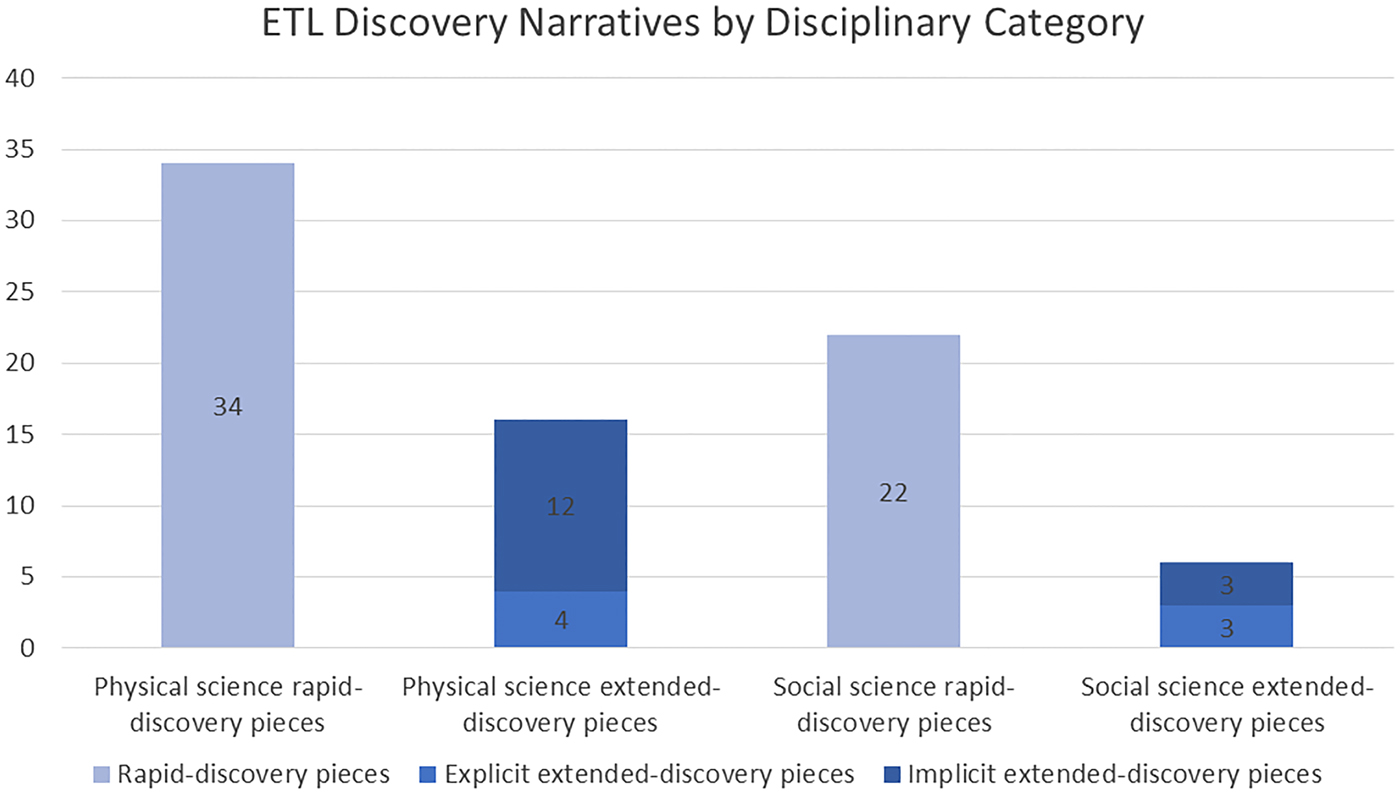
Of surveyed items, 42 were published in physical science journals or relied on quotes from physical scientists (e.g. astronomers, astrophysicists, biologists and geologists), while 24 were published in social science journals or relied on quotes from social scientists (e.g. historians, sociologists or psychologists). Of these, 34 physical science pieces and 22 social science pieces implied rapid discovery, four physical science and three social science pieces explicitly addressed an extended discovery, and 12 physical science and three social science pieces implied an extended discovery (Fig. 2). Two general-audience pieces, both implying only rapid discovery, contained statements from both physical and social scientists; one was placed in each category. Some pieces, e.g. Almár and Race's (Reference Almár and Race2011) rating of ETL discovery impact scales, implicate both or either rapid or extended discovery scenarios, and were counted in both categories. Physical science pieces implied extended discovery mostly by exemplifying the process themselves.
Rapid-discovery and extended-discovery pieces in reviewed media by publication (for scholarly) or quoted researcher (for general-audience) disciplinary ‘hardness’. Extended-discovery narratives are divided into items merely implying and those explicitly addressing an extended discovery process.
Most of the scholarly articles I identified focus on the interface between the ETL search and society rather than upon immediate developments (in observations or methods) within the ETL search, simply because journal articles covering the latter tend to clinically report developments without making implicit or explicit claims about the process of ETL discovery. Seventeen pieces focused directly upon reactions to and societal impacts of discovery; such discovery scenarios were uniformly portrayed as rapid. General-audience pieces typically covered researcher statements on the ongoing ETL search or developments therein. Notably – though possibly as an artefact of the sampling process – a few individual statements and research papers made a significant impact within surveyed mass-audience media. SETI senior astronomer Seth Shostak, who ‘bet the world a cup of coffee’ that we'll find intelligent life by 2037 (Gohd, Reference Gohd2017) appeared in nine different general-audience pieces; and Arizona State University psychologist Michael Varnum [co-author on Kwon et al.'s (Reference Lemonick2013) public ETL discovery reaction survey] appeared in seven, with Shostak and Varnum covering slightly under half (43%) of included general-audience pieces between them. Every piece in which either Shostak or Varnum appears implies or asserts a rapid discovery process.
Discussion
In light of scientific discovery's typically extended, contested nature, it seems reasonable to expect discussion of, attempted prediction of, and even preparation for ETL discovery to discuss it as such; but this is not always the case. This content analysis suggests that significant numbers of both published scholarly work and researchers' published statements to general-audience media outlets could presume or imply a rapid ETL discovery process. While a rapid discovery scenario is not impossible – and the most important or discussion-worthy possible futures are not always the most likely ones – its dominance in the body of literature I examined suggests a notable tension between how science usually proceeds towards discovery, and the accounts of this process that ETL research practitioners sometimes provide.
These results suggest at least some commonality among general-audience media outlets of dramatic-discovery narratives; and at most some general misunderstanding of the history of astronomy and its discovery process among ETL researchers and the general public. The former is unsurprising; the latter could be harmful to public understanding and expectations of science, the framing of social science on the subject, and even the astronomic endeavour itself. Simplistic histories of science among both the public and working scientists have been critiqued in realms as diverse as geology and medicine. Gould (Reference Gould1987) holds that whiggish, ‘cardboard’ (p. 7) myths about the discovery of deep time contribute to an ‘ecumenicism of creative thought’ and scientific practice unreflective upon science's situation in culture, accessibility, and contingency. Gross and Sepkowitz (Reference Gross and Sepkowitz1998) caution that such misunderstandings can lead to unrealistic expectations of and subsequent disillusionment with the scientific endeavour. Unbalanced public or researcher understanding of the scientific process could, as well, lead to misallocation of resources around the expectation of breakthroughs.
One might expect that portrayals of ETL discovery as a discrete ‘breakthrough’ (or statements to that effect) are good for drumming up media coverage and perhaps even research support in the short term; but in the longer term they may harm public perceptions of science, as expected dramatic discoveries fail to materialize. Perhaps equally important, more accurate portrayals of the likely ETL discovery process would provide a useful opportunity to improve public understanding of scientific practice, and perhaps even to help researchers understand their own work. This latter point becomes especially important in the burgeoning field of astrosociology, which concerns societal relations to and reactions to astronomy.
Over 17 surveyed scholarly pieces concerned the social impacts of an ETL discovery. All attempts to predict such impacts assumed a rapid, rather than extended, discovery process. This is understandable, due to common cultural narratives about ETL contact; and to the relative ease of querying survey respondents' reactions to a hypothetical discovery headline rather than their extended processes of living with a years-long debate below the typical threshold of newsworthiness. That said, it still means that much research on the public effects of ETL discovery may study a relatively unlikely scenario. The ways in which extended ETL discovery processes could gradually reshape general, shared understandings of life and its place in the Universe merits study.
Indeed, such reshaping is already well underway; the ETL hypothesis has influenced astronomical and cosmological research and speculation for over two millennia, and has increasingly affected popular culture and views of the Universe over recent centuries (Dick, Reference Dick1982, Reference Dick1998). In this regard, part of the reason that discoveries of the first exoplanets caused so little cultural impact may be because their effects were already spent; exoplanets had long been expected. In 1990 CE, when Aleksandr Wolszczan first detected what is now agreed to be an exoplanet, popular science fiction books and films had been presenting alien worlds to broad publics for nearly a century. The proper question for astrosociologists may not be, ‘What will happen when we discover ETL?’ but ‘What has happened, is happening, and will happen while we discover ETL?’
Conclusion
While public understanding of science has attracted enormous attention from science advocates, policymakers, the media and social science researchers, the issue of scientist understanding of science remains relatively neglected. Though researchers are experts in the working knowledge, techniques, and objectives of their field, such competence is no guarantee of familiarity with the cultural, historical, or philosophical context of their work or of scientific endeavours in general. Further inquiry could explore the degree to which inaccurate portrayals by scientists of the discovery process reflect genuine misunderstanding; simple imprecision in wording; editorial discretion in response to institutionalized incentives; sensationalist reporting; researcher response to societal pressures for dramatic breakthroughs; or other, less obvious factors. Further work could improve knowledge about scientists' beliefs about their own work and the ways in which public understandings of scientific activities develop.
Whatever the answers, ETL research presents a high-profile opportunity to improve public understanding of science – an opportunity of which the research community does not currently take full advantage. The UFO phenomenon, a century of science fiction, and continued media coverage illustrate the ETL question's power to capture public imagination; and, unlike many high-profile scientific domains, ETL research enjoys a position subject to little explicit, mainstream politicization. The ETL search is, thus, a prime opportunity for a generally supportive public to witness science in action – and to thereby develop an improved understanding of the roles of incrementalism, contestation, uncertainty, and judgement in the production of public facts. Dramatic discovery narratives, however exciting, elide the true granularity, contingency, and contestability inherent to the construction of scientific truth, potentially contributing to unrealistic expectations of science on the parts of the public and even of researchers. As I've suggested, they may also distort social science inquiries into the social dynamics of how science reshapes how humanity understands its world. The gap between discovery narrative and discovery reality examined in this piece can and should be closed. Practicing ETL researchers, as the public face of their endeavour, are in the best position to do so.
Acknowledgements
This work received no funding. I thank Daniel Sarewitz, Director of Arizona State University's Consortium for Science, Policy & Outcomes, for his guidance, support and comments, which greatly improved the work detailed and the paper itself. Any errors remaining are wholly my own.
Conflict of interest
None.
Author biography
John P. Nelson is a doctoral student in the Human and Social Dimensions of Science and Technology programme at Arizona State University's School for the Future of Innovation in Society. There, he studies the democratic governance of socio-technical change; modes of knowledge-making and use under high uncertainty and value dissonance; and the construction and propagation of modal narratives in public policy debate. His current work involves deliberative public engagement on the conduct and governance of solar radiation management.
Appendix: Tables of surveyed media
Scholarly pieces addressing ETL discovery process
Scholarly items in sample with coding. Note that implicit and explicit address of extended-discovery narratives are coded separately

General-audience pieces addressing ETL discovery process
General-audience items in sample with coding. Note that implicit and explicit addresses of extended-discovery narratives are coded separately



