Introduction
Adults and larvae of Epilachna dodecastigma (Wiedemann) (Coleoptera: Coccinellidae) feed on leaves of Momordica charantia Linnaeus (Cucurbitaceae), which is commonly known as bitter gourd and is a valuable vegetable crop of tropical Africa and Asia (Choudhuri et al. Reference Choudhuri, Mondal and Ghosh1983; Moronkola et al. Reference Moronkola, Ogunwande, Oyewole, Baser, Ozek and Ozek2009). This insect also feeds on pumpkin, teasel gourd, sponge gourd, yardlong bean, potato, etc. (Khan et al. Reference Khan, Islam, Rahman and Rahman2000; Hossain et al. Reference Hossain, Khan, Haque, Mannan and Dash2009). Farmers of developing countries used to cultivate bitter gourd for production of fruits, and the young leaves are also consumed as a vegetable in developing countries (Lee et al. Reference Lee, Eom, Kim, Park and Park2009). The young leaves and immature fruits of this vegetable crop have been used as a source of natural medicines such as anticancer, antiviral, antibacterial, antifertility, and hepatotoxicity activities including diabetes (Grover and Yadav Reference Grover and Yadav2004; Chen et al. Reference Chen, Chiu, Nie, Cordell and Qiu2005; Krawinkel and Keding Reference Krawinkel and Keding2006; Akihisa et al. Reference Akihisa, Higo, Tokuda, Ukiya, Akazawa and Tochigi2007; Modak et al. Reference Modak, Dixit, Londhe, Ghaskadbi and Devasagayam2007; Braca et al. Reference Braca, Siciliano, D’Arrigo and Germanò2008; Leung et al. Reference Leung, Birtwhistle, Kotecha, Hannah and Cuthbertson2009). A number of polyphagous insects such as Pseudaletia separata Walker (Lepidoptera: Noctuidae), Spodoptera litura Fabricius (Lepidoptera: Noctuidae), Aulacophora femoralis (Motschulsky) (Coleoptera: Chrysomelidae), Aulacophora nigripennis Motschulsky (Coleoptera: Chrysomelidae), Epilachna admirabilis Crotch (Coleoptera: Coccinellidae), and Epilachna boisduvali Mulsant (Coleoptera: Coccinellidae) rarely attack leaves of M. charantia due to presence of feeding deterrents such as the curcubitane glucoside momordicines I–V (Yasui et al. Reference Yasui, Kato and Yazawa1998; Mekuria et al. Reference Mekuria, Kashiwagi, Tebayashi and Kim2005, Reference Mekuria, Kashiwagi, Tebayashi and Kim2006; Kashiwagi et al. Reference Kashiwagi, Mekuria, Dekebo, Sato, Tebayashi and Kim2007) and 3-O-malonylmomordicine I act as an oviposition deterrent to the leafminer, Liriomyza trifolii (Burgess) (Diptera: Agromyzidae) (Mekuria et al. Reference Mekuria, Kashiwagi, Tebayashi and Kim2005). However, larvae of E. dodecastigma pass through four instars to complete larval development within 12–16 days and adults voraciously consume the epidermis of bitter gourd leaves for 35–40 days, causing a net-like appearance of the leaves, and finally the plant turns brown (Choudhuri et al. Reference Choudhuri, Mondal and Ghosh1983; Hossain et al. Reference Hossain, Khan, Haque, Mannan and Dash2009). The heavy infestation by this insect causes death of branches and shoot of this plant, which ultimately reduces crop production (Hossain et al. Reference Hossain, Khan, Haque, Mannan and Dash2009). Farmers are often forced to apply chemical-based insecticide (pyrethroids, organophosphates) to control outbreaks of this insect. To reduce yield losses including environmental risks resulting from insecticide application, it is prerequisite to develop new environment friendly products which might be included in integrated pest management schemes for this pest.
A complex blend of green leaf volatiles comprising saturated and monounsaturated six carbon aldehydes, alcohols and corresponding esters, terpenoids, etc. is released by plants, and herbivorous insects employ these volatile organic compounds (VOCs) for host location (Schoonhoven et al. Reference Schoonhoven, Van Loon and Dicke2005). Long-chain alkanes and fatty acids from bitter gourd leaves, which are low volatile substances, might act as close range attractants after arrival of the insect, E. dodecastigma to the plant (Sarkar et al. Reference Sarkar, Mukherjee and Barik2013a, Reference Sarkar, Mukherjee and Barik2013b). To date, long-range volatiles from M. charantia leaves, which act as attractant of E. dodecastigma, have not yet been identified. There is an increased amount of research evidence that indicates semiochemicals involved in host location may contribute to novel and sustainable pest management programme such as baited traps. To address this, long-range volatiles from undamaged plants and plants following the initiation of continuous adult E. dodecastigma female feeding were collected by push-pull technique, and subsequently identified and quantified by gas chromatography mass spectrometry (GC-MS) and gas chromatography flame ionisation detector (GC-FID) analyses. The behavioural responses of E. dodecastigma to whole volatile blends from undamaged and conspecific-damaged bitter gourd plants were examined using a Y-shaped glass tube olfactometer bioassay. We further studied the role of individual synthetic volatile components that were characteristic of insect damaged bitter gourd plants as an olfactory cue to E. dodecastigma.
Materials and methods
Insect rearing
The insect used in this study was collected by light trap from M. charantia plants growing in the Crop Research Farm, The University of Burdwan (West Bengal, India), and maintained in 1 L glass jars, containing bitter gourd leaves covered with fine-mesh nylon nets at 27±1 °C temperature, 65±10% relative humidity and 12 light:12 dark photoperiod in a “BOD” incubator (ADS instruments and Tech., Calcutta, India). Newly emerged F 2 adult females were separated and fed with newly excised bitter gourd leaves. To maintain natural condition of leaves, a moist piece of cotton was placed around cut ends of leaves followed by wrapping with aluminium foil to prevent moisture loss, and fresh leaves were given daily by replacing the previous one. The F 2E. dodecastigma female insects between two and three weeks old were used for olfactory bioassays and 10 hours before olfactory bioassay the insects were not provided food but with water. Females were used in bioassay because they are guided by olfactory cues for both adult feeding and location of suitable larval hosts.
Plant materials
Momordica charantia (cultivar Meghna 2) seeds were germinated on damp filter paper, and each seed with cotyledon was planted in a pot containing ~150 cm3 of soil (organic matter 3.3±0.2% (±SE), pH 7.7) collected from the field of Crop Research Farm, The University of Burdwan (23°16′N, 87°54′E), West Bengal, India and grown in natural condition during the month of April–May, 2013 under a 13:11 hour light:dark photoperiod at 30–35 °C. The whole plant with the pot was covered with a clear plastic dome (100 cm [height]×60 cm [diameter]) to prevent any insect attack and unintentional infection. Plants were provided with water alternate days. Plants two to three weeks old (about 55–60 cm height) with 10 fully expanded leaves were used for volatile collections.
Volatile collections
Momordica charantia plants were placed into environmental chambers (27±1 °C, 65±5% relative humidity, and 13:11 hour light:dark photoperiod) for collection of volatiles from undamaged, and insect damaged plants. There were two insect feeding damage treatments, in which (i) two adult females were allowed to feed only the lower one leaf of a bitter gourd plant containing 10 leaves, and volatiles were collected 24 hours following the insect attack from all five undamaged upper leaves, and (ii) two adult females (replaced with a new pair of starved insects every 24 hours with an undamaged leaf) were allowed to feed continuously on lower five leaves of a bitter gourd plant, and volatiles were collected 120 hours following insect attack from all five undamaged upper leaves (Röse et al. Reference Röse, Manukian, Heath and Tumlinson1996). To encourage immediate feeding after being placed to the plants, insects were provisioned with water and starved for 12 hours. Volatiles were also collected from upper five leaves of undamaged plants. Plants with undamaged upper five leaves for all treatments were placed individually in 4-L closed glass domes with Teflon bases leaving only a small opening for the stem of the plant. Cotton balls were loosely plugged around the stem of the plant to prevent any abrasion by the Teflon bases. This system helps us to collect volatiles from undamaged upper five leaves while isolating lower five leaves of the plant where adults were fed in herbivore-damaged treatments. Volatiles from all treatments (n=5 replicates for each treatment) were collected over 10 hours during the light phase of photoperiod from 8AM to 6PM. Charcoal-filtered air was pushed (6 L/minute) into top of the closed chamber and pulled (1 L/minute) through volatile collector traps (150 mm long×5 mm outer diameter) containing 40 mg of HayeSep Q (80–100 mesh; Sigma-Aldrich Chemie GmbH, Steinheim, Germany) as an adsorbent, that were inserted into four-sided sampling ports around the base of closed glass chamber.
Volatiles from a single leaf were collected by a specially designed 10 cm diameter×7 cm height round glass chamber from undamaged, and insect damaged plants. There were also two insect feeding damage treatments, in which (i) two adult females were allowed to feed only on the lower one leaf of a bitter gourd plant containing 10 leaves, and volatiles were collected 24 hours following insect attack from an undamaged upper leaf, and (ii) two adult females (replaced with a new pair of starved insects every 24 hours with an undamaged leaf) were allowed to feed continuously on lower five leaves of a bitter gourd plant, and volatiles were collected 120 hours following insect attack from an undamaged upper leaf. Volatiles from all treatments (n=5 replicates for each treatment) were collected over 10 hours as mentioned above. Charcoal-filtered air was pushed (1 L/minute) into one side of the round glass chamber and pulled (0.5 L/minute) through volatile collector traps (150 mm long×5 mm outer diameter) containing 40 mg of HayeSep Q as an adsorbent which is situated 90° apart from the right angle of air-entrance.
Volatiles were eluted from the adsorbent washing with 500 µL methylene chloride, and concentrated to 200 µL by a nitrogen flow. One hundred µL of each extract were used for olfactory bioassays, and the remaining 100 µL were used for chemical analyses. For olfactory bioassays, an aliquot of 20 µL (equivalent to volatiles released by five leaves of a plant in ~1 hour) were applied to Whatman No. 41 filter paper (1 cm2). For quantification through GC, nonyl acetate was added as internal standard, at 20 ng/µL. All the solvents used were purchased from Sigma Aldrich.
Chemical analysis of volatile samples
Five separate volatile samples from upper five leaves of undamaged, 24 and 120 hour after insect feeding bitter gourd plants were analysed by a Techcomp GC (Em Macau, Rua De Pequim, Nos. 202 A-246; Centro Financeiro F7, Hong Kong) model 7900 fitted with a HP-5 capillary column (Agilent; Palo Alto, California, United States of America; length: 30 m×0.25 mm×0.25-μm film thickness) and a flame ionisation detector. The oven temperature programme was initially 50 °C held for 3 minutes, then raised at 3.75 °C/minute to 240 °C and finally held for five minutes. The carrier gas was nitrogen with a flow rate of 18.5 mL/minute. The injector port temperature was 280 °C. One µL sample was injected with a split ratio of 1:10. Components were characterised and quantified against the retention times of authentic standards, which were purchased from Sigma Aldrich.
For further confirmation of identifications, the volatiles from each treatment were analysed with an Agilent 6890 GC coupled to a 5973 Mass Selective Detector with a HP-5 column, which was run under same temperature conditions as described for GC analysis. Helium was the carrier gas. The MS parameters were 250 °C at the interface, ionisation energy 70 eV, scan speed ~1 second. The identities of the volatile compounds were confirmed by comparison of the diagnostic ions and GC retention times with those of respective authentic standards.
Olfactometer bioassays
The behavioural responses of adult female E. dodecastigma (two to three weeks old) to bitter gourd plant volatiles were investigated in a Y-shaped glass tube olfactometer (15 cm stem and arms long, 0.6 cm radius, 45° Y angle) with modifications of that used in the previous studies (Sarkar et al. Reference Sarkar, Mukherjee and Barik2013a, Reference Sarkar, Mukherjee and Barik2013b). The stem of the olfactometer was connected to a porous glass vial (1 cm radius×3 cm long) in which test insects were released. Each arm of the olfactometer was connected to a glass-made micro kit adapter fitted into a (1 cm radius×3 cm long) glass vial. One glass vial contained a piece (1 cm2) of Whatman No. 41 filter paper moistened with 20 µL of volatiles, whilst the other glass vial contained a filter paper of same size moistened with 20 µL of the control solvent (methylene chloride). Charcoal-filtered air was pushed into the system at 600 mL/minute. All the connections between different parts of the set-up consisted of silicon tubing.
The effectiveness of volatiles as attractant was evaluated in the following manner in the laboratory at 27±1 °C, 70±5% relative humidity, and light intensity 150 lux. Twenty µL of volatile sample and the control solvent were applied to the filter paper pieces and allowed to evaporate the solvent in open space under laboratory condition, and these filter papers were introduced into the glass vials before the first insect was released into olfactometer, for each experiment. One adult female E. dodecastigma was introduced into the porous glass vial which was then attached with the stem of the olfactometer and exposed to a particular odour, consisting of 20 µL of the control solvent (methylene chloride) in one glass vial, and 20 µL of one of the different odours (volatile samples) in another glass vial. This insect was not attracted by the control solvent (methylene chloride) in preliminary assays. The responses of female E. dodecastigma to VOCs collected from the upper five leaves or a single leaf were tested in the following combinations: (1) undamaged plant (A) versus solvent control (methylene chloride); (2) plants 24 hours post feeding (B) versus solvent control; (3) plants 120 hours post feeding (C) versus solvent control; (4) A versus B; (5) A versus C. The behaviour of each female was observed for two minutes such as wandering in the Y-tube. Finally, the responses of the insect to all volatile components characteristic of insect damaged plant were assayed, and the compounds that elicited attraction to the insect were also tested at different doses. A female was considered to have made a choice if it reached at the end of either arm, and the insect was removed from the Y-tube, and the choice of the insect was recorded as a positive response or negative response by one unit, respectively. By contrast, a female was considered not having made a choice within two minutes, that is, “non-responding” if it remained in the common arm of the Y-tube by the end of the observation period (Borges et al. Reference Borges, Millar, Laumann and Moraes2007; Magalhães et al. Reference Magalhães, Borges, Laumann, Sujii, Mayon and Caulfield2012). Each experiment with one volatile sample was conducted with a group of 90 näive female insects; and after testing five insects the olfactometer set-up was cleaned with petroleum ether followed by acetone, and the position of the two arms was systematically changed in order to avoid positional bias.
Chemicals
HayeSep Q (80–100 mesh) was purchased from Sigma Aldrich, Germany. 1-Hexanol (⩾99.5%), α-pinene (⩾99%), benzaldehyde (⩾99%), 1-octen-3-ol (⩾98%), 3-octanone (⩾98%), 3-octanol (99%), cis-3-hexenal (50% in triacetin), trans-2-penten-1-ol (95%), benzyl alcohol (99.8%), acetophenone (⩾99%), linalool oxide (⩾97%), 1-octanol (⩾99%), 1-nonanol (⩾98%), geraniol (98%), methyl laurate (99.5%), nerolidol (98%), pentadecane (⩾99%), 1-tridecanol (97%), methyl palmitate (⩾99%), 1-pentadecanol (99%), 1-hexadecanol (⩾99%), farnesyl acetone (⩾90%), geranyl linalool (⩾95%), and phytol (⩾97%) were purchased from Sigma Aldrich.
Statistical analyses
The data on total amounts of volatiles from upper five leaves of undamaged and insect damaged bitter gourd plants were log (x+1) transformed before performing statistical analyses, and were subjected to one-way analysis of variance (ANOVA) analysis followed by Tukey’s test. The amounts of individual VOCs present in upper five leaves of undamaged, 24 and 120 hours following insect attack bitter gourd plants were subjected to Kruskal–Wallis nonparametric ANOVA to compare the treatment effects of individual VOCs. If found significant for Kruskal–Wallis test, the data were applied for Steel–Dwass–Critchlow–Flinger multiple pair wise comparisons test with α=0.05 using XLSTAT software (Addinsoft 2010). The data obtained on responses of E. dodecastigma to VOCs were analysed by a χ² test (Koschier et al. Reference Koschier, Kogel and Visser2000; Barik and Banerjee Reference Barik and Banerjee2005; Magalhães et al. Reference Magalhães, Borges, Laumann, Sujii, Mayon and Caulfield2012; Roy et al. Reference Roy, Laskar and Barik2012; Mukherjee et al. Reference Mukherjee, Sarkar and Barik2013; Sarkar et al. Reference Sarkar, Mukherjee and Barik2013a, Reference Sarkar, Mukherjee and Barik2013b). Insects that did not respond by selection either arm of the olfactometer were excluded from the analysis.
Results
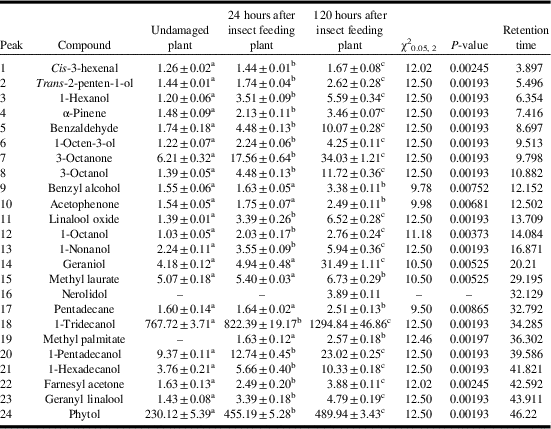
Chemical analyses of volatiles emitted from upper five leaves of undamaged, 24 and 120 hours after insect feeding bitter gourd plants revealed 22, 23, and 24 compounds, respectively (Fig. 1) (Table 1). Methyl palmitate was detected in volatiles after feeding, whereas nerolidol was identified only in volatiles 120 hours after feeding. The Levene’s test (W) for homogeneity of variance indicated that the data for total amounts of VOCs from undamaged and insect damaged plants were homogenous conforming to application of ANOVA (W=2.750; df=2, 12; P>0.05). It was observed that the total amounts of VOCs varied significantly with treatments through one-way ANOVA (F=280.226; df=2, 12; P<0.05), and the Tukey multiple pair wise comparisons test revealed that total VOCs were significantly higher in plants 120 hours after feeding followed by plants 24 hours after feeding and undamaged plants (Fig. 2). For individual VOCs in the undamaged and insect damaged bitter gourd plants, log (x+1) transformed data did not reduce the heterogeneity of variances among the groups and, therefore, the original values were used for Kruskal–Wallis nonparametric ANOVA followed by Steel–Dwass–Critchlow–Flinger multiple pair wise comparisons test. 1-Tridecanol was predominant in undamaged, 24 and 120 hours after feeding plants, accounting for 767.72±3.71, 822.39±19.17, and 1294.84± 46.86 µg/10 hours, respectively (Table 1). Phytol was the second most abundant volatile representing for 230.12±5.39, 455.19±5.28, and 489.94± 3.43 µg/10 hours in undamaged, 24 and 120 hours after feeding bitter gourd plants, respectively (Table 1). 1-Hexanol was least abundant in undamaged whole plants (1.20±0.06 µg/10 hours); whereas cis-3-hexenal was least abundant in 24 and 120 hours after feeding plants, representing for 1.44±0.01, and 1.67±0.08 µg/10 hours, respectively (Table 1). Rest of the identified VOCs were higher in plants 120 hours following continuous adult female feeding (Table 1).
Example gas chromatography flame ionisation detector chromatogram (HP-5) of volatiles collected from upper five leaves of: (A) undamaged, (B) 24 hours after insect feeding, and (C) 120 hours after insect feeding bitter gourd plants. Identification of peaks: 1. cis-3-hexenal, 2. trans-2-penten-1-ol, 3. 1-hexanol, 4. α-pinene, 5. benzaldehyde, 6. 1-octen-3-ol, 7. 3-octanone, 8. 3-octanol, 9. benzyl alcohol, 10. acetophenone, 11. linalool oxide, 12. 1-octanol, 13. 1-nonanol, 14. geraniol, 15. methyl laurate, 16. nerolidol, 17. pentadecane, 18. 1-tridecanol, 19. methyl palmitate, 20. 1-pentadecanol, 21. 1-hexadecanol, 22. farnesyl acetone, 23. geranyl linalool, and 24. phytol.

Total amounts of volatiles (mean±SE) emitted from upper five leaves of undamaged, 24 and 120 hours after insect feeding bitter gourd plants.
Gas chromatography flame ionisation detector analysis of volatile organic compounds emitted (µg/10 hours) by upper five leaves of undamaged, 24 and 120 hours after insect feeding bitter gourd plants (mean±SE, n=5).
Note: χ2 value is for Kruskal–Wallis test. Within the row means followed by different letters are significantly different by Steel–Dwass–Critchlow–Flinger multiple pair wise comparisons test with α=0.05. For identification of peaks see Fig. 1.
In Y-tube olfactometer bioassays, female E. dodecastigma attracted to VOCs released by upper five leaves of undamaged bitter gourd plants (χ2=14.4; df=1; P=0.00015) against solvent controls, and plants that had been damaged by conspecifics, for either 24 hours (χ2=42.71; df=1; P<0.0001) or 120 hours (χ2=48.4; df=1; P<0.0001) against solvent controls (Fig. 3A). However, female E. dodecastigma attracted to VOCs from a single leaf of bitter gourd plants that have been damaged by conspecifics, for either 24 hours (χ2=5.38; df=1; P=0.02037) or 120 hours (χ2=10; df=1; P=0.00157) against solvent controls, whereas females showed no preference for VOCs collected from a single leaf of undamaged plants against solvent controls (χ2=3.6; df=1; P=0.05778) (Fig. 3B).
Female Epilachna dodecastigma responses to volatiles, (A) upper five leaves of undamaged plants or plants 24 hours after insect feeding or plants 120 hours after insect feeding versus solvent (CH2Cl2) controls, (B) a single leaf of undamaged plants or plants 24 hours after insect feeding or plants 120 hours after insect feeding versus solvent (CH2Cl2) controls in Y-tube olfactometer bioassay. Numbers in brackets are the number of insects that did not respond to either treatment.
Female E. dodecastigma elicited attraction to VOCs collected from upper five leaves of bitter gourd plants damaged by conspecifics, at both 24 hours (χ2=19.6; df=1; P<0.0001) or 120 hours (χ2=19.6; df=1; P<0.0001) against VOCs collected from upper five leaves of undamaged plants (Fig. 4A); whereas females showed preference to VOCs collected from a single leaf of bitter gourd plants damaged by conspecifics, at both 24 hours (χ2=5.38; df=1; P=0.02037) or 120 hours (χ2=7.51; df=1; P=0.00614) against VOCs from a single leaf of an undamaged plants (Fig. 4B). The results indicated that volatiles from upper five leaves or a single leaf of insect-damaged plants caused higher attraction of E. dodecastigma than volatiles from upper five leaves or a single leaf of undamaged plants.
Female Epilachna dodecastigma responses to volatiles, (A) upper five leaves of an undamaged plants versus plants 24 hours after insect feeding or plants 120 hours after insect feeding, (B) a single leaf of undamaged plants versus plants 24 hours after insect feeding or plants 120 hours after insect feeding in Y-tube olfactometer bioassay. Numbers in brackets are the number of insects that did not respond to either treatment.
In Y-tube olfactory bioassays, three individual compounds, geraniol, 1-tridecanol, and phytol that are found to be characteristic of undamaged and insect damaged bitter gourd plants elicited attraction of the test insect (versus solvent controls) (Fig. 5), whereas rest of the identified 21 compounds in plants 120 hours following insect attack showed no preference to the insect. Geraniol was attractive at 30 μg (χ2=7.51; df=1; P=0.00614), and 60 μg (χ2=23.51; df=1; P<0.0001) (Fig. 5A). 1-Tridecanol showed attraction at 300 μg (χ2=5.38; df=1; P=0.02037), 600 μg (χ2=11.38; df=1; P= 0.00074), and 1200 μg (χ2=21.51; df=1; P<0.0001) (Fig. 5B). Female E. dodecastigma was attracted to phytol at 600 μg (χ2=23.51; df=1; P<0.0001) (Fig. 5C).
Female Epilachna dodecastigma responses to synthetic volatiles versus solvent (CH2Cl2) controls in Y-tube olfactometer bioassay, (A) geraniol, (B) 1-tridecanol, (C) phytol. Numbers in brackets are the number of insects that did not respond to either treatment.
Discussion
The present study demonstrated a total of 22, 23, and 24 VOCs from undamaged, 24 and 120 hours following insect attack bitter gourd plants, respectively, and 1-tridecanol was the major compound followed by phytol in undamaged and insect damaged plants; whereas 63 different compounds were identified in the oil obtained from bitter gourd aerial shrubs, accounting for 88.8% of the total oil contents, and (Z)-3-hexenol (34.7%), (E)-2-hexenol (10.1%), phytol (8.3%), and linalool (5.8%) were detected in significant amounts (Moronkola et al. Reference Moronkola, Ogunwande, Oyewole, Baser, Ozek and Ozek2009). α-Pinene (monoterpene) and geraniol (a combination of monoterpne and alcohol) were identified in the VOCs of bitter gourd leaves, and the contents were increased from undamaged plants to plants 120 hours following insect attack, but the previous studies indicated presence of linalool, which was not detected in this study (Fernando and Grün Reference Fernando and Grün2001; Moronkola et al. Reference Moronkola, Ogunwande, Oyewole, Baser, Ozek and Ozek2009). The major VOCs emitted by fruits and vines of bitter gourd have been found to contain myrtenol, (Z)-3-hexenol, benzyl alcohol, 1-penten-3-ol, (Z)-2-pentenol, (E)-2-hexenal, and cis-sabinol, and the volatiles elicited attraction of the fly Dacus cucurbitae (Binder et al. Reference Binder, Flath and Mon1989). This study indicated presence of cis-3 hexenal, trans-2-penten-1-ol, 1-hexanol, and benzyl alcohol and many other compounds that were also identified in previous studies (Fernando and Grün Reference Fernando and Grün2001; Moronkola et al. Reference Moronkola, Ogunwande, Oyewole, Baser, Ozek and Ozek2009), but VOCs emitted from undamaged and insect damaged bitter gourd plants have not been reported previously in literature. The steam volatile constituents of bitter gourd seed oils indicated presence of seven acidic compounds, 19 n-parafins, alcohols, and terpenoids (Ishikawa et al. Reference Ishikawa, Kikuchi, Iida, Seto, Tamura and Matsumoto1985), whereas p-cymene, nerolidol, squalene and aliphatic aldehydes and alcohols were detected in steam volatile constituents of bitter gourd seeds (Kikuchi et al. Reference Kikuchi, Ishikawa, Seto, Tamura and Matsumoto1992). This study demonstrated presence of 10 alcohols, two aldehydes, two ketones, aliphatic compounds, and terpenoids in the bitter gourd leaves. The headspace-GC/MS analysis of odoriferous compounds of bitter gourd flowers revealed four key odoriferous compounds, 1H-indole (33%), methyl anthranilate (27%), 2-aminobenzaldehyde (27%), and linalool (5%) (Fernando and Grün Reference Fernando and Grün2001), but none of these compounds were detected in this study.
In this study, the total amounts of volatiles were significantly higher in plants 120 hours after feeding followed by plants 24 hours after feeding and undamaged bitter gourd plants (Paré and Tumlinson Reference Paré and Tumlinson1996; Röse et al. Reference Röse, Manukian, Heath and Tumlinson1996; Magalhães et al. Reference Magalhães, Borges, Laumann, Sujii, Mayon and Caulfield2012). The volatile compounds, 1-hexanol, benzaldehyde, 3-octanone, 3-octanol, geraniol, 1-tridecanol, 1-pentadecanol, 1-hexadecanol, and phytol constituted major VOCs of insect damaged bitter gourd plants.
The olfactometric bioassay results clearly demonstrated that the test insect, E. dodecastigma could discriminate between the whole volatile blends released from conspecific-damaged bitter gourd plants and those released from undamaged bitter gourd plants, and preferentially respond to the former. But, whole volatile blends from a single leaf of undamaged bitter gourd plants were not attractive to the insect, whereas whole volatile blends from a single leaf of insect damaged plants were attractive to the insect. This implies that E. dodecastigma attack in bitter gourd plants might cause further attraction of the insect in the field, which ultimately would reduce crop production. Methyl palmitate was detected following insect attack, whereas nerolidol was recorded in volatiles 120 hours after feeding; though these two compounds did not indicate any attraction to the insect. Attraction of E. dodecastigma to conspecific-damaged bitter gourd plants indicated increased emissions of several compounds that were also present in whole volatile blends of undamaged plants as well, including benzyl alcohol. It is well established that benzyl alcohol might play an important role in plant defense induced by herbivory such as facilitating attraction of natural enemies to the insect pest (De Moraes et al. Reference De Moraes, Lewis, Paré, Alborn and Tumlinson1998; Tabata et al. Reference Tabata, De Moraes and Mescher2011). This compound was released in greater amounts by plants 120 hours after E. dodecastigma feeding than by undamaged and 24 hours after feeding plants (as seen in Table 1). The present olfactory bioassay result demonstrated no significant attraction of the test insect to synthetic benzyl alcohol when this compound was tested in isolation. Further, benzaldehyde, 3-octanol, 3-octanone, 1-pentadecanol, and 1-hexadecanol differed in an order of magnitude from undamaged plants to 120 hours post feeding (as seen in Table 1), but did not elicit attraction of beetles in Y-shaped olfactometer bioassays. However, the attraction to the overall blend of plant-derived VOCs released by insect damaged plants cannot be ruled out, as insect responses to olfactory foraging cues depend on overall volatile blend rather than on attraction of individual compounds (Riffell et al. Reference Riffell, Lie, Christensen and Hildebrand2009; Webster et al. Reference Webster, Bruce, Pickett and Hardie2010).
In summary, our findings document that herbivore feeding results in increased emissions of the total amount of volatile compounds. Feeding by E. dodecastigma resulted in differences of volatile productions compared to undamaged and insect damaged plants, and the female beetles significantly responded to volatiles from plants 24 hours following insect attack than from undamaged bitter gourd plants. Such studies may facilitate the development of much needed eco-friendly trapping tools for pest management of E. dodeacstigma. However, further studies are needed to observe whether feeding by other herbivores to the bitter gourd plants induces greater production of volatiles.
Acknowledgements
The authors thank Dr. Poorani Janakiraman, National Bureau of Agriculturally Important Insects (formerly PDBC), Karnataka, India for identifying the insects. They thank two anonymous reviewers for helpful comments on earlier versions of the manuscript. The financial assistance from the Department of Science and Technology (DST) (SR/FT/LS-85/2009), India as a Fast Track proposal is gratefully acknowledged.