


The 1978 World Cup was a gold brooch for repression, a mundial that was made to wash the faces of the murderers … in front of the world.
—Mabel Gutierrez, Argentine human rights activistIntroduction
International sports events such as the Olympic Games or the FIFA World Cup attract unparalleled global media attention. For example, the 2016 Summer Olympics in Rio de Janeiro were followed by about half the world’s population. To host governments, such publicity offers the unique opportunity to boost their reputation and their international standing. In recent years, sports megaevents have become increasingly attractive to autocratic regimes (Brancati and Wohlforth Reference Brancati and Wohlforth2021). Examples include the Olympic Games hosted by China (2008, 2022) and Russia (2014), the Handball Championship in Egypt (2021), and the Football World Cup in Qatar (2022). However, for autocratic governments, hosting international tournaments also entails risks (Cha Reference Cha2009). Foreign journalists who accompany international sports events may investigate human rights violations and openly criticize those in charge. In the worst case, the regime loses its legitimacy while the world is watching. How do autocrats solve this fundamental dilemma between scrutiny and publicity?
This article reveals how authoritarian host regimes seek to benefit from the publicity of international sports events while reducing the costs of scrutiny by foreign media. We argue that regimes strategically adjust their repressive activities around tournaments to minimize the risk of both international pillorying and domestic dissent. We expect that host regimes adapt levels of violence across time and space: (1) in the run-up to the tournament, illiberal regimes are likely to escalate repression in host cities to clear the streets of potential dissidents, and (2) during the event itself, we expect that hosts largely refrain from using overt violence to convey the image of a liberal regime. In producing this Potemkin village, autocrats try to keep threats to their rule in check while reaping the benefits from international sports events.
We systematically test our hypotheses with the 1978 FIFA World Cup in Argentina. The tournament was particularly controversial because Argentina was under the rule of a military dictatorship that had disappeared thousands of alleged subversives since it seized power in 1976. For the junta, much was at stake. The generals sought to maintain their tight grip on the opposition but also market themselves as peace-loving hosts. To prevent both negative reporting and domestic resistance, the regime had to decide when and where repression should be increased or decreased.
Using original archival material on the organization of the 1978 World Cup in conjunction with unique geolocated, day-level repression data, we find empirical support for both of our hypotheses. The analysis of enforced disappearances and killings in the context of the tournament reveals the details of the junta’s repressive strategy. In the months before the start of the World Cup, the regime launched a deadly campaign in host cities to eliminate dissidents and deter potential troublemakers. During the World Cup, in turn, it halted its repressive operations in order not to give the assembled world press a lead for criticism.
To probe our mechanism, we provide a wide range of additional qualitative and quantitative evidence. We particularly scrutinize whether changes in state violence were indeed driven by the junta’s concerns about international media presence during the World Cup. Results from our high-resolution analyses show that the Argentine regime strategically adjusted repression in terms of location, timing, and type of violence: repressive adjustment was particularly pronounced in locations in direct proximity to the 74 hotels reserved for foreign journalists, the temporal targeting pattern changed in line with the working hours of international media representatives, and covert disappearances increasingly replaced overt killings in the run-up to the World Cup. Furthermore, we show that the media-induced constraints on the use of repression during the tournament also influenced local levels of repression after the international reporters had left the country.
This article presents the first systematic investigation of the influence of international megaevents on the local dynamics of state repression. The findings contribute to several research streams. First, we offer new insights into the nexus between politics and sports (e.g., Alrababa’h et al. Reference Alrababa’h, Marble, Mousa and Siegel2021; Bertoli Reference Bertoli2017; Bowersox Reference Bowersox2018; Brancati and Wohlforth Reference Brancati and Wohlforth2021; Miguel, Saiegh, and Satyanath Reference Miguel, Saiegh and Satyanath2011; Orttung and Zhemukhov Reference Orttung and Zhemukhov2017). Second, the study adds to our understanding of how authoritarian regimes maintain political stability (e.g., Dukalskis Reference Dukalskis2021; Geddes, Wright, and Frantz Reference Geddes, Wright and Frantz2018; Gerschewski Reference Gerschewski2013; Svolik Reference Svolik2012). Third, by theorizing the influence of foreign media attention on the survival strategies of illiberal regimes, we inform debates about international naming and shaming (e.g., DeMeritt Reference DeMeritt2012; Keck and Sikkink Reference Keck and Sikkink1998; Strezhnev, Kelley, and Simmons Reference Strezhnev, Kelley and Simmons2021), press freedom and the escalation of violence (Carey and Gohdes Reference Carey and Gohdes2021; Carey, González, and Mitchell Reference Carey, González and Mitchell2021; Whitten-Woodring Reference Whitten-Woodring2009), regime propaganda (e.g., Gläßel and Paula Reference Gläßel and Paula2020; King, Pan, and Roberts Reference King, Pan and Roberts2017; Roberts Reference Roberts2018), and preemptive repression (e.g., Danneman and Ritter Reference Danneman and Ritter2014; Dragu and Przeworski Reference Dragu and Przeworski2019; Ritter and Conrad Reference Ritter and Conrad2016; Truex Reference Truex2019). Finally, the article complements a growing literature on the microdynamics of state violence (e.g., Balcells and Sullivan Reference Balcells and Sullivan2018; Hassan and O’Mealia Reference Hassan and O’Mealia2018; Osorio, Schubiger, and Weintraub Reference Osorio, Schubiger and Weintraub2018; Rozenas, Schutte, and Zhukov Reference Rozenas, Schutte and Zhukov2017; Scharpf and Gläßel Reference Scharpf and Gläßel2020).
The Benefits of Hosting International Sports Events
Hundreds of international sports tournaments take place each year. This article focuses on sports megaevents, “which have a dramatic character, mass popular appeal and international significance” (Roche Reference Roche2000, 1). Well-known examples are the Summer and Winter Olympics as well as the world championships in basketball, cricket, handball, hockey, and football. Among these, football (soccer) is by far the single most popular sport. Every four years, the FIFA World Cup reaches the highest viewing figures and generates the largest broadcasting revenues across the globe (Harris Reference Harris2010). For example, an estimated 3.5 billion people watched the 2018 World Cup in Russia, with coverage by 1,964 international journalists and 730 photographers (FIFA 2018).
A significant number of international sports events are hosted by autocratic regimes. Figure 1 shows that the share of autocracies among host nations has risen from 8% after the end of the Cold War to 37% in 2020. To autocratic regimes, international sports events offer outstanding opportunities but also pose serious risks. Next, we detail how international sports events influence the three pillars of authoritarian stability in order to explain why hosting autocrats may want to strategically adjust repression.
Autocratic Hosts of International Sports Events, 1990–2024
Note: Graph shows the five-year shares of autocratic states among all hosting nations of the world championships in athletics, basketball, cricket, football, handball, ice hockey, rugby, table tennis, and volleyball, as well as the Summer and Winter Olympics. See Figure SI.1.1 for a breakdown of all tournaments and hosts since 1945.

Research agrees that authoritarian governments are ultimately driven by their desire to stay in office (e.g., Bueno De Mesquita et al. Reference De Mesquita, Bruce, Siverson and Morrow2003; Frantz Reference Frantz2018; Wintrobe Reference Wintrobe1998). In the absence of free and fair elections, autocrats face the dual threat of revolutions and coups (Geddes, Wright, and Frantz Reference Geddes, Wright and Frantz2018; Greitens Reference Greitens2016; Svolik Reference Svolik2012). To reduce the risk of challenges from the masses and the elites, most autocrats rely on a combination of repression, legitimation, and cooptation (Brownlee Reference Brownlee2007; Gandhi Reference Gandhi2008; Gerschewski Reference Gerschewski2013; Magaloni Reference Magaloni2006). Repression is designed to withhold the resources required to challenge the government (Davenport Reference Davenport2007; DeMeritt Reference DeMeritt and Thompson2016). Legitimation strategies seek to increase citizens’ support for the government’s rule (Dukalskis Reference Dukalskis2021; Gerschewski Reference Gerschewski2013; Tannenberg et al. Reference Tannenberg, Bernhard, Gerschewski, Lührmann and Von Soest2021). Finally, cooptation seeks to increase loyalty by tying influential actors to the regime (Gerschewski Reference Gerschewski2013; Wintrobe Reference Wintrobe1998). Hosting an international sports tournament such as the Olympics or the FIFA World Cup affects all three pillars of autocratic stability in distinct ways.
From the perspective of autocratic hosts, major sports events promise benefits in legitimacy and cooptation. First, hosting an international sports event is likely to generate unique opportunities for cooptation. Megaevents require huge investments, which allows authoritarian governments to strategically allocate large sums of money to key elites. By distributing perks, privileges, or posts, autocrats can buy off rivals and reward loyal supporters (e.g., Gandhi and Przeworski Reference Gandhi and Przeworski2006; Magaloni Reference Magaloni2006; Wintrobe Reference Wintrobe1998). For example, Russian President Vladimir Putin provided his cronies with lucrative construction contracts for the 2014 Winter Olympics in Sochi (Orttung and Zhemukhov Reference Orttung and Zhemukhov2017; Pomerantsev Reference Pomerantsev2014). Such strategic channeling of funds enables autocrats to tie elites to the regime and thus ensure its longevity (Bove and Rivera Reference Bove and Rivera2015; McMillan and Zoido Reference McMillan and Zoido2004).
Second, the successful organization of an international sports event may also boost the government’s legitimacy both at home and abroad (Bowersox Reference Bowersox2018). Domestically, victories of national sports teams can have a positive effect on people’s evaluation of their government (Busby, Druckman, and Fredendall Reference Busby, Druckman and Fredendall2017; Healy, Malhotra, and Mo Reference Healy, Malhotra and Mo2010). Megaevents may also increase national pride (Bertoli Reference Bertoli2017; Depetris-Chauvin, Durante, and Campante Reference Depetris-Chauvin, Durante and Campante2020; Rosenzweig and Zhou Reference Rosenzweig and Zhou2021).Footnote 1 Leaders can use these positive effects to consolidate their regimes. For example, even Nelson Mandela, the first democratic president of South Africa, used the hosting of the rugby World Cup in 1995 to unite the population behind the national team—the Springboks—which had long been seen as the embodiment of the Apartheid system (Carlin Reference Carlin2008; Steenveld and Strelitz Reference Steenveld and Strelitz1998). This suggests that international sports events can increase domestic unity and support for the regime in power.
Internationally, hosts can use the publicity of sports events to improve their prestige and standing. This is particularly advantageous for leaders who face criticism for their undemocratic rule or poor human rights record. Both Benito Mussolini and Adolf Hitler, the hosts of the 1934 World Cup and the 1936 Summer Olympics, respectively, used the powerful images of cheering crowds in ultramodern stadiums to showcase their claims of technological and cultural superiority (Bachrach Reference Bachrach2000; Martin Reference Martin2004; Tomlinson and Young Reference Tomlinson and Young2006). Today, host regimes of international sports events devote significant amounts of their budgets to image campaigns in the hopes of advancing their international reputation, attracting foreign investment, and boosting tourism (Burbank, Andranovich, and Heying Reference Burbank, Andranovich and Heying2001; Knott, Fyall, and Jones Reference Knott, Fyall and Jones2015; Kobierecki and Strożek Reference Kobierecki and Strożek2017).Footnote 2 Taken together, the positive effects on cooptation and legitimacy provide autocrats with great incentives to host international sports tournaments.
The Risks of Hosting International Sports Events
Notwithstanding the potential benefits in legitimacy and loyalty, international sports events can be politically dangerous. For autocratic host regimes, extensive international media attention during an international megaevent may backfire. The risk of backlash is particularly high when foreign media starts to critically examine the political situation in the host country. International journalists may put a spotlight on corruption, criticize undemocratic governance, and denounce the government’s human rights violations (Cha Reference Cha2009). Such reporting may trigger public outcry and condemnations by international organizations and human rights groups. Research suggests that naming and shaming campaigns have the potential to delegitimize regimes, forcing autocrats to show more restraint toward the opposition and to make political concessions (e.g., DeMeritt Reference DeMeritt2012; Keck and Sikkink Reference Keck and Sikkink1998; Strezhnev, Kelley, and Simmons Reference Strezhnev, Kelley and Simmons2021).
Dissidents and opposition groups, in turn, may use the international spotlight around sports tournaments to raise awareness for their cause. Extensive media coverage and the presence of international journalists might incentivize activists to voice their grievances in the hope of generating wider solidarity (Gitlin Reference Gitlin2003; Tufekci Reference Tufekci2017). In addition, international sports events present an opportunity for spurring mobilization. Opposition leaders have good reason to hope that their calls for antiregime protests or boycotts will be more successful than usual: security forces are more likely to shy away from excessive force in front of the world press, and with more people in the streets, it becomes safer for bystanders to join, which allows antiregime movements to reach a critical mass (DeNardo Reference DeNardo1985). Autocrats must therefore fear that dissident and opposition movements will gain momentum during international sports events, making them more difficult to quash later on.
The 1988 Olympic Games in Seoul demonstrate how the media pressure accompanying international sports events can contribute to the breakdown of autocratic host regimes (Cha Reference Cha2009). At the time, the military junta under General Chun Doo-hwan confronted a growing democracy movement. In the spotlight of the assembled world press, Chun shied away from putting down the protests. Instead, he agreed to democratic elections that not only ended his presidency but also decades of de facto military rule. The example illustrates the scrutiny–publicity dilemma for illiberal host regimes: although international sports tournaments promise heightened prestige, they force autocrats to forgo repressive practices. This article reveals how autocratic regimes attempt to solve this dilemma. We argue that, in the context of an international megaevent, autocrats adjust their repression to portray themselves as peace-loving to the world without risking the loss of control at home.
The Strategic Adjustment of Repression around International Sports Events
In this section, we explain how international sports events shape repression by authoritarian host regimes. We start with the assumption that illiberal regimes seek to maximize their chances of survival (Bueno De Mesquita et al. Reference De Mesquita, Bruce, Siverson and Morrow2003). Autocratic hosts are also assumed to anticipate heightened media attention during sports megaevents and to be aware of opposition groups’ incentives to voice their dissent (Carter and Carter Reference Carter and Carter2020). We argue that autocrats solve this dilemma by adapting repression to tournament schedules with the intent of minimizing both the risk of international condemnation and the occurrence of domestic upheaval.
To formulate testable hypotheses on the adjustment of repression, we analytically disaggregate time and space. On the temporal dimension, we distinguish between the phase before the sports event with a comparably low presence of foreign journalists and the actual tournament period, during which the host country harbors the world press. On the spatial dimension, we differentiate between host cities, where sports events take place and media presence is high, and cities outside of the spotlight where no events take place.
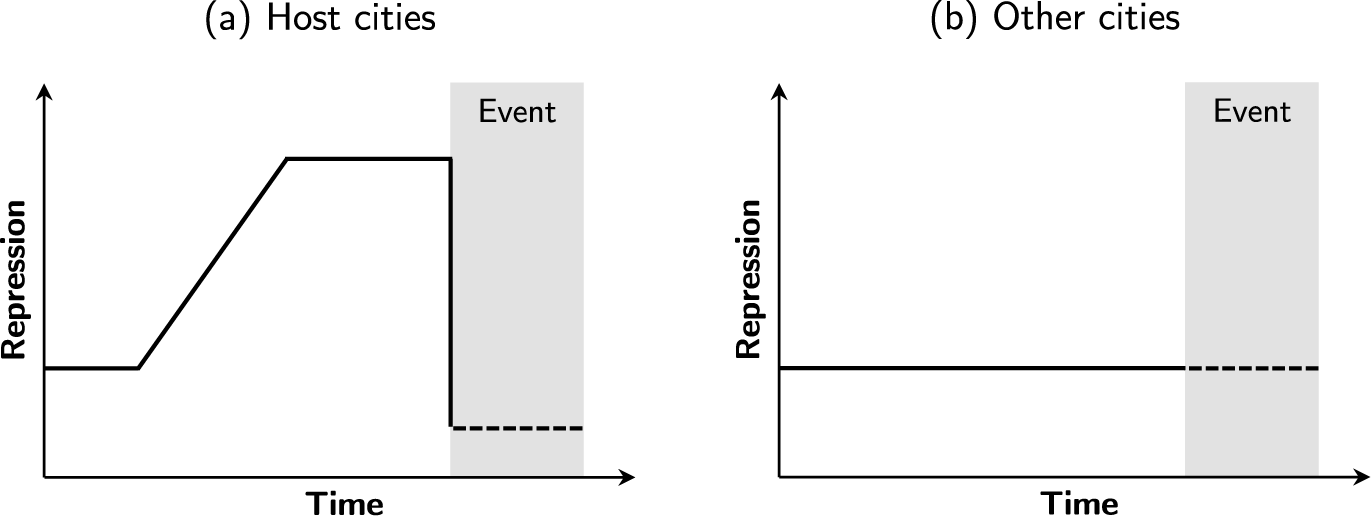
In short, we expect that regimes seek to minimize overt repression during the ongoing tournament. Yet, as this might invite dissidents to challenge the regime, autocrats are likely to preemptively clear host cities in the run-up to the tournament. Figure 2 visually summarizes our theoretical expectations. Next, we detail the way in which host regimes strategically adjust repression before and during international sports events.
Strategic Adjustment of Repression within a Host Country
Note: Graph shows temporal repression patterns in host versus nonhost cities. We expect that governments adjust repression in cities with tournament venues and a high presence of international journalists. Panel (a) shows that repression should drop during the tournament but spike right before it. We do not expect to see such adjustment in cities that are not part of the tournament and thus lack the presence of international journalists, as shown in Panel (b).

Pretournament Period
During a tournament, autocratic hosts have their hands tied, as the massive international media presence constrains the possibilities of repression. Without precautionary measures before the tournament, autocrats risk that the opposition will publicly expose their regime’s illiberal nature in front of the world press. In anticipation of this looming threat, remaining idle is not a viable option. Therefore we argue that autocrats engage in preemptive violence to avoid any embarrassment during the tournament. Preemptive repression can work in two ways (Ritter and Conrad Reference Ritter and Conrad2016). First, autocrats may cripple the mobilization capacity of opposition groups by removing the informational, material, and human resources necessary to challenge the regime (DeMeritt Reference DeMeritt and Thompson2016). The idea is to detect and destroy resistance networks and opposition movements before they become manifest. In the most extreme case, this involves the physical destruction of individuals or groups (Rozenas, Schutte, and Zhukov Reference Rozenas, Schutte and Zhukov2017).
Second, autocratic host regimes may use preemptive repression to undermine people’s willingness to challenge the regime. The autocrat’s goal is to discourage public resistance and deter would-be protesters by instilling fear. By clearing the streets of troublemakers and subversives, regimes can expect to send a clear message to those who consider disrupting the games (Ritter and Conrad Reference Ritter and Conrad2016). Especially torture and enforced disappearances are known to intimidate and terrorize bystanders into submission (Conrad et al. Reference Conrad, Conrad, Walsh and Piazza2017). Such forms of state violence show potential protesters the grave consequences should they challenge the regime. Moreover, this deterrence effect may even reach beyond the consideration of one’s personal security.
Closely resembling the effect of hostage taking, disappearances and unexpected arrests can give regimes leverage over entire dissident organizations. Members of these organizations may believe that—while the regime holds their comrades captive—refraining from public dissent can improve the fate of the arrested and will make their release from captivity more likely. That is, although preemptive repression might well exacerbate grievances within opposition networks, these measures can effectively undercut the short-term mobilization capacity and the willingness of groups to challenge the regime (Sullivan Reference Sullivan2016). As part of their preemptive repression strategy, regimes thus often rely on “catch-and-release” tactics (Truex Reference Truex2019). If these tactics succeed, targeted dissident networks shy away from acts of resistance when the tournament is ongoing.
To avoid repression sparking rather than quelling mobilization (Ritter and Conrad Reference Ritter and Conrad2016; Sutton, Butcher, and Svensson Reference Sutton, Butcher and Svensson2014), autocrats must ensure that their preemptive measures either effectively incapacitate or at least discourage dissident activity. Thus, autocratic hosts are likely to adopt a “better-safe-than-sorry” approach. Should the regime fail to undercut individual opposition networks, resistance is likely to appear during the tournament when the international press is closely covering the events. In the worst case, the regime has to crack down on peaceful protesters when the whole world is watching, with potentially grave consequences for the regime’s image and stability (Sutton, Butcher, and Svensson Reference Sutton, Butcher and Svensson2014). Autocrats are therefore likely to ramp up repression before international sports events in the hope of eliminating any source of resistance.
For an autocratic regime, the incentive to use such preemptive clearing is particularly high in cities that will host competitions. These are the places where most journalists are present and thus where resistance acts are most likely to receive media coverage. Therefore, the government has an interest in ensuring quiescence through preemptive repression in host cities. In contrast, in cities without competitions, where the presence of international journalists is low, the regime has more leeway in countering opposition groups even when the tournament is ongoing. As a result, autocrats have little incentive to escalate preemptive repression in nonhost cities.
Hypothesis 1: In the run-up to an international sports tournament, state repression spikes in host cities, but not in other cities.
Tournament Period
During the tournament, host governments have a strong incentive to refrain from employing repression. Research shows that violence against peaceful opposition members, protesters, or activists causes public outrage and is often met with condemnation by human rights groups or international organizations, who observe state violence from the sidelines (Chenoweth and Stephan Reference Chenoweth and Stephan2012; DeMeritt Reference DeMeritt2012). For autocrats, the risk of being named and shamed is particularly high during the ongoing tournament, when journalists provide their audience with daily updates. Reports about torture, disappearances, or killings quickly find their way into headlines. Host regimes must fear that observable wrongdoings will end up in the news, which threatens their desired image of a friendly and peaceful host.
The risk of bad publicity is particularly high when repression occurs right in front of the cameras of the assembled world press. Pictures of heavy-handed security operations are likely to spread like wildfire, with unpredictable consequences for the regime’s domestic legitimacy and international reputation. Autocratic hosts are thus likely to curb overt forms of state repression in places with high media presence. In Nazi Germany, for example, the regime “briefly suspended” its “campaign against Jews” during the 1936 Summer Olympics to maintain a facade of hospitality (Bachrach Reference Bachrach2000, 85). The newsstand owners of Berlin, where the Games took place, were even ordered to remove the anti-Semitic Nazi smear sheet Der Stürmer from their shelves in order not to alienate the international guests.
Hypothesis 2: During an international sports tournament, state repression drops in host cities but remains unchanged in other cities.
The 1978 FIFA World Cup in Argentina
We empirically test our hypotheses with the case of the 1978 FIFA World Cup in Argentina. Between June 1st and 25th, 16 national teams from five continents competed for the most coveted title in world football. The tournament took place in five cities: the capital Buenos Aires, Córdoba and Rosario in central Argentina, Mar del Plata on the Atlantic coast, and Mendoza on the border with Chile. Although a record-breaking 500 million people witnessed the Argentine team’s win in the final against the Netherlands, the tournament went down in history as one of the most controversial international sports events.
In 1978, Argentina was ruled by a repressive military dictatorship. For the regime under President Jorge Videla, the approaching World Cup presented a scrutiny–publicity dilemma. Although the junta saw the World Cup as a unique opportunity to improve its tarnished image, it also feared that political opponents would hijack the attention of the international press to undermine the regime’s legitimacy.
Political Context
Argentina was selected to host the 1978 World Cup in 1966. The 12 years between the awarding of the tournament and the opening match were marked by economic and political turbulence. Since the late 1960s, two left-wing insurgent groups called “Ejército Revolucionario del Pueblo” and “Montoneros” had kidnapped and assassinated politicians and business representatives. The military interpreted these attacks as part of a world communist conspiracy that sought to infiltrate Argentine society, cripple the economy, and destroy the state (Gläßel, González, and Scharpf Reference Gläßel, González and Scharpf2020; Scharpf Reference Scharpf2018). To stop the chaos, the military staged a coup in May 1976 and implemented a ruthless terror campaign, killing thousands of alleged subversives (Klor, Saiegh, and Satyanath Reference Klor, Saiegh and Satyanath2020; Pion-Berlin and Lopez Reference Pion-Berlin and Lopez1991; Scharpf and Gläßel Reference Scharpf and Gläßel2020).
The government’s brutal persecution of supposed dissidents provoked strong criticism and condemnation from the international community. For example, on June 20, 1976, the French newspaper Le Monde published a protest note by influential European politicians accusing the Argentine junta of gross human rights violations. Later that year, the United Nations passed a resolution that installed a task force to investigate the disappearances (Lewis Reference Lewis2002, 188).
The World Cup as a Unique Public Relations Opportunity
The Argentine military government saw the hosting of the 1978 FIFA World Cup as a unique opportunity to counter its negative image (Duke and Crolley Reference Duke and Crolley2014). The junta wanted to use the unprecedented media attention “to impress their own people and the world” (Kuper Reference Kuper2011, 176). To do this, they would have to showcase hospitality and deliver a well-organized tournament without any disruption. Right after taking power, the regime therefore issued decree No. 21.349, which made the World Cup a matter of national interest and established the new organizing committee “Ente Autárquico Mundial 78” (EAM). The EAM was staffed with high-ranking retired officers and equipped with vast financial resources estimated at $700 million (Canelo Reference Canelo2018).
In addition, the Argentine junta commissioned the American public relations (PR) company Burson-Marsteller to cast the regime in a positive light (Pears Reference Pears2006). In their application brochure, the firm detailed the goals associated with their services: “The Videla administration must project a new progressive and stable image throughout the world […] and a successful exploitation of the World Cup can and should make Argentina famous” (Sagaian Reference Sagaian2018a). Burson-Marsteller considered the “enormous [media] coverage of the World Cup” as the country’s “unique opportunity to present itself to the whole world” (Sagaian Reference Sagaian2018a). However, these high hopes were threatened by the fact that the World Cup would also offer opposition groups the chance to catch the attention of international reporters, voice their grievances, and thus exacerbate the junta’s image problem.
International Media and the Junta’s Fears of a Public Relations Disaster
From the perspective of the Argentine junta, the influx of thousands of foreign journalists posed a significant risk of turning the World Cup into a PR disaster. Argentina’s domestic media were under tight government control, and critical reporting was largely absent.Footnote 3 Following the junta’s narrative, domestic journalists denounced international allegations about human rights violations as an “unfounded anti-Argentine smear campaign” (Acevedo Reference Acevedo2018). In contrast, the junta lacked control over the thousands of international reporters that would come to cover the World Cup. Figure 3 shows that among those countries with the highest number of internationally accredited journalists, two-thirds were liberal democracies with a tradition of free and independent reporting. During the tournament, the generals would thus confront reporters who were used to covering opposition campaigns and unearthing government wrongdoing.
Accredited International Journalists by Country
Note: Graph shows the top sending countries of foreign journalists accredited at the end of 1977 (EAM 1977).

In the months before the World Cup, various international newspapers and human rights organizations had already criticized Argentina’s role as a host (Jiménez Botta Reference Botta and Felix2016). For example, Amnesty International had launched a campaign to raise awareness of the Argentine state terror and to exert pressure on the regime. In France, a large group of journalists and Argentine exiles had founded the Committee for the Boycott of the World Cup under the motto “No football amidst concentration camps” (Relano Reference Relano1978). And in various other European countries, people publicly protested the approaching tournament (Rein Reference Rein, Rinke and Schiller2014).
On top of the international criticism, the junta feared that the world press would offer the domestic opposition a unique stage to undermine the regime. In 1977, one year before the Cup, the Madres de Plaza de Mayo organized to denounce the government’s campaign of state terror. Moreover, one of the insurgent groups had survived the junta’s heavy crackdown and announced its intention to use the tournament for propaganda (Sagaian Reference Sagaian2018c). Afraid of a looming PR disaster, the government decided to do everything possible to prevent reports that could tarnish the carefully painted “image of ‘peace’ and ‘tranquility’” during the World Cup (Sagaian Reference Sagaian2018c).
Public Evaluations of Argentina’s Role as Host of the World Cup
Public evaluations of the 1978 World Cup suggest that the tournament was a success for the Argentine junta. According to an Argentine journalist at the time, the regime’s strategy around the World Cup generated an “exaltation of nationality” (Verrina Reference Verrina2018). Former U.S. Secretary of State Henry Kissinger praised the regime for “projecting an excellent image of Argentina to the world” (Sagaian Reference Sagaian2018b). Likewise, Berti Vogts, the captain of the German national team, noted that “Argentina is a country where order reigns, and I did not see a single political prisoner” (Rein and Davidi Reference Rein and Davidi2009, 677). And even the international football reporters were excited about “how happy the people of Argentina were” (Pears Reference Pears2006). As the historian Jiménez Botta (Reference Botta and Felix2016, 2) put it, the tournament “propelled the junta to the peak of its popularity and power.” How did the regime manage such deception?
Research Design, Data, and Method
To assess whether the Argentine junta strategically adjusted its repression according to the schedule of the 1978 FIFA World Cup, we compile an original dataset at the department-day level.Footnote 4 It comprises information about all acts of state violence in Argentina during the three months before the World Cup (March 1–May 31) and the 25 days of the tournament itself (June 1–25).Footnote 5
Our dependent variable is repression, which captures the junta’s violence based on the National Commission on the Disappearance of Persons (CONADEP 1984). We draw on the 2016 update of the report, which offers the most comprehensive source of data on acts of state violence during Argentina’s last dictatorship. Using information on location and time, the dependent variable counts the daily number of all recorded disappearances and killings within each department, which we analyze with negative binomial regression models with robust and clustered standard errors.Footnote 6 Although CONADEP (1984) offers information at an extraordinarily high temporal and spatial resolution, victim numbers might be underreported (Brysk Reference Brysk1994).Footnote 7 However, if true, the undercounting of victims should bias the results against our hypotheses. Research on reporting biases agree that media presence increases the likelihood that instances of political violence are recorded (Davenport and Ball Reference Davenport and Ball2002; Weidmann Reference Weidmann2016). We hypothesize that state repression spikes when media attention is low and thus the risk of undercounts is high. We should thus be less likely to find evidence for Hypothesis 1. Similarly, during the tournament, when international media attention is at its maximum, victims are most likely to be recorded. Again, this implies that we should be less likely to find support for Hypothesis 2.
Our explanatory variables capture both time and space. On the temporal dimension, the variable Time is a running number of days, starting from March 1 through June 25. Its quadratic term
 $ {Time}^2 $
accounts for the inverted U-shaped relationship stated by Hypotheses 1 and 2.Footnote 8 On the spatial dimension, we distinguish between host and nonhost venues at the department level. The variable Host City indicates whether a given department includes a host city (coded as 1) or not (coded as 0).Footnote 9 To capture the hypothesized dynamics of repression in host and nonhost cities before and during the tournament, we interact Host City with Time and
 $ {Time}^2 $
, respectively.
To account for potential confounders, we collect information on various pretreatment, department-level control variables that might have affected both the selection of host cities at the end of 1974 and repression patterns across departments in 1978. From the 1970 Argentine census, we include Literacy Rate as a proxy for socioeconomic composition and Population Size to capture differences in the potential breeding ground for subversion. As the selection of host cities might have been influenced by visible opposition to the dictatorship, we also control for departments’ Peronist Vote Share in the 1973 elections—the last national election before the junta took power. We also include the variable Rebel Activity, which is based on the collection of original data on insurgent attacks in 1974, using published statements by security forces and the insurgent groups. To account for pre-World Cup trends in violence, we add Past Repression, which measures the history of state repression in each department between 1970 and 1977. Finally, we include fixed effects for military zones to control for subnational features of Argentina’s repressive system (Scharpf Reference Scharpf2018).
Results
How do international sports events shape repression in authoritarian host countries? We have argued that autocratic hosts of international sports events strategically adjust repression according to the tournament schedule. Figure 4 provides initial descriptive evidence for the Argentine junta’s strategy around the 1978 FIFA World Cup. It shows that the military dictatorship largely refrained from using repression in host cities during the event but escalated violence in the run-up to the Cup. This suggests that the regime calibrated its violence to prevent any disruption or embarrassment.
Repression before and during the 1978 FIFA World Cup
Note: Gray bars show raw counts of daily repression events in departments with host cities. Black line gives five-day moving average.

Quantitative Evidence on the Strategic Adjustment of Repression
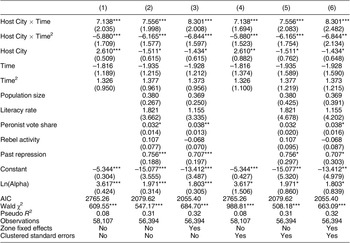
The descriptive evidence is corroborated by the statistical analyses. Results in Table 1 are in line with our theoretical expectations that (1) in the run-up to the World Cup, repression spiked within host cities but not in others and that (2) during the tournament, state violence essentially stopped across the country. The coefficients of both interaction terms are in the expected direction and statistically significant (p
 $ < $
0.01). The positive coefficient of the interaction between Host City and Time and the negative coefficient of the interaction between Host City and
 $ {Time}^2 $
indicate that repression in host cities first went up and then again dropped. Next, we calculate substantive effects to gauge the overall effect of the nonlinear interaction.
Repression in Departments with and without Host Cities

Note: Values are coefficients with robust standard errors in parentheses. †p < 0.10, *p < 0.05, **p < 0.01, ***p < 0.001.
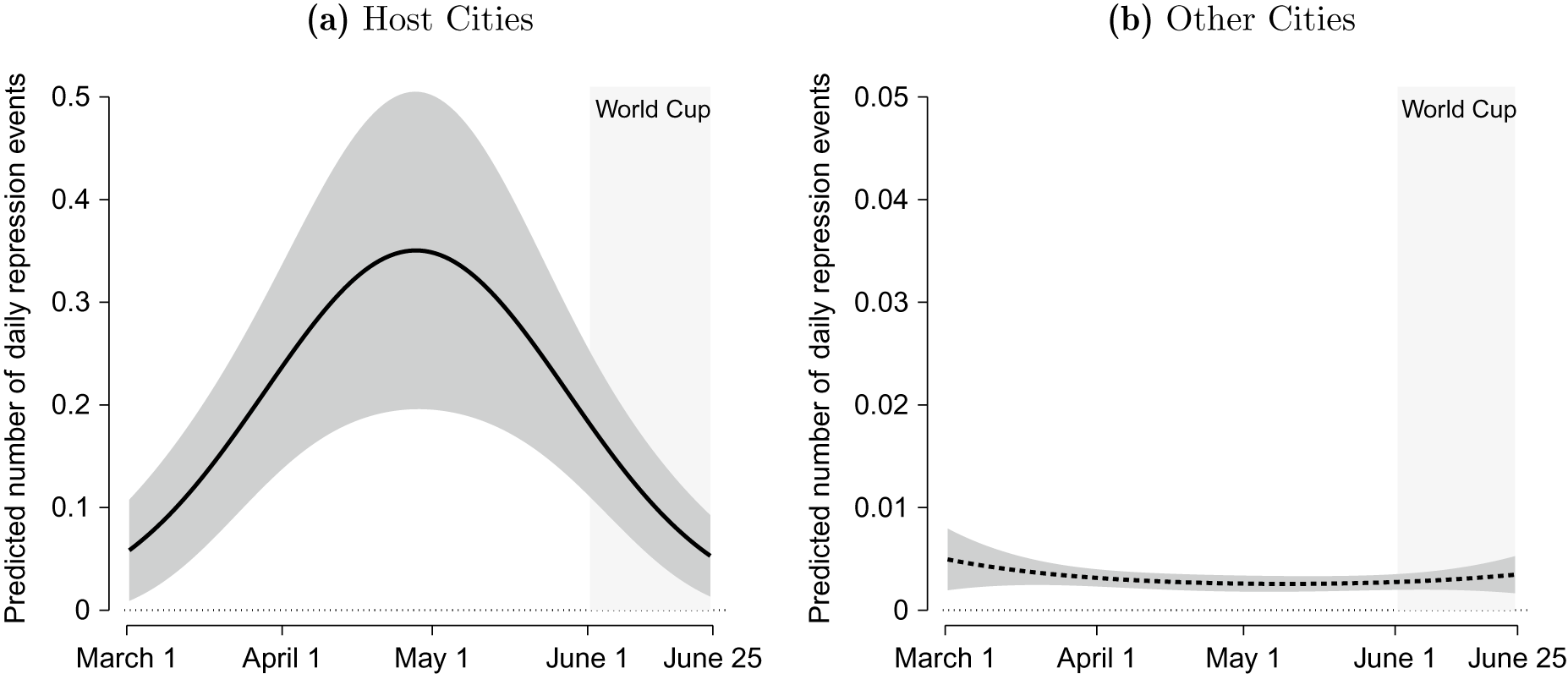
In line with Hypothesis 1, Figure 5 shows that repression in host cities substantively increased in the months before the tournament (panel a), whereas state violence was at a consistently low level in other departments (panel b). Figure 5 also shows that—as predicted in Hypothesis 2—the level of repression within host cities sharply dropped during the tournament, whereas state violence remained unchanged in nonhost cities. Together, this offers strong support for our theoretical expectations. The findings clearly suggest that the Argentine junta sought to build up the facade of a liberal, peace-loving host and largely refrained from using violence when the World Cup was ongoing. However, this restraint cost many lives in the run-up to the tournament. To prevent domestic resistance and embarrassment in front of the assembled world press, the military dictatorship preemptively cleared the host areas shortly before the arrival of foreign reporters. In sum, the Argentine host regime strategically adjusted its repression according to the World Cup schedule.
Substantive Effects
Note: Graph shows predicted numbers of daily repression events in departments with host cities (left panel) and in other departments (right panel). Calculations are based on interaction effects of Model 3, Table 1, with control variables held at observed values. Shading around lines gives 95% confidence intervals.

Robustness Checks
In the Supplementary Information (SI), we offer a wide range of robustness checks. The results of all tests corroborate the findings from our main analyses. First, the results do not change when we use linear regressions (ordinary least squares) instead of negative binomial models (Table SI.4.1). Second, the results are robust to the use of clustered standard errors that account for temporal correlation within departments and spatial correlation between them (Table SI.4.2 and Table SI.4.3). Third, the analyses with cubic polynomials show that our results are not are driven by an overly restrictive functional form (Table SI.4.4 and Figure SI.4.2). Fourth, the results remain unchanged when employing a dichotomous indicator of repression (Table SI.4.5). Fifth, the results hold across three different matched samples, as also shown in Figure 6 (Table SI.4.6 and Table SI.4.7). Sixth, the results are not driven by a single host city as demonstrated by a leave-one-out test (Table SI.4.8). Seventh, the results are robust to different temporal windows of the pretournament period (Table SI.4.9). Eighth, the results remain unchanged when controlling for province and military subzone factors (Table SI.4.10). Ninth, the results fully replicate in Heckman models that account for the selection of host venues (Table SI.4.11). Tenth, the results also fully replicate when aggregating the data to the weekly level (Table SI.4.12 and Table SI.4.13). Finally, we use hand-coded data on protests between 1976 and 1981 to demonstrate that the results remain unchanged when accounting for dissidents’ resistance strategies and activities (Table SI.4.14 and Figure SI.4.3).
Substantive Effects for Matched Sample
Note: Calculations are based on Model 6, Table SI.4.6, with control variables held at observed values. Shading around lines gives 95% confidence intervals.

Zooming in on the Junta’s Scrutiny–Publicity Dilemma
In this section, we provide further evidence for our mechanism. We scrutinize whether changes in state violence were indeed driven by the regime’s scrutiny–publicity dilemma—that is, its high hopes for publicity and its concerns about the scrutiny by international media. First, we analyze whether the scrutiny–publicity dilemma faced by the Argentine dictatorship affected the types of repression it employed. Second, by drawing on the locations of all international journalist hotels, we show that the (anticipated) presence of foreign media indeed shaped the spatiotemporal dynamics of repression before and during the World Cup. Finally, we demonstrate that the regime strategically reversed its daytime pattern of repression in accordance with the working schedule of international journalists during the tournament.
The Scrutiny–Publicity Dilemma and Repression Types
We have argued that the scrutiny–publicity dilemma around international sports events incentivizes autocratic hosts to use repression before tournaments. Such preemptive repression has the dual purpose of eliminating alleged troublemakers and deterring opposition networks. However, with the event approaching, repressive operations must be conducted as secretly as possible. Regimes may thus cease using tactics that draw too much attention but increasingly employ covert repression with a strong deterrence effect on others. Throughout its existence, the Argentine junta predominantly relied on killings and disappearances. Disappearances were generally conducted secretly and could paralyze entire dissident networks, analogously to a hostage situation. In contrast, killings often resulted from hasty operations that involved the risk of wild shootouts. We thus expect that, with the approaching World Cup, the junta increasingly disappeared rather than killed suspects.
Figure 7 confirms that the Argentine regime directly killed individuals early on but ceased those operations as the World Cup drew closer. Conversely, by May, the junta significantly increased disappearances to clear the streets of alleged dissidents and coerce their peers into quiescence. Anecdotal evidence offers additional support for the use of elimination and deterrence. Months before the tournament, the junta evicted potential troublemakers from host cities. For example, security forces “cleared Buenos Aires’ worst ghettos and their inhabitants were removed to the Catamarca desert” (Pears Reference Pears2006). According to the Nobel Peace Price Laureate Adolfo Pérez Esquivel, the regime “did not want the politically suspect to be around to meet foreign journalists” (Kuper Reference Kuper2011, 176).
Types of Repression before and during the 1978 World Cup
Note: Graph shows predicted numbers of daily disappearances and killings. Calculations are based on Models 1 and 3, Table SI.5.1. Vertical lines give 95% confidence intervals.

Shortly before the World Cup, the focus of repressive operations then seemed to have shifted toward deterrence. In the host city of Mendoza, the junta created a special task force—the Special Group 78—that systematically disappeared alleged subversives in the last days of May (Bullentini Reference Bullentini2018). Likewise, a report by the U.S. government explicitly describes how the kidnapping of a human rights activist in the week before the tournament was “designed to warn domestic critics not to speak out […] during the World Cup” (National Foreign Assessment Center 1978, 3). The report highlights that the “timing of the detention reflects the dilemma” of the junta to prevent any disruptions “during the soccer tournament while not doing further damage to Argentina’s human rights image” (National Foreign Assessment Center 1978, 3).
The Spatial Presence of International Journalists and Repression
We have argued that the presence of foreign journalists induces a regime to reduce violence in host cities during a tournament while increasing repression beforehand. To offer further evidence on the Argentine junta’s spatiotemporal adjustment of repression, we collect original archival data on the locations of all hotels that accommodated journalists during the tournament as a proxy for journalist presence.Footnote 10 Journalist hotels were not only located in departments with a World Cup stadium. For example, many journalists were accommodated in the resort town of Villa Carlos Paz in Punilla although the department did not host any World Cup matches. We rerun our main regression models using the variable Proximity to Hotel, which measures the distance (in kilometers) from the centroid of each department to the nearest journalist hotel instead of the original host city indicator.Footnote 11
Figure 8 presents surface plots from a Gaussian generalized additive model.Footnote 12 As expected, the results show that the temporal adjustment of repression almost exclusively occurred in locations of close geographic proximity to international journalist hotels. The closer a location was to the accommodations of foreign reporters, the more repression spiked before the World Cup and decreased during the tournament. This suggests that the Argentine regime indeed strategically adjusted repression to avoid disruptions and embarrassment in the spotlight of the world press.
Repression by Proximity to Journalist Hotels before and during the 1978 World Cup
Note: Plot shows Gaussian generalized additive model estimates of repression (y-axis) by distance to journalist hotels (x-axis) and over time (z-axis). Calculations are based on Model 3 in Table SI.5.4.

Temporal Absence of International Media Attention and Repression
Next, we further disaggregate the temporal dimension of repression to offer additional evidence for the influence of foreign media presence on state violence. The focus of this test is on the time of day during which the junta perpetrated repression. We have argued that regimes want to ensure that international journalists do not witness acts of state violence. If correct, the few repressive operations that take place during international sports events are likely to occur when journalists are occupied with reporting on the matches. For the Argentine World Cup we thus expect that the junta primarily targeted individuals during the core working hours of international journalists.
Based on the 1978 match schedule, we split the day into the broadcasting hours, during which international journalists were busy working, and the rest of the day. Figure SI.5.2 in the SI visualizes the start and end times of all matches during the World Cup. During the tournament, journalists’ working hours present a proxy for the temporary absence of international media attention, whereas in the periods before and after the Cup, the working hours serve as a placebo category.
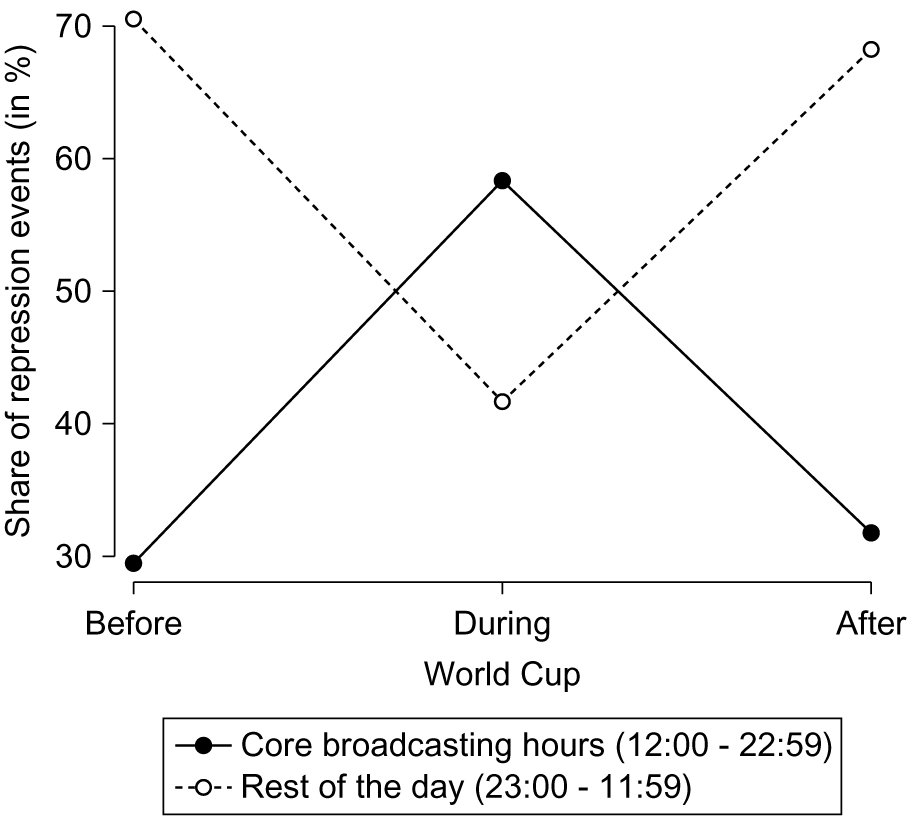
Figure 9 illustrates the shares of repressive events that occurred during the core working hours of journalists and those that happened at any other time of the day. It shows that the regime’s temporal targeting pattern during the World Cup markedly deviated from the timing of operations before and after the tournament. During the World Cup, roughly 60% of repressive events occurred when international journalists were occupied covering the matches. This is a complete reversal of the junta’s usual targeting pattern: in the three months before and after the World Cup, only around 30% of the disappearances and killings happened during these hours. Together, this suggests that the junta even adapted its repressive operations to the working hours of international journalists.
Daytime Patterns of Repression before, during, and after the World Cup
Note: Graph shows shares of repression events within and outside broadcasting hours. Shares are calculated for each period.

Additional Implications
In this section, we probe two additional implications. First, we scrutinize whether the media-induced repressive restraint during the tournament led to a rebound in state violence right after the World Cup. Second, we describe the junta’s strategic use of additional tools to influence public opinion and international reports in its favor.
Repressive Rebound after the Tournament
We have argued that autocratic hosts must show repressive restraint during the tournament to avoid international pillorying. Dissidents, in turn, might exploit the presence of foreign media to regroup and extend their networks. This implies that autocrats have an incentive to again escalate repression in host cities once the last match has been played and the world press has left. In Argentina, the end of the World Cup might therefore have triggered a second wave of repression in host cities.
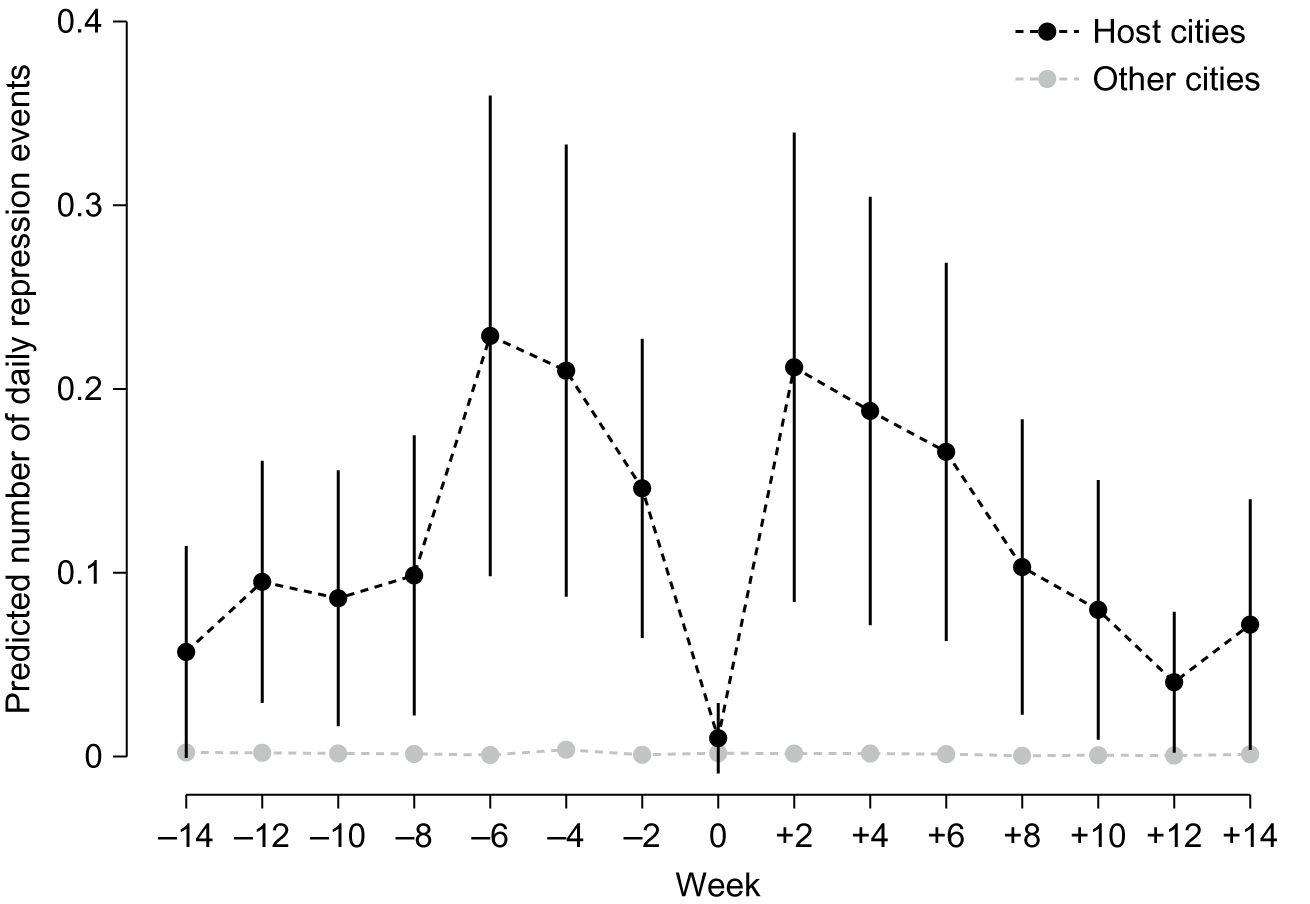
To test this implication, we compare the levels of repression before, during, and after the World Cup in departments with and without host cities. We create biweekly indicator variables and interact them with the variable Host city to allow a functional form that captures multiple repression spikes. The sample consists of daily repression events in the 30 weeks around the World Cup (March—September 1978). If correct, we should observe that, after the tournament, repression significantly increased in host cities but not in others.
As expected, the results in Figure 10 show a statistically significant spike in daily repression in host cities both right before and right after the World Cup. Twelve weeks after the tournament, repression then again approached the comparably low levels of violence in nonhost cities. This suggests that, after the international journalists had left the country, the Argentine dictatorship sought to break any resistance networks that might have flourished under the protection of the world press during the World Cup.
Changes in Repression before, during, and after the World Cup
Note: Graph shows predicted number of daily repression events for departments with and without host cities. Calculations are based on Model 3, Table SI.6.1, with control variables held at observed values. Vertical lines give 95% confidence intervals. Week 0 denotes the 14 days up to the World Cup’s final.

The Junta’s Manipulation of the Media
Finally, we have argued that autocratic hosts lower repression to portray themselves as liberal and peace-loving. This likely motivates regimes to complement their adjustment of repression with further measures of media manipulation. The Argentine junta used several tools to avoid critical reporting, including intimidation and distraction.
Months before the World Cup, the junta set up a special PR unit staffed with intelligence officers and propaganda specialists in Paris. The unit was tasked with defusing critical reporting on the World Cup and Argentina’s human rights situation. On the first day of the tournament, government officials then held a press conference in Buenos Aires to send a “subtle” warning to the assembled world press. Authorities claimed that they got hold of a Montonero document, containing the names and addresses of several foreign media representatives. A spokesperson elucidated that “the mere fact their names and addresses were listed in a Montonero document did not constitute involvement with subversives but warned the press not to become unwitting instruments of subversive propaganda” (Central Intelligence Agency 1978).
The government also used distraction to prevent negative reporting. The junta’s organizing committee offered an extensive social program for international journalists. It consisted of lavish barbecues, vineyards trips, and visits to polo matches and fashion shows, as well as a friendly reception with the national police (EAM 1978). Moreover, according to a journalist, who had been covering dozens of international championships for a large European magazine, the World Cup stood out in that “the press centers in all the venues were staffed with extremely charming, beautiful, ‘outgoing’ hostesses. […] Among colleagues, half a dozen marriages broke down afterwards … but [during the World Cup] the boys were relaxed, you know what I mean.”Footnote 13
External Validity
Can we expect similar strategic considerations and repressive adjustments around international sports events beyond the context of Cold War Argentina? Before we turn to current megaevents that saw similar patterns of repression, we identify three factors that might moderate the identified patterns of state violence around international sports tournaments: regime type, information technologies, and state capacity.
Potential Scope Conditions
First, at the time of the 1978 World Cup, the Argentine regime was a relatively young military dictatorship suffering from considerable image problems. Military dictatorships commonly lack the co-optation ability of party-based regimes and the power concentration of personalist dictatorships (e.g., Gandhi and Przeworski Reference Gandhi and Przeworski2007; Geddes, Wright, and Frantz Reference Geddes, Wright and Frantz2018; Svolik Reference Svolik2012). Thus, party-based and personalist autocracies may be less concerned that dissidents team up with foreign journalists and might therefore see less need for repression adjustments.
Second, repressive adjustments may be influenced by ongoing advancements in media and communication technologies. Digitization and an ever-growing media landscape have prolonged cycles of international media attention around major events (Bowersox Reference Bowersox2018). Current hosts might therefore come under scrutiny earlier than did the Argentine junta. In such settings, autocratic hosts are likely to antedate preemptive repression.Footnote 14 In addition, modern communication technologies might provide host regimes with new surveillance capacities that allow them to target suspects more selectively and covertly. This can lower the government’s perceived need for preemptive violence.
Finally, host regimes’ state capacity and economic resources might influence the geography of repressive adjustments around international sports events. Although the Argentine regime invested heavily in the World Cup, it had to largely rely on existing infrastructure. Equipped with far greater resources, rulers like the Emir of Qatar or Russian President Putin are able to rebuild not only stadiums or infrastructure but also entire host cities. Such purpose-built venues might be designed to minimize unwanted encounters between journalists and dissidents, reducing the perceived need for preemptive crackdowns in host cities.
Evidence across Autocratic Host Regimes, Time, and Space
Notwithstanding the potentially moderating effects of political institutions, economic endowment, and technological progress, there are striking similarities in repressive adjustments around current megaevents. Although the overall severity of repression may have changed, authoritarian regimes across type, age, or ideology seem to share the belief that preemptive violence helps them to portray themselves in a positive light.
One example is the 2008 Olympic Games in Beijing. Prior to the Games, the Chinese regime had been criticized for its disregard of civil liberties. In response, regime officials designated three “protest zones” in Beijing 17 days before the opening ceremony. They announced that—upon prior notification—people could protest within these zones during the Olympic Games. However, instead of giving citizens the opportunity to voice discontent, the regime set up a trap. According to Human Rights Watch (2008), Beijing police used the notifications to identify opposition figures who were then arrested right before the start of the tournament. As a result, the protest zones largely remained empty, enabling officials to claim that there was no protest because China’s “social environment is good” (Radio Free Asia Reference Asia2008).
Likewise, Equatorial Guinea’s long-term President Teodoro Obiang silenced even minor forms of critique in the run-up to the 2015 Africa Cup of Nations. In the host city of Malabo, the police instantly arrested activists who urged people to abstain from the upcoming matches to prevent an outbreak of the Ebola virus (Amnesty International 2015). During the tournament, the regime refrained from targeting protesters in broad daylight but arrested them “in their homes at night, or in streets far from the football stadium” (Amnesty International 2019). Analogously, in the run-up to the 2019 edition of the Africa Cup of Nations, the Egyptian military government secretly detained football fans who had played a crucial role in the protests against President Mubarak during the Arab Spring. Based on the investigations by Amnesty International, the “only aim [was] to keep activists off the streets and stadiums before the tournament” (Der Standard 2019).
Although the examples show how present-day autocrats handled the scrutiny–publicity dilemma, we next assess the prevalence of preemptive repression in illiberal host regimes across time. Figure 11 shows yearly repression dynamics around international sports events in autocratic regimes between 1945 and 2020. In line with our theory, violence spiked in the two years prior to the event, followed by a visible drop in the year of the tournament. The fact that we can observe such adjustments at the year level suggests that many autocratic hosts indeed antedate their preemptive repression campaigns, which could reflect prolonged attention cycles around modern sports events. Taken together, the evidence suggests that, throughout history, dictatorial host regimes have sought to maximize publicity and minimize scrutiny by adjusting repression around sports megaevents.
Changes in Repression around International Sports Events, 1945–2020
Note: Graph shows average repression scores (Fariss, Kenwick, and Reuning Reference Fariss, Kenwick and Reuning2020), standardized to account for structural differences across event windows using demeaning. Events, occurring at Year0, include Summer and Winter Olympics, FIFA World Cup, Africa Cup, and Copa América.

Conclusion
How do international sports events shape repression in autocratic host countries? Illiberal governments organize global sports events in the hope of boosting their prestige. However, for autocratic host regimes international tournaments like the Olympic Games or the FIFA World Cup come with significant risks. Foreign journalists might expose the host’s wrongdoings, whereas domestic opposition groups may use the unique media attention to voice their grievances and challenge the regime. This article shows that autocrats seek to solve this scrutiny–publicity dilemma by systematically clearing the streets of dissidents and potential troublemakers in the run-up to international tournaments. High levels of preemptive repression in host cities allow autocrats to curb violence during the megaevent and to portray themselves as liberal and peace-loving.
Drawing on the historic case of the 1978 FIFA World Cup, we uncover how the Argentine military dictatorship strategically adapted its repression to the tournament schedule. Our systematic analyses draw on unique micro-level data on the exact date and location of repressive events as well as original archival information on opposition activities and the accommodation of foreign journalists. The results demonstrate that, in the run-up to the media spectacle, the Argentine junta strategically eliminated alleged dissidents in areas where it expected international journalists to stay during the World Cup, whereas repression remained low in cities without foreign media presence. The period of preemptive clearing stopped with the start of the World Cup. Between the opening ceremony and the final match, the regime largely refrained from using violence to produce a facade of hospitality. After the tournament, the regime then continued its political persecution, presumably to destroy resistance networks that may have formed as a consequence of the World Cup’s lull in repression.
Our findings have implications for future research and practitioners alike. First, by exposing the hosts’ deceptive rationale behind repression, our findings may assist human rights organizations and outside observers with where and when to watch out for state violence. Our identified patterns can thus help to protect dissidents and pro-democracy activists in the context of international sports events.Footnote 15 This way, international organizations should also be in a better position to refute the assertion of “clean games” so widely invoked by state officials and sports functionaries.
Second, future research may want to investigate patterns of repression around sports events that are regularly hosted in the same venue. More and more authoritarian regimes host annual events such as the tennis ATP and WTA Tour or the Formula 1 series. Recent examples include the Women’s Tennis Open in Abu Dhabi and the Saudi Arabian Grand Prix in Jeddah. Our findings suggest that venues of annual events might experience yearly cycles of repression (Truex Reference Truex2019).
Third, our findings suggest that international sports events can affect a country’s repression infrastructure. Host countries often invest huge sums in modern security technologies to guarantee the safety of athletes and visitors (Bennett and Haggerty Reference Bennett and Haggerty2012). Not least since the fatal hostage-taking of 11 members of the Israeli team at the 1972 Summer Olympics in Munich, governments often expand their security measures and acquire potent technologies for surveillance and crowd control. Scholars might investigate whether regimes employ these tools to oppress their population well beyond the tournament.
Finally, this study informs future research on repression around international megaevents beyond sports. Our theory might equally apply to cultural, economic, or political events that receive high international media coverage. Host regimes are likely to adjust violence to the schedule of major international trade fairs, such as Expo; political summits, such as the G20; or state visits by government leaders, heads of states, and members of royal families (Malis and Smith Reference Malis and Smith2021). All these events combine the ingredients of an autocrat’s scrutiny–publicity dilemma, presumably triggering similar adjustments in repression.
SUPPLEMENTARY MATERIALS
To view supplementary material for this article, please visit http://doi.org/10.1017/S0003055422000958.
DATA AVAILABILITY STATEMENT
Research documentation and data that support the findings of this study are openly available at the American Political Science Review Dataverse: https://doi.org/10.7910/DVN/RJY34I.
ACKNOWLEDGMENTS
We are grateful to Hana Attia, Felix Bethke, Dawn Brancati, Tim Büthe, Sean Carey, Alexander De Juan, Christoph Dworschak, Jennifer Gandhi, Scott Gates, Anita Gohdes, Belén González, Edward Goldring, Felix Haass, Sebastian Hellmeier, Marina Henke, Edgar Hirschmann, Sebastian Köhler, Esteban Klor, Carl-Henrik Knutsen, Jean Lachapelle, Philipp Lutscher, Katrin Paula, Maryna Povitkina, Roni Lehrer, Federico Rossi, Jonah Schulhofer-Wohl, Julian Wucherpfennig, and Yuri Zhukov for helpful feedback. We also thank the participants of the 2021 EPSA conference, the 2022 ISA conference, the 2021 AFK workshop, and the presentations at Emory University, GIGA, Hertie School, Leuphana University Lüneburg, RWTH Aachen, TU Munich, University of Copenhagen, University of Oslo, and York University as well as the three reviewers and the editors for insightful comments.
FUNDING STATEMENT
Adam Scharpf acknowledges research support by the German Institute for Global and Area Studies (GIGA).
CONFLICT OF INTEREST
The authors declare no ethical issues or conflicts of interest in this research.
ETHICAL STANDARDS
The authors affirm this research did not involve human subjects.










Comments
No Comments have been published for this article.