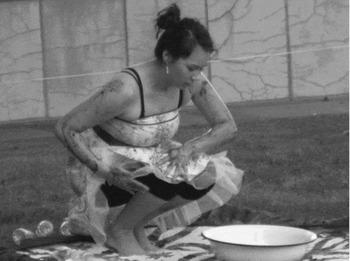
Alutiiq performer Tanya Lukin Linklater began Woman and Water by clearing the space on the quad outside UCLA's Royce Hall. Crouched on the grass near a tree, not far from a fountain, she gathered leaves, sticks, bits of debris. At first the audience, walking out from the conference meeting hall and getting settled on the grass, did not really seem to notice what she was doing. Had the performance started? Was this just the getting-ready part? Slowly, as she continued gathering, cleaning up, clearing, we shushed, watching the work she was doing, this getting ready, so domestic and familiar. She spread out a fitted blue bed sheet, smoothing out the folds, then lay a blanket down, and another, and another, tucking the fitted sheet up around the final quilt. There. Then she brought in the leaves she had gathered, a nest for herself, or maybe for others, and knelt in it.
Tanya had come from Canada where she was living – the only performer at the Actions of Transfer event travelling down from that far north – and was engaging in her performance with cosmologies and understandings and ways of behaving drawn from her Alutiiq family and tribal background, from Kodiak Island, Alaska. Yet the piece had been performed first and sparked by another place: a specific site in front of the City Hall in Edmonton, Alberta, with a wading pool for kids, in a city and location where, due to the oil and gas boom at the time and a subsequent shortage of affordable housing, there were a lot of ‘visibly Aboriginal homeless people’.Footnote 1 In her earlier performances at this site, she brought food with her: canned salmon from her home village, strawberries washed the way she had been taught (you soak them so the bugs come out). Once she had built her nest, she fed people. Living in Edmonton, Lukin Linklater said, she is always aware of how ‘in this market economy, I myself could potentially be homeless’. In her performance, she brought into this capitalist, time-managed, production-driven sphere a bit of the way her village, Afognak, would always provide a home for you, if you behave appropriately, fasting before a hunt and wearing your best clothes for the occasion, attentive to the subsistence cycles, how you have to follow the salmon and the deer, not expect them to follow you. This attention in the piece to subsistence as a way of being, she later explained, is particularly crucial to her and to her work, which often deals with subsistence. ‘Subsistence is a vital issue to our people,’ Lukin Linklater wrote. ‘Subsistence is what makes us who we are.’ She explained, ‘all of our ceremonial life was tied to subsistence. Our dances and songs and stories were and are tied to subsistence. Living off the land really has to do with a series of intimate relationships between humans and other non human persons’.Footnote 2 As her performance of Woman and Water continued it created for those around her the experience, briefly, just for a spell, of this subsistence-based interconnection to the land and to one another, of time felt in relation to cycles of these interconnections, to a community that, like a family, would always house and feed you.
On the quad at UCLA, Lukin Linklater, kneeling in her nest, washed blackberries in a white tin bowl, and rather than feeding them to those of us watching, slowly, gracefully, crushed and smeared them down her throat and arms to stress her body itself as that which provides. She later explained that it is through our bodies that women especially do this providing and caretaking and connecting: through giving birth and nursing our babies, yes, and not just that, through all sorts of other acts as well, like ‘the physical labor of gathering those berries, that fish’; and ‘this invisible domestic work that women do all the time, that's unpaid, and ignored’, like cleaning up, smoothing sheets, tucking blankets. Her body thus marked, Lukin Linklater left the nest to dance as a bird. Head cocked, elbows bent and lifted, with jerking bobbing steps, she came out to try and reach us, coming right up to people sitting apart, in their distance. At first it felt tense – oh dear, this goofy bird is peering right in our faces. We were spread apart from one another, on this lawn in LA, in our conference mindset, and she was coming up close and acting silly. People tittered at first, but then they laughed outright, and the mood relaxed. ‘I went to the Alaska Native movement, because it's entertaining, full of fun and humor. It's so entertaining and animated. They make you laugh, there's so much joy,’ she explained. ‘People were at such a physical distance, and not engaged. I was trying to project my energy out further, creating space not only physically, but energetically.’
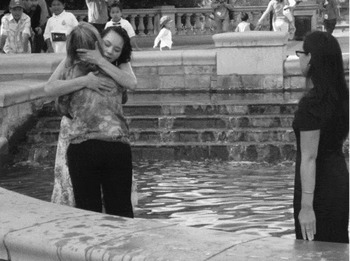
From here, Lukin Linklater strutted her way to the water, into the fountain. In Alutiiq geography and cosmology, Lukin Linklater explained, there is land and ocean. The boundary between them covers so much, but only humans and birds cross that boundary often. The birds, she said, were considered spirit-helpers by her people. She stretched and stepped into the water, turning, splashing, then reached out to a woman nearby, clasped her hands, and drew her into the fountain, too. The woman startled a touch, surprised, but stepped right in with her. Together in the water, Lukin Linklater wrapped her arms around this person, chest to chest, and started singing, deep gorgeous singing. Then they parted, and she invited in another. Then another. People standing around the fountain now drew closer in. ‘I hug people and I sing to them. It doesn't matter that others are watching, that this is a performance. This is a moment between us,’ she explained.
We applauded her in the fountain, then Lukin Linklater came out, dissembled her nest and gifted her blankets, first to those who had been in the water with her, and then to others; to me she gave the white tin bowl she had washed the berries in.
Woman and Water (photo courtesy Tanya Lukin Linklater).

Lukin Linklater's piece Woman and Water, I suggest, provides an exciting lens through which to consider – perhaps to reframe – academic discussion of ‘performance, politics, and the nation state’.Footnote 3 The piece creates the opportunity for an experience of a way of being in the world, in intimate interconnection with one another, the land and other animals, and the experiences of time that this intimacy compels, that differs from the models of affiliation presumed in understandings of ‘nation states’ generally referenced by contemporary academic discussions of nationalism and transnationalism. In reframing this approach, it provides a way of recognizing Indigenous epistemologies and cosmologies, and of sidestepping discourses on ‘nation’, ‘nationalism’, or the ‘nation state’ that subsume Indigenous people into the state in ways that render invisible or assimilate the particular political status, and epistemologies, of Indigenous groups, as well as the role of performance – song, dance, stories, acts of gathering together – within Indigenous political models.
Part of the intervention Woman and Water provides into these discussions stems from different understandings of what ‘nationhood’ means. Cherokee scholar Daniel Heath Justice writes about how what nationhood means in Indigenous contexts differs ‘significantly from discussions about the coercive nationalism of industrialized nation-states’.Footnote 4 He adds,
Indigenous nationhood is more than simple political independence or the exercise of a distinctive cultural identity; it is also an understanding of a common social interdependence within the community, the tribal web of kinship rights and responsibilities that link the people, the land, and the cosmos together in an ongoing and dynamic system of mutually affecting relationships.Footnote 5
Indigenous nationhood, Justice explains, ‘is a necessary ethical response to the assimilationist directive of imperialist nation-states’.Footnote 6 Andrea Smith, writing about ‘American Studies without America: Native Feminisms and the Nation-State’, has suggested similarly that whereas
nation-states are governed through domination and coercion, indigenous sovereignty and nationhood are predicated on interrelatedness and responsibility. In opposition to nation-states, which are based on control over territory, these visions of indigenous nationhood are based on care and responsibility for land that all can share. These models of sovereignty are not based on a narrow definition of nation that would entail a closely bounded community and ethnic cleansing.Footnote 7
Abenaki scholar Lisa Brooks, addressing the question from an Abenaki perspective, writes,
In the Abenaki language, as Joe Bruchac points out in his book Roots of Survival, the word for tribe is Negewet kamigwezo, or ‘those of one family’. The word for ‘nation,’ however is Mizi Negewet kamigwezoi, meaning ‘families gathered together.’ Thus the means of nation-building, in the Abenaki sense, is not a means of boundary-making but rather a process of gathering from within.Footnote 8
Yet most often, when discussions of nation, nationalism and transnationalism start to circulate in academic contexts, Indigenous understandings of ‘nation’ and Indigenous political sovereignty are invisibilized. Michelle Raheja, writing about the limits of recent redefinitions of American studies as transnational American studies, has suggested that the move to suddenly focus on American studies as ‘transnational’ denies the way the geographical space of what is now the US has always been transnational. She writes,
the Americas have always already been a transnational space. Native American communities were recognized as sovereign nations by invader/settlers working from European models of jurisprudence and this sovereign status is recognized in the many treaties signed between the early Anglophonic colonies from the 16th through the 19th centuries. More importantly, Native nations prior to European invasion theorized about the concept of sovereignty in order to distinguish themselves from the other human, spirit, animal, and inanimate communities surrounding them through linguistic practice, performance, songs, stories, dreams, and visual texts such as wampum and pictographs.Footnote 9
Significantly, Raheja's comment underscores the way that Native nations used performance – ‘linguistic practice, performance, songs, stories’ – as one way of theorizing about sovereignty. Indigenous song, dance, storytelling, fishing and hunting practices have long been used in tribal understandings and, of late, also recognized in US and Canadian courts as legal proof of tribal identity and status.Footnote 10
Starting from these Indigenous understandings of ‘nation’ provides a way of stepping outside models of the nation state in the Americas that willfully ignore the political status of Indigenous people. It also, given the role that ‘linguistic practice, performance, songs, stories’ play in establishing Indigenous understandings of relationships to land and to nation, provides exciting ways to think about performance. How, for instance, might scholars of performance studies use these understandings to think about performance and its relation to geopolitics? What would it mean to think about what performance does in relation to concepts of ‘nation’ that rely ‘on the multi-faceted, lived experiences of families who gather in particular places’,Footnote 11 as Brooks writes? What would it look like to explore the continuing performance practice of dance, songs, stories, dreams, languages and hunting and fishing acts as a part of what establishes an understanding of nationhood, based on a ‘an ongoing and dynamic system of mutually affecting relationships’? Rather than talking about the ways that radical performance practices challenge or disrupt the nation state, could we think instead about what kinds of communities and political constituencies they constitute?
In performing Woman and Water, Tanya Lukin Linklater reminds me, she does not exactly see herself as constituting a nation. ‘Those things take time,’ she says. It takes time to build these affiliations and connections, to come into relationship with one another. We are having this conversation because we have come, over a number of years now, to know one another some: we have built a relationship. (She gave that white berry-washing bowl, which she has used in many performances, she explains, particularly to me.) Nor is Alaska Native relationship to sovereignty, at least for the majority of Alaskan Natives who did not sign treaties, the same as that of other US Indigenous people. What her performance does do, though, she agreed, is provide an experience for participants – however fleetingly – of time and place and of ways of being in interrelationship with others, that is intrinsic to Alutiiq and other Indigenous understandings of what ‘home’ and ‘Nation’ provide. In her performance, she says, she engages with the subsistence-infused kind of time that her father and many other Indigenous peoples still today live in, a more expansive kind of time, in relation to cycles of the day, month and year and the interconnections and migrations of all kinds of creatures – not to messages travelling so, so fast, like with Twitter, Facebook, email, telephone. ‘I'm asking people to breathe differently, to slow everything down,’ she says. She engages with the risks of intimate, physical connection to other beings – land, water, birds, animals, grass, each other – and asks us to join her in these connections. I can still feel my hug in the fountain, the reverberations of her voice in my chest, the calmness in its intimacy.
‘They take that risk, to come into the water, to take a blanket’, even given the cold, the wet, the physical touch, the history of blanket-giving and disease and sexualization of Native women in Indigenous history. She engages Alutiiq cosmology, in dancing as a bird and crossing the boundary between land and water, and in engaging humour as a way of connecting across barriers. She engages in acts of caretaking and hospitality, feeding her audience, either literally or through the labour of her physical body, marked with/as that which sustains. She gifts her things to others, just like that, embodying a relation to property outside of capitalist systems (and remarks at how whenever she has performed this piece, the people she has given the blankets to try and give them back when the performance is over, like they see it as just an act, and she has to tell them, no, really, they are for you to take away, to have and make something of, as you wish). ‘In my practice, I often feel like the market economy is not benefiting my people,’ she says, explaining the drive behind these desires to enact an experience of this different economy, this other way of understanding time and ‘productivity’, within the moments of her performance. ‘I still see it as an alternative way of being,’ she says, of subsistence and of the ways of being it enables. ‘Colonization is only one piece of the larger story.’ In other words, Lukin Linklater performs in and through this piece, as Justice writes of Indigenous nationhood, a way of being constituted through the ‘web of kinship rights and responsibilities that link the people, the land, and the cosmos together in an ongoing and dynamic system of mutually affecting relationships’. Like a web, it takes time to build.
A hug in the fountain, Woman and Water (photo courtesy Tanya Lukin Linklater).

In a sense, much live performance does these things – brings us into proximity in time and space, enacts intimacy, interconnection, attention to breath. Woman and Water, enacting the Alutiiq-based conceptualizations that Lukin Linklater accesses, articulates with clarity and power the way these performance practices support models of Indigenous nationhood that, as Smith writes, ‘are predicated on interrelatedness and responsibility’, unlike ‘nation-states, which are based on control over territory’. As such, performances like Woman and Water astutely sidestep conceptualizations of the nation state, and of nationalism and transnationalism, developed without recognition of Indigenous history, politics and ways of knowing, and instead create for audiences an experience of Indigenous political models, as Smith writes, ‘based on care and responsibility for land that all can share’.