Prevention of central-line–associated bloodstream infections (CLABSIs) requires a comprehensive approach addressing the insertion, access, and maintenance of central lines.Reference Lee, Cho, Jeong, Kim, Han and Song1–Reference Ista, van der Hoven and Kornelisse3 CLABSI prevention efforts are most successful when owned by local physicians and nurses, rather than seen as a problem to be solved by infection prevention or quality departments.Reference Pham, Goeschel and Berenholtz4 Groups such as the Agency for Healthcare Research and Quality and the Joint Commission recommend unit-based audits as one tool for CLABSI prevention.5, 6
At the University of North Carolina (UNC) Medical Center, a 945-bed academic hospital, our rate had stagnated at >2.00 CLABSIs per 1,000 central-line days after years of reductions. A fiscal year 2018 (FY18) organizational goal was set to reduce our CLABSI rate by 10% from our FY17 baseline of 2.11. One initial intervention was the use of a compliance coach, an infection prevention staff member who worked as an auditor/educator on central venous access device (CVAD) care and maintenance.Reference Buchanan, Summerlin-Long, DiBiase, Sickbert-Bennett and Weber7 We expanded this initiative by implementing a hospital-wide peer-audit model in FY18, in which frontline staff provided real-time feedback and submitted compliance data on process measures related to CVAD care.
Methods
The rollout of the hospital-wide peer audit occurred in 3 phases prior to launch. First, a team of nurses, infection preventionists, and quality improvement staff created and piloted an audit tool as part of a service-wide quality improvement initiative. Second, infection prevention staff met with units that already had their own audit processes in place to get them using the hospital-wide tool. Third, infection prevention staff conducted individual trainings with remaining units and multiple hospital committees to ensure awareness and buy-in from stakeholders.
Trainings included the “why” and “how” of central line dressing/tubing peer audits and reviewed the tool to ensure standard use. The tool included the following measures: line type; dressing and/or tubing labeled correctly and not expired; dressing clean, dry, intact, and applied correctly; feedback given.
Trainers gave tips on how to give and/or receive feedback, including sharing opportunities for improvement (just-in-time education) or reinforcing good habits by praising colleagues. They shared ideas on involving more staff in audits and provided both paper and electronic versions of the tool and a tip sheet.
Units with ≥365 central-line days per year were asked to do ≥10 audits each month. Infection preventionists recommended units experiencing higher CLABSI rates conduct more audits and that units include as many staff as possible in the process to increase awareness and balance workload. To encourage participation and reinforce the importance of feedback, an auditor who had provided feedback was randomly selected monthly for a small award.
We calculated monthly hospital-wide CLABSI rates as number of CLABSI per 1,000 central-line days. CVAD compliance data were entered into the online survey tool and downloaded each month into Microsoft Excel software (Microsoft, Redmond, WA) for analysis. We provided CLABSI rates, measure compliance, and staff participation to units each month. Using SAS version 9.4 software (SAS Institute, Cary, NC), we created a Poisson regression model to further investigate the association between CVAD audit compliance and CLABSI rates. Each element of the peer audit tool was modeled independently as a linear variable to see if changes in compliance over time were associated with changes in hospital-wide CLABSI rates.
Results
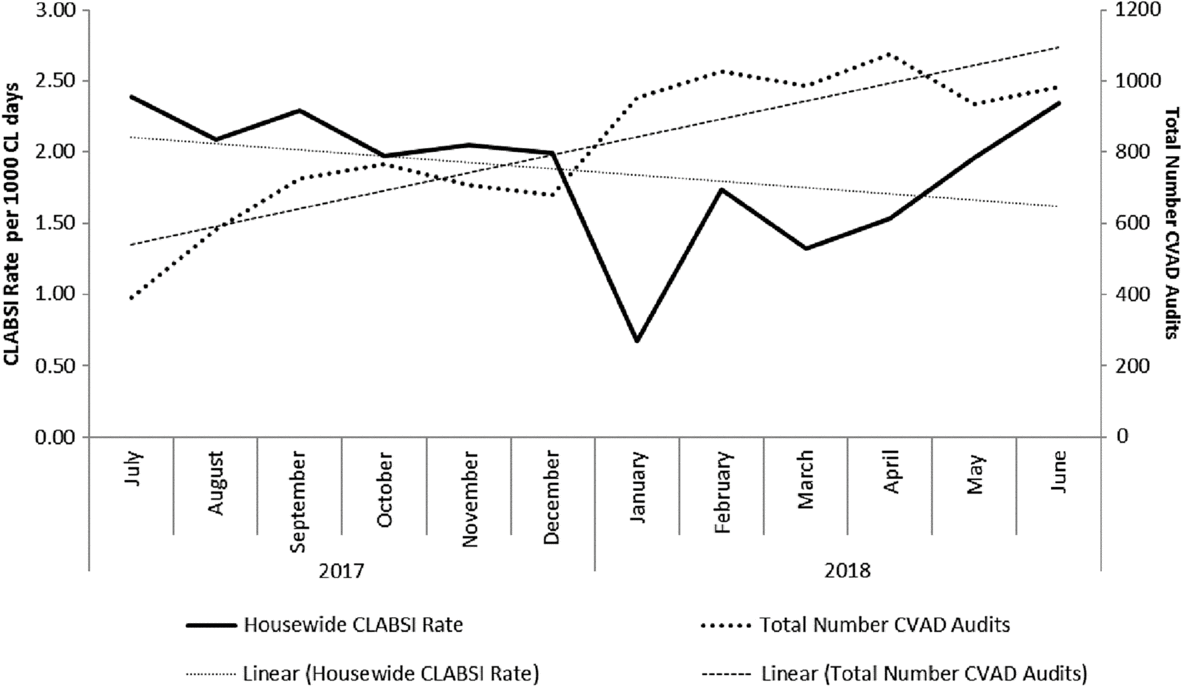
During FY18, >9,800 audits were submitted. Baseline compliance data were >80% on all process measures, increasing to >90% throughout the year. In FY18, our hospital-wide CLABSI rate was 1.86, representing a 12% decrease from FY17. We found a statistically significant inverse relationship between the monthly number of audits submitted and monthly CLABSI rates (r = −0.56; P = .05) (Fig. 1).
Hospital-wide central-line–associated bloodstream infection (CLABSI) rate per 1,000 central line days compared to total number of hospital-wide central line audits completed.

Results from the Poisson regression showed that increased compliance on each process measure was incrementally associated with a decreased CLABSI rate, but none of the process measures was statistically significantly associated with the outcome. A 5% improvement in compliance with each process measure contributed to decreases ranging from 0.02 to 0.90 in CLABSI rates.
Discussion
Given that development of a CLABSI is multifactorial, implementing any single strategy cannot be viewed as the sole contributor to reducing infections. However, after implementing a comprehensive peer audit program with feedback as our major hospital-wide initiative in FY18, UNC Medical Center did reduce its CLABSI rates. Including frontline nursing staff as auditors and reinforcing the importance of feedback encouraged a culture of accountability and cooperation. Routine dissemination of consolidated process and outcome measures directly influenced and informed quality improvement initiatives. We theorize that conducting peer audits increased awareness and education on the importance of properly maintaining CVADs and that the improved compliance in multiple process measures incrementally contributed to overall reduced rates.
Our study has several limitations. First, it is a single-center study that assessed the association between audit compliance and CLABSI rates for 1 year. Additionally, compliance data were high at implementation, and lack of variation in compliance data limited our ability to fully examine the effects of compliance on CLABSI rates. Additionally, since other CLABSI prevention efforts occurred during the same time (CVAD insertion courses, unit-specific interventions), it is difficult to attribute how much of the reduction in CLABSI was due to the peer audits alone. Still, the audit initiative was the only hospital-wide initiative occurring during FY18.
Continued challenges include changing the perception of “audits” from data collection to just-in-time education providing the opportunity to prevent infections in real time through peer feedback. In FY19, nurses conducted >13,000 CVAD audits with 85% feedback on average. Based on the continued high volume of audits with feedback, we believe culture change around audits, accountability, and feedback is possible and that peer audits can contribute to CLABSI prevention.
Acknowledgments
Financial support
No financial support was provided relevant to this article.
Conflicts of interest
All authors report no conflicts of interest relevant to this article.