

Introduction
West European countries today are confronted with the twin challenges of substantial unemployment and fiscal austerity (Bengtsson, De La Porte, & Jacobsson, Reference Bengtsson, De La Porte and Jacobsson2017). To deal with these challenges, welfare states have turned to demanding active labour market policies (ALMPs) that are market-oriented and focus on work incentivization (Bonoli, Reference Bonoli2013; Fossati, Reference Fossati2018). With regards to unemployed workers, these policies impose restrictive conditions and obligations on their unemployment benefit recipiency. They may include accepting any available jobs, even worse ones that may impose income or status loss (Buss, Reference Buss2018; Fossati, Reference Fossati2018). When unemployed workers fail to meet these conditions, they face sanctions such as cuts to their unemployment benefits (Knotz, Reference Knotz2018). From an activation perspective, demanding ALMPs impose such obligations to pressure unemployed workers into regaining re-employment.
However, demanding ALMPs also entail a distributive aspect. Häusermann and Kriesi (Reference Häusermann, Kriesi, Kriesi, Kitschelt, Beramendi and Häusermann2015) stress that maintaining or increasing benefit levels for one group generally comes at the expense of cuts for other social groups, especially when governments seek to find cost savings under austerity. From this perspective, it is possible to view demanding ALMPs as distributive policies. They allow employed workers to maintain their benefit levels at the expense of unemployed workers. They distribute by tightening the latter’s access to unemployment benefits, justified under the guise that the former deserves welfare more than the latter.
A burgeoning research shows that currently employed and unemployed workers differ in their support for demanding ALMPs (Buss, Reference Buss2018; Fossati, Reference Fossati2018). Employed workers support demanding ALMPs, whereas unemployed workers oppose them. Yet, we seem to know far less about a group of workers that straddle between these two categories of workers: employed workers who are threatened by unemployment. Namely, how does their risk of unemployment affect their support for demanding ALMPs? It is relevant to focus on these workers because they will be subjected to demanding ALMPs, should they become unemployed.
In this paper, I focus on employed workers who are threatened by unemployment from workplace automation. Workplace automation is a major disruptor of employment structures in contemporary advanced economies (Goos, Manning, & Salomons, Reference Goos, Manning and Salomons2014; Oesch & Rodríguez Menés, Reference Oesch and Rodríguez Menés2011; Sacchi, Guarascio, & Vannutelli, Reference Sacchi, Guarascio, Vannutelli, Careja, Emmenegger and Giger2020). Numerous studies show that employment shares for occupations consisting of routine tasks, namely job activities that are repetitive and codifiable, have declined relative to employment shares for occupations consisting of nonroutine tasks (Autor, Levy, & Murnane, Reference Autor, Levy and Murnane2003; Biagi & Sebastian, Reference Biagi, Sebastian and Zimmermann2020; Goos, Manning, & Salomons, Reference Goos, Manning and Salomons2014). The implication here is that workers in routine occupations experience a greater threat of unemployment than workers in nonroutine occupations.
I anticipate that these workers react to their risk of becoming unemployed. This view leverages other studies that explore the political consequences of labour market risk based on a similar occupational approach (Rehm, Reference Rehm2009; Schwander & Häusermann, Reference Schwander and Häusermann2013; Thewissen & Rueda, Reference Thewissen and Rueda2017). These studies show that individuals respond to their occupational risk of unemployment, regardless of whether such risks actually materialize (Kurer, Reference Kurer2020).
There are at least two self-interest considerations through which automation-related unemployment risk may influence routine workers’ support for stricter obligations and conditions. On one hand, routine workers may seek to reduce barriers that impede their access to unemployment benefits because they may come to rely on such benefits, should they become unemployed. They may then oppose demanding ALMPs which restrict welfare access. On the other hand, unemployment-threatened routine workers may worry about the fiscal viability of their benefits, especially when austerity renders welfare scarcity concerns even more acute. They may then support demanding ALMPs to impede currently unemployed “competitors” from accessing their unemployment benefits, thereby reducing welfare competition. It is likely that both considerations, welfare access and welfare competition, weigh on unemployment-threatened routine workers’ minds. Ultimately, routine workers’ support for such policies may depend on which consideration is more dominant on balance.
This study hence investigates: how does the risk of unemployment from automation affect individual-level support for demanding ALMPs? It bridges an emerging body of research on determinants of individual-level support for demanding ALMPs to reach on automation (Buss, Reference Buss2018; Fossati, Reference Fossati2018). It also contributes theoretically by disentangling the effects of unemployment risk from the effects of unemployment status on demanding ALMP support (see also Rovny & Rovny, Reference Rovny and Rovny2017). I first briefly review the demanding ALMP and automation literature. I next elaborate on the theoretical framework of the paper that relates automation-related unemployment risk to demanding ALMP support. I then present the data and methods. Finally, I discuss the results and conclude.
Determinants of demanding ALMP support
Demanding ALMPs attach stringent conditions and sanctions to unemployment benefit recipiency (Fossati, Reference Fossati2018). From an activation perspective that places a premium on improving labour market participation, demanding ALMPs help to reduce labour slack. Furthermore, this aim may have become more pressing when West European governments are confronted by permanent austerity (Bengtsson, De La Porte, & Jacobsson, Reference Bengtsson, De La Porte and Jacobsson2017). When unemployed workers are redeployed into the labour force, they are more likely to become net contributors rather than net beneficiaries of welfare states. Demanding ALMPs may help governments relieve the pressures of cost containment by pressuring unemployed workers away from benefit recipiency and activating them into re-employment. This tends to be the dominant view within the burgeoning literature on demanding ALMPs (Buss, Reference Buss2018; Fossati, Reference Fossati2018; Garritzmann, Busemeyer, & Neimanns, Reference Garritzmann, Busemeyer and Neimanns2018).
However, demanding ALMPs may also be viewed from another perspective, namely a distributive one. Under austerity, increases or maintenance of benefit levels for one group frequently comes at the expense of cuts or restrictions for other groups (Häusermann & Kriesi, Reference Häusermann, Kriesi, Kriesi, Kitschelt, Beramendi and Häusermann2015). In this regard, demanding ALMPs may be seen as policies that distribute from unemployed workers to employed workers. This distribution leverages popular views about unemployed workers’ welfare deservingness. Namely, unemployed workers are frequently viewed as less deserving of welfare than employed workers (van Oorschot, Reference Van Oorschot2006), which enables the imposition of stringent conditions on the former’s access and recipiency of unemployment benefits. One may thus view demanding ALMPs as having a distributive mechanism: they allow employed workers to maintain their (future) benefit levels by restricting unemployed workers’ (current) use of unemployment benefits.
Recent studies convincingly show that current employment status significantly affects support for demanding ALMPs (Buss, Reference Buss2018, Reference Buss2019; Fossati, Reference Fossati2018). Employed workers support such policies, whereas unemployed ones oppose them. However, we know far less about how unemployment risk affects demanding ALMP support.Footnote 1 This gap is problematic since employed workers who are threatened by unemployment may make up a sizable share of the labour force, especially as West European countries contend with economic change (Kurer & Palier, Reference Kurer and Palier2019). Furthermore, this group of workers will be affected by demanding ALMPs, should their risk materialize into actual unemployment. In addition, unemployment risk and current employment status may affect political behaviour through different mechanisms (Rovny & Rovny, Reference Rovny and Rovny2017). Therefore, these considerations warrant a deeper investigation into how unemployment risk affects demanding ALMP support. To this end, I adopt a risk-based approach that focusses on workers’ likelihood of becoming unemployed, as opposed to a current employment status approach (see Rehm, Reference Rehm2009; Schwander & Häusermann, Reference Schwander and Häusermann2013; Thewissen & Rueda, Reference Thewissen and Rueda2017). Contemporary workers are exposed to unemployment risks arising from various labour market disruptions such as job offshoring and international trade (Autor et al., Reference Autor, Dorn and Hanson2013). Here, I focus on unemployment risk from one major disruption: workplace automation (Sacchi, Guarascio, & Vannutelli, Reference Sacchi, Guarascio, Vannutelli, Careja, Emmenegger and Giger2020; Thewissen & Rueda, Reference Thewissen and Rueda2017).
Automation and the threat of unemployment
Workplace automation refers to computer capital that may substitute for human labour as a factor of production. It encompasses computers (Autor, Levy, & Murnane, Reference Autor, Levy and Murnane2003), robotics and artificial intelligence (Frey & Osborne, Reference Frey and Osborne2017) and advanced computer software and machine-learning algorithms (Levy, Reference Levy2018). The labour market effects of automation arise from relative differences in productivity between technological capital (automation) and labour in producing a unit of output. When automation is cheaper than labour in the production process, profit-maximizing firms may substitute labour for automation.
During the 1980s, employment shares for low-skilled labour declined, whereas employment shares for high-skilled labour rose in the United States and Western Europe. A number of labour economists argued that this skill-biased technological change (hereafter SBTC) could be attributed to automation (Acemoglu & Autor, Reference Acemoglu, Autor, Card and Ashenfelter2011; Katz & Murphy, Reference Katz and Murphy1992). Namely, automation substituted for low-skilled labour but complemented high-skilled labour.
However, SBTC could not explain a different employment pattern that emerged in these countries in the 2000s, namely job polarization (Goos, Manning, & Salomons, Reference Goos, Manning and Salomons2014). These countries saw a relative decline in middle-wage jobs that tend to require middle-skills. Concurrently, there was growth in high-wage jobs and, to a lesser extent, low-wage ones. To explain this trend, some labour economists argue that the effects of automation depend less on a job’s skill composition but depend more on a job’s task composition (Acemoglu & Autor, Reference Acemoglu, Autor, Card and Ashenfelter2011; Autor, Levy, & Murnane, Reference Autor, Levy and Murnane2003). This routine-biased technological change (RBTC) approach views automation as a substitute for routine tasks that are repetitive and codifiable but a complement for nonroutine manual and cognitive tasks that involve physical dexterity, problem-solving and/or complex communication.Footnote 2 According to these studies, routine tasks tend to be concentrated in middle-wage jobs requiring middle-skills. By contrast, nonroutine tasks tend to be concentrated in both lower and higher wage jobs requiring lower and higher skills, respectively. Such differences in routine content may explain why middling jobs have declined relative to other jobs, thus yielding job polarization. Biagi and Sebastian (Reference Biagi, Sebastian and Zimmermann2020) conducted a meta-review of 12 influential studies to assess the robustness of RBTC as an explanation of recent changes to employment patterns. The authors find that most of the reviewed studies confirm that job polarization has taken place, and it is attributable to RBTC.Footnote 3
At the level of workers, RBTC implies that workers in occupations with more routine tasks experience greater unemployment risk than workers in occupations with more nonroutine tasks (Sacchi, Guarascio, & Vannutelli, Reference Sacchi, Guarascio, Vannutelli, Careja, Emmenegger and Giger2020; Thewissen & Rueda, Reference Thewissen and Rueda2017). Yet, it is important to highlight that unemployment risk does not equate to actual unemployment (Rovny & Rovny, Reference Rovny and Rovny2017). That is, although routine workers are more threatened by unemployment from automation, their elevated unemployment risk may not necessarily materialize into actual unemployment. Recent studies show that only a fraction of routine workers become unemployed; most manage to “survive” in their routine jobs (Kurer, Reference Kurer2020; Kurer & Gallego, Reference Kurer and Gallego2019). Like other risk-based approaches, however, I contend that routine workers’ elevated threat of unemployment may still give rise to significant political consequences (Rehm, Reference Rehm2009; Schwander & Häusermann, Reference Schwander and Häusermann2013; Thewissen & Rueda, Reference Thewissen and Rueda2017). Namely, even if routine workers do not actually become unemployed, they may still worry and react to their elevated threat of becoming unemployed.
Automation risk and demanding ALMP support
Routine workers’ support for demanding ALMPs may be influenced by at least two economic self-interest considerations.Footnote 4 First, unemployment-threatened routine workers may seek to reduce barriers that impede their access to unemployment benefits. Research highlights that individuals, who are in vulnerable socioeconomic positions and have a greater risk of needing welfare, tend to demand generous unemployment benefits to insure against potential income loss (Rehm, Reference Rehm2009; Thewissen & Rueda, Reference Thewissen and Rueda2017). It stands to reason that they may also oppose strict obligations and conditions that may limit or thwart their access to welfare (Jeene, Van Oorschot, & Uunk, Reference Jeene, Van Oorschot and Uunk2014). Specifically, they may fear that they will need to meet these obligations or risk losing access to welfare which they may need. Routine workers who are threatened by automation-related unemployment may react similarly. To insure against their unemployment risk, they may desire more generous unemployment benefits (Thewissen & Rueda, Reference Thewissen and Rueda2017) and oppose any barriers which may impede their access to such benefits. Since demanding ALMPs activate unemployed workers by imposing conditions and obligations that hinder their access to unemployment benefits, routine workers may oppose such policies.
Second, unemployment-threatened routine workers may also be concerned about welfare competition. Rather than oppose obligations, routine workers may support them to hinder their competitors’ access to unemployment benefits. Several studies find that individuals in vulnerable socioeconomic positions support attaching stringent obligations and conditions to welfare recipiency (see Golding & Middleton, Reference Golding and Middleton1982; Maassen & De Goede, Reference Maassen and De Goede1989), which they then justify on the grounds of welfare deservingness (Jeene, Van Oorschot, & Uunk, Reference Jeene, Van Oorschot and Uunk2014).Footnote 5 At first glance, these individuals’ support for such restrictive obligations may seem paradoxical given their high risk of relying on such welfare. However, these studies point out that vulnerable individuals’ motivation for such obligations is motivated by a fear that benefit levels will decline when too many people claim benefits. From this perspective, it is possible to square this circle: vulnerable individuals, who may come to rely on welfare, support restrictive obligations because they desire generous benefits which they fear are being eroded by potential “competitors.” Vulnerable individuals may thus support such obligations being imposed on their “competitors,” even if there is a possibility that these obligations may fall on them as well. Such welfare competition concerns may have become even more salient under austerity during which citizens have become even more worried about the fiscal sustainability of welfare programmes (Häusermann & Kriesi, Reference Häusermann, Kriesi, Kriesi, Kitschelt, Beramendi and Häusermann2015; Laenen, Rossetti, & Van Oorschot, Reference Laenen, Rossetti and Van Oorschot2019).
From this perspective, it is plausible that routine workers may also support strict obligations to hinder their competitors’ access to unemployment benefits. One obvious group of “competitors” is currently unemployed workers. Routine workers, who face an elevated threat of unemployment, may worry about competition over unemployment benefits because they may come to rely on such benefits. They may therefore support demanding ALMPs to assuage their worries about welfare competition. Such policies may ensure that unemployment benefits are sufficient in the future by limiting their current use. In other words, they distribute away from currently unemployed workers to currently employed workers. In short, routine workers may support demanding ALMPs because they may worry about the future viability of their unemployment benefits. This proposition may explain Sacchi, Guarascio, and Vannutelli’s (Reference Sacchi, Guarascio, Vannutelli, Careja, Emmenegger and Giger2020) related findings: Italian routine workers significantly support a highly conditional and means-tested generalized minimum income scheme which imposes strong activation requirements but are ambivalent towards unconditional unemployment benefits in the form of a universal basic income.
All in all, routine workers who are threatened by unemployment from automation probably have both concerns in mind. That is, they are concerned about both welfare access and about welfare competition. Since both concerns pull in opposing directions, the impact of unemployment risk from automation on demanding ALMP support may ultimately depend on which concern is more dominant on balance.
Hypothesis (H1A): If routine workers are more concerned about their welfare access than welfare competition, all things equal, they will oppose demanding ALMPs.
Hypothesis (H1B): If routine workers are more concerned about welfare competition than their welfare access, all things equal, they will support demanding ALMPs.
Data and method
Data
I used cross-sectional data from Round 8 (2016) of the European Social Survey (ESS). The ESS is a biennial cross-national survey which maintains a core module on respondents’ socioeconomic background. It also runs rotating modules capturing respondents’ opinions on different issues. Round 8 has a rotating module on respondents’ welfare attitudes, and it is the only round which contains variables that directly measure respondents’ support for demanding ALMPs.
I selected 15 West European countries included in the round: Austria, Belgium, Switzerland, Germany, Spain, Finland, France, Great Britain, Iceland, Ireland, Italy, the Netherlands, Norway, Portugal and Sweden. I excluded non–West European countries because these countries are arguably at a different stage of economic development than West European countries, even if they may have caught up with the latter prior to the Great Financial Crisis. The impact of automation may hence vary substantially between these two groups of countries.
Since I am primarily interested in the impact of unemployment risk from workplace automation on demanding ALMP support, I excluded all respondents who are not currently employed. I also excluded self-employed workers as I am mainly interested in employed workers whose firms may render them redundant through automation. After this exclusion, the sample consists of 12,105 cases.
I next excluded cases that had missing values on the variables which were used to construct the dependent variable (see the section below). The ESS used a split ballot to randomly assign respondents to four groups (European Social Survey, 2016, p. 42). Each of these four groups then received a different battery of questions about different welfare policies. One of these batteries was about demanding ALMPs. After excluding respondents who did not receive these questions, the sample consists of 2910 cases.
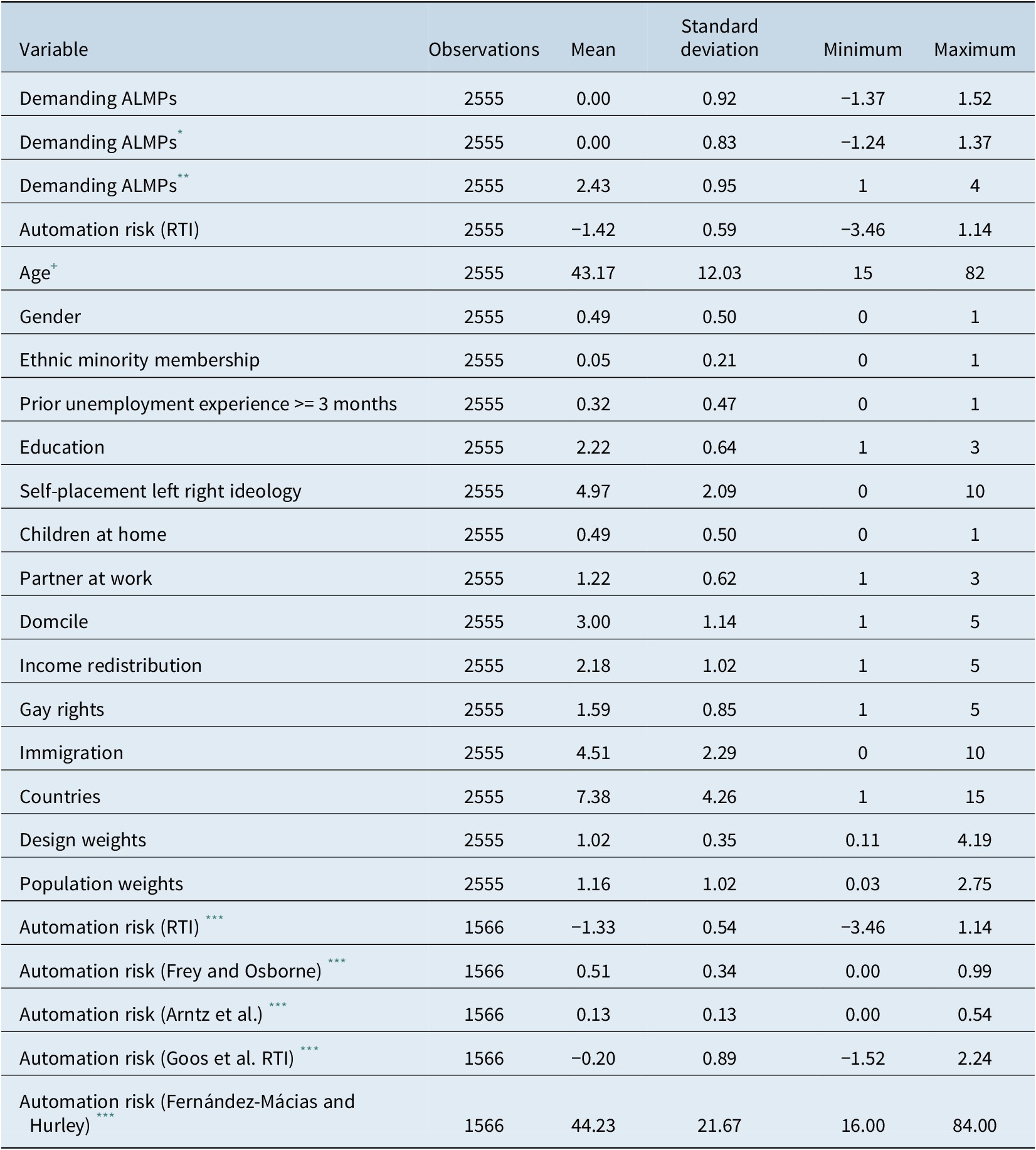
I then conducted a list-wise deletion of cases which had missing values on any of the covariates included in the main models. The percentage of cases with missing values is less than 5 per cent of the pooled sample for most covariates. The only variable with missing cases above 5 per cent is self-placement on the left–right scale: 214 cases (7 per cent). However, it does not represent a substantially high number of missing cases. A pooled analysis of the missing cases shows that they are missing at random (mean correlation = 0.02).Footnote 6 The final sample consists of 2555 cases.
Variables
I operationalized the dependent variable using two indicators.Footnote 7 Both indicators asked respondents about their preferred level of cuts to unemployed workers’ benefits when they turn down jobs. The first indicator concerns unemployed workers who rejected lower-paying jobs. The second indicator relates to unemployed workers who rejected jobs that have educational requirements lower than these workers’ educational qualifications. These two indicators thus capture two types of obligations imposed by demanding ALMPs on unemployed workers’ benefit recipiency. Although demanding ALMPs may impose other obligations, it is relevant to focus on these two conditions because unemployed workers are frequently under greater pressure to accept jobs in different occupations today (Knotz, Reference Knotz2018).
Both indicators are ordinal. They range from 1 to 4 and are strongly correlated (Pearson’s correlation value = 0.68). I standardized these two variables and then combined them into a single indicator which has good internal consistency (Cronbach’s alpha = 0.81). It ranges from −1.37 to 1.52 with a mean of 0. Higher values on this variable indicate support for bigger cuts to unemployment benefits for refusing job offers, which implies greater support for demanding ALMPs.
I used the Routine Task Intensity (RTI) index to construct the explanatory variable, unemployment risk caused by automation. Although there are a few other indices used in the automation literature (see eg. Arntz, Gregory, & Zierahn, Reference Arntz, Gregory and Zierahn2017; Frey & Osborne, Reference Frey and Osborne2017), most studies seem to settle on using RTI to measure an occupation’s vulnerability to automation (see eg. Owen & Johnston, Reference Owen and Johnston2017; Sacchi, Guarascio, & Vannutelli, Reference Sacchi, Guarascio, Vannutelli, Careja, Emmenegger and Giger2020; Thewissen & Rueda, Reference Thewissen and Rueda2017).Footnote 8 I used the RTI index supplied by Owen and Johnston’s (Reference Owen and Johnston2017) study that assigned RTI values to occupations categorized at the International Standard Classification of Occupations (ISCO) system four-digit level. In other words, an individual’s automation risk reflects her occupation’s vulnerability to automation. The authors based their operationalization of RTI on Acemoglu and Autor’s (Reference Acemoglu, Autor, Card and Ashenfelter2011) calculations for occupations in the United States. They computed RTI by subtracting the natural log of routine tasks from the sum of the natural log of abstract and manual tasks (Goos, Manning, & Salomons, Reference Goos, Manning and Salomons2014). RTI values are considered to be country invariant (Thewissen & Rueda, Reference Thewissen and Rueda2017). Across the sample, RTI ranges from −3.46 to 1.14 with a mean value of −1.42. Higher values indicate that individuals face a greater threat of unemployment from automation.
I also included a set of covariates frequently used in similar studies (Buss, Reference Buss2018; Fossati, Reference Fossati2018; Garritzmann, Busemeyer, & Neimanns, Reference Garritzmann, Busemeyer and Neimanns2018). They are age; gender; education; if respondents belong to an ethnic minority; current employment status; if respondents had prior experience of unemployment lasting for more than 3 months; self-placement on the left–right ideological scale; if respondents’ partners are in paid work; if respondents have children at home and their domicile’s level of urbanization. I controlled for education because lower educated individuals tend to have more authoritarian political attitudes (Dekker & Ester, Reference Dekker and Ester1987), which may then influence their support for strict obligations on benefit recipiency (Achterberg, Van Der Veen, & Raven, Reference Achterberg, Van Der Veen and Raven2014). Furthermore, since individuals’ level of education may affect their choice of occupations, controlling for education allows me to purge education-related effects that may confound the relationship between occupational automation risk and demanding ALMP support. I also purge confounding effects arising from economic and social attitudes, by controlling for individuals’ preferences on a set of political issues, namely income redistribution, gay rights and immigration (see Häusermann & Kriesi, Reference Häusermann, Kriesi, Kriesi, Kitschelt, Beramendi and Häusermann2015).
Method
I estimated the models using ordinary least squares (OLS) regression and applied population and design weights supplied by the ESS. OLS is appropriate as the dependent variable is continuous. I used a pooled fixed effects model (country dummies) to control for potential country-related confounders (Allison, Reference Allison2009), which may include the rate of automation adoption (Acemoglu & Restrepo, Reference Acemoglu and Restrepo2020), labour market institutions (Fernández-Macías & Hurley, Reference Fernández-Macías and Hurley2016) and social policy regimes.
According to Bryan and Jenkins (Reference Bryan and Jenkins2016), it is justified to use a single-level pooled model when a researcher is primarily interested in individual-level effects, which is the focus of this study, rather than contextual ones.Footnote 9 The alternative would be to apply mixed-effect models. However, the authors cautioned against using mixed-effects models when the number of level 2 cases is less than 25. Instead, McNeish and Stapleton (Reference Mcneish and Stapleton2016) and McNeish and Kelley (Reference Mcneish and Kelley2019) recommend using fixed-effect models when there are few level 2 cases, such as in this study. McNeish and Stapleton (Reference Mcneish and Stapleton2016) found that fixed-effect models perform best with respect to minimizing bias when there are few level 2 cases. In sum, a fixed-effect model allows me to focus on the individual-level effects of automation risk while controlling for country-level confounders. Country dummies absorb all of these confounders, and so “researchers need not be concerned with including level 2 predictors in the model because variance attributable to all level 2 variables (whether available in the data or not) is consumed by the cluster affiliation variables” (McNeish & Kelley, Reference Mcneish and Kelley2019, p. 23).
The model is specified formally below for which subscript  $ i $ refers to the nth observation,
 $ \alpha $ refers to the population average intercept and
 $ \beta $ refers to the respective covariate’s coefficient for the
 $ i $th observation.
 $ X $ refers to automation risk, and
 $ C $ refers to the battery of controls, including countries dummies. Finally,
 $ u $ represents the error term. The regression specification is applied to a sample which pools observations from all countries included in this study.
 $$ {y}_i=\alpha +{X}_i\beta +{C}_i\beta +{u}_i\quad1em \left(i=1,\dots, m.\right). $$
I conducted the analysis in a stepwise manner. The first model is an empty model. The second model includes control covariates. The third model adds the explanatory variable, automation risk. The fourth model includes individuals’ educational levels to purge the confounding effect of education. The fifth model adds individuals’ self-placement on the left–right scale to purge the effects of political ideology on demanding ALMP support (Fossati, Reference Fossati2018). The final model includes individuals’ preferences on a set of political issues to purge the effects of economic and social attitudes on demanding ALMP support.
Results
Main findings
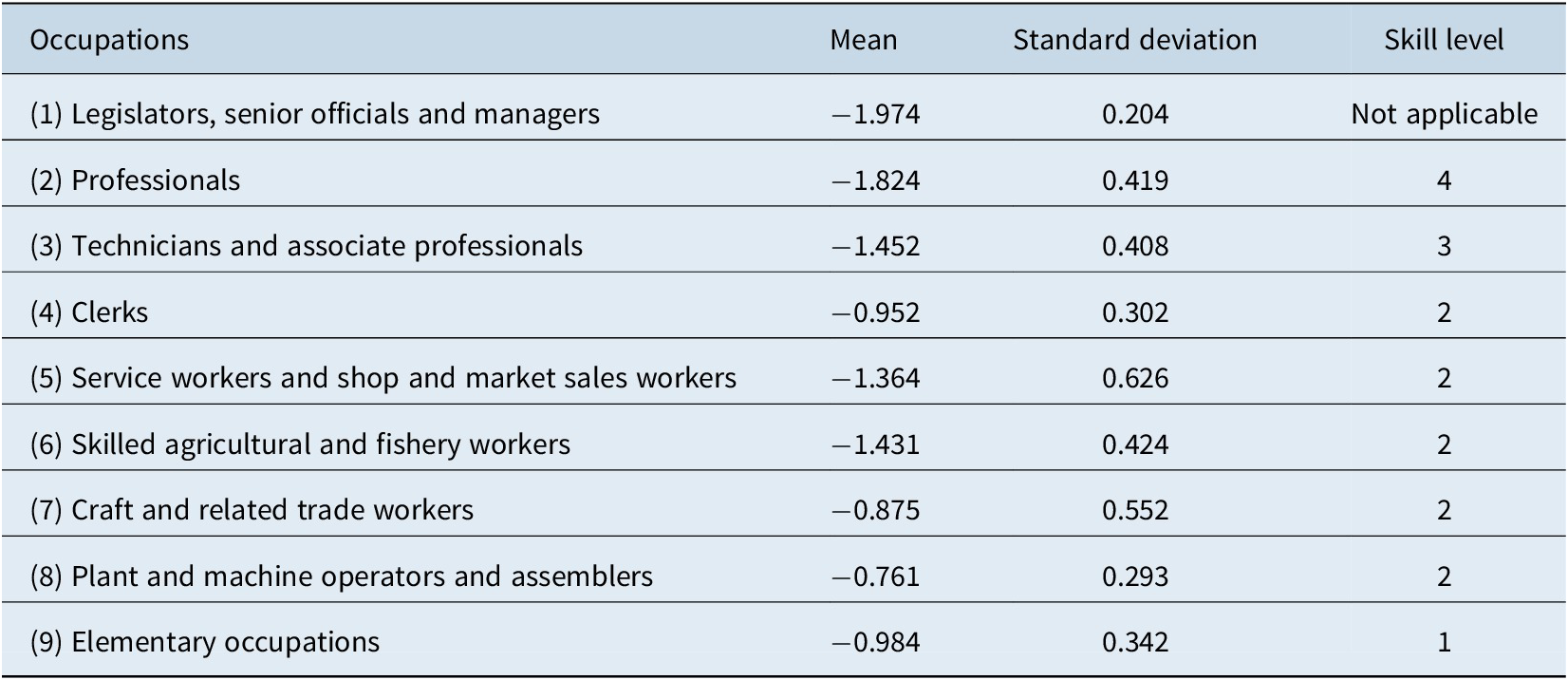
Table 1 presents the mean and standard deviation values of automation risk for different occupations. Occupations are broadly classified at their ISCO-88 one-digit level for ease of comparison. According to the International Labour Organization (ILO), the ISCO-88 system also differentiates different categories of occupations by their required skill level. Skill level refers to the degree of specialization and the complexity of tasks to be performed in an occupation. The rightmost column shows the skill level for each occupation assigned by ILO for which higher values indicate greater complexity and specialization. Occupations with higher skill levels frequently also require higher levels of education.
Automation risk by occupational categories.

Occupations categorized at the International Standard for Classification of Occupations 88 1-digit level. Skill level assignment: higher values indicate greater complexity and specialization. Values from the International Labour Organization.
This table shows how workers in different occupations have varying levels of automation risk. Workers in plant and machine operating and assembly, craft and related trade work, clerical, and elementary occupations experience the highest automation risk in descending order. By contrast, legislators, senior officials and managers and professionals have the lowest automation risk. Table 1 also demonstrates that workers in occupations that require middling skill levels (level 2) experience the highest automation risk. Plant and machine operators and assemblers, craft-related trade workers and clerks who require middling skills face higher automation risk than elementary workers who require low skills (level 1). Table 1 thus highlights that automation risk does seem to be concentrated among workers in medium-skilled occupations (RBTC hypothesis), rather than among workers in low-skilled ones (SBTC hypothesis).
Nevertheless, it is worth highlighting that workers’ automation risk varies substantially within these broad occupational categories. This is because automation risk was assigned at a finer four-digit classification level. This table however presents automation risk at the coarser one-digit classification level. The variation in automation risk within these one-digit occupational categories is reflected in their standard deviation values. For instance, automation risk varies substantially within technician, service work and shop and market work and craft and related trade work occupations.
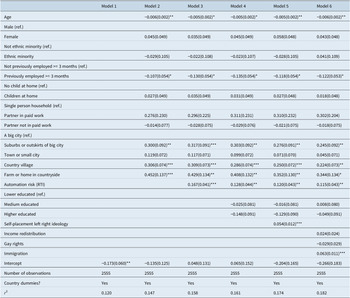
Table 2 presents results from the regression analyses. Model 1, which is an intercept-only model, shows that the population significantly opposes demanding ALMPs on average. In other words, demanding ALMPs are not popular on average in the 15 West European countries included in this study. Model 2 however reveals that individuals are stratified in their support for demanding ALMPs: the inclusion of controls erases the significance of the intercept. Younger individuals with no prior unemployment experience and who live in suburbs, country villages or the countryside are significantly more supportive of demanding ALMPs.
Demanding ALMP support

Standard errors in parentheses
* p<0.05 ** p<0.01 *** p<0.001
Notes:
Higher values for self-placement on left-right scale indicates more rightist ideology.
Higher values on income redistribution indicate opposition to income redistribution.
Higher values on homosexual rights indicate opposition to such rights.
Higher values on immigration indicate immigrants make country worse place to live in.
Design and population weights applied.
Model 3 further considers how automation risk may stratify support for demanding ALMPs. It shows that individuals, who are more threatened by unemployment from automation, are significantly more supportive of demanding ALMPs (p < .001). This correlation between automation risk and demanding ALMP support is robust, despite the inclusion of other individual-level covariates from Model 2.
Models 4 examines if the impact of automation risk on demanding ALMP support is sensitive to individuals’ educational levels. Education may confound the impact of automation risk on demanding ALMP support in two possible ways. First, the effect of automation risk may be driven by education if it is concentrated among lower educated workers (SBTC) (Fernández-Macías & Hurley, Reference Fernández-Macías and Hurley2016; Katz & Murphy, Reference Katz and Murphy1992). Second, lower educated workers are more likely to have authoritarian political views (Dekker & Ester, Reference Dekker and Ester1987) and may thus be more inclined to support restrictive welfare policies such as demanding ALMPs (Achterberg, Van Der Veen, & Raven, Reference Achterberg, Van Der Veen and Raven2014; Häusermann & Kriesi, Reference Häusermann, Kriesi, Kriesi, Kitschelt, Beramendi and Häusermann2015). In other words, education may have direct and indirect effects on demanding ALMP support, and these effects may be correlated with the effects of automation risk. Model 4 demonstrates that automation risk remains robust after purging the effects of educational differences. However, decreases in automation risk’s effect magnitude and level of significance (p < .01) suggest that some of its correlation with demanding ALMP support, as observed in Model 3, was driven by educational differences.
Models 5 and 6 further assess if the impact of automation risk on demanding ALMP support is sensitive to individuals’ political ideology and economic and social attitudes, respectively. It is relevant to control for individuals’ economic (redistributive) and social (authoritarian) attitudes as they may represent the indirect effects of education on demanding ALMP support. Unsurprisingly, individuals who have right-wing ideology and hold authoritarian attitudes manifesting as opposition to immigration are significantly more supportive of demanding ALMPs. Nevertheless, automation risk remains robust even after purging these two confounders in these two models. However, decreases in automation risk’s effect magnitude and level of significance (p < .01) suggest that some of its correlation with demanding ALMP support, as observed in Model 3, was driven by political ideology and attitudes.
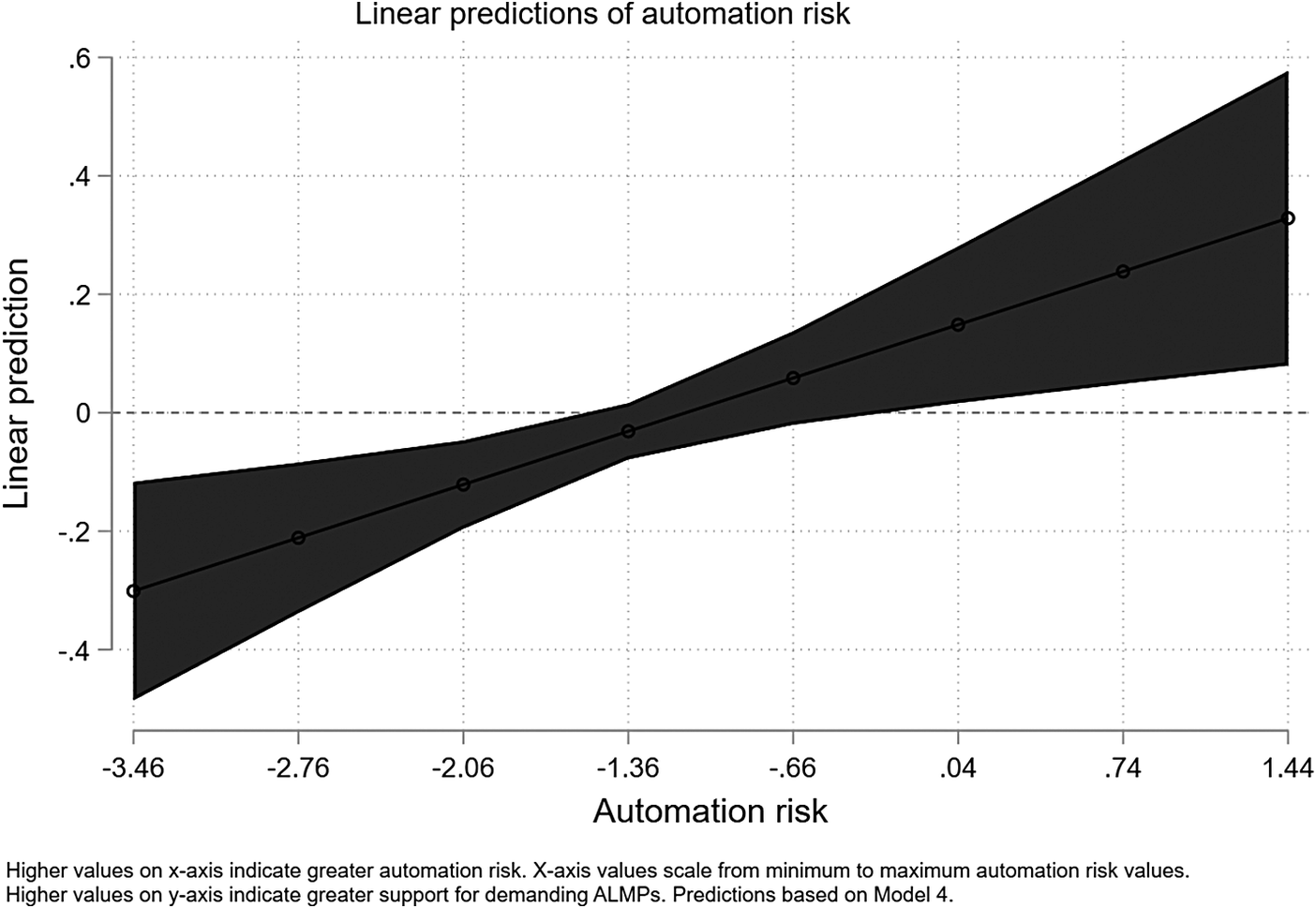
Figure 1 illustrates the effect magnitude of automation risk based on Model 4 which controls for workers’ sociodemographic traits and education. The dependent variable, demanding ALMP support, ranges from −1.37 to 1.52. It however has a value of −0.30 at the minimum value of automation risk and a value of 0.32 at its maximum value. A rise in automation risk from its minimum to its maximum values therefore translates to a 20.8 percentage point increase in support for demanding ALMPs, which is sizable. Figure 1 also indicates that support for demanding ALMPs is only significantly distinct at the poles of automation risk. Workers who experience a low/high threat of unemployment from automation significantly oppose/support demanding ALMPs. However, workers who experience a middling threat of unemployment are neither significantly more predisposed nor opposed to such policies.
Linear predictions of automation risk.

Robustness checks
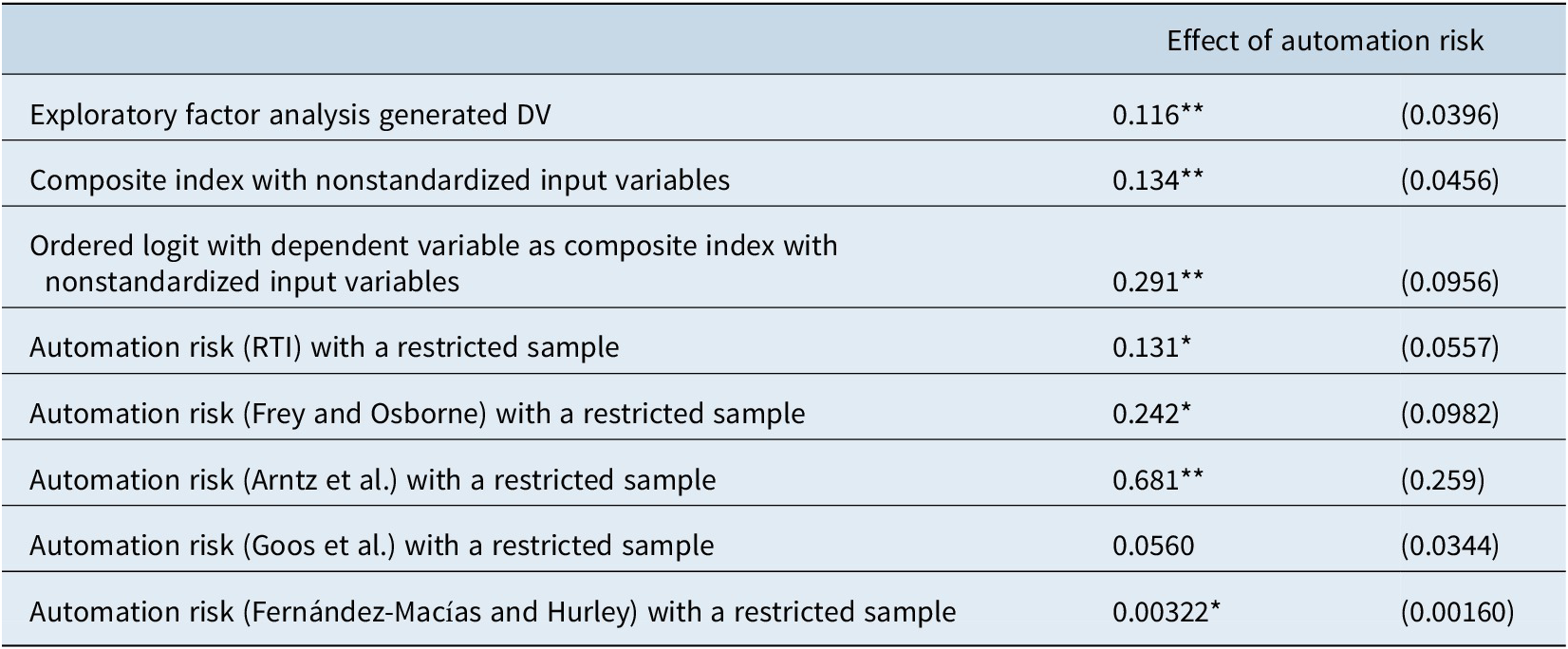
Table 3 presents results on the robustness of the association between automation risk and demanding ALMP support to alternate specifications of demanding ALMP support and automation risk, and alternate model estimations. I conducted these robustness checks by replicating Model 4 (see Table 2), which includes sociodemographic and education controls. With regards to alternate specifications of demanding ALMP support, the effect magnitude and significance of automation risk are comparable to the base model. With regards to an alternate estimation strategy, the effect magnitude and significance of automation risk are also comparable to the base model.Footnote 10
Robustness checks.

Standard errors in parentheses. Estimation strategy: OLS based on Model 4 (unless otherwise stated). In restricted samples, the sample size is 1566. This is because the other four indices Arntz et al., Frey and Osborne, Goos et al., Fernández-Macías and Hurley have more observations with missing values than RTI.
*p < .05, **p < .01, ***p < .001.
In addition, I tested alternate specifications of automation risk. Some of them are based on studies included in Biagi and Sebastian’s (Reference Biagi, Sebastian and Zimmermann2020) meta-review. This list is not exhaustive, but comparing results from these different operationalizations will lend confidence to the robustness of the findings. The sample size here is restricted to observations which do not have missing values across all five indicators. Table 3 shows that the effect direction and significance of automation risk are similar, irrespective of whether it is operationalized as the RTI, Frey and Osborne, Arntz et al., or Fernández-Macías and Hurley indices. However, the effect magnitude varies according to the indicator selected. By contrast, the Goos et al. index approaches but does not achieve conventional levels of statistical significance (p = .104 > .1). It is not possible to fully ascertain the reasons for this difference here. It may relate to the index’s weaker correlation with other indices, which may in turn hint at underlying differences in measurement.Footnote 11 It is however reassuring that results from the Fernández-Macías and Hurley (Reference Fernández-Macías and Hurley2016) indicator are comparable with results from the RTI specification in terms of effect significance and direction. The former calculates an occupation’s routineness based on European data, which minimizes the drawback of basing automation risk on U.S. labour data. In short, it is reassuring that the effect direction and significance of automation risk are generally robust across different indicators, despite substantial differences in how these indicators were constructed (Biagi & Sebastian, Reference Biagi, Sebastian and Zimmermann2020). Such differences in operationalization may also explain variations in effect size for different indices.
Discussion and conclusion
This paper contributes to current debates on individual-level determinants of demanding ALMP support by focussing on the impact of unemployment risk rather than current employment status. The need to distinguish between these two factors is highlighted by recent political economy studies which demonstrate that risk and status may stimulate different mechanisms and yield dissimilar outcomes (Rovny & Rovny, Reference Rovny and Rovny2017). Studies on unemployment risk show that vulnerable workers seek to insure against costs arising from these risks (Rehm, Reference Rehm2009; Thewissen & Rueda, Reference Thewissen and Rueda2017). Unemployment benefits satisfy these workers’ insurance demand because they mitigate the effects of income loss. However, vulnerable workers’ potential reliance on unemployment benefits also opens the door to concerns about threats to these benefits, such as restrictions to welfare access and welfare competition. It is likely that vulnerable workers worry about both concerns, but to unequal degrees, which in turn affect their support for demanding ALMPs.
In the case of automation, I find that routine workers support, rather than oppose, demanding ALMPs. Hypothesis H1A can thus be rejected in favour of Hypothesis H1B. The findings suggest that routine workers place greater emphasis on welfare competition than welfare access. They may find welfare competition to be more salient due to the characteristics of unemployment risk from automation. Although routine workers face a greater threat of becoming unemployed than nonroutine workers, only a fraction of them actually become unemployed thus far (Kurer, Reference Kurer2020; Kurer & Gallego, Reference Kurer and Gallego2019). Furthermore, actual unemployment, should it occur, may take place in the future rather than imminently. This is because automation “gradually alters the employment structure [such that] jobs are eliminated over a long period of time” (Cortes, Reference Cortes2016; Kurer & Palier, Reference Kurer and Palier2019, p. 2). Consequently, routine workers may not view themselves to be under immediate threat of unemployment. They may therefore also not consider themselves to be in imminent need of unemployment benefits. Instead, the threat of future unemployment may render concerns about the future viability of benefit systems more salient, especially when individuals have become more anxious about the costs and sustainability of welfare programmes under permanent austerity (Laenen, Rossetti, & Van Oorschot, Reference Laenen, Rossetti and Van Oorschot2019). In short, the slow-burn effect of automation on employment patterns may lead routine workers to consider welfare competition to be more salient than welfare access on balance. Routine workers may hence support demanding ALMPs to maintain their (future) benefit levels by imposing restrictive obligations on unemployed workers’ (current) use of unemployment benefits. The findings here echo results from Sacchi, Guarascio, and Vannutelli’s (Reference Sacchi, Guarascio, Vannutelli, Careja, Emmenegger and Giger2020) study: routine workers significantly prefer unemployment benefits with stringent obligations but are ambivalent towards unconditional ones.
It is nevertheless important to demarcate the perimeters of this study. It focusses on how individuals’ occupational vulnerability to automation may affect their support for demanding ALMPs. This emphasis on individuals is motivated by a view that individuals in similar occupations face relatively similar automation risks across countries because some tasks are more easily automated than others (Goos, Manning, & Salomons, Reference Goos, Manning and Salomons2014; Thewissen & Rueda, Reference Thewissen and Rueda2017, p. 8). Consequently, the first order of business would be to explore the relationship between automation risk and demanding ALMP support at the individual level. It would however be naïve to disregard institutional differences that may mediate this relationship. Labour market institutions shape the adoption of automation (Arntz, Gregory, & Zierahn, Reference Arntz, Gregory and Zierahn2017; Fernández-Macías & Hurley, Reference Fernández-Macías and Hurley2016) and the extent to which routine workers are exposed to the threat of automation. Social policy institutions may also cushion unemployment risk. This study used fixed-effect models to purge these institutional effects. Future studies could instead hone in on these institutional differences.
Furthermore, future studies could compare the impact of automation risk to the impact of other labour market risks. Although different labour market risks may induce similar economic and welfare concerns, their specific characteristics may still lead unemployment-threatened workers to respond differently. For instance, the threat of unemployment from the COVID-19 shock is more imminent than the threat of unemployment from automation. Similarly, vulnerable workers may respond to these two risks dissimilarly because of differences in the time horizon of unemployment. Unemployment risk from COVID-19 may stimulate a greater concern for welfare access, whereas unemployment risk from automation may induce a greater concern for welfare competition. In short, future studies could explore the extent to which different risks yield varying levels of support for social and public policies, including demanding ALMPs.
Acknowledgements
This study acknowledges support from the Jos Berghman Welfare Studies Stipend provided by the Social Policy and Social Work team of the Centre for Sociological Research at KU Leuven, Belgium. I would like to thank Kathrin Komp, Heikki Hiilamo, Anne Kouvonen and Rosa von Gleichen for their comments, advice and support. I would also like to thank two anonymous reviewers whose suggestions helped improve and clarify this manuscript. Finally, I would also like to thank Erica Owen and Noel Johnston, as well as Melanie Arntz, Terry Gregory and Ulrich Zierahn for making their codes available.
Disclosure
The author has no conflict of interest to declare.
Notes on Contributors
Zhen Im is a doctoral candidate at the Faculty of Social Sciences at the University of Helsinki.
Supplementary Materials
To view supplementary material for this article, please visit http://dx.doi.org10.1017/ics.2020.22
Appendix I
Descriptive statistics