Introduction
Co-morbidity is a significant indicator for predicting the outcomes and risks of cancer treatments. The University of Washington Adult Co-morbidity Evaluation 27 (‘ACE-27’) index has been validated for use in cancer patients. Patients with moderate or severe co-morbidity indices have a significantly lower overall survival rate compared with those without co-morbidity.Reference Piccirillo, Tierney, Costas, Grove and Spitznagel 1 For this reason, the Adult Co-morbidity Evaluation 27 score is routinely collected in UK national head and neck annual audits. 2
Researchers in Newcastle, UK, developed a structured patient questionnaire to evaluate the Adult Co-morbidity Evaluation 27 score. Use of the questionnaire was shown to improve the completeness of data collection compared with a retrospective review alone.Reference Paleri and Wright 3 Touch-screen computer technology has been successfully used for data collection for a variety of clinical applications, including assessment of anxiety and depression, symptomology, and quality of life.Reference Turgeon, Petrak, Slobodian and Bohm 4 – Reference Mackenzie, Carey and Sanson-Fisher 6 In the field of head and neck cancer, touch-screen technology has been successfully used to assess the use of a patient-concerns inventory in the out-patient setting and to evaluate patient quality of life.Reference Scott, Ghazali, Lowe, Bekiroglu and Rogers 7 – Reference Cnossen, de Bree, Rinlet, Eerenstein, Rietveld and Buter 10
This study aimed to establish whether a simplified version of the Newcastle patient-completed Adult Co-morbidity Evaluation 27 questionnaire, as modified for use with a touch-screen computer, was acceptable for determining co-morbidity scores in head and neck cancer patients. It also compared scores obtained via the computer programme with those obtained via physician assessment.
Materials and methods
A computer-based questionnaire and a database to store responses were developed by the Royal Wolverhampton Hospitals Trust Cancer Services by modifying the Newcastle Adult Co-morbidity Evaluation 27 patient questionnaire. The questionnaire comprised 23 core questions, with further questions prompted by an affirmative response to specific domains. All new patients attending the Wolverhampton Joint Surgical–Oncology Head and Neck Cancer Clinic who had a cancer diagnosis, had no significant visual deficit and were sufficiently able to read English without assistance were invited to participate in the audit.
A total of 96 patients attending the joint surgical–oncology clinic for assessment prior to treatment from July 2012 to August 2013 completed the questionnaire using an HP ElitePad (Hewlett Packard, Palo Alto, CA, USA) touch-screen computer. A clinical nurse specialist was available to assist with any problems that arose. A case review was then performed by the clinical team for each patient to discuss treatment options. An oncologist who was blind to the results of the patient-completed questionnaire assigned an Adult Co-morbidity Evaluation 27 score to each patient based on a medical history obtained at the clinic and a review of the medical notes. Patient-derived and physician-derived Adult Co-morbidity Evaluation 27 scores were compared; where there was discrepancy, a final score was determined by the investigator following a full review of the medical records and further consultation with the patient, if required.
Following consultation with the medical team and a clinical nurse specialist review, the patient was asked to complete a short paper-based questionnaire to rate use of the computer as very easy, easy acceptable, difficult or very difficult. A similar question was used to evaluate the comprehensibility of the questionnaire. Patients were asked whether they would be willing to use a computer again (with or without assistance), whether they would prefer to use a pen and paper, or whether they would prefer not to complete a questionnaire at all. The results from this acceptability audit were collated.
Statistical analysis
Significant differences in audit variables between patients aged 65 years or younger and those aged over 65 years and between patients with World Health Organisation (WHO) performance status 0 or 1 vs those with WHO performance status 2 or 3 were determined using a χ2 test.
Results
Patient demographics
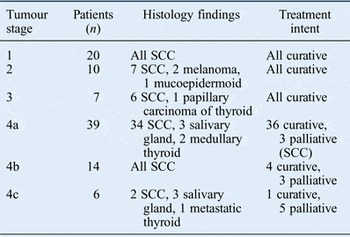
Of the 96 patients who participated in the study, 67 were men, 29 were women and the median age was 63 years (range 26–91 years), reflecting the expected demographics for head and neck cancer patients. In all, 85 patients received treatment with curative intent and 11 received palliative therapy. Twenty patients had stage 1 disease, 10 had stage 2 disease, 7 had stage 3 disease, 39 had stage 4a disease, 14 had stage 4b disease and 6 had stage 4c disease (Table I).
Tumour stage and histological classification

n = 96. SCC = squamous cell carcinoma
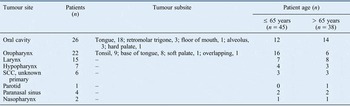
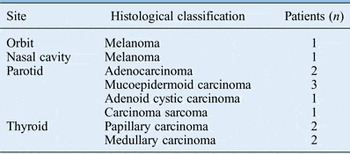
A total of 83 patients had tumours of squamous cell origin. The commonest sites of squamous cell carcinomas were the oral cavity and oropharynx (Table II). All patients with carcinoma of the tonsil were aged 65 or younger, which may reflect the demographic of human papilloma virus (HPV) related malignancy, although HPV testing was not carried out for oropharyngeal cancers. Non-squamous cell tumour sites are listed in Table III.
Squamous cell carcinomas: tumour site and subsite

Total, n = 83
Non-squamous cell carcinomas: tumour site and histological classification

n = 13
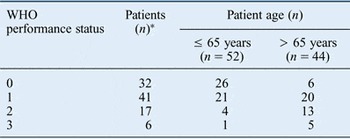
Patients included in the study generally had a good WHO performance status: 32 had performance status 0, 41 had performance status 1, 17 had performance status 2 and 6 had performance status 3. Age correlated with performance status (Table IV): patients with performance status 0 were more likely to be younger than 65 years (χ2 test; p = 0.0002), and those with performance status 3 were more likely to be older than 65 years (χ2 test; p = 0.06).
Patient performance status by age

*n = 96.WHO = World Health Organization
Adult Co-morbidity Evaluation 27 score
Patient-completed Adult Co-morbidity Evaluation 27 scores were 0 (none) for 29 patients; 1 (mild) for 30 patients; 2 (moderate) for 19 patients; and 3 (severe) for 18 patients. Physician-completed co-morbidity scores for the same cohort were 0 for 31 patients, 1 for 29 patients, 2 for 18 patients and 3 for 18 patients.
There was concordance between patient-completed questionnaire and physician co-morbidity assessment scores for 88 out of 96 patients (92 per cent). After reviewing the discordant assessments, a correct assessment was achieved via patient-completed questionnaire for 92 out of 96 patients (96 per cent) and via the physician in 92 out of 96 patients (96 per cent). Discordance in the patient questionnaire vs physician assessed Adult Co-morbidity Evaluation 27 score did not correlate with patient age or performance status. Discordance was found for 4 of the 52 patients aged 65 years or under and for 4 of the 44 patients aged over 65 years (χ2 test; p = 0.79). When analysed by performance status, discordance was noted for 7 out of 73 patients with performance status 0 or 1, and in 1 out of 23 patients with performance status 2 or 3 (χ2 test; p = 0.43). For the eight patients with discordant co-morbidity scores, the patient-completed questionnaire underscored co-morbidity in two patients: one patient failed to report a history of a Dukes’ B carcinoma of the colon and another patient appeared to be in denial of having any illness at all. The latter patient refused radical treatment for their head and neck cancer, and sought an alternative medicine approach. The patient-completed questionnaire overestimated co-morbidity in two patients: one patient believed that their blood pressure was not under control when in fact it was well controlled by medication; and another obese patient ascribed shortness of breath on exercise that limited activity to a diagnosis of asthma. The clinician-derived score underestimated co-morbidity in four patients: in three patients, the patient-completed questionnaire indicated undiagnosed peripheral vascular disease which was not detected by clinicians; and one patient had a history of hypertension which was controlled by diet and lifestyle measures and not noted in a medical history taken at the clinic.
Although the study was not sufficiently powered to enable correlation between the Adult Co-morbidity Evaluation 27 score and survival to be assessed, 13 out of 19 patients with a final score indicating severe co-morbidity died within 12 months of completing treatment.
Patient-derived co-morbidity score and treatment given
Of those receiving curative treatment, 10 out of 14 patients with a score indicating severe co-morbidity received a non-surgical treatment, as opposed to 28 out of 71 patients who scored 0, 1 or 2. This difference was statistically significant (χ2 test; p = 0.03).
Of the 11 patients who did not receive potentially curative treatment, 5 had been assigned a severe co-morbidity score.
Acceptability audit
The acceptability audit showed that 80 per cent of patients found the computer easy or very easy to use, 94 per cent found the computer acceptable to use, and 5 per cent of patients (n = 5) found the computer difficult to use. Four of the latter patients were aged over 75 years and the other had learning difficulties. One elderly patient with hemiplegia found the computer very difficult to use.
In all, 90 per cent of patients found the questions very easy or easy to understand, 98 per cent found the questions very easy, easy or acceptable to understand, and two patients (2 per cent) found the questions difficult to understand without help. In all, 78 per cent of patients with performance status 2–3 said they preferred to have help in completing the questionnaire.
In all, 97 per cent of patients found use of the touch-screen computer acceptable and would be willing to use one again. A total of 62 per cent of patients would be willing to use the touch-screen computer without help: 77 per cent (40 out of 52) of those aged 65 years and under; and 45 per cent (20 out of 44) of those older than 65 years (χ2 test; p = 0.002).
In all, 75 per cent of patients (55 out of 73) with performance status 0–1 would be happy to use a computer without help, compared with 22 per cent of patients (5 out of 23) with performance status 2–3 (χ2 test; p = 0.0003).
Discussion
This study demonstrated that a touch-screen computer is an acceptable tool for use in an out-patient setting. With assistance, use of the computer was acceptable to 97 per cent of patients, who would be willing to use the computer again. As the questionnaire was written in English, patients requiring an interpreter were excluded, as were those with significant visual impairment or those suffering from dementia. Although a weakness of the study, these restrictions were necessary because, although a nurse was on hand to give assistance if required, completion of the questionnaire and use of the computer had to be assessed when help was not routinely offered. If assistance to read the questions or for translation were available, then the questionnaire could be routinely used in a clinical setting for patients with additional needs. While use of only an English language version of the questionnaire was a weakness of the study, the patients involved had various different cultural backgrounds. Thus, the use of a touch-screen computer appeared to be acceptable across the cultural spectrum of Wolverhampton. The demographics of audit participants were those expected for a head and neck cancer clinic in the UK.
The accuracy of the patient-completed questionnaire was 96 per cent, unaffected by patient age or performance status, and equivalent to the physician assessment. Peripheral vascular disease was one of commonest causes of discrepancy between patient and physician co-morbidity assessments when physicians were blinded to patient assessments. Making patient-directed co-morbidity assessments available to clinicians at a busy clinic would probably improve the co-morbidity assessment by helping direct the consultation. Blinding clinicians to the results of the patient questionnaire is a strength of the audit because it allowed a direct comparison between the clinical assessment of co-morbidity and the patient-completed questionnaire score. However, this does not reflect how such a tool would be used in clinical practice. In clinical practice, making the completed electronic questionnaire available to the clinician for review prior to the patient's consultation would enable a targeted review of co-morbidity with additional examination or assessment as required (i.e. of peripheral pulses, in our experience).
While information on co-morbidity could be collected via a paper questionnaire, use of a computer program enables immediate calculation of the score, which reduces error and variability in interpretation. Paper questionnaires also require preparation prior to the clinic appointment, as well as filing or scanning into patient records for storage. These tasks are labour intensive and do not facilitate data interrogation for trends or measuring the outcome for audit or research. In contrast, an electronic questionnaire saves time and enables large quantities of data to be reviewed. An additional advantage of the electronic questionnaire is the ability to easily increase the font size to make it easier for many older patients to read.
Transferring the questionnaire data into electronic patient records may also improve the coding of health-care episodes as a broad, standardised co-morbidity assessment has already been documented.
-
• Adult Co-morbidity Evaluation 27 can be scored via a patient-completed questionnaire using touch-screen computer technology
-
• Score assessment using this method is feasible and can complement physician assessment
-
• Touch-screen computer technology is acceptable to most patients
-
• Older patients or those with poor performance may need assistance to use the technology in an out-patient setting
Wu et al. demonstrated that the use of touch-screen technology and electronic systems had a high degree of both acceptability and data completion for adolescent patients.Reference Wu, Johnson, Schepp and Karen 11 Unsurprisingly, the present study found that patient satisfaction with the technology was affected by advanced age and reduced performance status, with only 45 per cent of patients aged over 65 years being happy to use the computer again without assistance. However, 95 per cent of patients aged over 65 years and 91 per cent of those with performance status 2–3 found the use of a touch-screen computer acceptable and would be willing to use one again, highlighting the importance of providing assistance. It is important, particularly in a new patient assessment clinic, that the computerised questionnaire does not replace face-to-face contact with the multidisciplinary team but is instead used to enhance information-gathering and eliminate subjectivity in assessment.
Conclusion
Use of a patient-completed Adult Co-morbidity Evaluation 27 questionnaire via touch-screen computer in head and neck clinics is an appropriate way to assess co-morbidity in all patients prior to clinical review. Assistance should be offered to all patients, particularly those aged over 65 years or with a poor performance status. However, the questionnaire needs to be assessed in other patient groups.