Introduction
Dietary WG may be included in poultry feed in three different ways: ad libitum access to WG and another feed in separate feeders (free-choice feeding), WG mixed with another feed in the same feeder (mixed feeding), and sequential feeding of WG and another feed in the same feeder, but at different times (Rose et al., Reference ROSE, FIELDEN, FOOTE and GARDIN1995). In many experiments, two variants of mixed feeding were applied: WG offered with a commercial diet, which resulted in a dilution of the daily ration (Plavnik et al., Reference PLAVNIK, MACOVSKY and SKLAN2002; Bennett and Classen, Reference BENNETT and CLASSEN2003; Wu et al., Reference WU, RAVINDRAN, THOMAS, BIRTLES and HENDRIKS2004) or WG offered with protein-mineral-vitamin concentrate (PC), without reducing the nutritional value of the daily ration (Wu et al., Reference WU, RAVINDRAN, THOMAS, BIRTLES and HENDRIKS2004; Ravindran et al., Reference RAVINDRAN, WU, THOMAS and MOREL2006; Amerah et al., Reference AMERAH, RAVINDRAN, LENTLE and THOMAS2008). The incorporation of WG into pelleted poultry diets has been investigated in only a few experiments (Svihus et al., Reference SVIHUS, JUVIK, HETLAND and KROGDAHL2004; Taylor and Jones, Reference TAYLOR and JONES2004).
This paper discusses the effect of different feeding strategies (pre-pelleting inclusion of WG, post-pelleting inclusion of WG with or without dilution of the daily ration and free-choice feeding) on growth performance, carcass yield and incidence of foot-pad-dermatitis (FPD) in growing turkeys.
Methods of whole grain inclusion and their effects on the nutritional value of diets
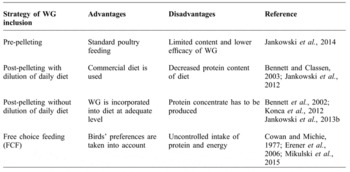
Different strategies aimed at WG inclusion in chicken diets have been described in the literature: (1) WG is first mixed with other feed components and then pelleted, (2) WG is mixed with another feed (complete feed or protein concentrate) in the same feeder, (3) birds have ad libitum access to WG offered free choice with another feed in separate feeders, (4) WG and another feed are offered in the same feeder, but at different times (Singh et al., Reference SINGH, AMERAH and RAVINDRAN2014a). In experiments performed on turkeys, some of the above strategies were used to incorporate WG into diets ( Table 1 ).
WG incorporation into turkey diets in different feeding systems.

In pre-pelleting system, WG was first mixed with other components and then the mixture was subjected to pelleting. Such treatment has no influence on the chemical composition of feed; it only changes the physical form of part of the grain contained in the mixture. In the experiment conducted by Jankowski et al. (Reference JANKOWSKI, MIKULSKI, ZDUNCZYK, JUSKIEWICZ and LICHTOROWICZ2014) and presented in Table 1 , a diet containing 20% GW had no effect on gizzard weight in turkeys. This suggests that pelleting disrupts grain structure and alleviates the adverse physiological effect of dietary supplementation with GW.
In one experiment involving chickens, pre-pelleting inclusion of whole corn increased AME and total tract DM retention up to 30% of WG inclusion, which decreased or levelled off with further inclusion (Singh et al., Reference SINGH, RAVINDRAN, WESTER, MOLAN and RAVINDRAN2014b). Similar results were noted in other studies with dietary inclusion of WW (Svihus et al., Reference SVIHUS, JUVIK, HETLAND and KROGDAHL2004; Wu et al., 2004). In an experiment on growing turkeys (Jankowski et al., Reference JANKOWSKI, MIKULSKI, ZDUNCZYK, MIKULSKA and JUSKIEWICZ2012), dry matter digestibility and metabolisable energy increased, but only with lower substitution of basal diet (5%) with WW, and the nutritional value of the diet did not improve with higher addition of WW (10% and 15%). In another experiment (Konca et al., Reference KONCA, KIRKPINAR, MERT and ATAC2012), nutrient digestibility was similar when whole barley (WB) was mixed into the basal diet or given separately.
Post-pelleting inclusion of WG, as a partial substitute for a complete diet, is known to decrease crude protein concentrations in the daily ration (Bennett et al., Reference BENNETT, CLASSEN, SCHWEAN and RIDDELL2002; Jankowski et al., Reference JANKOWSKI, MIKULSKI, ZDUNCZYK, MIKULSKA and JUSKIEWICZ2012). When WW was added at 8.2, 13.3 and 18.2% in the full feeding cycle of turkeys, average crude protein concentrations in the diet decreased by 3.4%, 5.8% and 7.6%, respectively, in comparison with the control diet (Jankowski et al., Reference JANKOWSKI, MIKULSKI, ZDUNCZYK, MIKULSKA and JUSKIEWICZ2012). In the post-pelleting inclusion system, a decrease in the protein content of the diet can be prevented if the amount of protein concentrate included in the diet corresponds to the amount of WG incorporated into the diet. Such a strategy allows an increase of WG inclusion levels up to 100% of the total grain content of the diet, without changes in nutrient intake. In the experiments presented in Table 1 , the WG content of the diet ranged from 16.7% (Konca et al., Reference KONCA, KIRKPINAR, MERT and ATAC2012) to 50% of whole barley and triticale (Bennett et al., Reference BENNETT, CLASSEN, SCHWEAN and RIDDELL2002), and 60% of WW (Jankowski et al., Reference JANKOWSKI, MIKULSKI, ZDUNCZYK and JUSKIEWICZ2013a) in the final phase of feeding.
In contrast to other systems, FCF can lead to considerable differences in the nutritional value of turkey diets. In first experiments on turkeys under FCF, the birds voluntarily consumed slightly more PC and less WW (Cowan and Michie, Reference COWAN and MICHIE1977; Reference COWAN and MICHIE1979) or more WG and less of a complete pelleted diet (Majewska, Reference MAJEWSKA1996). In another experiment (Erener et al., Reference ERENER, OCAK, GARPOGLU, SAHIN and OZTURK2006), in turkeys fed a basal diet or offered a choice between a basal diet and WG (wheat or corn), protein intake was lower and metabolisable energy intake was higher. In studies by Cowan and Michie (Reference COWAN and MICHIE1977), and Emmerson et al. (Reference EMMERSON, DENBOW and HULET1990), turkeys on the FCF system consumed less feed and protein but the same amount of energy. However, in a recent FCF experiment performed by Mikulski et al. (Reference MIKULSKI, JANKOWSKI, MAJEWSKA and ZDUNCZYK2015), turkeys fed WW and PC consumed only small amounts of WG and large amounts of PC. In the FCF system, daily feed intake increased by 11% and 27% compared with the control group fed a complete diet, in the first and second periods of the experiment (5-8 and 9-12 weeks, respectively). Those results corroborate the findings of Cowan and Michie (Reference COWAN and MICHIE1977) who reported that in comparison with other poultry species, turkeys are characterised by lower ability to control the intake of protein concentrate combined with cereal grain.
Effect of whole grain on the growth performance of birds in different feeding systems
feeding WW to turkeys with pre-pelleting inclusion of WG
Despite an increased interest in the use of WG in poultry nutrition observed over the past few decades, there are no published studies investigating the effects of pre-pelleting inclusion of WW in turkey diets. In an experiment on broiler chickens (Taylor and Jones, Reference TAYLOR and JONES2001), pre-pelleting inclusion of 20% WW in the diet had no effect on BWG or feed efficiency (FCR). Svihus et al. (Reference SVIHUS, JUVIK, HETLAND and KROGDAHL2004) demonstrated that pre-pelleting inclusion of 50% WW in broiler chicken diets led to a 26% increase in relative gizzard weight, but it did not affect growth performance parameters. In an experiment performed by Singh and Ravindran (Reference SINGH and RAVINDRAN2015) on broilers fed diets containing 20% WW in the form of pellets with a larger diameter (4.76 mm), feed intake and BWG decreased, and feed intake per kg body weight gain increased.
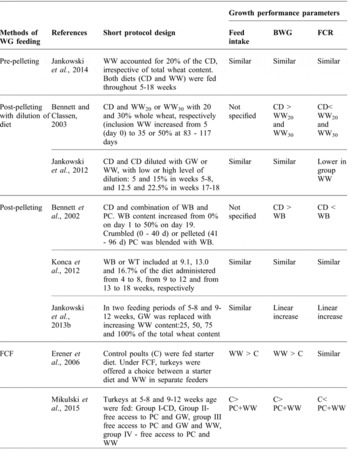
Table 2 presents the results of a recent experiment that compared the effects of feeding a complete diet (CD) with feeding a diet supplemented with 20% WW before pelleting (Jankowski et al., Reference JANKOWSKI, MIKULSKI, ZDUNCZYK, JUSKIEWICZ and LICHTOROWICZ2014). After 14 weeks of feeding, from five to 18 weeks of age, the BW of turkeys and FCR were similar in both dietary treatments. These authors found that a high WW content of turkey diets hindered the pelleting process, and the proposed a maximum WW inclusion of 20%. Pre-pelleting inclusion of WG may be technically easier with larger pellet diameters. However, a recent experiment conducted by Singh and Ravindran (Reference SINGH and RAVINDRAN2015) revealed that the effect of pellet diameter on broiler performance depended on the form of wheat and the method of WW inclusion. The adverse effects of WW on weight gain observed in the pre-pelleting group were primarily due to reduced feed intake resulting from poor pellet quality.
post-pelleting inclusion of WG with dilution of CD
In experiments on chickens fed complete commercial diets, dietary dilution with WG decreased nutrient concentrations in the analysed diets and the BWG of birds (Bennett et al., Reference BENNETT, CLASSEN and RIDDELL1995; Plavnik et al., Reference PLAVNIK, MACOVSKY and SKLAN2002; Bennett and Classen Reference BENNETT and CLASSEN2003). In an earlier study on turkeys (Classen and Bennett, Reference CLASSEN and BENNETT1996) the growth rate of young birds was maintained when starter and finisher diets were diluted with 5% and 35% WG, respectively. In another experiment by the same authors (Bennett and Classen, Reference BENNETT and CLASSEN2003), the dilution of CD with WW, without extra synthetic amino acid supplementation, resulted in significant reductions in BW and FCR. At the highest level of dietary dilution with 50% WW, the BW of birds was reduced by 15%. In comparison with the findings of Bennett and Classen (Reference BENNETT and CLASSEN2003), in an experiment performed by Jankowski et al. (Reference JANKOWSKI, MIKULSKI, ZDUNCZYK, MIKULSKA and JUSKIEWICZ2012), commercial turkey diets were diluted with ground and pelleted wheat (GW) or WW at a low or high level, i.e. 5 and 15% in weeks 5-8, and 12.5 and 22.5% in weeks 17-18. The physical form of wheat had no influence of the BWG of turkeys, whereas FCR improved when WW was used instead of GW ( Table 2 ). This may indicate that such dilution of the daily ration, which had no effect on the energy but decreased total protein concentrations by 3.5% and 7.6% (at the low and high dilution level, respectively), had no negative effect on feed utilisation.
post-pelleting inclusion of WG without dilution of the daily diet
Post-pelleting inclusion of WG was by far the most popular method used in chicken nutrition. According to Singh et al. (Reference SINGH, AMERAH and RAVINDRAN2014a), who summarised the results of numerous experiments in their review article, the above method of WG inclusion either decreased or had no adverse effect on the BWG of broilers. The results of very few studies conducted on turkeys are presented in Table 2 .
Bennett et al. (Reference BENNETT, CLASSEN, SCHWEAN and RIDDELL2002) reported that 20% whole barley (WB) could be fed to turkeys with little or no depression in growth rate, whereas feeding 35% or more WB caused an adjustment period in which BWG and FCR were reduced. Lower WB content, from 9.1 to 13.0 and 16.7% of the diet administered in weeks four to eight, nine to 12 and 13 to18, respectively, did not affect growth parameters, but the same amount of triticale increased the BWG of turkeys (Bennett et al., Reference BENNETT, CLASSEN, SCHWEAN and RIDDELL2002). In an experiment by Jankowski et al. (Reference JANKOWSKI, ZDUNCZYK, MIKULSKI, PRZYBYLSKA-GORNOWICZ, SOSNOWSKA and JUSKIEWICZ2013b), turkeys were fed a control diet composed of PC and GW (WW0 diet) or mixtures containing PC and GW, in which the latter component was partially or completely replaced with WW, in 25, 50, 75 and 100%.
Effect of different methods of WG inclusion on the growth performance of turkeys.

As a result, the total WW content of the diet was 0, 12.5, 25, 37.5 and 50% in the first feeding period (five to eight weeks of age), and 0, 15, 30, 45 and 60% in the second period (nine to 12 weeks). Increasing inclusion levels of WW caused a linear decrease in the final BW of turkeys. In comparison with group WW0, the decrease in final the BW of birds was estimated at 2.1, 3.4, 5.5 and 7.2% for increasing levels of WW addition. The authors concluded that due to lower costs of feed containing WW, it is recommendable to include up to 25 and 30% WW in the daily ration in feeding periods of four to eight and nine to 12 weeks, respectively.
feeding whole grain wheat to turkeys in a free-choice system
Forbes and Covasa (Reference FORBES and COVASA1995) speculated that while birds self-select the grain and protein concentrate, some factors can interfere with their choices. Feed form and shape are important, with birds preferring to eat larger particles as they grow older. In theory, birds given a choice are able to formulate a balanced ration on their own using ‘nutritional wisdom’, but this is not always the case (Singh et al., Reference SINGH, AMERAH and RAVINDRAN2014a). One of the experiments performed on chickens revealed that FCF was detrimental to BWG and FCR (Zulkifli et al., Reference ZULKIFLI, IMAN RAHAYU, ALIMON, VIDYADARAN and BABJEE2001). In other experiments, broiler chickens fed WW in the FCF system had similar BW to birds fed a complete pelleted diet (Gabriel et al., Reference GABRIEL, MALLET and LECONTE2003b), or a decrease in BWG was accompanied by an improvement in FCR (Rose et al., Reference ROSE, FIELDEN, FOOTE and GARDIN1995; Amerah et al., Reference AMERAH, RAVINDRAN, LENTLE and THOMAS2008). The results of previous studies on chickens, evaluating WW offered free-choice, are limited and contradictory (Singh et al., Reference SINGH, AMERAH and RAVINDRAN2014a). Even less is known about the efficacy of WG offered to turkeys in the FCF system.
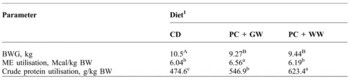
In the first experiments on turkeys under FCF (Cowan and Michie, Reference COWAN and MICHIE1977; Reference COWAN and MICHIE1979), growth performance was not affected when the birds voluntarily consumed protein concentrate and WG (barley or wheat), and different protein amounts. The results of two more recent experiments involving turkeys in the FCF system are shown in Table 3 . In a study by Erener et al. (Reference ERENER, OCAK, GARPOGLU, SAHIN and OZTURK2006), turkey poults fed a starter diet (from one to nine weeks of age) and WW were characterised by higher efficiency in terms of BWG and final BW. In contrast, in a recent study by Mikulski et al. (Reference MIKULSKI, JANKOWSKI, MAJEWSKA and ZDUNCZYK2015), the highest growth performance was noted in turkeys fed a complete diet (CD), as compared with birds under FCF. When PC was fed with GW, more metabolisable energy and crude protein were utilised per kg BWG. However, when PC was offered with WW in the FCF system, energy conversion was similar to that in group CD and protein utilisation was highest.
Average body weight gains (BWG) of turkeys and feed utilisation parameters during seven weeks of a free-choice (FCF) test (Mikulski et al., Reference MIKULSKI, JANKOWSKI, MAJEWSKA and ZDUNCZYK2015).

1CD - complete diet, PC + GW - voluntarily consumed protein concentrate and ground and pelleted wheat, PC + WW - voluntarily consumed protein concentrate and whole wheat
Means in the same row without common superscripts differ significantly at P ≤ 0.01 (A, B) and P ≤ 0.05 (a, b).
Free-choice feeding (FCF), which was used in traditional feeding practice in backyard poultry, is believed to be of particular importance to small poultry producers in developing countries, because it can substantially reduce the cost of feed (Henuk and Dingle, Reference HENUK and DINGLE2002). In large poultry farms, the use FCF is often limited since it requires extra equipment because WG and a balancer or complete diet has to be provided ad libitum in separate feeders (Singh et al., Reference SINGH, AMERAH and RAVINDRAN2014a). Recent years have witnessed an increasing interest in this type of feeding in small- and medium-scale free-range poultry production for local and regional markets, where FCF can have similar effects in slow-growing meat chickens to those observed when feeding a fully formulated diet (Fanatico et al., Reference FANATICO, BREWER, OWENS-HANNING, DONOGHUE and DONOGHUE2013).
Effect of whole grain feeding on carcass characteristics
The inclusion of WG may affect slaughter yield in poultry in two ways, by inducing changes in the final BW of birds or by increasing gizzard weight. Since gizzard weight increases in response to WG feeding, some reduction in carcass yield could be expected if the gizzard is not recovered or saleable (Singh et al., Reference SINGH, AMERAH and RAVINDRAN2014a). The results of experiments on chickens are inconclusive. Studies investigating WW content ranging from 5 to 65% revealed that WW inclusion had no effect on carcass yield (Bennett et al., Reference BENNETT, CLASSEN, SCHWEAN and RIDDELL2002; Wu and Ravindran, Reference WU and RAVINDRAN2004), increased abdominal fat content at the expense of breast meat (Plavnik et al., Reference PLAVNIK, MACOVSKY and SKLAN2002) or reduced the relative weight of abdominal fat with no effect on breast meat (Amerah et al., Reference AMERAH, RAVINDRAN, LENTLE and THOMAS2008). In the latest experiment conducted by Singh and Ravindran (Reference SINGH and RAVINDRAN2015), neither pre-pelleting nor post-pelleting inclusion of WW affected the carcass yield of broiler chickens. Larger pellet diameter (4.76 vs. 3.0 mm) increased carcass yield but only if pellets containing ground wheat were used.
To date, only a few studies have investigated the potential influence of WG on the slaughter yield of turkeys. In one such experiment (Bennett and Classen, Reference BENNETT and CLASSEN2003), the dilution of commercial diets with WW (up to 50%), without extra synthetic amino acid supplementation, resulted in large reductions in breast meat yield, up to 20% when the highest level of dietary dilution with wheat was applied. In more recent studies by Jankowski et al. (Reference JANKOWSKI, MIKULSKI, ZDUNCZYK, MIKULSKA and JUSKIEWICZ2012; Reference JANKOWSKI, MIKULSKI, ZDUNCZYK, JUSKIEWICZ and LICHTOROWICZ2014), WW incorporated at 20% into the final diet before pelleting or offered at nearly 20% in the post-pelleting system had no significant effect on carcass yield or the yields of major muscles (breast, thigh and drumstick) in turkeys.
Effect of whole grain feeding on excreta moisture and FDP incidence
The results of recent experiment performed by De Jong et al. (Reference DE JONG, GUNNINK and CHOUSALKAR2014) indicated that wet litter not only impaired overall welfare, but also reduced performance and carcass yield in broilers. Feeding WG to poultry has been found to improve gut health and the welfare of birds (Ferket, Reference FERKET2000; Banfield and Forbes, Reference BANFIELD and FORBES2001; Gabriel et al., Reference GABRIEL, MALLET, LECONTE, FORT and NACIRI2003a). This is an important consideration in view of the increasing incidence of wet litter syndrome caused by various insufficiently investigated nutritional factors (Francesch and Brufau, Reference FRANCESCH and BRUFAU2004: Mayne et al., Reference MAYNE, ELSE and HOCKING2007), and gizzard erosion and ulceration (Kaldhusdal et al., Reference KALDHUSDAL, HETLAND and GJEVRE2012; Gjevre et al., Reference GJEVRE, KALDHUSDAL and ERIKSON2013). The latter disease is caused by a number of predisposing and environment factors and one of the prevention strategies relies on a diet rich in insoluble fibre from cereals (Kaldhusdal et al., Reference KALDHUSDAL, HETLAND and GJEVRE2012). Wet litter, which may be caused by high excreta moisture content, is a risk factor for the development of foot pad dermatitis (FPD) in poultry (Mayne et al., Reference MAYNE, ELSE and HOCKING2007; Wu and Hocking, Reference WU and HOCKING2011; De Jong et al., Reference DE JONG, GUNNINK and CHOUSALKAR2014). Increased viscosity of the gut contents can affect faecal dropping adhesion to the foot and over time it may deteriorate the epidermis and keratin layers (Shepherd and Fairchild, Reference SHEPHERD and FAIRCHILD2010).
The results of published studies indicate that the incorporation of WG into the diet increased litter moisture content if triticale was fed (Konca et al., Reference KONCA, KIRKPINAR, MERT and ATAC2012), whereas it had no effect on the DM content of excreta if wheat was fed to turkeys (Jankowski et al., Reference JANKOWSKI, MIKULSKI, ZDUNCZYK, MIKULSKA and JUSKIEWICZ2012; Reference JANKOWSKI, ZDUNCZYK, MIKULSKI, PRZYBYLSKA-GORNOWICZ, SOSNOWSKA and JUSKIEWICZ2013b; Reference JANKOWSKI, MIKULSKI, ZDUNCZYK, JUSKIEWICZ and LICHTOROWICZ2014; Mikulski et al., Reference MIKULSKI, JANKOWSKI, MAJEWSKA and ZDUNCZYK2015). The DM content of excreta and FDP incidence were similar in the system involving pre-pelleting inclusion of 20% WW (Jankowski et al., Reference JANKOWSKI, MIKULSKI, ZDUNCZYK, JUSKIEWICZ and LICHTOROWICZ2014) and in the FCF system (Mikulski et al., Reference MIKULSKI, JANKOWSKI, MAJEWSKA and ZDUNCZYK2015). In a study by Jankowski et al. (Reference JANKOWSKI, ZDUNCZYK, MIKULSKI, PRZYBYLSKA-GORNOWICZ, SOSNOWSKA and JUSKIEWICZ2013b), increasing dietary levels of WW linearly increased the viscosity of small intestinal digesta, but did not increase the viscosity of caecal digesta, and significantly increased excreta DM content. A comparison of the results of two experiments (Jankowski et al., Reference JANKOWSKI, MIKULSKI, ZDUNCZYK, MIKULSKA and JUSKIEWICZ2012; Reference JANKOWSKI, ZDUNCZYK, MIKULSKI, PRZYBYLSKA-GORNOWICZ, SOSNOWSKA and JUSKIEWICZ2013b) suggests that excreta moisture content may increase in response to high dietary inclusion levels of WW. In the first study (Jankowski et al., Reference JANKOWSKI, MIKULSKI, ZDUNCZYK, MIKULSKA and JUSKIEWICZ2012), moderate dilution of standard diets with wheat (up to 22.5%) contributed to differences in the incidence and severity of FPD in young turkeys aged eight weeks, but no significant differences were found between groups of birds aged 18 weeks when fed diets with the highest WW content. This indicated that susceptibility to FPD decreases with both bird's age and a decrease in protein concentrations in the diet. According to Wu and Hocking (Reference WU and HOCKING2011), turkeys were equally susceptible to FPD from one to 10 weeks of age, and foot pad scores were minimised when litter moisture was less than 30%.
Conclusions
This review revealed that the range of experimental inclusion of WW, mainly WG, into turkeys’ diets seems to be modest, and the results obtained so far indicate three regularities: (1) moderate inclusion of WW (up to 20%), both in pre-pelleting or with dilution of standard turkey diets has no effect on growth performance of growing birds, (2) WW inclusion in the FCF system results in poor growth performance of turkeys due to an inadequate total protein intake in daily diet, and (3) in post-pelleting methods, it is recommended to include up to 25 and 30% WW in the daily ration in feeding periods of four to eight and nine to 12 weeks, respectively. Further studies should provide deeper insights into the feeding behaviour of turkeys under intensive production systems and conditions for effective inclusion of not only WW but also other types of WG in diets.