



1. Introduction
A central goal in complex geometry is to determine when algebraic varieties admit canonical metrics, especially Kähler–Einstein metrics. Such metrics are known to exist for varieties of general type and Calabi–Yau varieties. In contrast, the case of Fano varieties is more subtle, as not all Fano varieties admit Kähler–Einstein metrics. Early counterexamples include the blow-up of  ${\mathbb P}^2$ at one point.
A breakthrough philosophical approach emerged in the late 20th century: Yau’s 1993 conjecture proposed that the existence of a Kähler–Einstein metric on a Fano variety should correspond to an algebro-geometric stability condition. This idea led to the development of the notion of K-stability, which was first introduced by Tian via the α-invariant, and later reformulated in a fully algebro-geometric setting by Donaldson.
Smooth del Pezzo surfaces are among the most familiar and fundamental objects in algebraic geometry. They arise as blow-ups of general points in  ${\mathbb P}^2$ and can be regarded as slight generalizations of blow-ups of the weighted projective plane
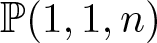
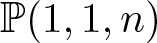 ${\mathbb P}(1,1,n)$ along the horizontal direction. The weighted projective plane
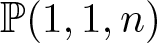 ${\mathbb P}(1,1,n)$ is also a fundamental object in algebraic geometry and is related to Sasakian geometry and symplectic geometry [Reference Park and Won.22].
The K-stability of smooth del Pezzo surfaces is well established through various methods [Reference Araujo.2, Reference Cheltsov.6, Reference Park and Won.21]. While  ${\mathbb P}^2$ is K-polystable, it becomes K-unstable after one or two blow-ups. However, after three blow-ups, it regains K-stability and retains this stability until the Fano condition is violated, that is, after eight blow-ups. We demonstrate that a similar phenomenon occurs in the blow-ups of
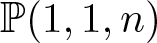 ${\mathbb P}(1,1,n)$. It is well known that the only K-polystable weighted projective plane
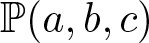 ${\mathbb P}(a,b,c)$ is the projective plane
 ${\mathbb P}^2$. In particular, this implies that
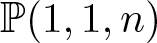 $\mathbb{P}(1,1,n)$ is not K-semistable for any n > 1. Nevertheless, we observe that the α-invariant tends to increase with each successive blow-up of
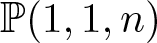 $\mathbb{P}(1,1,n)$. This suggests the conjecture that there exists an integer N such that the blow-up of
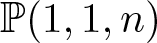 $\mathbb{P}(1,1,n)$ at more than N general points becomes K-polystable. In particular, the singular del Pezzo surfaces obtained by performing n + 4 blow-ups of
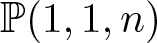 ${\mathbb P}(1,1,n)$ are K-stable. Thus, we conjecture that K-polystable varieties of the form
 $B_n^m$ lie in the range of blow-ups between
 $B_n^{n+4}$ and
 $B_n^N$ as illustrated below:
 \begin{equation*}
B_n^{n+4} \longrightarrow \cdots \longrightarrow B_n^N \longrightarrow \cdots \longrightarrow {\mathbb P}(1,1,n)
\end{equation*}
Let  $\phi_m\colon B_n^m\to {\mathbb P}(1,1,n)$ be the blow-up along m general smooth points, where m is a nonnegative integer. We consider the case n = 1. Since the weighted projective plane
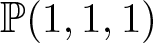 ${\mathbb P}(1,1,1)$ is the projective plane
 ${\mathbb P}^2$,
 $B_1^{m}$ is the smooth del Pezzo surface of degree
 $9-m \gt 0$. The K-stability of
 $B_1^{m}$ is well-known as follows:
Theorem 1.1 ([Reference Tian.23])
For n = 1, the surface  $B_n^m$ is K-polystable if and only if m is neither 1 nor 2.
Next, we consider singular del Pezzo surfaces. For the case n = 2, the surfaces  $B_2^{m}$ are singular del Pezzo surfaces of degree
 $8-m \gt 0$ that have a singularity of type
 ${\mathbb A}_1$. We know that the K-stability of
 $B_2^{m}$ is studied in [Reference Odaka, Spotti and Sun.20]. Recently, the delta-invariants of Du Val del Pezzo surfaces were calculated in [Reference Denisova.8–Reference Denisova.11]. From these results, we deduce
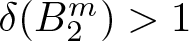 $\delta(B_2^m) \gt 1$ for
 $m\in\{5,6,7\}$. Meanwhile,
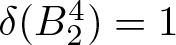 $\delta(B_2^4) = 1$. By [Reference Cheltsov and Prokhorov.7], the automorphism group of
 $B_2^4$ is finite. From this, it follows that
 $B_2^4$ is not K-polystable (see [Reference Blum and Xu.4, Corollary 1.3]). For
 $m\in\{0,1,2,3\}$, it is known from [Reference Liu.18, Corollary 6] that
 $B_2^{m}$ is not K-polystable. Therefore, the K-stability of
 $B_2^{m}$ can be summarized as follows:
Theorem 1.2. For n = 2, the surface  $B_n^m$ is K-polystable if and only if
 $m\in\{5, 6, 7\}$.
We consider the case where  $m=n+4$. For a positive integer k, if
 $n = 2k-1$ then
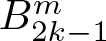 $B_{2k-1}^{m}$ is isomorphic to a quasi-smooth complete intersection embedded in the weighted projective space
 ${\mathbb P}(1,1,k,k,2k-1)$ defined by two hypersurfaces of degree 2k (see [Reference Cavey and Prince.5] and [Reference Kim, Kim and Won.14]). By [Reference Kim and Won.15, Theorem 1.4],
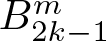 $B_{2k-1}^{m}$ is K-polystable.
On the other hand, if 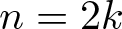 $n=2k$ then
 $B_{2k}^{m}$ is isomorphic to a hypersurface of degree
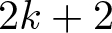 $2k+2$ which is embedded in the weighted projective space
 ${\mathbb P}(1,1,k,k+1)$ (see [Reference Cavey and Prince.5]). Using these constructions we can prove the K-polystability of
 $B_n^m$ and its blow-ups.
For the case n = 3,  $B_3^{m}$ are singular del Pezzo surfaces of degree
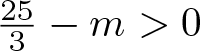 $\frac{25}{3}-m \gt 0$ that have a singularity of type
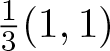 $\frac{1}{3}(1,1)$. The K-stability of
 $B_3^{m}$ is as follows:
Theorem A. For n = 3, the surface  $B_n^m$ is K-polystable if and only if
 $m\in \{6, 7, 8\}$.
Finally, we consider  $B_n^m$ of degree
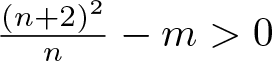 $\frac{(n+2)^2}{n} - m \gt 0$. The K-stability of
 $B_n^m$ is as follows:
Theorem B. Let  $\phi_m\colon B_n^m\to {\mathbb P}(1,1,n)$ be the blow-up along m general smooth points, where m is a nonnegative integer and n > 3 is a positive integer. Then
 $B_n^m$ is K-polystable if and only if m is n + 4.
2. Preliminaries
2.1. Foundation
Let N be a positive integer. For positive integers  $a_0,\ldots , a_N$, let
 \begin{equation*}
R[a_0, \ldots, a_N]:= {\mathbb C}[x_0,\ldots, x_N]
\end{equation*}
be the graded ring where the variable xi has weight 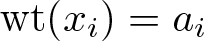 $\operatorname{wt}(x_i) = a_i$. We define
 \begin{equation*}
{\mathbb P}(a_0,\ldots, a_N) = \operatorname{Proj} R[a_0, \ldots, a_N]
\end{equation*}
and call it the weighted projective space with homogeneous coordinates  $x_0,\ldots , x_N$. We sometimes denote
 \begin{equation*}
{\mathbb P}(a_0,\ldots, a_N)_{x_0,\ldots , x_N}
\end{equation*}
in order to make it clear the homogeneous coordinates  $x_0,\ldots , x_N$. For
 $i=0,\ldots, N$ we denote by
 \begin{equation*}
\mathsf p_{x_i}=(0:\cdots :1:\cdots : 0)\in {\mathbb P}(a_0,\ldots , a_N)
\end{equation*}
the coordinate point at which only the coordinate xi does not vanish.
Let X be a surface with at most cyclic quotient singularities, and let D be an effective  ${\mathbb Q}$-divisor on X.
Lemma 2.1 [Reference Lazarsfeld.17, Proposition 9.5.13]
Let  $\mathsf{p}$ be a smooth point of the surface X. If the log pair (X, D) is not log canonical at
 $\mathsf{p}$, then
 \begin{equation*}
\operatorname{mult}_{\mathsf{p}}(D) \gt 1.
\end{equation*}
For orbifold singularities, the following analogous result holds.
Lemma 2.2 [Reference Kollár.16, Proposition 3.16]
Let  $\mathsf{p}$ be a singular point of type
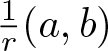 $\frac{1}{r}(a, b)$ on the surface X. If the log pair (X, D) is not log canonical at
 $\mathsf{p}$, then
 \begin{equation*}
\operatorname{mult}_{\mathsf{p}}(D) \gt \frac{1}{r},
\end{equation*}
where the multiplicity is the orbifold multiplicity defined by the finite covering of the cyclic quotient.
Lemma 2.3 [Reference Cheltsov.6, Remark 2.1]
Suppose that there is an effective  ${\mathbb Q}$-divisor D0 on X such that
 $D_0\equiv -K_X$ and
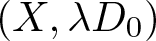 $(X, \lambda D_0)$ is log canonical at the point
 $\mathsf p$. Then there is an effective
 ${\mathbb Q}$-divisor Dʹ on X such that
 $D' \equiv -K_X$, at least one irreducible component of D0 is not contained in the support of Dʹ and
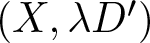 $(X, \lambda D')$ is not log canonical at the point
 $\mathsf p$.
2.2. α-invariant
Let X be a  ${\mathbb Q}$-Fano variety that is a normal projective
 ${\mathbb Q}$-factorial variety with at worst Kawamata log terminal singularities such that
 $-K_X$ is ample.
Definition 2.4. Let (X, D) be a pair, that is, D is an effective  ${\mathbb Q}$-divisor, and let
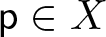 $\mathsf p \in X$ be a point. We define the log canonical threshold of (X, D) and the log canonical threshold of (X, D) at
 $\mathsf p$ to be the numbers
 \begin{equation*}
\begin{split}
\operatorname{lct} (X,D) &= \sup \{\, c \mid (X, c D) \text\ {is\ log\ canonical} \,\}, \\
\operatorname{lct}_{\mathsf p} (X,D) &= \sup \{\, c \mid (X, c D) \text\ {is\ log\ canonical\ at}\ \mathsf p \,\},
\end{split}
\end{equation*}
respectively. We define
 \begin{equation*}
\operatorname{lct}_{\mathsf p} (X) = \inf \{\, \operatorname{lct}_{\mathsf p} (X,D) \mid D\ \text{is an effective ${\mathbb Q}$-divisor}, D \equiv -K_X \,\},
\end{equation*}
and for a subset 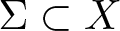 $\Sigma \subset X$, we define
 \begin{equation*}
\operatorname{lct}_{\Sigma} (X) = \inf \{\, \operatorname{lct}_{\mathsf p} (X) \mid \mathsf p \in \Sigma \, \}.
\end{equation*}
The number  $\alpha (X) := \operatorname{lct}_X (X)$ is called the global log canonical threshold or the α-invariant of X.
2.3. δ-invariant
In [Reference Fujita and Odaka.13] Fujita and Odaka introduced a new invariant of Fano varieties, so-called δ-invariant, that serves as a criterion for K-stability. To define the δ-invariant of Fano varieties, we measure how singular the average divisors of sections that form a basis for pluri-anticanonical linear systems are, using their log canonical thresholds.
Let X be a projective  ${\mathbb Q}$-factorial normal variety and Δ be a
 ${\mathbb Q}$-divisor on X such that the log pair
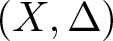 $(X, \Delta)$ has at worst Kawamata log terminal singularities. We suppose that
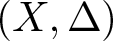 $(X, \Delta)$ is a log
 ${\mathbb Q}$-Fano variety, that is, the divisor
 $-(K_X + \Delta)$ is ample.
Definition 2.5. Let k be a positive integer such that  $| -k(K_X+\Delta)|$ is non-empty. Set
 $l_k=h^0(X, \mathcal{O}_X(-k(K_X+\Delta)))$. For a section s in
 $H^0(X, \mathcal{O}_X(-k(K_X+\Delta)))$, we denote the effective divisor of the section s by D(s). If lk sections
 $s_1,\ldots,s_{l_k}$ form a basis of the space
 $H^0(X, \mathcal{O}_X(-k(K_X+\Delta)))$, then the anticanonical
 ${\mathbb Q}$-divisor
 \begin{equation*}
D:= \frac{D(s_1)+\cdots + D(s_{l_k})}{kl_k}
\end{equation*}
is said to be of k-basis type. We set
 \begin{equation*}
\delta_k(X, \Delta)=\mathrm{sup}\left\{\lambda\in\mathbb{Q}\ \left|\
\begin{aligned}
&\text{the log pair}\ \left(X, \Delta+\lambda D \right)\, \hbox{is log canonical for} \\
&\text{every effective}\ \, \mathbb{Q}-divisor\, D \,of\, k-basis \, type\\
\end{aligned}\right.\right\}.
\end{equation*}
The δ-invariant of 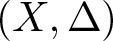 $(X, \Delta)$ is defined by the numbers
 \begin{equation*}
\delta(X, \Delta) =\limsup_{k\to \infty} \delta_k(X).
\end{equation*}
To study the δ-invariant from local viewpoints, we set
 \begin{equation*}
\delta_{Z,k}(X, \Delta)=\mathrm{sup}\left\{\lambda\in\mathbb{Q}\ \left|\
\begin{aligned}
&\text{the log pair} \left(X, \Delta+\lambda D \right)~is~log~canonical~along~Z \\
&\text{for every effective}\ \mathbb{Q}-divisor~D~of~k-basis~type\\
\end{aligned}\right.\right\}
\end{equation*}
for a closed subvariety Z of X. The local δ-invariant of 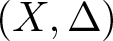 $(X, \Delta)$ along Z is defined by the number
 \begin{equation*}
\delta_Z(X, \Delta) =\limsup_{k\to \infty} \delta_{Z,k}(X).
\end{equation*}
Theorem 2.6 ([Reference Blum and Jonsson.3, Theorem B])
Let X be a  ${\mathbb Q}$-Fano variety.
• X is K-semistable if and only if
 $\delta(X)\geq 1$;
• X is uniformly K-stable if and only if
$\delta(X) \gt 1$.
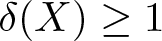

There is a relation between the α-invariant and the δ-invariant of  ${\mathbb Q}$-Fano varieties. By [Reference Blum and Jonsson.3, Theorem A], we have the following:
 \begin{equation}
\left(\frac{\dim(X) + 1}{\dim(X)}\right)\alpha(X)\leq \delta(X) \leq (\dim(X) + 1)\alpha(X).
\end{equation}
2.4. K-stability of log Fano pairs
Definition 2.7. Let  $(X,\Delta)$ be a log pair, that is, X is a normal variety and Δ is an effective
 ${\mathbb Q}$-divisor on X such that
 $K_X+\Delta$ is
 ${\mathbb Q}$-Cartier. We call
 $(X,\Delta)$ a log Fano pair if additionally X is projective and
 $-(K_X+\Delta)$ is a
 $\mathbb{Q}$-Cartier ample
 ${\mathbb Q}$-divisor. A normal projective variety X is called
 $\mathbb{Q}$-Fano if
 $(X,0)$ is a klt log Fano pair.
Definition 2.8. Let E be a prime divisor over a normal variety X, i.e., there is a proper birational morphism  $\sigma:Y \rightarrow X$ from a normal variety Y and E is a divisor on Y. For a log pair
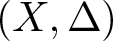 $(X,\Delta)$ the log discrepancy
 $A_{X, \Delta}(E)$ of
 $(X,\Delta)$ along E is defined to be
 \begin{equation*}
A_{X, \Delta}(E) = \operatorname{ord}_E(K_Y - \sigma^*(K_X + \Delta)) + 1.
\end{equation*}
If  $\Delta = 0$, then we simply denote
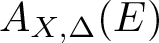 $A_{X,\Delta}(E)$ by
 $A_X(E)$.
Let L be a  ${\mathbb Q}$-Cartier
 ${\mathbb Q}$-divisor on X. We set
 \begin{equation*}
\tau_L(E) = \sup\{\tau\in {\mathbb R}_{\geq 0}\mid \operatorname{vol}(\sigma^*(L) - \tau E) \gt 0\}.
\end{equation*}
It is called the pseudoeffective threshold of E with respect to L. For a log Fano pair  $(X, \Delta)$ we set
 \begin{equation*}
\tau_{X,\Delta}(E) = \tau_{-(K_X+\Delta)}(E).
\end{equation*}
If 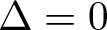 $\Delta = 0$, then we simply denote
 $\tau_{X,\Delta}(E)$ by
 $\tau_X(E)$.
If L is big then we define the S-invariant
 \begin{equation}
S_L(E)=\frac{1}{\operatorname{vol}(L)}\int_0^{\tau_L(E)}\operatorname{vol}(\sigma^*(L)-tE) \mathrm{d} t.
\end{equation}
If  $(X, \Delta)$ is a log Fano pair, then we set
 \begin{equation*}
S_{X,\Delta}(E) = S_{-(K_X + \Delta)}(E).
\end{equation*}
If moreover 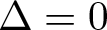 $\Delta = 0$, we simply denote
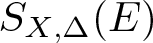 $S_{X,\Delta}(E)$ by
 $S_X(E)$.
2.5. Abban–Zhuang method
Let 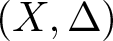 $(X,\Delta)$ be a klt log del Pezzo surface pair. We now explain how to apply Abban–Zhuang method to estimate
 $\delta(X,\Delta)$. Let E be a prime divisor over X. Then there is a birational morphism
 $\phi\colon Y\to X$ where E is a prime divisor on Y. [Reference Abban and Zhuang.1] gives the definition of the number
 $S(W^E_{\bullet,\bullet};q)$ for
 $q\in E$ which can be calculated by the following theorem.
Theorem 2.9 ([Reference Araujo.2, Equation (1.7.13)], [Reference Fujita.12, Lemma 3.16])
Let P(u) and N(u) be the positive and negative parts, respectively, of the Zariski Decomposition of the divisor  $\pi^*(-K_X-\Delta)-uE$. For each point q in E, we denote
 \begin{equation}
h(u):=(P(u)\cdot E)\cdot \mathrm{ord}_q(N(u)|_E)+\int_0^{\infty}\operatorname{vol}(P(u)|_E-vq) \mathrm{d} v.
\end{equation}
Then we have
 \begin{equation}
S(W^E_{\bullet,\bullet};q)=\frac{2}{\operatorname{vol}(-(K_X+\Delta))}\int_0^{\tau(E)}h(u) \mathrm{d} u.
\end{equation}
We denote by Φ the difference such that  $(K_Y+\widetilde{\Delta}+E)|_E=K_E+\Phi$, where
 $\widetilde{\Delta}$ is the strict transform of Δ. From [Reference Abban and Zhuang.1, Theorems 3.2 and 3.4], we have the following result.
Theorem 2.10 ([Reference Abban and Zhuang.1])
We have
 \begin{equation*}
\delta_{\mathsf p}(X, \Delta)\geq \min\left\{\frac{A_{X, \Delta}(E)}{S_{X, \Delta}(E)}, \frac{A_{E, \Phi}(\mathsf q)}{S(W^E_{\bullet,\bullet};\mathsf q)}\right\},
\end{equation*}
where  $A_{E, \Phi}(\mathsf q) = \frac{1}{n} - (\widetilde{\Delta}\cdot E)_{\mathsf q}$ for the quotient singular point of type
 $\frac{1}{n}(a,b)$.
3. K-stability
Let  $W_n = {\mathbb P}(1,1,n)_{x,y,z}$ be the weighted projective plane where n > 2 is a positive integer. And let
 $\phi_m\colon B_n^m\to W_n$ be the blow-up along general smooth points
 $\mathsf p_1,\ldots ,\mathsf p_m$. In this section, we discuss the K-stability of
 $B_n^m$. For this, we require the following.
Let  $l_1,\ldots , l_m\in |\mathcal{O}_{W_n}(1)|$ be curves such that li passes through the point
 $\mathsf p_i$ for each
 $i\in \{1,\ldots , m\}$. We have
 \begin{equation*}
\phi_m^*(l_i) = L_i + E_i,
\end{equation*}
where Li is the strict transform of li under the birational morphism ϕm and Ei is ϕm-exceptional such that  $\phi_m(E_i) = \mathsf p_i$.
3.1. m < n + 4 cases
We begin by considering the cases  $m \lt n+4$.
Lemma 3.1. For  $m=n+3$ and n > 4, there is a prime divisor E over
 $B_n^m$ such that
 $A_{B_n^m}(E) - S_{B_n^m}(E) \lt 0$.
Proof. Let  $l\in |\mathcal{O}_{W_n}(n+1)|$ be a curve passing through the points
 $\mathsf p_1, \ldots , \mathsf p_{n+3}$. We have
 \begin{equation*}
-K_{B_n^{n+3}}\equiv \frac{1}{2}(L_1 + \cdots + L_{n+3} + L),
\end{equation*}
where L is the strict transform of l. Consider the weighted blow-up  $\pi\colon Y\to B_n^{n+3}$ at the point
 $\mathsf p\in B_n^{n+3}$ with weights
 $(1,1)$, where
 $\phi_{n+3}(\mathsf p)=\mathsf p_z$. We have
 \begin{equation*}
\pi^*(-K_{B_n^{n+3}}) - \lambda E \equiv \frac{1}{2}(\widetilde{L}_1 + \cdots + \widetilde{L}_{n+3} + \widetilde{L}) + \left(\frac{n+4}{2n} - \lambda\right)E,
\end{equation*}
where E is π-exceptional. Since the intersection matrix of the curves 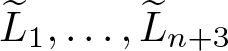 $\widetilde{L}_1, \ldots , \widetilde{L}_{n+3}$ and
 $\widetilde{L}$ is negative definite, the pseudoeffective threshold of E is
 $\frac{n+4}{2n}$. We set
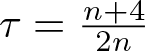 $\tau = \frac{n+4}{2n}$. The positive part of the Zariski decomposition of
 $\pi^*(-K_{B_n^{n+3}}) - \lambda E$ is
 \begin{equation*}
P(\lambda) =
\begin{cases}
\pi^*(-K_{B_n^{n+3}}) - \lambda E & \text{for}\ 0 \leq \lambda \leq \frac{2}{n},\\
\left(\frac{n+4}{2n} - \lambda\right)(\widetilde{L}_1 + \cdots + \widetilde{L}_{n+3} + \widetilde{L} + E) & \text{for}\ \frac{2}{n}\leq \lambda\leq \frac{n+4}{2n}.
\end{cases}
\end{equation*}
We have
 \begin{equation*}
\operatorname{vol}(\pi^*(-K_{B_n^{n+3}}) - \lambda E)=
\begin{cases}
\frac{n+4}{n} - n\lambda^2 & \text{for}\ 0 \leq \lambda\leq \frac{2}{n},\\
4\left(\frac{n+4}{2n} - \lambda\right)^2 & \text{for}\ \frac{2}{n} \leq \lambda\leq \frac{n+4}{2n}.
\end{cases}
\end{equation*}
For the function (2), we have
 \begin{equation*}
S_{B_n^{n+3}}(E) = \frac{n}{n+4} \left(\frac{2n+8}{n^2} - \frac{8}{3n^2} + \frac{1}{6}\right) = \frac{n^2 + 12n + 32}{6n(n+4)}.
\end{equation*}
Since  $A_{B_n^{n+3}}(E) = \frac{2}{n}$,
 $A_{B_n^{n+3}}(E) - S_{B_n^{n+3}}(E) \lt 0$ holds for n > 4.
Lemma 3.2. For  $n\leq m \lt n+3$ and n > 2, there is a prime divisor E over
 $B_n^m$ such that
 $A_{B_n^m}(E) - S_{B_n^m}(E) \lt 0$.
Proof. We have
 \begin{equation*}
-K_{B_n^m} \equiv \frac{n+2}{m}(L_1+\cdots +L_m) + \left(\frac{n+2}{m} - 1\right)(E_1 + \cdots + E_m).
\end{equation*}
Let  $\pi\colon Y\to B_n^m$ be the weighted blow-up at the singular point
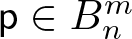 $\mathsf p\in B_n^m$ with weights
 $(1,1)$, where
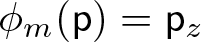 $\phi_m(\mathsf p)=\mathsf p_z$. We have
 \begin{align*}
\pi^*(-K_{B_n^m}) - \lambda E &\equiv \frac{n+2}{m}(\widetilde{L}_1+\cdots + \widetilde{L}_m) + \left(\frac{n+2}{m} - 1\right)(\widetilde{E}_1 + \cdots + \widetilde{E}_m) \\ &\quad + \left(\frac{n+2}{n} - \lambda\right)E,
\end{align*}
where  $\widetilde{L}_i$ and
 $\widetilde{E}_i$ are the strict transforms of Li and Ei, respectively, and E is π-exceptional. Since the intersection matrix of
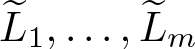 $\widetilde{L}_1,\ldots , \widetilde{L}_m$ and
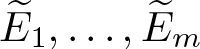 $\widetilde{E}_1 , \ldots , \widetilde{E}_m$ is semi-negative definite, the pseudoeffective threshold of E is
 $\frac{n+2}{n}$. The positive part of the Zariski decomposition of
 $ \pi^*(-K_{B_n^m}) - \lambda E$ is
 \begin{equation*}
P(\lambda) =
\begin{cases}
\pi^*(-K_{B_n^m}) - \lambda E & \text{for}\ \lambda\leq \frac{2}{n},\\
\left(\frac{n+2}{m} - 1\right)(\widetilde{L}_1+\cdots + \widetilde{L}_m + \widetilde{E}_1 + \cdots + \widetilde{E}_m) & \\
+ \left(\frac{n+2}{n} - \lambda\right)(\widetilde{L}_1+\cdots + \widetilde{L}_m + E) & \text{for}\ \frac{2}{n}\leq \lambda\leq \frac{n+2}{n}.
\end{cases}
\end{equation*}
Then
 \begin{align*}
&\operatorname{vol}(\pi^*(-K_{B_n^m}) - \lambda E)\\ &\quad =
\begin{cases}
\frac{(n+2)^2}{n} - m -n\lambda^2 & \text{for}\ \lambda\leq \frac{2}{n}\\
2m\left(\frac{n+2}{m} - 1\right)\left(\frac{n+2}{n} - \lambda\right) + \left(\frac{n+2}{n} - \lambda\right)^2(m-2) & \text{for}\ \frac{2}{n}\leq \lambda\leq \frac{n+2}{n}.
\end{cases}
\end{align*}
For the function (2), we have
 \begin{equation*}
S_{B_n^m}(E) =
\begin{cases}
\frac{3n^2 + 12n + 8}{6n(n+1)} & {\text{for}}\ m = n,\\
\frac{4n^2+18n+16}{3n(3n+4)} & {\text{for}}\ m = n+ 1,\\
\frac{(n+4)}{3n} & \text{for}\ m = n+ 2.
\end{cases}
\end{equation*}
Since  $A_{B_n^m}(E)=\frac{2}{n}$ we can see that
 $A_{B_n^m}(E) - S_{B_n^m}(E) \lt 0$.
Lemma 3.3. For m < n the α-invariant of the surface  $B_n^m$ is less than
 $\frac{1}{3}$.
Proof. Suppose that m < n. We have
 \begin{align*}
& K_{B_n^{m}} + \sum_{i=1}^{m-1}L_i + (n+3-m)L_m + (n+2-m)E_m \\ &\quad\equiv \phi_m^*\left(K_{W_n} + \sum_{i=1}^{m-1}l_i + (n+3-m)l_m\right).
\end{align*}
The log canonical threshold of the log pair  $(B_n^m ,\sum_{i=1}^{m-1}L_i + (n+3-m)L_m + (n+2-m)E_m)$ is less than or equal to
 $\frac{1}{n+3-m}$. It implies that the α-invariant of
 $B_n^m$ is less than or equal to
 $\frac{1}{n+3-m}$.
Lemma 3.4. For  $m \lt n+4$ and n > 2,
 $B_n^m$ is not K-polystable except
 $B_3^6$.
Proof. By the proof of lemma 3.1, we deduce that 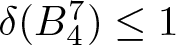 $\delta(B_4^7)\leq 1$. Moreover, the automorphism group of
 $B_4^7$ is finite. Thus,
 $B_4^7$ cannot be K-polystable by [Reference Blum and Xu.4, Corollary 1.3]. Moreover, by lemmas 3.1 and 3.2,
 $B_n^m$ is not K-polystable for
 $n\leq m \lt n+4$ and n > 2 except
 $B_3^6$. Finally, the inequalities (1), lemma 3.3, and theorem 2.6 imply that
 $B_n^m$ is not K-semistable for m < n.
There exist K-polystable singular del Pezzo surfaces for certain values of m and n. We now examine the cases where these surfaces are K-polystable.
3.2. n = 3 case
We first consider the blow-up  $\phi_6\colon B_3^6\to {\mathbb P}(1,1,3)$ at six points
 $\mathsf p_1,\ldots, \mathsf p_6$ in general position.
Theorem 3.5.  $B_3^6$ is K-stable.
Proof. Consider a smooth point 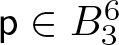 $\mathsf p\in B_3^6$ such that
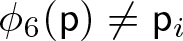 $\phi_6(\mathsf p)\neq \mathsf p_i$ for every
 $i\in \{1,\ldots,6\}$. There is an irreducible curve
 $c\in |\mathcal{O}_{{\mathbb P}(1,1,3)}(5)|$ containing the points
 $\phi(\mathsf p)$ and
 $\mathsf p_i$,
 $i=1,\ldots , 6$. Then the strict transform
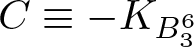 $C\equiv -K_{B_3^6}$ of c passes through the point
 $\mathsf p$. The pseudoeffective threshold
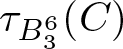 $\tau_{B_3^6}(C)$ of C is 1. For the function (2), we have
 \begin{equation*}
S_{B_3^6}(C) = \frac{3}{7}\int_0^1 \frac{7}{3}(1-\lambda)^2 \mathrm{d} \lambda = \frac{1}{3}.
\end{equation*}
Since 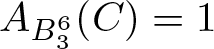 $A_{B_3^6}(C) = 1$, we have
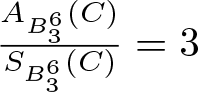 $\frac{A_{B_3^6}(C)}{S_{{B_3^6}}(C)} = 3$. For the function (3), we have
 \begin{equation*}
h(u) = \frac{49}{18}\left(1-u\right)^2.
\end{equation*}
Then the value in (4) is given by
 \begin{equation*}
S(W^C_{\bullet,\bullet};\mathsf p) = \frac{6}{7}\int_0^1h(u) \mathrm{d} u = \frac{7}{9}.
\end{equation*}
For the curve Φ such that  $(K_{B_3^6} + C)|_C = K_C + \Phi$, we have
 $A_{C, \Phi}(\mathsf p) = 1$. By theorem 2.10, we obtain
 $\delta_{\mathsf p}(B_3^6) \geq \frac{9}{7} \gt 1$.
Next, we consider a point  $\mathsf p \in E_i$ where
 $i\in \{1,\ldots,6\}$. Let
 $c\in |\mathcal{O}_{W_3}(4)|$ be a curve passing through the points
 $\mathsf p_1,\ldots ,\mathsf p_6$. We have
 \begin{equation*}
-K_{B_3^6}\equiv C + L_i + E_i,
\end{equation*}
where C is the strict transform of c. Since the intersection matrix of C and Li is negative definite, the pseudoeffective threshold 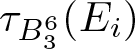 $\tau_{B_3^6}(E_i)$ is one. The positive and negative parts of the Zariski decomposition of
 $C + L_i + (1-\lambda)E_i$ are
 \begin{equation*}
P(\lambda) =
\begin{cases}
C + L_i + (1-\lambda)E_i & \text{for}\ \lambda\leq \frac{2}{3},\\
(1-\lambda)(3C + 3L_i + E_i) & \text{for}\ \frac{2}{3}\leq \lambda \leq 1
\end{cases}
\end{equation*}
and
 \begin{equation*}
N(\lambda) =
\begin{cases}
0 & \text{for}\ \lambda\leq \frac{2}{3},\\
(-2 + 3\lambda)(C+L_i) & \text{for}\ \frac{2}{3}\leq \lambda \leq 1,
\end{cases}
\end{equation*}
respectively. For the function (2), we have
 \begin{equation*}
S_{B_3^6}(E_i) = \frac{3}{7}\left(\int_0^{\frac{2}{3}} -\frac{2}{3}-(1-\lambda)^2 + 4(1-\lambda) \mathrm{d} \lambda + \int_{\frac{2}{3}}^1 5(1-\lambda)^2 \mathrm{d} \lambda\right)=\frac{87}{189}.
\end{equation*}
Since 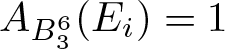 $A_{B_3^6}(E_i) = 1$, we have
 $\frac{A_{B_3^6}(E_i)}{S_{{B_3^6}}(E_i)} = \frac{189}{87}$. For the function (3), if
 $\mathsf p\not\in E_i\cap(C\cup L_i)$ we have
 \begin{equation*}
h(\lambda) =
\begin{cases}
\frac{(1+\lambda)^2}{2} & \text{for}\ \lambda\leq \frac{2}{3},\\
\frac{25(1-\lambda)^2}{2}& \text{for}\ \frac{2}{3}\leq \lambda \leq 1,
\end{cases}
\end{equation*}
otherwise,
 \begin{equation*}
h(\lambda) =
\begin{cases}
\frac{(1+\lambda)^2}{2} & \text{for}\ \lambda\leq \frac{2}{3},\\
5(1-\lambda)(-2+3\lambda)+\frac{25(1-\lambda)^2}{2}& \text{for}\ \frac{2}{3}\leq \lambda \leq 1.
\end{cases}
\end{equation*}
Then the value in (4) is given by
 \begin{equation*}
S(W^{E_i}_{\bullet,\bullet};\mathsf p) = \frac{6}{7}\int_0^1 h(\lambda) \mathrm{d}\lambda =
\begin{cases}
\frac{41}{63} &\text{for}\ \mathsf p\not\in E_i\cap(C\cup L_i),\\
\frac{46}{63} &\text{for}\ \mathsf p\in E_i\cap(C\cup L_i).
\end{cases}
\end{equation*}
For the curve Φ such that  $(K_{B_3^6} + E_i)|_{E_i} = K_{E_i} + \Phi$, we have
 $A_{E_i, \Phi}(\mathsf p) = 1$. By theorem 2.10, we obtain
 $\delta_{\mathsf p}(B_3^6) \geq \frac{63}{46} \gt 1$.
Finally, we consider the singular point  $\mathsf p$ of
 $B_3^6$. Let
 $\pi\colon Y\to B_3^6$ be the weighted blow-up at the point
 $\mathsf p$ with weights
 $(1,1)$. In the proof of lemma 3.1 we have
 \begin{equation*}
\pi^*(-K_{B_3^6}) - \lambda E \equiv \frac{1}{2}(\widetilde{L}_1 + \cdots + \widetilde{L}_6 + \widetilde{L}) + \left(\frac{7}{6} - \lambda\right)E,
\end{equation*}
where E is π-exceptional. The positive and negative parts of the Zariski decomposition of  $\pi^*(-K_{B_3^6}) - \lambda E$ are
 \begin{equation*}
P(\lambda) =
\begin{cases}
\pi^*(-K_{B_3^6}) - \lambda E & \text{for}\ 0 \leq \lambda\leq \frac{2}{3},\\
\left(\frac{7}{6} - \lambda\right)(\widetilde{L}_1 + \cdots + \widetilde{L}_{6}+\widetilde{L} + E) & \text{for}\ \frac{2}{3}\leq \lambda\leq \frac{7}{6}
\end{cases}
\end{equation*}
and
 \begin{equation*}
N(\lambda) =
\begin{cases}
0 & \text{for}\ 0 \leq \lambda\leq \frac{2}{3},\\
\left(-\frac{2}{3} + \lambda\right)(\widetilde{L}_1 + \cdots + \widetilde{L}_6 + \widetilde{L}) & \text{for}\ \frac{2}{3}\leq \lambda\leq \frac{7}{6}.
\end{cases}
\end{equation*}
For the function (3) if  $\mathsf p\not\in E\cap(\widetilde{L}_1\cup \cdots \cup \widetilde{L}_6 \cup \widetilde{L})$ we have
 \begin{equation*}
h(\lambda) =
\begin{cases}
\frac{9}{2}\lambda^2 & \text{for}\ 0\leq \lambda\leq \frac{2}{3},\\
8\left(\frac{7}{6} - \lambda\right)^2 & \text{for}\ \frac{2}{3}\leq \lambda\leq \frac{7}{6}
\end{cases}
\end{equation*}
otherwise,
 \begin{equation*}
h(\lambda) =
\begin{cases}
\frac{9}{2}\lambda^2 & \text{for}\ 0 \leq \lambda\leq \frac{2}{3},\\
4\left(\frac{7}{6} - \lambda\right)\left(-\frac{2}{3} + \lambda\right) + 8\left(\frac{7}{6} - \lambda\right)^2 & \text{for}\ \frac{2}{3}\leq \lambda\leq \frac{7}{6}.
\end{cases}
\end{equation*}
Then the value in (4) is given by
 \begin{equation*}
S(W^{E}_{\bullet,\bullet};\mathsf q) = \frac{6}{7}\int_0^{\frac{7}{6}} h(\lambda) \mathrm{d}\lambda =
\begin{cases}
\frac{2}{3} &\text{for}\ \mathsf p\not\in E\cap(\widetilde{L}_1\cup \cdots \cup \widetilde{L}_6 \cup \widetilde{L}),\\
\frac{31}{42} &\text{for}\ \mathsf p\in E\cap(\widetilde{L}_1\cup \cdots \cup \widetilde{L}_6 \cup \widetilde{L}).
\end{cases}
\end{equation*}
For the curve Φ such that  $(K_{B_3^6}+E)\vert_{E}=K_{E}+\Phi$, we have
 $A_{E,\Phi}(p)=1$. By theorem 2.10, we obtain
 $\delta_{\mathsf p}(B_3^6) \geq \frac{42}{31} \gt 1$.
Let  $B_3^7\subset {\mathbb P}(1,1,2,2,3)_{x,y,z,t,w}$ be a quasi-smooth complete intersection defined by two hypersurfaces of degree 4. By [Reference Kim and Won.15, Theorem 1.4], the singular del Pezzo surface
 $B_3^7$ is K-stable. We next consider the blow-up
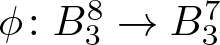 $\phi\colon B_3^8\to B_3^7$ at a smooth point
 $\mathsf p\in B_3^7$, where no negative curve passes through
 $\mathsf p$. We discuss the α-invariant of
 $B_3^8$. In this subsection, we set
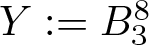 $Y:= B_3^8$ and
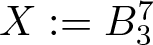 $X:= B_3^7$ for convenience.
Lemma 3.6. For the singular point 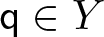 $\mathsf q\in Y$,
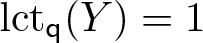 $\operatorname{lct}_{\mathsf q}(Y) = 1$.
Proof. Suppose that 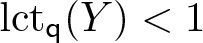 $\operatorname{lct}_{\mathsf q}(Y) \lt 1$. Then there is an effective
 ${\mathbb Q}$-Cartier divisor
 $D\equiv -K_Y$ such that the log pair (Y, D) is not log canonical at the point
 $\mathsf q$. Let
 $H\in |\mathcal{O}_X(1)|$ be the hyperplane section passing through
 $\mathsf p$. We write
 \begin{equation*}
D = a\widetilde{H} + \Delta,
\end{equation*}
where a is a nonnegative rational number,  $\widetilde{H}$ is the strict transform of H and Δ is an effective
 ${\mathbb Q}$-divisor such that
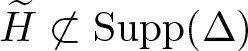 $\widetilde{H}\not\subset\operatorname{Supp}(\Delta)$. By the inversion of adjunction formula and lemma 2.2 we have
 \begin{equation*}
\frac{1}{3} - \frac{a}{3} = \Delta\cdot \widetilde{H} \geq \operatorname{mult}_{\mathsf q}(\Delta |_{\widetilde{H}}) \gt \frac{1}{3}.
\end{equation*}
It is impossible.
Let E be ϕ-exceptional. We consider the log canonical threshold 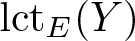 $\operatorname{lct}_E(Y)$.
Lemma 3.7. For every point  $\mathsf q\in E$,
 $\operatorname{lct}_{\mathsf q}(Y) \gt \frac{2}{3}$.
Proof. Suppose that 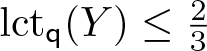 $\operatorname{lct}_{\mathsf q}(Y)\leq\frac{2}{3}$. Then there is an effective
 ${\mathbb Q}$-Cartier divisor
 $D\equiv -K_Y$ such that the log pair
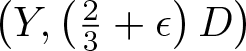 $\left(Y, \left(\frac{2}{3} +\epsilon\right)D\right)$ is not log canonical at
 $\mathsf q$, where ϵ is a very small positive real number. We write
 \begin{equation*}
D \equiv aE + \Delta,
\end{equation*}
where a is a nonnegative rational number and Δ is an effective  ${\mathbb Q}$-divisor such that
 $E\not\subset\operatorname{Supp}(\Delta)$. We have
 \begin{equation}
\frac{1}{3} = D\cdot (-K_Y)\geq aE\cdot(-K_Y) = a.
\end{equation}
It implies that  $a\leq \frac{1}{3}$. By the inversion of adjunction formula and lemma 2.1 we have
 \begin{equation*}
\frac{2}{3}(1+a) = \frac{2}{3}\Delta\cdot E \geq \operatorname{mult}_{\mathsf q} \left(\frac{2}{3}\Delta|_E\right) \gt 1.
\end{equation*}
It implies that  $a \gt \frac{1}{2}$. By the inequality (5) it is impossible. Therefore the log pair
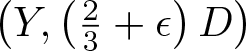 $\left(Y, \left(\frac{2}{3} +\epsilon\right)D\right)$ is log canonical at
 $\mathsf q$.
Lemma 3.8. For every point  $\mathsf q\in Y\setminus (E\cup\operatorname{Sing}(Y))$, we have
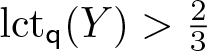 $\operatorname{lct}_{\mathsf q}(Y) \gt \frac{2}{3}$, where
 $\operatorname{Sing}(Y)$ is the singular locus of Y.
Proof. Suppose that  $\operatorname{lct}_{\mathsf q}(Y)\leq\frac{2}{3}$. Then there is an effective
 ${\mathbb Q}$-Cartier divisor
 $D\equiv -K_Y$ such that the log pair
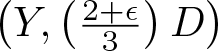 $\left(Y, \left(\frac{2+\epsilon}{3}\right)D\right)$ is not log canonical at
 $\mathsf q$, where ϵ is a very small positive real number. Then there is an effective
 ${\mathbb Q}$-Cartier divisor
 $D_X\equiv -K_X$ such that the log pair
 $\left(X, \left(\frac{2+\epsilon}{3}\right)D_X\right)$ is not log canonical at
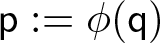 $\mathsf p:=\phi(\mathsf q)$.
Let  $\mathcal{L}=|\mathcal{O}_X(1)|$ be the complete linear system of X. There is the unique member
 $H\in \mathcal{L}$ passing through the point
 $\mathsf p$. If the curve H is irreducible then we can see that it is smooth at
 $\mathsf p$ (see [Reference Kim and Won.15, Lemma 4.1]). Then, by lemma 2.3, we have
 \begin{equation*}
\frac{4}{3}= D_X\cdot H\geq \operatorname{mult}_{\mathsf q}(D_X) \operatorname{mult}_{\mathsf q}(H) \gt \frac{3}{2+\epsilon}.
\end{equation*}
It is impossible. Thus H is reducible. Then H is the sum of two irreducible curves L 1 and L 2, that is, we write
 \begin{equation*}
H = L_1 + L_2.
\end{equation*}
Then L 1 and L 2 satisfy the following intersection numbers:
 \begin{equation*}
L_1\cdot L_2 = \frac{4}{3},\qquad L_1^2 = L_2^2 = -\frac{2}{3}.
\end{equation*}
Without loss of generality we assume that 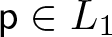 $\mathsf p\in L_1$. Put
 $D = aL_1 + \Delta$, where a is nonnegative rational number and Δ is an effective
 ${\mathbb Q}$-divisor such that
 $L_1\not\subset \operatorname{Supp}(\Delta)$. By lemma 2.3 we may assume that the support of D does not contain at least one irreducible component of H. From the inequality
 \begin{equation*}
\frac{4a}{3} = aL_1\cdot L_2 \leq D_X\cdot L_2 = \frac{2}{3},
\end{equation*}
we obtain that  $a\leq \frac{1}{2}$. Then, by lemma 2.1, we have
 \begin{equation*}
\frac{2}{3} + \frac{2a}{3} = \Delta\cdot L_1 \geq\operatorname{mult}_{\mathsf p}(\Delta|_{L_1}) \gt \frac{3}{2+\epsilon}.
\end{equation*}
It is impossible. Therefore 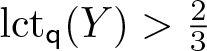 $\operatorname{lct}_{\mathsf q}(Y) \gt \frac{2}{3}$.
Theorem 3.9. The surface Y is K-stable.
Proof. By lemmas 3.6, 3.7, and 3.8, the α-invariant of Y is greater than  $\frac{2}{3}$. It implies that Y is K-stable.
3.3. Even cases
In this subsection, we consider the case  $m = n + 4$, dividing it into two cases depending on whether n is odd or even.
First, consider the case where n is odd. Let  $n=2k-1$ for a positive integer k > 2. In this case, the variety
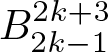 $B_{2k-1}^{2k+3}$ is isomorphic to a quasi-smooth complete intersection in the weighted projective space
 ${\mathbb P}(1,1,k,k,2k-1)$ defined by two hypersurfaces of degree 2k (see [Reference Cavey and Prince.5]). According to [Reference Kim and Won.15, Theorem 1.4], every such quasi-smooth complete intersection in
 ${\mathbb P}(1,1,k,k,2k-1)$ is K-stable.
Next, consider the case where n is even. Let  $n=2k$ for a positive integer k > 1. In this case, the variety
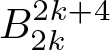 $B_{2k}^{2k+4}$ is isomorphic to a hypersurface
 $X\subset{\mathbb P}(1,1,k, k+1)_{x,y,z,t}$ defined by a quasihomogeneous polynomial
 \begin{equation*}
t^2 + f_2(x,y)z^2 + f_{k+2}(x,y)z + f_{2k+2}(x,y) = 0,
\end{equation*}
where each  $f_i(x,y)$ is a homogeneous polynomial of degree i. The hypersurface X is only singular at the point
 $(0:0:1:0)$ with type
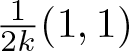 $\frac{1}{2k}(1,1)$ (see [Reference Cavey and Prince.5]). We set
 $W_k = {\mathbb P}(1,1,k)_{x,y,z}$. Then there is the double covering
 $\rho\colon X\to W_k$ defined by
 $(x:y:z:t)\mapsto (x:y:z)$. We have
 $K_X = \rho^*(K_{W_k} + \frac{1}{2}B)$, where B is the branch divisor of ρ. By [Reference Liu and Zhu.19, Theorem 1.2] we know that the K-polystability of
 $(X,0)$ is equivalent to the K-polystability of the log pair
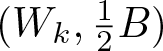 $(W_k, \frac{1}{2}B)$. In this section we prove the K-polystability of the log pair
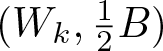 $(W_k, \frac{1}{2}B)$.
We first consider a smooth point  $\mathsf p \in W_k$. Let
 $B\in |\mathcal{O}_{W_k}(2k+2)|$ be a general member. The curve B is defined by a quasihomogeneous polynomial
 \begin{equation*}
f_2(x,y)z^2 + f_{k+2}(x,y)z + f_{2k+2}(x,y) = 0,
\end{equation*}
where 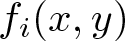 $f_i(x,y)$ are homogeneous polynomials of degree i. The curve B has a singularity only at the point
 $\mathsf p_z$, which is a node.
Lemma 3.10. For every smooth point  $\mathsf p\in W_n$, the δ-invariant of the log pair
 $(W_k, \frac{1}{2}B)$ is greater than one.
Proof. Let  $C\in |\mathcal{O}_{W_k}(k)|$ be an irreducible curve passing through the point
 $\mathsf p$. We have
 \begin{equation*}
-\left(K_{W_k} + \frac{1}{2}B\right) - uC \equiv \left(\frac{1}{k}-u\right)C,
\end{equation*}
where u is a positive real number. The pseudoeffective threshold  $\tau = \tau(C)$ is
 $\frac{1}{k}$. Since the volume of
 $-\left(K_{W_k} + \frac{1}{2}B\right) - uC$ is
 \begin{equation*}
\operatorname{vol}\left(-\left(K_{W_k} + \frac{1}{2}B\right) - uC\right) = \left(\frac{1}{k}-u\right)^2C^2 = \left(\frac{1}{k}-u\right)^2k
\end{equation*}
if u < 1, the S-invariant 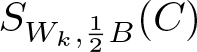 $S_{W_k, \frac{1}{2}B}(C)$ of the log pair
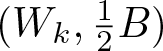 $(W_k, \frac{1}{2}B)$ along C is
 \begin{equation*}
S_{W_k, \frac{1}{2}B} (C)= \frac{1}{\operatorname{vol}\left(-\left(K_{W_k}+\frac{1}{2}B\right)\right)}\int_0^{\tau}\left(\frac{1}{k}-u\right)^2k \mathrm{d} u = \frac{1}{3}.
\end{equation*}
We set
 \begin{equation*}
P(u) = \left(\frac{1}{k}-u\right)C\qquad\text{and}\qquad N(u) = 0.
\end{equation*}
Then P(u) and N(u) are the positive and negative parts of the Zariski decomposition of  $-(K_{W_k} + \frac{1}{2}B) - uC$ for
 $u\in (0,\frac{1}{k})$. For the function in (3), we have
 \begin{equation*}
h(u) = \frac{1}{2}(P(u)\cdot C)^2 = \frac{1}{2}\left(\frac{1}{k}-u\right)^2k^2.
\end{equation*}
Then the value in (4) is given by
 \begin{equation*}
S(W^C_{\bullet,\bullet};\mathsf p) = \frac{2}{\operatorname{vol}\left(-\left(K_{W_k}+\frac{1}{2}B\right)\right)}\int_0^{\tau}h(u) \mathrm{d} u = \frac{1}{3}.
\end{equation*}
If the point  $\mathsf p$ is contained in the curve B then we can choose the curve C such that
 $(B\cdot C)_{\mathsf p} = 1$. Thus for the divisor Φ such that
 $\left(K_{W_k} + \frac{1}{2}B + C\right)|_C = K_C + \Phi$ we have
 \begin{equation*}
A_{C, \Phi}(\mathsf p) =
\begin{cases}
1 & \text{if}\ \mathsf p\not\in B\\
\frac{1}{2} & \text{if}\ \mathsf p\in B.
\end{cases}
\end{equation*}
By theorem 2.10 we obtain  $\delta_{\mathsf p}(W_k, \frac{1}{2}B) \gt 1$.
Lemma 3.11. The δ-invariant of the log pair 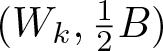 $(W_k, \frac{1}{2}B)$ at the point
 $\mathsf p_z$ is greater than one.
Proof. Let  $\pi\colon Y\to W_k$ be the weighted blow-up at the point
 $\mathsf p_z$ with weights
 $(x,y) = (1,1)$ and E be its exceptional curve. For a point
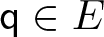 $\mathsf q\in E$ we can choose
 $H\in |\mathcal{O}_{W_k}(1)|$ such that
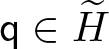 $\mathsf q\in\widetilde{H}$ where
 $\widetilde{H}$ is the strict transform of H. We have
 \begin{equation*}
\pi^*(H) = \widetilde{H} + \frac{1}{k}E.
\end{equation*}
Then the log discrepancy 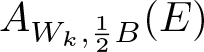 $A_{W_k, \frac{1}{2}B}(E)$ is
 $\frac{1}{k}$. For a positive real number u the equality
 \begin{equation*}
\pi^*\left(-\left(K_{W_k} + \frac{1}{2}B\right)\right) - uE\equiv \widetilde{H} + \left(\frac{1}{k} - u\right)E
\end{equation*}
holds. Since 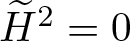 $\widetilde{H}^2 = 0$,
 $\pi^*(-\left(K_{W_k} + \frac{1}{2}B\right)) - uE$ is big if
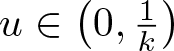 $u\in \left(0, \frac{1}{k}\right)$. The positive part P(u) and the negative part N(u) of the Zariski decomposition of
 $\pi^*(-(K_{W_k} + \frac{1}{2}B)) - uE$ are
 \begin{equation*}
P(u) = \widetilde{H} + \left(\frac{1}{k} - u\right)E \qquad\text{and} \qquad N(u) = 0,
\end{equation*}
respectively. We have
 \begin{align*}
S_{W_k, \frac{1}{2}B} &= \frac{1}{\operatorname{vol}\left(-\left(K_{W_k} + \frac{1}{2}B\right)\right)}\int_0^{\tau}\operatorname{vol}\left(\pi^*\left(-\left(K_{W_k} + \frac{1}{2}B\right)\right) - uE\right) \mathrm{d} u\\
&= k \int_0^{\tau} \frac{1}{k} - ku^2 \mathrm{d} u = \frac{2}{3k}.
\end{align*}
The function in (3) is given by
 \begin{align*}
h(u) = \frac{1}{2}(P(u)\cdot E)^2 = \frac{k^2u^2}{2}.
\end{align*}
Then the value in (4) is given by
 \begin{equation*}
S(W^E_{\bullet,\bullet};\mathsf q) = \frac{2}{\operatorname{vol}\left(-\left(K_{W_k}+\frac{1}{2}B\right)\right)}\int_0^{\tau}h(u) \mathrm{d} u = \frac{1}{3}.
\end{equation*}
For the divisor Φ such that  $(K_Y + \frac{1}{2}\widetilde{B} + E)|_E = K_E + \Phi$ where
 $\widetilde{B}$ is the strict transform of B we have
 \begin{equation*}
A_{E, \Phi}(\mathsf q) =
\begin{cases}
1 & \text{if}\ \mathsf p\not\in \widetilde{B}\\
\frac{1}{2} & \text{if}\ \mathsf p\in \widetilde{B}.
\end{cases}
\end{equation*}
By theorem 2.10 we obtain  $\delta_{\mathsf p_z}(W_k, \frac{1}{2}B) \gt 1$.
Theorem 3.12 X is K-polystable.
Proof. By lemmas 3.10 and 3.11 the δ-invariant of the log pair 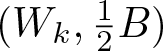 $(W_k, \frac{1}{2}B)$ is greater than one. By [Reference Liu and Zhu.19, Theorem 1.2] X is K-polystable.
4. Proofs of the main theorems
In this section we give the proofs of the main theorems.
Let  $\phi_m\colon B_n^m\to {\mathbb P}(1,1,n)$ be the blow-up along m general smooth points, where m is a nonnegative integer.
4.1. Proof of theorem A
We consider the case where n = 3.  $B_3^m$ is
 ${\mathbb Q}$-Fano if and only if m < 9. Thus, we restrict our attention to the case m < 9. By lemma 3.4,
 $B_3^m$ is not K-polystable for m < 6. From [Reference Kim and Won.15, Theorem 1.4] and theorems 3.5 and 3.9, we conclude that
 $B_3^m$ is K-polystable for
 $m\in\{6,7,8\}$.
4.2. Proof of theorem B
We consider the case where m is a nonnegative integer and n > 3 is a positive integer.  $B_n^m$ is
 ${\mathbb Q}$-Fano if and only if
 $m \lt n+5$. Thus, we consider only the case where
 $m \lt n+5$.
By lemma 3.4  $B_n^m$ is not K-polystable for
 $m \lt n+4$. In the case
 $m = n + 4$, theorem 3.12 shows that
 $B_n^m$ is K-polystable when n is even. Finally, for odd n, we conclude that
 $B_n^m$ is K-polystable by [Reference Kim and Won.15, Theorem 1.4].
Acknowledgements
We would like to thank the referees for the careful reading of the paper and helpful comments. This work was supported by the National Research Foundation of Korea [NRF-2023R1A2C1003390 to I.-K.K.; RS-2025-00513064 to J.W.].



