Introduction
Nature can play a vital role in human well-being (Kaplan, Reference Kaplan1995; Maller et al., Reference Maller, Townsend, Preyor, Brown and St Leger2005). For people with dementia, the natural environment can provide several therapeutic benefits: it may stimulate them through light (Connell et al., Reference Connell, Sanford and Lewis2007) and sensory experiences, as nature is an abundant source of multi-sensory stimulation (Gibson et al., Reference Gibson, Chalfont, Clarke, Torrington Barch and Sixsmith2007). It can provide pleasant and meaningful activities (Kane, Reference Kane2001) and restore or maintain a sense of self (Cohen-Mansfield et al., Reference Cohen-Mansfield, Golander and Arnheim2000). Although the evidence base in dementia care is still quite small, the review of Gonzalez and Kirkevold (Reference Gonzalez and Kirkevold2013) on sensory gardens and horticultural activities is very insightful. They included 16 studies with participants with dementia visiting a day center or living in a nursing home or care home. Based on the results of the studies reviewed, they concluded that these types of non-pharmacological interventions may reduce agitation, increase the engagement in activities, and improve sleep and well-being of people with dementia. One of the included studies (Lee and Kim Reference Lee and Kim2008) showed that the cognition of people with dementia significantly improved after indoor gardening. In a recent study into the clinical use of sensory gardens and outdoor environments (Gonzalez and Kirkevold, Reference Gonzalez and Kirkevold2015), leaders and staff of Norwegian nursing homes reported that the sensory gardens positively influenced agitation, restlessness, pacing, balance, and mobility of people with dementia, and also improved their sleep. Other reviews on the use of nature interventions for people with dementia, show positive results on the quality of life and again also effect on behavior and mood problems, especially on agitation and mood/affect (Olsson et al., Reference Olsson, Lampic, Skovdahl and Engström2013; Whear et al., Reference Whear, Thompson Coon, Bethel, Abbott, Stein and Garside2014). In general, nature seems to contribute positively to the health of people with dementia (Milligan et al., Reference Milligan, Gatrell and Bingley2004; Maller et al., Reference Maller, Townsend, Preyor, Brown and St Leger2005).
Several controlled trials in day care, residential care, and nursing homes showed that personalized care is more effective than usual care offered in these settings (Dröes et al., Reference Dröes, Meiland, Schmitz and van Tilburg2004; Finnema et al., Reference Finnema2005; Chenoweth et al., Reference Chenoweth2009). Also, meeting the personal needs and wishes of persons with dementia is thought to be important in managing behavior and emotional dysregulation according to the need-driven dementia-compromised behavior model (Algase et al., Reference Algase1996, Kovach et al., Reference Kovach, Noonan, Matovina Schlidt and Wells2005). Personalized nature activities are an attractive addition to the traditional activities in dementia care, and give an extra opportunity to fulfill individual needs.
Nature and outdoor spaces may thus be important for persons with dementia and improve their well-being. However, nature is often not easily available for people with dementia living in a nursing home, or it is underused for different reasons (Chalfont, Reference Chalfont2007), such as a non-supportive organizational policy or the lack of provision of activities that are meaningful to persons with dementia (Connell et al., Reference Connell, Sanford and Lewis2007; Grant and Wineman, Reference Grant and Wineman DArch2007). Moreover, there is still a lack of knowledge on how to use nature in a person-centered way for the target group (Gonzalez and Kirkevold, Reference Gonzalez and Kirkevold2013).
Utilization of nature and outdoor activities and their effectiveness may be improved by developing a series of personalizable activities, which can then be shaped for individual persons based on their preferences, wishes, and abilities and on the “nature experience” they specifically find important for their well-being and quality of life. Dröes et al. (Reference Dröes2006) interviewed people with dementia about what they find important for their quality of life. This revealed several domains of importance, such as: health, mood, and enjoyment of activities.
Although the previously mentioned reviews provide important insights into the possible impact of nature and being outdoors on the well-being of people with dementia, not much is known about how to translate these insights into personalized activities that are optimally attuned to people's preferences, wishes, abilities, and nature experience. Furthermore, little is known about the possible barriers to implementing nature activities in a personalized way. The aim of this study was therefore to develop an approach, including examples of personalizable nature activities and a decision tool to design personalized nature activities for people with dementia, and to try this out among people with behavior and mood disruptions. The study had the following research questions:
-
1. Which aspects of being in nature or outdoor spaces do people with dementia find important for their quality of life?
-
2. What types of activities in nature do people with dementia prefer?
-
3. What tool can be developed to support the execution of nature activities among people with dementia living in the community and in long-term care settings in a person-centered way?
-
4. A. Do people with dementia who experience behavior and mood dysregulation appreciate personalized nature activities?
B. Are personalized nature activities feasible according to professionals in care practice?
Methods
The local Medical Ethics Review Committee stated that the study was not subject to the Medical research Involving Human Subjects Act. Nursing home management boards gave permission for the study, which was conducted in accordance with the Declaration of Helsinki (1964). An informed consent procedure was followed to make sure that people with dementia (and a representative family caregiver) confirmed they were willing to participate in this study.
Research question 1 and 2
Design
A qualitative descriptive study using focus group methodology was conducted. An international literature review on nature activities for people with dementia with a special focus on preferred activities and nature experiences (Hendriks et al., in preparation), was executed beforehand to provide input for the composition of a discussion guide that was applied in the focus group study.
Participants and setting
Focus group interviews were conducted in different healthcare settings in different regions of the Netherlands to maximize the diversity of views of people with dementia in different stages of dementia and contexts. Six focus group interviews were conducted in total: two at meeting centers for people with dementia and their informal caregivers, two at day care centers, and two in long-term care institutions. The centers were recruited via the national meeting center-network and via the long-term care organizations of an academic network. Inclusion criteria were: having a dementia diagnosis, no aphasia, interest in nature, and having provided informed consent. There were no specific exclusion criteria. People were invited to participate by the coordinators of the different care centers. All participants received a small gift after the focus group interview to thank them for their participation.
Measurements and procedure
In the focus groups, questions were asked regarding nature experiences and activities, for example: “What would you like to do in nature?,” “What do you experience when being in nature?,” “Do you think you go outside enough? If not, why?.” The focus group interviews lasted approximately 1 hour and were tape recorded. Skilled moderators with experience in communicating with people with dementia facilitated the discussions. One moderator had previous experience in moderating focus groups of people with dementia. The other moderator was theoretically and practically trained by the experienced moderator before conducting focus groups herself. All focus group participants were supported in a person-centered way. The moderators took into account the severity of dementia when asking the questions. In case of more severe dementia, more closed questions were asked (e.g. “Do you like to walk in the park?,” “Would you like to grow a vegetable garden?”). In all but one focus group, a healthcare professional who knew the participants well joined the focus group. In one focus group, the professional was absent because of illness. In this focus group, the moderator was joined by a research assistant (a Master student in cultural anthropology) who was trained in conducting focus groups and observation studies.
Data analysis
All tape-recorded focus group interviews were completely transcribed verbatim. Using ATLAS.ti, content analysis of the transcriptions was carried out by two independent researchers to identify themes from the data on which nature experiences and activities people with dementia found important for their quality of life. These themes were categorized into quality of life domains as described by Dröes et al. (Reference Dröes2006) and examples of activities were provided for each category.
Research question 3
Design
We used the results of the focus groups and the literature review, to develop a first version of the approach, consisting of a decision tool and example activities that could be personalized by means of the decision tool.
Participants and setting
The developed decision tool and example activities were presented for feedback to five persons with dementia (three people from a meeting center and two people from a day care center), and to nine professionals in the field of dementia care or nature interventions (one activity coordinator, one social worker, two psychologists, one coordinator of a meeting center, one coordinator of a day care center, two staff members of a care institution, and one director of a nature foundation).
Measurements and procedure
The draft version of the approach, consisting of a decision tool and three example nature activities, was presented for feedback to persons with dementia and professionals in the field of dementia care or nature interventions. Of the decision tool, two graphical formats were presented (one with a checklist with only words and one with a combination of pictures and words). To inform them on the applicability of the approach in practice, the personalization possibilities were explained.
The people with dementia were asked for feedback in a semi-structured interview in which a professional or a researcher actually used the decision tool together with the person with dementia. After answering the personal interest questions in the decision tool, the researcher presented the relevant example activities and the persons with dementia were asked if they would like to participate in one or more of these activities, and how the activity could be improved in their opinion. The professionals received the two graphical formats of the decision tool and the instruction of the three example nature activities. They were asked in a structured interview about the relevance of the approach (“How do the personalized nature activities relate to usual and nature activities that are already offered?” and “Do the personalized nature activities match the needs of the persons with dementia?”) and the feasibility of the approach (e.g. “Is the instruction of the tool clear?,” “Do you foresee barriers in executing the personalized nature activities?”).
Research question 4
Design
The approach was tried out in a qualitative descriptive pilot study with a one-group design among people with dementia regarding the acceptability, experience of, and satisfaction with the intervention. Additionally, the organizational feasibility was investigated (see Figure S1 published as supplementary material online attached to the electronic version of this paper at http://journals.cambridge.org/ipg).
Participants and setting
Persons with dementia were recruited for the pilot-study through the meeting center, the day care facility, and the long-term care units that also participated in the focus group study. Participants were included if they had a dementia diagnosis and provided informed consent. A purposive sampling strategy was used, with a specific focus on recruiting persons with dementia who were known to have one or more behavior or mood problems (based on the NPI, see measurements and procedure). One activity coordinator, one staff member, two care coordinators, and four volunteers guided the activities.
Measurements and procedure
Before the intervention, data were collected on background characteristics of the participants: age, gender, diagnosis, severity of dementia (Global Deterioration Scale, Reisberg et al., Reference Reisberg, Ferris, De Leon and Crook1982), living situation/care setting, and behavior problems present in the last month (Neuropsychiatric Inventory (NPI-Q); Kaufer et al., Reference Kaufer1998).
To assess the acceptability of the designed person-centered nature activities by people with dementia, systematic observations of their mood and (positive and negative) behavior were conducted during the activity by the researchers using the 5-item Observed Emotion Rating Scale (OERS; Lawton et al., Reference Lawton, van Haitsma and Klapper1996) and the Interact instrument as used by Van Dijk et al. (Baker and Dowling Reference Baker and Dowling1995; Van Dijk et al., Reference van Dijk, van Weert and Dröes2012). However, we used the six “relating to person” items twice, i.e. relating to the professional/volunteer guiding the activity and relating to the other participants. Both instruments are frequently used in (Dutch) dementia care research and have been shown to have good psychometric properties (Van Weert et al., Reference Van Weert, van Dulmen, Spreeuwenberg, Ribbe and Bensing2005). Results of the interact are commonly reported per item; no total score is calculated (Van Weert et al., Reference Van Weert, van Dulmen, Spreeuwenberg, Ribbe and Bensing2005; Van Dijk et al., Reference van Dijk, van Weert and Dröes2012).
After the activity, semi-structured interviews were conducted with people with dementia, which focused on their experience of and satisfaction with the activity, and with healthcare professionals about the organizational feasibility of the approach.
Intervention in pilot study
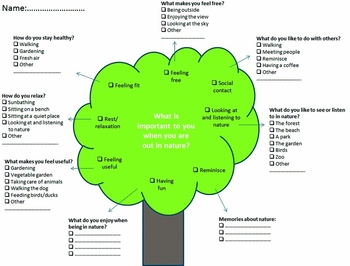
Before offering the nature activities, a healthcare professional used the decision tool (see Figure 1) to determine, in a conversation with the person with dementia the persons’ experiences, needs, and wishes concerning nature. Based on the outcomes of the decision tool, participants were assigned to one of the three designed example activities (i.e. nature walk, gardening, and sensory activation in nature) that fitted their preferences best. All activities were adapted to the individual's needs, wishes, and preferred experiences, as determined by the professional caregiver using the decision tool. The activities were offered in a group context.
Decision tree.

The nature walk was guided by a healthcare professional or volunteer who used cards with small assignments, for example regarding memories, sensory stimulation, feeling useful, and rest/relaxation, to connect optimally to the person with dementia.
The gardening sessions could each focus on different central themes, e.g. flowers, herbs, fruit trees, and vegetable garden, including sowing, fertilizing, and watering, harvesting, and cooking with home-grown vegetables.
The sensory activation activity uses nature attributes belonging to a theme (for example, farm, forest, beach) that could be matched to the person's history. People are invited to sit in a calm place outside and the healthcare professional or volunteer guiding the activity, let him or her see, feel, and smell the attributes and stimulates the person to talk about his history by asking questions.
The pilot study was executed during the Spring of 2015.
Data analysis
All collected data were entered in an anonymous database. Using SPSS, descriptive analyses (mean, sd) were conducted on the quantitative data (background characteristics, GDS, NPI, OERS, and Interact). Based on this analysis, descriptions were made of the participants’ background characteristics and behavior problems before the activity, as well as their mood and (positive and negative) behavior during the activity. Qualitative data from the interviews on acceptability, satisfaction, and feasibility were thematically analyzed and summarized.
Results
Research question 1 and 2
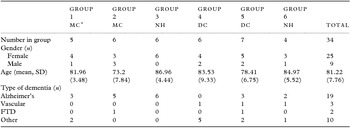
A total sample of 34 participants took part in the focus groups, full demographic information is shown in Table 1.
Group characteristics of the participants for each focus group

*MC = meeting center, DC = day care center, NH = nursing home.
Research question 1
Concerning the question, what kind of experiences people with dementia find important for their well-being and quality of life when being in nature, eight key themes emerged: pleasure, relaxation, feeling fit, enjoying the beauty of nature, feeling free, the social aspect of nature, feeling useful, and memories.
Well, sometimes nature calms me, when I am very sad and I walk and see the sunset. (Meeting Centre (MC))
I enjoy the fresh air, the freedom.(Nursing Home (NH))
Also the skies. The colors of the skies. It is so beautiful. (Day Care Centre (DC))
Research question 2
Concerning the question, what nature activities people with dementia prefer, participants mentioned active activities like walking, cycling, swimming, and exercising; passive activities like sitting outside, watching, and talking about nature; social activities like drinking coffee outside with family and watching children play; activities involving animals; activities with flowers and plants, like gardening; and inside nature activities, like watching a film about nature or handicraft with flowers.
I often go for a walk. With the walker. My grandchildren want to sit on it. (DC)
If the weather is good, we often sit outside, drinking coffee. (DC)
We used to pick blueberries, my mother made jam of them and we would secretly eat of it! (DC)
Some participants were fine with the amount of time spent in nature. Others indicated they would like to be outside more often. They mentioned that it is often not possible to go outside because someone needs to accompany them because of mobility problems. Some people felt they were not able to go outside anymore because they were getting “old.” Some said they did not go outside that often because of the weather being too hot or too cold. When asked about their wishes concerning nature activities, walking was often named as an activity they would like to do. Also, gardening and activities with animals were mentioned. Some participants indicated preferring doing activities they can choose themselves.
When possible, I am outside. But being outside more would even be better. (NH)
I enjoy being in the garden. I also like to take care of flowers. But it's all gone now, so what can you do? (NH)
If it were possible, I would go with somebody else. Otherwise I have to go alone, and that is less appealing of course. (NH)
Research question 3
Development of approach
Based on the results of the focus groups, we designed a decision tool in two graphical formats and three example activities. We chose these three specific activities for the following reasons: walking was the activity that was mentioned most often in the focus groups as an activity the participants would like to do; gardening was also mentioned in the focus group as an activity people would like to do, but which they felt they were no longer able to do. The sensory stimulation activity was added because in the focus groups many participants said they enjoyed the beauty of nature, and because we also wanted to offer an activity that could be applied to people who had more advanced dementia, or who had limited mobility. These activities were designed to be useable outdoors as well as indoors and in different stages of dementia.
Staff and user feedback on person-centered approach
First, the draft version of the decision tool (representing relevant experiences, categorized in quality of life domains, and activities) was presented for feedback to nine professional caregivers. Two graphical formats were presented: one with pictures and words (decision tree, see Figure 1) and one in checklist format. The majority of the nine professionals preferred the format with pictures over the checklist format, especially because of its appealing design. The decision tool was considered highly (n = 5) or reasonably feasible (n = 1). It was mentioned it could make care staff more aware of possible nature activities. However, some professionals indicated the accompanying questions may be too difficult for people with dementia to answer, especially for those in advanced stages of dementia. They proposed that in these situations, family members could be asked to answer the questions. Some suggestions were made to include additional activities in both formats of the decision tool. In addition, professionals suggested that the instruction should clarify that the decision tree should not be applied too strictly, but should be used as a guide to talk about nature and to get to know a person's needs, preferences, and experiences with nature. The idea of developing an app, to be used on a tablet, with more pictures to make the decision tree even more visual and easier to use in practice, was generally considered a good idea.
Second, the professionals were asked for their opinion on the content and feasibility of the developed example nature activities. Overall, in all settings, the content of the activities was rated positively and thought to match the needs of people with dementia. The nature walk and the gardening activity were preferred most, while the sensory activation was preferred by only two professionals (working in a nursing home and working for a nature foundation). Two professionals working in a Meeting Centre and in a day care center, indicated this activity was “not suitable for our people, but more suitable for people with severe dementia.” Concerning the nature walk, four professionals thought the cards with assignments would provide a useful basis for the activity and would stimulate staff awareness that walking in the park can be more than just exercise. One professional suggested adding more cards with assignments to optimize the personalization of the activity. However, another professional indicated the assignment cards were too difficult to be used by staff in practice. Regarding the gardening activity, suggestions were made for more assignments during the activity. Regarding sensory stimulation, one professional suggested putting the nature attributes in a box to make the activity applicable indoors also.
Concerning the expected feasibility of the activities, most professionals thought the staff working in day facilities and care institutions would be motivated to execute these nature activities. However, some professionals, from different backgrounds, believed that the staff did not have enough expertise and experience to guide personalized nature activities. Concerning the instruction of the activities, two professionals thought the written instruction was not sufficient. Additional training for people who assist in executing nature activities was suggested. Three professionals noted the importance of emphasizing in the instruction of the activities that the assignments should be executed in a spontaneous way. One professional was concerned too many actions are needed for the implementation of the person-centered approach: first, administrating the questions of the decision tool, second, recording the answers in the care dossier, and last, staff having to read the instruction material before providing the nature activity. Other barriers to implementing personalized nature activities mentioned were: no (suitable) outdoor space, not enough doors to the garden so people cannot go outside by themselves, not enough personnel to guide people individually, and personnel lacking time to guide the activity. Two professionals were concerned about how to finance nature activities. Suggested solutions for this problem were: ask rotary clubs for support, make use of volunteers and family members. Expected facilitators to implement nature activities were: motivating and training personnel to assist in executing nature activities, utilizing volunteers and family members, and asking people from nature associations to help with the activities.
Third, one of the two formats of the decision tool and the nature activities were presented to people with dementia. Based on their answers to the questions on the decision tool, the participating people with dementia were asked if they would like to do the nature walk and/or the gardening activity. The sensory activation activity appeared not to match these participants’ preferences. People reacted enthusiastically to the proposed activities. It should be noted that for some people with dementia, it appeared to be quite difficult to answer the open-ended questions of the decision tree, the closed questions were easier.
Adaptations based on feedback
In line with the recommendations of the professionals and the experiences using the decision tool together with people with dementia, the instructions of the decision tree and the nature walk were adapted. Also, more assignment cards were added for the nature walk and gardening activity. Concerning the sensory stimulation activity, the recommended boxes were included in the activity. Because of the preference for the decision tree, we decided to use this format of the person-centered approach in the pilot study.
Research question 4
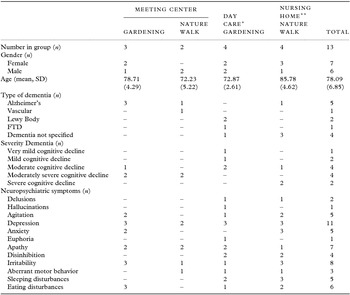
In total, 13 participants took part in the nature walk or gardening activity, full demographic information is shown in Table 2.
Background characteristics of the people with dementia participating in the pilot study

Three participants also participated in the focus groups.
*People in the Day Care group only participated in the gardening activity.
**People in the Nursing Home group only participated in the nature walk.
Observations during activity
Scores on the Interact (available upon request from the authors) showed that participants overall displayed high levels of “positive” behaviors during the activities (such as happy/content, alert/active, enthusiasm, spontaneous talk, relate well with professional/volunteer, co-operate with others, focus on activity, doing things on one's own initiative, enjoying oneself) (mostly >3), and low levels of “negative” behaviors (such as tearful/sad, fearful/anxious, confused, bored, aggressive, negativistic, reluctance, repetitious mannerism, wandering) (all < 1) during the activities (see Table S1 published as supplementary material online attached to the electronic version of this paper at http://journals.cambridge.org/ipg). Negative behaviors were absent in five participants (not in table). Four of the 13 participants showed lower levels of positive behavior (most scores < 3) and higher levels of negative behaviors compared to the rest of the group (not in table). Overall, the highest scores were found for relating to professional/volunteer and relating to environment, the most variation in scores was found for speech and relating to other participants.
Results on the OERS showed that none of the participants displayed anger, fear, or sadness during any of the activities. Expression of pleasure as measured by the OERS (laughing, singing, kissing, etc.) was infrequent, with two participants showing pleasure for more than 5 minutes, three participants showing pleasure for 1 to 5 minutes, four participants for 16–59 sec and four participants less than 16 sec. Alertness was most commonly observed. Twelve participants were alert for longer than 5 minutes and one for 1 to 5 minutes.
Evaluation of the experience of, and satisfaction with, the activity
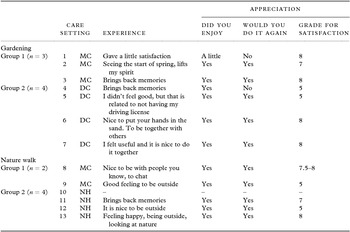
All participants enjoyed the activity and almost all of them would like to do the activity again. Some said the activity brought back memories, and some participants mentioned they enjoyed being with others during the activity (see Table 3).
Experience and satisfaction of participants

*MC = meeting center; DC = day care center; NH = nursing home.
Evaluation of facilitators, barriers, and recommendations
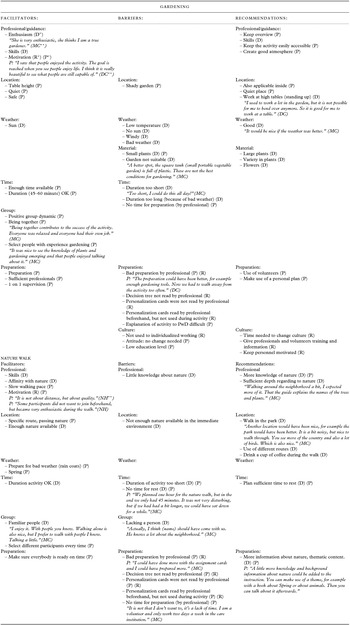
From the interviews with four professionals, three volunteers and 12 people with dementia after the activities, eight themes for the successful implementation of the nature activities were identified: preparation, guidance, location, weather, material, duration, group conditions, and cultural aspects of the organization.
As shown in Table 4, good preparation is crucial to successfully implement the nature activities. One of the professionals guiding the gardening activity noted the importance of making a plan beforehand. The lack of preparation resulted in less attention for the participants and interfered with the activity. To personalize the nature activities, it is important to know the needs, wishes, abilities, and experiences with nature of the participants. In one of the gardening sessions and in one of the nature walk sessions, the filled out decision trees were not seen by all persons guiding the activity. Moreover, the instruction was not read adequately, resulting in a less person-centered and less stimulating setting. Because of the importance of one-on-one support during the personalized nature activities, one of the professionals mentioned using volunteers as very helpful.
Evaluation of facilitators, barriers, and recommendations for personalized nature activities

*D = Person with dementia, P = professional, R = researcher.
**MC = meeting center, DC = day care, NH = nursing home.
In some of the care settings, the professionals and volunteers were not used to individualized working. One professional (DC) noted that the staff at her care institution did not think they needed to change the way they work. Therefore, professionals and volunteers need information and training to become familiar with the personalized way of working and to keep them motivated.
We did not find large differences in facilitating and obstructing factors for implementation between the different care settings (meeting center, day care center, and nursing home ward).
Discussion
The aim of this exploratory study was to find out which aspects of being in nature or outdoor spaces people with dementia find important for their well-being and quality of life (question 1), which activities in nature they appreciate (question 2), what tool could be used to support activities in nature in a person-centered way (question 3), and whether personalized nature activities are appreciated by people with dementia (question 4.A.) and feasible according to professionals in care practice (question 4.B).
Research question 1
From the focus groups, eight themes emerged on the aspects of being in nature people with dementia find important for their quality of life: pleasure, relaxation, feeling fit, enjoying the beauty of nature, feeling free, the social aspect of nature, feeling useful, and memories. Most of these aspects of experiencing nature have been mentioned in previous studies (Duggan et al., Reference Duggan, Blackman, Martyr and Van Schaik2008; Olsson et al., Reference Olsson, Lampic, Skovdahl and Engström2013; Whear et al., Reference Whear, Thompson Coon, Bethel, Abbott, Stein and Garside2014). However, the relevance of connecting to the past by recollecting and sharing memories and the importance of feeling fit and staying healthy were both mentioned in only one of the three studies about nature experiences (Duggan et al., Reference Duggan, Blackman, Martyr and Van Schaik2008; Whear et al., Reference Whear, Thompson Coon, Bethel, Abbott, Stein and Garside2014). Although the relationship between maintaining self-confidence and outdoor activities was identified by Olsson et al. (Reference Olsson, Lampic, Skovdahl and Engström2013), the importance of feeling useful was not emphasized here, or in the other studies.
Research question 2
From the focus groups also became clear that people with dementia appreciate a variety of activities: active activities (e.g. walking, cycling, and swimming), passive activities (e.g. sitting outside, looking at nature, and talking about nature), social activities, activities involving animals, activities with flowers and plants, and inside nature activities. Interestingly, although the passive activities mentioned here are in line with the meaningful activities named by people with dementia in Raske (Reference Raske2010), the active activities identified here were not mentioned in that study, while, according to the focus groups, walking was, in all care settings, the most desired and popular nature activity.
Research question 3
Based on the aspects of nature and activities derived from the focus groups, we developed an approach which can be used to personalize nature activities, and three (examples of) easy applicable nature activities to explore the feasibility and appreciation of personalized nature activities.
Research question 4.A
Not all example activities were tried out in the pilot study: the sensory activation activity appeared not to fit with the wishes of the persons who participated in the pilot. Trying out the activities showed that all participants positively appreciated the activities: they enjoyed the activity and almost all of them would like to do the activity again. This matched with our findings that participants showed high levels of positive behaviors and low levels or absence of negative behaviors during the activities. When negative behaviors occurred, the frequency was very low. This is notable since the participants did show a great variation of behavior problems in the month before the activity. The results correspond with the findings of Milligan et al. (Reference Milligan, Gatrell and Bingley2004) and Maller et al. (Reference Maller, Townsend, Preyor, Brown and St Leger2005) who indicated that both nature in general and outdoor spaces can be beneficial in dementia care. Whear et al. (Reference Whear, Thompson Coon, Bethel, Abbott, Stein and Garside2014) even found quantitative evidence of decreased agitation associated with garden use. Because the current study was an exploratory pilot evaluation focused on the development and trying out of an approach for person-centered nature activities, the effects of the nature activities on specific outcome measures in people with dementia were not investigated. However, the positive reactions of the participants are sufficient reason for further investigation. Furthermore, as connecting to personal needs is considered a starting point for treating behavior problems, and Algase et al. (Reference Algase1996) and other studies suggest nature activities may have positive effects on behavior and mood problems (Connell et al., Reference Connell, Sanford and Lewis2007; Detweiler et al., Reference Detweiler, Murphy, Meyers and Kim2008), it would especially be interesting to investigate the effects of nature activities that are personalized according to this approach on challenging behavior of people with dementia.
Research question 4.B
Regarding the practical feasibility of the nature activities, eight themes for the successful implementation of nature activities were identified: preparation, guidance, location, weather, material, duration, group conditions, and cultural aspects of the organization. We found that the most crucial factor for successful implementation of nature activities was a good preparation of the activity. Often the instruction was not thoroughly read, which resulted in a less person-centered setting. We also noted a barrier regarding the care culture. We found that most professionals and volunteers were not used to working in a person-centered way. One professional, working in a day care institution, observed that many of her colleagues felt no change was needed in the way they work. This barrier was also mentioned in a study about the implementation of Snoezelen Multi-Sensory Environment (Van Weert et al., Reference van Weert, Kerkstra, van Dulmen, Bensing, Peter and Ribbe2004): “It is not always easy to achieve or to adhere to the new working style.” To overcome these barriers, it is important that the professionals and volunteers receive information and training to adopt the personalized way of working and to keep them motivated. The importance of staff training for successful implementation of psychosocial interventions was also emphasized by Boersma et al., (Reference Boersma, Van Weert, Lakerveld and Droës2015). No large differences were found in facilitators and barriers to implementation between the different care settings.
Limitations
Limitations of the pilot study were the small number of participants and that the activities were not always executed according to the outcomes of the decision tree. As a result, the setting not always optimally matched the interests, wishes, abilities, and nature experiences of the person with dementia. This should be taken in account when preparing an effect study. General training regarding the principles of person-centered care is necessary to use the person-centered approach as intended. Also, the weather was not always optimal for outside activities. This may have influenced the execution and appreciation of some activities. In the future, we may counter this for instance by adding weather conditions to the decision tree, allowing different types of activities, depending on different weather conditions. For some people with dementia, it appeared to be quite difficult to answer the open-ended questions of the decision tree, the closed questions were easier. To overcome this problem, we will extend the decision tree with more closed questions to make sure the person's interests, wishes, abilities, and experiences with nature become clear.
Because of the physical movement during the nature walk, executing the observations was sometimes experienced as somewhat challenging by the researchers. This may have influenced the reliability of the observations. A way to improve this in future effect studies, might be to always let two researchers observe each participant. We also noticed that some participants had difficulty quantifying their satisfaction with the activity on a scale from one to ten: sometimes a participant evaluated the activity positively, while he/she gave a low grade, and vice versa. In future studies, it is therefore advised to check if the person understands the method of scoring beforehand, or the scoring method might be improved using visual cues such as smiley faces.
Scientific and societal impact
This study contributes to the development of knowledge regarding the implementation of person-centered care activities for people with dementia living in different care settings. For the first time, a tool was developed to adapt nature activities to the personal wishes, needs, and experiences of people with dementia. This was done in co-operation with people with dementia and healthcare professionals. The promising experiences in practice emphasize the need for further research into the effects on behavior, mood, and quality of life of person-centered nature activities for people with dementia in different care settings, preferably by means of controlled studies, with a pre-test–post-test design. Our primary intention was to study the person-centered nature approach as a means to prevent and treat mood and behavior dysregulations of people with dementia. We therefore conducted a pilot study within this group. In future studies, it would be very interesting to also investigate the effects of person-centered nature interventions on the quality of life of people with dementia without specific behavior and mood problems.
Conclusion
This study resulted in a tool that can be applied by healthcare professionals and other caregivers to personalize nature activities for people with dementia in meeting centers, day care centers, and long-term care settings. The tool shows promising accessibility and user-friendliness. However, independently of the care setting, training in the application of the person-centered approach, including the use of materials, is needed. With some adaptations, it may also be possible to use this approach for other psychosocial interventions for people with dementia, which could be of great value in promoting person-centered work in dementia care.
Funding
This work was supported by the Nature Assisted Health Foundation (NAHF).
Conflict of Interest
Besides on the research questions, the funding organization had no influence on the data collection, data analyses, or reporting. The authors have not entered into an agreement with the funding organization that has limited their ability to complete the research as planned and publish the results. The authors have had full control of all the primary data.
Description of authors’ roles
Iris Hendriks and Deliane van Vliet conducted the data collection and analyses and wrote the paper. Debby Gerritsen and Rose-Marie Dröes designed the study, supervised the data collection, and analyses and contributed to writing of the paper.
Supplementary Material
To view supplementary material for this article, please visit http://dx.doi.org/10.1017/S1041610216000612.