Acanthosomatidae (Hemiptera) consists of three subfamilies, 56 genera, and about 285 species (Tsai and Rédei Reference Tsai and Rédei2015). The monophyly of Acanthosomatidae has been demonstrated by morphological and molecular studies (Grazia et al. Reference Grazia, Schuh and Wheeler2008), and maternal care of eggs and young, i.e., guarding against predators with shielding posture and aggressive responses, has been reported in several genera (Tachikawa Reference Tachikawa1991; Tsai et al. Reference Tsai, Kudo and Yoshizawa2015). Costa (Reference Costa2006) suggested that acanthosomatids are well suited for comparative studies on the correlated evolution of parental care and other life history traits, such as egg size and clutch size (Shine Reference Shine1978; Fox and Czesak Reference Fox and Czesak2000) and on the association between the evolution of life history traits and environmental factors (Wilson Reference Wilson1975; Wong et al. Reference Wong, Meunier and Kölliker2013). However, with the exception of studies on a few closely related species (Kaitala and Mappes Reference Kaitala and Mappes1997; Kudo Reference Kudo2001), no comparative studies have been conducted using this taxon.
Recently, Tsai et al. (Reference Tsai, Kudo and Yoshizawa2015) reconstructed the phylogeny of this family using molecular data and inferred the origin of maternal care in 52 species and one subspecies of the three subfamilies in Acanthosomatidae. Based on their findings, it is considered that maternal care evolved repeatedly within this lineage, providing a strong basis for future comparative analyses of life history traits. However, in order to ensure that such analyses are sufficiently robust, quantitative data needs to be collected from as many species as possible.
The genus Elasmostethus Fieber belongs to the subfamily Acanthosomatinae. Monophyly of this genus has been suggested based on molecular phylogenetic analysis (Tsai et al. Reference Tsai, Kudo and Yoshizawa2015). Some reproductive traits, such as clutch size and egg size, have been recorded in E. interstinctus (Linnaeus) and E. humeralis Jakovlev (Mappes et al. Reference Mappes, Kaitala and Rinne1996; Kudo Reference Kudo2001). While there are some descriptions of breeding behaviour in other Elasmostethus species (Carter and Hoebeke Reference Carter and Hoebeke2003; Kobayashi and Tachikawa Reference Kobayashi and Tachikawa2004), no quantitative data have been published for these species to date.
Here we present life history data, i.e., clutch size, egg size (weight), and the developmental periods of eggs, which can be associated with mortality risks (Shine Reference Shine1978). We also present data on female body (abdomen) size, which limits the total amount of resources allocated to reproduction (Fox and Czesak Reference Fox and Czesak2000) in E. amabilis Yamamoto, E. brevis Lindberg, E. humeralis, E. interstinctus, E. kerzhneri Yamamoto, and E. nubilus (Dallas).
In June and July from 1986 to 2016, we collected overwintered females from different localities in Japan; E. kerzhneri at Mount Hakkoda, Aomori, Honshu; E. brevis at Taisetsu-ko, Kamikawa, Hokkaido; E. amabilis, at Mount Haruka-yama, Sapporo, Hokkaido; E. nubilus at Naruto, Tokushima, Shikoku; E. interstinctus at Hitsujigaoka, Sapporo, Hokkaido; and E. humeralis at Maruyama, Sapporo, Hokkaido. Voucher specimens were deposited in the Otaru Museum, Otaru, Hokkaido, Japan.
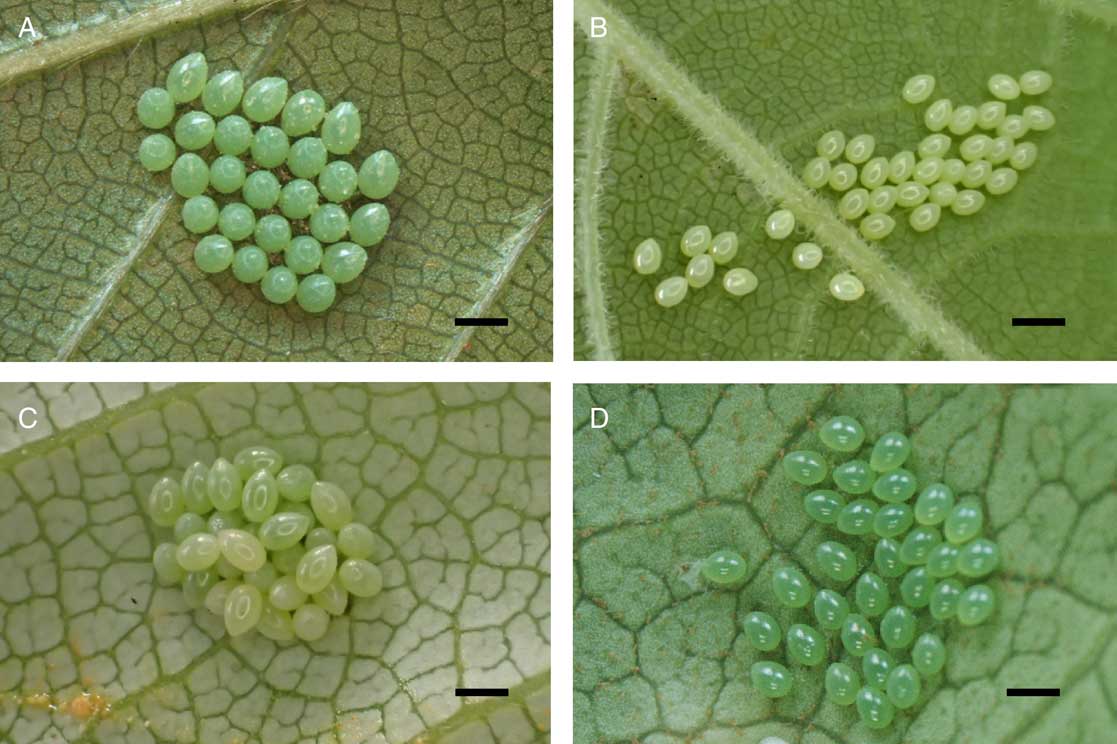
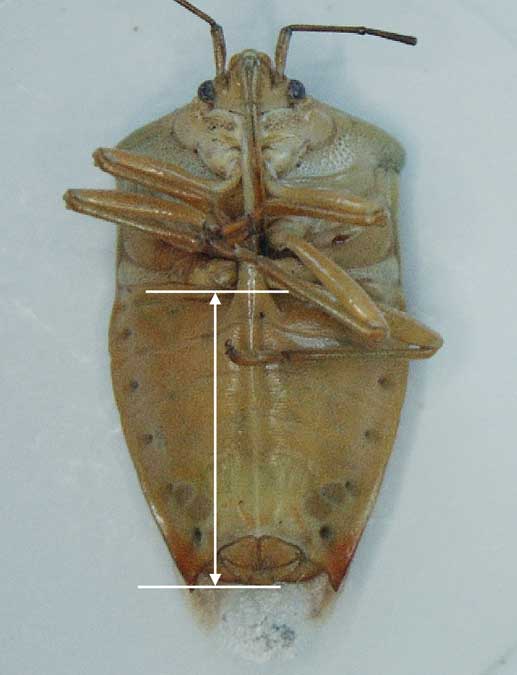
Females were maintained individually in a plastic container (9 cm in diameter, 3 cm in height) with host plant leaves and fruit at 20.0 ± 0.5 °C under 15:9 hour light:dark conditions. Females typically laid clutches of eggs on the leaf (Fig. 1) or on the fruit, but occasionally on the inside surface of the plastic container. After counting the number of eggs in the first clutch, five to 10 eggs were randomly selected and weighed together to the nearest 0.01 mg to calculate average egg weight. In some species, clutch size and egg weight data were also obtained from clutches without scars, which might be made by predators on host plant leaves in the field. To measure the developmental period of eggs, egg clutches were kept at 20.0 ± 0.5 °C under 15:9 hour light:dark conditions. We recorded the day when the first egg hatched in each clutch, but the egg hatching usually synchronised within clutches. Female abdomen length (Fig. 2), which is used as a measure of female body size, was measured under a stereomicroscope using a calibrated ocular micrometer.
Egg clutches in Elasmostethus species. A, Elasmostethus kerzhneri; B, E. humeralis; C, E. brevis; D, E. nubilus. Scale bars = 1.0 mm.

Elasmostethus female abdomen length measurement.

We compared the size of the clutches laid under laboratory conditions against clutch sizes observed in the field in three species, i.e., E. humeralis (the number of field clutches and that of laboratory clutches = 233 and 38), E. kerzhneri (20 and 14), and E. nubilus (62 and 28). Since no significant difference was observed within any of the three species (all P > 0.05 using analysis of variance), we pooled the data for the laboratory and field clutches for inter-specific comparison. JMP13 (SAS Institute 2016) was used for the statistical analyses.
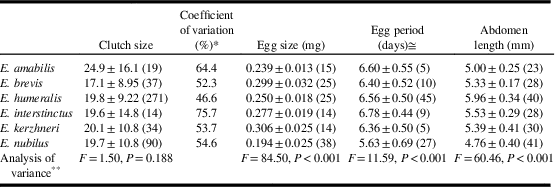
Table 1 shows a summary of life history traits in six Elasmostethus species. Although clutch size did not vary significantly among the species examined, significant differences were observed in the other traits. None of the species exhibited maternal care, including E. amabilis, for which the reproductive behaviour was previously unknown (Tsai et al. Reference Tsai, Kudo and Yoshizawa2015).
A summary of life history traits of Elasmostethus species.

Notes: Average values with standard deviations are shown. The number in the parenthesis is sample size.
* The coefficient of variation of clutch size.
≅ Eggs were kept at 20.0 ± 0.5 °C under 15:9 hour light:dark conditions.
** One-way analysis of variance for the comparison of each trait among six species.
Elasmostethus species use different plants for breeding, on which nymphs feed on fruit (seeds); for example, E. interstinctus and E. kerzhneri depend on members of the Betulaceae, E. humeralis on Apiaceae and Araliaceae, E. nubilus on Araliaceae, and E. brevis and E. amabilis on Salicaceae (Yamamoto Reference Yamamoto2003; Yamamoto et al. Reference Yamamoto, Hayashi and Kudo2009). These host plants can provide Elasmostethus with different environmental conditions in terms of physical and chemical defence mechanisms, the risk of predation and parasitism and intraspecific and interspecific competition over food resources (Price et al. Reference Price, Bouton, Gross, McPheron, Thompson and Weis1980). Such host-specific ecological factors may exert different selection pressures on the life history traits of Elasmostethus species, promoting divergence through trade-offs between the traits.
Mappes et al. (Reference Mappes, Kaitala and Rinne1996) reported that E. interstinctus females adjust resource allocation among clutches, particularly for clutch size, according to female age (in laying sequence). A marked variation in clutch size was observed within each Elasmostethus species in this study (Table 1); the coefficient of variation in clutch size for each species was usually over 50%. In all of the species investigated in the present study, the females produce clutches repeatedly (Mappes et al. Reference Mappes, Kaitala and Rinne1996; S.K., personal observation). Although the clutch size data presented here were typically from the first clutch produced by field-collected females, the breeding experience of females may differ at the time of collection. The large variation in clutch size may include components of variation not only among females, but also among clutches laid by females.
When these life history traits of the species examined in this study are compared with those of other genera in the Acanthosomatidae, some meaningful trends can be found. For example, clutch sizes in Elasmostethus are smaller than those in Elasmucha Stål and Sastragala Amyot and Serville (Kaitala and Mappes Reference Kaitala and Mappes1997; Kudo Reference Kudo2001), both of which exhibit maternal care of eggs and nymphs (Tsai et al. Reference Tsai, Kudo and Yoshizawa2015). This may imply the existence of a functional relationship between clutch size and maternal care. While there do not seem to be marked differences in egg size between Elasmostethus and Elasmucha (in some cases, the egg size of the former species is larger than that of the latter species; Kaitala and Mappes Reference Kaitala and Mappes1997; Kudo Reference Kudo2001), the egg developmental periods in the former are consistently shorter than those in the latter (under the same temperature used in the present study; Kaitala and Mappes Reference Kaitala and Mappes1997). These findings may be inconsistent with the assumptions of the safe harbour hypothesis (Shine Reference Shine1978), which proposes that species with maternal care have larger eggs than asocial species, and that larger eggs have longer egg development periods.
Unfortunately, the number of species examined in this study was not sufficient for explicitly testing hypotheses on the evolution of life history traits (Wilson Reference Wilson1975; Shine Reference Shine1978; Fox and Czesak Reference Fox and Czesak2000; Wong et al. Reference Wong, Meunier and Kölliker2013). Such analyses would require the collection of data on the life histories of other Elasmostethus species, as well as those of other genera in the Acanthosomatidae.
Acknowledgements
The authors thank I. Yao, T. Kanbe, Y. Sakamaki, and C. Koshio for their assistance in the field. The authors also thank Hokkaido Research Center, Forestry and Forest Products Research Institute for permission to collect insects. This study was partly supported by a grant-in-aid of Japan Society for the Promotion of Science, JSPS KAKENHI(JP16K07518).