

The coronavirus disease 2019 (COVID-19) pandemic, caused by severe acute respiratory syndrome coronavirus 2 (SARS-CoV-2), originated in Wuhan, Hubei Province, China, and it has rapidly spread worldwide (Zhu et al., Reference Zhu, Zhang, Wang, Li, Yang, Song, Zhao, Huang, Shi, Lu, Niu, Zhan, Ma, Wang, Xu, Wu, Gao and Tan2020). The development of vaccines against SARS-CoV-2 has significantly reduced the spread of COVID-19 (Vitiello et al., Reference Vitiello, Ferrara, Troiano and La Porta2021). Currently, the development of antiviral drugs against SARS-CoV-2 is ongoing worldwide. Remdesivir was the first small-molecule anti-COVID-19 drug approved for global marketing. It targets viral RNA-dependent RNA polymerase. This drug, administered via intravenous infusion, has received emergency authorization for COVID-19 treatment because it shortened the recovery time of patients in clinical trials (Beigel et al., Reference Beigel, Tomashek, Dodd, Mehta, Zingman, Kalil, Hohmann, Chu, Luetkemeyer, Kline, Lopez de Castilla, Finberg, Dierberg, Tapson, Hsieh, Patterson, Paredes, Sweeney, Short, Touloumi, Lye, Ohmagari, Oh, Ruiz-Palacios, Benfield, Fätkenheuer, Kortepeter, Atmar, Creech, Lundgren, Babiker, Pett, Neaton, Burgess, Bonnett, Green, Makowski, Osinusi, Nayak and Lane2020). Molnupiravir targets the same viral enzyme, but it is an orally bioavailable prodrug (Painter et al., Reference Painter, Natchus, Cohen, Holman and Painter2021). Nirmatrelvir/ritonavir (Paxlovid) and ensitrelvir are 3-chymotrypsin-like cysteine protease inhibitors that were approved for COVID-19 treatment in 2021 and 2022, respectively (Owen et al., Reference Owen, Allerton, Anderson, Aschenbrenner, Avery, Berritt, Boras, Cardin, Carlo, Coffman, Dantonio, Di, Eng, Ferre, Gajiwala, Gibson, Greasley, Hurst, Kadar, Kalgutkar, Lee, Lee, Liu, Mason, Noell, Novak, Obach, Ogilvie, Patel, Pettersson, Rai, Reese, Sammons, Sathish, Singh, Steppan, Stewart, Tuttle, Updyke, Verhoest, Wei, Yang and Zhu2021; Unoh et al., Reference Unoh, Uehara, Nakahara, Nobori, Yamatsu, Yamamoto, Maruyama, Taoda, Kasamatsu, Suto, Kouki, Nakahashi, Kawashima, Sanaki, Toba, Uemura, Mizutare, Ando, Sasaki, Orba, Sawa, Sato, Sato, Kato and Tachibana2022).
Although these anti-SARS-CoV-2 agents are already in use, given the continuous emergence of new variants, it is important to try to prevent infection through daily diet. Human breast milk is known to inhibit several virus infections, including human immunodeficiency virus, cytomegalovirus, dengue virus and even SARS-CoV-2 (van der Strate et al., Reference van der Strate, Beljaars, Molema, Harmsen and Meijer2001; Fan et al., Reference Fan, Hong, Luo, Peng, Wang, Jin, Chen, Hu, Shi, Li, Zhuang, Zhou, Tong and Xiang2020; Kell et al., Reference Kell, Heyden and Pretorius2020). Breast milk contains more than 400 different proteins, which can be divided into three groups: casein, mucin and whey proteins. Lactoferrin, mucin 1 and α-lactalbumin contained in whey protein have been revealed to have anti-SARS-CoV-2 activity. Lactoferrin and mucin 1 inhibit multiple steps, including viral attachment, entry, and post-entry replication, whereas α-lactalbumin inhibits viral attachment and entry (Lai et al., Reference Lai, Yu, Xian, Ye, Ju, Luo, Dong, Zhou, Tan, Zhuang, Li, Liu, Ding and Xiang2022). In addition, other whey proteins, such as lysozyme, β-lactoglobulin, and lactoperoxidase, are also considered to have anti-SARS-CoV-2 activity (Gallo et al., Reference Gallo, Giansanti, Arienzo and Antonini2022). Notably, SARS-CoV-2 infection can be inhibited by commercial bovine formula milk, however, little is known about dairy products that effectively inhibit SARS-CoV-2 infection.
In this study, we investigated the anti-SARS-CoV-2 activity of 10 commercially available dairy products, including bovine milk, fresh cream, lactic acid bacterial beverages and infant formula.
Materials and methods
Cells and viruses
VeroE6/transmembrane protease serine 2 (TMPRSS2) cells were maintained in DMEM supplemented with 10% fetal bovine serum (FBS), 100 μg/ml penicillin, 100 μg/ml streptomycin, and 1 mg/ml geneticin. HEK293 T cells expressing angiotensin-converting enzyme 2 (ACE2) and TMPRSS2 (HEK293 T/ACE2/TMPRSS2) were established as described previously (Yamamoto et al., Reference Yamamoto, Kiso, Sakai-Tagawa, Iwatsuki-Horimoto, Imai, Takeda, Kinoshita, Ohmagari, Gohda, Semba, Matsuda, Kawaguchi, Kawaoka and Inoue2020) and maintained in DMEM supplemented with 10% FBS, 100 μg/ml penicillin, 100 μg/ml streptomycin, 5 μg/ml blasticidin, and 50 μg/ml hygromycin.
SARS-CoV-2 omicron (BA.2: hCoV-19/Japan/TY40-385/2022) was obtained from the National Institute of Infectious Diseases of Japan. These viruses were propagated in VeroE6/TMPRSS2 cells. At 48 or 72 h after infection, viral stocks were collected by centrifuging the culture supernatants at 1000 × g for 10 min. The clarified supernatants were stored at −80°C until use.
Dairy sample preparation
Bovine milks (commercial brand of Meiji oishii gyunyu: Meiji Milk Co Ltd, Tokyo, Morinaga no oishii gyunyu: Morinaga Milk Industry Co Ltd, Tokyo, Oishii yukijirushi megu milk: Megmilk Snow Brand Co Ltd, Tokyo, Dairy gyunyu: Minami Nihon Rakuno Kyodo Co Ltd, Miyazaki, and Oishii low-fat Dairy gyunyu: Minami Nihon Rakuno Kyodo Co Ltd.), fresh cream (Hokkaido fresh cream 35: Megmilk Snow Brand Co Ltd), lactic acid bacterial beverages (Yoghurppe: Minami Nihon Rakuno Kyodo Co Ltd, R1: Meiji Milk Co Ltd and Yakult: Yakult Co Ltd, Tokyo) and infant formula (Icreo akachan milk: Ezaki Glico Co Ltd, Osaka) were purchased from a local supermarket in Miyazaki City. The solutions were frozen at −30°C and lyophilized using an FDM-1000 freeze dryer (EYELA, Tokyo, Japan). The lyophilized samples dissolved in sterile water were used as dairy samples.
Cytotoxicity assay
VeroE6/TMPRSS2 cells were seeded in 96-well plates at a density of 4 × 10⁴ cells/well. The next day, the cells were cultured with dairy samples for 3 d, and cytotoxicity was determined using the WST-8 assay with Cell Counting Kit-8 (Dojindo, Kumamoto, Japan).
Cytopathic effect (CPE)-based screening assay
VeroE6/TMPRSS2 cells were seeded in 96-well plates (4 × 10⁴ cells/well). The next day, the cells were cultured with dairy samples and then with SARS-CoV-2 at a multiplicity of infection of 1.0. After culturing the cells with the extract and SARS-CoV-2 for 3 d, the level of CPE observed in SARS-CoV-2-exposed cells was determined using the WST-8 assay.
SARS-CoV-2 pseudoviral entry assay
Pseudotyped vesicular stomatitis virus (VSV) possessing the SARS-CoV-2 spike protein was generated as described previously (Tani et al., Reference Tani, Kimura, Tan, Yoshida, Ozawa, Kishi, Fukushi, Saijo, Sano, Suzuki, Kawasuji, Ueno, Miyajima, Fukui, Sakamaki, Yamamoto and Morinaga2021). The expression plasmid for the SARS-CoV-2 spike (S) protein, pCAG-SARS-CoV-2 S-t19, was provided by Dr Shuetsu Fukushi of the National Institute of Infectious Diseases, Japan. Briefly, HEK293 T cells were transfected with pCAG-SARS-CoV-2 S-t19, a 19 amino acid-truncated S protein of SARS-CoV-2, at the C-terminus. After 24 h of incubation, the cells were infected with G-complemented (*G) VSVΔG/Luc virus. Subsequently, the virus was adsorbed and extensively washed four times with DMEM. After 24 h of incubation, the culture supernatants containing the pseudotyped VSV possessing SARS-CoV-2 S were centrifuged to remove cell debris and then stored at −80°C until further use. HEK293 T/ACE2/TMPRSS2 cells were seeded in 96-well plates (5 × 10⁴ cells/well). The next day, the cells were cultured with onnamide A and subsequently infected with the SARS-CoV-2 pseudovirus. Pseudoviral entry into HEK293 T/ACE2/TMPRSS2 cells was assessed by measuring luciferase activity. After 24 h of viral infection, the relative light units of luciferase were determined using the Steady-Glo luciferase assay system with a GloMax Explorer microplate reader (Promega, Madison, WI, USA), according to the manufacturer's protocols.
Statistical analysis
All statistical analyses were performed using GraphPad Prism 6 (GraphPad Software, San Diego, CA, USA). For comparison, we conducted one-way ANOVA, followed by Dunnett's test. The results are presented as mean ± sd, with P < 0.05 considered as statistically significant.
Results and discussion
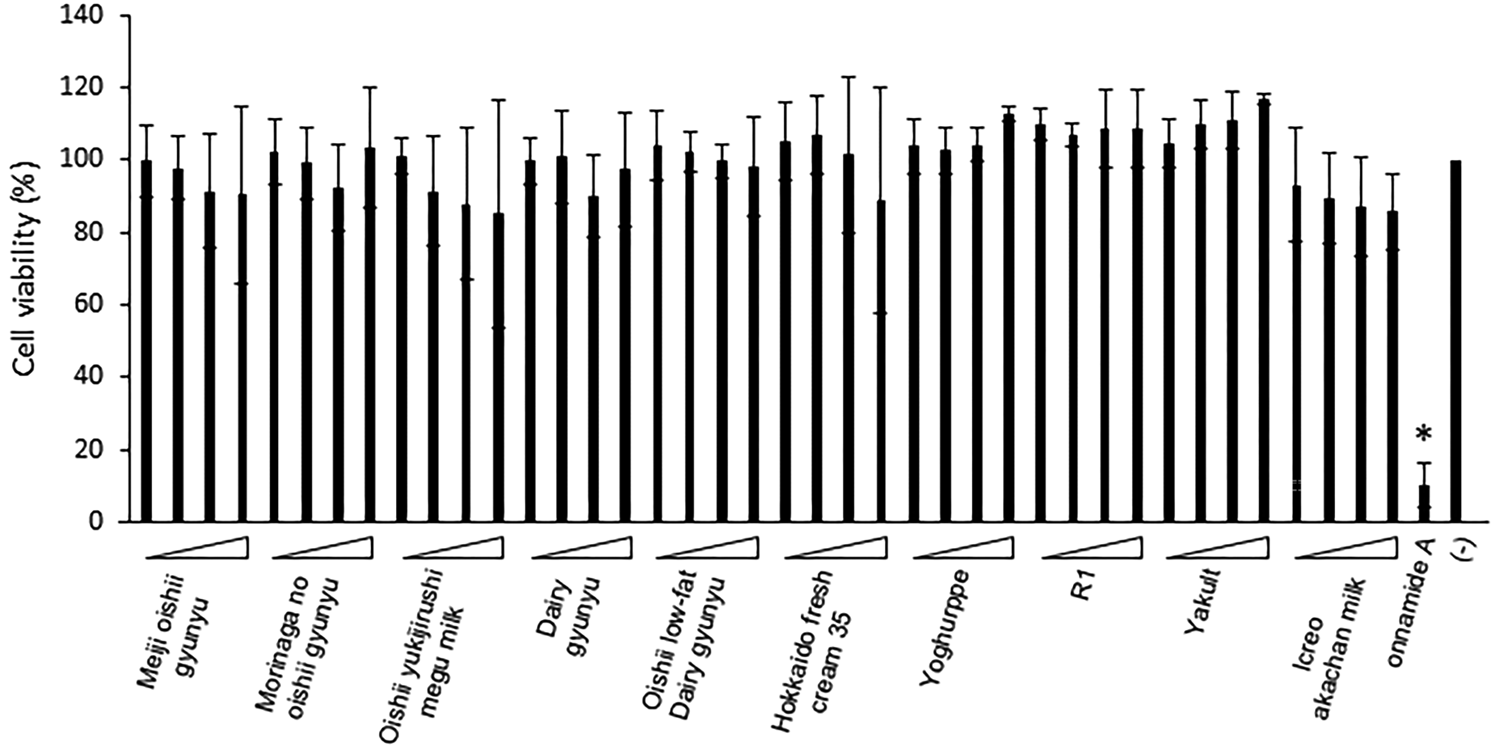
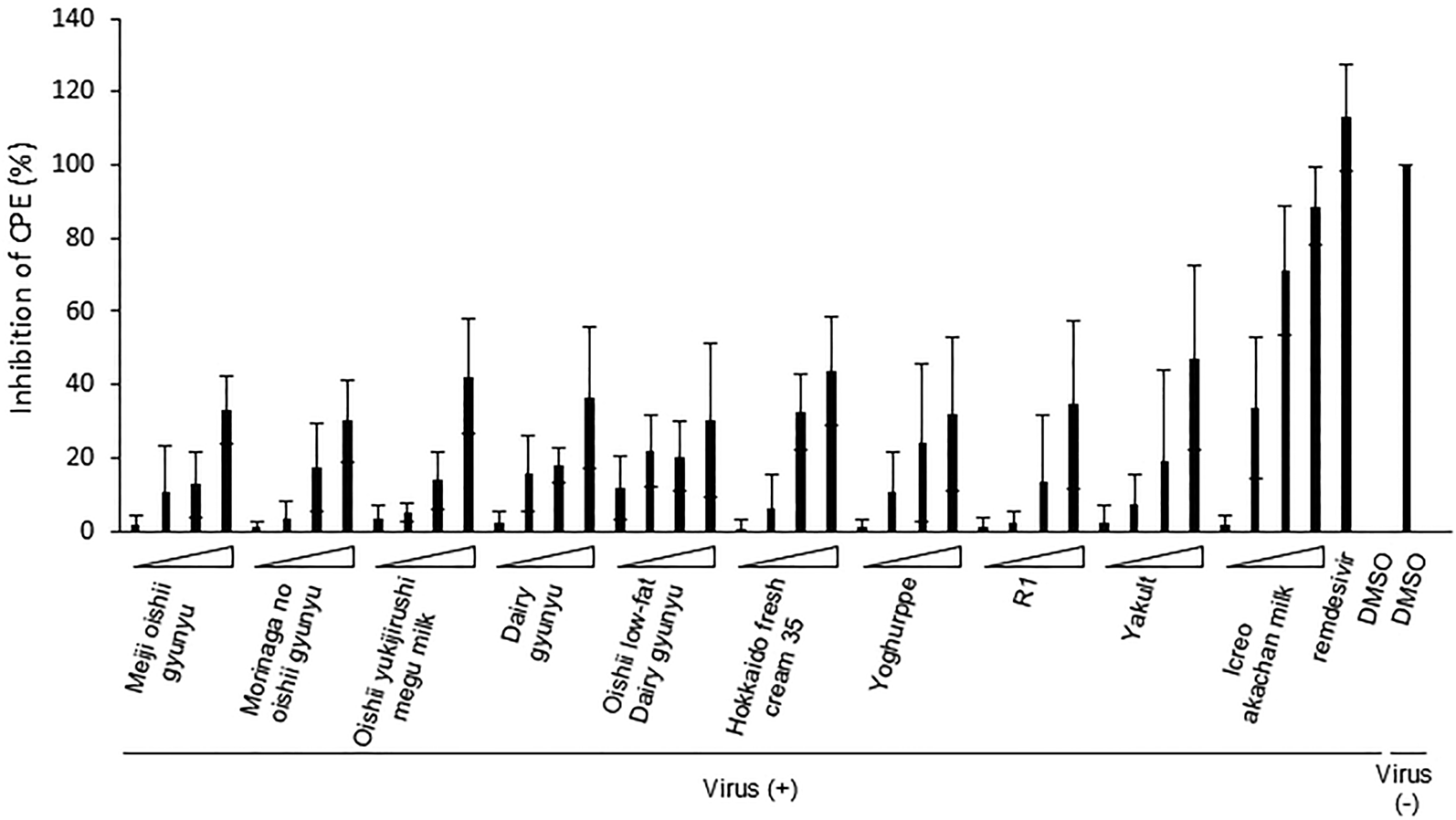
We purchased 10 commercially available dairy samples from a local supermarket to examine their anti-SARS-CoV-2 activity. Before evaluating their activity against SARS-CoV-2, the non-toxic concentration of each sample for the cells was determined using the WST-8 assay by enumerating viable cells with a sensitive colorimetric method. Dairy samples were added to 4-point, 2-fold dilutions from a top concentration of 4 mg/ml and incubated for another 3 d. Importantly, they did not show any cytotoxicity against VeroE6/TMPRSS2 cells (CC50 > 4 mg/ml: Fig. 1). Next, we assessed the effects of dairy samples on SARS-CoV-2 infection (Fig. 2). Importantly, VeroE6/TMPRSS2 cells were checked using the CPE assay, and all samples reduced the virus-induced CPE by more than 30% at 4 mg/ml. Notably, Icreo Baby Milk, an infant formula, showed high antiviral activity, with an IC50 of 1.4 mg/ml and 71% inhibition of CPE at 2 mg/ml and 89% inhibition at 4 mg/ml. These results indicate that dairy samples showed anti-SARS-CoV-2 properties, but limited cytotoxicity to VeroE6/TMPRSS2 cells.
Effects of dairy samples on cell viability. The effects of dairy samples on cell viability were examined in VeroE6/TMPRSS2 cells treated with 0.5, 1, 2, and 4 mg/ml of the dairy samples. Cells were treated with 20 μM Onamide A and used as a control for cytotoxicity. Onnamide A was prepared from the marine sponge T. swinhoei (Hayashi et al., Reference Hayashi, Higa, Yoshida, Tyas, Mori-Yasumoto, Yasumoto-Hirose, Tani, Tanaka and Jomori2024). Cell viability was examined using the WST-8 assay. The results are normalized to the rate of cell viability in vehicle-treated cells. The values represent mean ± sd from four independent experiments. Statistical significance was determined using one-way ANOVA, followed by Dunnett's test.
Effects of dairy samples on SARS-CoV-2 infection in the CPE assay. The effects of dairy samples on omicron variant SARS-CoV-2 infection were examined in VeroE6/TMPRSS2 cells treated with 0.5, 1, 2, and 4 mg/ml of the dairy samples. Remdesivir was used as the positive control drug. Antiviral activity was measured by reducing SARS-CoV-2-induced CPE in VeroE6/TMPRSS2 cells. The results are expressed as the percentage of inhibition in dairy sample-treated cells when compared with that in virus-untreated cells. The values represent mean ± sd from four independent experiments.
To further investigate the mechanism underlying the antiviral activity of the dairy products, we examined their effects on viral entry by using a SARS-CoV-2 pseudovirus assay with a firefly luciferase reporter (Fig. 3). Although most dairy products including Icreo Baby Milk did not affect viral entry, luciferase activity decreased by 31% in cells treated with 4 mg/ml R1 and 41% in cells treated with 4 mg/ml Yakult. R1 and Yakult, lactic acid bacterial beverages, showed high antiviral activities, with IC50 of 2.9 mg/ml and 3.5 mg/ml, respectively.
Effects of dairy samples on SARS-CoV-2 pseudovirus entry. Inhibition of SARS-CoV-2 pseudovirus entry was measured by reducing virus-induced luciferase activity in HEK293 T/ACE2-TMPRSS2 cells. Nafamostat was used as the positive control inhibitor. The results are expressed as the percentage of inhibition in dairy sample-treated cells when compared with that in vehicle-treated cells. The values represent mean ± sd from four independent experiments. Statistical significance was determined using one-way ANOVA, followed by Dunnett's test; * P < 0.01.

In conclusion, these results collectively indicate that commercially available dairy products moderately inhibit SARS-CoV-2 infection and may reduce the incidence of viral infections. In this study, we report that commercially available dairy products at 4 mg/ml moderately inhibit SARS-CoV-2 infection in VeroE6/TMPRSS2 cells. The lyophilized dairy samples (4 mg/ml) were equivalent to approximately 2–4 μl of dairy products, which is an easy amount for daily consumption. Icreo Baby Milk reduced virus-induced CPE, but did not affect viral entry, meaning that ICREO Baby Milk inhibited the post-entry phase of the viral life cycle. R1 and Yakult decreased the efficiency of pseudoviral entry, indicating that they inhibit viral attachment during the entry phase. Further investigation is needed to compare the content of compounds with anti-SARS-CoV-2 activity contained in dairy products. Although the detailed mechanism by which the components in dairy products suppress viral infection has not been elucidated in this study, we believe that our findings demonstrate the effective use of dairy products in preventing infection.
Acknowledgments
This study was supported by a Grant-in-Aid for Scientific Research (C: grant no. 22K06619) to Y.H. and by grants from the Dairy Products Health Science Council and Japan Dairy Association. We would like to acknowledge Editage (www.editage.cn) for the English language editing.



