Individuals with a bicuspid aortic valve represent 0.5–2% of the general population. Potential risks associated with participating in exercise and sports are largely related to valve function, accelerated aortic aneurysm formation, and aortic dissection with intense exertion. Reference De Mozzi, Longo, Galanti and Maffulli1–Reference Ward9 Because of these potential risks, guidelines have been published to aid health care practitioners in providing practical recommendations for sports participation. Reference Bonow, Cheitlin, Crawford and Douglas10,Reference Braverman, Harris and Kovacs11 The Bethesda Conference Guidelines for Sports Participation recommend avoiding high-intensity static or dynamic sports and sports with the potential for bodily collision for individuals with an isolated BAV (normal heart size and less than mild aortic stenosis or aortic regurgitation) associated with a dilated aortic root (≥40 mm or the equivalent per body surface area in children [z-scores > 2]). Reference Bonow, Cheitlin, Crawford and Douglas10 Since there is little high-quality evidence supporting these sports restrictions, the guidelines are largely based on expert consensus, and the recommendations remain controversial. Reference Baleilevuka-Hart, Teng, Carson, Ravekes and Holmes12,Reference Monda, Fusco and Della Corte13 The goals of this study were to describe the practice variation in sports restriction and to assess potential factors influencing these management decisions in children with an isolated bicuspid aortic valve.
Materials and methods
This single-centre retrospective cohort study included children (<18 years old) with an isolated bicuspid aortic valve with minimal dysfunction (≤ mild aortic stenosis and/or aortic regurgitation) at diagnosis, evaluated over a 10-year period (1/1/2005 to 12/31/2014). We limited our cohort to children with isolated bicuspid aortic valve and minimal dysfunction for easier comparability. Encounters where there was > mild aortic stenosis or regurgitation were also included, as long as the patient initially had ≤ mild aortic stenosis and regurgitation at diagnosis. Children with aortic stenosis and regurgitation were included, as long as the degree of valve dysfunction was mild or less at the time of diagnosis. Children were not excluded based on their degree of aortic root or ascending aorta dilation. Children with other CHDs were excluded. Children with a genetic syndrome were also excluded. Study data were collected and managed using REDCap electronic data capture tools hosted at the University of Utah. Reference Harris, Taylor, Thielke, Payne, Gonzalez and Conde14 The University of Utah Institutional Review Board approved this study under a waiver of consent.
The echocardiographic database (Syngo DynamicsTM, Siemens Medical Solutions USA, Inc., Ann Arbor, MI, USA) was searched for keyword “bicuspid aortic valve” to obtain a list of potentially eligible patients. The electronic medical record was reviewed to determine inclusion and exclusion criteria.
The outcome was paediatric cardiology provider recommendation regarding sports restriction at the time of a clinic encounter, as documented in the electronic medical record. Although the older 36th Bethesda Conference Guidelines for Sports Participation were used as appropriate for the study period, these were very similar to the updated guidelines, Reference Bonow, Cheitlin, Crawford and Douglas10,Reference Braverman, Harris and Kovacs11 with essentially identical criteria for restriction of aortic stenosis and regurgitation. Differences include that more recent guidelines state that athletes with severe aortic stenosis may participate in low-intensity sports, and athletes with severe aortic regurgitation can participate in competitive sports if there is normal exercise tolerance, no cardiac dysfunction, or progressive left ventricular dilation, instead of no sports participation. For aortic dilation, both guidelines base their restriction recommendations on the degree of aortic dilation, though z-scores and smaller dimensions for restriction for females were implemented in the more recent guidelines. Restriction categories were none, high-static or high-dynamic, moderate or greater intensity, low or greater intensity, or not documented in the medical record. Reference Bonow, Cheitlin, Crawford and Douglas10 If a specific sport was restricted, this sport’s restriction category was translated into the category of restriction.
Potential predictors for sports restriction included paediatric cardiology provider, age at encounter, sex, bicuspid aortic valve morphology, aortic stenosis, aortic regurgitation, and aorta z-scores (aortic root, ascending aorta). The outcomes were aortic dissection, endocarditis, and death. We also collected data on surgeries and procedures to address aortic valve dysfunction and aortic root or ascending aorta dilation. Paediatric cardiology provider recommendations included the follow-up interval, use of non-invasive imaging (echocardiogram or cardiac MRI), and medication usage.
Statistical methods
We included every encounter ≥7 years of age since this was estimated to be the time when children are likely to become involved in sports. Last carried forward single imputation was used to estimate missing values for time-varying variables including aortic root z-score, ascending aorta z-score, aortic stenosis, and aortic regurgitation. Descriptive statistics were summarised using mean (± standard deviation) or median (interquartile range) for continuous variables depending on distribution skew. Categorical variables were summarised using frequencies and percentages. Univariable and multivariable logistic mixed-effect models were used to evaluate the association of the predictor variables and the outcome category of sports restriction. Two separate logistic mixed-effect models were constructed, where one model estimated the odds of “sports restriction” versus “no restriction,” and the other estimated the odds of “not documented” versus “no restriction.” Random effects for both patients and providers were included in these models. Odds ratios, 95% confidence intervals and p-values were reported from the models. Firth’s penalised logistic regression was used to obtain inferential results for the ascending aorta z-score variable due to quasi-separation. Reference Firth15 The intraclass correlation coefficient was calculated with and without adjusting for covariates to describe the relative contributions of providers and patients, and the impact of including covariates. All statistical analyses were performed using SAS 9.4 (SAS Inc., NC). Statistical significance was assessed at the 0.05 level, and all tests were two-tailed.
Results
Study population
The 253 patients who met study criteria had 565 encounters among 34 paediatric cardiology providers. The average age of patients for all encounters was 11.5 ± 3.1 years (range: 7 to 17 years), and 78% were male. The majority of patients had right/left fusion BAV morphology at 74% versus 26% with right/non-fusion BAV morphology. More than mild aortic stenosis was present for 2.6% of encounters, and >mild aortic regurgitation was present for 0.7% of encounters. The majority of encounters had aortic root and ascending aorta z-scores that were not dilated at 81 and 54%, respectively. The average aortic root and ascending aorta z-scores were 0.8 (standard deviation ± 1.4) and 2.2 (standard deviation ± 1.8). Patients were followed for an average of 4.1 ± 2.4 years. Aortic root and ascending aorta dilation were previously studied in this cohort. No clinically significant progression in aortic dilation was observed for this cohort, with ascending aorta z-score increasing by 0.1/year and no significant change to the aortic root z-score. Reference Yamauchi, Puchalski and Weng16 Only 11 patients (<1%) were on medications that potentially target aortic enlargement, including 7 patients on angiotensin-converting enzyme inhibitors, 4 patients on angiotensin receptor blockers, and 1 patient on a beta-blocker medication.
Sports restriction recommendations
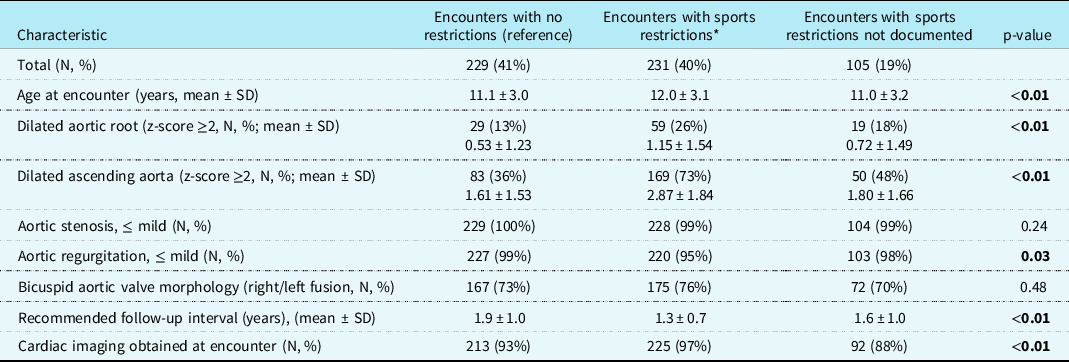
Overall, paediatric cardiology providers recommended no sports restrictions for 41% of encounters, high-static and high-dynamic restrictions for 40% of encounters and failed to document any recommendation regarding restrictions for 19% of encounters. No moderate-static and moderate-dynamic restrictions or low-static and low-dynamic restrictions were recommended for any encounter (Table 1). Males were restricted in a larger proportion of encounters (47% versus 15% in females, p < 0.01).
Aggregate characteristics for sports restrictions for all encounters in children with a bicuspid aortic valve

* High-static and high-dynamic sports restrictions.
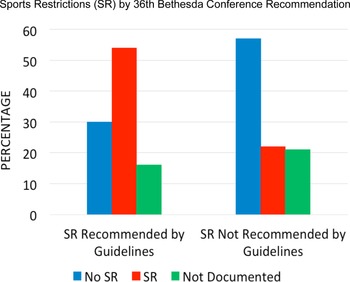
For those encounters where the 36th Bethesda Conference Guidelines Reference Bonow, Cheitlin, Crawford and Douglas10 recommended sports restrictions, 54% of providers complied with the recommendations and documented high-static and high-dynamic sports restrictions. However, despite the guidelines recommending sports restrictions, 30% of providers documented that they recommended no restrictions and 16% had no documented recommendations (Fig 1).
Sports Restrictions by 36th Bethesda Conference Recommendation: The proportion of high-static or high-dynamic sports restrictions recommended, no sports restrictions recommended or sports restrictions not documented by provider, categorised by whether sports restrictions were indicated by the 36th Bethesda Conference. SR = sports restrictions.

For encounters where the Bethesda Guidelines recommended no sports restrictions Reference Bonow, Cheitlin, Crawford and Douglas10 , 57% of providers also recommended no restrictions, but 22% restricted the child from sports, and 21% failed to document any recommendations regarding sports.
Sports restrictions by patient characteristics, valvar, and aortic anatomy
Recommendations for sports restrictions were more frequent in older children with an average age of 12.0 ± 3.1 years (p < 0.01, Table 1). When categorised by age 7–12 years versus ≥12 years, providers for 45% of encounters in the 7–12 years recommended no restrictions versus 36% of encounters with age ≥12 years. Conversely, providers for 48% of encounters for ≥12 years had restrictions versus 34% in the 7–12 years. No sports restrictions were recommended by providers in 21% of encounters for 7–12 years versus 16% for ≥ 12 years.
The aortic root at the level of the sinuses of valsalva was dilated for 26% of encounters where restrictions were recommended (mean ± standard deviation: 1.15 ± 1.54) versus 13% of encounters where no restrictions were recommended (mean ± standard deviation: 0.53 ± 1.23) and 18% of encounters with no documented recommendations (mean ± standard deviation: 0.72 ± 1.49) (p < 0.01). The ascending aorta was dilated for 73% of encounters with restrictions (mean ± standard deviation: 2.87 ± 1.84) versus 36% of encounters with no restrictions (mean ± standard deviation: 1.61 ± 1.53) and 48% of encounters with no recommendation regarding sports participation (mean ± standard deviation: 1.80 ± 1.66) (p < 0.01). BAV morphology was not significantly different between restriction recommendations (p = 0.48).
Over 98% of all encounters had ≤ mild aortic stenosis, and the prevalence was similar among the 3 recommendation categories: 1) sports restrictions, 2) no sports restrictions, and 3) no documented recommendation (p = 0.24, Table 1). Mild or less aortic regurgitation was present for 95% of encounters where the provider recommended high-static or high-dynamic restrictions, 99% where the provider recommended no restrictions, and 98% where the provider failed to document recommendations (p = 0.03, Table 1).
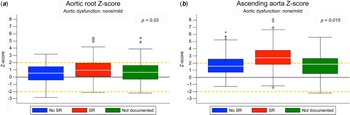
For encounters where the child had ≤ mild aortic stenosis or aortic regurgitation, the aortic root and ascending aorta z-scores were significantly higher for encounters with high-static or high-dynamic sports restrictions compared to no restrictions and failure to document recommendations (p = 0.03 and p = 0.02, respectively, Fig 2). As opposed to the recommendations in the Bethesda Guidelines, Reference Bonow, Cheitlin, Crawford and Douglas10 the provider recommended no competitive sports restrictions (Table 1) in 36% of encounters where the child had a dilated ascending aorta. Conversely, paediatric cardiology providers recommended sports restrictions for 22% of encounters where the individuals had ≤ mild aortic stenosis or aortic regurgitation and no aortic root dilation (Fig 1).
( a ) Aortic Root Z-scores with ≤ Mild Aortic Stenosis or Regurgitation, Sorted by Sports Restriction Recommendations. SR = sports restrictions. p-value for detected difference in Z-score across No SR, SR and not documented groups. ( b ) Ascending Aorta Z-scores with ≤ Mild Aortic Stenosis or Regurgitation, Sorted by Sports Restriction Recommendations. SR = sports restrictions. p-value for detected difference in Z-score across No SR, SR and not documented groups.

Association of sports restrictions and follow-up recommendations
The follow-up interval was shorter for encounters with recommendations of high-static or high-dynamic sports restrictions compared to no restrictions and to no documented recommendations (1.3 ± 0.7 versus 1.9 ± 1.0 versus 1.6 ± 1.0 years, respectively; p < 0.01 for each comparison). Non-invasive imaging was performed at most encounters regardless of the sports recommendation, including 97% of encounters with high-static or high-dynamic sports restrictions, 93% of encounters with no restrictions, and 88% of encounters with no documented recommendations (p < 0.01 for both no restrictions and not documented versus sports restrictions, Table 1).
Independent predictors of sports restriction recommendations
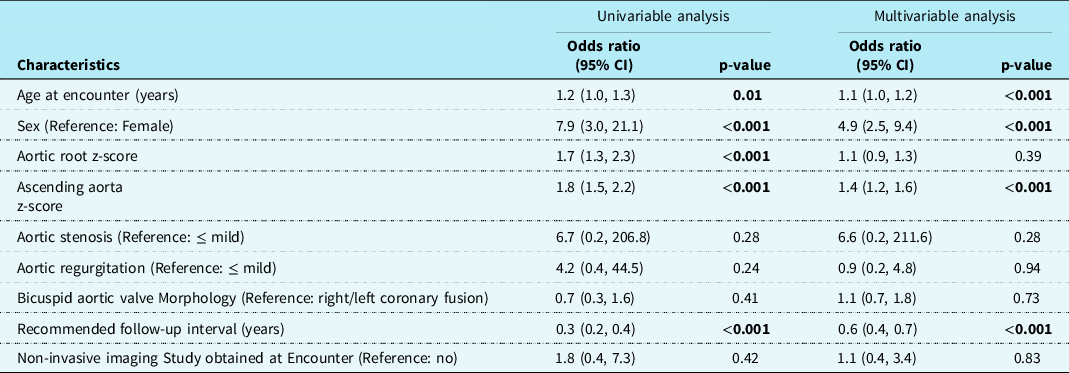
Older age (odds ratio 1.3, 95% confidence interval 1.2–1.4), male sex (odds ratio 7.9, 95% confidence interval 3.0–21.1), shorter recommended follow-up interval (odds ratio 0.5, 95% confidence interval 0.4–0.7), and larger ascending aorta z-score (odds ratio 1.5, 95% confidence interval 1.2–1.8) were independently associated with recommendation for high-static and high-dynamic sports restrictions compared to no restrictions (multivariable analysis, Table 2). When controlling for clinical variables, encounters where the provider recommended no restrictions were similar to those where they failed to document sports recommendations.
Characteristics associated with sports restrictions

Variability in provider recommendations
The individual providers and patients contributed significant variability to recommendations regarding sports restrictions. When comparing encounters where high-dynamic and high-static sports were restricted to encounters where no sports restrictions were recommended, providers accounted for 29% of variability on unadjusted analysis and increased to 37% on adjusted analysis. Individual patient accounted for 31% of the variation on the unadjusted and only 10% on the adjusted analysis (p < 0.01 for all).
There were no adverse outcomes including deaths, aortic dissections, or episodes of endocarditis. For the entire cohort, only one individual had an intervention (aortic root replacement for a dilated aorta and severe aortic regurgitation at 16 years of age).
Discussion
Paediatric cardiology providers frequently failed to address sports recommendations for patients with an isolated bicuspid aortic valve and, when addressed, often failed to follow the 36th Bethesda Conference guidelines, which were the available guidelines during the study period. Reference Bonow, Cheitlin, Crawford and Douglas10 Males, older age, and a dilated ascending aorta were significantly associated with sports restrictions, and in general, individuals with restrictions were followed in the paediatric cardiology clinic at more frequent intervals. The individual provider and patient contributed significant variability in recommendations for restricting sports participation, with provider contributing more than patient to the variability.
Several studies showed no difference in aortic dilation between athletes and non-athletes with a bicuspid aortic valve over short-term follow-up, including one recent study in children. Reference Monda, Fusco and Della Corte13,Reference Boraita, Morales-Acuna and Mainra-Breysse17,Reference Gati, Malhotra and Sharma18 Baleilevuka-Hart found children who met criteria for sports restrictions based on current guidelines were likely over restricted based on their low incidence of adverse events and absence of disease progression. Reference Baleilevuka-Hart, Teng, Carson, Ravekes and Holmes12 We found children who were older, males, had a dilated aorta, and more frequent follow-up, rather than severity of disease, were more likely to have sports restrictions. These observations may reflect the provider’s perception of risk that is not supported by adverse outcomes with only one child undergoing an intervention during the 10-year study period. The more frequent sports restrictions given to individuals that were older and male may also reflect more prevalent competitive sports participation in these groups, though the observed 1-year difference in age between groups may not be clinically significant (11.1 versus 12.0 years for those without and with sports restrictions, respectively, Table1). Potential reasons males are more likely to be restricted may be related to the relatively higher proportion of male versus female adolescents participating in moderate to vigorous physical activity Reference Guthold, Stevens, Riley and Bull19,Reference Hallal, Andersen, Bull, Guthold, Haskell and Ekelund20 and competitive contact sports. In addition, biological sex is associated with differences in exercise performance. Reference Hilton and Lundbert21,Reference Bassett, Ahlmen, Rosendorf, Romeo, Erickson and Bishop22 Therefore, providers may assume that since males might perform in a given competitive sport at a higher level compared to females, more sports restrictions for males may be required.
There was also a significant difference found in the proportion of individuals of ≤ mild aortic regurgitation between the sports restriction groups. However, the actual difference may not be clinically significant (99% for those with no sports restrictions, 95% for sports restrictions and 98% for those that did not have documented sports restrictions).
Overall, the most striking findings in this study were the frequent deviation from published guidelines, frequent failure to document sports recommendations, and provider variability. Deviation from the guidelines occurred in both directions with providers recommending sports restrictions when not indicated, and recommending no sports restrictions when guidelines recommend the child should be restricted. While some may argue for “erring on the side of safety,” there may be equal risk in preventing a child from enjoying the health and psychosocial benefits of exercise and sports participation. Reference Longmuir, Brothers and de Ferranti23,Reference Dean, Gillespie and Greene24 In addition, several recent studies failed to show strong evidence that supports physical activity leads to accelerated aortic dilation and aortic dissection, including in adult elite athletes and children, which may weaken the strength of these related sports restriction guidelines. Reference Monda, Fusco and Della Corte13,Reference Boraita, Morales-Acuna and Mainra-Breysse17 There is, therefore, a strong need for long-term study of bicuspid aortic valve disease progression in children who have participated in a wide variety of documented activities. By improving the level of evidence for sports restrictions, providers may be more willing to comply with guidelines for sports participation for children with a bicuspid aortic valve. This study is limited to a single centre and may not reflect practice at other centres. Sports restrictions may have been discussed, but not documented and, therefore, unavailable on chart review. Information on actual sports participation was not gathered for this study. Newer guidelines were published after our study period; however, these are similar to the 36th Bethesda Conference guidelines so unlikely to impact the results and conclusions of this study. Reference Bonow, Cheitlin, Crawford and Douglas10,Reference Braverman, Harris and Kovacs11
Conclusions
Significant variation is observed among paediatric cardiology providers for sports restrictions in children with a bicuspid aortic valve. Recommendations regarding sports restriction are often not documented, and, when documented, recommendations often fail to align with those from published guidelines. As no adverse outcomes occurred in this cohort, consistent with other studies, further investigation is needed to understand how deviation from sports restriction guidelines impacts long-term bicuspid aortic valve outcomes.
Acknowledgements
None.
Financial support
This investigation was supported by the University of Utah Population Health Research Foundation, with funding in part from the National Center for Advancing Translational Sciences of the National Institutes of Health under the Award Number UL1TR002538. The content is solely the responsibility of the authors and does not necessarily represent the official views of the National Institutes of Health.
Conflicts of interest
None.
Ethical standards
Human and animal experimentation did not occur in this study. The University of Utah Institutional Review Board approved this study under a waiver of consent.