

1 Introduction
In this paper, we study the effects of a pay-as-you-go pensions scheme when fertility choices are endogenous and life expectancy increases. The demographic challenge from population ageing has recently hit the pension systems of developed countries that have been facing, for some decades, a fertility rate well below the replacement level, combined with a substantial rise in life expectancy. For example, among the countries with the highest life expectancy at birth, Japan and Italy are those more under pressure: their fertility rate is around 1.4, well below the replacement rate, while the projected fraction of people over 60 by 2050 exceeds 40%. Correspondingly, the ratio of pensioners to workers has increased, putting a strain on pension systems. Therefore, profound reforms to the social security system seem urgent and unavoidable. These reforms seek to ensure the sustainability of the pay-as-you-go system by various measures that essentially impinge upon the contribution or the benefit rate and the retirement age. For example, as many as 14 OECD countries have reformed their pension policies in order to extend the working lives in the past 5 years (OECD, 2015) and many countries, in the same period, have increased taxes and contributions for the financing of public pensions.
We set up an overlapping-generations model to study the effects of ageing and of these policies in the presence of a pay-as-you-go pension system. We show that partial analyses, like all those assumed in the background by the policy-makers, are of limited help and therefore conventional policy measures, such as raising the mandatory retirement age, should be considered with caution. The paper is structured as follows: in the next section, we briefly review the literature; in Section 3, we present the model; in Section 4, we look at the effects of ageing and pension policies; we then provide a numerical simulation to supplement our qualitative results and a brief conclusion. Finally, a sensitivity analysis is performed in an Appendix.
2 Literature review
A number of papers have analysed the effects of population ageing in overlapping-generations models with pensions, especially in order to study the sustainability of the pension system. As a consequence of falling fertility and increasing longevity, a first relevant effect studied in the literature is the capital dilution effect, whereby there is an increase in the capital labour ratio and the subsequent positive effect on output per capita. Among the relevant papers in this area are Michel and Pestieau (Reference Michel and Pestieau1993) and Cigno (Reference Cigno1993). More recently, Yakita (Reference Yakita2001) considered an endogenous fertility setting, where an increase in life expectancy also reduces fertility. Another effect investigated in the literature, the intergenerational transfer effect, refers to the fact that in the decentralised equilibrium, there might be too few workers to support the pensioners. For some examples of these models, see Alders and Broer (Reference Alders and Broer2005) or Wigger (Reference Wigger1999).
A recent literature has paid closer attention to the study of increasing life expectancy in the overlapping-generations model. For instance, Cipriani (Reference Cipriani2014), complementing the results of Fanti and Gori (Reference Fanti and Gori2012) to include longevity, presents a model with ageing resulting from changes in fertility and in longevity and shows that pensions are adversely affected. However, both these papers do not take retirement into account. In fact, very few theoretical papers take into account the retirement decision in an overlapping-generations model. Two recent exceptions in this area are Cabo and García-González (Reference Cabo and García-González2014), which study a parametric reform of the pension system in a dynamic game between the government and the representative consumer, and the calibrated study in continuous time by Chen and Lau (Reference Chen and Lau2014). Other recent works include Mizuno and Yakita (Reference Mizuno and Yakita2013) and Aísa et al. (Reference Aísa, Pueyo and Sanso2012), which focus, respectively, on fertility and longevity. However, the first paper assumes wages and interest rates as fixed, which can only be justified in a small open economy, and the second paper assumes that old agents’ labour force participation is a zero-one decision. Differently from these papers, Cipriani (Reference Cipriani2018) takes a dynamic general equilibrium perspective and allows for partial participation to the labour market in the last period of life. In that model, population ageing may not be detrimental to the pension system if agents can adjust their old-age labour supply. Another paper that considers retirement (both endogenous and exogenous) and looks at the effects of working longer on welfare is Lachance (Reference Lachance2008) that finds that delaying retirement does little to mitigate the negative impact of the expected pension reductions on welfare. Finally, Fanti (Reference Fanti2014, Reference Fanti2015) builds an overlapping-generations model with pay-as-you-go pensions to study the effects of the postponement of the retirement age and finds that it may be harmful for growth and also for pension payments.
Differently from the aforementioned articles, in the present paper we assume a mandatory retirement age and consider, instead, fertility as an endogenous variable. This is an important extension since population ageing is obviously the result of both increasing longevity and decreasing fertility. Therefore, it should be important to consider the effects on fertility choices of longer life expectancy and pensions policies. Other recent attempts to study this issue, albeit without considering retirement policies, are Cremer et al. (Reference Cremer, Gahvri and Pestieau2011) that also includes human capital accumulation, and Yasuoka and Goto (Reference Yasuoka and Goto2011), Meier and Wrede (Reference Meier and Wrede2010), and Gahvari (Reference Gahvari2009), which include child care policies. Finally, in our model, we also retain a closed economy setting. This implies that when longevity increases we take into account the fact that if savings increase, the capital–labour ratio increase, and therefore there is a positive income effect on fertility through wages, as well as a negative effect from child-rearing costs. Furthermore, the fall in the interest rate has a positive substitution effect on fertility. These general equilibrium effects may, in theory, even offset the direct negative effect on fertility from the decision to save more when life becomes longer.
3 The model
3.1 Households
Our framework is a simple overlapping-generations model with two generations, endogenous fertility and exogenous mortality. The representative agent maximises an expected utility:
 $$U = {\rm ln\;} c_{y,t} + \gamma \ln n_t + \beta \pi \ln c_{o,t + 1} $$
In the first period of life, the agent is young and chooses the level of consumption c y,t and the optimal fertility rate n t – the number of children per individual. In the second period, the agent chooses old age consumption c o,t+1, facing a conditional probability π of living till the end of period t + 1, given that she survived to the first period with full probability. β ∈ (0, 1) is the usual time-preference discount factor. The parameter γ measures the relative preference with respect to the number of children: in this set-up, children generate utility just because they are born, that is, they are implicitly considered as consumption goods when parents are young. At time t, the agent has to satisfy the following budget constraint:
 $$c_{y,t} = w_t (1 - \tau ) - s_t - n_t qw_t $$
where w t is the wage income, τ ∈ (0, 1) is the contribution rate decided by the social security system, s t > 0 denotes the resources saved and invested in the capital market, and q > 0 is the fixed proportion of income spent per child – that is, the child-rearing cost. In the second period, following Miyazaki (Reference Miyazaki2014), consumption is financed by gross savings, labour income from the fraction of time spent working, and pension benefits:
 $$c_{o,t + 1} = \theta w_{t + 1}^e (1 - \tau )x + \displaystyle{{R_{t + 1}^e} \over \pi} s_t + p_{t + 1}^e (1 - x)$$
Here the agent will supply x ∈ [0, 1] units of labour in old age, where x is the official retirement age set by the social security system. It can also be interpreted as the fraction of the second period of life in which the agent works and gets the net wage income 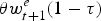 $\theta w_{t + 1}^e (1 - \tau )$ where θ ∈ (0, 1) is an index of productivity of old age workers compared with the younger ones; for the remaining life fraction 1 − x they receive a pension
 $p_{t + 1}^e $ and consume their savings. We assume that intermediaries in financial markets operate in a perfectly competitive market, hence the rate of return on savings is
 $R_{t + 1}^e /\pi $.
Solving the optimisation problem for n t and s t, we derive the optimal fertility rate and savings:
 $$n_t = \displaystyle{{\gamma (1 - \tau )w_t R_{t + 1}^e + \gamma \pi [\theta w_{t + 1}^e (1 - \tau )x + p_{t + 1}^e (1 - x)]} \over {qw_t R_{t + 1}^e (1 + \beta \pi + \gamma )}}$$
 $$s_t = \displaystyle{{\beta \pi w_t R_{t + 1}^e (1 - \tau ) - (1 + \gamma )\pi [\theta w_{t + 1}^e (1 - \tau )x + p_{t + 1}^e (1 - x)]} \over {R_{t + 1}^e (1 + \beta \pi + \gamma )}}$$
From here, we can rewrite the fertility rate in terms of the present value of lifetime income (in the square brackets):
 $$n_t = \displaystyle{1 \over {qw_t}} \left( {\displaystyle{\gamma \over {1 + \beta \pi + \gamma}}} \right)\left[ {w_t (1 - \tau ) + \displaystyle{\pi \over {R_{t + 1}^e}} (\theta w_{t + 1}^e (1 - \tau )x + p_{t + 1}^e (1 - x))} \right]$$
The lifetime income is distributed among consumption and child-rearing expenditure according to the parameters of the utility function and longevity. In particular, the optimal fraction of lifetime income devoted to child rearing is (γ/1 + βπ + γ), and by dividing this income for the child-rearing cost, qw t, we derive the optimal number of children.
3.2 Firms
Firms maximise profits producing a homogeneous good that can be used both for consumption and investment. Markets are assumed to be perfectly competitive. The price of output is normalised to one, and output is defined by a Cobb–Douglas production function, 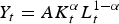 $Y_t = AK_t^\alpha L_t^{1 - \alpha} $. Workers can either be young or old. In particular, there is only a fraction of old people in period t that is both alive and working. This is weighted by an index of productivity, thus labour supply is defined as:
 $$L_t = N_{y,t} + N_{o,t} \pi \theta x$$
where N y,t and N o,t are young and old age individuals at time t, with each person supplying inelastically one unit of labour when young, or an effective unit θ when old. The older working (and still living) generation is only a fraction πx of the whole old population.
As usual, we rewrite the production function in intensive form  $y_t = Ak_t^\alpha $. The problem of the firm, then, is to maximise its profit function, by choosing the optimal capital–labour ratio, k. Capital is paid at the market interest rate; hence, assuming full depreciation,
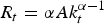 $R_t = \alpha Ak_t^{\alpha - 1} $. Labour is paid at the market wage,
 $w_t = (1 - \alpha )Ak_t^\alpha $.
The capital market is in equilibrium when firms’ demand for capital equals households’ supply of savings. The amount of capital available today is equal to the amount of resources saved in the previous period; hence if those who saved previously are the elderly of today, N y,t−1 = N o,t, then we have the following market-clearing condition:
 $$K_t = s_{t - 1} N_{o,t} $$
To express it in terms of capital–labour ratio, we have to divide both sides of the equation by L t. Considering that the number of young individuals today is equal to the offsprings per current old person at time t − 1, that is, N y,t = n t−1 N o,t, the equilibrium condition becomes:
 $$k_t = \displaystyle{{s_{t - 1}} \over {n_{t - 1} + \pi \theta x}}$$
3.3 Social security system
The social security system adopts a pay-as-you-go defined-contribution plan and runs a balanced budget:
 $$w_t \tau \; L_t = p_t \pi N_{o,t} (1 - x)$$
On the left-hand side, resources are gathered from the entire working population, using wage income as the tax base; on the right-hand side, pensions, p t, are paid only to the living and retired old population. Substituting the labour supply and rearranging in terms of the fertility rate, pension benefits are defined as follows:
 $$p_t = \displaystyle{{\tau w_t} \over {\pi (1 - x)}}(n_{t - 1} + \pi \theta x)$$
3.4 General equilibrium
Given expectations of future prices  $w_{t + 1}^e $ and
 $R_{t + 1}^e $ and substituting pension benefits in equations (4) and (5), the temporary equilibrium satisfies the conditions:
 $$n_t = \displaystyle{{\gamma (1 - \tau )w_t R_{t + 1}^e + \gamma \pi \theta xw_{t + 1}^e} \over {qw_t R_{t + 1}^e (1 + \beta \pi + \gamma ) - \gamma \tau w_{t + 1}^e}} $$
 $$s_t = \displaystyle{{\beta \pi w_t R_{t + 1}^e (1 - \tau ) - (1 + \gamma )\pi \theta xw_{t + 1}^e - \tau (1 + \gamma )w_{t + 1}^e n_t} \over {R_{t + 1}^e (1 + \beta \pi + \gamma )}}$$
Then, the stationary equilibrium with perfect foresight is:
 $$n^{^\ast} = \displaystyle{{\gamma [(1 - \tau )R^{^\ast} + \pi \theta x]} \over {[qR^{^\ast} (1 + \beta \pi + \gamma ) - \gamma \tau ]}}$$
 $$s^{^\ast} = \displaystyle{{w^{^\ast} [\pi q(\beta R^{^\ast} (1 - \tau ) - \theta x(1 + \gamma )) - \gamma \tau (1 - \tau )]} \over {[qR^{^\ast} (1 + \beta \pi + \gamma ) - \gamma \tau ]}}$$
 $$k^{^\ast} = \left[ {\displaystyle{A \over {2\pi x\gamma \theta (1 - \tau )}}\left( {\sqrt {4\pi ^2 qx(1 - \alpha )\alpha \beta \gamma \theta (1 - \tau )^2 + z^2} - z} \right)} \right]^{1/(1 - \alpha )} $$
where z ≡ πqx(1 + γ)θ + α(π 2qxβθ + γ(1 − τ)2) + γτ(1 − τ) > 0. Apart from the uninteresting steady state where capital is zero, k* is the unique positive solution to the dynamic equation k t+1 = g(k t), obtained from equation (9). Moreover, since the function g(.) is non-decreasing and concave, k* is also globally stable as shown in Appendix A.
The corresponding steady-state level of the pension benefit is:
 $$p^{^\ast} = \displaystyle{{\tau w^{^\ast}} \over {\pi (1 - x)}}\left( {\displaystyle{{\gamma [(1 - \tau )R^{^\ast} + \pi \theta x]} \over {[qR^{^\ast} (1 + \beta \pi + \gamma ) - \gamma \tau ]}} + \pi \theta x} \right)$$
This model encompasses Cipriani (Reference Cipriani2014). In fact, if we assume that individuals cannot work in the second period (i.e., x = 0), then the above solutions are exactly equal to those found in that article. Our extension allows us to study explicitly not only the impact of a change in the contribution rate, but also of the effects of a change in the official retirement age.
4 Comparative statics
We focus on the effects of changes in longevity, contribution rate, and retirement age on the steady state. In our model, these variables play an important role in the choice of savings and on labour supply, and consequently on the long-run level of output-per-worker and pensions. The first shock allows us to investigate the impact of ageing from above, which may trigger ageing from below because of the general equilibrium effects on the fertility rate. The second and third shocks are important, since these are typical pension policy instruments. Through a comparative statics analysis, we study their effects on equilibrium pension benefits and the steady-state capital stock.
4.1 Longevity shock
In the first place, capital-per-worker in the steady-state changes due to a change in longevity as follows:
 $$\displaystyle{{dk^{^\ast}} \over {d\pi}} = \displaystyle{{k^{^\ast} [ - \alpha ( - \pi ^2 qx\beta \theta + \gamma (1 - \tau )^2 ) - \gamma \tau (1 - \tau )]} \over { - \pi \left( {1 - \alpha} \right)\sqrt {4\pi ^2 qx(1 - \alpha )\alpha \beta \gamma \theta (1 - \tau )^2 + z^2}}} $$
The sign of the partial derivative is in general ambiguous. However, defining this threshold value of π:
 $$\bar \pi \equiv \sqrt {\displaystyle{{\alpha \gamma (1 - \tau )^2 + \gamma \tau (1 - \tau )} \over {\alpha qx\beta \theta}}} $$
we have that if  $0 \lt \pi \lt \bar \pi $, then (dk*/dπ) > 0 and if
 $\bar \pi \lt \; \pi \; \lt 1$, then (dk*/dπ) < 0. Hence if
 $\bar \pi \gt 1$, the derivative will always be positive. Otherwise, if the threshold value is sufficiently low, a higher survival probability reduces capital-per-worker in the long run. In general, the condition
 $\pi \lt \bar \pi $ is satisfied for a sufficiently high value of child preferences, γ, or a sufficiently low level of child-rearing costs, q.
The effects on the fertility rate and pensions are:
 $$ \displaystyle{{dn^{\ast}} \over {d\pi }} = \displaystyle{\matrix{\gamma [(1 - \tau )(dR^{\ast}{\rm /}d\pi ) + \theta x][(1 + \beta \pi + \gamma )qR^{\ast} - \gamma \tau ] - \hfill \cr [\beta R^{\ast} + (1 + \beta \pi + \gamma )(dR^{\ast}{\rm /}d\pi )]q\gamma [(1 - \tau )R^{\ast} + \pi \theta x] \hfill} \over {{[(1 + \beta \pi + \gamma )qR^{\ast} - \gamma \tau ]}^2}} $$
 $$\displaystyle{{dp^{^\ast}} \over {d\pi}} = \displaystyle{{\tau w^{^\ast} (\varepsilon _{w^{^\ast}, \pi} - 1)} \over {\pi ^2 (1 - x)}}(n^{^\ast} + \pi \theta x) + \left( {\displaystyle{{dn^{^\ast}} \over {d\pi}} + \theta x} \right)\displaystyle{{\tau w^{^\ast}} \over {\pi (1 - x)}}$$
where, from now on, εa,b is the elasticity of a with respect to b. The sign of the derivative of n is ambiguous and therefore the effect of life expectancy on pensions is also ambiguous. Obviously, if we considered only the direct effect of longevity on pensions, the effect would be negative, that is, (∂p*/∂π) < 0. On the other hand, if we ignored the general equilibrium effect of ageing on wages, for instance by assuming a small open economy, equation (21) would simplify to:
 $$\displaystyle{{dp^{^\ast}} \over {d\pi}} = \displaystyle{{n^{^\ast} \tau w^{^\ast} (\varepsilon _{n^{^\ast}, \pi} - 1)} \over {\pi ^2 (1 - x)}}$$
Now the derivative depends on the elasticity of fertility with respect to longevity. If fertility was positively elastic with respect to longevity (i.e., ε n*,π > 1), then pensions would rise: the effect of ageing from above would be overwhelmed by a reduction of ageing from below. These results highlight the limits of partial analyses, which inevitably conclude that demographic consequences on the sustainability of the pension systems are unavoidable.
4.2 Social security system shocks
In order to maintain a balanced budget in the face of an increasing number of pensioners without reducing pension benefits, the typical policies adopted by governments are the increase in the payroll tax or in the retirement age. However, we find that capital-per-worker always declines following an increase in the contribution rate or an increase in the official retirement age. In fact:
 $$\displaystyle{{dk^{^\ast}} \over {d\tau}} = \displaystyle{{ - k^{^\ast} [\pi qx(1 + \pi \alpha \beta )\theta + \gamma (\pi qx\theta + (1 - \alpha )(1 - \tau )^2 )/[(1 - \alpha )(1 - \tau )]]} \over {\sqrt {4\pi ^2 qx(1 - \alpha )\alpha \beta \gamma \theta (1 - \tau )^2 + z^2}}} \lt 0$$
 $$\displaystyle{{dk^{^\ast}} \over {dx}} = \displaystyle{{Ak^{^\ast} \phi} \over {\pi x^2 (1 - \alpha )\gamma \theta (1 - \tau )}} \lt 0$$
where ϕ < 0 for any value of the parameters.Footnote 1
The general equilibrium effect on the optimal number of children can be deduced from the following decomposition:
 $$\displaystyle{{dn^{^\ast}} \over {d\tau}} = \displaystyle{{\partial n^{^\ast}} \over {\partial k^{^\ast}}} \displaystyle{{dk^{^\ast}} \over {d\tau}} + \displaystyle{{\partial n^{^\ast}} \over {\partial \tau}} $$
where (∂n*/∂k*) > 0, (dk*/dτ) < 0 and the last component is given by:
 $$\displaystyle{{\partial n^{^\ast}} \over {\partial \tau}} = - \displaystyle{{\gamma (R^{^\ast} - n^{^\ast} )} \over {[qR^{^\ast} (1 + \beta \pi + \gamma ) - \gamma \tau ]}}$$
If R* > n*, then the partial derivative above is negative and, consequently, also the total derivative. This is in general the case, since R* is defined as the gross return of an investment lasting, say, 30 years, whereas n* is the number of children per individual. For example, where the fertility rate per couple equal to 3, which is much above the average in the developed world, the corresponding number of children per individual n* would be 1.5, implying an average yearly rate of return of 1.36%, which is clearly too low. In particular, if we consider the reasonable case in which the household fertility rate is about 2, that is, about one child per individual, we will find that for any value of R* the above condition is satisfied. Therefore, we can safely argue that in any plausible scenario the optimal number of children declines as the contribution rate increases.
The general equilibrium effect on pensions is, however, ambiguous:
 $$\displaystyle{{dp^{^\ast}} \over {d\tau}} = \displaystyle{{w^{^\ast}} \over {\pi (1 - x)}}[(\varepsilon _{w^{^\ast}, \tau} + 1)(n^{^\ast} + \pi \theta x) + n^{^\ast} \varepsilon _{n^{^\ast}, \tau} ]$$
In fact, if wages are inelastic with respect to τ, and the fertility rate declines as the contribution rate rises, then nothing can be said about the sign of the derivative. In the next section, we provide a numerical simulation to study this further.
The alternative policy is to increase the official retirement age, but its effect on capital-per-worker is also negative, as shown in equation (24). The increase of old-age labour supply has two implications on the production side: first, there are more workers in the economy, and second, households need to save less, thus reducing the aggregate capital stock. Also, as the labour supply increases, the wage rate falls, mitigating the effect on the saving decision.
As far as the steady-state level of fertility rate and pension benefits are concerned, the derivatives are the following:
 $$\displaystyle{{dn^{\ast}} \over {dx}} = \gamma \displaystyle{\matrix{[(dR^{\ast}{\rm /}dx)(1 - \tau ) + \pi \theta ][(1 + \beta \pi + \gamma )qR^{\ast} - \gamma \tau ] \hfill \cr - (dR^{\ast}{\rm /}dx)(1 + \beta \pi + \gamma )q[(1 - \tau )R^{\ast} + \pi \theta x] \hfill} \over {{[(1 + \beta \pi + \gamma )qR^{\ast} - \gamma \tau ]}^2}} $$
 $$\displaystyle{{dp^{^\ast}} \over {dx}} = \displaystyle{{\tau w^{^\ast} \pi} \over x}\left[ {\displaystyle{{\varepsilon _{w^{^\ast}, x} (1 - x)x - 1} \over x}} \right]\displaystyle{{(n^{^\ast} + \pi \theta x)} \over {\pi ^2 (1 - x)^2}} + \left( {\displaystyle{{\partial n^{^\ast}} \over {\partial x}} + \pi \theta} \right)\displaystyle{{\tau w^{^\ast}} \over {\pi (1 - x)}}$$
As before, it is not possible to analytically determine the sign of the derivatives. Recall, however, that from equation (14), the partial effect of an increase in the official retirement age is positive. Similarly, the direct effect on pensions is also positive.Footnote 2 The general equilibrium effects are much more complicated and must take into account the effects of factors’ prices.
4.3 Case with x = 0
To simplify the analysis of policy variations, we can study the model in the case in which x = 0. As previously said, the model collapses into that of Cipriani (Reference Cipriani2014). Here we show that it is possible to study an exogenous variation in retirement also in this simpler model, although the general model we have outlined in Section 3 allows for an explicit analysis. If x = 0, individuals work only when young, while during retirement they consume their accumulated savings and the pension. Therefore, in order to study the variation in retirement age, we could focus on the length of the working life. That is, we can directly manipulate the time scale by changing the value of the time-varying parameters β and π. In particular, the discount factor can be interpreted as  $\beta = \beta _y^{\Delta t} $, where β y is the constant yearly discount factor, and Δt is the duration of the first period. Since β y ≤ 1, β is non-increasing in Δt. Longevity, instead, is a survival probability; therefore, it is also non-increasing over time. Thus, given the monotonicity of β and π with respect to Δt, we can study the effects of an increase in the retirement age by changing these parameters. In general, labour productivity θ also changes over time; however, if we set x = 0, the parameter disappears from the model. To retain the parameter θ, we should modify both the consumer's budget constraint and the constraint of the social security system in equations (2) and (10), by multiplying w t by θ. However, labour productivity may change non-monotonically over time: for example, θ may increase when the worker is young and is accumulating experience, while it may decrease when the mental and physical capabilities start declining. Hence, here we consider only the simple case with no change in labour productivity.
The steady-state levels of capital, fertility, and pensions are:
 $$k^{^\ast} = \left[ {\displaystyle{{Aq(1 - \alpha )\alpha v} \over {\gamma (\alpha + \tau (1 - \alpha ))}}} \right]^{1/(1 - \alpha )} $$
 $$n^{^\ast} = \displaystyle{{\gamma (1 - \tau )R^{^\ast}} \over {qR^{^\ast} (1 + v + \gamma ) - \gamma \tau}} $$
 $$p^{^\ast} = \displaystyle{{\tau w^{^\ast} n^{^\ast}} \over \pi} $$
where v ≡ βπ is the combined discount factor in the utility function. This formulation of the model allows us to study the impact of an extension of the working life by looking at changes of v. It is easy to see that, as expected, k* declines as the working life gets longer, that is, when a smaller discount factor v is applied. Also, the fertility rate increases as v shrinks, as shown by differentiating with respect to v:
 $$\displaystyle{{dn^{^\ast}} \over {dv}} = \displaystyle{{ - \gamma \alpha \; n^{^\ast}} \over {v(1 - \alpha )[qR^{^\ast} (1 + v + \gamma ) - \gamma \tau ]}} \lt 0$$
In this scenario, it is also possible to show that the relationship between contribution rate and pensions is non-monotonic. In fact by computing the derivative in the neighbourhood of τ = 0 and τ = 1, we find different signs:
 $$\left. {\displaystyle{{dp^{^\ast}} \over {d\tau}}} \right \vert _{\tau = 0} = \displaystyle{{\gamma (1 - \alpha )A} \over {\pi q(1 + \pi \beta + \gamma )}}\left[ {\displaystyle{{q(1 - \alpha )A\pi \beta} \over \gamma}} \right]^{\alpha /(1 - \alpha )} \gt 0$$
 $$\left. {\displaystyle{{dp^{^\ast}} \over {d\tau}}} \right \vert _{\tau = 1} = - \displaystyle{{\gamma (1 - \alpha )A} \over {\pi q(1 + \alpha \pi \beta + \gamma )}}\left[ {\displaystyle{{q\alpha (1 - \alpha )A\pi \beta} \over \gamma}} \right]^{\alpha /(1 - \alpha )} \lt 0$$
For sufficiently low values of τ, raising the contribution rate produces new inflows into the social security system, at the expenses of a marginal decrease in capital and fertility. However, the positive impact of a higher contribution rate outweighs the loss in the tax base and, consequently, pensions increase. The opposite argument applies when the level of taxation is already high enough. However, the overall effects of the contribution rate and retirement age on pension benefits are still ambiguous. The following section, therefore, complements the analytical results with a numerical example.
5 Numerical simulations
In this section, the results from the comparative statics exercise are complemented with those of a numerical simulation, in which the model is calibrated on Italian data. The contribution rate in 2012 is 13.5%, estimated as the ratio of social contribution to GDP (Eurostat, 2014). The official retirement age is difficult to evaluate given the complexity of the legislation that allows for various retirement schemes. Moreover, the pension legislation has been recently modified: with the recent system, the official retirement age increases over time as life expectancy increases. In any case, we set the official retirement age at 65. The parameter x is evaluated consequently. Assuming that each period lasts 30 years, and that people start working at 25, the second period is from 55 to 85. Retiring at 65, the agent works for 10 more years after the end of the first period. The production function is defined by the parameters A and α. The former is just a scale parameter, which has no direct effect on the fertility rate and pensions and is freely set to 100. The latter is the capital income share, which in the literature is usually set equal to 1/3. In the utility function, the quarterly individual discount factor β is equal to 0.99; for the entire life span, it is evaluated as 0.99120, roughly 0.3. There is no reference to evaluate γ; therefore, it is calibrated in order to replicate the Italian fertility rate. The actual fertility rate is 1.43; however, since in the model the household is composed of a single individual, we calibrate γ such that n* equals 0.7. Thus, the corresponding γ is 0.425. Longevity is modelled as the conditional probability of living until 85 given that the individual is 55 years old. In Italy (Istat, 2013 data), this survival probability is 0.41 for males and 0.59 for females, then π is set equal to 0.5. Concerning the index of old age workers productivity, θ, there is no clear evidence of a decreasing productivity over time; for simplicity, θ is set equal to 1. The last parameter is the fraction of income spent for child rearing, q. Menon et al. (Reference Menon, Pendakur and Perali2012) analyse Italian household-level data for 2009, looking at the share of consumption of each individual within the household. They find that this share does not depend on the level of monthly disposable income and is approximately 1/3 for households with one child.
5.1 Rise in longevity
As stated in Section 4, the impact of a longer life on capital accumulation depends on the threshold value  $\bar \pi $: if the probability is below the threshold, then capital will always increase in the steady state as response to the rise in longevity. Indeed, with the values assigned to the parameters, the threshold is 3.75; therefore, capital is always increasing with longevity. Fertility rate drops when longevity increases: there is, therefore, a reinforcement of ageing. The impact on pension benefits is also negative due to the prevailing effect of the larger number of pensioners per worker. Figure 1 plots fertility and pensions.
Change in longevity

With these parameters, the fertility rate seems poorly sensitive to a variation of the survival probability. Consequently, the direct effect on pensions, as shown in equation (22), is negative; furthermore, also the general equilibrium effect on pensions is negative and the relationship is convex.
5.2 Pension policies
We found that ageing generates additional capital per worker in the steady state, with a consequent increase in output per worker. Nonetheless, the impact on pensions is the same as we might expect from a partial equilibrium analysis: more pensioners and fewer taxpayers imply lower pensions and may require a change in the social security system in order to avoid a decrease of the pension benefits. Thus, decision-makers typically choose either to increase the contribution rate or the retirement age. Both policies have an unambiguously negative effect on capital per worker. However, as discussed in the previous section, the final effect on pensions is in general ambiguous: it might be the case that both do not provide any improvement to equilibrium pensions.
As can be seen in Figure 2, with our chosen parameters, fertility decreases: the reduced capital accumulation generates a negative income effect that cuts fertility, thus aggravating the ageing problem. Pension benefits follow an inverted-U shape, with a maximum when the contribution rate reaches 52.3%. However, since it is highly unlikely that the contribution rate for social security would reach such a high level, we can focus only on the first half of the graph, and assume that, for any plausible level of the contribution rate, pension benefits are increasing.
Change in contribution rate.

The analysis is replicated also for a change in the official retirement age (Figure 3). Like for the increase of the contribution rate, capital per worker is decreasing with the retirement age. However, in this case, an increasing fertility path does not reinforce the ageing problem as before. Pensions are always increasing in retirement age, and the size of the increase is higher than before.
Change in the retirement age

6 Conclusion
Many countries have responded to an ageing population by reforms aimed at keeping the pension system financially sustainable. Among these reforms, the most popular has been the increase in the retirement age in order to enlarge the contribution base preserving an adequate level of pensions. Another popular measure has been the increase in revenues by increasing taxes or the contribution rates in defined-benefit systems. In this paper, we set up a theoretical model with endogenous fertility to assess the general equilibrium effects of such measures. We show that the effects might be quite different from those usually assumed by policy-makers and resulting from a partial equilibrium setting. In particular, pension policies may exacerbate the ageing problem by reducing fertility.
Although these results are not entirely new in the theoretical literature, they are derived in a different setting. In fact, we consider endogenous fertility and retirement policies in a fully fledged overlapping-generations model with endogenous factor prices. In our model, the negative effect of increasing longevity on fertility that is found in an open economy (see Yakita, Reference Yakita2001) could be reinforced by a positive income effect from an increase in the level of capital per worker but, on the other had, the general equilibrium effects of this increase in k may lead to opposite results. To disentangle some of these ambiguous results, we carry out a simulation.
The model could be extended to include the case of endogenous retirement. In fact, in many countries, individuals can choose for how long to stay in the labour market after a minimum retirement age. When agents can decide to optimally extend their working life, the effects of ageing could be quite different.
Appendix A – Dynamics
The dynamic equation k t+1 = g(k t) for capital accumulation can be obtained from the market-clearing condition given in equation (9). By rewriting everything on the left-hand side we get:
 $$n_t k_{t + 1} + \pi \theta xk_{t + 1} - s_t = 0$$
where n t and s t are derived in equations (12) and (13). By recursive substitution, it can be shown that the dynamics is derived from a quadratic equation in k t+1. Initially, substitute s t into the above equation. Next, substitute n t. The last step requires substituting the formulae for the factors’ prices under the assumption of perfect foresight. After rearranging, the final result is:
 $$k_{t + 1}^{2\alpha - 2} [ak_{t + 1}^2 + (bk_t^\alpha )k_{t + 1} - ck_t^{2\alpha} ] = 0$$
or, since  $k_{t + 1}^{2\alpha - 2} $ can never be equal to zero, simply:
 $$ak_{t + 1}^2 + (bk_t^\alpha )k_{t + 1} - ck_t^{2\alpha} = 0$$
where the parameters are:
 $$\eqalign{a &= \pi \theta x\gamma (1 - \tau ) \gt 0 \cr b & = A\{ \pi \theta xq(1 + \alpha \beta \pi + \gamma ) + \gamma (1 - \tau )[\alpha (1 - \tau ) + \tau ]\} \gt 0 \cr c & = \alpha \beta \pi q(1 - \tau )(1 - \alpha )A^2 \gt 0}$$
Solving the quadratic equation, we get:
 $$k_{t + 1} = \left( {\displaystyle{{ - b \pm \sqrt {b^2 + 4ac}} \over {2a}}} \right)k_t^\alpha $$
but, given that b > 0, one solution is always negative; therefore, the non-negative root returns the dynamic equation k t+1 = g(k t):
 $$k_{t + 1} = \left( {\displaystyle{{ - b + \sqrt {b^2 + 4ac}} \over {2a}}} \right)k_t^\alpha $$
First- and second-order derivatives can be easily computed as follow:
 $$g^{\prime}(k_t ) = \alpha \left( {\displaystyle{{ - b + \sqrt {b^2 + 4ac}} \over {2a}}} \right)k_t^{\alpha - 1} \gt 0$$
 $$g^{\prime \prime}(k_t ) = - \alpha (1 - \alpha )\left( {\displaystyle{{ - b + \sqrt {b^2 + 4ac}} \over {2a}}} \right)k_t^{\alpha - 2} \lt 0$$
Since the dynamic equation is always increasing and concave in k t, we conclude that capital converges to the unique and globally stable steady-state k*.
Appendix B – Sensitivity analysis
In this appendix, we check the robustness of our results with a sensitivity analysis with respect to the old age productivity index θ and the propension to fertility γ. As it can be seen in equations (11)–(13), lower productivity in old age reduces pensions and the fertility rate, while it increases savings. However, the literature does not provide concluding evidence about the effects of the worker's age on productivity, thus for simplicity θ has been set to 1. Figure B1 shows that even a large variation of 0.5 in old age productivity scarcely affects the results in the previous section, with a small variation in the level of pensions. Moreover, the range for the fertility rate is minimal all over the domain of π.
Change in old-age productivity.

Propension to fertility has a similar effect on the main variables; however, the size of the impact is greater, especially on the fertility rate (Figure B2). For example, doubling or halving γ generates relatively large deviations from the benchmark, with variations of about 0.4 points around the fertility rate. Pensions are also influenced, but the distortion decreases as survival probability rises.
Change in propension to fertility.

Overall, the results are robust with respect to θ, while the choice of γ appears to be more critical when quantifying the output of the model.



