Introduction
The notion of person-centered care is central to relationships between people with dementia and paid carers. A person-centered approach has been strongly advocated to improve outcomes for people with dementia within a professional care service context (Brooker, Reference Brooker2007), and is set as a good care standard in the UK National Dementia Strategy (Department of Health, 2009). Kitwood's (Reference Kitwood1990) seminal work pioneering person-centered care in care services was based on the notion that well-being is associated with human interactions that enhance or retain a person's sense of identity and value. Key to providing person-centered care is the idea of enhancing the person with dementia's (PWD) sense of value as a human being, and their sense of agency, through empathizing with their subjective experience, appreciating their individual life history, and addressing their basic psychological needs (Downs, Reference Downs2013). Studying the components of person-centered and non-person-centered care is important to better understand how care impacts upon the person with dementia's well-being. Such understanding can be used to inform national healthcare policies about best practice (de Silva, Reference De Silva2014). Currently, there is a paucity of research exploring the impact of person-centered care on the well-being of people with dementia.
Research into person-centered care has predominantly focused on residential care settings, and measures have been created to assess person-centered care within a care service context (e.g. Dementia Care Mapping (DCM); Brooker and Surr, Reference Brooker and Surr2006). By contrast, there has been little research on the applicability of the concept to the provision of care by family members, and no measure of person-centered care within family relationships exists currently. This is surprising given that most care is delivered to people with dementia at home by spouses (Schulz and Martire, Reference Schulz and Martire2004), and a plausible case can be made for thinking that the concepts of person-centered care do apply to family-provided care. Person-centeredness, for example, might be demonstrated by a spouse seeking the person with dementia's opinion, empathizing with them, or inviting them to contribute to an activity. In contrast, non-person-centered care might include the care-giving spouse being impatient with the person with dementia, blaming them for any mistakes or taking control of an activity.
There is some indication from research that carers’ subjective accounts of interaction may differ from their actions. Small et al. (Reference Small, Gutman, Makela and Hillhouse2003), for example, found that carers perceived themselves as using simple language when communicating with a spouse with dementia in everyday tasks, but observations of their interactions showed that they overestimated its use. This implies that observation might provide a more accurate way of assessing the quality of interaction between people with dementia and family carers.
There are several potential advantages in developing a measure of family person-centered care. It would provide researchers with a means of investigating the extent of person-centered and non-person-centered care within family settings; and assessing whether person-centered care in this context has benefits for the person with dementia, their family carer, and their relationship. If there turns out to be significant variation in the extent to which families provide person-centered care, and such variation is associated with differential outcomes, then the measure could also have clinical application. It could, for example, be used as a way of providing feedback to family carers to help them to understand and enhance person-centered support.
Aims of the current study
The aim of the present study was to develop and evaluate the psychometric properties of a quantitative observational tool that could be used to measure person-centered care in the context of family relationships. Three major steps were followed to achieve this aim. The first step involved constructing a coding system for a range of person-centered and non-person-centered behaviors that might occur in the context of a couple working together to complete an everyday domestic task. The second step involved recruiting and videotaping couples carrying out such tasks together. The coding system was then applied to the behaviors of the care-giving spouse, labeling examples of behavior as person-centered or non-person-centered. The final step involved assessing the reliability of the coding system.
Method
Development of the coding system
The coding system capturing person-centered behaviors was developed and refined over several stages. The focus was on coding person-centered behaviors during an everyday task of daily living, since it was felt that working together on such a task represents a prime opportunity for person-centered and non-person-centered behaviors to occur, and that its observation would be acceptable to couples without being too intrusive.
The primary basis for the development of the measure was qualitative research investigating interaction between people with dementia and their family members (Perry and O’Connor, Reference Perry and O’Connor2002; Small et al., Reference Small, Gutman, Makela and Hillhouse2003; Clare and Shakespeare, Reference Clare and Shakespeare2004; Hellström et al., Reference Hellström, Nolan and Lundh2005, Reference Hellström, Nolan and Lundh2007; Vikström et al., Reference Vikström, Borell, Stigsdotter-Neely and Josephsson2005, Reference Vikström, Josephsson, Stigsdotter-Neely and Nygård2008; Phinney, Reference Phinney2006; Sanders and Power, Reference Sanders and Power2009). Papers were chosen if there was a focus on how family members help promote or enhance the person with dementia's sense of agency or personhood in everyday domestic interaction. The “themes” from these papers were listed and then decided by the first author whether or not they related to components of person-centered or non-person-centered care by using the VIPS framework (Brooker, Reference Brooker2007); where VIPS means V = valuing people with dementia's rights, I = meeting the person with dementia's individual needs, P = understanding the person with dementia's perspective, S = creating a positive social environment. A total of 28 codes were obtained through this process, divided into two broad sets of codes reflecting person-centered and non-person-centered care. One person-centered code related to whether the spouse involved their partner with dementia in making choices and decisions (Perry and O’Connor, Reference Perry and O’Connor2002; Vikström et al., Reference Vikström, Borell, Stigsdotter-Neely and Josephsson2005). The associated non person-centered code related to whether the spouse was focused on simply getting the task done, either by telling the person with dementia what to do or taking over and completing the task alone (Hellström et al., Reference Hellström, Nolan and Lundh2005; Vikström et al., Reference Vikström, Josephsson, Stigsdotter-Neely and Nygård2008). Another person-centered code related to the spouse avoiding highlighting inadequacies or failures, and avoiding negative criticism of task performance (Perry and O’Connor, Reference Perry and O’Connor2002; Sanders and Power, Reference Sanders and Power2009). In contrast, a non-person-centered code involved the spouse blaming, criticizing, or finding fault with the person with dementia's task performance. It was considered person-centered when a spouse took into account the cognitive impairments of their partner with dementia and thereby tailoring the way they communicated with them (Small et al., Reference Small, Gutman, Makela and Hillhouse2003; Phinney, Reference Phinney2006), whereas it was considered non-person-centered if they used too complicated language that did not allow the person with dementia the opportunity to understand.
Second, other observational measures were consulted, including those that have been applied to observe the behavior with people with dementia in institutional settings, and those used to study marital interaction in “normal” couples. The former included DCM (Brooker and Surr, Reference Brooker and Surr2006) and PIECE-dem (acronym for: Person, Interaction, Environment, Care Experience in Dementia) (Brooker et al., Reference Brooker, La Fontaine, De Vries, Porter and Surr2011). Person-centered codes derived from these measures included “Enabling” and “Acknowledgment”; non-person-centered codes included “Ignoring” and “Mockery.” Their limitations, in the current context, were that they have been developed from observation in institutional care for use in institutional care, and not for use in the family home. The nature of interaction in a home setting between relatives is likely to be different from that between staff and people with dementia in care.
The couple observational coding systems included the Marital Interaction Coding System (Hops et al., Reference Hops, Wills, Weiss and Patterson1972; cited in Heyman, Reference Heyman, Kerig and Baucom2004), which was used by Gallagher-Thompson et al. (Reference Gallagher-Thompson, Dal Canto, Jacob and Thompson2001) to assess spousal interactions in couples where one has dementia during mealtime and future event-planning tasks; the Specific Affect Coding System (Gottman et al. Reference Gottman, McCoy, Coan, Collier and Gottman1996; cited in Shapiro and Gottman, Reference Shapiro, Gottman, Kerig and Baucom2004), which was designed to study affect in marital interaction; and the Kategoriensystem für Parnerschaftliche Interaktion (Hahlweg et al., Reference Hahlweg, Reisner, Kohli, Vollmer, Schindler, Revenstorf, Hahlweg and Jacobson1984; cited in Hahlweg, Reference Hahlweg, Kerig and Baucom2004), which aims to observe and compare interactions between martially distressed and non-distressed couples. However, these measures were developed using “normal” couples of any age for the purpose of assessing the quality of interaction in marital relationships but not in a context of caregiving. Many of the codes focus on generic aspects of communication and relationships, such as “Agreement,” “Justification,” or “Dysphoric affect” rather than on aspects of person-centered behavior. Despite the fact that these systems were not developed to understand person-centered family care in their context of dementia, their codes were nonetheless examined to see whether they reflected the components of person-centered care generated from family-based dementia research. Where this was the case, the code from the marital observation system was merged with the resonant code from the dementia care literature, broadening the code's definition. For example, a person-centered code relating to “Praise” was incorporated following this process, as was its counterpart non-person-centered code of “Fault-find/Criticize.” This process refined the coding system into 13 codes of person-centered and non-person-centered behaviors, merging similar codes together to provide a more comprehensive description.
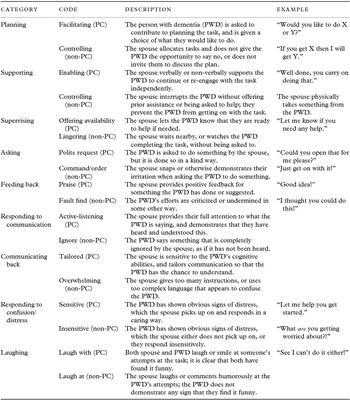
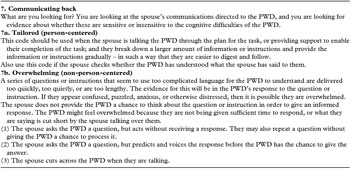
This version of the coding system was piloted using videos of three couples from the general population working together on an everyday task. The pilot indicated that most of the person-centered codes were appropriate and featured throughout the tasks (for example, “Humor”), but did not have a non-person-centered counterpart; the latter were created following the pilot. Feedback from the two voluntary raters suggested that it was difficult to distinguish between some codes and further clarity was needed in the form of instructions and examples. Further refinement of the system, including merging of similar codes, resulted in a total of nine broad categories: planning, supporting, supervising, asking, feeding back, responding to communication, communicating back, responding to confusion/distress, and laughing. Each category included a person-centered code and a contrasting non-person-centered code, creating a total of 18 codes (Table 1). Further feedback from the raters suggested a need for instructions on applying the codes, which provided a definition of person-centered care before giving an explanation of what to look for in terms of identifying the occurrence of a behavioral category. Once the appropriate category was identified, the instructions then provided further descriptions and examples to allow the rater to classify the instance of a behavioral category as person-centered or non-person-centered. An example of instructions for one of the categories is provided in Table 2; full instructions are available upon request.
Codes created by analyzing video transcripts (the coding system)

Note: PC = person-centered. Non-PC = non-person-centered.
Example of instructions for behavioral category seven.

Participants
Ethical approval was obtained from a National Health Service (NHS) Research Ethics Committee. As the system was developed on the basis of qualitative research into spousal interactions, couples were recruited in which one person had dementia and the other was their spouse/partner. A diagnosis of any type of dementia was sufficient; both the person with dementia and their spouse had to have the capacity to consent to take part; the person with dementia needed to be cared for or supported by their spouse in the home setting; and the couple had to have been together for two years or more. Participants were recruited via NHS staff working with older people in a Mental Health Trust, who informed couples of the research during routine appointments. Voluntary agencies, providing help and advice to people with dementia and their families, were asked to provide contact details for couples who had expressed an interest in taking part in the future research. While 25 couples expressed an initial interest in the study, only 11 couples consented to take part. Of the 13 who did not take part, six were not eligible because the person with dementia lacked capacity to consent or they were not living at home, four withdrew their interest because they were reluctant to be videotaped, and three did not have the time. Participation took place between November 2012 and March 2013.
Seven couples were recruited through NHS staff, and four through voluntary agencies. Of the people with dementia, seven were men and four were women, with a mean age of 74 years (SD = 10.90, range 52–87 years). Six had a diagnosis of Alzheimer's disease, two had frontotemporal dementia, one had mixed dementia, one had vascular dementia, and one had dementia not otherwise specified. No formal measures were collected regarding severity of dementia, although all participants with dementia required prompts and verbal instructions from their spouse during the task. The average length of time since diagnosis was 47 months (SD = 29.39, range four months to eight years). Spousal carers comprised seven women and four men, with a mean age of 72 years (SD = 7.67, range 62–83 years). The average length of relationship was 46 years (SD = 14.56, range 16–64 years).
Procedure
Once a couple had expressed interest in taking part and had consented for their information to be passed onto the first author, they were contacted by telephone to confirm that they were eligible, to provide more information about the study, and to answer questions. If they verbally consented to take part, then a time and date were agreed for a meeting. Couples were informed that their involvement would be kept confidential, and that they could withdraw from the study at any point without repercussion.
The first author visited couples at their home to obtain written consent and demographic information. Couples were asked to think of an everyday, cooperative task that they would be comfortable to do while being videotaped. It was judged that one task would be sufficient to yield useful data while also not taking up too much of the participants’ time. The selection of a single task also allowed the chosen activity to be videotaped at the time that it usually took place in the participants’ routine, in order for their behavior to remain as natural as possible. Tasks chosen included preparing a meal, raking leaves, getting ready to go out, and preparing medication. The authors considered using the same task for all participants, but decided against this because of the likely variation in the level of impairment across participants; it would have been difficult to find a single task that suited all participants in terms of requiring adequate levels of cooperation and allowing a meaningful contribution from the person with dementia. The first author videotaped couples completing their chosen task.
Data analysis
Each video was transcribed by the first author; transcriptions included verbal content as well as non-verbal aspects, such as facial expression, tone of voice, use of gestures, and physical interaction with the person with dementia (e.g. patting them on the back, taking something from them).
The unit of analysis comprised each behavior or speech turn produced by the care-giving spouse. The coding involved the first author – the “‘primary rater” – identifying each instance of the care-giving spouse's behavior by pausing (and, if necessary, replaying) sections of the video. This gave the primary rater time to refer to the instructions and make a decision about whether or not this unit of behavior could be categorized. If the decision was that the behavior exemplified one of the nine categories, then the relevant part of the transcript was highlighted and assigned one of the 18 codes depending on whether the behavior was person-centered or non-person-centered. When the behavior could not be clearly assigned to one of the nine categories, it was assigned to a “null” category (allocated 0 in the analysis).
The primary rater coded all 11 videos. Each video was also rated by one of the two “secondary raters” (one of whom coded six, the other five videos) who were recruited specifically to code the videos for the purposes of evaluating inter-rater reliability. They were given a two-hour tutorial about person-centered care and the coding system, and practised coding using the three pilot videos. The secondary raters coded each instance of behavior from the care-giving spouse in the participants’ videos using the same procedure as the primary rater. Each rater was blind to the primary rater's responses.
SPSS version 20 was used to perform statistical analysis. Cohen's κ (Cohen, Reference Cohen1960) was used to assess inter-rater reliability. This statistic considers base rates for behavior, and adjusts for chance agreement. Cohen's κ was used to assess each of the two levels of inter-rater agreement, regarding first, assignment of instances as person-centered or non-person-centered, and second, assignment to the categories. A Cohen's κ of 0.6 and above was considered an acceptable level of reliability (Landis and Koch, Reference Landis and Koch1977).
Results
Descriptive statistics
The length of the video recordings, the total number of instances of behavior that were assigned a category by both raters, and the number of person-centered and non-person-centered instances of behavior across the 11 videos are given in Table 3. There was considerable variation between couples in the length of recordings and the number of instances of coded behavior. A higher percentage of person-centered behavior than non-person-centered behavior was observed.
Descriptive data for videotapes, and nature of caregiver interaction.

To demonstrate the difference between person-centered and non-person-centered behaviors, the following are two contrasting examples of the communicating back category, as demonstrated by the same care-giving spouse. A person-centered, tailored way of communicating with the person with dementia: [Carer points to cupboard behind PWD. PWD turns around and puts hand on cupboard door but does not move it, looking around confused] “That's it, push.” In contrast, a non-person-centered, overwhelming way of communicating: “Shall I do it? Shall I take over?” [PWD doesn't move or answer. Carer quickly reaches in front of PWD to take the cup and kettle from PWD].
Inter-rater reliability
Raters were required to do two things. The first was to identify the occurrence of a behavioral category. Interactive behavior of the carer could be classified as belonging to one of the nine categories or to a null category (i.e. the rater decided it did not fall into any of the nine categories). Examples of interactions falling into the null category are as follows: “It’ll take a little while to do this” [carer puts soup tin in bin, while PWD carries cutlery to table] and PWD: “Gosh that's horrible out there isn't it?” Carer: “[daughter’s] gone round to [friend’s].” PWD: “I know. She only lives round the corner.” Once the category was decided, the rater then had to determine whether to rate it as an example of the person-centered or the non-person-centered code.
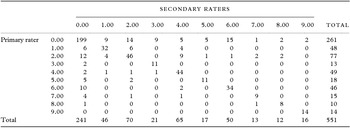
The Cohen's κ in relation to agreement between raters about the category was 0.65, with a 95% Confidence Interval (CI) of 0.60 to 0.70. As shown in Table 4, much of the disagreement came from the fact that one rater often assigned a unit to the null category that the other rater had placed in one of the nine categories. The secondary raters failed to give a category code to 17% of the behaviors given a category code by the primary rater, and the primary rater failed to give a category code to 24% of the behaviors given a category code by the secondary raters. If the null category was excluded from the calculation, then Cohen's κ for the level of agreement between raters was 0.81, with a 95% Confidence Interval of 0.76 to 0.87.
Cross tabulations of the frequencies of use of coding categories by two independent raters.

Note: 0 represents caregiver intervention that one rater identified, but did not assign to a category. 1 = planning, 2 = supporting, 3 = supervising, 4 = asking, 5 = feeding back, 6 = responding to communication, 7 = communicating back, 8 = responding to confusion/distress, 9 = laughing.
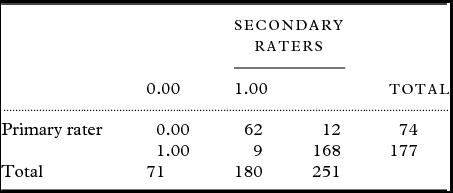
Cohen's κ was also calculated in relation to the level of agreement between raters on whether the behaviors classified as belonging to one of the nine categories were person-centered or non-person-centered (see Table 5). For the purpose of this analysis, the type of category was not taken into account. Cohen's κ was 0.79, with a 95% Confidence Interval of 0.71 to 0.87.
Cross tabulations of the frequency of person-centered and non-person-centered codes by two independent raters.

Note: 0 = non-person-centered, 1 = person-centered.
The frequency of use of each of the 18 codes, and the percentage level of agreement between raters, is shown in Table 6. All 18 types of behavior were observed in the sample and, within each of the nine categories, person-centered behaviors were seen more frequently than non-person-centered behaviors. The most frequently four person-centered codes assigned by the primary rater were: enabling, polite request, facilitating, and active listening. The level of agreement about identifying a behavioral category (Table 6, column B) was generally good, but was lower for the supporting and communicating back categories, suggesting the need for a refinement of the instructions relating to the identification of these two categories. When both raters identified the same category, the level of agreement about whether to use the person-centered or non-person-centered code (Table 6, column C) was generally excellent. Fault finding and laughing at were exceptions, but these both were based on only four instances and so reliability of this finding is unclear.
Descriptive data for the codes used by the raters.

Discussion
An 18-code observational coding system was developed as a means of capturing a range of person-centered and non-person-centered behaviors shown by spouses toward their partner with dementia while collaboratively completing an everyday task. The coding system comprised nine categories: planning, supporting, supervising, asking/ordering, feeding back, responding to communication, communicating back, responding to confusion or distress, and laughing. These categories were created from themes found in previous research findings, marital observational coding systems, and refined through analyzing three pilot videos of couples interacting on an everyday task; followed by testing on 11 video recordings of couples completing an everyday task. The results suggested that the coding system has good inter-rater reliability for identifying the category (including the null category) in which a particular instance of behavior should be placed (Cohen's κ = 0.65). This improved to an excellent level (0.81, as defined by Landis and Koch, Reference Landis and Koch1977) when the null category was excluded. Agreement between raters was near excellent (Cohen's κ = 0.79) for whether the behavior was person-centered or not. This was particularly important, given that the coding system was designed to measure this construct.
Weaknesses of the coding system
The key drawback of the coding system was highlighted in the level of disagreement between raters as to when a spouse's behavior could be classified as falling into one of the nine categories (as opposed to the null category). This suggests that the instructions for the application of the coding system needed to be clearer, i.e. regarding what types of behaviors the raters are expected to code. After obtaining feedback from the secondary raters, it was clear that some codes needed further refinement in the form of clearer, more distinct descriptions. These could be accompanied by further examples of behaviors that might be appropriately assigned to each code.
Strengths of the coding system
A good level of inter-rater reliability was achieved on the novel instrument developed for this study, supporting the notion that the coding system is a reliable tool for the purpose of observing and identifying person-centered spousal behaviors within an everyday task. The coding system has a clear theoretical basis, as the codes were carefully grounded in Kitwood's (Reference Kitwood1990) theory of person-centered care. The descriptions given to the raters were detailed and the provision of examples aimed to enhance understanding of the codes. The high level of agreement between raters regarding person-centered and non-person-centered instances supports that this was effective. Although validity was not formally evaluated, it can be argued that the coding system has good ecological validity as it was applied in a naturalistic setting (the couples’ own home) and with a familiar, everyday activity.
Further strengths were that coder training was not a time-consuming process, and its application to the data was relatively quick. Coding software was originally intended to be used to analyze the videotapes. However, this study has demonstrated that no specialist equipment or resources are required to produce good and reliable results. In light of the above, the coding system could be deemed to have good practical utility, although further studies would be needed to support this statement.
Weaknesses of the evaluation
The main limitation of the study was the small sample size, largely due to recruitment difficulties. As mentioned in the Method section, some couples who were initially interested in the study withdrew their interest because they did not wish to be on videotape. Furthermore, there was no formal assessment of validity.
It is possible that participants’ behavior was influenced by the presence of the first author, in that couples may have behaved in a way that they thought the first author wanted to see. This could have led to more person-centered behavior, and less non-person-centered behavior, than would have been the case if social demand characteristics had not been present. Nevertheless, it shows that spouses are able to provide person-centered support. It is also possible that there was some sample bias, in that those who volunteered to take part may have been confident in the positive nature of their relationship, which may correlate with being more person-centered in approach. A larger, more diverse sample would reduce the sample biases that may have occurred in this study.
It is also recommended that raters using the coding system should achieve a minimum percentage agreement with each other before proceeding to analyze participant data. Higher levels of agreement might have been obtained in this study if the secondary raters had worked through more pilot data.
Strengths of the evaluation
The present study allowed couples to choose their own everyday task, leading to variety in the nature and duration of tasks. The average duration of tasks was just under ten minutes, but some recordings were shorter than this. The shortest task allowed capture of only ten instances of person-centered or non-person-centered behavior, which is unlikely to be a representative sample. In the context of coding couple interactions, Heyman et al. (Reference Heyman2001) reported that a ten-minute task is long enough to elicit a sufficient number of behaviors to produce reliable results. The authors felt that giving couples the freedom to choose the task enhanced participation, and also demonstrated that the coding system was not limited to one type of task. We would therefore advocate retaining the element of choice to make the interaction meaningful and the recording acceptable. However, a minimum of ten minutes of recording is recommended.
Potential value and development of the coding system
Further work in developing and evaluating the system is recommended. As noted earlier, clearer instructions are required to enable raters to more reliably identify incidents of behavior that require rating (particularly the categories of supporting and communicating back). Most disagreements between raters centered on whether a behavior belonged to one of the nine categories or to the null category. Post-rating discussions between raters suggested that this occurred often because the behavior had simply not registered to one of the raters as something that may belong to a category; once the behavior was pointed out, there was agreement that it should have been placed into one of the nine categories). To address this, additional instructions may be required about how to partition the videotapes into instances of behavior in which the family member interacts with the person with dementia, and about what should be classified as behaviors belonging to the null category (e.g. task-irrelevant conversation). A larger scale study would provide more robust evidence about the reliability of the system. Its validity also needs to be evaluated. Construct validity, for example, could be evaluated by using the coding system to test hypotheses and by correlating the degree of person-centeredness with other measures investigating the same construct (e.g. asking spousal carers to complete a questionnaire about empathy, which is a component of person-centered care). Studies are also required to evaluate the extent to which the system can be applied to interactions between the person with dementia and family members other than spouses. The present study focused on developing a measure of spousal interactions because qualitative research about couple interactions in dementia, on which the system was based, focused on spousal interaction, but interactions within other types of family relationship (e.g. daughter/sons caring for a parent) are also likely to be important in promoting good outcomes for the person with dementia. If necessary, the system could be further developed to encompass these other types of family relationship. Further work is also required to establish the stability of the construct across different tasks within the same couple, i.e. whether the spouse shows very similar levels of the observed behaviors in different tasks. The results of this would be of theoretical interest, but also provide justification for applying the system to a task chosen by the participants rather than imposed by the researcher.
This coding system offers a promising means of quantifying person-centered care-giving behavior in couple relationships, and thereby a method of studying quantitatively how this relates to other aspects of the relationship and other outcomes. For example, a comparison of gender could contribute to a wider understanding of whether the level or nature of person-centered care differs between male and female carers. The system could allow researchers to test some of the suggestions about relationships derived from qualitative research, for example, the importance of person-centered support for how well the family and the person with dementia cope with the challenges of dementia as well as how well the person with dementia retains their self-esteem and sense of agency.
Understanding more about approaches that promote good outcomes will eventually help clinicians provide more effective support for families and people with dementia. For example, informing caregivers about the types of communication strategies that they use, and whether these are helpful or unhelpful in the context of person-centered care, may help promote and maintain a good relationship. Reflective coaching using video-feedback could provide an intervention to teach person-centered skills and responses.
The approach developed in this study builds on previous, largely qualitative work by providing a systematic coding system for observation of spousal person-centered care in domestic settings. Further development and application of this system may allow hypothesis-driven exploration of relationships in dementia care and inform dyadic interventions that could support and enhance couple relationships in the context of dementia care.
Conflict of Interest
None.
Description of authors’ roles
S. Ellis-Gray recruited participants, collected the data, performed statistical analysis of the data, and wrote the paper. J. Oyebode assisted with the design of the study, supervised the first author, and contributed to the writing of the paper. G. Riley assisted with the design of the study, statistical analysis, supervised the first author, and contributed to the writing of the paper.
Acknowledgments
The authors wish to acknowledge and thanks Bradley Crook and Lauren Albrecht for their assistance with coding the videos.